Turning on the tap should mean instant confidence, not a second thought about what’s actually in that glass. A dependable drinking water filtration system removes the guesswork, stripping out chlorine, sediment, and heavy metals so every sip tastes clean and crisp.
I’m Mohammad Maruf — the founder and writer behind AirfryerBite. I’ve spent years analyzing water filtration hardware, from micron ratings and flow rates to filter lifespans and certification standards, so you get straight facts about what separates a so-so unit from one that truly performs.
Whether you need a countertop solution, an under-sink upgrade, or a full reverse osmosis setup, this guide cuts through the marketing noise to help you find the best drinking water filtration system for your home and budget.
How To Choose The Best Drinking Water Filtration System
Picking the right water filtration system is less about brand hype and more about matching the hardware to your specific tap water chemistry, available space, and daily volume. Three factors will define your shortlist: filtration technology, installation type, and total cost over time.
Filtration Technology: Carbon, UF, or RO?
Activated carbon filters (found in most countertop and under-sink units) excel at removing chlorine, taste, and odor but leave total dissolved solids (TDS) untouched. Ultrafiltration (UF) membranes with a 0.01-micron pore size trap bacteria and sediment while retaining beneficial minerals. Reverse osmosis (RO) systems are the heavy hitters, reducing TDS, lead, fluoride, and hundreds of other contaminants, but they produce wastewater and require more maintenance. If your concern is taste and odor, carbon is enough. For hard water or high TDS, you need RO.
Installation Type: Countertop vs. Under-Sink vs. Gravity
Countertop systems connect directly to your faucet with no drilling — ideal for renters or quick setup. Under-sink units tuck away but require cabinet space and basic plumbing. Gravity-fed systems (two-chamber carafes) need no plumbing or electricity, making them perfect for off-grid use or emergency prep, but their flow rate is slower. Choose based on how much permanence and setup effort you’re willing to commit.
Filter Lifespan and Replacement Cost
The purchase price is only half the story. A filter that lasts 6,000 gallons but costs more upfront can save money compared to a cheaper unit needing replacement every three months. Look for models that clearly state capacity in gallons and have readily available replacement cartridges. Systems with 304 stainless steel housings (like the LCF or Waterdrop units) also outlast plastic-bodied competitors.
Quick Comparison
On smaller screens, swipe sideways to see the full table.
| Model | Category | Best For | Key Spec | Amazon |
|---|---|---|---|---|
| Waterdrop G3P800 RO | Reverse Osmosis | Whole-home pure water, high volume | 800 GPD flow rate | Amazon |
| DREO Countertop RO | Reverse Osmosis | No-install RO, small households | 3:1 pure-to-drain ratio | Amazon |
| Waterdrop TST-UF Under Sink | Ultrafiltration | Under-sink, mineral retention | 0.01 μm UF membrane | Amazon |
| LCF Stainless Steel Countertop | Countertop | Budget-friendly, metal build | 16,000 gal (2 filters) | Amazon |
| Purewell 2.25G Gravity | Gravity Fed | No-electricity, camping/RV | 0.01 μm, 2.25 gal | Amazon |
| OEMIRY Countertop | Countertop | Alkaline filtration, fast flow | 1.6 GPM flow rate | Amazon |
| Filtrete 3US-AS01 | Under Sink | Entry-level chlorine reduction | ANSI certified | Amazon |
In‑Depth Reviews
1. Waterdrop G3P800 Reverse Osmosis System
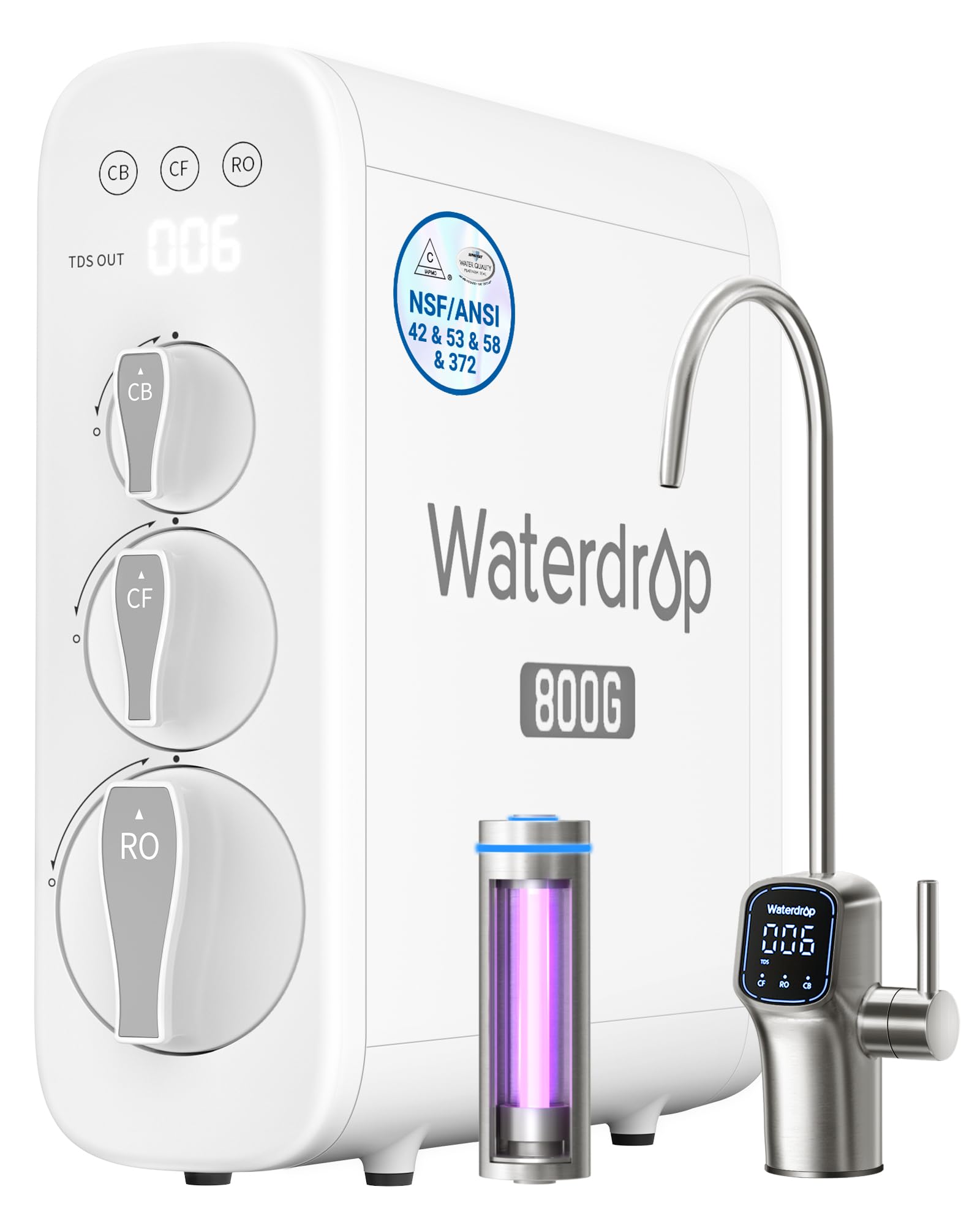
The Waterdrop G3P800 is a tankless under-sink RO system built for serious throughput. With an 800-gallon-per-day capacity, it fills a standard cup in about five seconds — no waiting for a storage tank to refill. The 10-stage filtration includes a carbon block, PP cotton, and a reverse osmosis membrane that SGS testing confirms reduces over 1,000 impurities including PFAS, lead, chromium, and fluoride. It also carries NSF/ANSI certifications across four standards (42, 53, 58, 372), covering everything from chlorine reduction to lead-free materials.
The smart faucet with integrated LED display shows real-time TDS levels and filter life, which takes the guesswork out of when to swap cartridges. With a 3:1 pure-to-drain ratio, this system wastes less water than older RO designs. The tankless form factor frees up cabinet space, though installation requires drilling two holes — one for the faucet and one for the drain connection. It’s a premium investment, but the combination of certification depth, flow speed, and 800 GPD capacity makes it the unit to beat for larger families or anyone who wants bottled-water quality on tap.
Keep in mind that the annual filter replacement cost is higher than simpler carbon units, and the system requires cold water feed only. For households with very high TDS or well water, this is the most thorough and fastest option in the roundup.
Why it’s great
- 800 GPD tankless design with 5-second cup fill
- NSF certified across 42, 53, 58, 372 standards
- Smart faucet with TDS and filter life readout
Good to know
- Requires drilling two holes for installation
- Higher annual filter replacement cost
2. DREO Reverse Osmosis Water Filter Countertop
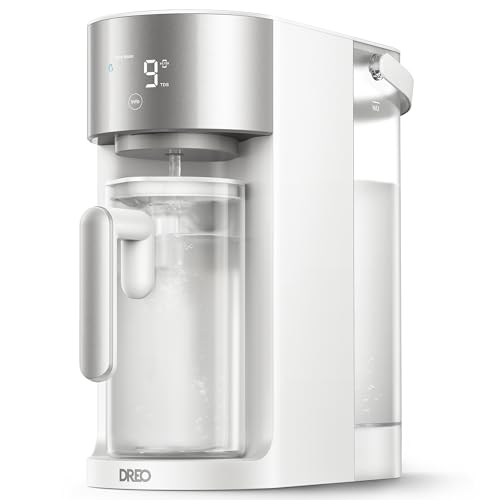
The DREO countertop RO system solves the biggest pain point of reverse osmosis: installation. There is no plumbing, no drilling, and no under-sink commitment — just plug it in and fill the 3-liter tank. The 7-in-1 filtration, tested by SGS against NSF/ANSI 58 standards, removes 99.99% of contaminants including PFOA, PFOS, chlorine, and fluoride. Real-time TDS monitoring on the unit lets you compare raw water and pure water readings, so you can see exactly what the filter is pulling out.
The auto-fill sensor on the 1.1-liter pitcher refills itself hands-free, and the self-cleaning cycle flushes internal tubes to keep the water fresh. With a 3:1 pure-to-drain ratio, it wastes only one cup of water for every three cups of purified water — impressive for a countertop RO. The filter lasts 6 to 12 months, and replacement is a simple twist-and-lock motion. The slim footprint (14.5 inches wide) fits easily on a kitchen counter without overwhelming the space.
This unit is best suited for 1 to 2 person households who want RO-level purity without a permanent installation. The catch is a slightly lower capacity than under-sink systems — the 3L tank means you’ll refill it a few times during the day if you’re cooking or drinking heavily. But for renters, small kitchens, or anyone who wants TDS reduction without calling a plumber, this is the smartest plug-and-play RO option available.
Why it’s great
- Zero installation — just plug in and use
- Real-time TDS and filter life display
- Efficient 3:1 pure-to-drain ratio
Good to know
- Limited to 3-liter tank capacity
- Filter replacement needed every 6-12 months
3. Waterdrop TST-UF 0.01μm Ultra-Filtration Under Sink

The Waterdrop TST-UF sits in the sweet spot between simple carbon filters and full RO systems. It uses a 0.01-micron ultrafiltration membrane to trap sediment, bacteria, and cysts while allowing beneficial minerals like calcium, potassium, and magnesium to pass through. The result is water that tastes clean without the demineralized flatness some RO users dislike. The 6-layer filtration stack includes a PP sediment filter, an activated carbon block, and the UF membrane, all housed in a lead-free 304 stainless steel casing.
Flow rate reaches 1.59 GPM — fast enough to fill an 8-ounce cup in about 2.3 seconds. The modular filter design lets you stagger replacements: the PP filter lasts 6-8 months, the UF membrane a full year, and the CT filter 12-24 months. Installation is DIY-friendly with connections for 3/8-inch or 1/2-inch water lines, and the unit can sit on the cabinet floor or hang on the wall. No electrical power is needed.
A critical distinction: this system does NOT reduce TDS. If your water has high dissolved solids or you’re concerned about specific heavy metals beyond what a UF membrane catches (like lead or arsenic), an RO system is a better choice. But for households on municipal water who want great-tasting, mineral-rich water with strong bacterial protection, the TST-UF is a mid-range champion with a low total cost of ownership.
Why it’s great
- Retains healthy minerals while filtering 0.01 μm particles
- Fast 1.59 GPM flow rate
- Durable 304 stainless steel housing
Good to know
- Does not reduce TDS
- Not suitable for well water or hot water
4. LCF Upgrade Countertop Water Filter
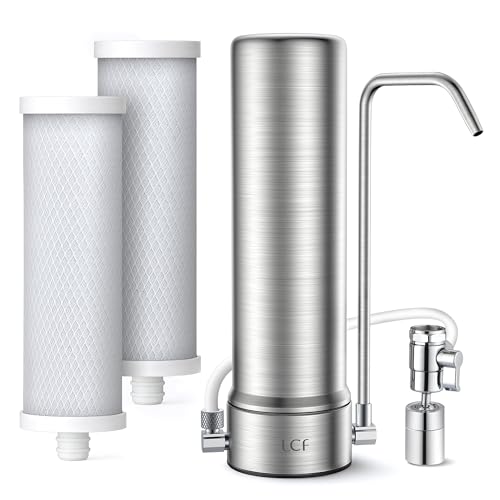
The LCF countertop filter stands out for its material and value proposition. The housing is 304 food-grade stainless steel — fingerprint-resistant, corrosion-proof, and free of BPA and lead. This is a noticeable upgrade from the ABS plastic bodies found on entry-level units. The 6-stage filtration includes coconut shell activated carbon, KDF55, mineralized materials, and a silver-ions layer that inhibits bacterial growth inside the filter media. It reduces 99% of chlorine, heavy metals (including lead), fluoride, and hydrogen sulfide while adding back calcium, magnesium, and potassium.
Each set comes with two filter cartridges, giving a combined capacity of 16,000 gallons or up to two years of use. Flow rate is 1.6 GPM, and the included 360-degree rotating aerator improves faucet usability. Installation is tool-free with six included adapters for standard faucet threads — no drilling required. The unit is compact at just 4 inches in diameter, so it doesn’t crowd the sink area.
The one trade-off: like all countertop units that do not use RO, this system does not reduce TDS. If your tap water TDS is over 300 ppm, you may still notice mineral buildup in your kettle. But for the vast majority of municipal water users who want a durable, long-lasting filter that makes tap water taste great, the LCF is the most cost-effective metal-built choice in this roundup.
Why it’s great
- 24-month / 16,000-gallon capacity with 2 filters
- 304 stainless steel body resists corrosion
- Silver ions prevent bacterial growth in filter
Good to know
- Does not reduce TDS
- Requires standard faucet thread compatibility
5. Purewell 2.25G Gravity Water Filter System

The Purewell 2.25G takes a completely different approach: no faucet connection, no electricity, no plumbing. It’s a gravity-fed system where you pour tap water into the upper chamber, it filters through a 3-stage composite cartridge, and collects in the lower chamber. The standout spec here is the 0.01-micron hollow fiber UF membrane — ten times finer than the 0.2-micron pores found on many gravity competitors. This translates to better removal of rust, sediment, organic matter, and bacteria.
A transparent water level window on the lower chamber lets you see exactly how much filtered water is available without opening the lid, a practical feature for daily use. Each filter handles up to 3,000 gallons, with a pair lasting about 12 months under normal use. The flow rate is 4 gallons per hour, which is decent for a gravity system but much slower than pressurized countertop or under-sink units. The upper chamber holds 2.25 gallons, enough for a small family’s drinking and cooking needs.
This system shines in scenarios where power or permanent installation isn’t an option: camping, RV trips, emergency preparedness, or simply for people who prefer a countertop pitcher without any hose connections. It won’t lower TDS, and the flow rate requires patience compared to tap-connected units. But for off-grid reliability and bacterial reduction without consumable electricity, the Purewell is the most versatile gravity option available.
Why it’s great
- No electricity or plumbing required
- 0.01 μm UF membrane for bacterial reduction
- Transparent water level window
Good to know
- Slow flow rate compared to pressurized systems
- Does not reduce TDS
6. OEMIRY Countertop Water Filter

The OEMIRY countertop filter prioritizes speed and simplicity. The tested flow rate hits 1.6 gallons per minute — enough to fill an 8-ounce cup in about two to three seconds. The multi-stage alkaline filtration uses coconut shell carbon, KDF, and mineral media to reduce 99% of chlorine, heavy metals, fluoride, and bad odors while adding potassium, calcium, and magnesium. The housing is made from food-grade ABS, keeping the weight low and the cost down.
Installation is genuinely tool-free: six adapters and a wrench are included to connect to most standard kitchen faucets, and the whole process takes under a minute. The filter lasts 12 months or 8,000 gallons (whichever comes first), and replacement cartridges are widely available. The system produces zero wastewater and requires no electricity. The twist-switch design lets you toggle between filtered and unfiltered tap water, extending filter life when you don’t need purified water for rinsing dishes.
The ABS plastic body feels less substantial than the stainless steel alternatives, and the system is only compatible with standard faucets — pull-out or spray-style faucets won’t work. Also, like other non-RO units, it does not reduce TDS. But for a budget-friendly, fast-flowing countertop filter that addresses the most common tap water complaints (chlorine taste, odor, sediment), the OEMIRY delivers strong value at a low entry point.
Why it’s great
- 1.6 GPM fast flow rate
- One-minute tool-free installation
- 12-month / 8,000-gallon filter life
Good to know
- ABS plastic body less durable than stainless steel
- Not compatible with pull-out or spray faucets
7. Filtrete Standard Under Sink Quick Change 3US-AS01

The Filtrete 3US-AS01 is the entry-level workhorse for anyone who just wants to reduce chlorine taste and sediment without spending much. The system uses a polypropylene filter with ANSI certification to reduce chlorine taste, odor, sand, soil, rust, and sediment. It installs under the sink with a quick-change cartridge design — no tools needed for filter swaps. The dimensions (4.1″ D x 5.2″ W x 12.25″ H) make it compact enough for even the tightest cabinet spaces.
This is a no-frills solution: there are no multi-stage media, no mineral addition, no TDS reduction, and no alkaline boost. What it does, it does reliably: it polishes municipal tap water to remove the most common flavor offenders. The included bracket and cartridge simplify setup, and the 3M Filtrete brand backs it with a straightforward warranty against defects. Replacement cartridges (3US-AS01) are widely available and inexpensive.
The limitation is the narrow scope of filtration. If your water has heavy metals, fluoride, or bacterial concerns, this system won’t address them. It is strictly a taste-and-sediment filter. But for the price, it’s the most affordable way to get under-sink filtration with a recognized brand name. Ideal for budget-conscious buyers on clean municipal water who just want to eliminate the chlorine twang.
Why it’s great
- Lowest entry price for under-sink filtration
- ANSI certified for chlorine and sediment
- Tool-free quick-change cartridge
Good to know
- Only reduces chlorine, taste, and sediment
- No heavy metal or fluoride reduction
FAQ
What is the difference between UF and RO filtration for drinking water?
Will a countertop filter reduce TDS from my tap water?
How often do I need to replace the filter in a drinking water system?
Can I install an under-sink water filter myself without a plumber?
Final Thoughts: The Verdict
For most users, the best drinking water filtration system winner is the Waterdrop TST-UF Under Sink because it strikes the ideal balance of high-flow UF filtration, durable stainless steel build, and mineral retention — all without the complexity or wastewater of RO. If you want true TDS reduction and top-tier contaminant removal with zero installation hassle, grab the DREO Countertop RO. And for large families who need maximum capacity and certified RO performance, nothing beats the Waterdrop G3P800.