Dull knives and cross-contamination are the two biggest frustrations when prepping meals. A board that works for raw meat often wrecks the finish for delicate veggies, and the wrong material can harbor bacteria or slide dangerously under pressure. Finding one surface that handles both tasks without compromise requires looking past generic designs.
I’m Mohammad Maruf — the founder and writer behind AirfryerBite. I’ve spent years analyzing kitchen hardware specifications, from wood hardness ratings and grain orientation to juice groove depth and non-slip foot adhesion, to determine which boards actually separate meat and vegetable prep safely without destroying knife edges.
This guide breaks down the specific construction details and material science behind the top contenders, so you can pick the right tool without guesswork. You’ll see exactly why each board earned its place on this list of the best cutting boards for meat and vegetables.
How To Choose The Best Cutting Boards For Meat And Vegetables
Not every board handles both tasks well. A design optimized for raw meat might lack the surface feel for precise vegetable cuts, while a board that protects knife edges may not contain juices properly. Focus on these three factors to avoid a poor investment.
Material and Grain Orientation
End-grain wood features fibers oriented vertically, allowing knife blades to slide between them rather than being grated across them. This preserves edge sharpness far longer than edge-grain or bamboo. Teak and walnut offer natural moisture resistance and hardness, while acacia provides a dense surface that resists warping. Avoid bamboo if you prioritize knife longevity — its high silica content accelerates blade dulling.
Separate Boards vs. Single Large Surface
A single large board with a deep juice groove can handle meat, but if you flip it for vegetables, any residual bacteria on the surface becomes a contamination risk. Dedicated sets of two or three boards allow true separation without compromising workspace. If you prefer one oversized board, ensure it has a reversible design with distinct sides for meat and produce use.
Thickness and Stability
Boards under 0.75 inches are prone to warping and sliding under heavy chopping pressure. Look for at least 1.5 inches of thickness for a butcher-block feel that stays planted on the counter. Rubber feet or silicone grips further reduce movement, which is critical when breaking down large cuts of meat or dense root vegetables.
Quick Comparison
On smaller screens, swipe sideways to see the full table.
| Model | Category | Best For | Key Spec | Amazon |
|---|---|---|---|---|
| BABILONIA Black Walnut | Premium End-Grain | Heavy-duty chopping with plate insert | 1.7″ thick end-grain walnut | Amazon |
| Teakhaus Butcher Block | Premium Teak | Professional-grade, lifetime durability | 1.5″ thick end-grain teak | Amazon |
| SMIRLY Walnut Set | Multi-Board Set | Separation of raw and cooked foods | 3 boards with stand, 0.83″ each | Amazon |
| WoodForChef Maple | Edge-Grain Maple | All-purpose with deep juice groove | 1.5″ thick North American maple | Amazon |
| EDELHAUS Acacia Set | Value Multi-Board | Eco-friendly kitchen with storage stand | 3 boards with juice grooves | Amazon |
| GAOMON Acacia XXL | Oversized Single | Large batch prep and stovetop cover | 24″ x 18″ acacia wood | Amazon |
| Socisen Teak XXL | Mid-Range Teak | Non-slip stability with FSC teak | 20″ x 14″ teak with non-slip feet | Amazon |
| BAMOTTO CRAFTBAMBOO | Budget Bamboo | Large surface at entry-level price | 24″ x 18″ organic bamboo | Amazon |
| Winco Rubber Wood | Commercial Heavy | Heavy-duty commercial use | 1.75″ thick rubber wood | Amazon |
In‑Depth Reviews
1. BABILONIA Black Walnut Cutting Board
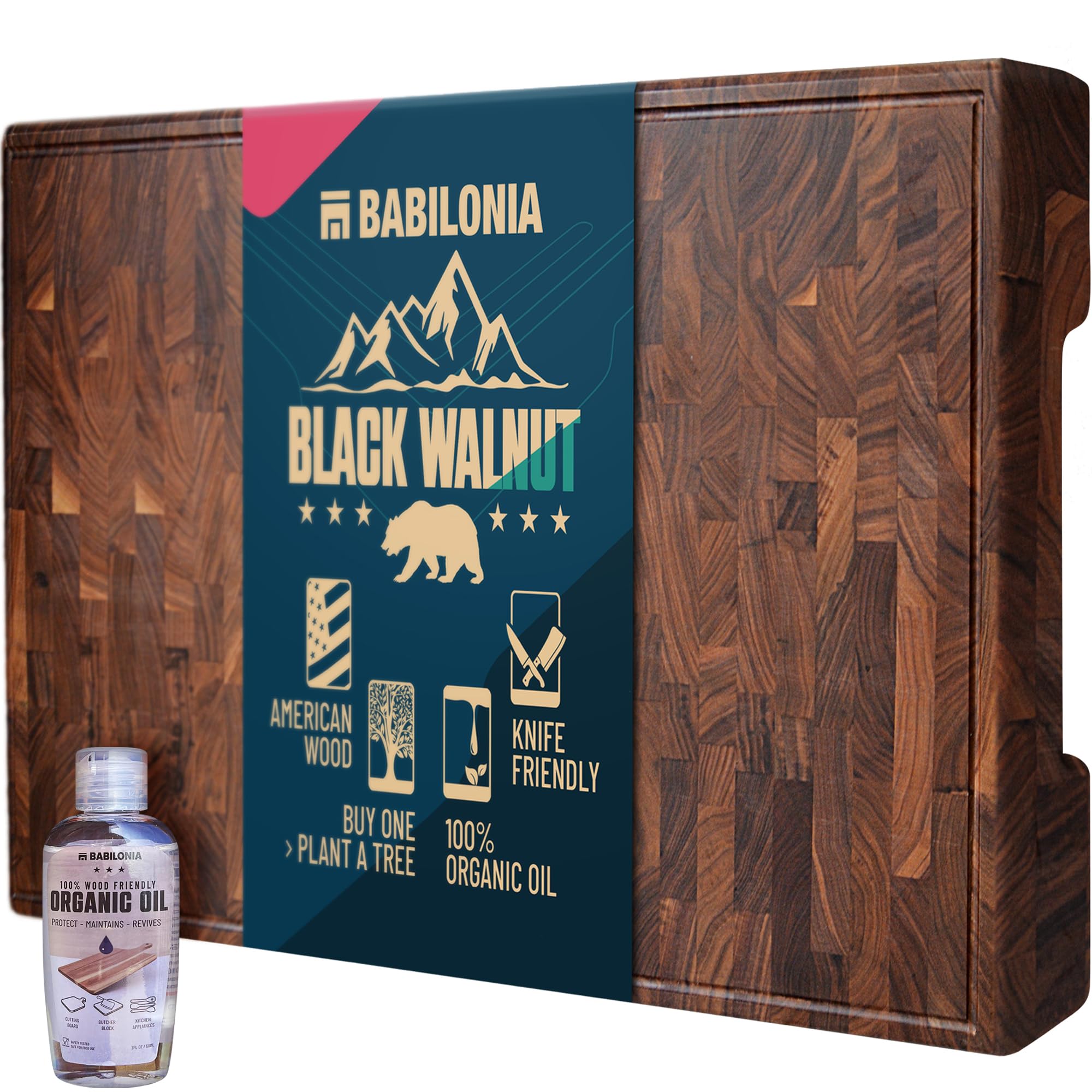
This board uses 100% American black walnut in an end-grain construction at 1.7 inches thick, making it exceptionally stable under heavy meat cleaver work. The end-grain orientation allows knife edges to sink between fibers rather than slide across them, reducing sharpening frequency significantly compared to edge-grain boards.
It ships pre-seasoned with a food-safe mineral oil and beeswax blend, so it is ready immediately. The juice groove runs deep enough to catch runoff from a large roast, and the integrated notch accepts a serving plate for easy transfer of chopped produce directly to the stove. The reversible design lets you use one side for raw meat and the other for vegetables, provided you clean between uses.
A free bottle of organic oil and a small serving plate are included, making this a gift-ready package. The walnut’s natural hardness resists deep scoring, and after several months of daily use, owners report minimal visible cut marks. Hand wash only, and oil monthly to maintain the rich color.
Why it’s great
- End-grain walnut is knife-friendly and self-healing
- Integrated plate slot speeds veggie transfer
- Pre-seasoned and ready out of the box
Good to know
- Hand wash only; no dishwasher
- Walnut can darken with oiling over time
2. Teakhaus Butcher Block Cutting Board

At 24 by 18 inches with a full 1.5-inch thickness, this teak board offers one of the largest usable surfaces in the premium tier. Teak’s natural silica content and dense grain make it highly moisture-resistant, which is critical when breaking down raw poultry or large fish fillets. The end-grain pattern reduces blade dulling compared to plastic or bamboo alternatives.
FSC certification confirms the teak was harvested from responsibly managed forests, an important consideration for eco-conscious buyers. The board arrives with a smooth finish and no chemical coatings. It requires hand washing and occasional mineral oil applications to prevent drying, especially in low-humidity environments.
The reversible design allows one side for meat and the other for vegetables, though the board lacks a juice groove, so you must use a rimmed tray underneath for particularly juicy cuts.
Why it’s great
- Massive 24×18 workspace for batch prep
- Teak naturally resists moisture and bacteria
- Sustainably sourced with full FSC certification
Good to know
- No juice groove; juices may pool on surface
- Requires regular oiling to maintain appearance
3. SMIRLY Walnut Cutting Board Set
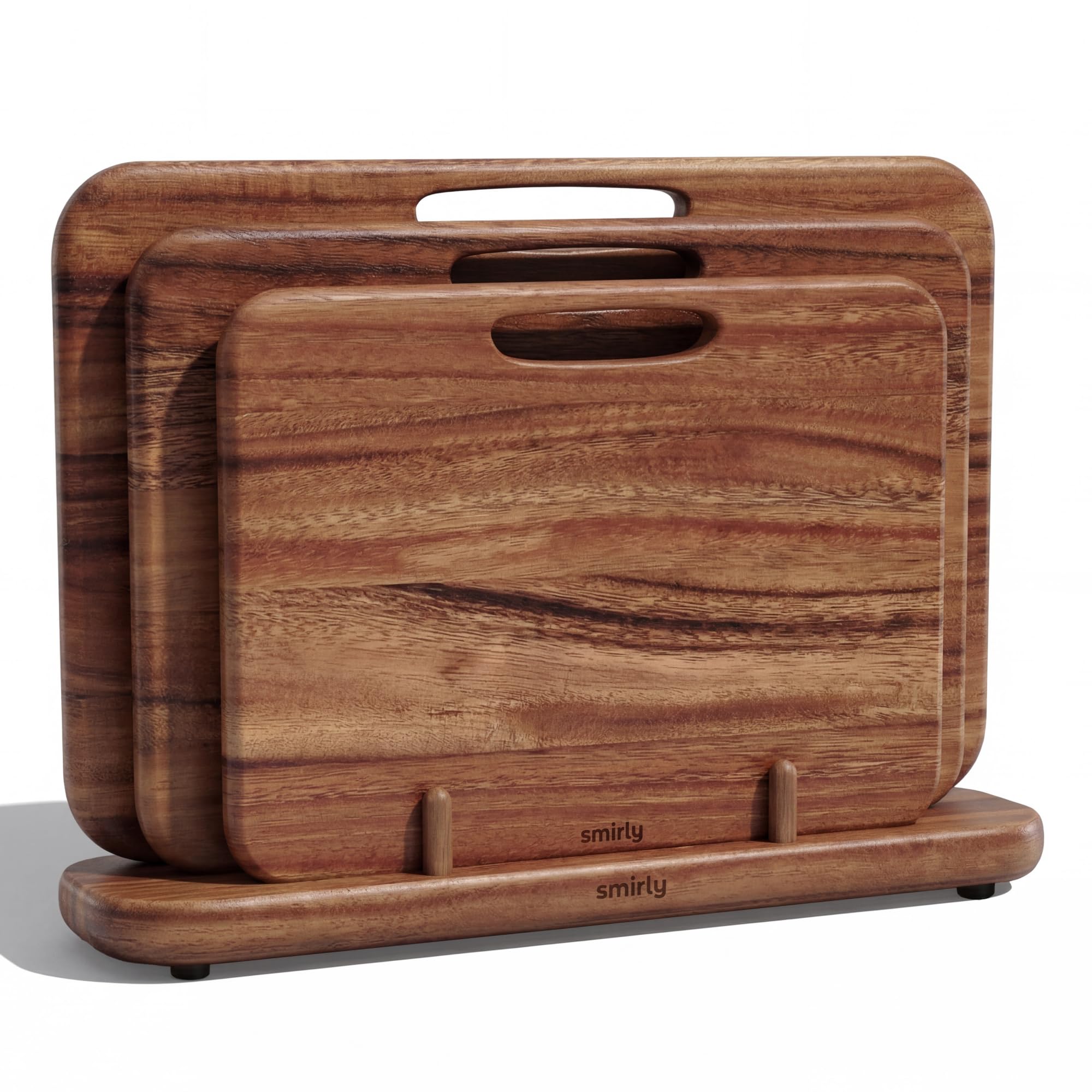
This set includes three walnut boards sized at 14.5 by 9.4 inches, 13 by 8.66 inches, and 11.4 by 7.87 inches, each 0.83 inches thick. The graduated sizing allows you to dedicate the largest board exclusively to raw meat while using the medium and small boards for vegetables, fruits, and herbs — eliminating cross-contamination without needing to wash between tasks.
Walnut offers moderate hardness that resists cutting marks without being overly abrasive on knife edges. Each board is double-sided, giving you six usable surfaces across the set. The included vertical wooden stand keeps the boards separated for airflow, reducing moisture buildup that can lead to warping or mold growth.
All boards feature built-in handles for easy transport from counter to sink. The surface is treated with food-grade mineral oil and is BPA-free. Hand washing is mandatory, and the boards should be allowed to air dry completely before returning to the stand. This is a strong pick for households that cook varied ingredients daily.
Why it’s great
- Dedicated boards prevent bacterial cross-contamination
- Walnut is gentle on knife edges
- Vertical stand promotes drying and saves counter space
Good to know
- Small boards may feel too compact for large produce
- Hand wash only; not dishwasher safe
4. WoodForChef Maple Cutting Board

Measuring 20 by 16 inches with a 1.5-inch thickness, this maple board from WoodForChef sits at the sweet spot between generous workspace and manageable weight. Maple is a traditional choice for butcher blocks because its tight grain resists liquid absorption and retains a smooth surface even after repeated scoring.
The deep juice groove runs the full perimeter, capturing runoff from large cuts of meat and juicy tomatoes alike. The board arrives pre-seasoned with a combination of mineral oil and beeswax, so it is ready for immediate use. FSC certification ensures the maple was sourced sustainably.
At 12.5 pounds, this board stays planted during heavy chopping without needing rubber feet. The edge-grain construction is more forgiving on knife edges than bamboo but slightly less gentle than end-grain walnut or teak. Hand washing and periodic oiling will keep this board in service for years, and the light color shows stains and cut marks more readily than darker woods.
Why it’s great
- Deep perimeter juice groove prevents counter mess
- Pre-seasoned with food-safe mineral oil and beeswax
- Heavy, stable build with no sliding
Good to know
- Light color shows cut marks and stains
- Edge-grain dulls knives faster than end-grain
5. EDELHAUS Acacia Cutting Board Set
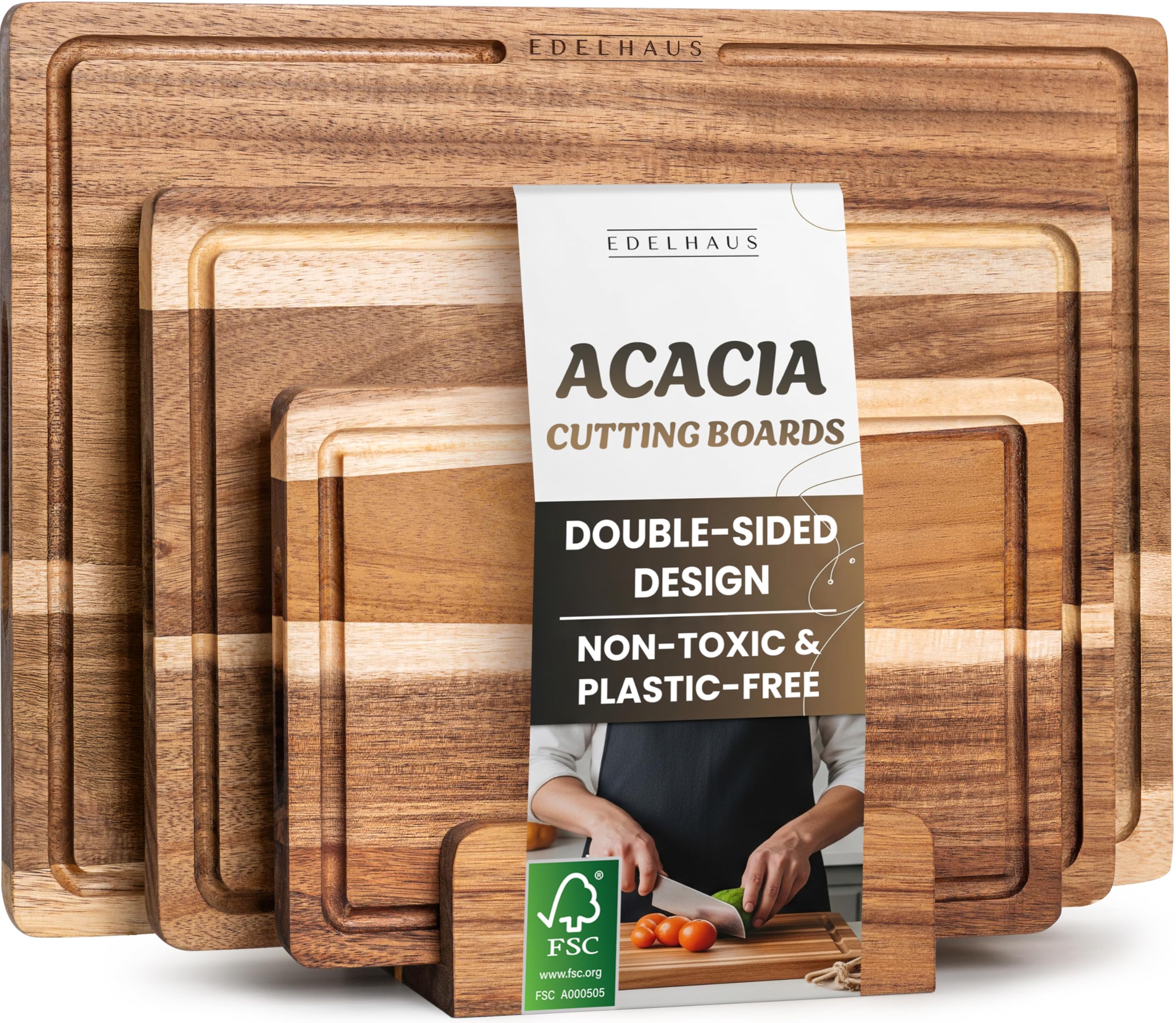
This set from EDELHAUS includes three acacia boards sized at 15.7 by 11.8 inches, 13 by 9.5 inches, and 10.2 by 7 inches, providing separate surfaces for meat, vegetables, and serving. Each board features a built-in juice groove and serving compartments, making them functional for both prep and charcuterie presentation.
The acacia wood is FSC-certified and treated with 100% food-grade mineral oil, free from BPA, phthalates, and synthetic coatings. Acacia is naturally durable and resists cracking, though it is denser than walnut and slightly heavier. The included storage stand keeps the boards organized and allows airflow to prevent moisture retention.
Buyers preparing large batches will appreciate that the large board can accommodate a whole chicken breakdown while the medium board handles vegetable mise en place. The juice grooves are shallow compared to dedicated meat boards, so very juicy roasts may still cause some liquid to spill. Hand washing is recommended, and the boards should be oiled every few weeks to maintain the patina.
Why it’s great
- Varied sizes cover meat, veg, and serving tasks
- Non-toxic finish with no synthetic coatings
- Stand keeps boards dry and organized
Good to know
- Juice grooves are shallow for heavy runoff
- Acacia is heavy and may be less portable
6. GAOMON Acacia Cutting Board

The GAOMON board measures 24 by 18 inches with a 1.2-inch thickness, offering an XXL surface that can cover a standard stove or serve as a carving station for a large turkey. Acacia wood provides a balance of durability and water resistance, and the natural grain pattern makes each board visually distinct.
The juice groove runs along the edge and captures runoff effectively during meat prep. The reversible design allows you to use one side for raw proteins and the other for vegetables or dough kneading. At roughly five pounds, it is lighter than many boards of this size, making it easier to lift for cleaning.
Board surface is smooth and ready to use, though some initial oiling may be beneficial. Because the board is large, it may not fit in standard sinks for washing — a damp cloth and scraping are often more practical. Owners who use it as a stovetop cover report that it fits most four-burner gas ranges without overhang issues.
Why it’s great
- Oversized surface covers stove and counters
- Lightweight for its size; easy to move
- Juice groove contains meat runoff
Good to know
- Does not fit in most kitchen sinks
- Natural color variations between boards
7. Socisen Teak Wood Cutting Board
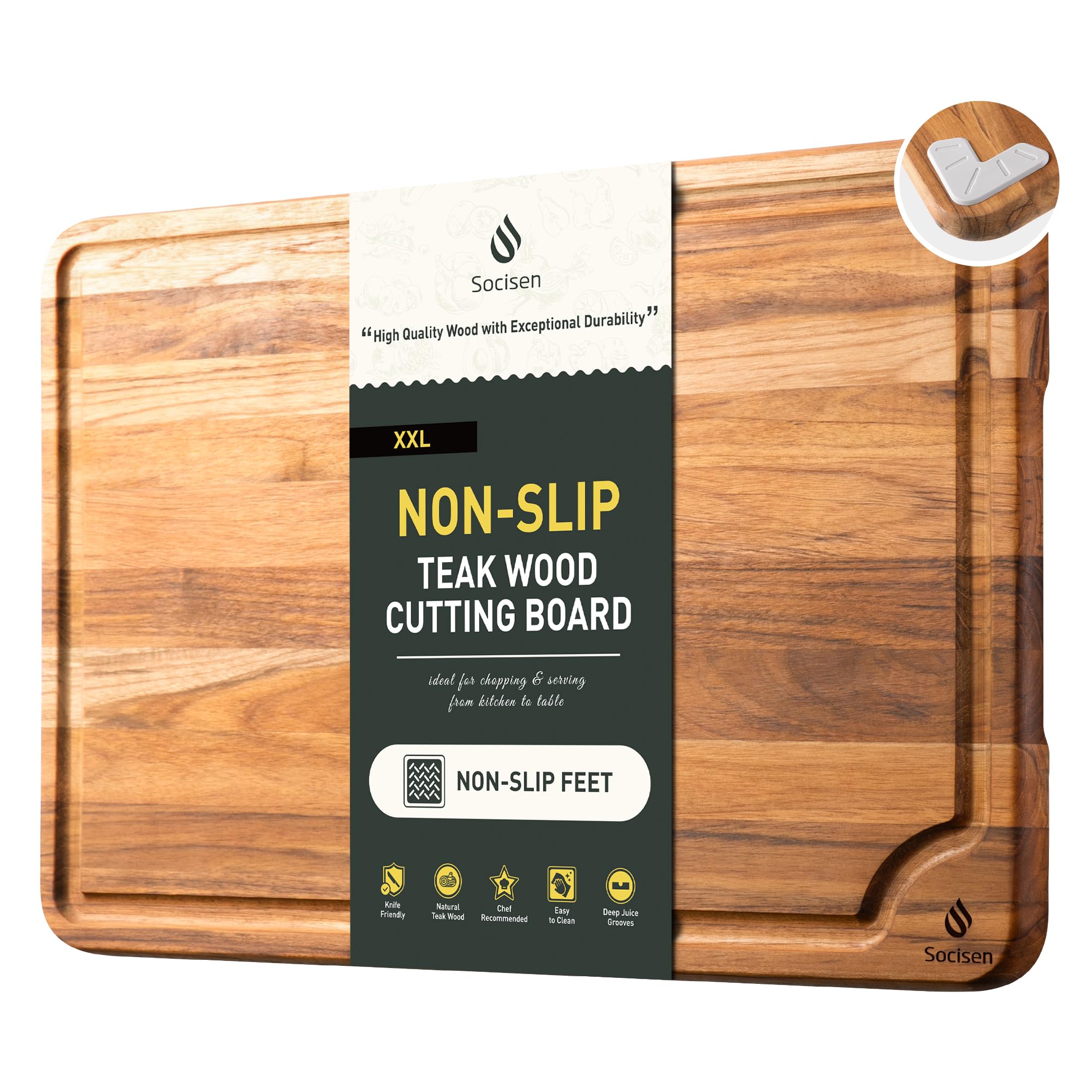
This 20 by 14 inch teak board from Socisen comes with non-slip feet on the bottom, which keep the board securely in place during aggressive chopping. At 0.8 inches thick, it is slimmer than the premium end-grain boards, but the teak’s natural moisture resistance and hardness compensate for the reduced thickness.
The FSC-certified teak is sourced from responsibly managed forests, and the board features rounded edges for comfortable handling. A built-in juice groove captures liquid from meats and fruits. The surface is smooth and free from chemical coatings, making it food-safe immediately after a quick rinse.
Users note that the board resists scratching well for a 0.8-inch profile, though it is not intended for heavy butchery work. It performs best for slicing cooked meats, dicing vegetables, and serving charcuterie. The non-slip feet are a genuine advantage for safety, but the board should not be left in standing water to prevent warping despite the teak’s tolerance.
Why it’s great
- Non-slip feet provide excellent stability
- Teak naturally resists moisture and bacteria
- FSC-certified sustainable wood source
Good to know
- 0.8 thickness is slimmer than butcher block
- Not suited for heavy-duty meat breakdown
8. BAMOTTO CRAFTBAMBOO Cutting Board

The BAMOTTO board provides a massive 24 by 18 inch surface from 100% organic bamboo at a budget-friendly entry point. Bamboo is harder than most domestic hardwoods, which makes it resistant to deep scoring, but the high silica content can accelerate knife edge wear over time. For cooks who sharpen frequently or use budget knives, this trade-off is acceptable.
The board features a front juice groove that catches liquids without reducing the cutting area, and the reverse side is flat with handles for use as a large cheese or charcuterie board. No paint or wax is applied, so the surface is food-safe directly. The bamboo grain is natural and varies between boards, which adds character but can be visually inconsistent.
Weighing only five pounds, this board is easy to move and store, though the weight does not anchor it as well as heavier wood options. Hand washing is required, and the manufacturer recommends occasional mineral oil treatment to maintain the bamboo’s appearance. This board is ideal for occasional heavy prep or as a secondary large surface for parties.
Why it’s great
- Very large surface at an accessible price
- Organic bamboo with no paint or wax
- Juice groove catches liquids effectively
Good to know
- Bamboo dulls knives faster than wood
- Lightweight ; may slide without a damp towel
9. Winco Rubber Wood Cutting Board

At 24 by 18 inches with a massive 1.75-inch thickness, the Winco rubber wood board is the heaviest option on this list at 17.8 pounds. Rubber wood is a hard, dense material harvested after latex production, making it a sustainable by-product. The board’s weight alone keeps it planted during aggressive chopping, and the thickness absorbs impact without transferring force to the countertop.
There is no juice groove, which simplifies cleaning but means you need a rimmed tray underneath for juicy meats. The surface is smooth and free of chemical finishes, and the rubber wood is less abrasive on knives than bamboo while harder than traditional maple or walnut. This board is a common sight in commercial kitchens because it withstands daily heavy use.
Shipping damage is a noted concern due to the board’s weight and size — some units arrive with corner dings despite packaging. Once received intact, the board resists warping and cracking well if kept dry and oiled occasionally. This is the right choice for serious home cooks who break down whole animals or prep large volumes of vegetables weekly.
Why it’s great
- Commercial-grade thickness and stability
- Sustainable rubber wood is dense and durable
- No chemical finishes; food-safe bare surface
Good to know
- No juice groove ; requires tray for liquids
- Heavy at 17.8 pounds; difficult to move
FAQ
Is bamboo a safe and durable material for both meat and vegetable prep?
How often should I oil a wooden cutting board that handles meat and vegetables?
Can I use one side of a reversible board for meat and the other for vegetables?
Does a thicker board actually prevent warping, or is it just a marketing claim?
Final Thoughts: The Verdict
For most users, the cutting boards for meat and vegetables winner is the BABILONIA Black Walnut because its end-grain construction, 1.7-inch thickness, and integrated plate slot deliver the best balance of knife protection, stability, and practical food transfer. If you want a dedicated multi-board system that fully separates raw and cooked ingredients, grab the SMIRLY Walnut Set. And for massive batch prep where surface area is everything, nothing beats the Teakhaus Butcher Block.