Choosing a cutting board for meat is a different decision than picking one for vegetables or bread. Meat work requires a surface that can handle the weight of a whole bird or a thick roast, resist deep knife gouges from repeated slicing, and—most critically—not trap bacteria in cuts and pores. Get the material wrong, and you’re either dulling your best chef’s knife on a rock-hard surface or fighting a board that slides across the counter with every chop.
I’m Mohammad Maruf — the founder and writer behind AirfryerBite. I’ve spent years dissecting the material science behind kitchen prep surfaces, from end-grain wood density to titanium hardness and rubber porosity, to understand what actually protects both your knife’s edge and your family’s health when handling raw proteins.
This guide breaks down the critical specs—thickness, grain direction, non-slip design, and hygiene—that define a truly capable meat board. My goal is simple: help you find the absolute best cutting board for meat by matching your cooking style to the right material and build.
How To Choose The Best Cutting Board For Meat
Meat cutting boards face stresses other boards do not: the downward force of a cleaver, the lateral drag of a slicing knife, and the constant moisture from raw proteins. The right board balances three things: knife protection, ease of sanitation, and stability under pressure. Here is what to look for.
Material: Wood vs. Titanium vs. Composite
End-grain wood—like teak or maple—is the top choice for knife longevity. The wood fibers compress rather than cut, so your blade stays sharp longer. Non-porous materials like titanium offer superior hygiene because they cannot absorb meat juices, but they are harder on knives and can feel noisy. Wood fiber composite boards (like the Freshware) split the difference, offering a knife-friendly surface that is also dishwasher-safe.
Thickness and Weight for Stability
A board under 1 inch thick will shift when you apply pressure to a large roast. Look for a minimum thickness of 1.5 inches for heavy-duty meat work. Heavier boards (8 to 18 pounds) stay put without needing a damp towel underneath. If you are tight on storage, a thinner board with rubber non-slip feet (like the large bamboo option) can work if you keep one hand stabilizing the board.
Juice Groove and Handles
A deep juice groove prevents raw meat blood from spilling onto your counter, reducing cross-contamination risk. Built-in handles or cutouts make it easier to lift a heavy board and scrape the waste directly into the trash. For dedicated meat prep, these are not luxury features—they are practical necessities.
Quick Comparison
On smaller screens, swipe sideways to see the full table.
| Model | Category | Best For | Key Spec | Amazon |
|---|---|---|---|---|
| Yes4All Teak End Grain | End-Grain Wood | Heavy daily meat prep | 1.5 in. thick, 20×15 in. | Amazon |
| WoodForChef Maple Board | Edge-Grain Maple | Large-batch butchery | 1.5 in. thick, 24×18 in. | Amazon |
| GoodArtificer Titanium Set | Non-Porous Titanium | Hygiene-conscious cooks | 0.5 in. thick, set of 3 | Amazon |
| Winco Rubber Board | Commercial Rubber | Professional or heavy use | 1.75 in. thick, 24×18 in. | Amazon |
| Socisen Bamboo Large | Bamboo | Budget-friendly large surface | 1 in. thick, 24×18 in. | Amazon |
| Freshware Wood Set | Wood Fiber Composite | Dishwasher-safe convenience | 0.2 in. thick, set of 2 | Amazon |
| sufkodu Titanium Set | Non-Porous Titanium | Easy clean, odor-free prep | 0.06 in. thick, set of 3 | Amazon |
In‑Depth Reviews
1. Yes4All Teak End Grain Cutting Board

This board uses end-grain teak construction, meaning the wood fibers run vertically upward. When your knife blade hits the surface, it slides between the fibers rather than cutting across them, which dramatically reduces edge wear. At 1.5 inches thick and 11.2 pounds, it stays planted on the counter even when you are putting force into breaking down a whole chicken.
The integrated juice groove is cut deep enough to catch runoff from a large roast, and the built-in handles on each side let you lift the board without touching the wet surface. Teak’s natural oil content gives it inherent moisture resistance, so the board resists cracking better than maple or walnut in fluctuating humidity. With regular mineral oiling, this board will last through years of daily meat prep.
One trade-off: teak is a hardwood, so it will dent slightly over time with heavy cleaver use—those dents are normal in end-grain and don’t affect performance. The board also requires hand-washing only, as dishwasher heat will warp the wood grain and strip the natural oils.
Why it’s great
- End-grain construction protects knife edges better than edge-grain or plastic
- Teak’s density and natural oils resist moisture absorption and warping
- Deep juice groove and ergonomic handles designed for meat work
Good to know
- Requires hand-washing and periodic mineral oil conditioning
- Heavier than composite or titanium boards at over 11 pounds
2. WoodForChef Extra Large Maple Cutting Board

If your meat prep involves large roasts, whole briskets, or multiple steaks at once, the 24×18-inch surface of this maple board is your workspace. It is edge-grain construction, which means the wood strips run parallel to the surface, giving you a flat, stable cutting plane that handles heavy chopping without bending. The 1.5-inch thickness adds enough mass to keep it steady without a damp towel.
The deep juice groove runs along the full perimeter, preventing raw juices from pooling near your ingredients. This board arrives pre-seasoned with mineral oil and beeswax, so it is ready to use out of the box. The FSC certification on the North American maple is a real plus for sustainability-minded buyers—you know the sourcing is responsible.
Maple is harder than teak, so it shows fewer knife marks over time, but it is also slightly less forgiving on blade edges. You will notice your knife stays sharper longer than on glass or bamboo, though not quite as long as on a true end-grain board. Like all wood boards, this one must be hand-washed and oiled periodically to maintain the finish and prevent cracking.
Why it’s great
- Massive 24×18-inch surface ideal for large cuts and whole roasts
- Pre-seasoned with food-safe mineral oil and beeswax
- FSC-certified North American maple for responsible sourcing
Good to know
- Edge-grain is slightly harder on knife edges than end-grain
- Must be hand-washed; dishwasher will damage the wood
3. GoodArtificer Titanium Cutting Board Set
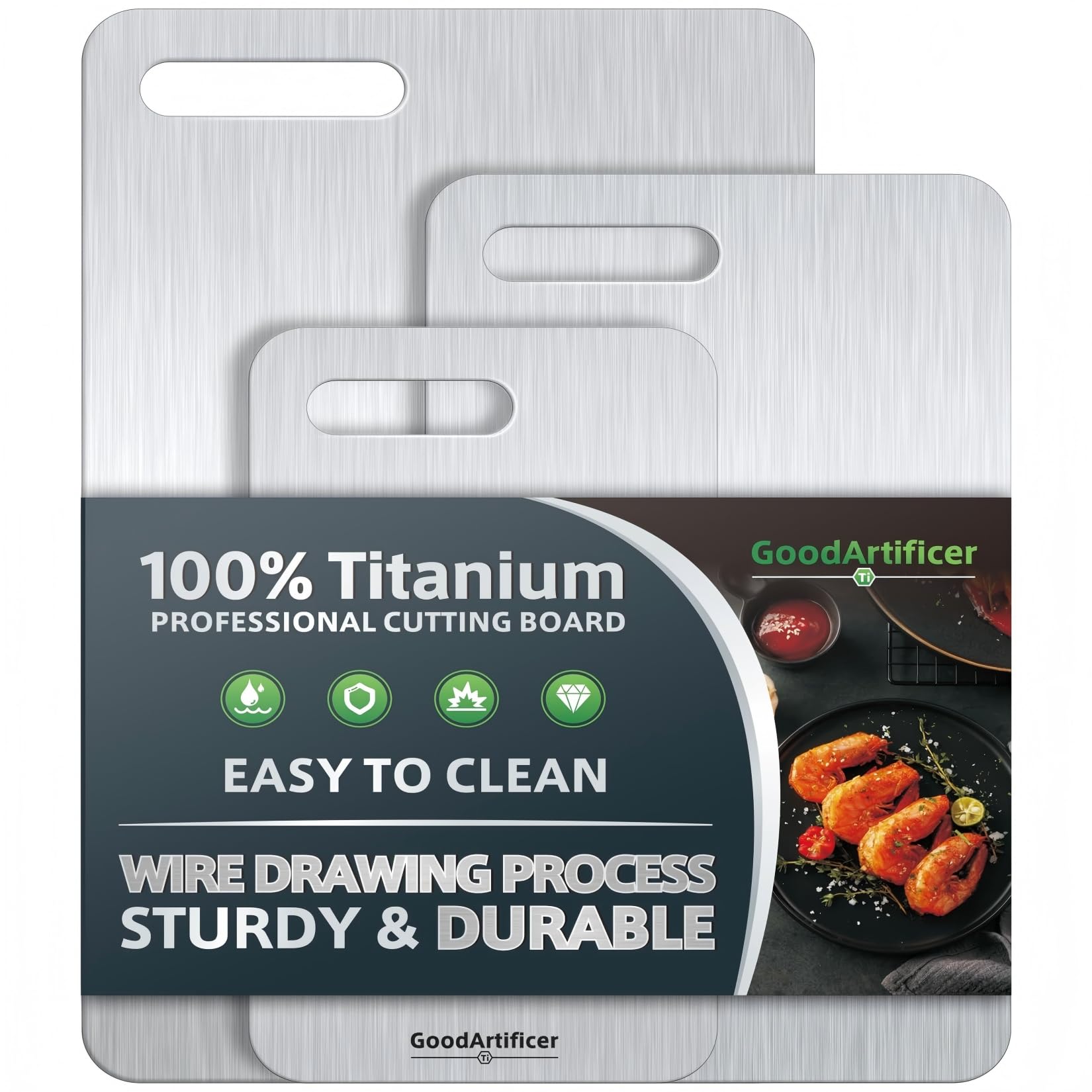
This set includes three titanium boards in sizes ranging from 10.5×6.5 inches up to 16×10 inches, giving you dedicated surfaces for raw meat, cooked meat, and vegetables without cross-contamination. The titanium is one-piece molded with no glue or adhesives, so there are zero seams where bacteria can hide. The brushed non-porous surface will never absorb odors or stains from raw beef or chicken.
Each board is dishwasher-safe, which is a major advantage over wood when handling raw proteins. A quick rinse under hot water removes residue, and a cycle in the dishwasher sanitizes the surface completely. The thin profile—around 0.02 to 0.06 inches depending on the board—makes them easy to store in a slot or cabinet despite the three-piece set.
The most important trade-off: titanium is much harder than wood, and it will accelerate knife dulling over time. If you are using high-end Japanese knives or thin German blades, you will need to sharpen more frequently. The boards also produce a metallic scraping sound that some users find unpleasant. For maximum hygiene at the cost of some knife life, this set is a strong choice.
Why it’s great
- Non-porous titanium surface eliminates bacterial absorption
- Dishwasher-safe for thorough sanitization after raw meat prep
- Three sizes allow strict separation of raw and cooked foods
Good to know
- Hard surface dulls knives faster than wood or bamboo
- Thin boards may flex slightly under heavy pressure
4. Winco WCB-1824 Wooden Cutting Board

Winco is a trusted name in commercial kitchens, and this board reflects that pedigree. Made from rubberwood, this 24×18-inch board is 1.75 inches thick—thicker than most residential boards, giving it exceptional weight (17.8 pounds) and stability under heavy chopping. The wood surface is dense enough to resist deep scoring but still knife-friendly compared to glass or plastic.
The rubberwood material is technically a hardwood from the rubber tree, often used in commercial settings because it balances durability and cost. The board has no fancy features—no juice groove, no handles, no non-slip feet—just a flat, large surface that is easy to sanitize. The eco-friendly construction uses a sustainable byproduct of latex production.
The lack of a juice groove is the main limitation for meat work: raw juices will bleed to the edges and potentially drip onto the counter. You will need a towel or rimmed tray underneath if you are breaking down a large piece of meat. This board is best for cooks who want a massive, stable surface and are willing to manage juices manually.
Why it’s great
- Commercial-grade rubberwood with 1.75-inch thickness for extreme stability
- Very large surface area (24×18 in.) for whole-animal prep
- Sustainable material from the rubber industry byproduct
Good to know
- No juice groove or handles included
- Heaviest board in this guide at 17.8 pounds
5. Socisen XL Bamboo Cutting Board
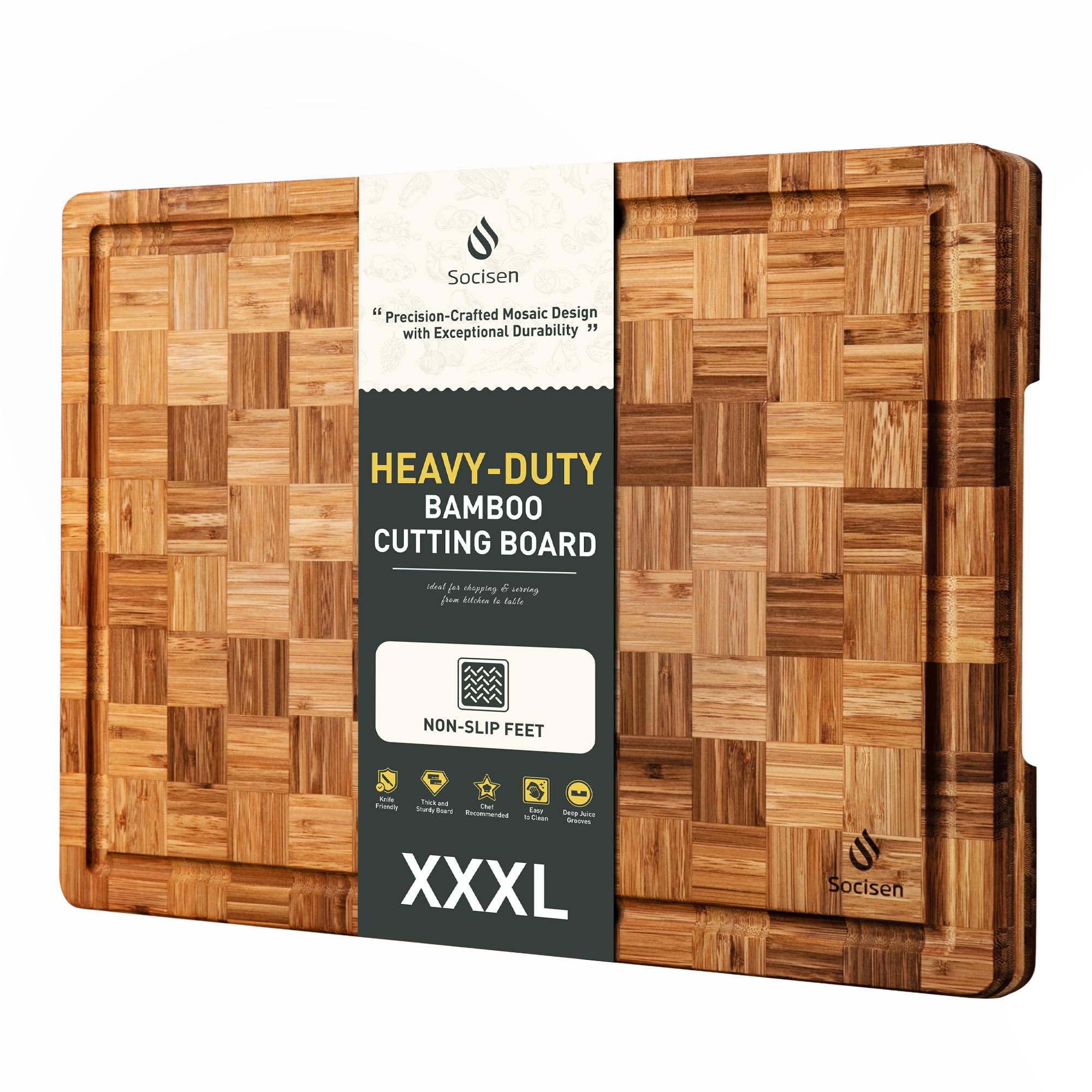
This bamboo board from Socisen delivers a massive 24×18-inch surface at a very accessible price point. The 5-layer construction uses bamboo strips laminated together, giving it more resistance to warping than single-piece boards. Rubber feet on the bottom prevent sliding during vigorous chopping, and the board is pre-finished with food-grade mineral oil.
The natural bamboo grain provides a nice look for serving or charcuterie, but functionally, bamboo is harder than maple or teak. It will dull your knives more quickly than end-grain wood, though still less aggressively than glass or titanium. The 1-inch thickness is adequate for medium-duty meat prep but will feel less stable than the 1.5-inch boards when you are applying heavy pressure.
This board is hand-wash only—bamboo can crack or delaminate in the dishwasher. The rubber feet are not replaceable, so if one peels off, the board will lose its non-slip stability. For occasional meat prep or for cooks who prioritize surface area over knife preservation, this is a solid entry-level choice.
Why it’s great
- Extra-large 24×18-inch surface area for big meat cuts
- Non-slip rubber feet keep the board stable during use
- Pre-oiled with food-grade mineral oil for immediate use
Good to know
- Bamboo is harder on knife edges than end-grain woods
- 1-inch thickness may flex slightly under heavy pressure
6. Freshware Wood Cutting Board Set

Freshware’s set uses a wood fiber composite—80% sustainable pine fibers compressed under high heat with no added glues or binders. The result is a lightweight board that is both heat-resistant up to 350°F and dishwasher-safe, a rare combination in the wood category. The set includes a medium 12×9-inch board and a large 15×11.25-inch board, giving you dedicated surfaces for different tasks.
Compared to solid wood, the composite surface is thinner at 0.2 inches, which means it stores easily in cabinets or can be hung via the built-in hole. The knife-friendly surface is gentler than plastic or glass but does not match the blade cushioning of a thick end-grain block. For smaller meat prep jobs like cutting chicken breasts or trimming steaks, the large board provides just enough room.
The main limitation is the lack of a juice groove. When slicing raw meat, juices will pool on the flat surface and may run off onto your counter. The thin profile also means the board can slide on slick surfaces; placing a damp paper towel underneath helps. For cooks who value dishwasher convenience and a small footprint, this set works well for lighter meat work.
Why it’s great
- Dishwasher-safe composite wood surface for easy sanitation
- Heat-resistant to 350°F for use as a trivet
- Lightweight and easy to store with hanging hole
Good to know
- Thin profile (0.2 in.) can slide without a damp towel underneath
- No juice groove—raw juices may run off the board
7. sufkodu Titanium Cutting Board Set
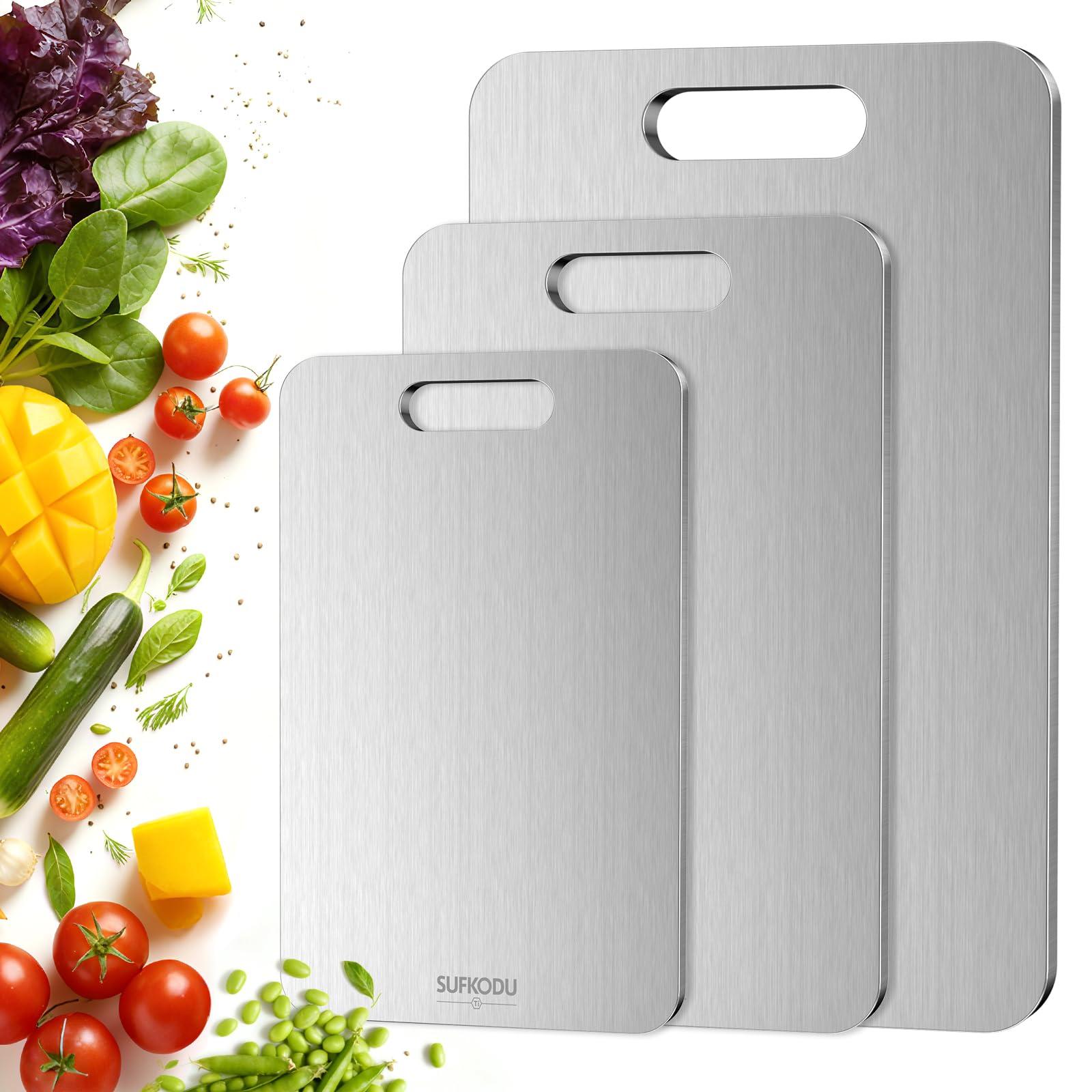
This titanium set from sufkodu offers the same core hygiene benefits as the GoodArtificer version—non-porous, one-piece molded construction, dishwasher-safe—at a more accessible price. The three boards (16×10 in., 13×8 in., 10.5×6.5 in.) let you separate raw meat, cooked meat, and produce cleanly. The brushed surface resists staining and will never hold odors from garlic or fish.
User reviews consistently highlight the ease of cleaning and the confidence of having dedicated sides for different foods. The double-sided design means each board effectively gives you six separate surfaces. The boards are ultra-thin at 0.06 inches, which makes them very light and easy to store, but also means they can flex if you are pressing down hard on a thick cut of meat.
The thinness is the biggest practical issue for meat work: the board lacks the heft to stay fully stationary on its own, so you will need to hold it with one hand or place it on a non-slip mat. The titanium surface is also very hard on knives—you will notice increased edge wear compared to any wooden board. For cooks who prioritize total hygiene and don’t mind frequent sharpening, this set delivers solid value.
Why it’s great
- Non-porous titanium blocks bacterial absorption and odors
- Dishwasher-safe and very easy to clean after raw meat
- Three sizes with double-sided design for six clean surfaces
Good to know
- Thin, lightweight boards require stabilization during heavy chopping
- Hard surface will dull knives faster than wood or bamboo
FAQ
Is bamboo a good material for a meat cutting board?
How often should I oil a wooden meat cutting board?
Can I use a titanium cutting board for cutting bone-in meat?
What size cutting board do I need for a whole turkey or brisket?
Final Thoughts: The Verdict
For most users, the best cutting board for meat winner is the Yes4All Teak End Grain Board because it combines superior knife protection with a deep juice groove and enough weight to handle any protein. If you want maximum hygiene with dishwasher convenience, grab the GoodArtificer Titanium Set. And for the biggest possible surface at a very accessible price, nothing beats the Socisen XL Bamboo Board.