The wrong cutting board is the fastest way to dull a quality knife. A hard glass or stone board can chip a blade in a single session, while a soft plastic board may shed microplastics into your meal. The surface beneath your knife matters more than most cooks realize, and choosing the correct material and construction determines how long your blades stay sharp between honing sessions.
I’m Mohammad Maruf — the founder and writer behind AirfryerBite. I’ve spent years analyzing kitchen tool specifications, focusing on how material hardness, grain orientation, and board thickness directly influence knife edge retention and cutting performance.
This guide breaks down the nine best options available today, ranking them by material quality, construction method, and knife-friendliness. My goal is to help you find the absolute best cutting board for knives that matches your cooking style and protects your blade investment.
How To Choose The Best Cutting Board For Knives
Selecting a cutting board that preserves your knife edges requires understanding three core factors: the material’s hardness relative to your blade steel, the grain orientation of wooden boards, and the board’s physical stability during use. A board that moves or is too hard will force you to sharpen more often, reducing your knife’s lifespan over time.
Material Selection: Wood, Plastic, or Composite
Wood is the gold standard for knife care because it is softer than most blade steels, allowing the knife edge to sink slightly into the surface rather than scrape across it. Hardwoods like maple, walnut, teak, and acacia offer the best balance of durability and knife-friendliness. Bamboo is technically a grass and is often harder than many hardwoods, which can dull knives faster. Plastic boards are gentle on edges but develop deep grooves that harbor bacteria. High-density composite boards like the Yoshihiro Hi Soft are engineered specifically for premium Japanese knives, providing a soft surface that minimizes edge wear.
Grain Orientation: End-Grain vs Edge-Grain
End-grain boards display the cut ends of the wood fibers, creating a surface where the fibers separate rather than get sliced when a knife passes through. This self-healing property means cuts close up after use, making the board more sanitary and significantly gentler on knife edges. Edge-grain boards show the long sides of the wood fibers. They are more prone to visible knife marks and slightly harder on blades. End-grain construction generally costs more but is the preferred choice for serious knife owners.
Thickness, Weight, and Stability
A board that slides around on the counter is a safety hazard and forces you to grip your knife tighter, leading to fatigue. Boards should be at least 1.5 inches thick to provide sufficient weight and stability for heavy chopping. Rubber feet or silicone grips on the underside add extra traction. Heavier boards in the 8 to 18 pound range stay planted during vigorous mincing and reduce the risk of the board tipping or shifting.
Quick Comparison
On smaller screens, swipe sideways to see the full table.
| Model | Category | Best For | Key Spec | Amazon |
|---|---|---|---|---|
| John Boos R-Board 24″x18″ | Edge-Grain Maple | Heavy daily chopping | 1.5″ thick, 18 lbs | Amazon |
| Teakhaus Butcher Block | End-Grain Teak | Knife preservation | FSC certified teak | Amazon |
| BABILONIA Black Walnut | End-Grain Walnut | Premium knife care | 1.7″ thick, 8.8 lbs | Amazon |
| Cookaholic Acacia | End-Grain Acacia | Self-healing surface | 20″x15″x1.5″ | Amazon |
| Yoshihiro Hi Soft | LDPE Plastic | Japanese high-carbon knives | 0.8″ thick, 4.75 lbs | Amazon |
| Yes4All Teak | End-Grain Teak | Large prep surface | 20″x15″x1.5″ | Amazon |
| WALDWERK Acacia Set | Edge-Grain Acacia | Multi-size versatility | 3 boards + stand | Amazon |
| Winco Rubber Board | Rubberwood | Budget large surface | 24″x18″x1.75″ | Amazon |
| John Boos R-Board 20″x15″ | Edge-Grain Maple | Mid-size maple durability | 1.5″ thick, 12 lbs | Amazon |
In‑Depth Reviews
1. John Boos R-Board 24″x18″ Maple Cutting Board

John Boos has been making professional butcher blocks in the USA since 1887, and the R-Board series carries that legacy into the home kitchen. The 24-by-18-inch surface offers the largest footprint in this lineup, giving you room to break down full racks of ribs or prep multiple vegetables simultaneously. The edge-grain maple construction is heat-sealed with Boos Block Mystery Oil, creating a moisture barrier that resists cracking better than untreated boards.
The 1.5-inch thickness and 18-pound weight keep this board absolutely planted on the counter. Countersunk finger grips on both sides make it easy to lift and rotate, and the reversible design doubles the usable life. Maple ranks around 1450 on the Janka hardness scale, which is firm enough to resist deep gouging but soft enough to avoid damaging high-carbon steel edges. This board arrives unfinished, so you will need to apply mineral oil weekly for the first month to prevent the wood from drying out.
Professional chefs and serious home cooks gravitate toward this board for its balance of size, stability, and edge-friendliness. The lack of a juice groove may be a drawback for those who frequently cut proteins, but the flat surface makes scraping chopped ingredients into a bowl effortless. This is a board built to outlast a decade of daily use.
Why it’s great
- Massive 24×18 inch workspace handles whole turkeys and large roasts
- Reversible design doubles the cutting life before replacement
- Made in the USA with a 130+ year manufacturing legacy
Good to know
- Requires manual oiling before first use and weekly conditioning
- No juice groove means liquids may spill over the edges
2. Teakhaus Butcher Block Cutting Board

The Teakhaus board uses end-grain teak construction, which is widely considered the most knife-friendly surface available. End-grain teak fibers compress rather than get severed when a blade passes through, so the board essentially heals itself after each cut. This self-healing property dramatically reduces visible knife marks and keeps the surface smooth and sanitary over years of use.
Teak contains natural oils that make it inherently moisture-resistant, unlike maple which requires regular oiling. This means the Teakhaus board arrives ready to use out of the box with no initial seasoning needed. The FSC certification ensures the teak comes from responsibly managed forests, an important consideration for environmentally conscious buyers. The surface has a warm golden-brown tone that complements both modern and traditional kitchen aesthetics.
Teak ranks around 1155 on the Janka scale, making it slightly softer than maple but harder than walnut. This moderate hardness provides an excellent balance of durability and blade protection. The Teakhaus board is available in multiple sizes, but the large version offers comparable surface area to the Yes4All and Cookaholic options in this guide. The end-grain pattern requires hand washing only — dishwashing will cause the wood fibers to swell and crack.
Why it’s great
- End-grain teak self-heals after cuts, reducing bacteria harboring grooves
- Natural teak oils eliminate the need for frequent conditioning
- FSC certified for sustainable wood sourcing
Good to know
- Higher upfront investment compared to edge-grain alternatives
- Not dishwasher safe; must be hand washed and dried immediately
3. BABILONIA American Black Walnut Cutting Board
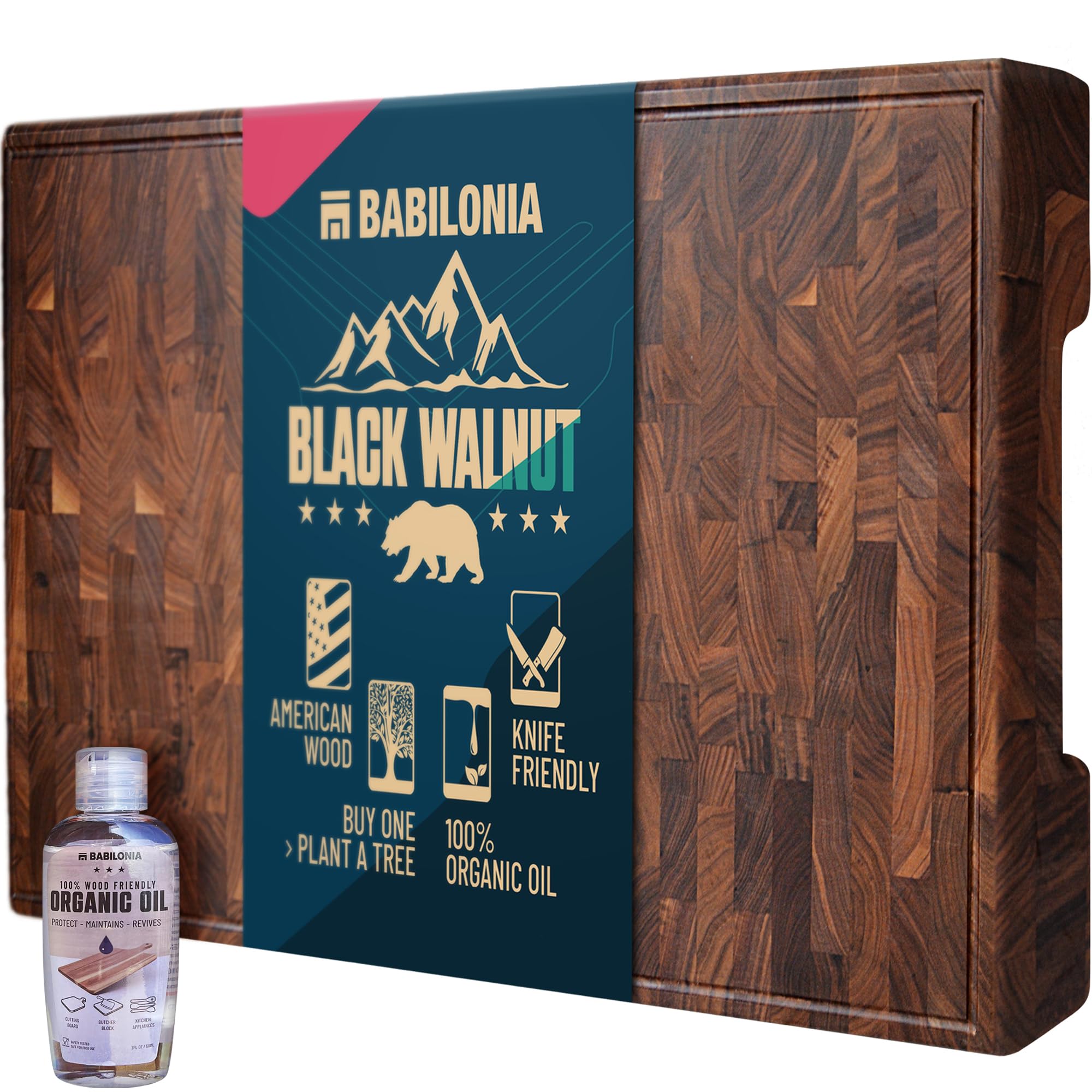
The BABILONIA board is crafted from 100 percent American black walnut, a hardwood that ranks around 1010 on the Janka hardness scale — the softest wood in this lineup, which makes it the gentlest on knife edges. The end-grain construction and 1.7-inch thickness provide a substantial cutting platform that absorbs impact without transferring shock to the blade. Walnut’s naturally dark color also hides stains better than lighter maple or acacia boards.
This board includes a removable stainless steel plate that slides into a notch on the side, allowing you to sweep chopped ingredients directly into a bowl or pan without lifting the board. This is a genuine time-saver during meal prep. A bottle of organic mineral oil is included, so you can condition the board immediately. The juice groove runs along the perimeter to catch runoff from tomatoes or melons, keeping your counter clean.
The hidden handles are cleverly integrated into the board’s profile, making it easy to carry without interrupting the flat surface. The board measures 19.7 by 12.2 inches, which is slightly smaller than the 20-by-15-inch options, but the included accessories and thoughtful design details justify the premium positioning. Hand wash only and dry immediately to maintain the walnut’s rich color.
Why it’s great
- Softest wood in the guide (Janka 1010) for maximum edge protection
- Innovative notch and plate system for easy ingredient transfer
- Includes organic mineral oil for immediate conditioning
Good to know
- Smaller cutting area than the 20×15 inch boards
- Walnut requires more frequent oiling than teak
4. Cookaholic Acacia Wood Cutting Board

The Cookaholic board brings end-grain acacia to the mid-range price segment without compromising on the self-healing properties that serious cooks demand. Acacia is one of the hardest woods commonly used for cutting boards, ranking around 1700 on the Janka scale, but the end-grain orientation mitigates the hardness by allowing the fibers to part rather than resist the blade. This board measures 20 by 15 inches with a 1.5-inch thickness and weighs a manageable 9.1 pounds.
The board is cured with coconut oil, which gives it a mild natural aroma and means it is ready to use after a quick wash. The deep juice groove runs along the entire perimeter, effectively containing liquids even during heavy chopping. Built-in handles on both sides make it easy to lift and carry, though the handles are cutouts rather than protruding grips, maintaining the board’s clean rectangular silhouette. The checkered end-grain pattern is visually striking and adds a decorative element to kitchen countertops.
Customer reports over several months of daily use indicate no warping or cracking, and the self-healing property keeps knife marks nearly invisible. The acacia wood has a rich reddish-brown tone with natural grain variation, so each board has a unique appearance. Hand washing is recommended, and occasional oiling with food-grade mineral oil will preserve the finish for years.
Why it’s great
- End-grain acacia self-heals despite the wood’s natural hardness
- Coconut oil curing provides mild aroma and immediate readiness
- Deep perimeter juice groove effectively captures liquids
Good to know
- Acacia is harder than walnut or teak; edge-grain versions would be less knife-friendly
- Requires hand washing and periodic oiling
5. Yoshihiro Hi Soft Professional Cutting Board

Yoshihiro is a respected Japanese brand known for its high-end cutlery, and the Hi Soft board is engineered specifically for the high-carbon steel knives that the company produces. The board is made from a specialized LDPE (low-density polyethylene) synthetic material that is soft enough to minimize stress on a blade’s edge while being dense enough to resist deep scoring. This is the only non-wood board in the guide, and it serves a specific purpose for users who own ultra-hard Japanese knives with edge angles below 15 degrees.
The medium size measures 17.3 by 9.8 inches with a 0.8-inch thickness. This is significantly thinner and lighter than the wooden boards in this guide, making it a better fit for cooks who prefer a lower profile or need a portable surface. The beige color and smooth texture make it easy to spot food debris, and the material is odor-resistant, so it won’t retain garlic or onion smells after washing. The board is dual-sided, providing two usable surfaces.
Because the Hi Soft is a synthetic material, it does not require oiling or conditioning. It can be washed with mild soap and water, though it is not dishwasher safe. The softness that protects knives also means the board will eventually develop surface cuts, but these do not affect performance. For owners of high-end Japanese knives, this board is one of the safest surfaces available to protect their investment.
Why it’s great
- Engineered specifically for high-carbon Japanese knives
- Soft LDPE material minimizes edge wear on acute blade angles
- Odor-resistant and easy to clean without oiling
Good to know
- Smaller cutting surface than most wooden boards
- Surface will show cut marks over time with heavy use
6. Yes4All Large Teak Cutting Board

The Yes4All teak board delivers end-grain construction at a price point that typically buys edge-grain boards. The 20-by-15-inch surface is identical in footprint to the Cookaholic acacia board, but the teak material provides natural moisture resistance and a slightly softer cutting feel. The 1.5-inch thickness and 11.2-pound weight give it substantial mass that stays anchored during aggressive chopping.
Built-in handles and a deep juice groove mirror the features found on boards costing significantly more. The end-grain pattern is tight and uniform, suggesting good manufacturing quality. Early customer feedback highlights the board’s flatness out of the box — no warping or cupping — and the teak’s natural oils mean it requires less frequent conditioning than maple or walnut boards. The surface is knife-friendly, with users reporting minimal blade dulling compared to their previous bamboo or glass boards.
This board is reversible, but the juice groove is only on one side, so you sacrifice the groove when flipping. Hand washing is required, and occasional mineral oil application will keep the teak looking rich. For cooks who want the benefits of end-grain teak without the premium price tag, the Yes4All board is the strongest value proposition in this guide.
Why it’s great
- End-grain teak at a mid-range price point
- Natural teak oils reduce conditioning frequency
- Flat, warp-free construction out of the box
Good to know
- Juice groove only on one side; flipping sacrifices the groove
- Teak may have a mild natural odor initially
7. WALDWERK Solid Acacia Wood Cutting Board Set

The WALDWERK set includes three acacia wood boards in graduated sizes — 15.75 by 12 inches, 13 by 9.5 inches, and 10 by 7 inches — along with a metal stand for vertical storage. This multi-board approach lets you dedicate one board for raw meat, one for vegetables, and one for fruit or bread, reducing cross-contamination risk without washing between tasks. The edge-grain construction means the surface is slightly harder than end-grain, but the 0.8-inch thickness keeps the boards lightweight and easy to handle.
The acacia wood has a warm, rustic appearance with pronounced grain variation. Each board features a milled juice groove to catch runoff, and the stand includes anti-slip knobs that keep the assembly stable on the counter. The set is a good option for cooks with limited counter space who want the flexibility of multiple surfaces. Customer reviews consistently praise the sturdy build and the aesthetic appeal of the wood grain.
The included stand allows the boards to air dry vertically, preventing moisture buildup that can lead to warping. The boards are not dishwasher safe, but they clean easily with mild soap and warm water. The smallest board has drawn mixed reviews due to inconsistent wood coloration, but the overall quality of the set remains high. This is a practical solution for households that prioritize food separation and kitchen organization.
Why it’s great
- Three dedicated boards prevent cross-contamination during meal prep
- Space-saving vertical stand with anti-slip knobs
- Milled juice grooves on all boards catch liquids
Good to know
- Edge-grain construction is slightly harder on knives than end-grain
- Smallest board may show inconsistent wood color
8. Winco WCB-1824 Wooden Cutting Board

The Winco WCB-1824 offers the largest physical surface of any board in this guide at 24 by 18 inches, with a 1.75-inch thickness that makes it the thickest option as well. Despite the misleading “Wooden Cutting Board” product name, this board is made from rubberwood — also known as parawood — which is a sustainable hardwood harvested from rubber trees that have stopped producing latex. Rubberwood ranks around 1100 on the Janka scale, making it comparable in hardness to teak.
The board weighs 17.8 pounds, providing extreme stability that prevents any movement during heavy work. This is the board a professional butcher would use for breaking down large primal cuts. The surface is edge-grain, which means it is slightly more resistant to knife marks than end-grain but also slightly harder on blade edges. The board is surprisingly labeled as dishwasher safe, though hand washing is recommended to preserve the wood’s lifespan.
The tan color and straightforward rectangular design are utilitarian, with no juice groove or built-in handles. The mass of the board itself makes it easy to grip from the sides. For cooks who need a massive, stable surface for large-volume prep and are willing to accept a basic design, the Winco board delivers exceptional value for the price per square inch. The rubberwood material is eco-friendly and resists moisture absorption better than many other hardwoods.
Why it’s great
- Largest cutting surface in the guide at 24×18 inches
- 17.8-pound weight provides unmatched stability
- Sustainable rubberwood material with good moisture resistance
Good to know
- No juice groove or handles on this basic design
- Edge-grain construction is less knife-friendly than end-grain
9. John Boos R-Board 20″x15″ Maple Cutting Board

The smaller sibling of the flagship 24-by-18-inch model, this 20-by-15-inch John Boos R-Board offers the same edge-grain maple construction and American manufacturing in a more manageable size. The 1.5-inch thickness and 12-pound weight still provide excellent stability, particularly for standard home kitchen countertops where the full-size board may feel overwhelming. Maple’s Janka hardness of 1450 strikes a proven balance between durability and knife-friendliness.
The edge-grain surface develops a patina of fine knife marks over time, which many cooks appreciate as a sign of use. The board is reversible, giving you two cutting surfaces before the board needs replacement. Countersunk finger grips on both ends make lifting and flipping easy, even with the board’s substantial weight. Like its larger counterpart, this board requires initial oiling and regular conditioning to prevent the maple from drying and cracking.
This board fits standard kitchen sinks for easier washing and takes up less counter space than the 24-inch model, making it a better choice for smaller kitchens or cooks who do not need to process large quantities of food at once. The lack of a juice groove is consistent across the R-Board line, so you will need to be mindful of liquids during prep. For cooks who trust the John Boos brand but need a board that fits their space, this is the natural choice.
Why it’s great
- Compact 20×15 inch footprint fits standard countertops and sinks
- Reversible edge-grain maple with proven durability
- Made in the USA with a heritage brand reputation
Good to know
- Requires initial oiling and weekly conditioning
- No juice groove on either side
FAQ
Does end-grain wood really preserve knife edges better than edge-grain?
How often should I oil a wooden cutting board for knives?
Can I use a bamboo cutting board with expensive Japanese knives?
Why does my cutting board slide around while I chop?
Is it safe to cut raw meat on a wooden cutting board?
Final Thoughts: The Verdict
For most users, the cutting board for knives winner is the Teakhaus Butcher Block because its end-grain teak construction provides the best balance of knife protection, natural moisture resistance, and long-term durability without requiring intensive maintenance. If you want the largest possible prep surface with a brand trusted by professionals, grab the John Boos R-Board 24″x18″. And for owners of high-end Japanese knives who prioritize edge preservation above all else, nothing beats the engineered softness of the Yoshihiro Hi Soft.