A premium Japanese knife demands a cutting surface that protects its fragile edge, not destroys it. Hard glass, stone, or bamboo boards are the fastest way to chip a 15-degree blade and send your investment to the sharpener. The right board should give way just enough to cradle the edge, then close back up after each cut.
I’m Mohammad Maruf — the founder and writer behind AirfryerBite. I spend my days analyzing kitchen hardware specifications, comparing wood densities, shore hardness ratings, and edge retention data to find the surfaces that truly preserve razor-sharp geometry.
After researching dozens of options across wood, rubber, and synthetic materials, this guide presents the definitive best cutting board for japanese knives based on material science, construction quality, and real kitchen performance.
How To Choose The Best Cutting Board For Japanese Knives
A cutting board for a western chef’s knife has different requirements than one built for a Japanese gyuto or yanagiba. The acute edge angle of Japanese blades — often ground to 15 degrees or less — makes them extraordinarily sharp but also vulnerable to hard, unforgiving surfaces. Selecting the wrong board accelerates dulling and can cause micro-chipping. Here is what matters most.
Material Matters: End Grain Wood vs. Edge Grain vs. Synthetic
End grain wood boards, where the wood fibers run perpendicular to the cutting surface, allow the blade to slide between the fibers. After the knife passes, the fibers spring back, minimizing visible cuts and edge wear. Edge grain boards (fibers running parallel) are harder and cheaper but require more frequent maintenance. Hinoki cypress, an inherently soft Japanese wood, is naturally gentle on edges even with edge grain construction. Synthetic rubber or LDPE boards offer the most consistent shore hardness — soft enough to protect the edge but dense enough to resist deep gouging.
Thickness and Weight for Stability
A board under 1 inch thick tends to shift during heavy chopping, which creates a dangerous instability when working with razor-sharp blades. Look for at least 1 inch thickness; 1.5 inches or more provides mass that keeps the board planted without needing a damp towel underneath. Heavier boards also reduce vibration transmitted to the wrist during prolonged prep sessions.
Dual-Sided Design and Maintenance Access
Many wooden boards offer a reversible design — one side for general chopping and the other for delicate items or presentation. Grain orientation, juice grooves, and sorting compartments vary widely. If you use a single side exclusively, uneven moisture exposure can cause warping. Boards with a built-in juice groove on at least one side prevent liquid runoff but can trap small chopped pieces, so consider whether you prefer a completely flat surface for efficient ingredient transfer.
Quick Comparison
On smaller screens, swipe sideways to see the full table.
| Model | Category | Best For | Key Spec | Amazon |
|---|---|---|---|---|
| THETCHRY Walnut End Grain | End Grain Wood | All-purpose prep & serving | 17x13x1 inch, end grain | Amazon |
| Kai Sekimoroku Cypress | Soft Wood | Japanese knife purists | 15.4×9.4×0.6 inch, hinoki | Amazon |
| MITSUMOTO SAKARI Acacia | Hard Wood | Heavy daily use | 16.5×11.2×0.9 inch, acacia | Amazon |
| WALDWERK Acacia Set | Edge Grain Wood | Multi-size meal prep | 3 boards, 0.8 inch thick | Amazon |
| RUBBER Synthetic Rubber | Rubber | Commercial-grade durability | 14.6×9.6×0.3 inch, rubber | Amazon |
| jNE Hinoki Cypress | Soft Wood | Ultra-gentle on edges | 19.75x12x1 inch, hinoki | Amazon |
| BABILONIA Black Walnut | End Grain Wood | Heavy-duty chopping | 19.7×12.2×1.7 inch, end grain | Amazon |
| Yoshihiro Hi Soft | LDPE Plastic | Edge retention maximizer | 17.3×9.8×0.8 inch, LDPE | Amazon |
| Sonder Los Angeles Alfred | End Grain Wood | Premium presentation & prep | 17x13x1.5 inch, end grain | Amazon |
In‑Depth Reviews
1. THETCHRY Walnut Wood Cutting Board

This 17x13x1 inch walnut end grain board represents the ideal balance of knife protection, workspace, and price for most Japanese knife owners. The end grain structure allows your blade to sink between the fibers rather than contacting hard edges, significantly reducing edge wear over time. The beeswax pre-treatment applied at the factory means you can use it immediately without seasoning, and the included maintenance kit extends the surface life considerably.
The sorting compartments on one side are a practical addition for meal prep — you can slide chopped onions or garlic directly into the recessed space, keeping your workspace tidy. The 1 inch thickness provides enough heft to stay anchored during vigorous cutting, and the rubber feet grip the counter firmly. Customers consistently praise the deep walnut color and the smooth, almost velvety feel of the end grain surface.
One detail to note is that both sides feature a juice groove; some users find that fine chopped ingredients get trapped in the groove on the flat side. If you prefer a completely uninterrupted surface for sweeping ingredients into a pan, this may require an adjustment. The board is hand wash only, and you should apply the included wax periodically to maintain water resistance.
Why it’s great
- True end grain construction protects knife edges exceptionally well.
- Generous 17×13 inch surface accommodates large proteins and vegetables.
- Includes beeswax polish, brush, and non-slip feet out of the box.
Good to know
- Juice grooves on both sides can trap small chopped pieces.
- Hand wash only; requires periodic oiling.
- Heavier than edge grain alternatives at 4.6 pounds.
2. Kai KAI AP5221 Sekimoroku Cypress
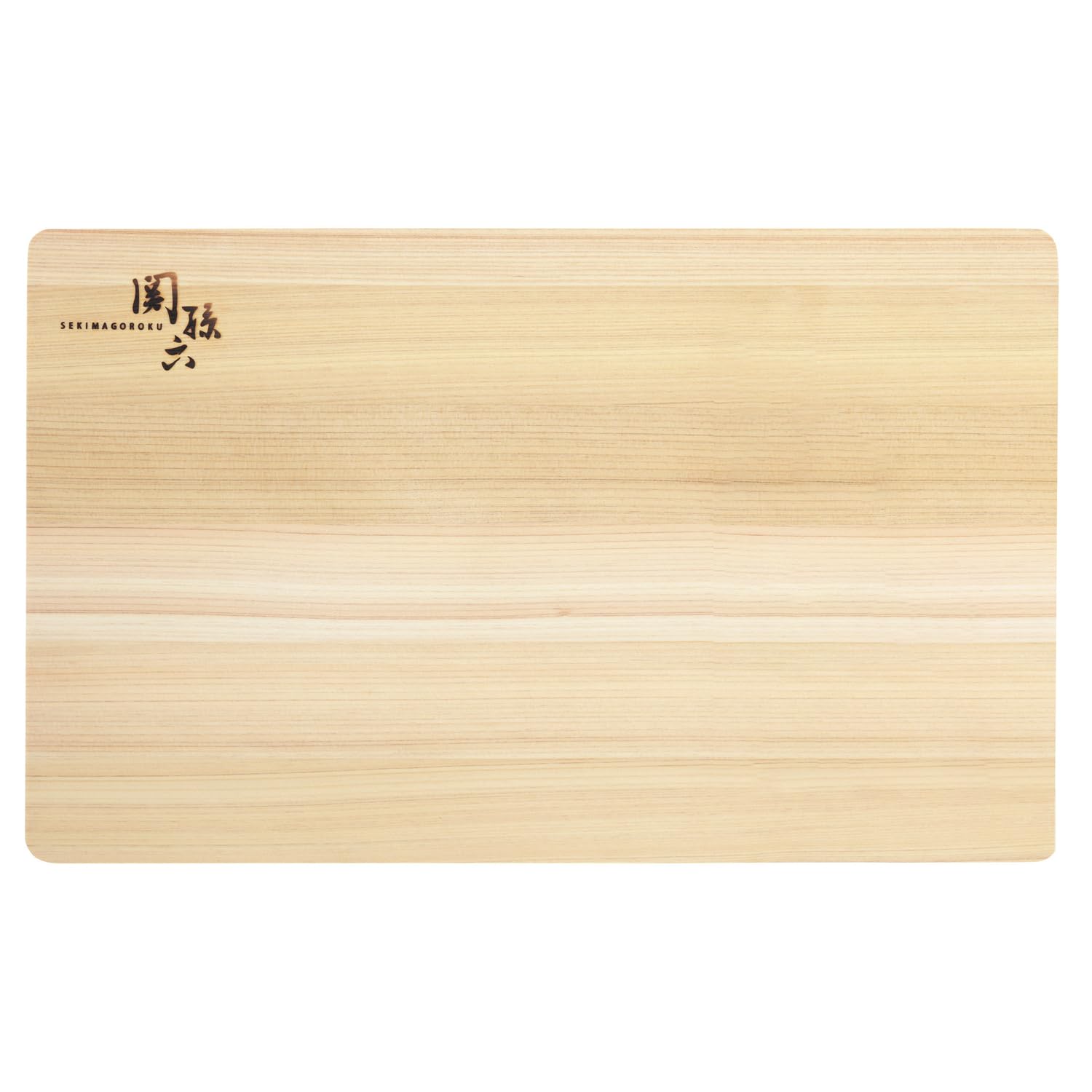
Kai, a renowned Japanese knife maker, produces this cypress board specifically to complement high-carbon steel blades. The hinoki cypress wood is naturally soft and antibacterial, providing a surface that yields to the blade without causing micro-chipping. At 15.4 x 9.4 inches, it is on the smaller side, but the material properties make it one of the gentlest surfaces you can use for a yanagiba or deba.
The board lacks any juice groove or sorting compartments, which is actually an advantage for many professional users — the flat surface allows you to scrape ingredients cleanly off the side without obstruction. Hinoki wood has a distinct, pleasant aroma that some users describe as slightly lemony. The board is lightweight and easy to store, though the thin profile requires a damp towel underneath to prevent sliding during heavy use.
Because hinoki is a soft wood, it will show cut marks more readily than walnut or acacia. These marks are cosmetic and do not affect performance — many users consider the patina a sign of a well-used board. The board should be hand washed and dried immediately; moisture left standing can cause warping in softer woods.
Why it’s great
- Authentic hinoki cypress is naturally gentle on Japanese knife edges.
- Flat surface without grooves allows efficient ingredient transfer.
- Lightweight and easy to store in smaller kitchens.
Good to know
- Smaller surface area limits large prep tasks.
- Thin profile may shift without a nonslip mat underneath.
- Shows cut marks faster than harder woods.
3. MITSUMOTO SAKARI Japanese Acacia Wood Cutting Board

Acacia wood occupies a middle ground between soft hinoki and dense walnut, offering enough hardness for durability while remaining considerably more forgiving than bamboo or maple. This 16.5 x 11.2 inch board from MITSUMOTO SAKARI delivers a spacious cutting surface at a cost that undercuts end grain walnut options. The deep juice groove captures liquid effectively during meat prep, keeping your counter clean.
The 0.91 inch thickness is adequate for stability, though it is not as hefty as premium end grain boards. Acacia is naturally water-resistant and less prone to warping than softer woods, making it a lower-maintenance option for daily use. The natural wood grain varies board to board, giving each piece a distinct appearance. The surface warms up quickly to the touch, which many users find pleasant during long prep sessions.
While acacia is harder than hinoki, it is still softer than maple or teak, making it a reasonable choice for Japanese knives if you prefer wood over synthetic. The board does not include any rubber feet, so you may need to place it on a damp towel or nonslip mat for secure positioning. Regular mineral oil treatment every few weeks helps maintain the wood’s luster and prevents cracking.
Why it’s great
- Spacious surface at a budget-friendly price point.
- Acacia wood resists warping and moisture absorption.
- Deep juice groove contains liquid effectively.
Good to know
- Harder than hinoki or end grain walnut — slightly more edge wear.
- No built-in feet, may need a nonslip mat.
- Requires periodic oiling for long-term maintenance.
4. WALDWERK Cutting Board Set

For cooks who need multiple surfaces for ingredient separation, this three-board acacia set delivers variety without occupying excessive storage space. The boards measure 15.75 x 12 inches, 13 x 9.5 inches, and 10 x 7 inches, each 0.8 inches thick, allowing you to dedicate one board to raw meat and another to vegetables. The included wooden stand keeps everything organized and promotes airflow for drying.
Acacia wood in this edge-grain orientation is sturdy and resists knife scarring better than softer woods. The 0.8 inch thickness is on the thinner side, but the rubber anti-slip knobs on the stand prevent the boards from shifting during use. The juice groove on the largest board is deep enough to collect fluids without overflow, and the smaller boards are completely flat, making them ideal for quick tasks like slicing fruit or cheese.
Because these are edge grain rather than end grain, they will dull your knives slightly faster than an end grain alternative. However, the low cost per board and the convenience of having separate surfaces for different food groups is a pragmatic trade-off for many home cooks. The boards are hand wash only, and the stand should be wiped dry to prevent moisture buildup.
Why it’s great
- Three boards with a stand for organized storage.
- Separate surfaces prevent cross-contamination.
- Includes deep juice groove on the largest board.
Good to know
- Edge grain construction is less knife-friendly than end grain.
- Boards are thinner than premium alternatives.
- Initial wood smell may require a few washes to dissipate.
5. RUBBER Synthetic Rubber Cutting Board

Rubber cutting boards are a staple in professional Japanese kitchens because they combine a soft, knife-friendly surface with extreme durability. This 14.6 x 9.6 inch black rubber board from RUBBER (made in Japan) has a shore hardness that is specifically formulated to reduce edge wear while resisting deep gouging. Unlike wood, it is non-porous, making it naturally resistant to bacterial growth and odors.
The 0.3 inch thickness is deliberately thin to keep the board flexible and lightweight for easy transport and storage. Many chefs appreciate the slight give of the rubber surface, which reduces wrist fatigue during long prep sessions. The black color hides stains from beets, berries, or turmeric, and the material can be washed with hot water and mild soap without concern for warping. The board lays flat on the counter without sliding due to the rubber’s natural grip.
The main limitation is the small surface area — 14.6 x 9.6 inches is snug for large cutting tasks like breaking down a whole chicken or slicing a large watermelon. Additionally, because the board is thin, it may not feel as substantial as a thick wooden board. Some users report that the board develops shallow cut marks over time, but these are purely cosmetic and do not affect performance.
Why it’s great
- Soft rubber is exceptionally gentle on Japanese knife edges.
- Non-porous surface resists bacteria and odors.
- Lightweight and easy to clean without special care.
Good to know
- Small surface area limits large prep tasks.
- Thin profile feels less substantial than wood.
- Shallow cut marks accumulate over time.
6. jNE Hinoki Cypress Wood Cutting Board

This single-piece hinoki cypress board is constructed without joints or glue, ensuring there are no weak points that could split after prolonged use. At 19.75 x 12 x 1 inches, it provides a generous surface that rivals many walnut boards, but the hinoki material is significantly softer, making it one of the best surfaces for protecting a fragile Japanese edge. The wood has a subtle, calming fragrance that many cooks find meditative.
The reversible design gives you two identical flat surfaces — one for everyday chopping and one reserved for presentation or lighter tasks. The 1 inch thickness provides enough weight to stay put, though hinoki is not as dense as walnut, so the board is lighter than its dimensions suggest. The board comes pre-moistened with natural oils, and the manufacturer recommends dampening the surface before each use to further reduce the risk of staining.
Hinoki is a soft wood, so it will show knife marks. These marks are part of the board’s character and do not harm the knife. Over time, the board may develop slight cupping if consistently exposed to moisture on one side. Regular flipping and hand drying with a towel after each wash will keep it flat. The board is not suitable for dishwasher use.
Why it’s great
- Single-piece hinoki construction, no glue or joints.
- Very soft surface maximizes edge retention.
- Large 19.75 x 12 inch workspace.
Good to know
- Soft wood shows cut marks quickly.
- Requires pre-moistening before each use to prevent staining.
- May cup over time if not dried evenly.
7. BABILONIA American Black Walnut Cutting Board
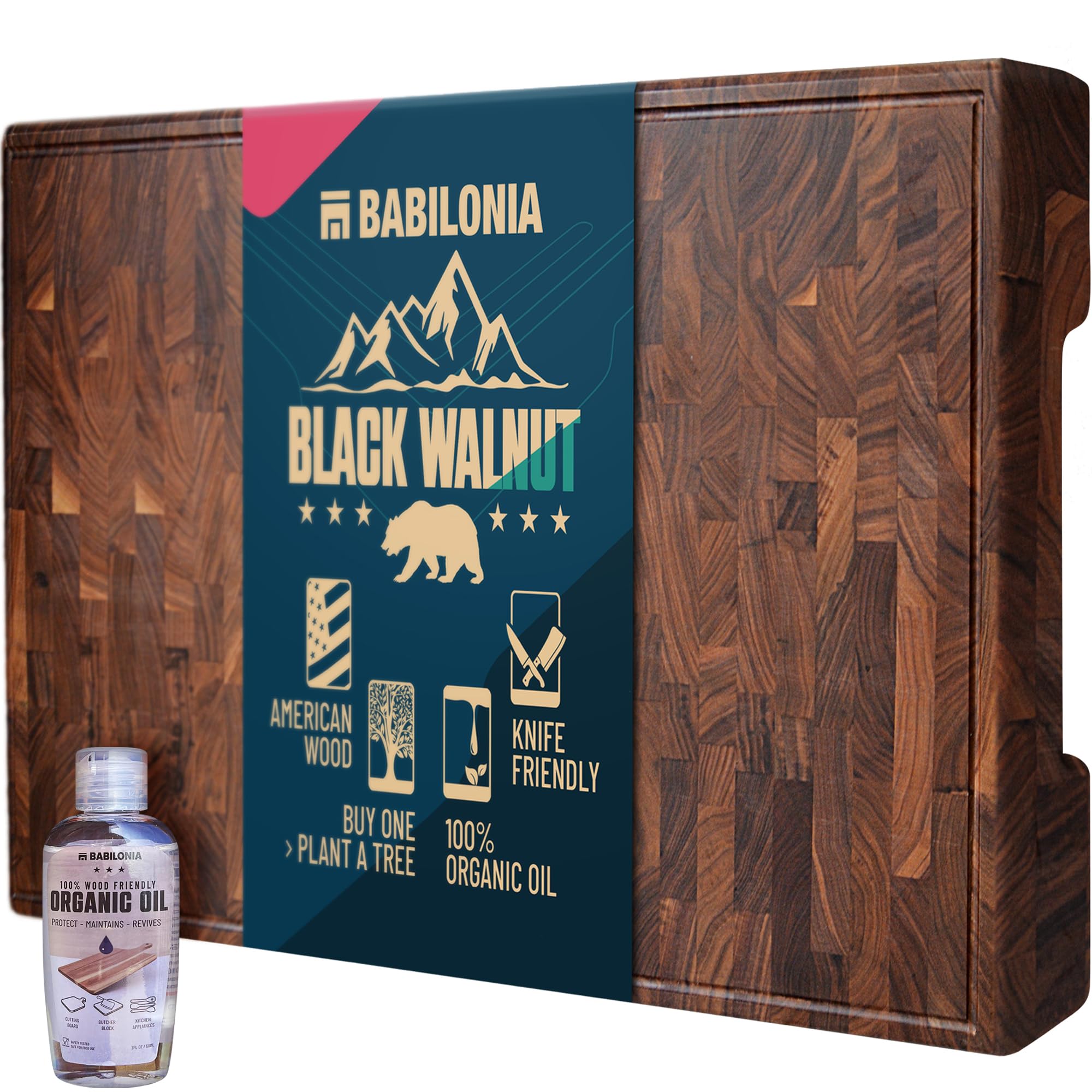
This 19.7 x 12.2 inch black walnut end grain board is built for serious cooks who want maximum durability and knife protection in one package. The 1.7 inch thickness gives it substantial weight — 8.8 pounds — which keeps it perfectly planted on the counter during heavy chopping tasks. The end grain construction ensures that your Japanese knife meets end grain fibers rather than hard edges, preserving the delicate edge geometry.
The board includes clever design elements: a notch on one side allows you to slide a plate underneath to catch chopped ingredients, eliminating the need for a separate bench scraper. The juice groove is deep and wide, and the board is reversible with a hidden handle cut into one edge. It comes pre-seasoned with organic oil, which is included in the box, so you can use it immediately. The American black walnut wood is sustainably sourced and naturally resistant to bacteria.
At 8.8 pounds, this is not a board you move frequently. It is best kept on the counter as a permanent fixture. The end grain surface requires more intensive care than edge grain — it needs regular oiling to prevent the fibers from drying out and developing cracks. Some users note that the board is so heavy that washing it in the sink requires careful handling. The included plate is a thoughtful addition for serving charcuterie.
Why it’s great
- Extremely thick 1.7 inch end grain protects knives superbly.
- Includes a notch and plate for easy ingredient transfer.
- Pre-oiled and ready to use out of the box.
Good to know
- Very heavy at 8.8 pounds; not portable.
- Requires regular oiling for long-term care.
- Large size may not fit small sinks for washing.
8. Yoshihiro Hi Soft High Performance Cutting Board

Yoshihiro is a respected name in Japanese cutlery, and this Hi Soft board is engineered specifically for high-carbon steel knives. Made from LDPE (low-density polyethylene), the board has a soft, slightly pliable surface that absorbs the impact of each cut, reducing stress on the blade and on your wrist. At 17.3 x 9.8 x 0.8 inches, it offers a medium-sized workspace that fits comfortably on most counters.
Unlike hard plastic boards, the Hi Soft material does not cause the blade to skid or chatter. The surface has a fine texture that grips the knife slightly, giving you more control during precise cuts. It is odor-resistant, easy to clean with mild soap, and does not require any oiling or special maintenance. The board is reversible and has a dual-sided design — one side is slightly textured and the other is smooth, giving you options depending on the task.
The main trade-off is that the surface is soft enough to show cut marks, especially with very sharp Japanese knives. These marks do not affect performance, but they will accumulate over time, giving the board a worn appearance. Some users who switched from wood boards note that the plastic does not have the same aesthetic warmth. Additionally, the board is not heat-resistant, so you cannot place hot pans on it.
Why it’s great
- Specifically designed for high-carbon steel Japanese knives.
- Soft LDPE material reduces edge wear significantly.
- Odor-resistant and easy to clean without maintenance.
Good to know
- Shows cut marks from sharp knife use.
- Less aesthetically pleasing than wood boards.
- Cannot withstand high heat from hot pans.
9. Sonder Los Angeles Alfred Cutting Board
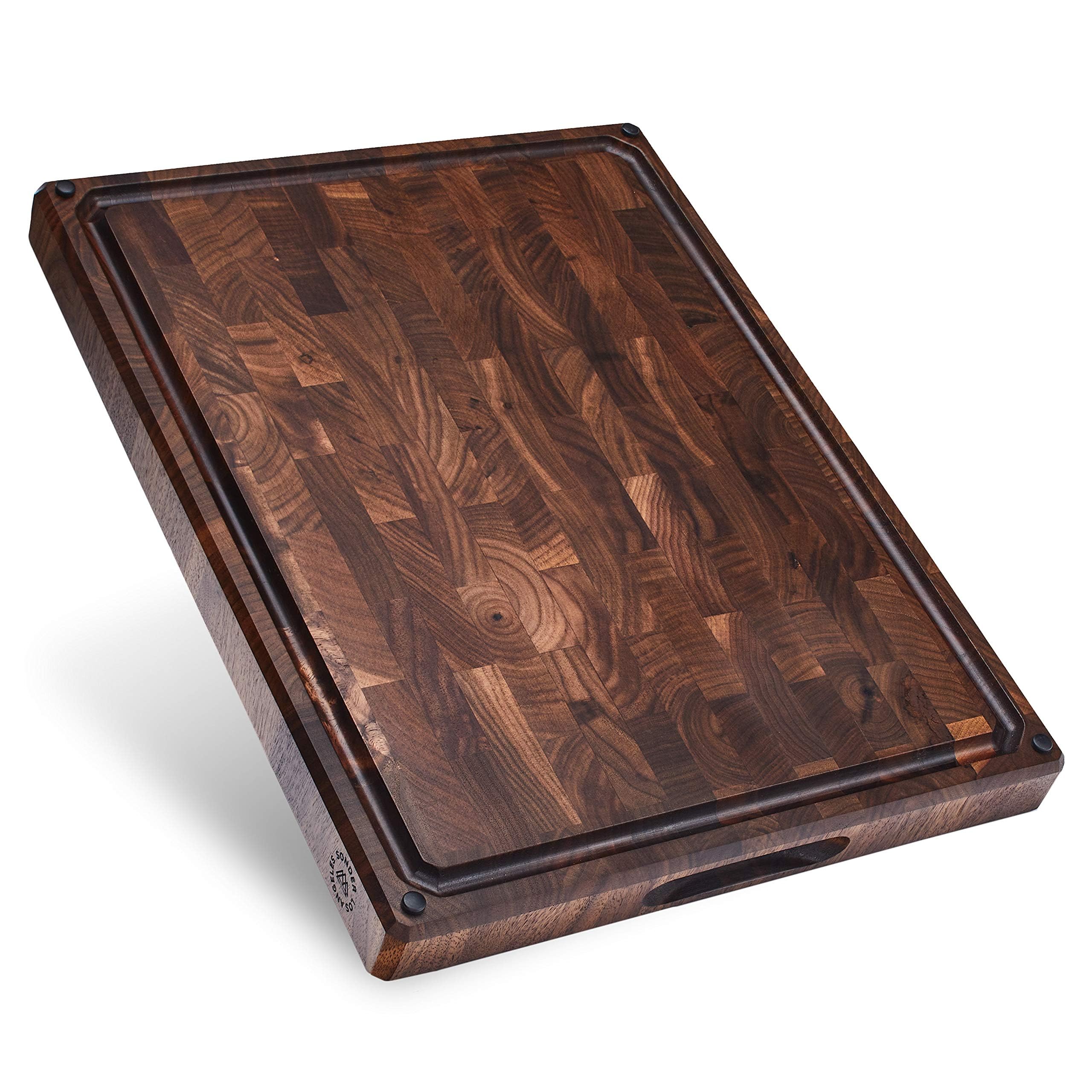
The Sonder Los Angeles Alfred board is an American-made end grain black walnut board that excels in both form and function. At 17 x 13 x 1.5 inches, it provides a generous surface with a substantial feel, and the 1.5 inch thickness ensures it stays firmly in place during the most aggressive chopping. The end grain construction is the gold standard for Japanese knife protection, allowing the blade to cut between fibers rather than across them.
The board features deep sorting compartments on one side and a juice groove on the opposite side, giving you flexibility depending on the task. The compartments are particularly useful for holding prepped ingredients, and the juice groove is wide enough to contain liquid from large roasts or watermelons. Non-slip rubber feet keep the board from moving, and the included gift box makes it a strong candidate for a serious kitchen gift. The black walnut wood has a rich, dark grain that develops a beautiful patina over time.
At its price point, this board is an investment. The end grain construction requires regular oiling to maintain its self-healing properties, and the board should never be submerged in water or placed in a dishwasher. Some users note that the rubber feet can eventually lose adhesion if exposed to heat or direct sunlight. However, for anyone who owns a set of high-end Japanese knives, this board provides the optimal surface for preserving their edge.
Why it’s great
- Premium end grain black walnut maximizes edge retention.
- Features both sorting compartments and a juice groove.
- Beautiful craftsmanship with a non-slip rubber feet base.
Good to know
- Requires regular oiling for proper maintenance.
- Rubber feet may degrade over time with heat exposure.
- Heavier than many alternative boards.
FAQ
Can I use a bamboo cutting board with my Japanese knives?
How thick should a cutting board be for Japanese knives?
Is a rubber cutting board better than wood for Japanese knives?
What is the best way to clean a hinoki cypress cutting board?
Final Thoughts: The Verdict
For most users, the best cutting board for japanese knives winner is the THETCHRY Walnut Wood Cutting Board because it delivers true end grain construction at a price that undercuts premium competitors while providing a generous workspace and included maintenance kit. If you want the gentlest possible surface for a fragile carbon steel edge, grab the jNE Hinoki Cypress Wood Cutting Board. And for a low-maintenance professional option, nothing beats the Yoshihiro Hi Soft Synthetic Board.