Feeding a crowd with a single orange or apple at a time is a recipe for a slow line and tired arms. A commercial juicer machine is built to handle the continuous, high-volume output that a home unit simply can’t sustain — it is the difference between a quick health-kick and a viable business asset. Picking the wrong one for your specific produce mix and daily volume either chokes your workflow or burns through your operating budget.
I’m Mohammad Maruf — the founder and writer behind AirfryerBite. I spend my time analyzing motor torque ratings, auger RPM curves, pulp separation efficiency, and chamber materials across the full commercial spectrum so you don’t have to guess whether a machine can survive a brunch rush or a weekend market stand.
Here you will find the most practical breakdown of the current commercial juicer machine market, organized by build quality, throughput, and cleaning convenience rather than a list of internet hearsay.
How To Choose The Best Commercial Juicer Machine
Choosing a commercial juicer is fundamentally different from buying a home appliance. You are selecting a piece of equipment that must operate reliably under daily stress, produce consistent juice quality, and clean up fast enough to keep your kitchen moving. Three factors separate a profitable purchase from a costly mistake.
Motor Type and Throughput: Centrifugal vs. Masticating
Centrifugal juicers use a high-speed blade (typically 10,000–15,000 RPM) to shred produce and spin juice through a mesh filter. They work fast and handle hard vegetables like carrots and beets well, but they introduce more air and heat, which can degrade nutrients and reduce shelf life of the juice. Masticating (slow) juisers operate at 40–100 RPM, crushing and pressing produce to extract a higher yield, less foam, and juice that stays fresh up to 48 hours. For a commercial setting handling leafy greens or wheatgrass, a masticating machine is the only real choice. For a high-volume citrus bar or a fast breakfast spot, a quality centrifugal or a dedicated citrus press wins on speed.
Build Materials and Cleanability
Look for stainless steel housing and food-grade components — aluminum castings are lighter but can react with acidic juices over time. The strainer basket, pulp container, and juice jug must be dishwasher-safe or designed for quick manual rinse with a dedicated cleaning brush. A machine that takes more than 10 minutes to break down and clean will increase labor costs and slow your service rotation. Also, pay attention to the diameter of the feed chute: a 3.4 to 3.5 inch wide chute lets you drop in whole apples, carrots, or large beets without pre-cutting, saving significant prep time.
Continuous Duty Cycle and Safety Features
Commercial equipment is rated for continuous operation — check whether the unit has a built-in cooling fan or an automatic shutoff after a certain period. For example, some centrifugal models must rest after 15 minutes, while premium masticating machines like the Kuvings CS600 can run 24 hours nonstop. Safety features such as interlock switches that stop the motor when the lid is opened, overload protection, and non-slip vibration-dampening feet are mandatory in any licensed food service environment.
Quick Comparison
On smaller screens, swipe sideways to see the full table.
| Model | Category | Best For | Key Spec | Amazon |
|---|---|---|---|---|
| Kuvings CS600 | Masticating | Continuous operation, high-nutrient yield | 88mm feed chute, 24h duty cycle | Amazon |
| Angel AG-7500 | Cold Press | Maximum yield, leafy greens, nut butters | SUS-304 steel, 82 RPM, 3 HP | Amazon |
| VEVOR Commercial Orange Juicer | Automatic Citrus | High-volume orange juice (20/min) | 120W motor, 2 peel buckets, auto-feed | Amazon |
| Breville BJE530BSS | Centrifugal | Fast family- or light-commercial juicing | 3.5″ chute, 1000W, 70 oz jug | Amazon |
| VBENLEM Heavy Duty | Centrifugal | High-speed fruit & veg juicing | 2800 RPM, 5‑grade gear transmission | Amazon |
| GDOR 1300W | Centrifugal | Large batch whole-fruit juicing | 3.4″ chute, 56 oz jug, 1300W motor | Amazon |
| Hamilton Beach 932 | Manual Citrus Press | Durable, NSF-certified citrus pressing | 2000 lbs of force, metal build | Amazon |
| Waring BJ120C | Electric Citrus | Compact bar/countertop citrus juicing | 120 oranges/hr, die-cast base | Amazon |
| Sunkist J-1 | Electric Citrus Press | High-volume citrus restaurant | 20 gal/hr, 3 interchangeable bulbs | Amazon |
In‑Depth Reviews
1. Kuvings CS600 Whole Slow Juicer

The Kuvings CS600 is a commercial-grade masticating juicer that sets the benchmark for longevity and nutrient preservation. Its 88mm wide feed chute accepts whole fruits and vegetables without pre-cutting, and the patented low-speed motor operates at roughly 60 RPM to gently squeeze juice while minimizing heat and oxidation. This directly translates to juice that stays fresh in the fridge up to 48 hours — a huge advantage for any beverage program that pre-batches.
Designed for around-the-clock operation, the CS600 includes a top-mounted flip gate to switch between recipes quickly and a drip-free Smart Cap that makes rinsing between ingredients clean and fast. The stainless steel housing and Ultem strainer handle commercial abuse far better than plastic-heavy competitors. An included rotating cleaning brush works with the strainer to cut cleaning time to under five minutes.
This machine occupies a serious footprint at 7.5″ deep, 10.5” wide, and 20” tall, and it weighs 20.5 pounds. While the motor is quiet enough for front-of-house use, it is a dedicated single-purpose unit — it excels at juice but does not function as a blender or food processor. For an operator who needs maximum yield from leafy greens, ginger, and wheatgrass, the CS600 justifies its premium position through raw throughput and durability.
Why it’s great
- 24-hour continuous run time with advanced cooling system
- Whole-fruit feeding saves significant prep labor
- Low-speed extraction preserves nutrients and extends juice shelf life
Good to know
- Requires dedicated counter space; not portable
- Does not include a blank strainer for sorbets (sold separately)
2. Angel AG-7500 Cold Press Juicer

The Angel AG-7500 is the gold standard for cold-press juice extraction in commercial kitchens. Every component that touches your ingredients is SUS-304 food-grade stainless steel — no plastic strainers, no aluminum housings. Its twin-gear system rotates at just 82 RPM while delivering a crushing force equivalent to 3 horsepower, enough to break open cellulose fibers in kale, wheatgrass, and even nuts for butter.
A standout upgrade from earlier Angel models is the automatic anti-jamming reverse function. When a dense piece of produce overloads the gears, the motor senses the stall, reverses for a few seconds to clear the jam, then resumes forward operation — no manual intervention required. The SHG (Shattering Helical Gear) technology produces a dry pulp and a remarkably oxidation-free juice that can be stored for up to 48 hours without noticeable separation.
Assembly and disassembly are tool-free, and the stainless steel parts are dishwasher-proof, though the manufacturer recommends hand drying to preserve the finish. At 19.5 inches deep and weighing in at a substantial 20-plus pounds, the AG-7500 is a permanent counter resident. It is the most expensive unit in this guide, but for a juice bar or a restaurant where juice quality is the entire product, few machines match its output consistency.
Why it’s great
- 100% stainless steel food path — no plastic degradation
- Auto-reverse prevents downtime from jams
- Produces shelf-stable juice up to 48 hours
Good to know
- Requires produce to be cut into thin pieces for best results
- High initial investment and heavy footprint
3. VEVOR Commercial Orange Juicer Machine

The VEVOR Commercial Orange Juicer is a specialized automatic citrus squeezer built for one job: producing fresh orange juice fast. It processes up to 20 oranges per minute using a concave-convex ball system that maximizes juice yield while separating peel and pith automatically. The machine accepts oranges between 55 mm and 80 mm in diameter, covering the most common size ranges found in wholesale produce.
Constructed from food-grade SUS-304 stainless steel and high-quality PC, the VEVOR includes a transparent protective cover with a pressure sensor that halts operation when lifted — a legal safety requirement in many commercial kitchens. The pull-out filter box and two peel-collecting buckets simplify cleanup and reduce the frequency of stopping to empty waste. A top-mounted storage basket holds pre-washed oranges, further accelerating the workflow.
This unit is not a general-purpose juicer; it handles only citrus fruits. The motor is rated at 120 watts, which is modest by centrifugal standards but ideal for the low-torque, high-volume squeezing action of a dedicated citrus press. It stands 30.7 inches tall and weighs over 88 pounds, so it requires a sturdy counter or a dedicated stand.
Why it’s great
- Fully automated peeling and juicing cycle
- Safety interlock on the protective cover
- High throughput — 20 oranges per minute
Good to know
- Dedicated citrus machine — does not juice other fruits or vegetables
- Very heavy; requires permanent placement
4. Breville BJE530BSS Juice Fountain Cold Plus
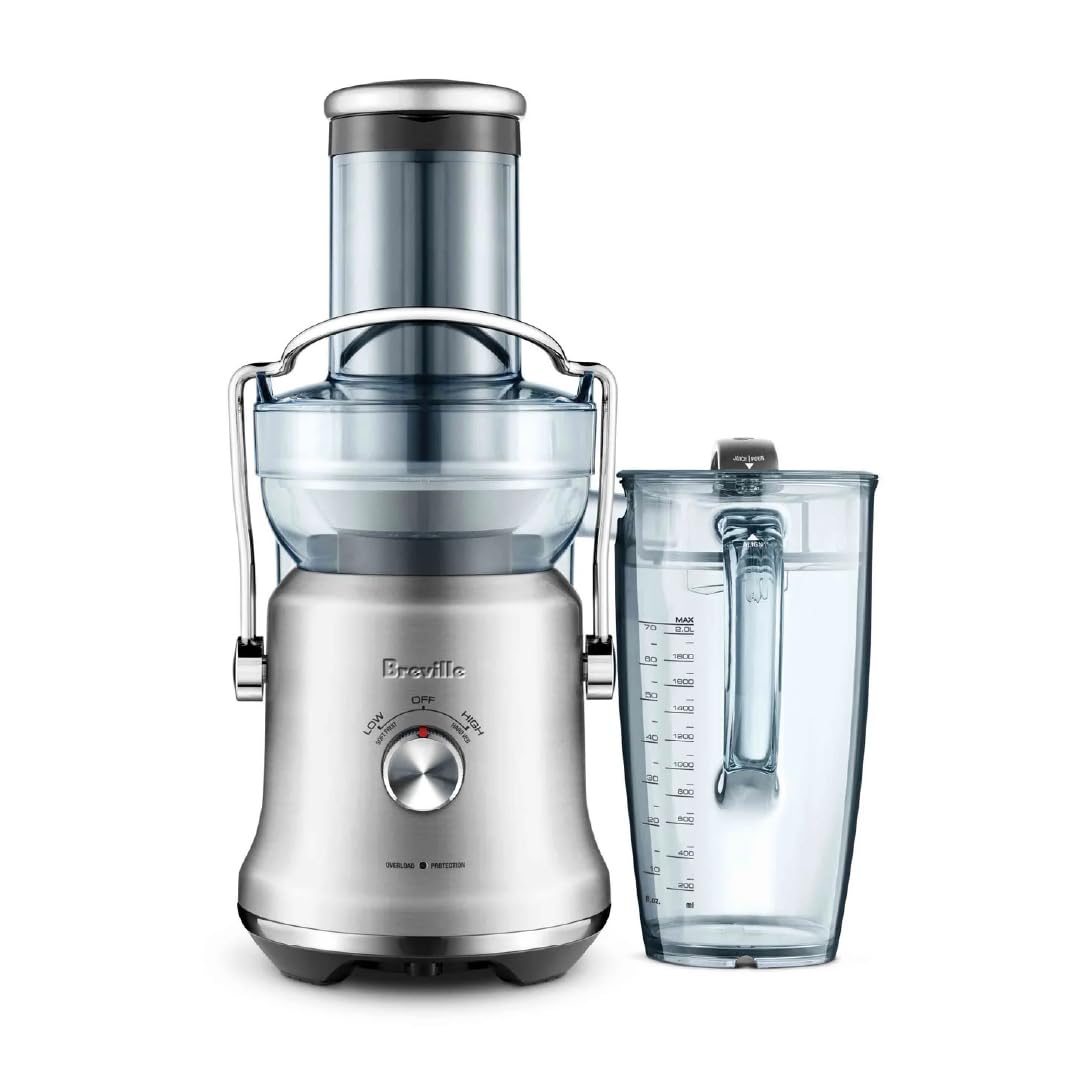
The Breville Juice Fountain Cold Plus straddles the line between high-end home and light commercial use better than almost any other centrifugal machine. Its Cold Spin Technology uses an Italian-made precision mesh filter that spins at a lower temperature to reduce heat buildup, preserving more vitamins compared to standard centrifugal designs. The 3.5-inch extra-wide feed chute accepts whole apples, large carrots, and even entire oranges without pre-cutting, shaving minutes off your prep routine.
Dual speed settings let you switch between hard produce (carrots, beets) and soft items (grapes, tomatoes). The pulp bin is positioned behind the base to save counter depth, and the 70-ounce Seal & Store jug includes a built-in froth separator. Breville also includes a detachable spout for mess-free direct-to-glass juicing — a small touch that keeps the counter clean during busy periods.
This unit is not NSF-certified, and the manufacturer warranty is only one year, so it is better suited to a very busy home kitchen or a low-volume cafe rather than a heavy-duty restaurant environment. Cleaning the mesh filter requires immediate rinsing to prevent pulp from drying, but the included brush makes the job manageable.
Why it’s great
- Cold Spin Technology reduces nutrient loss
- 3.5-inch chute speeds up whole-fruit feeding
- Compact footprint with rear-mounted pulp bin
Good to know
- Not NSF certified for commercial food service
- Motor requires rest periods after prolonged use
5. VBENLEM Commercial Juice Extractor

The VBENLEM Heavy Duty Juice Extractor is a metal-centric centrifugal machine designed for small-to-medium commercial settings. It uses a 5-grade gear transmission system that draws less power than belt-driven alternatives, while the 2800 RPM stainless steel blade assembly handles both hard vegetables and soft fruits. The body is constructed from cast aluminum with a stainless steel juicing net, giving it a solid 24-pound feel that stays planted during operation.
An 80-degree blade tooth geometry is designed to resist fiber wrapping, a common problem when juicing celery or wheatgrass at high speed. The machine features two tough buckles that seal the lid tightly to prevent leakage, a heavy-duty base with vibration-reducing foot pads, and easy-to-reach ON/OFF and reset buttons. A dedicated tool is included to safely remove the stainless steel net for cleaning.
User reviews note that the juice outlet is 0.7 inches (18 mm) in diameter, which allows for quicker dispensing compared to many home models. However, the unit is not dishwasher-safe, and the aluminum housing can be vulnerable to acidic citrus juices if not wiped down immediately. It is a strong performer for juice shops or restaurant prep kitchens that need fast, high-yield juicing at a mid-range cost.
Why it’s great
- Heavy cast aluminum and stainless steel construction
- 80-degree blade tooth reduces fiber clogging
- Large juice outlet for fast dispensing
Good to know
- Not dishwasher-safe; hand wash required
- Aluminum housing may react with acidic juice if left wet
6. GDOR 1300W Powerful Juicer

The GDOR 1300W Juicer punches above its price tier with a full copper motor that delivers high torque at both speed settings. The 3.4-inch wide feed chute accepts whole apples and large carrots, and the 56-ounce juice jug paired with a 106-ounce pulp container means fewer interruptions to empty waste during a busy session. The built-in foam separator in the jug pours pure juice rather than frothy liquid — a detail that reduces customer complaints in a commercial setting.
Dual speeds allow you to select low torque for soft fruits like oranges and tomatoes, and high speed for fibrous vegetables like celery and beets. The transparent lid and body give you a visual on the juicing process, and the included cleaning brush speeds up the post-service routine. Several parts are dishwasher-safe (top shelf only), though the manufacturer recommends running the machine empty twice before the first use to condition the motor.
The most significant limitation for commercial operators is the 15-minute continuous run limit: after 15 minutes of operation, the motor requires a 20-30 minute cooldown. This automatically disqualifies it from any high-volume, nonstop commercial operation. However, for a juice bar with moderate traffic or a market stand with peak periods followed by lulls, the GDOR delivers excellent yield and build quality at a budget-friendly entry point.
Why it’s great
- 1300W full copper motor provides strong torque
- Large pulp bin (106 oz) reduces emptying frequency
- Built-in foam separator for cleaner pour
Good to know
- 15-minute max run time before 30-minute cooldown
- Not designed for 24-hour continuous duty
7. Hamilton Beach Commercial 932 Manual Citrus Juicer
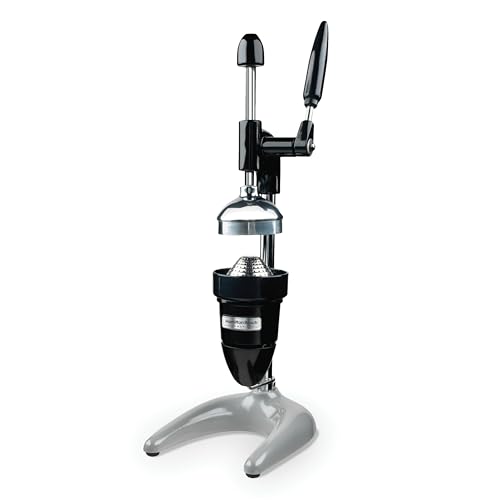
The Hamilton Beach Commercial 932 is a manual citrus press that has been a staple in bars and cafes for decades. It uses a lever-arm system that can exert up to 2,000 pounds of force, extracting maximum juice with minimal oil from the peel and very little pulp. The metal components and enamel finish resist the corrosive effects of citrus acids, and the stainless steel strainer cone and ABS funnel are removable for quick sanitation.
NSF certification means this machine meets strict commercial food-safety standards, which is a requirement for many licensed establishments. The sure-grip feet keep the base stable during the pressing stroke, and the compact footprint (9 inches wide, 7 inches deep) fits into tight counter spaces where electric machines cannot go. The unit is built to handle hundreds of lemons, limes, oranges, and grapefruits per day without mechanical wear.
Being a manual machine, it relies entirely on human effort — throughput is limited by the operator’s speed and stamina. For a high-volume breakfast spot that serves dozens of fresh-squeezed oranges every hour, an electric citrus press would be a better fit. But for a craft cocktail bar or a small juice stand where control and quality matter more than pure speed, the Hamilton Beach 932 is a reliable, repairable workhorse.
Why it’s great
- 2,000 lbs of pressing force for maximum juice extraction
- NSF certified for commercial food service
- Simple, durable design with replaceable parts
Good to know
- Manual operation requires physical effort and slows throughput
- Not suitable for high-volume continuous citrus service
8. Waring Commercial BJ120C Compact Citrus Juicer
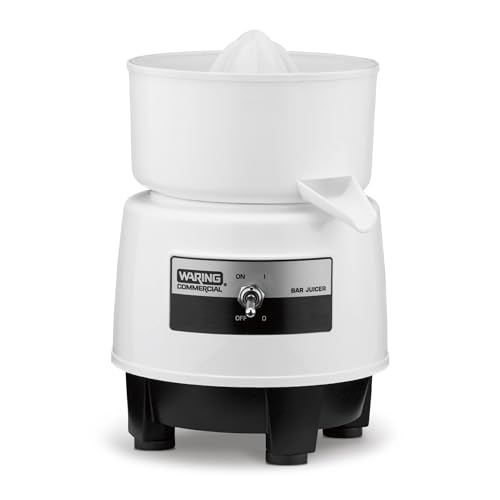
The Waring Commercial BJ120C is a compact electric citrus juicer designed for bars and small countertop spaces. It features a universal reamer that handles lemons, limes, oranges, and grapefruits, and the heavy-duty die-cast base includes vibration-dampening feet for quiet, stable operation. The unit can juice up to 120 oranges per hour, which makes it suitable for a moderately busy cafe or a cocktail program.
Cleanup is straightforward: the reamer and strainer are dishwasher-safe, and the sealed finish resists staining from citrus oils. The 34-ounce juice bowl is large enough to serve multiple drinks between emptying cycles. The motor is rated at 150 watts — modest, but sufficient for the constant low-torque reaming action that defines citrus juicing.
Some users note that the plastic bowl feels less durable than the all-metal construction of the Sunkist J-1 or the Hamilton Beach manual press. This is a trade-off you accept for the small footprint (7.25 inches square) and lower weight (6 pounds). If you need a dedicated electric citrus press that can sit on a crowded bar top without sacrificing workspace, the Waring BJ120C is a sensible pick.
Why it’s great
- Small footprint ideal for bar and small counter spaces
- Dishwasher-safe parts simplify cleaning
- Vibration-dampening feet for quiet operation
Good to know
- Plastic juice bowl may crack under heavy commercial use
- Limited to citrus fruits only
9. Sunkist Growers J-1 Commercial Juicer

The Sunkist J-1 is a heavy-duty electric citrus press built for high-volume commercial environments — think hotel breakfast buffets, large juice bars, and full-service restaurants. It includes three interchangeable extracting bulbs (for lemons, limes, and oranges), allowing you to switch between fruit sizes without losing extraction efficiency. The chrome-plated metal body is designed to withstand constant use and frequent cleaning cycles.
With a rated capacity of 20 gallons per hour, this machine can keep up with the busiest service periods. The metal and PC construction is robust, and the unit is listed as dishwasher-safe for most removable parts. The self-aligning reamer system adjusts to the size of the fruit, reducing operator fatigue and ensuring consistent yield from piece to piece.
At 31 pounds and a substantial footprint, the J-1 is not portable — it is a permanent fixture. It is also a dedicated citrus machine, so it cannot handle carrots, apples, or leafy greens. For any operation where fresh-squeezed orange or grapefruit juice is a core menu item, the Sunkist J-1 delivers industrial-scale throughput with minimal maintenance.
Why it’s great
- 20 gallons per hour output for peak periods
- Three interchangeable bulbs for different citrus sizes
- Self-aligning reamer for consistent yield
Good to know
- Dedicated citrus press; no other produce
- Heavy and requires permanent counter installation
FAQ
Can a commercial juicer handle leafy greens like kale and wheatgrass?
How many oranges per hour can a commercial citrus press handle?
Final Thoughts: The Verdict
For most commercial operators, the best overall commercial juicer machine is the Kuvings CS600 because it combines whole-fruit feeding, continuous 24-hour operation, and low-speed nutrient preservation in a single reliable package. If you need the absolute maximum juice yield and shelf life for green juice or nut-based products, the Angel AG-7500 is the premium choice with its 100% stainless steel construction and auto-reverse jam clearing. And for a high-volume citrus-focused operation, nothing beats the dedicated speed of the VEVOR Commercial Orange Juicer or the legendary throughput of the Sunkist J-1.