A juice bar lives or dies by its throughput. When the morning rush hits and a line of customers expects fresh juice in seconds, the difference between a machine that chokes on a beet or jams on an orange peel and one that feeds continuously is the difference between profit and chaos.
I’m Mohammad Maruf — the founder and writer behind AirfryerBite. I have spent years analyzing the mechanical reliability, motor torque, and material-grade specifications that separate a consumer-grade juicer from a true commercial workhorse that earns its keep on a countertop.
This guide compares the seven most serious contenders for a high-volume setting, from citrus specialists to twin-gear cold press machines, to help you identify the commercial juicer for juice bar that matches your menu and your traffic.
How To Choose The Best Commercial Juicer For Juice Bar
Buying a juicer for a juice bar is not the same as buying one for your home kitchen. The machine runs for hours, processes hundreds of pounds of produce daily, and must survive hot kitchens, sticky counters, and staff who clean it fast between shifts. Focus on these four factors before you decide.
Throughput and Type of Produce
A juice bar that sells mostly orange juice needs a citrus-specific centrifugal machine that can handle 20 to 30 oranges per minute. A bar that offers green juice, beet blends, and wheatgrass shots needs a masticating cold-press juicer that grinds fiber without clogging. Choose the type that matches your menu majority.
Material Grade and Cleanability
Food-grade SUS-304 stainless steel is the minimum for commercial kitchens. SUS-316 surgical-grade steel resists corrosion from acidic citrus juice better and lasts longer. Removable parts that are dishwasher-safe or rinse clean in under one minute reduce labor cost. Avoid machines with mesh filters that trap pulp and require scrubbing.
Continuous Operation and Cooling
A commercial machine must run for hours without overheating. Look for motors with dedicated cooling systems or thermal cut-off protection. Machines rated for 24-hour operation exist, but most juice bars need four to eight hours of continuous use between breaks. Never trust a wattage rating alone — check whether the manufacturer explicitly states continuous duty cycle.
Safety Features and Jam Protection
Pressure sensors that stop the blade when the cover is removed, waterproof switches, and auto-reverse functions for clearing jams are not luxuries in a commercial setting. A jammed juicer during peak hours loses money and frustrates staff. Verify that replacement parts are available and that the machine has a one-year minimum warranty on the motor.
Quick Comparison
On smaller screens, swipe sideways to see the full table.
| Model | Category | Best For | Key Spec | Amazon |
|---|---|---|---|---|
| Angel Juicer AG-8500 | Twin-Gear Cold Press | Maximum juice yield from leafy greens and hard produce | SUS-316 surgical steel, 82 RPM, 3 HP | Amazon |
| Kuvings CS600 | Vertical Slow Juicer | Continuous 24-hour operation, whole fruit juicing | 88 mm feed chute, BPA-free | Amazon |
| Sunkist J-1 | Citrus Press | High-volume orange juice production | 20 gallons per hour | Amazon |
| PYY Sugar Cane Juicer | 3-Roller Press | Specialty sugar cane juice extraction | 300 kg per hour, 800 W | Amazon |
| Hurom H70 | Masticating Slow Juicer | Compact cold press with strainer-free cleaning | No mesh filter, 2-part auger | Amazon |
| VEVOR Orange Juicer | Centrifugal Citrus | Entry-level citrus juicing for medium volume | 20 oranges per minute, 120 W | Amazon |
| VBENLEM Orange Juicer | Centrifugal Citrus | High-yield citrus juicing with pull-out filter | 22–30 oranges per minute, 120 W | Amazon |
In‑Depth Reviews
1. Angel Juicer AG-8500

The Angel Juicer AG-8500 is the most technically advanced machine in this lineup, built for juice bars that process high volumes of leafy greens, wheatgrass, hard root vegetables, and even nut milks. Its twin-gear system rotates at only 82 RPM, generating minimal heat and oxidation so the juice retains color and nutrients for up to 48 hours in refrigeration. The 3 HP motor delivers massive grinding force through the SHG technology, which shatters cellulose fibers to extract juice that would be left behind by slower auger designs.
Every part that contacts food is SUS-316 surgical-grade stainless steel — the same alloy used in medical instruments. This makes the machine resistant to corrosion from acidic citrus and easier to sanitize between batches. The anti-jamming auto-reverse function activates automatically when the motor detects a overload, backing the gears off and freeing the jam without manual intervention. Six separate safety features protect the motor from overheating, accidental activation, and mechanical shock.
The trade-off is weight and footprint. At over 50 pounds with a 19.5-inch depth, the AG-8500 demands dedicated counter space. Cleaning requires disassembling the twin gears and housing filter, and while all parts are dishwasher-safe, the process is more involved than a citrus centrifugal. For a juice bar whose menu depends on the highest possible yield from expensive organic produce, this machine pays for itself rapidly.
Why it’s great
- SUS-316 surgical steel construction resists corrosion and meets commercial hygiene standards
- Auto-reverse clears jams automatically without stopping workflow
- Juice stays fresh for 48 hours due to low-speed oxidation prevention
Good to know
- Heavy footprint requires dedicated counter space
- Disassembly and cleaning take longer than centrifugal models
2. Kuvings CS600

The Kuvings CS600 is the only vertical whole-fruit slow juicer in this roundup that is rated for continuous 24-hour operation. Its patented low-speed masticating technology uses a deceleration motor and a state-of-the-art cooling system that prevents overheating even during back-to-back juicing sessions. The 88 mm flip-gate feed chute is larger than typical consumer masticators, accepting whole apples, carrots, and beets without pre-cutting, which saves significant prep labor in a busy juice bar.
The drip-free Smart Cap design allows the operator to mix between recipes without leaking juice across the counter. To rinse between batches, simply close the cap and run water through the chamber. The included top set can be swapped quickly to switch between fine and coarse strainer settings. The CS600 also doubles as a baby food maker and sorbet machine with an optional blank strainer, adding versatility beyond juice.
The main drawback is that the flap-style lid can occasionally trap small pieces of produce, and some users report difficulty tightening the chamber after several months. Cleaning requires the provided rotating brush, and the parts are not dishwasher-safe. At 20.5 pounds with a compact 7.5-inch depth, however, this machine fits tighter counters better than most commercial alternatives while delivering exceptional yields from a wide variety of produce.
Why it’s great
- Rated for continuous 24-hour operation without overheating
- Large 88 mm flip gate reduces prep time by accepting whole fruits
- Drip-free Smart Cap allows quick recipe switching
Good to know
- Lid flap design can trap produce pieces occasionally
- Not dishwasher-safe; requires manual brush cleaning
3. Sunkist Growers J-1

The Sunkist J-1 is the name you see behind the counter at nearly every high-volume juice bar, and for good reason. This citrus press is rated at 20 gallons per hour, which means it can process roughly 200 oranges in a single hour without slowing down. The three interchangeable extracting bulbs accommodate different citrus sizes — from small limes and lemons to large grapefruit — ensuring maximum juice extraction from every fruit regardless of size variance in a delivery batch.
The chrome-plated metal body and stainless steel blade material are designed to withstand the constant acidic exposure from citrus juice. The machine is entirely dishwasher-safe, which is a huge advantage in a commercial kitchen where sanitation speed matters. The foot pedal or automatic cycling mechanism allows hands-free operation so staff can load fruit while the press cycles. At only 31 pounds, the J-1 is also relatively portable for a commercial unit.
The J-1 does one thing, but it does it exceptionally well. It is not suitable for celery, kale, beets, or any non-citrus produce. For a juice bar whose core offering is fresh-squeezed orange juice, this machine is arguably the most cost-effective choice in this list. The trade-off is that you will need a separate machine for green juices and vegetable blends.
Why it’s great
- Industry-standard 20 gallon per hour throughput for citrus
- Three interchangeable bulbs adapt to different fruit sizes
- Fully dishwasher-safe for fast commercial sanitation
Good to know
- Cannot process leafy greens, celery, or hard vegetables
- Requires a separate machine for non-citrus menu items
4. PYY Sugar Cane Juicer
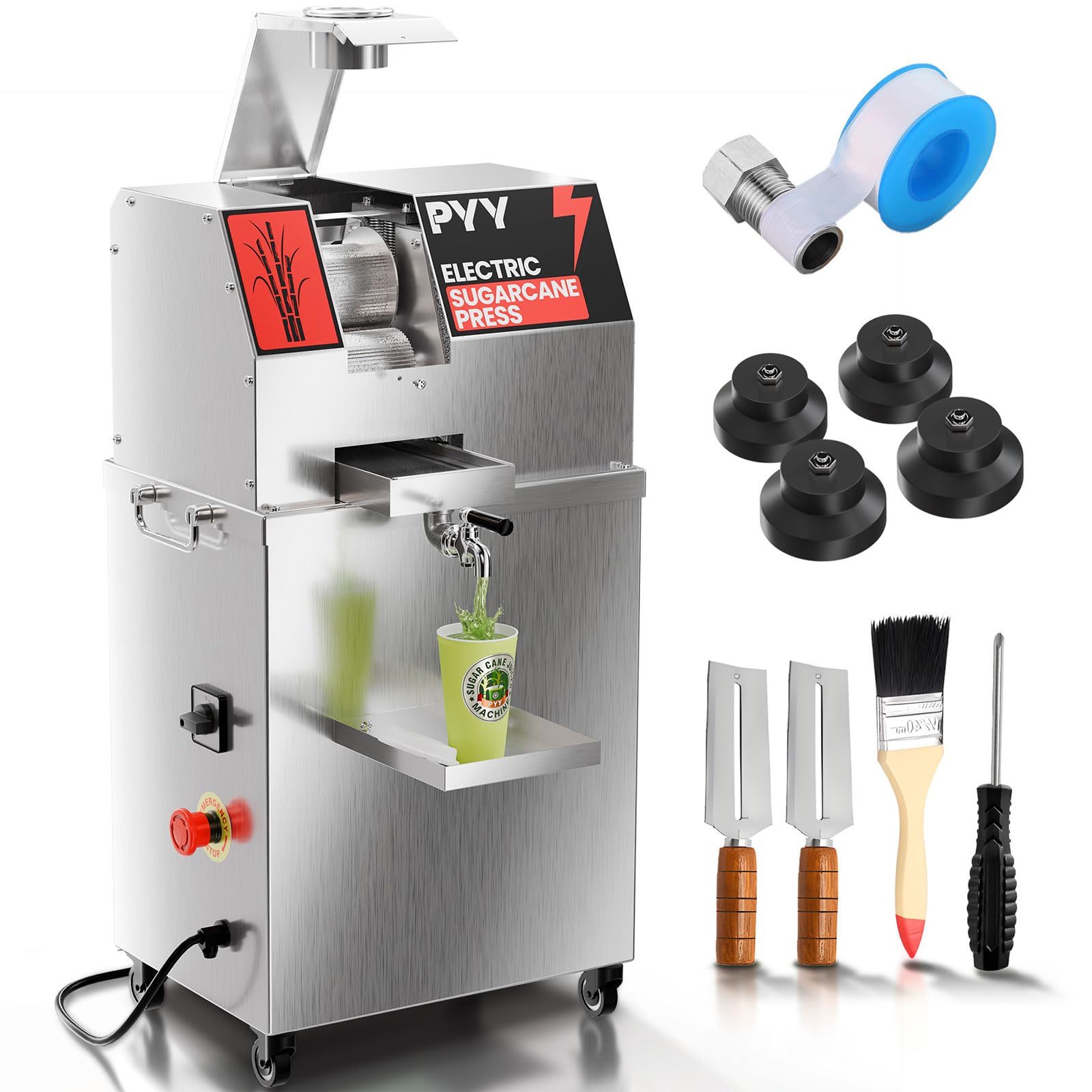
The PYY Sugar Cane Juicer is a purpose-built machine for juice bars that feature fresh sugar cane on their menu. Its three-roller design achieves a juice extraction rate of 75 percent, producing up to 300 kilograms of juice per hour. The 800-watt motor and built-in reverse knob handle jams effectively — when a cane stalk binds between the rollers, the motor reverses to push it back out without requiring manual disassembly.
Thickened stainless steel construction with food-grade 304 steel on all food-contact surfaces ensures long-term durability. The inclined feed inlet design prevents the blockages that plague flat-inlet sugar cane machines. The unit includes four flexible casters and two sturdy handles, allowing a single staff member to reposition the 114-pound machine between stations in a tight food truck or juice bar layout.
Cleaning is simplified by a screw-cap design on the feed inlet that twists open to reveal the rollers for deep cleaning. However, the machine is not dishwasher-safe and requires manual scrubbing of the rollers and juice tray. The included cleaning brush, peeling knives, and spare rubber feet add value, but replacement rollers can be expensive. This machine is a specialist tool — indispensable if you serve cane juice, but excessive counter weight if you do not.
Why it’s great
- Three-roller design achieves 75 percent juice yield at 300 kg per hour
- Reverse knob clears cane jams without disassembly
- Four casters and handles enable easy repositioning
Good to know
- Not dishwasher-safe; rollers require manual scrubbing
- Heavy at 114 pounds despite casters
5. Hurom H70
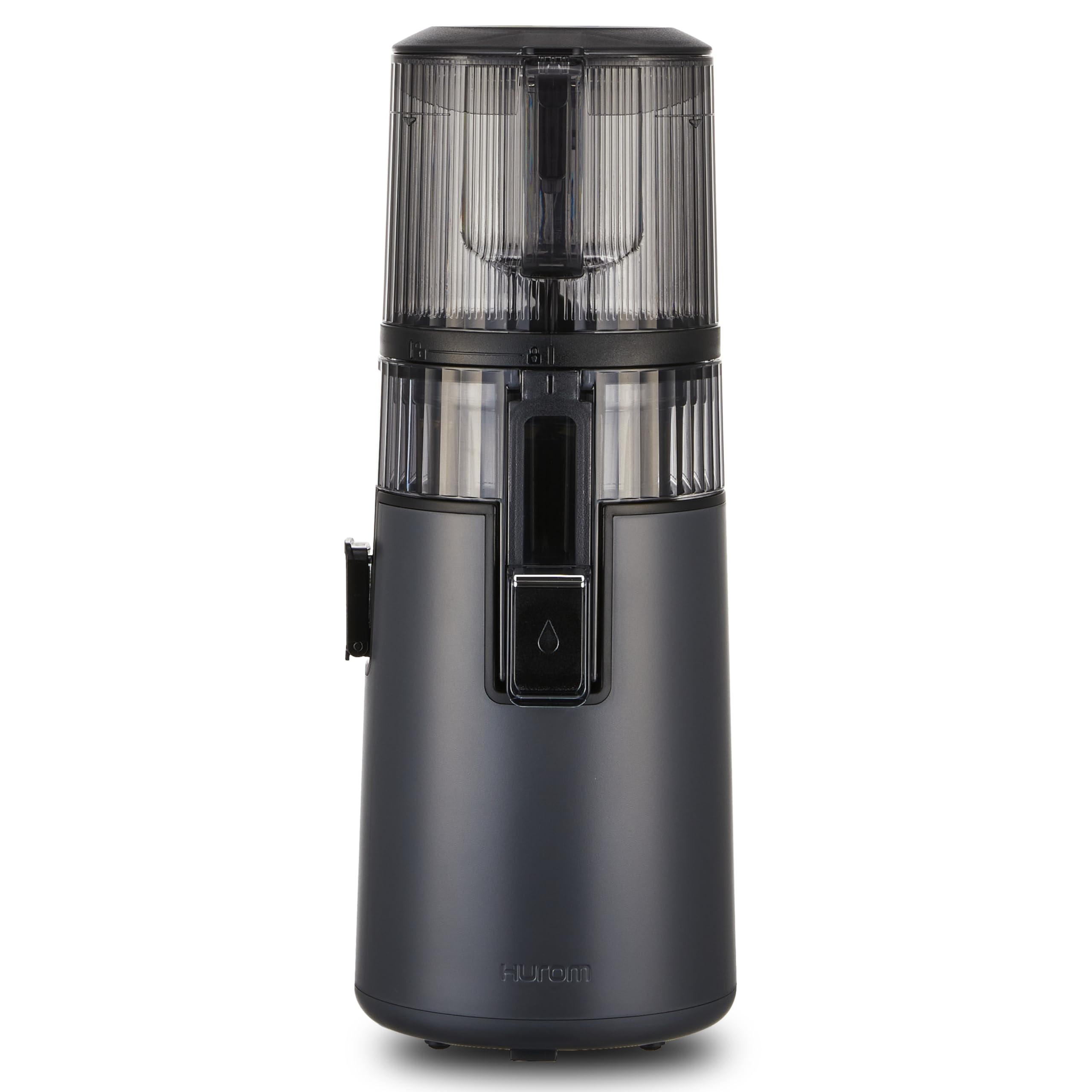
The Hurom H70 breaks away from the traditional mesh-filter cold press design with its strainer-free Easy Clean chamber. Instead of a metal screen that traps pulp and mineral buildup, the H70 uses a two-part auger system that naturally separates pulp from juice as it rotates. This eliminates the single most tedious cleaning step in masticating juicers. All parts detach and rinse clean in under one minute, which is a significant labor saver in a juice bar environment.
The self-feeding hopper and wider inlet allow the operator to add whole apples and large carrots without pre-chopping. The 150-watt motor and slow squeeze technology deliver a high yield while producing minimal heat. The front-facing gauge window lets staff monitor the juice chamber level without opening the machine. At only 8 inches deep and 14.8 pounds, the H70 fits on even the most crowded countertops and can be stowed away easily if space is tight.
The H70 is designed for light to medium commercial use, not the relentless high-volume demand of a major juice chain. Some users report difficulty unlocking the chamber for disassembly after juicing sticky fruits. The plastic construction, while BPA-free, does not feel as robust as the stainless steel designs from Kuvings or Angel. For a small juice bar, smoothie shop, or café that values quick cleaning, the H70 is a smart balance of yield and convenience.
Why it’s great
- Strainer-free design eliminates mesh filter scrubbing
- Parts rinse clean in under one minute
- Compact 8-inch depth fits tight counter spaces
Good to know
- Chamber lock can be difficult to release after sticky produce
- Plastic construction less durable for extreme volume
6. VEVOR Commercial Orange Juicer

The VEVOR commercial orange juicer is a budget-conscious entry into centrifugal citrus juicing for a juice bar that is just starting up or operating in a lower-traffic location. The 120-watt motor processes up to 20 oranges per minute via the automatic peeling, juicing, and filtering sequence. The concave-convex extraction balls are designed to press more juice from each orange half, increasing yield compared to flat-surface models.
The feed chute accepts oranges from 55 mm to 80 mm in diameter, which covers most standard citrus sizes. The top storage basket holds a large batch of pre-washed oranges so staff can feed continuously without stopping to reload. The pull-out filter box makes pulp removal faster than models that require removing the entire drum. The transparent PC cover includes a pressure sensor that halts operation when removed, and the switch is protected by a waterproof cover for safety.
At 88 pounds, the VEVOR is heavy but stable on a counter. The stainless steel and PC construction is food-safe, though the plastic cover may show wear sooner than an all-metal machine. Some users report that the gripping mechanism does not handle lemons well, as the larger extraction balls allow small fruit to slip without pressing. For a juice bar focused exclusively on medium-to-large oranges, the VEVOR delivers reliable throughput at a lower initial investment.
Why it’s great
- Automatic peeling and juicing sequence reduces manual prep
- Pull-out filter box speeds up pulp cleanup
- Safety pressure sensor stops operation when cover is removed
Good to know
- Extraction balls too large for small lemons and limes
- PC cover less durable than stainless steel
7. VBENLEM Commercial Orange Juicer

The VBENLEM commercial orange juicer is a step up from the VEVOR in throughput, managing 22 to 30 oranges per minute with the upgraded concave-convex extraction balls that reportedly increase juice yield by 5 percent over flat-surface competitors. The 120-watt motor drives the automatic peeling and juicing mechanism with integrated air vents that dissipate heat during extended operation, preventing the motor from overheating during busy service hours.
Construction uses food-grade 304 stainless steel for the tank and structural components, with PP plastic for the safety cover and drip tray. The upgraded pull-out filter box allows the operator to extract the pulp compartment and rinse it under running water without disassembling the main unit. The ON/OFF switch is protected by waterproof covers to guard against electrical leakage from washdowns. The safety interlock ensures the machine will not start unless the cover is properly seated.
The large top storage basket holds a significant quantity of pre-washed oranges for continuous feeding. The machine processes oranges within a 40 mm to 80 mm diameter range and can also handle pomegranates and lemons, though large pomegranates may require manual splitting. At 93 pounds, the VBENLEM is one of the heavier citrus machines in this list. While it lacks the brand recognition of a Sunkist, the upgraded extraction technology and stainless steel build make it a solid mid-range contender.
Why it’s great
- Concave-convex extraction balls boost juice yield by 5 percent
- Pull-out filter box simplifies cleaning without full disassembly
- Air vents prevent motor overheating during extended use
Good to know
- Heavy at 93 pounds; difficult to reposition
- Larger pomegranates need manual splitting before feeding
FAQ
Can a single commercial juicer handle both citrus and leafy greens?
What is the difference between a cold press juicer and a centrifugal juicer for a juice bar?
How many oranges per minute does a juice bar need to serve a morning rush?
Are automatic orange juicers worth the extra cost versus manual press models?
What is the average lifespan of a commercial juicer under daily use?
Final Thoughts: The Verdict
For most users, the commercial juicer for juice bar winner is the Kuvings CS600 because it combines whole-fruit feeding, continuous 24-hour rated operation, and easy cleaning in a vertical design that fits most countertops. If you want the highest possible juice yield from leafy greens and hard vegetables, grab the Angel Juicer AG-8500. And for a citrus-focused juice bar that needs massive throughput at a reasonable upfront cost, nothing beats the Sunkist Growers J-1.