A commercial espresso machine is the backbone of any serious coffee operation, demanding precision, durability, and repeatability shot after shot during peak service hours. The difference between a machine that handles a rush and one that buckles under pressure often comes down to boiler type, group head stability, and pump reliability—factors that define throughput and drink quality in a high-volume environment.
I’m Mohammad Maruf — the founder and writer behind AirfryerBite. I’ve spent years analyzing heavy-duty espresso hardware, studying PID temperature control algorithms, rotary versus vibration pump lifespans, and the thermal dynamics of heat exchanger versus dual boiler systems in demanding commercial workflows.
This guide breaks down the most capable machines on the market, helping you identify the commercial espresso machine that fits your specific volume, space, and skill requirements without wasting capital on unnecessary features.
How To Choose The Best Commercial Espresso Machine
Selecting a machine for a commercial setting means prioritizing reliability, speed, and serviceability over flashy features. You need hardware that can run for hours on end, deliver consistent 9-bar extraction, and be repaired by a local technician when something wears down. The right choice depends on your daily shot count, the ratio of straight espresso to milk drinks, and whether you have the electrical capacity for a high-wattage dual boiler system.
Boiler Configuration: Dual Boiler vs. Heat Exchanger
A dual boiler machine separates the brew and steam circuits, allowing you to pull shots and steam milk simultaneously without temperature fluctuation—critical for high-volume espresso bars. Heat exchangers use a single boiler to heat water for both functions, which can cause brew temperature spikes if the steam circuit kicks on mid-shot. For locations running more than a hundred milk-based drinks per day, dual boilers with PID control offer the thermal stability needed to maintain consistent espresso quality during back-to-back pulls.
Pump Type: Rotary vs. Vibration
Rotary pumps are standard in true commercial machines because they deliver steady pressure, run quieter, and last through tens of thousands of cycles. They also allow direct plumbing to a water line, eliminating the need for refilling a reservoir mid-service. Vibration pumps, common in prosumer models, work well for low-volume use but struggle to maintain consistent pressure under continuous operation. If your barista cranks out 30-plus shots an hour, a rotary pump is non-negotiable.
Group Head Design and Temperature Stability
The E61 group head, originally designed by Faema in 1961, uses a thermosiphon mechanism that circulates hot water through the group to stabilize brewing temperature. It is widely respected for its thermal inertia and ability to recover quickly between shots. Modern saturated group heads found in high-end commercial machines offer even tighter temperature control by submerging the group in a dedicated water jacket. PID-controlled saturated groups can hold temperature within 0.5°F—essential for dialing in light roasts and single-origin beans.
Build Quality, Serviceability, and Warranty
Commercial espresso machines take abuse daily. Look for stainless steel frames, brass or stainless boilers, and replaceable parts like gaskets, shower screens, and solenoid valves that a technician can swap in minutes. Avoid machines with proprietary components that require factory-only repairs. A three-year warranty on parts and labor is a strong indicator that the manufacturer trusts its build quality—and so should you.
Quick Comparison
On smaller screens, swipe sideways to see the full table.
| Model | Category | Best For | Key Spec | Amazon |
|---|---|---|---|---|
| Breville Dual Boiler BES920XL | Dual Boiler | Precision and home use | PID control & ±2°F temp stability | Amazon |
| Breville Dynamic Duo BEP920BSS | Bundle Package | Complete setup with grinder | Dual boiler + Smart Grinder Pro | Amazon |
| Ascaso Steel DUO PID | Dual Thermoblock | Energy efficiency | Stainless & aluminum thermoblocks | Amazon |
| Nuova Simonelli Oscar II | Heat Exchanger | Entry-level commercial | Copper boiler, 3-liter capacity | Amazon |
| Gaggia Accademia | Super Automatic | One-touch convenience | 19 drink settings, touchscreen | Amazon |
| De’Longhi Eletta Explore | Super Automatic | Cold brew and iced drinks | Cold Extraction Technology | Amazon |
| Rocket Appartamento Nera | Heat Exchanger | Compact pro performance | 1.8L heat exchange boiler | Amazon |
| Diletta Bello+ | E61 Dual Boiler | PID temp accuracy | 3L stainless boiler, programmed preinfusion | Amazon |
| Rancilio Silvia Pro X | Dual Boiler | Simultaneous brew & steam | 1L steam + 300ml brew boiler | Amazon |
| Bosch VeroCafe 800 TQU60307 | Super Automatic | App-controlled convenience | 36 drinks, Home Connect app | Amazon |
| Jura E8 | Super Automatic | Luxury one-touch brewing | 17 programmed specialties | Amazon |
| Rocket R58 Cinquantotto | Dual Boiler Rotary | Plumbable commercial grade | Touchscreen PID, 2.5L boilers | Amazon |
| Jura GIGA 10 Diamond Black | Super Automatic | Dual grinder, cold brew | 35 drinks, two ceramic grinders | Amazon |
In‑Depth Reviews
1. Rocket Espresso R58 Cinquantotto

The Rocket R58 Cinquantotto is built around dual stainless steel boilers—2.5 liters total capacity—paired with a commercial-grade rotary pump that supports direct plumbing or internal reservoir operation. Its detachable touchscreen PID gives you one-degree temperature control over both brew and steam circuits, a feature that matters when dialing in light-roast single-origin beans that demand precise thermal windows. The mirrored shot timer integrates cleanly into the machine’s classic aesthetic without adding visual clutter.
Hand assembled in Milan, the R58 uses E61 group heads with thermosiphon circulation for passive temperature stabilization, though it lacks programmable preinfusion, which some third-wave baristas will miss. The 58mm commercial portafilter and non-pressurized baskets offer full control over dose and distribution. At 58 pounds, the stainless steel frame absorbs vibrations from the rotary pump, resulting in quieter operation than many prosumer machines with vibration pumps.
Owner reports consistently highlight shot-to-shot consistency and the ability to steam milk and pull shots simultaneously without any temperature sag. The main trade-off is the absence of built-in preinfusion, requiring the user to manually pre-wet the puck via a brief pump cycle. For a dedicated operator who values temperature stability and repairability above automation, this machine earns its place as a serious contender for a low-to-mid-volume commercial environment or a demanding home setup.
Why it’s great
- Rotary pump enables direct plumbing for continuous operation
- Dual boilers with PID maintain tight temperature stability
- Detachable touchscreen simplifies adjustments
- Hand-built stainless steel chassis absorbs vibration
Good to know
- No programmable preinfusion—manual technique required
- Large footprint at 22.75 inches deep
- Premium-tier investment with limited automation
2. Jura E8

The Jura E8 delivers 17 programmed specialties through a 2.8-inch color display and a six-button control panel backed by a Jura-specific artificial intelligence layer that adapts product positions and settings over time. Its Professional Aroma Grinder, a conical steel burr unit, claims 12.2 percent more aroma extraction than previous generations, and the Pulse Extraction Process (P.E.P.) optimizes water flow for ristretto and espresso by pulsing at intervals shorter than standard preinfusion. The machine achieves precise temperature through its intelligent preheating system, ensuring the first cup is as hot as the last.
Cleaning is semi-automated via the Cockpit display, which guides maintenance steps and tracks care intervals. The high-gloss chrome cup grille and grooved water tank fit Jura’s premium design language. The E8 lacks a dual boiler, relying instead on a single thermoblock design that sequences brewing and steaming, so simultaneous milk and espresso production isn’t possible. Users rate it highly for ease of use and consistency, but the lack of on-the-fly grind adjustment without opening the bean hopper frustrates some.
The E8 suits a workplace with rotating shifts where simplicity and repeatability matter more than manual barista control. It sits comfortably in a breakroom or light commercial setting that serves espresso, cappuccino, and lungo all day without requiring a trained operator behind the machine.
Why it’s great
- P.E.P. delivers richer short shots like ristretto
- Intelligent preheating ensures consistent first-cup temperature
- Cockpit maintenance tracking reduces operator guesswork
Good to know
- Single thermoblock prevents simultaneous brewing and steaming
- Grind adjustment requires opening hopper
- Milk system requires daily cleaning cycle
3. Jura GIGA 10 Diamond Black

The Jura GIGA 10 sits at the top of the super-automatic food chain, sporting two separate 10-ounce bean containers each with its own electronically adjustable ceramic disc grinder. The independent grinders allow you to load regular beans in one and decaf or a different roast in the other, switching between them with a single touch on the 6.7-inch Panorama Coffee Panel. The machine offers 35 total drink options, including hot and genuine cold brew prepared through Jura’s exclusive Cold Extraction Process, which uses precise temperature and flow rate to produce cold coffee concentrate in minutes without heat.
The eighth-generation brew unit uses 3D Brewing Technology that adjusts brew chamber geometry based on the selected drink, and the Pulse Extraction Process remains active for short specialties. The GIGA 10 supports parallel preparation—you can brew two coffees at once while independent milk circuits handle steaming from a separate reservoir. Its Automatic Grinder Adjustment recalibrates burrs electronically to maintain consistent particle size as they wear. Owners praise the build quality and versatility, but the steep price and complex maintenance cycle are notable hurdles.
For a high-traffic office or a multi-roaster cafe that needs two beans on deck without cross-contamination, the GIGA 10 eliminates workflow friction. The milk system components are removable for refrigeration, and the step-by-step cleaning programs keep daily maintenance manageable, though descaling requires their branded tablets.
Why it’s great
- Two independent grinders support regular and decaf simultaneously
- Cold brew in minutes without pre-brewing concentrate
- 6.7-inch touchscreen with intuitive navigation
- Parallel brew function for dual-shot production
Good to know
- Branded cleaning and descaling products required
- Large footprint may not fit limited counter space
- High-end price point limits ROI for low-volume use
4. Rocket Espresso Appartamento Nera

The Rocket Appartamento Nera wraps an E61 group head and a 1.8-liter copper heat exchanger boiler into a compact frame measuring just 10.5 inches wide. The heat exchanger design allows simultaneous brewing and steaming by maintaining the boiler at steam temperature and running brew water through a heat exchange coil, sacrificing some brew temperature precision compared to a dual boiler. The E61 group uses thermosiphon circulation to stabilize temperature passively without electronics, a design trusted in cafes for decades.
Manual levers for steam, water, and brew control put every decision in the operator’s hands, which is either a draw or a deterrent depending on your comfort level. The 58-pound machine includes a stainless steel tamper, single and double spouted portafilters, and a cup rail for preheating. Users consistently note the quiet rotary pump (standard on this model) and the ability to pull back-to-back shots for a small brunch crowd without overheating. The compact width fits tight bar layouts, but the 17-inch depth still demands counter clearance for portafilter access.
The Appartamento Nera works best for a low-to-mid volume commercial space—think coffee cart, small espresso bar with 50 to 80 shots per day—or for a serious home user who values mechanical simplicity over digital programmability. The three-year warranty reflects Rocket’s confidence in the build, but prospective buyers should understand the heat exchanger’s temperature surfing requirement for optimal brew results.
Why it’s great
- Narrow 10.5-inch footprint fits tight counters
- Copper heat exchanger boiler recovers quickly
- Three-year parts and labor warranty
- Quiet rotary pump standard
Good to know
- Heat exchanger requires temperature surfing for brew accuracy
- Manual controls may intimidate new operators
- No PID or digital temperature readout
5. Diletta Bello+

The Diletta Bello+ is handmade in Milan and combines a 3-liter stainless steel boiler with an E61 group head and a front-mounted PID screen that displays both boiler temperature and a shot timer during extraction. The PID controller lets you adjust steam boiler temperature in one-degree increments, and a new low-power eco mode drops the boiler temperature when idle while still enabling faster recovery than a full cold restart. Programmable passive preinfusion—up to 10 seconds—adds control for light roasts that benefit from a gentle initial wetting phase before full pressure.
All-brew and steam controls are manual, putting the barista in charge of timing and pressure profiling. The stainless steel frame, case, and boiler provide long-term corrosion resistance. The 58mm portafilter, tamper, and baskets are included. Early adopters report consistent temperature stability and that the preinfusion programming significantly reduces channeling compared to non-adjustable E61 machines. The lack of an integrated shot timer on the main interface beyond the PID readout is a minor inconvenience.
The Bello+ suits a cafe owner who wants dual-boiler performance and PID accuracy without stepping into the price territory of Italian heavyweights like La Marzocco. The 3-liter boiler capacity supports moderate volume, and the stainless construction is built to last beyond five years of daily commercial use.
Why it’s great
- 3-liter stainless boiler supports sustained steaming
- Programmable preinfusion improves shot consistency
- Eco mode saves energy and speeds warm-up recovery
Good to know
- Manual controls require skilled operation
- PID doubles as shot timer, no separate display
- Limited distribution and service network in some regions
6. Rancilio Silvia Pro X

The Rancilio Silvia Pro X upgrades the classic Silvia platform with a proper dual boiler system — a 1-liter steam boiler and a 300-milliliter brew boiler — each controlled by its own PID circuit for independent temperature management. This design allows you to steam milk and pull shots at the same time without thermal interference, a significant step up from the single-boiler Silvia line. The brew boiler’s small volume means it recovers temperature quickly between shots, maintaining the 200°F window needed for consistent extraction.
Soft preinfusion is adjustable via the PID interface, and the front-facing screen doubles as a shot timer during extraction. The programmable auto-on feature sets a daily wake-up time so the machine is ready when staff arrive. The upgraded stainless portafilter from Rancilio’s Specialty line adds weight and thermal mass. The 58mm commercial baskets and included tamper, scoop, and cleaning tabs give you everything to start production immediately. Users note the build quality is typical Rancilio—tanks, but the machine runs over 50 pounds and pulls shots that easily compete with machines costing two grand more.
This machine fits a mid-volume cafe or a catering business that needs reliable dual-boiler performance without the space or electrical requirements of a three-group behemoth. The separate PIDs for brew and steam mean you can dial in each circuit independently, a flexibility that matters when your milk drink volume shifts seasonally.
Why it’s great
- Dedicated PID controllers for brew and steam circuits
- Adjustable soft preinfusion improves shot quality
- Auto-on programmable wake-up simplifies morning startup
- Upgraded Rancilio Specialty portafilter included
Good to know
- 300ml brew boiler is small—requires pause between multiple shots
- Heavy at over 50 pounds; not easily portable
- No rotary pump option; uses vibration pump
7. Breville Dual Boiler BES920XL

The Breville Dual Boiler BES920XL brings a true dual-boiler architecture with PID temperature control and a heated group head, maintaining brew temperature within 2°F of the set point. The system uses one stainless steel boiler for brewing and a separate boiler for steam, enabling simultaneous extraction and milk texturing. The over-pressure valve (OPV) limits maximum pump pressure during extraction, preventing bitter flavors by capping pressure at the optimal 9-bar range, while the low-pressure preinfusion gradually ramps water pressure to expand the coffee puck evenly before full extraction begins.
The 58mm portafilter accepts standard commercial accessories, and the integrated tamper, Razor dosing tool, and single and dual wall filter baskets provide everything needed for both fresh and pre-ground coffee. The LCD shows a shot clock for timing extraction and displays programmable settings for shot volume, temperature, and auto-start. A 2-year limited warranty backs the 1700-watt system. Users consistently note temperature consistency and steam power, though some report reliability concerns with internal electronics failing after 2 to 3 years, requiring out-of-warranty repair.
For a small coffee shop or a high-output home setup, the BES920XL offers near-commercial temperature stability in a package that requires no plumbing modifications. The 84-ounce water tank supports moderate volume before refilling, and the included cleaning kit and water filter help maintain scale-sensitive internals. It is a capable workhorse if you accept that certain plastic internal parts may need replacement within the first few years of commercial-level use.
Why it’s great
- Heated group head with PID maintains extraction temperature
- OPV prevents over-extraction and bitter flavors
- Includes Razor dosing tool for consistent puck prep
- 84-ounce water tank supports moderate volume
Good to know
- Some users report electronic failures after 2-3 years
- 2-year warranty is short for commercial duty
- Vibration pump may wear under heavy continuous use
8. Breville Dynamic Duo BEP920BSS

The Breville Dynamic Duo packages the BES920 Dual Boiler espresso machine with the Smart Grinder Pro, creating a single-purchase solution that covers grinding and brewing with matched workflow. The Dual Boiler machine itself remains identical to the standalone BES920XL—dual stainless boilers, PID temperature control, heated group head, 9-bar OPV regulation, and low-pressure preinfusion. The Smart Grinder Pro offers 60 grind settings via a precision conical burr set with digital time-based dosing, allowing you to dial in dose weight by adjusting grind time in 0.2-second increments.
The 22-gram dose capacity of the 58mm portafilter matches the grinder’s maximum output per cycle, and the package includes the same Razor dosing tool, integrated tamper, and filter basket set as the standalone unit. Owners report that the bundle simplifies the purchasing decision—no separate grinder research needed—and that the combination produces cafe-quality shots once the grind setting and dose time are dialed in. The grinder’s build quality is solid for the price, but serious commercial users may eventually upgrade to a stepless grinder for finer adjustment resolution.
This package hits a sweet spot for a start-up coffee cart or a cafe wanting a matched pair without sourcing components separately. The 2-year warranty on the espresso machine and 1-year on the grinder cover typical failure points. The Smart Grinder Pro works well for medium-roast espresso but struggles with very light or very oily beans during high-volume sessions.
Why it’s great
- Complete espresso setup in one purchase
- 60 grind settings with digital time-based dosing
- 22-gram dose matches 58mm portafilter capacity
Good to know
- Grinder may need replacement for high-volume commercial use
- Only 2 years warranty on espresso machine
- Vibration pump, not rotary
9. Ascaso Steel DUO PID

The Ascaso Steel DUO PID replaces traditional boiler systems with two independent thermoblocks—one aluminum-lined stainless block for brewing and a separate unit for steam—that heat water on demand rather than maintaining a reservoir at temperature. This approach reduces warm-up time to under 5 minutes and cuts standby energy consumption compared to copper boilers that hold 2 to 3 liters at steam temperature continuously. The PID controller provides one-degree temperature increments, and the volumetric programming lets you set preinfusion duration, single shot, double shot, and auto-standby parameters for repeatable results.
The body combines powder-coated carbon steel with polished stainless steel, and the 58mm portafilter features a real walnut wood handle that adds a tactile premium feel. The group head is constructed from stainless-lined aluminum, which Ascaso claims offers better thermal transfer than traditional brass. The 2-liter water reservoir is removable for easy filling. Owners highlight the fast heat-up time and energy efficiency, but note that the steam thermoblock, while delivering continuous steam, produces slightly wetter steam than a large boiler—a consideration for latte art execution in volume.
This machine fits a specialty coffee space where aesthetics and energy bills matter—think a boutique lobby cafe or a roastery tasting bar. The thermoblock design also appeals to operators in locations with variable electrical supply, since the on-demand heating draws less peak wattage than a dual boiler.
Why it’s great
- Heats up in under 5 minutes with on-demand thermoblocks
- Energy-efficient compared to traditional boiler machines
- Walnut-handled portafilter adds tactile comfort
- Volumetric controls with programmable preinfusion
Good to know
- Steam quality is wetter than large boiler systems
- Aluminum-lined group has niche service network
- 2-liter water tank requires frequent refills in high volume
10. Nuova Simonelli Oscar II

The Nuova Simonelli Oscar II uses a 3-liter copper heat exchanger boiler with a stainless steel exterior, providing enough thermal mass to support back-to-back milk steaming for a busy morning rush. It is a semi-automatic machine with manual brew and steam controls, relying on a traditional E61-style group head derived from the commercial Nuova Simonelli Appia line. The 12-inch width and 16-inch depth fit neatly onto a commercial counter, and the machine is rated for 110V operation, requiring no special electrical work for most North American cafes.
The included tamper, portafilter, milk frother, and shot baskets give a new operator everything needed to start pulling immediately. The 3-liter copper boiler recovers quickly between steam wand uses, and the pour-over water source—no plumbing required—simplifies installation in temporary spaces. Experienced owners note that the Oscar II produces steam-pressure comparable to Simonelli’s full-size commercial machines, making it popular for pop-ups and mobile espresso bars. The main compromise is the lack of PID temperature control, meaning the barista must temperature-surf the heat exchanger for optimal brew temperature.
This machine targets the cafe owner launching their first brick-and-mortar location or scaling up from a cart. The build is serviceable with widely available parts, and the heat exchanger design supports simultaneous brew-and-steam workflows if the operator learns the machine’s temperature behavior.
Why it’s great
- 3-liter copper boiler recovers steam quickly
- Compact 12-inch width fits small counters
- 110V operation, no special electrical work
- Uses commercial-grade E69/Appia group parts
Good to know
- No PID—requires temperature surfing for brew accuracy
- Pour-over water source limits continuous high volume
- Semi-automatic controls require trained operator
11. Gaggia Accademia

The Gaggia Accademia is a fully automatic Italian-made machine that integrates a glass touchscreen display with 19 on-demand beverage presets, from espresso and macchiato to flat white and lungo. It features a commercial-style steam wand for manual milk texturing combined with an integrated milk carafe for automated frothing, giving the operator both options depending on volume. The stainless steel housing and painted exterior finish match the aesthetic of Gaggia’s legacy in commercial espresso since 1938.
Beverage customization is extensive: users adjust coffee strength, temperature, milk ratio, and volume per drink, saving up to six personalized profiles. The brew group is a removable unit for cleaning, and the machine alerts when maintenance is due. The 1.6-liter water tank supports moderate daily use before refilling. Owners note that the touchscreen interface is responsive and intuitive, but that the automated milk system requires thorough daily cleaning to avoid clogs. The included Mavea Intenza water filter reduces scaling frequency in hard-water areas.
This machine suits a high-end office breakroom or a boutique hotel suite where guests value self-serve variety without barista training. The 19 presets cover nearly every espresso-based drink, and the commercial steam wand still allows skilled users to hand-texture milk when desired. The fully automatic operation means the machine handles grinding, dosing, tamping, and extraction internally, which limits barista control but maximizes consistency for untrained users.
Why it’s great
- 19 on-demand beverage options cover the full menu
- Removable brew group simplifies deep cleaning
- Commercial steam wand for manual texturing option
- Made in Italy with stainless steel build
Good to know
- Automated milk system needs daily deep cleaning
- 1.6-liter water tank requires frequent refilling for high volume
- Bean hopper holds only 250 grams
12. De’Longhi Eletta Explore

The De’Longhi Eletta Explore is a super-automatic espresso machine that differentiates itself with Cold Extraction Technology, producing cold brew concentrate in under 3 minutes using precisely controlled water flow and pressure at low temperature instead of 12-hour steeping. It offers over 50 one-touch recipes including hot espresso classics and iced variations, managed through a 3.5-inch TFT full-touch color display and soft-touch controls. Two separate LatteCrema systems handle hot and cold milk frothing; the LatteCrema Cool system uses a nitrogen-based process to produce cold foam without refrigeration.
The built-in grinder features 13 adjustment settings and is guided by Bean Adapt Technology, which walks the user through optimization steps based on the bean type loaded. The machine also supports smartphone connectivity via the De’Longhi Coffee Link App, allowing remote recipe customization and profile creation. The 60-ounce water tank is removable, and many parts including the brew group and milk carafes are dishwasher safe, reducing cleaning friction. A travel mug is included, and 15 of the recipes can brew directly into 16-ounce cups.
User reviews consistently praise the cold brew speed and the variety of hot-and-cold recipes, but some report inconsistent milk foam temperature from the cold frother and challenges with the app connectivity. The plastic-heavy build may feel less durable than Italian-made stainless machines, and the 13 grind settings limit fine-tuning for very light roasts. This machine fits a drive-through kiosk or a cafe that wants to offer cold brew without investing in separate equipment and overnight steep time.
Why it’s great
- Cold brew in under 3 minutes without overnight steep
- 50+ one-touch recipes including iced and hot drinks
- Dishwasher-safe components simplify daily cleaning
- Bean Adapt Technology guides grind optimization per bean
Good to know
- Cold milk frother temperature can vary
- App connectivity has reported stability issues
- Plastic-heavy construction at this price point
13. Bosch VeroCafe 800 TQU60307
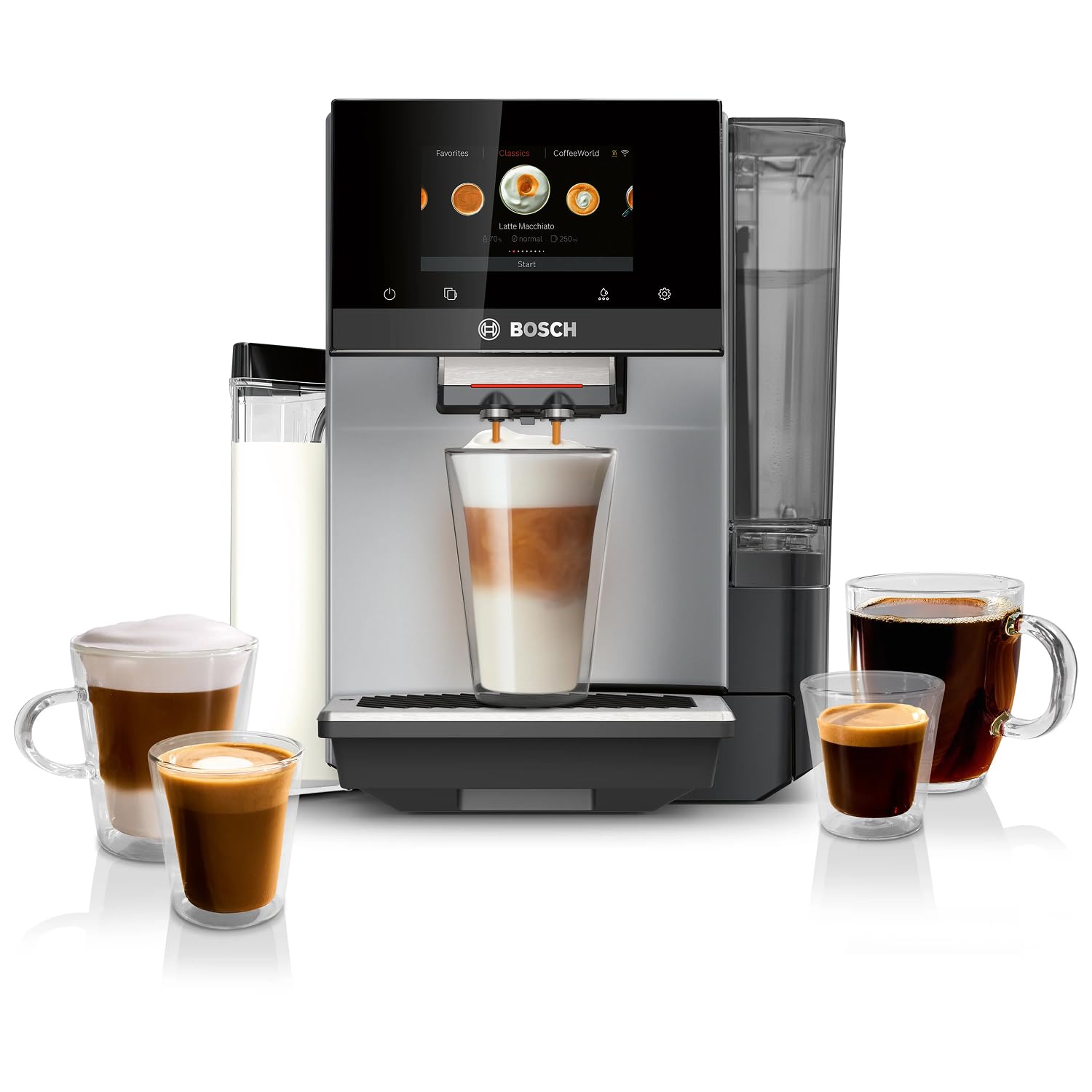
The Bosch VeroCafe 800 Series fully automatic espresso machine, model TQU60307, delivers 36 drinks including espresso, latte macchiato, cappuccino, and americano through a large touchscreen display. The machine offers personalization for strength, size, milk ratio, and aroma, and it supports remote operation and recipe discovery via the Home Connect app. A combined cleaning and descaling program minimizes maintenance time, and the machine includes a Calc’n Clean system that integrates cleaning tablets into the flush cycle.
The integrated milk container and milk adapter simplify automatic frothing, and the removable brew unit—a key advantage over Jura models—lets you rinse the brew group under running water for thorough hygiene. The 5.1-pound bean hopper capacity supports extended volume before refilling. Early adopters report excellent drink consistency and note that the automatic milk cleaning cycle is far simpler than competing super-automatics. The main complaints center on the initial setup time—up to two hours for water testing, filter installation, and part cleaning—and a small number of users report software glitches with the touchscreen requiring a restart.
This machine works well for a breakroom in a large office or a small cafe that wants the convenience of a super-automatic with a robust app for remote management. The removable brew unit and automated cleaning cycle reduce the labor of daily maintenance, and the 36-drink library covers a menu broad enough for any non-specialty coffee environment.
Why it’s great
- Removable brew group for easy rinsing and deep cleaning
- Combined cleaning and descaling program saves time
- Home Connect app enables remote operation and recipe customization
- Large 5.1-pound bean hopper for extended capacity
Good to know
- Initial setup can take up to two hours
- Touchscreen glitches reported by some users
- Plastic construction may not match all commercial aesthetics
FAQ
What size boiler do I need for a high-volume commercial coffee shop?
Is a rotary pump always better than a vibration pump for commercial use?
Can I use a super-automatic machine for a commercial espresso bar?
How often should I replace gaskets and shower screens on a commercial espresso machine?
Do I need a dedicated 220V circuit for a high-end commercial espresso machine?
Final Thoughts: The Verdict
For most users, the commercial espresso machine winner is the Rocket Espresso R58 Cinquantotto because its dual boiler, rotary pump, and PID control deliver the temperature stability and pressure consistency that define professional-grade output day after day. If you want the convenience of independent bean hoppers and cold brew capability in a single super-automatic unit, grab the Jura GIGA 10 Diamond Black. And for a budget-conscious entry into commercial hardware that still pulls genuine cafe-quality shots, nothing beats the Nuova Simonelli Oscar II.