The moment green coffee beans hit the roasting drum, a timer starts ticking against staleness. Commercially roasted whole beans begin losing aromatic oils within days of their roast date, yet green beans stay viable for roughly two years. That metabolic gap is exactly what drives the shift toward home coffee roasting equipment — a category that trades shelf convenience for absolute freshness control. This isn’t about pulling espresso shots; it’s about engineering the thermal curve that transforms raw seeds into the exact flavor profile you want.
I’m Mohammad Maruf — the founder and writer behind AirfryerBite. I’ve spent years analyzing the hardware specifications and real-world performance metrics of small-batch roasting machines, from drum capacity and wattage density to airflow dynamics and chaff management systems. This guide focuses exclusively on the measurable specs that separate a reliable roaster from a frustrating one.
Whether you are chasing consistent first-crack timing or upgrading from a makeshift popcorn popper setup, this deep dive into the best available coffee roasting equipment will help you match the right machine to your batch size and control preferences.
How To Choose The Best Coffee Roasting Equipment
Selecting a coffee roaster is fundamentally different from picking a coffee maker. You are buying a heat-controlled environment where bean chemistry develops. Three critical factors define your experience: batch capacity, heat delivery method, and control interface. Ignore these, and you will end up with scorched batches or unpredictable results.
Batch Capacity and Bean Movement
Every roaster has an ideal load range. Overloading chokes airflow or drum rotation, leading to uneven roasting. Underloading leaves too much air space, causing beans to bounce erratically. For home use, a recommended batch of 200 to 300 grams gives you enough volume for daily brewing without waste. A 400-gram drum running at half capacity is far more forgiving than a crammed 500-gram chamber. Look for roasters that explicitly state both maximum and recommended batch sizes.
Heat Source and Airflow Architecture
Direct-fire drums use gas or electric elements to heat the rotating drum walls, which then transfer heat to the beans. Hot-air or fluid-bed roasters suspend beans in a column of heated air, providing even contact but less body in the cup. Convection-dominant systems produce cleaner, brighter flavors, while conduction-dominant drums add depth and sweetness. Your preference for flavor profile should dictate which architecture you pursue. Smoke management — chaff collection and venting — is tied directly to airflow design, so examine whether the roaster includes a smoke filter, chimney tubes, or a dedicated cooling tray.
Control Depth: Manual, Automatic, or App-Based
Automatic modes with preset profiles work for beginners who want consistent light, medium, or dark roasts without constant supervision. Manual control over heat and fan speed is essential for experienced roasters who chase specific development time ratios. App-controlled roasters add profile storage and curve visualization but introduce a dependency on firmware stability and phone connectivity. The best choice for most users is a semi-automatic machine that offers both modes, so you can learn on auto and graduate to full control as your palate matures.
Quick Comparison
On smaller screens, swipe sideways to see the full table.
| Model | Category | Best For | Key Spec | Amazon |
|---|---|---|---|---|
| Fresh Roast SR800 Bundle | Fluid Bed | Beginners wanting a complete system | 6–8 oz (170–226g) per batch | Amazon |
| Fresh Roast SR800 (Base) | Fluid Bed | Precise heat and fan control | 9-level power settings | Amazon |
| MAGO MAGA Roma Pro | Hot Air | Ultra-low smoke operation | 300g capacity, auto/manual modes | Amazon |
| Precision 1 lb Roaster | Drum | Three-mode versatility | 1 lb capacity, touchscreen control | Amazon |
| NIASIA PKF-500g | Drum | Larger batches with smoke filter | 500g drum, 9 roasting profiles | Amazon |
| KAKA G400 | Gas Drum | Visible quartz glass roasting | 400g drum, 304 stainless steel | Amazon |
| ICZW 14.5L Drum | Gas Drum | High-volume batch roasting | 14.5L capacity, 3.5–4.0 kg | Amazon |
| Sandbox Smart R1 | Direct Fire | App-controlled precision roasting | 100–150g, 16 preloaded curves | Amazon |
| Precision 1kg Commercial | Commercial Drum | Small business or serious volume | 1 kg capacity, Artisan software | Amazon |
In‑Depth Reviews
1. Fresh Roast SR800 Coffee Roaster Bundle
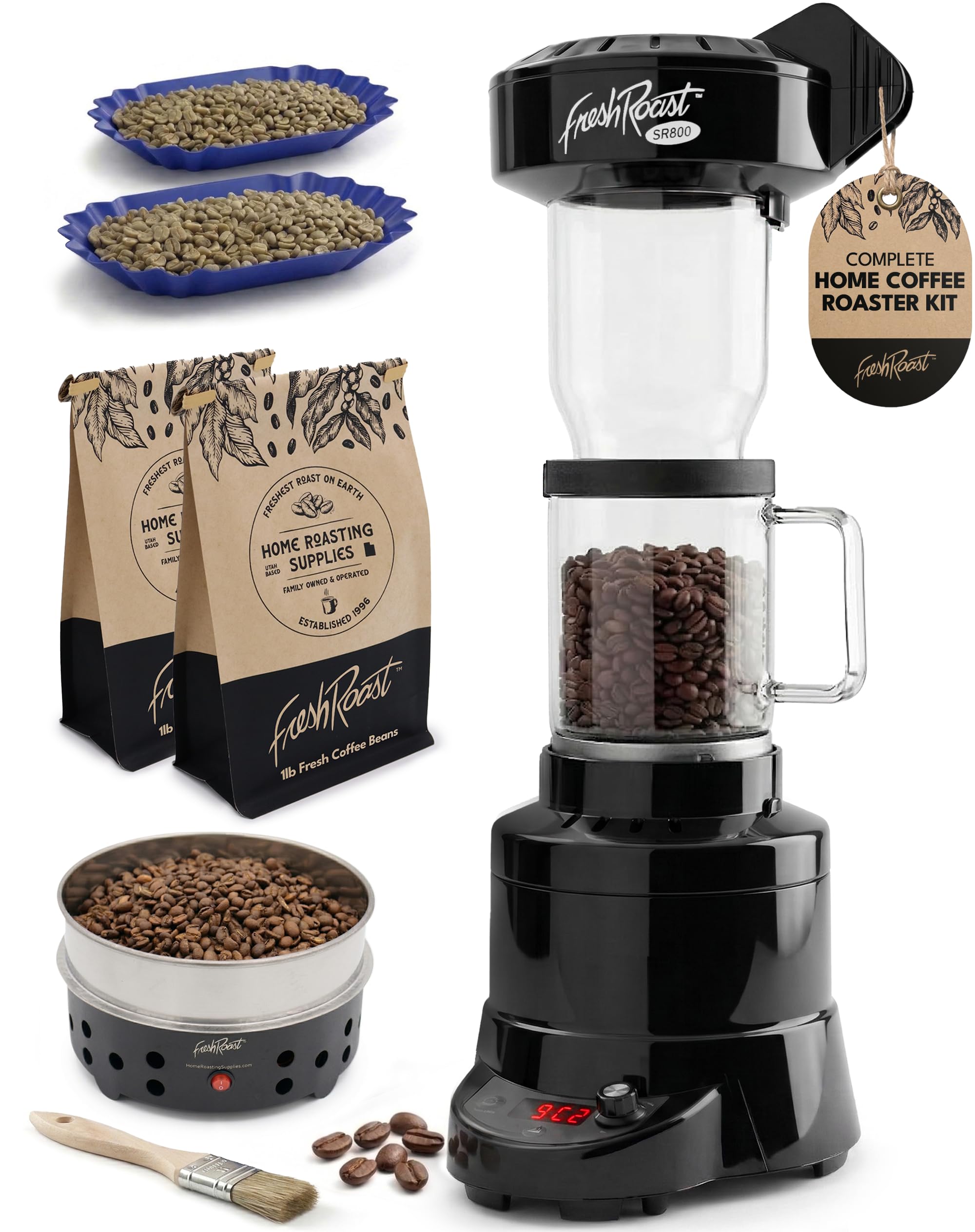
The SR800 bundle is engineered to eliminate the two biggest friction points for new roasters: learning curve and cooling lag. The fluid-bed convection system suspends 6 to 8 ounces of beans in hot air, ensuring every seed contacts the same temperature without scorching. The included glass extension tube improves bean lofting and heat distribution, which translates to more predictable first-crack timing across consecutive batches.
Where this kit truly differentiates itself is the dedicated bean cooler and the two one-pound sample packs of green coffee. The cooler drops bean temperature rapidly after the roast ends, locking in volatile aromatics that would otherwise degrade in a slow cool-down. Without a separate cooling tray, beans continue to cook internally and can move past your target roast level while sitting in the hot chamber.
Customer feedback over fifty-plus batches confirms that the SR800 delivers consistent roast quality batch after batch, with a small counter footprint and no complicated wiring. The one-year warranty on the base unit and six-month coverage on the top cap and chaff basket are standard for this price tier.
Why it’s great
- Complete all-in-one kit includes roaster, extension tube, cooler, and green bean samples
- Fluid-bed convection design eliminates hot spots and chaff burns
- Bean cooler preserves flavor by halting roasting instantly
Good to know
- Top cap and chaff basket can be slightly unstable when handling 8 oz loads
- Best results require watching the roast — no automatic shutoff
2. Fresh Roast SR800 Coffee Roaster (Base Unit)
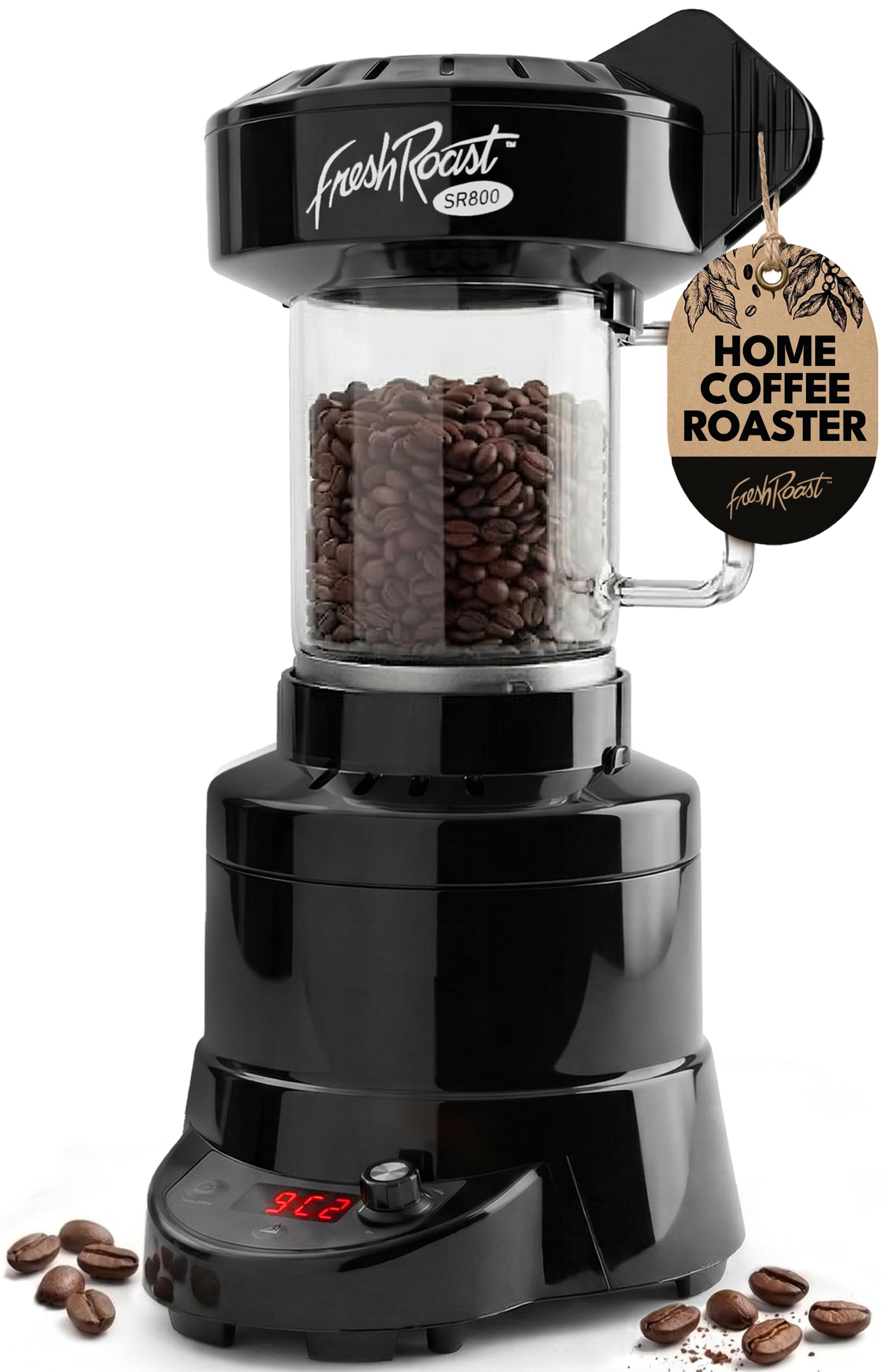
This standalone SR800 removes the cooling tray and extension tube to keep the entry price lower while retaining the same nine-level power settings and real-time temperature display that define the Fresh Roast platform. The fluid-bed motor and heating element are calibrated for batches between 6 and 8 ounces, with a speed-roast cycle that finishes in under ten minutes.
The nine fan-and-heat combinations give you granular control over the rate of rise — critical for developing caramelization without tipping into smoky bitterness. Experienced roasters use the lowest power settings during the drying phase and ramp up through the Maillard reaction before backing off at first crack. The clear glass roasting chamber lets you track color change and bean movement without removing the lid.
Fresh Roast is a US-based company that stands behind its warranty policy, covering the base unit for one full year and the roasting chamber components for six months. Note that warranty coverage is void if the roaster is shipped outside the United States, which limits international buyers.
Why it’s great
- Nine discrete power levels allow fine-grained rate-of-rise control
- Roasts 6–8 oz in under ten minutes with consistent convection heat
- Transparent glass chamber provides clear visual bean tracking
Good to know
- No cooling tray included — beans must be dumped into a separate colander
- Warranty only honored within the United States
3. MAGO MAGA Roma Pro Smart Home Coffee Bean Roaster
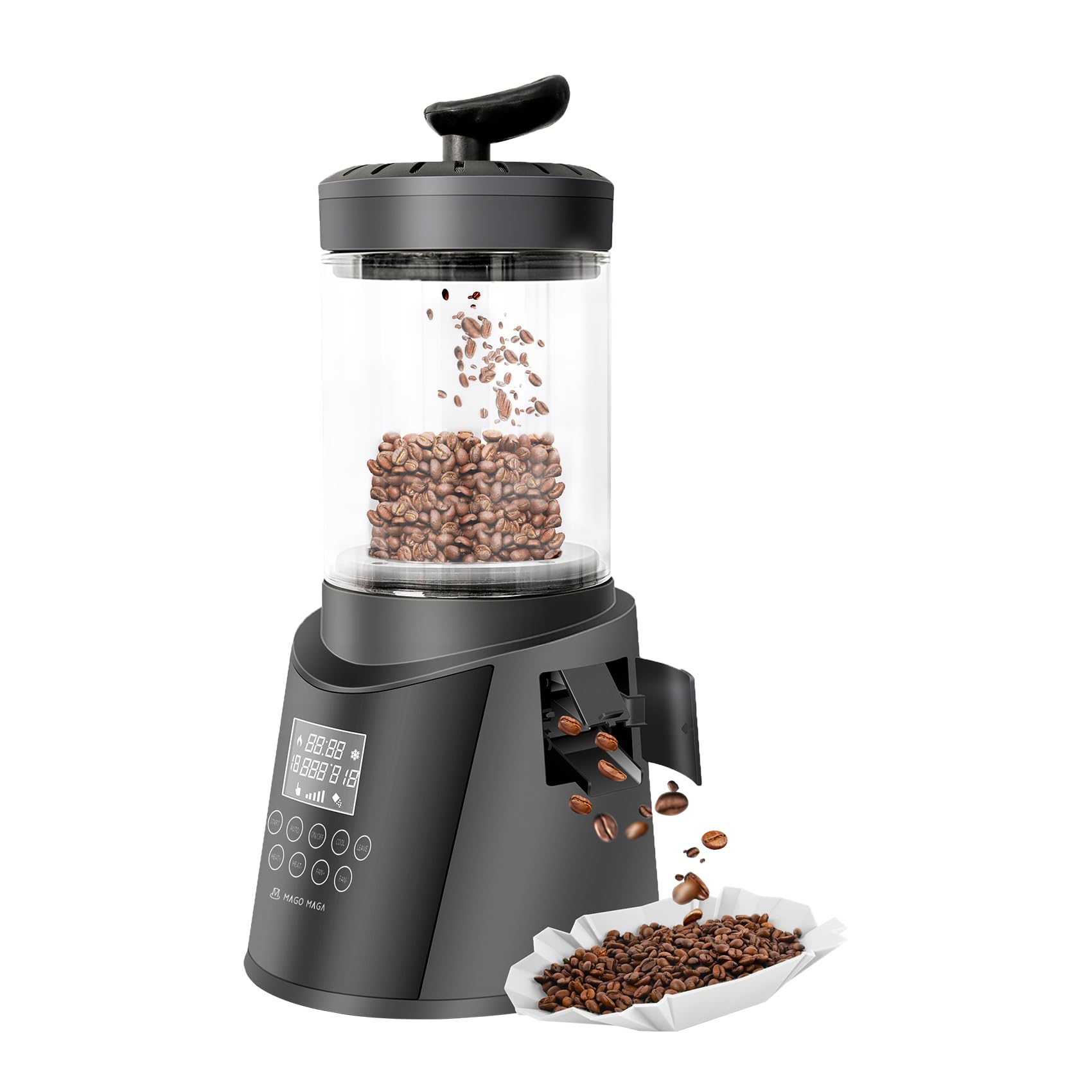
The Roma Pro targets the indoor roaster who prioritizes smoke management above all else. Its hot-air system routes exhaust through an efficient chaff collector that captures the papery silverskin before it can float around the kitchen. The ultra-low smoke claim is backed by CE and ETL certifications, meaning the electrical and filtration components have undergone independent safety and performance testing.
Two operational modes accommodate different skill levels. Auto mode runs a pre-programmed roast curve suitable for most regular green coffee beans, while manual mode unlocks temperature and time adjustments for decaf or experimental profiles. The double-layer glass viewing window stays cool enough to watch bean color development up close, and the auto-cooling function engages automatically when the roast cycle ends to prevent over-development.
At 300 grams per batch, this roaster sits in the sweet spot for daily home consumption. The version 1.5 upgrade addressed a bean bin door switch reliability issue noted in earlier units, and the ability to toggle between Celsius and Fahrenheit on the digital display makes it accessible regardless of your measurement standard.
Why it’s great
- ETL-certified low-smoke design with efficient chaff collection
- Auto and manual modes with clear digital temperature display
- Auto-cooling stops the roast immediately for flavor preservation
Good to know
- 300g capacity may feel limited if roasting for several people
- Decaf beans perform better in manual mode, not auto
4. Precision 1 Pound Electric Coffee Roaster (PKF-500)
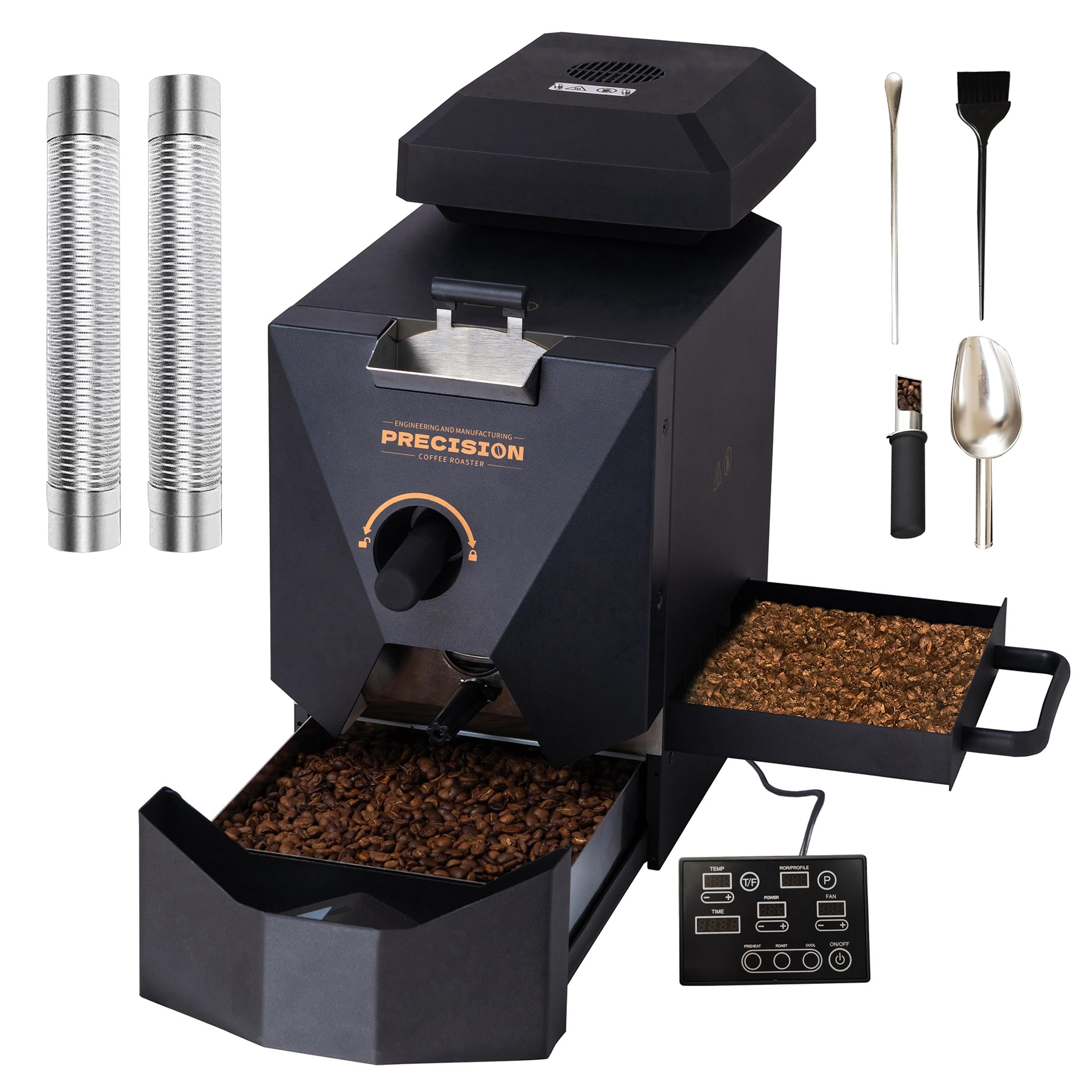
This roaster collapses three operation modes — automatic, assisted, and manual — into a single stainless steel drum platform. The automatic mode handles the full cycle from drying to first crack with a touchscreen interface, while assisted mode lets you override specific temperature intervals mid-cycle. Manual mode hands full authority to the user, which is ideal for those who have developed their own roasting profiles over years of practice.
A built-in smoke filter and vent pipe allow indoor operation without triggering smoke alarms, though reviewers note that medium and dark roasts still generate enough smoke to warrant window placement of the vent tube. The observation window and included sample spoon let you extract beans mid-roast for color checks without releasing all the heat from the drum.
The PKF-500 has a 1-pound capacity but users report that the most consistent results come from batches around 12 to 14 ounces. Some long-term reviewers experienced issues with moisture condensing on the circuit board after multiple consecutive roasts, which could affect the control panel responsiveness over time.
Why it’s great
- Three distinct modes (auto, assisted, manual) cover all skill levels
- Smoke filter and vent pipe keep indoor air quality manageable
- Observation window and sample spoon enable real-time bean monitoring
Good to know
- Moisture condensation near the circuit board was reported in extended use
- USB-based control panel means a single point of failure if damaged
5. NIASIA PKF-500g Automatic Coffee Roaster Machine

The NIASIA PKF-500g is structured around a stainless steel drum that can hold up to 500 grams of green beans, with a recommended sweet spot of 350 to 400 grams per batch. Nine built-in roasting profiles cover light, medium, and dark roasts, as well as profiles calibrated for sun-dried, washed, and honey-processed beans. Selecting a profile code automates the entire temperature curve, which removes guesswork for new users while still allowing manual fan speed override.
This machine ships with two smoke exhaust solutions: a smoke purifier suitable for light roasts, and two aluminum alloy smoke pipes for venting medium and dark roasts outdoors. The separate high-speed cooling tray is a smart inclusion — without it, residual drum heat would continue cooking the beans after the cycle ends. The precise temperature probe monitors drum air temperature rather than bean mass temperature, so understanding that offset is important when replicating profiles from other roasters.
NIASIA recommends using defect-free green beans because broken or uneven seeds can jam the drum rotation. The manual mode requires airflow to stay at a minimum of 60 throughout the roast, increasing to 90–100 after first crack, which gives experienced users a clear benchmark.
Why it’s great
- Nine application-specific roasting profiles cover multiple bean types
- Dual smoke management: purifier for light roasts, pipes for dark roasts
- Separate cooling tray stops the roast instantly for flavor retention
Good to know
- Maximum capacity of 500g, with best results at 350–400g
- Defective green beans can jam the drum mechanism
6. DYVEE KAKA G400 Gas Burner Coffee Roaster

The KAKA G400 is a gas-fired drum roaster built around a quartz glass drum that provides 360-degree visibility of the bean mass. Unlike opaque metal drums, the quartz wall lets you see exactly when the beans begin to yellow, when the first crack starts, and when the silverskin releases. This visual feedback is particularly valuable for beginners learning to correlate bean color with internal temperature progression.
The frame is made from 304 stainless steel with a wooden handle, and the 12-volt motor operates on a low-voltage adapter for safety near a gas burner. Maximum capacity is 400 grams, though the manufacturer recommends 200 to 300 grams per batch for even roasting. The gas burner adjustment gives you instantaneous heat control, which is different from electric heating elements that lag when you change the setting.
This machine also doubles as a peanut and nut roaster, which adds versatility if you want to use the equipment for more than coffee. The included funnel and instruction manual make the initial setup straightforward, but be aware that gas roasting requires a well-ventilated area and a stable burner base.
Why it’s great
- Quartz glass drum provides full visual access to bean color changes
- Gas burner heat responds instantly to adjustments
- Low-voltage 12V motor adds safety around open flame
Good to know
- Requires a separate gas burner — not a self-contained unit
- Recommended batch size of 200–300g is smaller than max capacity suggests
7. ICZW 14.5L Coffee Bean Roaster Drum

This drum-type roaster is scaled for volume, with a 14.5-liter capacity that handles 3.5 to 4.0 kilograms of green beans per batch. The stainless steel construction and external motor design make cleaning and maintenance straightforward, and the included thermometer lets you track drum temperature as the roast progresses. Cooling holes and double baffles inside the drum promote even seed tumbling, which is critical when dealing with dense loads that could otherwise trap heat in the center of the mass.
The unit sits on top of a gas stove, so it requires an existing burner and a well-ventilated kitchen. The S-hook and shovel included in the package assist with sample removal mid-roast. Because this machine is intended for both home and commercial use, the external motor placement means you can replace or service the motor without disassembling the entire drum assembly.
At this capacity, you are roasting enough coffee to supply a small office or a weekly farmers market stand. The batch size change will require you to recalibrate your temperature curve compared to smaller roasters — higher thermal mass means the drum heats up more slowly and retains heat longer between batches.
Why it’s great
- Massive 14.5L drum handles 3.5–4.0 kg per batch for high throughput
- External motor simplifies maintenance and replacement
- Cooling holes and double baffles improve heat distribution
Good to know
- Requires a gas stove and does not include its own heat source
- Drum thermal mass slows heat-up compared to smaller units
8. Sandbox Smart R1 Home Coffee Roaster

The Sandbox Smart R1 brings app-controlled roasting to the home counter. The machine itself is a direct-fire drum that roasts 100 to 150 grams per batch in roughly 15 minutes, and the accompanying smartphone app stores your roast profiles automatically. The app comes preloaded with 16 roasting curves spanning light to dark profiles, plus community-shared recipes and a personal roast history that lets you refine your approach over successive batches.
Chaff management is a standout feature here: a dedicated drawer collects silverskin during the roast, preventing the papery flakes from drifting into the air. The cooling tray also serves as a chaff removal station, pulling remaining silverskin off the finished beans. Users who live in apartments have noted that this design nearly eliminates airborne chaff compared to fluid-bed roasters that vent chaff through a top basket.
Manual mode unlocks adjustable power and fan speed for advanced users who want to control the rate of rise without relying on preloaded curves. However, some users have reported that the drum latch can loosen over time and the door alignment may require periodic adjustment. The roaster is entirely dependent on the app for full functionality — if the app loses support or your phone becomes incompatible, you lose access to stored profiles.
Why it’s great
- Chaff drawer and cooling tray capture silverskin and prevent airborne mess
- 16 preloaded roasting curves with automatic profile saving
- Manual mode gives experienced roasters full power and fan control
Good to know
- App dependency means lost functionality if the software platform changes
- Drum latch and door alignment may need periodic adjustment
9. Precision 1kg Commercial Electric Coffee Roaster
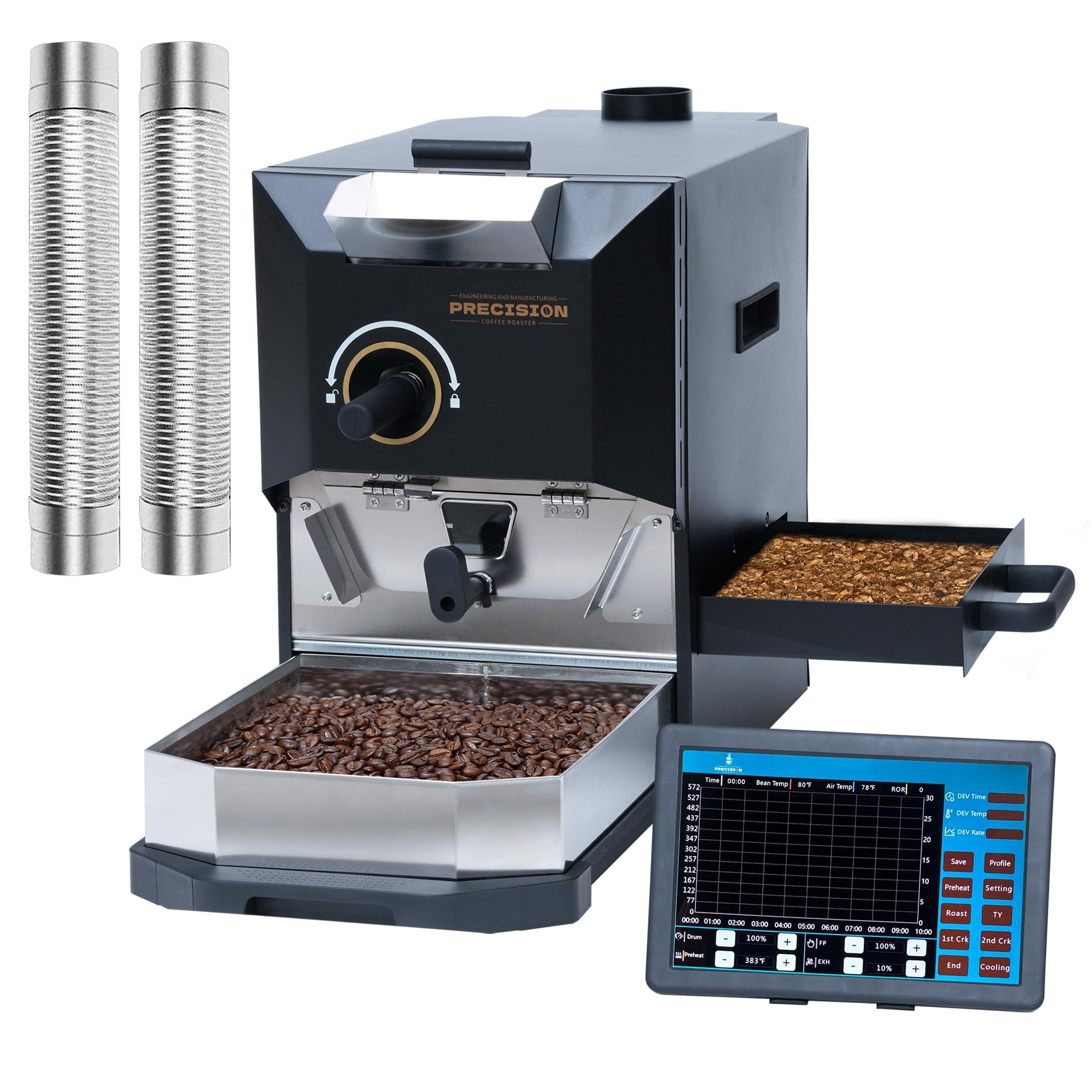
This 1-kilogram electric drum roaster is built for small businesses and serious home roasters who need commercial throughput without commercial square footage. The unit runs on 240V with a NEMA 6-15 plug and draws 2000W, delivering enough heat to sustain a daily output of up to 20 kilograms of green beans when running back-to-back batches. The upgraded bearing motor and siphon exhaust fan are designed to handle continuous operation without overheating.
The control system is the defining feature: a 10.1-inch HD LCD screen displays real-time temperature curves, and the machine is compatible with Artisan software for importing and exporting roast profiles. Ten automatic profiles are preloaded, but the open-access Artisan connection means you can download community curves or develop your own on a laptop and upload them directly to the machine. The full metal front panel resists high temperatures and adds structural rigidity.
At 70 pounds, this is not a countertop appliance that you move around freely. The stainless steel construction and microfilter are standard for commercial units, and the included stainless steel bowl aids with bean handling. Artisan software compatibility makes this the most flexible option for roasters who want to data-log every batch and replicate specific development time ratios with precision.
Why it’s great
- 1kg capacity with 20kg daily throughput for small commercial operations
- Artisan software compatibility for custom profile import and export
- 10.1-inch HD LCD screen provides real-time curve visualization
Good to know
- Requires a dedicated 240V NEMA 6-15 outlet
- Heavy 70-pound unit is not portable or counter-swappable
FAQ
What is the ideal batch size for a beginner using a fluid-bed roaster?
Can I roast coffee indoors without setting off a smoke alarm?
How does gas drum roasting differ from hot air roasting in flavor?
What does a chaff collector do and why is it important?
Do I need separate cooling equipment for home roasting?
Final Thoughts: The Verdict
For most users looking for the best coffee roasting equipment, the winner is the Fresh Roast SR800 Bundle because it combines a proven fluid-bed platform with a dedicated cooling tray and green bean samples — everything a serious home roaster needs to start producing consistent batches immediately. If you want precision app control with minimal airborne chaff, grab the Sandbox Smart R1. And for small business volume with professional software integration, nothing beats the Precision 1kg Commercial Roaster.