A chef’s knife under $100 is the single most debated purchase in any home kitchen. The market is flooded with options promising “German steel” and “Damascus layers,” but the real test is whether a blade can hold a sharp edge through a week of dicing onions, slicing tomatoes, and breaking down a whole chicken without needing a steel after every third cut. Price alone tells you nothing about that performance.
I’m Mohammad Maruf — the founder and writer behind AirfryerBite. I’ve spent the last three years analyzing the thermal and mechanical specs of budget to premium kitchen gear, cross-referencing customer failure rates against advertised hardness ratings and blade geometries for this exact price bracket.
After sifting through hundreds of reviews and technical schematics, I’ve narrowed the field to the nine knives that actually deliver on their promise. This guide breaks down each contender so you can buy with confidence and find the chef knife under $100 that matches your cutting style.
How To Choose The Best Chef Knife Under $100
The difference between a knife that frustrates you and one that makes prep a pleasure comes down to three things you can verify on the spec sheet: the steel type and its hardness rating, the blade construction method, and the ergonomics of the handle. Here is exactly what to look for.
Steel Type and Hardness Rating (HRC)
High-carbon stainless steel is the standard in this price bracket. Look for a Rockwell hardness rating between 58 and 62. A blade at 56 HRC will dull noticeably after a few days of heavy use and require frequent honing. Anything above 62 HRC under $100 is almost certainly a marketing claim or a trade-off in toughness — those blades can chip on a poly board. The sweet spot is 58-60 HRC for a home cook who wants a sharp edge that lasts without being brittle.
Forged vs. Stamped Construction
A forged blade starts as a single piece of steel that is heated and hammered into shape, producing a denser grain structure and a heavier, more balanced feel at the bolster. Stamped blades are cut from a sheet of steel — lighter and thinner, but perfectly adequate for fine slicing and utility work. In the sub-$100 range, forged blades are rare but exist (usually from Chinese or Japanese manufacturers). Stamped blades from Swiss brands like Victorinox are the most reliable proven option. Neither is “better” — it depends on whether you prefer heft for chopping or lightness for precision.
Handle Material and Full Tang Design
A full tang — where the steel runs the entire length of the handle — provides better balance and durability. Look for handles made from Pakkawood, G10 fiberglass, or textured Santoprene that remain grippy even with wet hands. Avoid handles that are fully polished stainless steel or smooth plastic; they force you to squeeze harder to maintain control, leading to fatigue and reduced accuracy over a long prep session. A good handle should let you hold the knife with a relaxed pinch grip and still feel secure.
Quick Comparison
On smaller screens, swipe sideways to see the full table.
| Model | Category | Best For | Key Spec | Amazon |
|---|---|---|---|---|
| Dalstrong Kiritsuke Chef Knife | Premium Kiritsuke | All-purpose precision with knuckle clearance | 8.5-inch, 56+ HRC, Forged German Steel | Amazon |
| KYOKU Shogun Series Chef Knife | Damascus VG-10 | Japanese-style thin slicing with edge retention | 8-inch, 58-60 HRC, VG-10 Core | Amazon |
| Victorinox Wood Chef’s Knife | Wood Handle | Traditional feel with Swiss blade reliability | 8-inch, Forged, Rosewood Handle | Amazon |
| HOSHANHO Chef Knife | Japanese High Carbon | Harder blade for lasting sharpness | 8-inch, 62 HRC, 10cr15 Core | Amazon |
| SCOLE 7-Piece Knife Set | Full Tang Set | Getting a complete knife set in one purchase | 8-inch Chef, 58±2 HRC, German Steel | Amazon |
| Victorinox Fibrox Pro Chef’s Knife | Stamped Utility | Everyday workhorse with reliable edge | 8-inch, High Carbon Stainless, Fibrox Grip | Amazon |
| ROCOCO Meat Cleaver Knife | Curved Cleaver | Effort-saving slicing through large cuts | 8.66-inch, 60±2 HRC, Hand-Forged | Amazon |
| howfrey Damascus Chef Knife | Damascus VG-10 | Entry-level Damascus with high edge retention | 8-inch, 62 HRC, VG-10 Core | Amazon |
| Mercer Culinary Millennia Chef’s Knife | Economy Workhorse | Budget entry without sacrificing sharpness | 8-inch, High Carbon Japanese Steel | Amazon |
In‑Depth Reviews
1. Dalstrong Kiritsuke Chef Knife – 8.5 inch – Gladiator Series Elite

The Dalstrong Gladiator Elite is a kiritsuke-profile chef knife that combines a tall blade with a flat edge and a slight curve at the tip, giving you knuckle clearance while maintaining the rocking motion needed for chopping herbs. The full-tang forged German high-carbon steel runs from tip to pommel, and the hand-polished edge at 14-16 degrees per side delivers a razor finish out of the box. At 56+ Rockwell, it is intentionally softer than some Japanese competitors, which makes it notably tougher and less prone to chipping if you accidentally scrape the board.
The black G10 handle is triple-riveted and fully sealed, resisting moisture absorption even after extended use. The knife comes with a fitted sheath and an NSF certification, signaling that the construction meets commercial sanitation standards. Some users report that the factory edge fades after a few weeks of heavy prep, but it responds quickly to a steel or ceramic rod. The blade height of roughly 51mm provides ample clearance for those with larger hands, and the satin finish resists food sticking better than a mirror-polished surface.
If you are looking for a single do-everything knife that feels weighty and balanced without crossing into premium pricing, the Dalstrong kiritsuke is the strongest contender. The included sheath and the brand’s money-back guarantee reduce the risk of buying blind. The edge angle is aggressive enough for fine slicing yet durable enough for rough chopping, making this the most versatile shape in the sub-$100 category.
Why it’s great
- Tall blade provides excellent knuckle clearance for comfortable prep
- Full-tang G10 handle is moisture-resistant and feels solid over long sessions
- Included sheath and NSF certification add professional-grade confidence
Good to know
- Factory edge may dull sooner than some 60-HRC Japanese knives
- Kiritsuke profile has a flatter curve, which changes your rock-chopping technique slightly
2. KYOKU Chef Knife – 8″ Shogun Series

The Kyoku Shogun Series features a 67-layer Damascus blade with a VG-10 stainless steel core, cryogenically treated for additional hardness and edge stability. The 8-inch blade is sharpened to an 8-12 degree edge using the traditional Honbazuke method, which is noticeably more acute than most Western knives. The result is a blade that glides through tomato skin and raw fish with minimal resistance. The HRC rating of 58-60 sits at the practical upper limit for a home kitchen knife — hard enough to hold a fine edge for weeks, but not so hard that it becomes brittle on a poly board.
The handle is constructed from fiberglass with a mosaic pin, providing resistance to thermal expansion and moisture. The included sheath and storage case protect the edge when not in use. The hammered finish on the blade reduces drag and helps food release during slicing, although sticky items like potatoes still need a quick wipe. The knife is distinctly lighter than a German-style forged blade, which makes it ideal for push-cutting and thin slicing rather than heavy rock-chopping through root vegetables.
If you prefer a Japanese-style gyuto profile with a hard steel core that takes a screaming edge and holds it, the Kyoku Shogun is a strong option in the mid-range. The cryo treatment at this price point is unusual and reduces internal stresses in the steel, which translates to better edge stability over time. Just be mindful that the acute edge requires a ceramic rod rather than a standard honing steel for maintenance.
Why it’s great
- Cryo-treated VG-10 core delivers exceptional edge retention for the price
- Hammered finish reduces sticking during slicing tasks
- Comes with both a sheath and a storage case for edge protection
Good to know
- 8-12 degree edge is extremely sharp but easier to chip on hard surfaces
- Lighter weight may feel unbalanced for cooks accustomed to German-style heft
3. Victorinox Wood 8 Inch Chef’s Knife

Victorinox brings its Swiss forging heritage to this rosewood-handled chef’s knife, which shares the same steel composition as the famous Fibrox Pro but replaces the synthetic grip with a fully polished wood handle. The 8-inch blade is stamped from high-carbon stainless steel and given a precision edge that is laser-tested for consistency. The wood handle is ergonomically shaped and secured with three brass rivets, giving it the look and heft of a traditional European chef’s knife.
The blade geometry is slightly thinner than a fully forged knife, which makes it nimble for slicing and dicing but less suited for heavy chopping through dense squash. The rosewood is sealed to resist moisture, but it is not dishwasher safe and should be hand-dried immediately to prevent the wood from cracking over time. The edge retention is typical of Victorinox — good but not exceptional, requiring a quick pass on a steel before each use to keep it razor sharp.
For cooks who appreciate the timeless feel of a wood handle and want the reliability of a Swiss-made blade, this Victorinox offers a balanced middle ground. The fit and finish are consistent, and the blade profile is a true 8-inch curve that supports a comfortable rock chop. It is the most aesthetically refined option from Victorinox and holds its edge slightly better than the Fibrox thanks to the heat treatment applied during the forging process.
Why it’s great
- Rosewood handle with brass rivets offers classic looks and comfortable grip
- Laser-tested blade ensures a consistent, sharp edge out of the box
- Swiss heat treatment delivers reliable edge performance for daily use
Good to know
- Wood handle requires careful hand washing and drying to prevent damage
- Thinner blade is less effective for heavy chopping through hard vegetables
4. HOSHANHO Chef Knife 8 Inch
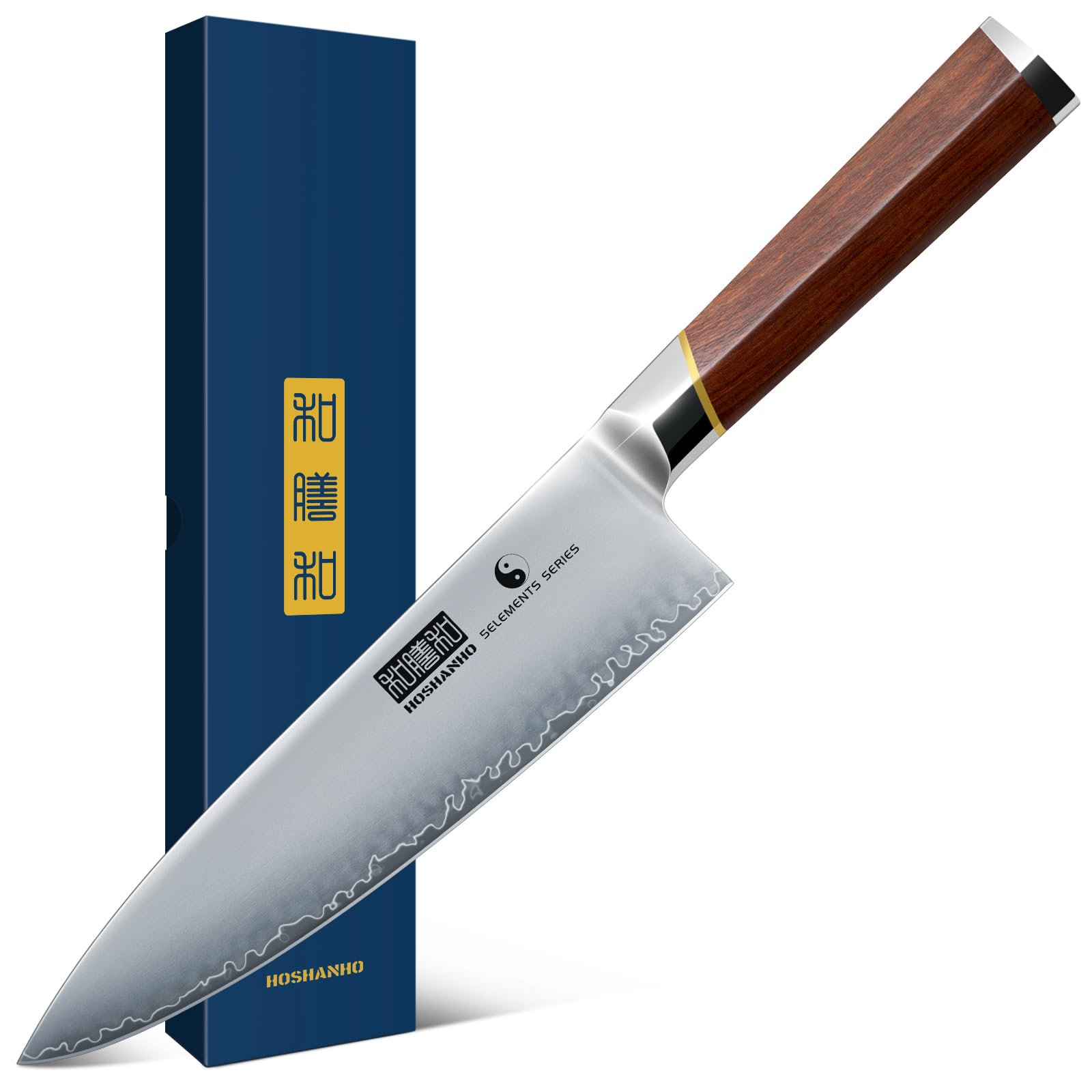
The HOSHANHO chef knife uses a 10cr15 high-carbon stainless steel core through vacuum heat treatment, achieving a hardness of 62 HRC — the highest of any knife in this roundup. The 15-degree double-bevel edge is hand-polished on both sides, giving it a balanced sharpness that works equally well for right and left-handed users. The blade surface is sandblasted to create a matte texture that reduces food adhesion during slicing, which is a practical improvement over mirror-polished blades.
The handle is made from natural red sandalwood, chosen for its high density and natural oil content that resists cracking and moisture absorption. The ergonomic profile is slightly bulbous at the rear and tapers toward the blade, promoting a pinch grip that keeps your index finger and thumb securely on the steel. At roughly 12.3 ounces, the knife feels substantial but not fatiguing, and the weight distribution is blade-forward, aiding in a natural chopping motion.
This knife is best for cooks who want a hard Japanese-style blade that stays sharp longer between sharpenings. The 62 HRC steel will hold a fine edge for extended periods, but it also means the edge is less tolerant of twisting motions on the board or contact with hard surfaces like ceramic plates. The included packaging is simple, but the quality of the fit and finish at this price is excellent. It is a strong choice for precise slicing and detailed prep work.
Why it’s great
- 62 HRC hardness provides long-lasting edge retention without frequent honing
- Sandblasted blade finish prevents food from sticking during slicing
- Natural red sandalwood handle is dense, moisture-resistant, and ergonomically shaped
Good to know
- Higher hardness means the edge is more brittle and can chip if used carelessly
- Blade-forward weight may feel unbalanced for cooks who prefer handle-heavy knives
5. SCOLE Chef Knife Ultra Sharp 7-Piece Set

The SCOLE 7-piece set includes an 8-inch chef knife, an 8-inch slicing knife, an 8-inch bread knife, a 5-inch santoku, a 5.5-inch serrated utility knife, a 5-inch utility knife, and a 3.5-inch paring knife, covering every cutting task in the average home kitchen. The blades are made from German 1.4116 stainless steel with a Rockwell hardness of 58±2, a well-proven balance of sharpness and toughness. The full-tang construction extends through the ABS triple-riveted handle, giving each knife a solid, balanced feel that you normally expect from individually sold knives at a higher price.
The hand-polished edge at 14 degrees per side is sharp enough for precise vegetable work straight from the box. The handles are designed with a slight curve at the bolster to encourage a safe pinch grip, and the triple rivets provide visual structure without creating pressure points. The set comes in a fitted gift box, making it an appealing package for someone starting a new kitchen. The bread knife has a scalloped serration that cuts through crusty loaves without crushing the crumb, and the paring knife holds a good edge for small veggie prep.
If you need a full set of kitchen knives and want to avoid the hassle of buying them one at a time, the SCOLE set provides excellent coverage. The German 1.4116 steel is stain-resistant and easy to sharpen, and the full-tang handles feel more substantial than most budget sets. The knives are dishwasher safe, but hand washing will preserve the edge geometry longer. The chef knife alone performs well enough to justify the purchase, and the rest of the set is a genuine bonus.
Why it’s great
- Seven-piece set covers all essential knife types in one purchase
- Full-tang German 1.4116 steel with 58 HRC offers a reliable balance of hardness and toughness
- Hand-polished 14-degree edge provides excellent sharpness out of the box
Good to know
- ABS handles lack the warmth of natural wood or G10 materials
- Some customers report the edge needs touching up after a month of heavy use
6. Victorinox Fibrox Pro Chef’s Knife, 8 Inch
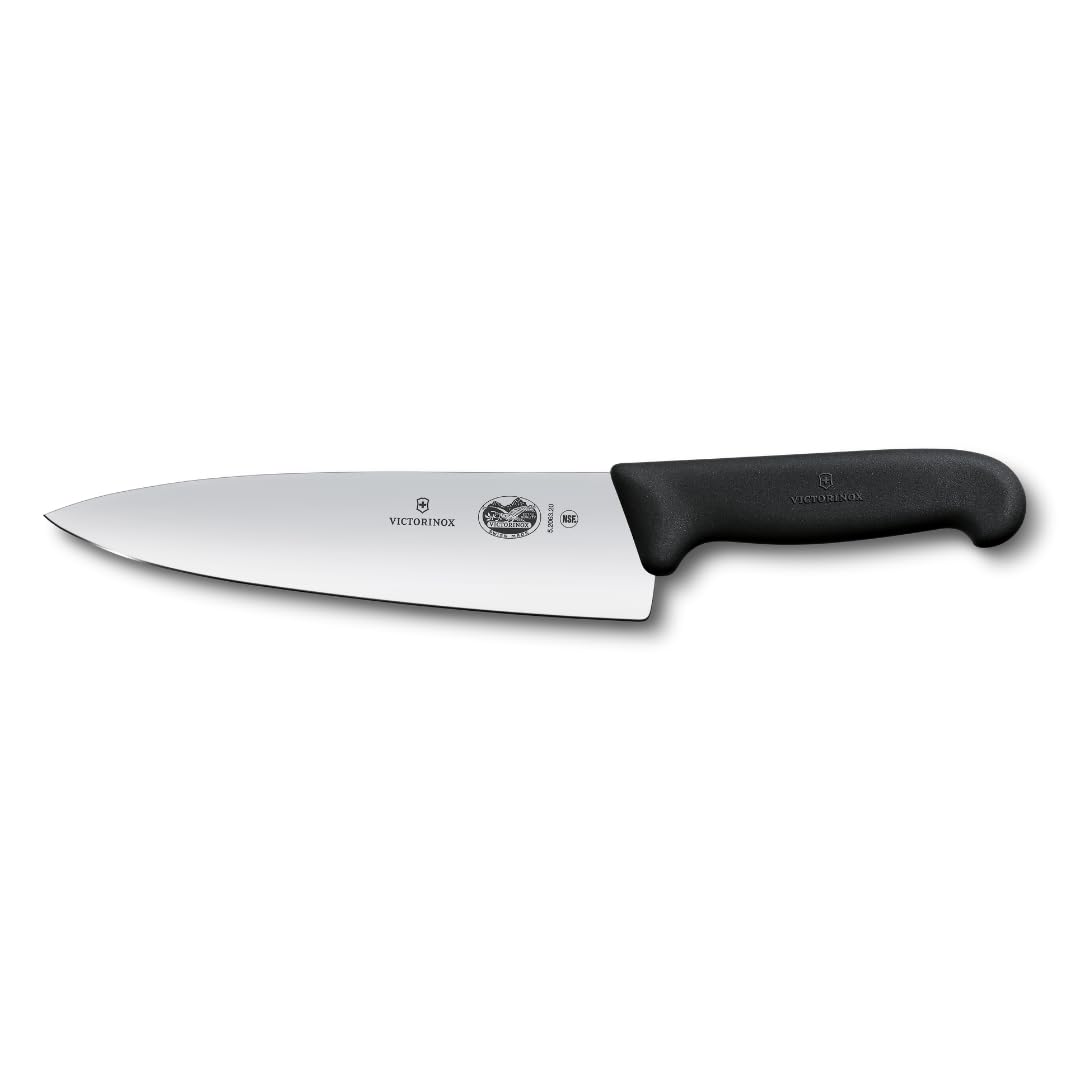
The Victorinox Fibrox Pro is arguably the most reviewed and recommended chef’s knife under $100 in the world. The 8-inch blade is stamped from high-carbon stainless steel, then laser-tested for a consistent edge. The Fibrox handle is made from thermoplastic elastomer (TPE) with a textured surface that remains grippy even when your hands are slick with oil or water. The handle is not the prettiest, but its function is flawless — it provides a secure hold without needing extra grip force.
The blade profile is a classic European curve that supports a fluid rock chop for mincing garlic or herbs. The edge is sharp enough out of the box to slice a ripe tomato without compressing it. What makes this knife stand out is its consistency: Victorinox has been making this same model for years, and the heat treatment and edge geometry are identical batch after batch. The knife is also dishwasher safe, though I recommend hand washing to avoid the blade banging against other utensils.
For a first chef knife or a backup that you can abuse without guilt, the Fibrox Pro is the safest recommendation. It does not look fancy, it will not stay sharp as long as a 62-HRC Japanese blade, but it will perform every kitchen task reliably for years. The lifetime warranty against defects adds peace of mind. If you want a knife that simply works and never surprises you, this is the one to buy.
Why it’s great
- TPE Fibrox handle provides exceptional non-slip grip even when wet or oily
- Laser-tested blade delivers consistent sharpness across every unit
- Dishwasher safe for easy cleaning, backed by a lifetime warranty
Good to know
- Stamped blade lacks the weight and balance of a forged knife
- Edge dulls faster than harder steel options and requires frequent honing
7. ROCOCO Meat Cleaver Knife
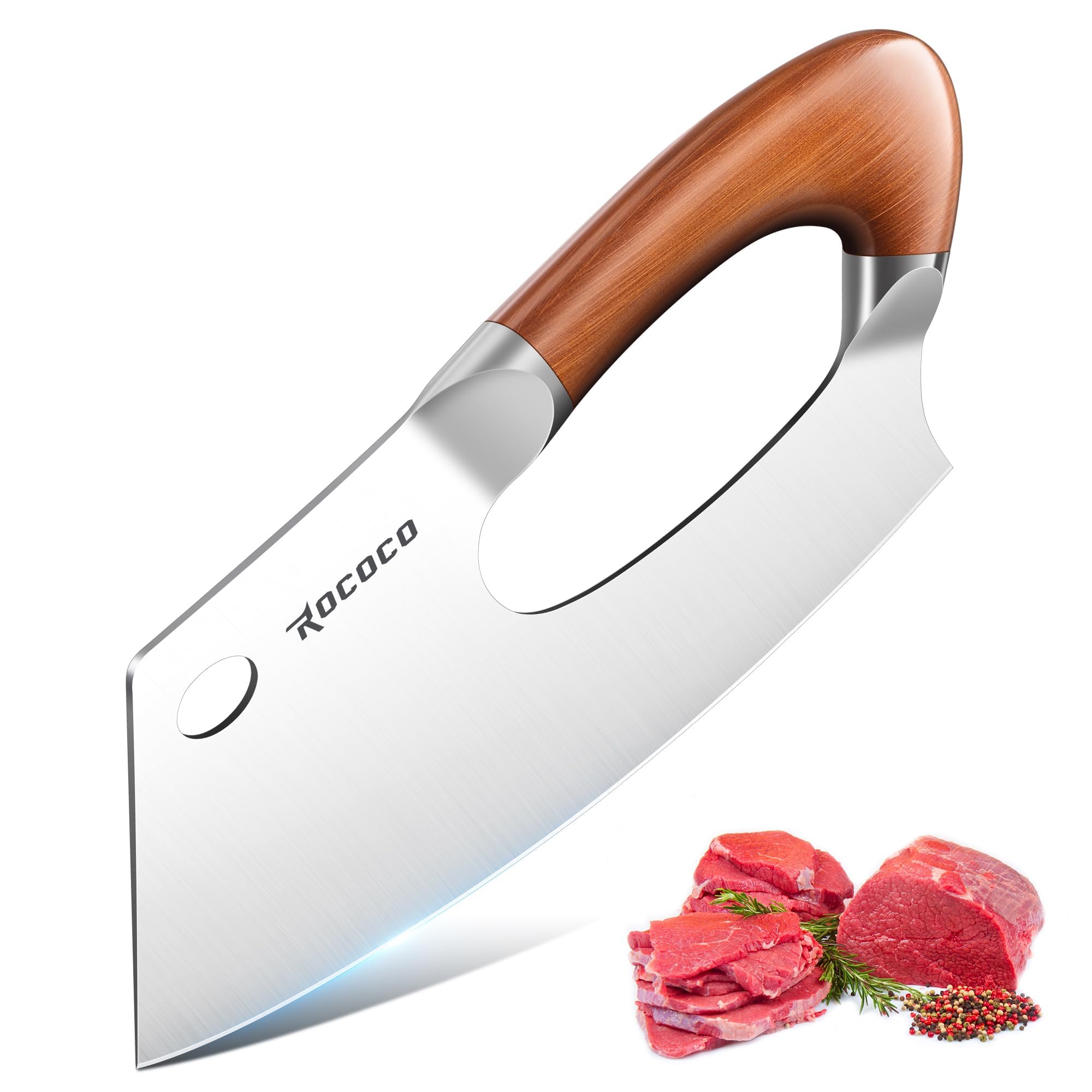
The ROCOCO cleaver has a distinctively upcurved bronze handle that shifts the center of gravity forward, which the brand claims reduces the force needed for slicing. The 8.66-inch blade is hand-forged from stainless steel with a hardness rating of 60±2 HRC and a hand-polished 15-degree V-shaped edge. The curved profile of the blade is designed to minimize cutting resistance — the blade rocks through food rather than chopping straight down, which reduces the crushing of delicate fruits or meat fibers.
The stainless steel handle is seamlessly integrated into the blade with no visible joint, creating a one-piece structure that is easy to clean and completely sanitary. The bronze coloring comes from a surface treatment rather than actual bronze, but the finish holds up well to regular washing. The knife is not intended for bone chopping — it is a cleaver in shape only, designed for slicing meats and vegetables with minimal effort. The included finger hole in the handle allows you to hang the knife for storage, but the lack of a sheath in the box is a notable omission given the sharpness of the edge.
If you have wrist or hand fatigue from standard chef knives and want a shape that changes the leverage mechanics, the ROCOCO cleaver is worth considering. The forward-curved handle forces your hand into a more neutral position, reducing strain during extended prep sessions. The steel is hard enough for good edge retention, and the blade geometry makes it particularly effective for slicing through large cuts of protein.
Why it’s great
- Upcurved handle reduces wrist strain by changing the force angle
- Hand-forged 60-HRC stainless steel delivers sharp edges with good retention
- Seamless one-piece construction is easy to clean and fully sanitary
Good to know
- No sheath included, which is a safety concern for such a sharp blade
- Not designed for chopping through bones or hard squash
8. howfrey Damascus Chef Knife 8 Inch
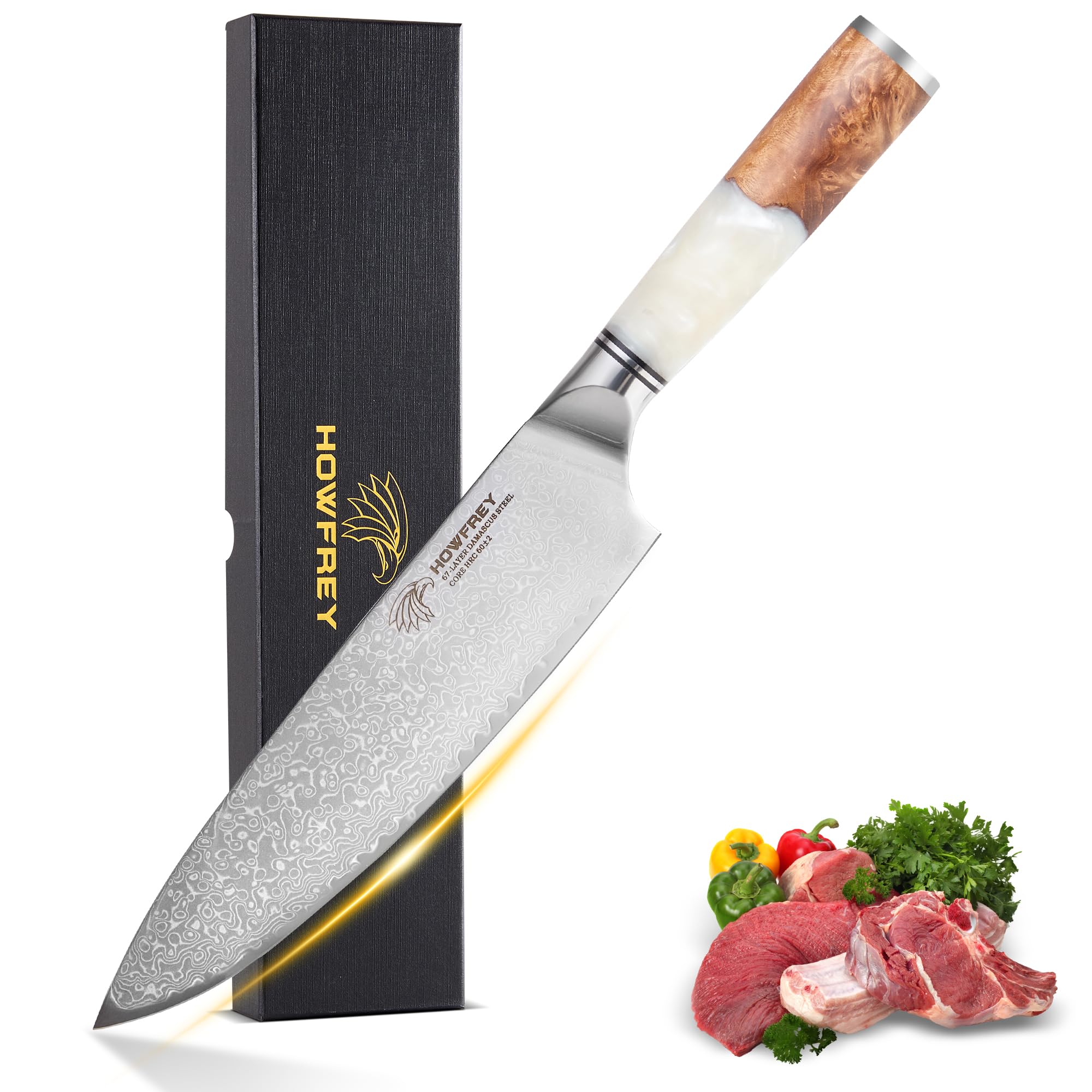
The howfrey Damascus chef knife uses a VG-10 cutting core wrapped in 67 layers of high-carbon stainless steel, achieving a Rockwell hardness of 62. The 15-degree hand-polished edge on each side creates a blade that is exceptionally sharp and capable of push-cutting through paper-thin slices of tomato or raw fish. The octagonal Pakkawood handle is made from wenge wood, a dense tropical hardwood that naturally resists moisture and provides a warm, textured grip that becomes more comfortable as your hand warms up.
The damascus pattern is visually striking, and the blade thickness of 2.0 mm at the spine keeps the knife light and nimble for precise work. The included sheath protects the edge during storage. Some users have noted that the blade profile is slightly more curved than a classic gyuto, which makes it better suited for rock chopping than for straight push cuts. The handle is shorter than average at 5.2 inches, which may feel cramped for cooks with larger hands.
At this price point, getting a VG-10 core with 62 HRC and a layered Damascus finish is excellent value. The knife performs well above its cost in terms of sharpness and edge retention, though the fit and finish on the handle may show minor inconsistencies. If you want a budget-friendly way to experience a high-hardness Japanese-style blade with the visual appeal of Damascus, the howfrey is a compelling option.
Why it’s great
- VG-10 core with 62 HRC provides exceptional edge retention
- 67-layer Damascus finish is visually striking and resistant to rust
- Included sheath protects the edge during storage
Good to know
- Handle is relatively short at 5.2 inches, which may not suit larger hands
- Minor fit-and-finish inconsistencies around the handle bolster have been reported
9. Mercer Culinary M22608RD Millennia Chef’s Knife, 8 Inch
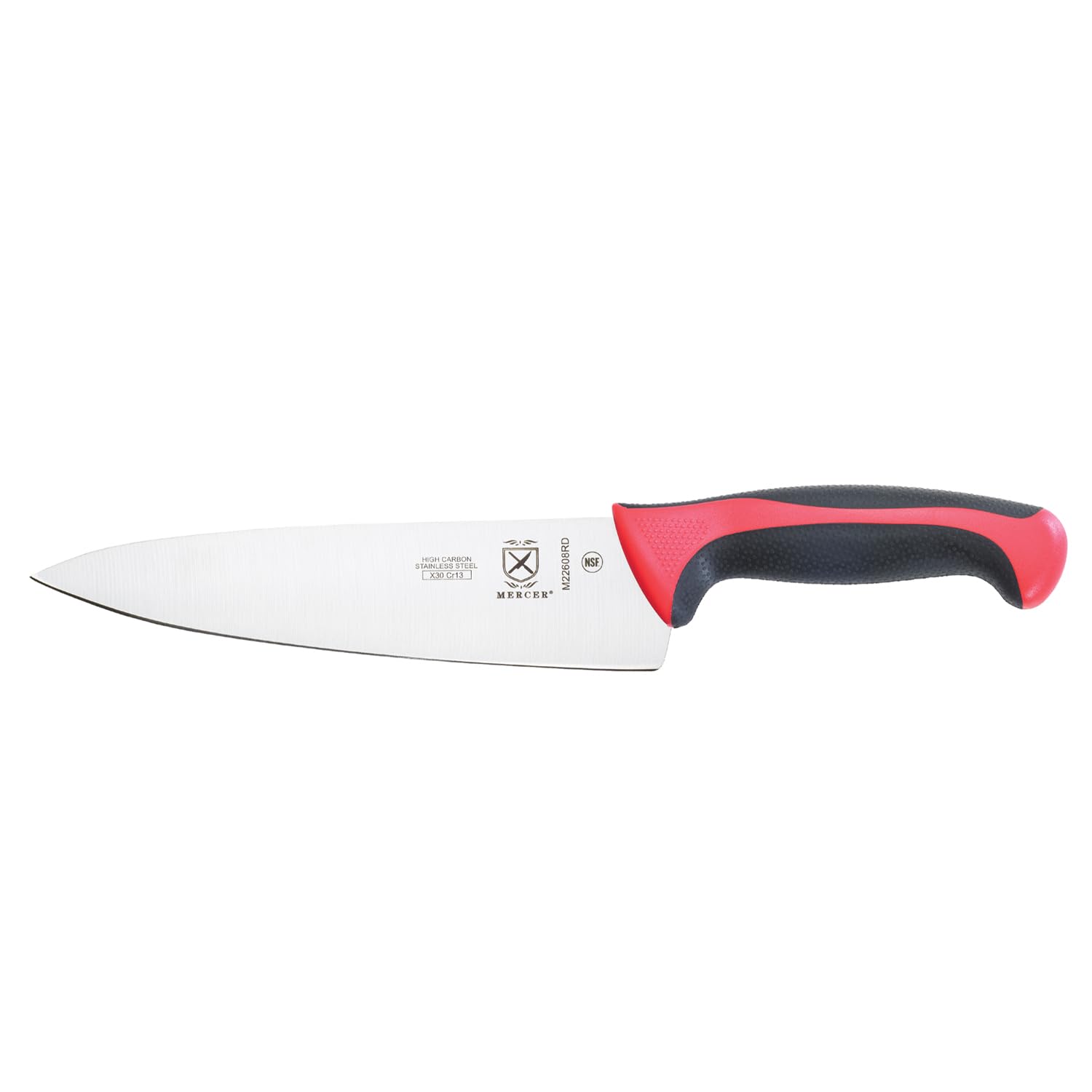
The Mercer Culinary Millennia is a staple in culinary school kit bags because it offers reliable performance at a price that makes replacing it painless. The 8-inch blade is stamped from one-piece high-carbon Japanese steel, and while the exact HRC rating is not advertised, the edge takes a sharp finish and holds it reasonably well for a stamped blade. The Santoprene handle is textured with finger points that guide your hand into a secure grip without slipping, even when wet.
The blade is thin and flexible enough for fine slicing but still rigid enough for general-purpose chopping. The knife is lightweight at 6.4 ounces, which reduces fatigue during long prep sessions but also means it lacks the forward weight that aids in chopping hard vegetables. The color-coded handle (red in this case) helps prevent cross-contamination if you use multiple knives for different proteins, though this is a bigger advantage in professional kitchens than in a home setting.
For cooks on a tight budget who still want a knife that performs well out of the box and is easy to maintain, the Mercer Millennia is the best entry-level option. The Japanese steel responds well to honing and sharpening, so you can keep it in good shape with basic tools. The handle texture is genuinely effective, and the overall build quality is consistent. It will not match a forged German blade in longevity, but it costs a fraction of the price and still delivers sharp, dependable cuts.
Why it’s great
- Lightweight 6.4-ounce design reduces arm fatigue during long prep sessions
- Textured Santoprene handle provides a secure non-slip grip
- Japanese high-carbon steel takes a sharp edge and responds well to honing
Good to know
- Stamped blade lacks the weight and balance of forged alternatives
- Edge dulls faster than higher-HRC knives and requires frequent touching up
FAQ
Is a higher HRC always better in a chef knife under $100?
Can I use a VG-10 core chef knife for chopping through chicken bones?
Does a fuller bolster mean a better forged knife under $100?
Final Thoughts: The Verdict
For most users, the chef knife under $100 winner is the Dalstrong Kiritsuke Chef Knife because it delivers a tall, versatile blade profile with a tough German steel core and a comfortable G10 handle, all backed by an NSF certification and a balanced weight that suits both rock chopping and push cutting. If you want a lighter Japanese-style blade with exceptional edge retention, grab the KYOKU Shogun Series. And for the safest, most reliable everyday workhorse that requires zero fuss, nothing beats the Victorinox Fibrox Pro.