You want real espresso at home, but the price tags on those pro machines have you questioning your life choices. The counter is small, the budget is tight, and the “cheap” options online look like they might just dispense hot brown water instead of a proper shot. You do not need to spend a small fortune to get a machine that delivers genuine crema, consistent pressure, and reliable steam. The real challenge is separating the actual espresso makers from the glorified drip machines hiding in the espresso aisle.
I’m Mohammad Maruf — the founder and writer behind AirfryerBite. I’ve spent years dissecting the hardware specs of budget espresso machines to find which components actually deliver at a low price point.
The market is saturated with machines promising 20 bars of pressure and café-quality foam, but only a handful deliver on that promise without breaking down. After analyzing nine of the most talked-options, I have built this final list of the best cheap espresso machine picks so you can buy with confidence, not guesswork.
How To Choose The Best Cheap Espresso Machine
A budget espresso machine that actually works comes down to three things: real pump pressure, thermal stability, and a steam wand that does not just puff air. Ignore the flashy numbers and look for what those components actually do inside the machine.
Pump Pressure vs. “Pump Pressure” on Paper
Most cheap machines claim 15 or 20 bars. What matters is whether the pump can sustain that pressure through the entire extraction, not just spike it at the start. Machines with a thermoblock and a dedicated vibration pump (common in this tier) will give you consistent pressure if the internal boiler is well-made. Look for machines with a pre-infusion function, which gradually ramps up pressure to avoid channeling.
Temperature Control Beyond the Thermometer
Water temperature should stay between 195°F and 205°F during the shot. Cheap machines often lose heat in the group head, causing sour or bitter shots. A PID controller or NTC sensor (like those found on the HIBREW or LERTIN models) is a huge advantage at this price. Without it, you are gambling on 50-degree temperature swings every shot.
The Steam Wand Is a Dealbreaker
A cheap machine with a pannarello wand (the plastic tube with a side hole) will not give you real microfoam. You need a stainless steel steam wand with a single hole tip for proper latte art texture. Machines like the CASABREWS 5418 PRO and the SHARDOR offer this, while others use the inferior pannarello attachment. If you drink cappuccinos or lattes, this is your most important filter.
Material Build and Longevity
Stainless steel boilers and portafilters survive heat cycles better than aluminum or chrome-plated brass in the long run. A machine with a stainless steel body and a brass or stainless steel brew group will last years longer than one with a plastic housing. Check the weight: a machine over 8 pounds typically has heavier, better internal components.
Quick Comparison
On smaller screens, swipe sideways to see the full table.
| Model | Category | Best For | Key Spec | Amazon |
|---|---|---|---|---|
| CASABREWS 5418 PRO | Premium | Barista-grade speed & microfoam | 3-second steam switching | Amazon |
| HIBREW H10B | Premium | Full control over temp & volume | 194-204°F adjustable temp | Amazon |
| SHARDOR 20-Bar | Mid-Range | Beginner-friendly with LCD display | Thermoblock heating 30 sec | Amazon |
| XIXUBX 20Bar (Silver) | Mid-Range | Quiet operation with pressure gauge | Stainless steel single-hole wand | Amazon |
| Neretva 15 Bar | Mid-Range | Pressure gauge + automatic relief valve | Pre-infusion & OPV system | Amazon |
| Chefman CraftBrew | Mid-Range | Lungo/ristretto shot customization | 15-bar pump, 1350W heat | Amazon |
| LERTIN 20 Bar | Mid-Range | Fast 16-second preheat + HD touch | HD screen, 16-second preheat | Amazon |
| AMZCHEF 20 Bar | Budget | Family-sized 44oz tank, touch screen | 1350W, 30-sec preheat | Amazon |
| XIXUBX 20 Bar (White) | Budget | Compact PID-controlled entry model | PID controller, 20-bar pump | Amazon |
In‑Depth Reviews
1. CASABREWS 5418 PRO
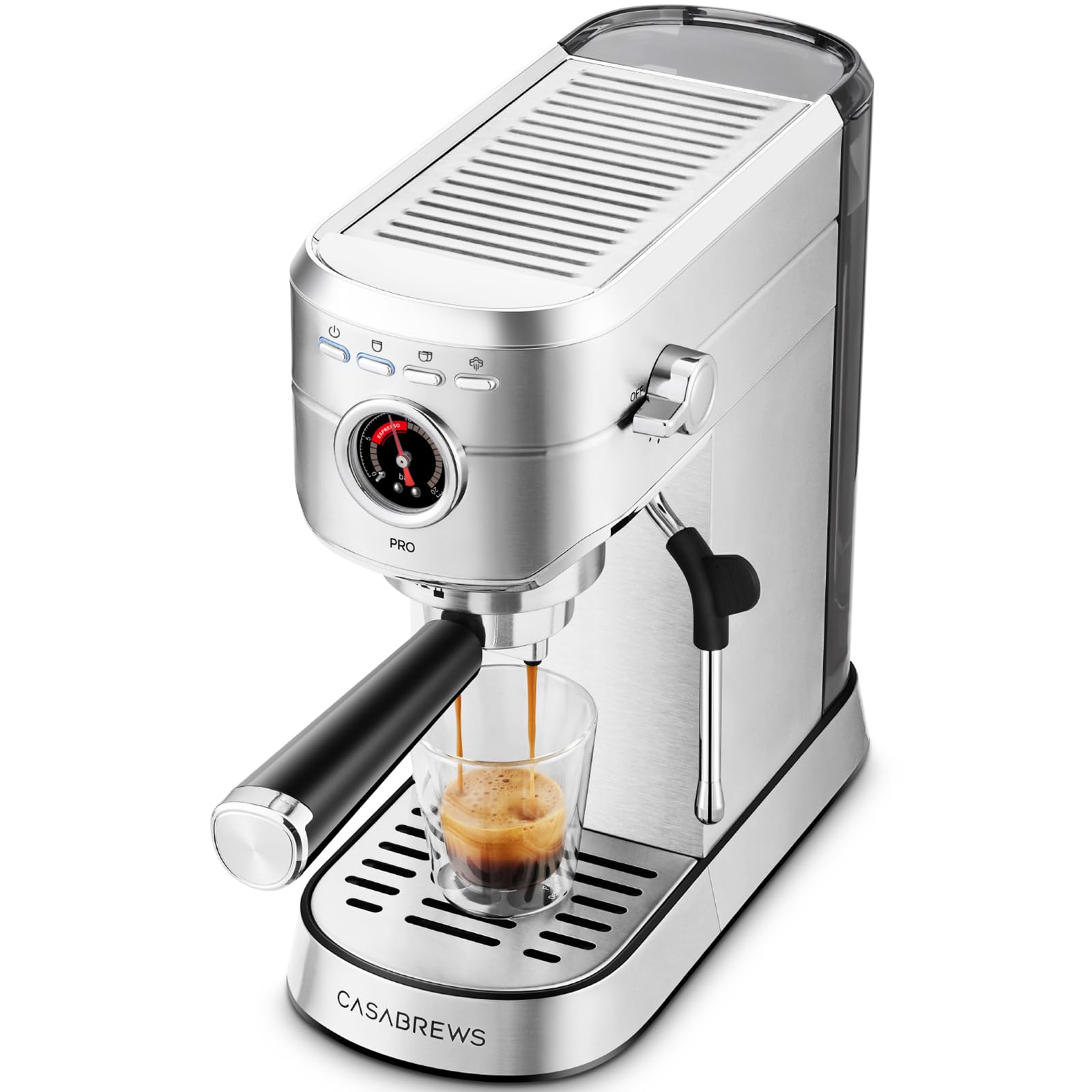
The CASABREWS 5418 PRO justifies its premium position in the cheap espresso machine category with a real-world advantage that matters every morning: the Flashheat system reaches brewing temperature in under five seconds, and the steam switch engages in just three seconds. That rapid transition between brewing and steaming eliminates the awkward waiting period that plagues most sub-200 machines. The 20-bar pump is paired with a pre-infusion function that gently saturates the puck before full pressure kicks in, reducing channeling and delivering consistent crema even with pre-ground coffee.
The included pressure gauge gives you real-time feedback on extraction quality, a feature usually reserved for machines costing three times as much. The stainless steel steam wand with a single-hole tip produces genuine microfoam for latte art, not the bubbly pannarello foam you find on cheaper units. The machine is built with a stainless steel body and a brass-reinforced brew group, weighing in at over eight pounds, which signals internal quality that can withstand daily use.
One caveat: the machine is not compatible with espresso pods, so you need to use ground coffee. It also lacks a built-in cup warmer, though preheating the portafilter with a blank shot is easy enough. For the price, the 5418 PRO offers the best shot-to-froth speed ratio in this entire lineup.
Why it’s great
- Flashheat technology brings water to optimal temperature in under five seconds
- Three-second steam switch allows seamless transition from brew to froth
- Built-in pressure gauge gives real-time control over extraction quality
Good to know
- Not compatible with espresso pods, needs ground coffee only
- Does not include a built-in cup warming tray
2. HIBREW H10B

The HIBREW H10B is the most customizable machine in this roundup, offering adjustable extraction temperature across a ten-degree range (194°F to 204°F) plus programmable pre-infusion timing. That level of granularity lets you dial in light roasts at higher temps and dark roasts at lower temps, something most cheap espresso machines completely ignore. The NTC temperature sensor maintains stability within the group head, so your second shot is as consistent as the first.
The built-in pressure gauge and LED display give you both a visual on extraction pressure and a shot timer, which is critical for learning proper technique. The steam wand is a dedicated stainless steel unit with adjustable temperature settings reaching up to 302°F, capable of producing dry microfoam for latte art. The machine also comes with a pressurized filter basket, so you can use pre-ground coffee without dialing in an expensive grinder.
The build quality is solid with a matte stainless steel body and a substantial nine-pound weight that anchors the machine during tamping. The water tank holds 44 ounces, reducing refill frequency. The only limitation is the lack of dishwasher-safe components, but the included cleaning tools make maintenance straightforward. For anyone who wants to learn espresso without leaving budget land, the H10B is the best teacher.
Why it’s great
- Adjustable temperature range from 194°F to 204°F for different roast levels
- Customizable pre-infusion time minimizes channeling
- Pressurized basket works with pre-ground coffee for consistent results
Good to know
- Components are not dishwasher-safe
- Steam wand requires immediate purging after use to prevent clogs
3. SHARDOR 20-Bar Espresso Machine

The SHARDOR 20-Bar machine is designed for the first-time espresso buyer who wants a simple, guided experience. The LCD display shows a shot timer that helps you dial in your extraction time without guesswork. The 1350W thermoblock heating system brings the machine to temperature in about thirty seconds, and the built-in cup warming tray on top keeps your mugs warm during that heat-up phase — a small touch that noticeably improves the final cup temperature.
The steam wand is the adjustable type, allowing you to angle the nozzle for better milk pitcher positioning. It produces decent microfoam, though it requires more practice than the CASABREWS or HIBREW wands to get the texture right. The machine includes both single and double-shot filter baskets made from stainless steel, and the reusable filter system means you never need paper filters.
Some users have noted that customer service can be slow to respond, but the machine itself has proven reliable over months of daily use. The 60-ounce water reservoir is the largest in this group, perfect for households that go through multiple drinks in a row. If you want an entry-level machine that does not overwhelm you with controls but still gives you real espresso, the SHARDOR is a solid mid-range choice.
Why it’s great
- LCD screen with shot timer simplifies the learning process
- Cup warming tray helps maintain beverage temperature
- Large 60-ounce water reservoir reduces frequent refills
Good to know
- Customer service response times can be slow
- Steam wand requires some practice for microfoam consistency
4. XIXUBX 20Bar (Silver)
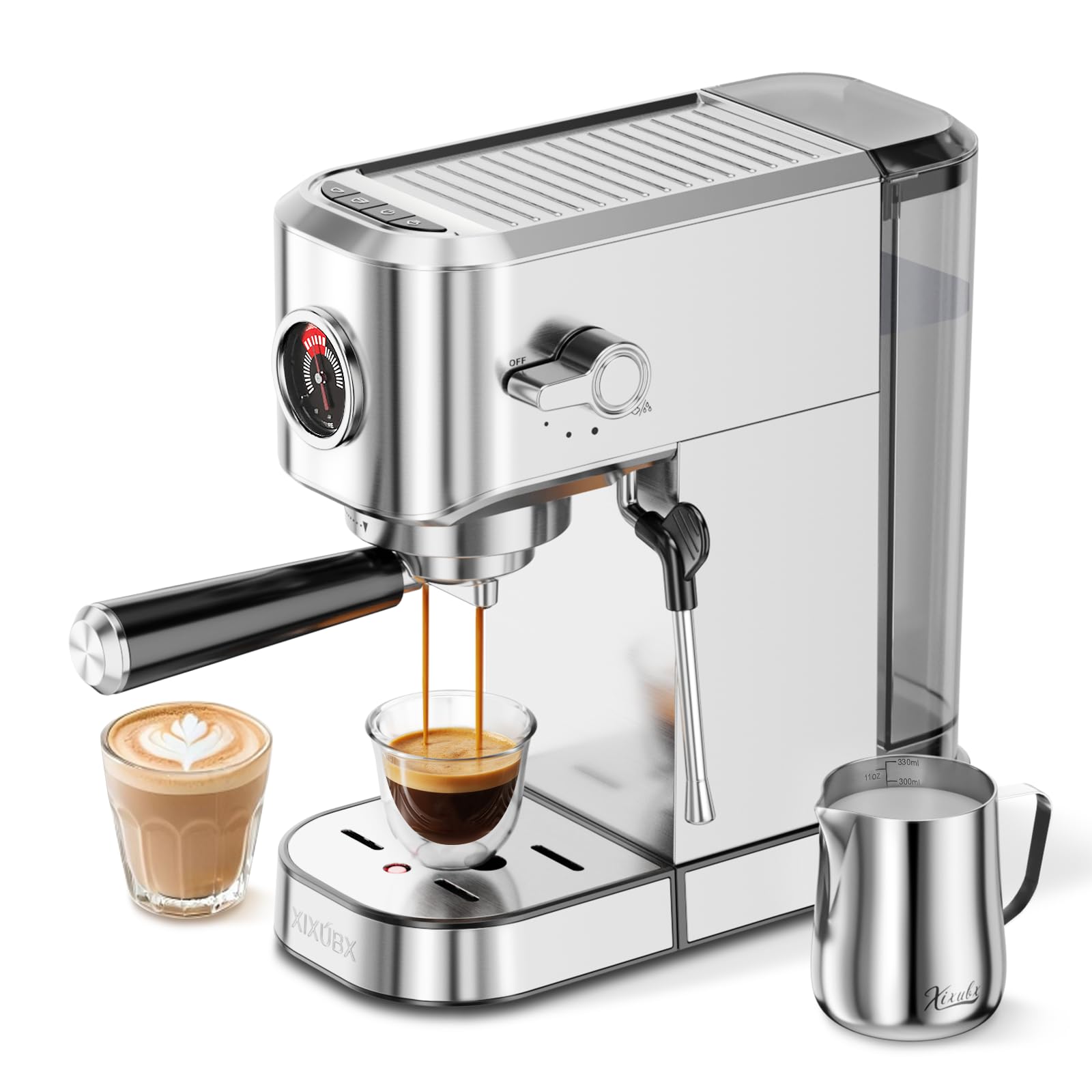
The silver XIXUBX 20Bar stands out for its visible pressure gauge and its unusually quiet brewing system. Most budget espresso machines vibrate loudly throughout extraction, but the XIXUBX dampens that noise to a manageable hum, making it a better fit for early morning kitchens where noise matters. The 20-bar pump delivers consistent pressure, and the visible gauge lets you track whether you are hitting the 9-bar sweet spot for proper espresso extraction.
The steam wand features a detachable nozzle and full 360-degree rotation, giving you more control over milk texture than fixed wands. The 42-ounce removable water tank has a clear level indicator so you never run dry mid-shot. The machine also supports customizable single and double shot volumes, which is a feature you usually see on machines in a higher price class.
The portafilter locks in securely with a three-ear design that prevents accidental dislodging during tamping. The machine weighs over eight pounds, indicating sturdy internals, and the stainless steel body is easy to clean. The included tamper with a built-in spoon is a welcome convenience. The main drawback is that it requires careful priming and proper grind size to avoid pressure issues, but the pressure gauge makes troubleshooting straightforward.
Why it’s great
- Low-noise brewing system is quieter than most in this price tier
- Visible pressure gauge allows real-time extraction monitoring
- 360-degree rotating steam wand with detachable nozzle for easy cleaning
Good to know
- Requires proper priming and correct grind size for optimal performance
- Not dishwasher safe, components need hand washing
5. Neretva 15 Bar
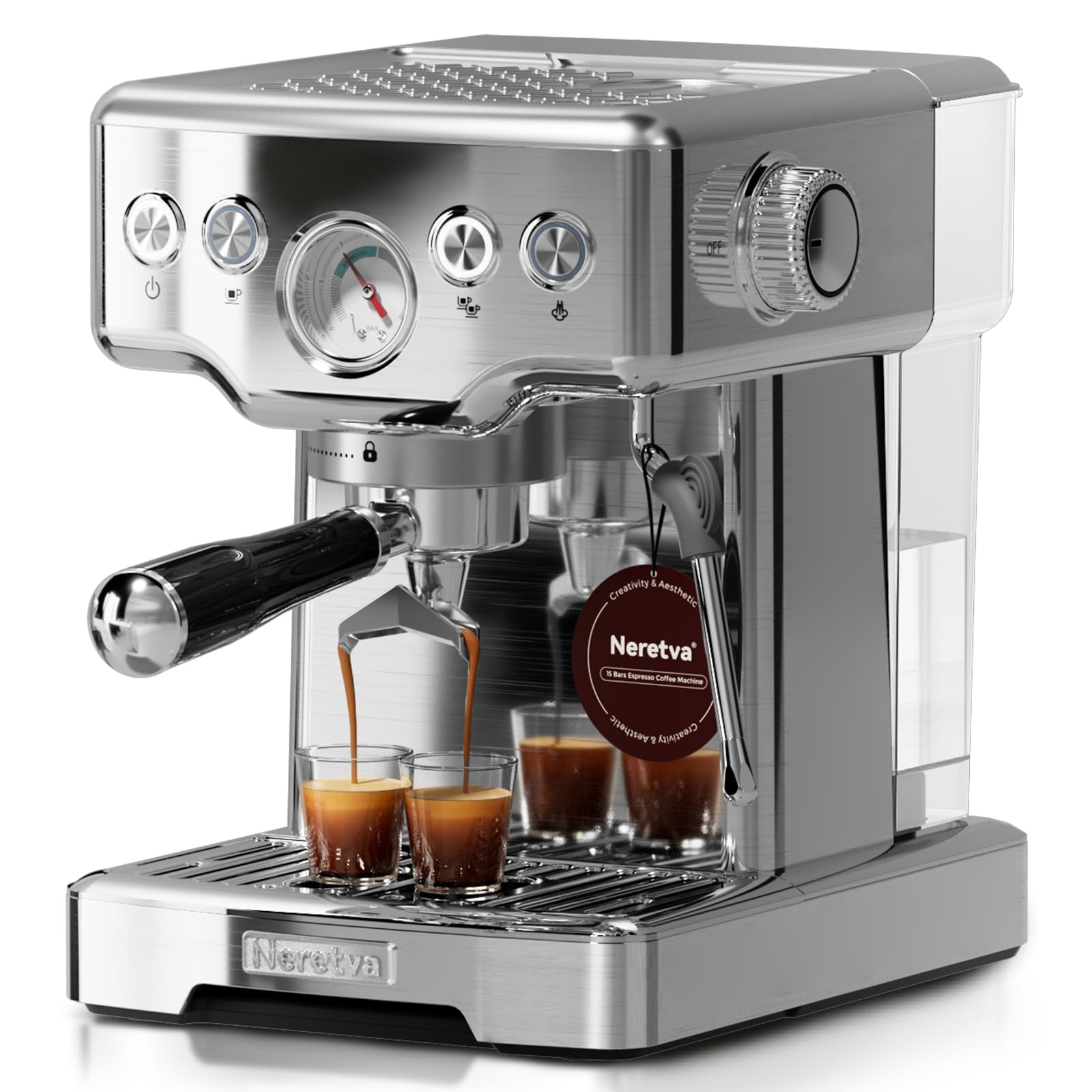
The Neretva 15 Bar machine is built for the home barista who wants to fine-tune every shot. The visible pressure gauge shows real-time extraction pressure, and the built-in OPV (Over Pressure Valve) automatically releases excess pressure to protect both the machine and the quality of your shot. This is a serious technical advantage at this price point, as it prevents the boiler from over-pressurizing after multiple shots in a row.
The pre-infusion function operates at low pressure initially, gradually building up to reduce air bubbles and ensure even saturation of the coffee puck. The result is a more balanced extraction with fewer sour or bitter notes. The steam wand is powerful and generates dense microfoam, and the machine includes a milk frothing pitcher and dosing funnel in the box, which is rare in the budget tier.
The build quality is strong with a stainless steel body and a weight of 3.8 kilograms (about 8.4 pounds). The portafilter is a standard 51mm size, and it works with standard third-party accessories. The main tradeoff is the 1.8-liter water tank, which is smaller than some competitors, requiring more frequent refills if you make multiple drinks. Despite that, the Neretva delivers the most professional-level pressure control in this price range.
Why it’s great
- OVP system automatically releases excess pressure for consistent shots
- Pre-infusion gradually increases pressure for even extraction
- Includes milk frothing pitcher, dosing funnel, and other accessories
Good to know
- Water tank capacity is 1.8 liters, smaller than several competitors
- Requires proper tamping technique to achieve sufficient pressure
6. Chefman CraftBrew

The Chefman CraftBrew brings programmability to the mid-range with its touch control panel and built-in timer that lets you adjust shot volume for ristretto or lungo styles. The 15-bar pump is paired with a 1350W heating system that preheats quickly, and the machine includes both single and double-shot baskets for flexible brewing. The removable 1.5-liter water tank is large enough for multiple drinks without constant refilling.
The stainless steel build looks clean on any counter, and the descaling alert after 500 cycles takes the guesswork out of maintenance. The steam wand is effective for creating frothed milk for cappuccinos, though it is the pannarello style, which produces larger bubbles rather than the microfoam needed for latte art. For milk-based drinks where texture is less critical, this works fine.
Customer feedback highlights that the machine produces excellent crema and consistent temperature across consecutive shots. Some users noted that the grind size and tamping pressure need to be dialed in to avoid under-extraction, but the programmability helps compensate. The 1-year warranty from Chefman adds peace of mind. For the price, this is a reliable workhorse that prioritizes convenience over advanced control.
Why it’s great
- Programmable shot volume for ristretto or lungo preferences
- Descaling alert after 500 cycles simplifies maintenance
- Large 1.5-liter water tank reduces refill frequency
Good to know
- Steam wand is pannarello style, not suited for microfoam latte art
- Requires dialing in grind size for optimal extraction
7. LERTIN 20 Bar
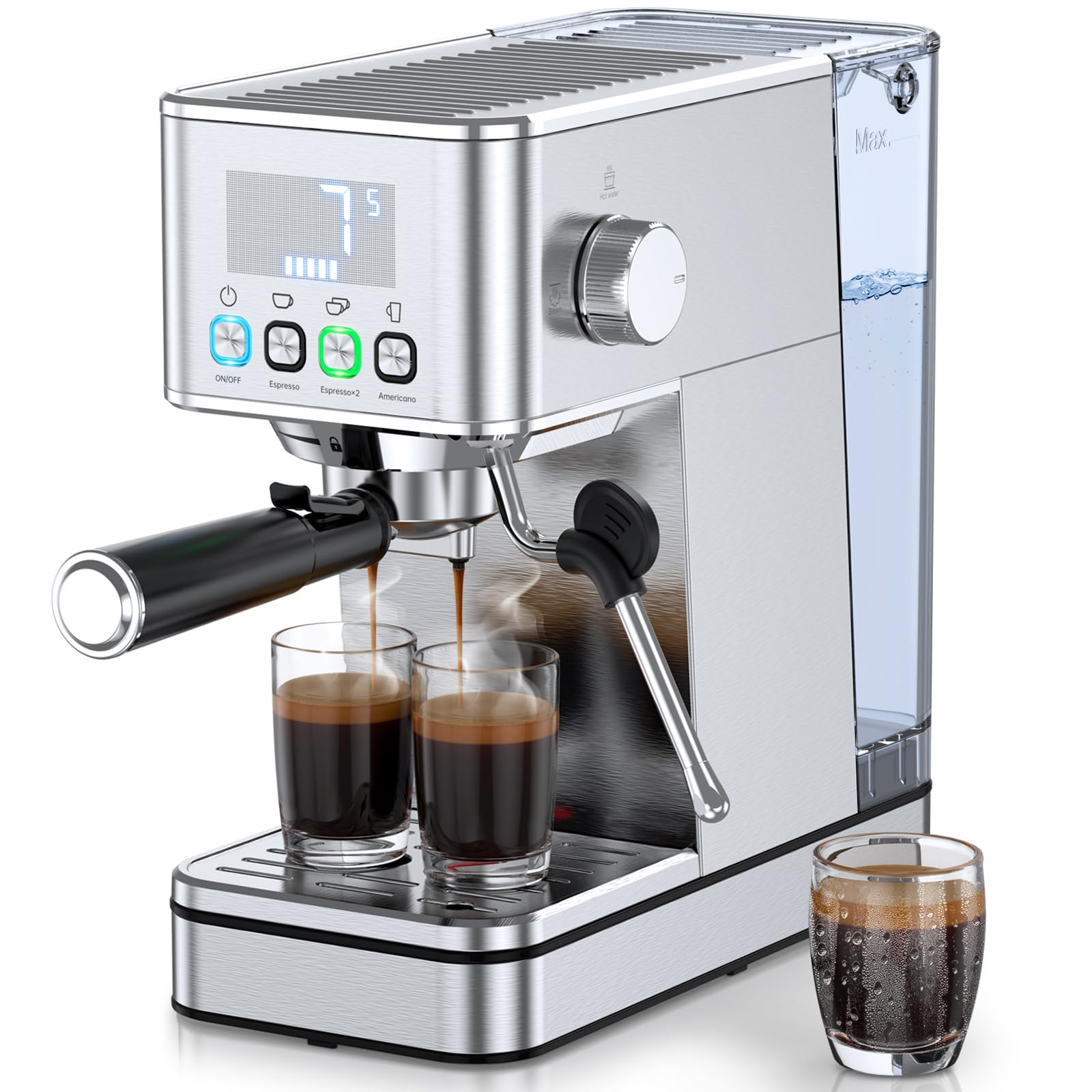
The LERTIN 20 Bar machine prioritizes speed with a 16-second preheat time — the fastest in this entire lineup. The HD touch screen displays the preparation process in real time, letting you monitor the extraction from start to finish. You get single, double, and even a customized mode, which is rare at this price point. The 20-bar pump is paired with an NTC temperature control system that keeps the brewing water between optimal temperature zones.
The 57.5-ounce water tank is generous, and the stainless steel boiler resists scale buildup better than aluminum alternatives. The built-in cleaning mode helps extend the machine’s life by running a descale cycle when needed. The auto-shutoff function kicks in after 30 minutes of inactivity, which saves energy and prevents dry-firing the pump.
The steam frother works well for creating foam for lattes and cappuccinos. The compact footprint (5 inches deep, 11.4 inches wide) makes it one of the most counter-space-efficient machines in this guide. The machine does not include a cup warmer, and the user manual could be more detailed, but the instructional videos on the product page help bridge that gap. For speed and simplicity, the LERTIN is hard to beat.
Why it’s great
- Fastest preheat in this roundup at just 16 seconds
- HD touch screen provides real-time extraction monitoring
- Built-in cleaning mode and 30-minute auto-shutoff
Good to know
- No built-in cup warming surface
- Manual lacks some detail, rely on video tutorials
8. AMZCHEF 51mm Coffee Espresso Machine
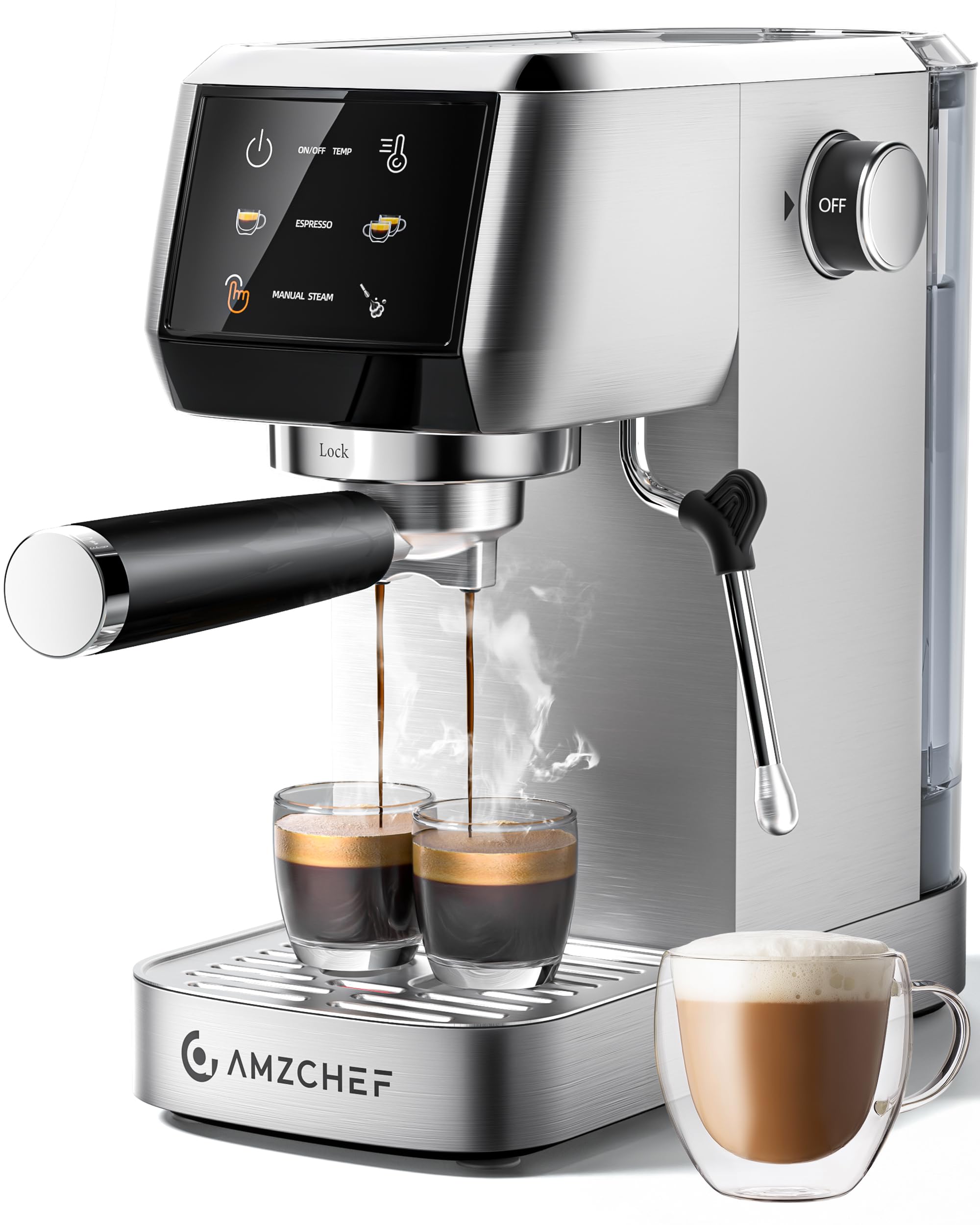
The AMZCHEF 51mm Espresso Machine fits the budget tier perfectly, offering a 20-bar pump with 6-second pre-infusion and a 44-ounce water tank that keeps you brewing even with multiple guests. The 1350W heating system preheats in roughly 30 seconds, and the 3-level NTC temperature control lets you choose between 3 heat settings up to 201°F to match your preferred roast profile. This is more temperature adjustability than you typically find on entry-level machines.
The 360-degree adjustable steam wand is the pannarello type, which is adequate for basic milk frothing but will not produce the silky microfoam needed for advanced latte art. The HD touch screen and volume memory are conveniences that feel more premium than the price suggests. The stainless steel body with a silver-black finish looks modern and resists fingerprints.
The built-in 15-minute auto-off function is a welcome safety feature that saves energy and prevents accidents. The portafilter locks in securely with a standard 51mm design, and the reusable filter means no ongoing paper filter costs. Some users report that the machine operates slightly louder than average, but for the price, the feature set is difficult to beat. It is the best choice for households that need a large water tank and do not require professional-grade steam performance.
Why it’s great
- Large 44-ounce water tank reduces refill frequency for multiple drinks
- Three-level NTC temperature control up to 201°F for roast customization
- HD touch screen with volume memory for consistent results
Good to know
- Steam wand is pannarello style, not suitable for microfoam
- Operation is slightly louder than some alternatives in this range
9. XIXUBX 20 Bar (White)
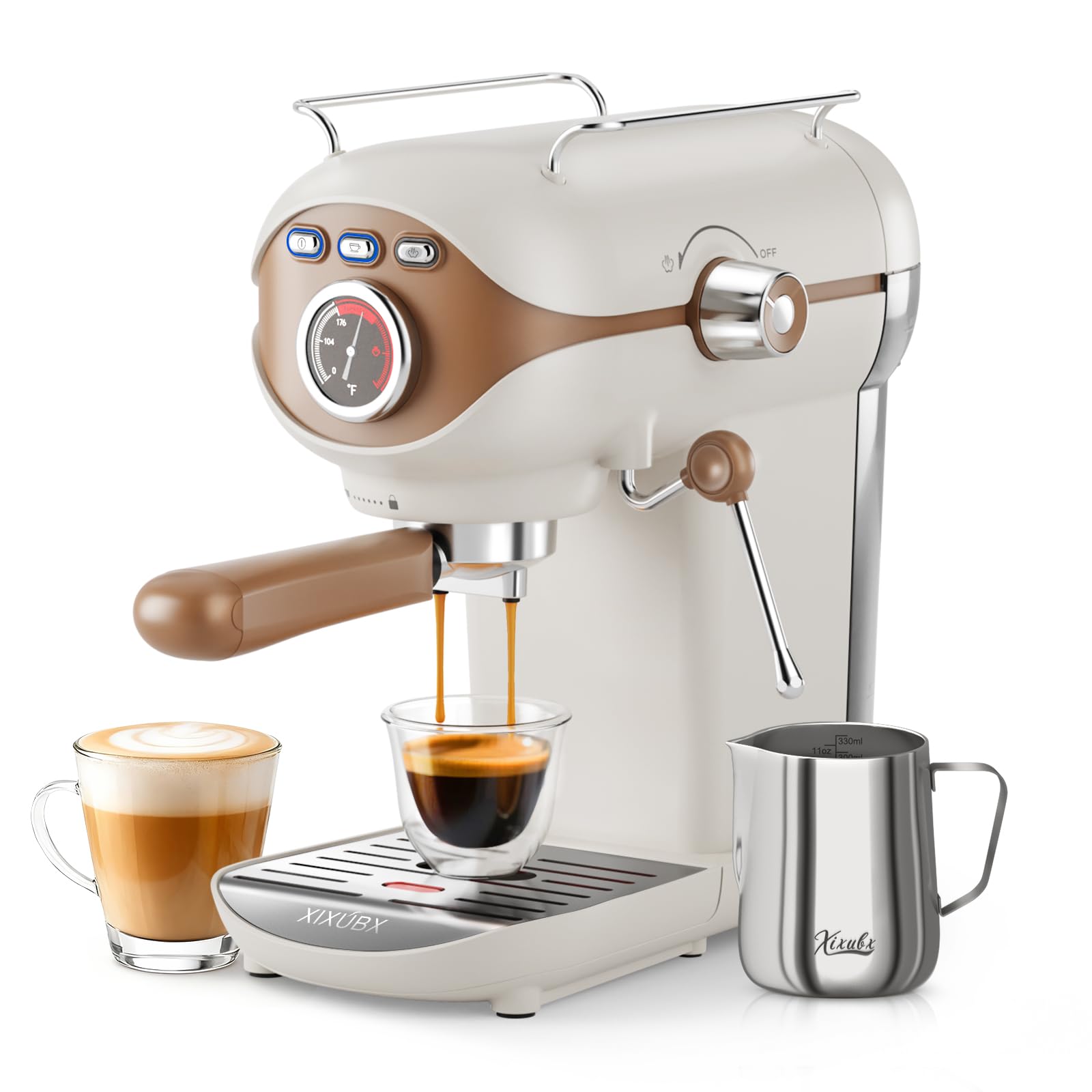
The white XIXUBX 20 Bar machine brings PID temperature control to the absolute entry-level price point, which is significant because PID controllers maintain stable water temperature throughout the shot instead of letting it swing wildly. This means you get consistent extraction shot after shot, something that most machines under 100 dollars cannot deliver. The 20-bar pump produces genuine crema, and the semi-automatic design gives you manual start/stop control over the shot.
The steam wand is effective for creating silky milk foam, though it requires some practice to avoid large bubbles. The compact dimensions (11.4 inches deep, 6.7 inches wide, 11.8 inches high) make this the smallest footprint in the guide, ideal for tight counter spaces. The 34-ounce water tank is adequate for a few drinks, but you will refill it more often than with the larger tanks on the AMZCHEF or SHARDOR models.
The included accessories — a 51mm portafilter, single and double filter baskets, tamper with spoon, and cleaning needle — cover everything you need to get started. The machine is not dishwasher-safe, so hand washing is required. Some users found the learning curve steeper than expected because the PID system is more responsive to grind size and tamp pressure. However, for the lowest price in this lineup, the PID control alone makes this a compelling entry point for anyone serious about espresso without spending serious money.
Why it’s great
- PID temperature control ensures stable brewing temperature shot after shot
- Smallest footprint in this guide, perfect for tight counter spaces
- Includes all necessary accessories including tamper and cleaning needle
Good to know
- 34-ounce water tank requires more frequent refills
- Not dishwasher-safe, requires hand washing all components
FAQ
Can a cheap espresso machine actually produce genuine crema?
What is the difference between a 15-bar and a 20-bar pump in a budget machine?
Do I need a separate grinder, or can I use pre-ground coffee?
How often do I need to descale a cheap espresso machine?
What size portafilter do most cheap espresso machines use?
Final Thoughts: The Verdict
For most users, the best cheap espresso machine winner is the CASABREWS 5418 PRO because it combines sub-five-second heat-up, three-second steam switching, a real pressure gauge, and a genuine microfoam wand all at a price that undercuts the competition by a wide margin. If you want full control over temperature and pre-infusion, grab the HIBREW H10B for its adjustable 194°F to 204°F range and customizable shot parameters. And for the absolute lowest entry point with PID temperature control, nothing beats the white XIXUBX 20 Bar — it proves you do not have to overspend to get a machine that respects the science of espresso.