You want real espresso, not a sour, watery mess that leaves your machine sputtering. That requires a grinder capable of a fine, consistent powder without overheating the beans. But “cheap” often means blade grinders that smash beans into random shards, destroying any hope of balanced extraction. A true conical burr grinder is the baseline for decent home espresso, and you do not need to spend hundreds to get one.
I’m Mohammad Maruf — the founder and writer behind AirfryerBite. I’ve spent years analyzing the hardware, specifications, and real-world performance of espresso grinders under aggressive price constraints.
The challenge is finding a grinder that delivers espresso-fine consistency without triggering buyer’s remorse. After combing through the specs of dozens of models, I’ve narrowed the field to the machines that actually deliver on the promise of a cheap espresso grinder.
How To Choose The Best Cheap Espresso Grinder
The barrier to entry for espresso is not the machine; it is the grinder. A pressurised basket machine can hide mediocre grinds, but for real, unpressurized extraction, the grind quality is everything. Here is what you need to look for when the budget is tight.
Conical Burrs vs. Blade Mills
For espresso, blade grinders are useless. They create a wide particle distribution — some powder, some chunks — leading to over-extracted fines and under-extracted boulders in the same shot. Conical burrs, on the other hand, crush beans between a fixed ring and a rotating cone, producing a narrow particle distribution. Every grinder on this list uses conical burrs.
Adjustable Settings and Micro-Steps
The difference between a good espresso grind and a choked machine is often a single click in the adjustment dial. You need at least a dozen steps to dial in a non-pressurised basket. Models with 30 or more settings allow you to fine-tune the flow rate for different beans, roast levels, and humidity.
Static Cling and Retention
In an espresso grinder, static electricity causes grounds to stick to the chute and the dosing cup. This mess not only wastes coffee but also makes your dose inconsistent. Anti-static technology, like that found in the SHARDOR and Gevi models, improves consistency and cleanup. Retention — the coffee trapped inside the burrs after grinding — matters too. Low retention is a sign of a well-designed grinding path.
Quick Comparison
On smaller screens, swipe sideways to see the full table.
| Model | Category | Best For | Key Spec | Amazon |
|---|---|---|---|---|
| SHARDOR Conical Burr | Electric | Dialing-in by time | 51 grind settings | Amazon |
| Gevi Electric Burr | Electric | Portafilter grinding (51mm) | 35 grind settings | Amazon |
| OXO Brew Compact | Electric | Quiet, consistent grinding | 15 settings + micro-steps | Amazon |
| AYCHIRO Conical Burr | Electric | General home brewing | 30 grind settings | Amazon |
| KIDISLE Conical Burr | Electric | Versatile cup selection | 35 grind settings | Amazon |
| Vivaant Manual | Manual | Portable, quiet brew | Dragon tooth burr | Amazon |
| Alpaca Ventures Manual | Manual | Lightweight travel | 12 click steps | Amazon |
In-Depth Reviews
1. SHARDOR Conical Burr Espresso Coffee Grinder

The SHARDOR is the strongest contender for real espresso at this price tier. Its 40-millimeter stainless steel conical burr runs at a low RPM to minimize heat transfer, protecting the delicate oils in the beans. With a staggering 51 precise grind settings, you can move from Turkish-fine to French-press-coarse, but the real draw is the fine-tuning bandwidth inside the espresso range. The precision electronic timer adjusts in 0.1-second increments, so you can dial in a consistent dose down to the gram.
The anti-static technology built into the grounds chamber significantly reduces the mess that plagues cheaper electric grinders. The included portafilter cradle works for direct grinding, and the dosing ring helps contain stray grounds. The unit is somewhat tall at 13.5 inches, so check your overhead cabinet clearance before committing.
Over time, the touchscreen interface remains responsive, and the 165-watt motor handles dense light roasts without bogging down. For any budget-conscious espresso enthusiast who wants the closest thing to a prosumer workflow without the price tag, this is the unit to beat.
Why it’s great
- Exceptionally wide 51-setting range for espresso dial-in
- Anti-static technology keeps grinding mess low
- 0.1-second timer gives precise dose control
Good to know
- Tall footprint may not fit under low cabinets
- Touchscreen can be less intuitive than a physical dial
2. Gevi Coffee Grinder Electric
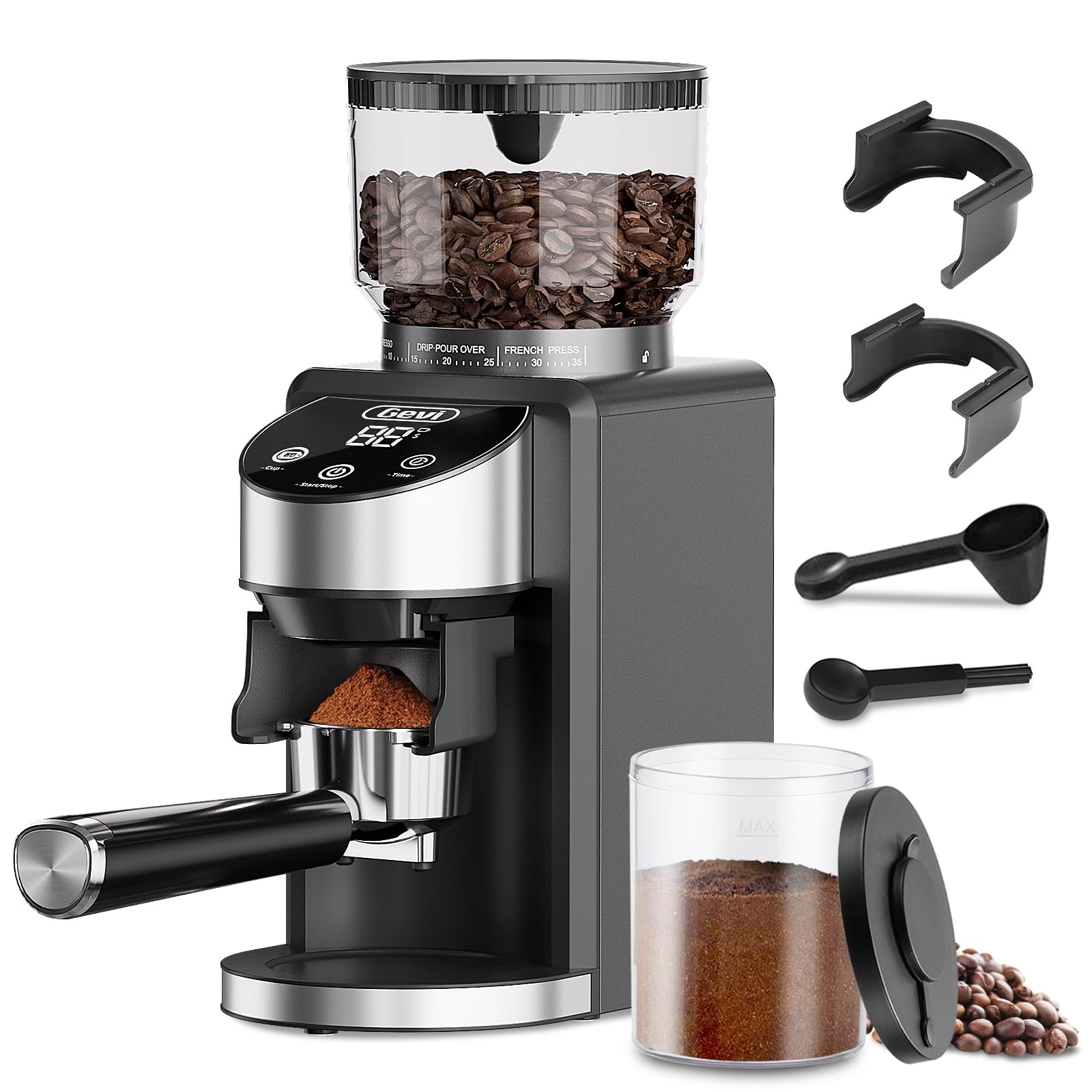
The Gevi electric grinder packs 35 precision grind settings and a large 240-gram bean hopper, making it ideal for users who go through multiple dosing sessions without refilling. The standout feature is the included portafilter cradle designed for standard 51-millimeter baskets, letting you grind directly into the handle. This cuts down on the transfer steps that can introduce mess and waste.
The anti-static design helps keep the grounds container relatively clean, and the machine includes a coffee spoon and cleaning brush in the box. The 5.92-pound weight gives it a solid, planted feel on the counter. Some users report a frustrating “sleep mode” that requires unplugging and re-plugging the unit to resume grinding, though Gevi customer service appears proactive about replacing faulty units.
For the price-conscious user who already owns a 51-millimeter espresso machine, this grinder offers a direct-dosing solution that few competitors at this level provide. It will not fit 58-millimeter portafilters natively, so double-check your basket size before buying.
Why it’s great
- 35 settings cover espresso to cold brew
- Sturdy 5.9-pound build stays put on the counter
- 51mm portafilter cradle reduces transfer mess
Good to know
- Some units experience a sleep-mode glitch
- No native 58mm portafilter fit
3. OXO Brew Compact Conical Burr Coffee Grinder

The OXO Brew Compact lives up to its name — it stands just 10.75 inches tall with a 3.75-inch footprint, making it the best choice for tight kitchen real estate. Despite the compact size, the stainless steel conical burrs deliver high grind consistency through 15 distinct settings augmented by 29 micro-adjustments. This gives you enough granularity to move incrementally through the espresso zone.
Noise levels are notably low compared to other electric grinders at this price. The 50-gram bean capacity yields up to six cups, which suits a single or small household. The upper and lower burrs are fully removable for cleaning, a rarity at this price point that significantly impacts long-term grind quality. The hopper and grounds container are made from recycled-content Tritan renew material.
The OXO is a pure grinder — no portafilter cradle, no timer, no touchscreen. It relies on simplicity and build quality. The biggest complaint is that it can be slightly messy, with static causing some grounds to fly. But for quiet, consistent grinding that fits on a shelf, it is a top performer.
Why it’s great
- Extremely compact footprint (3.75″ wide)
- Removable burrs for thorough cleaning
- Quiet operation, ideal for early mornings
Good to know
- Some static mess near the grounds bin
- No direct portafilter grinding option
4. AYCHIRO Conical Burr Coffee Grinder Electric
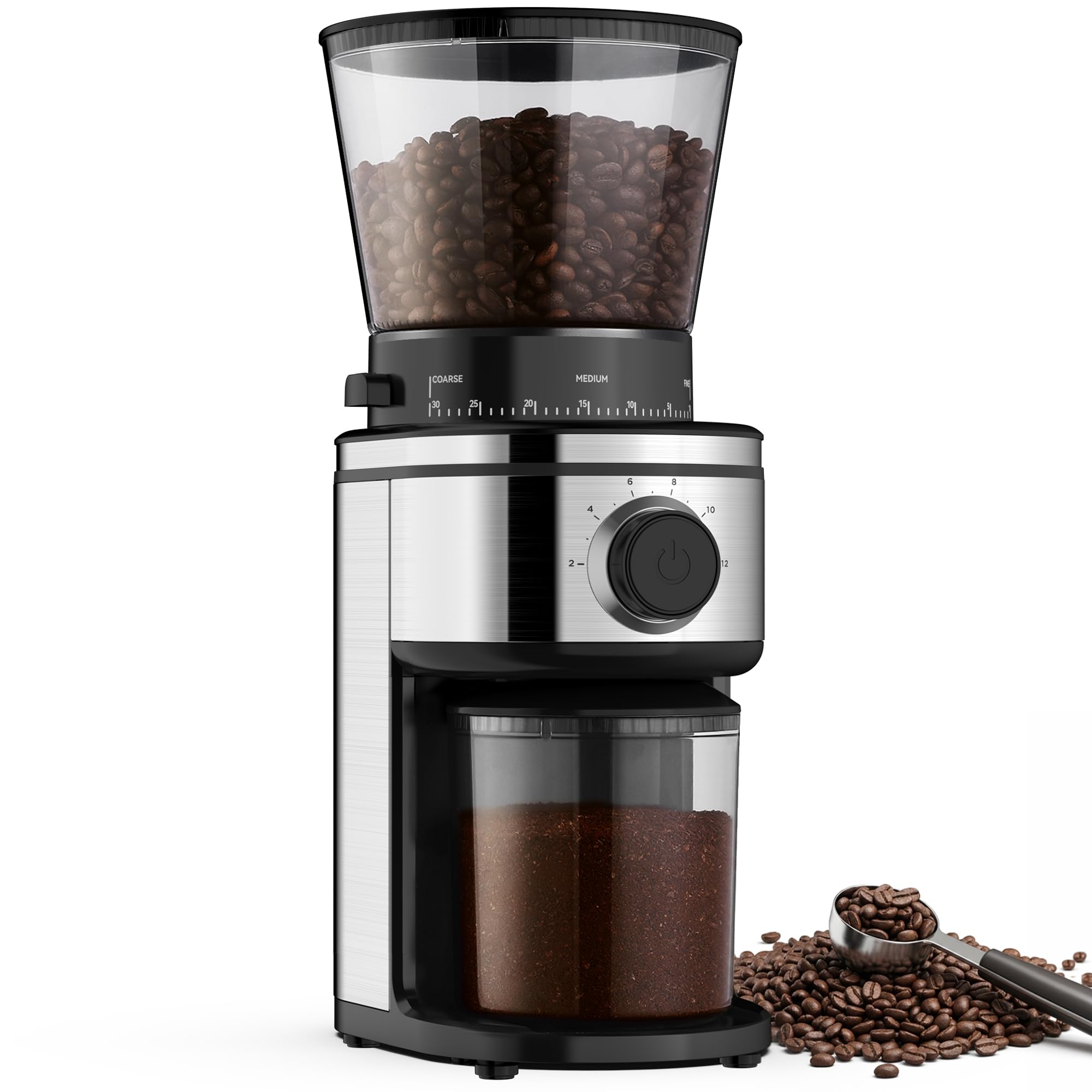
The AYCHIRO hits a sweet spot for the home user who wants electric convenience without spending into the premium bracket. It offers 30 grind settings, with settings 1-9 dedicated to espresso grinding. Setting 1 delivers the finest powder, suitable for tight, concentrated shots. The 12-cup capacity means you can grind for a family batch brew or a single espresso session without refilling.
The stainless steel conical burr delivers uniform particle size that preserves flavor integrity, though the 150-watt motor lacks the grunt of more expensive models. Grinding dense, light-roast beans will be slower, but it manages without stalling. The compact 12.9-inch height and 5.4-inch width let it slide under most cabinets. The hopper, upper burr, and chamber all detach for cleaning.
The biggest concession is the lack of a portafilter cradle. You must grind into the included container and then transfer, which creates an extra step and potential mess. For drip, pour-over, and French press users who also want espresso capability without a premium budget, this is a strong entry point.
Why it’s great
- 30 grind settings with dedicated espresso range
- Easy-to-remove burrs and hopper for cleaning
- Small footprint for tight counter space
Good to know
- No portafilter cradle, requires catch cup transfer
- 150w motor is slower on dense roasts
5. KIDISLE Conical Burr Coffee Grinder
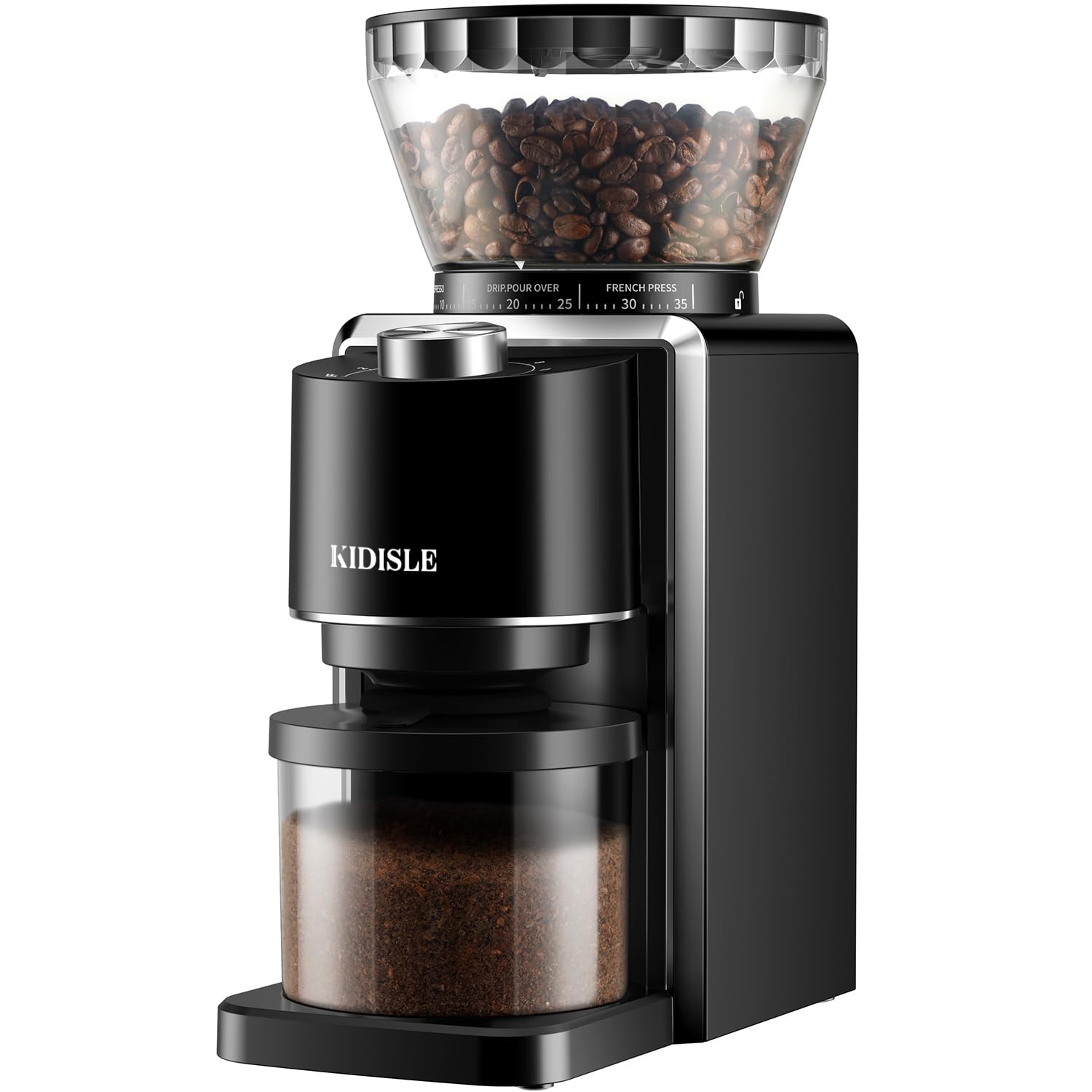
The KIDISLE is designed around simplicity and consistency. With 35 grind settings, it provides a broad sweep from fine espresso to coarse press. The anti-static design is a key feature at this price level, reducing the cling of grounds to the plastic parts after grinding. The 2–12 cup selector works reliably for batch grinding.
The stainless steel conical burrs produce a consistent particle size that supports decent espresso extraction, though the build is primarily plastic, which affects durability over the long term. The electrical specs are comparable to other entry-level burr grinders, and the machine runs quietly enough for early morning use. The included cleaning brush helps maintain the chute.
The KIDISLE works best for users who switch frequently between espresso and pour-over methods. Its drawback is the lack of detailed documentation or an easy way to calibrate the zero point, so you may need to spend some time dialing in the exact espresso setting by trial and error.
Why it’s great
- 35 setting range covers multiple brew methods
- Anti-static design cuts down on mess
- Cup selector for dose control
Good to know
- Predominantly plastic construction
- Zero-point calibration can be unclear
6. Vivaant Coffee Grinder Manual

The Vivaant manual grinder is built for portability and speed. Its defining feature is the “dragon tooth” stainless steel conical burr, which the manufacturer claims cuts twice as fast as standard ceramic burrs. The 32-gram capacity is enough for a double shot or a single strong pour-over.
The grinder has six adjustable settings, controlled by a ring that clicks into place without disassembly. The grind consistency is solid for a manual unit, and the glass catch jar has measurement markings for repeatable dosing. The all-metal body and glass jar make for a premium feel that defies the budget tier, though the glass is fragile if dropped.
The Vivaant is ideal for espresso on the go, camping, or coffee drinkers who want the quietest possible grinding experience. The main limitation is the grind adjustment range — six steps is narrow for anyone who wants to fine-tune between a slow and fast shot. It is best for single-origin roasts where you can commit to one setting.
Why it’s great
- Fast hand-grinding with aggressive burr geometry
- Compact, portable all-metal and glass build
- Whisper-quiet, no power needed
Good to know
- Only 6 grind steps limit espresso fine-tuning
- Glass jar is breakable
7. Alpaca Ventures Premium Manual Coffee Grinder

The Alpaca Ventures manual grinder differentiates itself with a dual-bearing drive system and a 420 stainless steel conical burr. The built-in bearings reduce friction in the crank, making the grinding motion smooth and requiring less force than unibody manual grinders. The lengthened stainless steel handle adds leverage, useful when you grind down to espresso fineness.
The 12-click adjustment dial is accessible only when the handle is on, a deliberate safety measure that prevents accidental changes during operation. The grind ranges from Turkish fine to French press coarse, though the step size leaves little room for micro-adjustment inside the espresso window. The 1-pound weight and 6.3-inch height make it the most portable option here, fitting easily into a travel bag.
Reviewers note that the aluminum body feels premium and that the grinder handles cloves for spice grinding on top of coffee. The main drawback is that the 12 steps are too few for those who want to chase a perfect 25-30 second espresso shot. It is an excellent starter manual grinder, but espresso enthusiasts may outgrow its resolution quickly.
Why it’s great
- Dual-bearing system for smooth, easy cranking
- Lightweight and compact for travel
- Rust-proof 420 stainless steel burr
Good to know
- 12 grind steps limit espresso fine-tuning
- Handle must be attached to adjust grind setting
FAQ
Can I use a blade grinder for espresso?
How many grind settings do I need for espresso?
Is a manual or electric grinder better for cheap espresso?
Final Thoughts: The Verdict
For most users, the cheap espresso grinder winner is the SHARDOR Conical Burr Grinder because it combines a 51-setting range, anti-static technology, and a 0.1-second timer in a package that competes with grinders twice its price. If you want a dedicated portafilter dosing solution for a 51mm basket, grab the Gevi Electric Burr Grinder. And for travel, quietness, and raw build quality, nothing beats the Vivaant Manual Grinder.