A standard can opener that works fine on a 14.5-ounce tomato can often stalls or slips on a #10 can of crushed tomatoes or a tall institutional-sized can of stock. The sheer diameter, gauge of metal, and height of large cans demand a tool built for the task rather than a universal gadget. A dedicated unit changes the workflow entirely for anyone who buys in bulk, runs a kitchen, or preps for large gatherings.
I’m Mohammad Maruf — the founder and writer behind AirfryerBite. I analyze small kitchen hardware through the lens of material science, gearing mechanics, and real-world durability to separate proven designs from packaging claims.
After comparing seven models built for heavy can duty, from manual tabletop units to rechargeable electrics, one thing is clear: the right can opener for large cans saves time, protects your hands, and eliminates the frustration of a half-finished cut.
How To Choose The Best Can Opener For Large Cans
Large cans, most commonly #10 cans that hold about 3 quarts of product, measure 6.5 inches in diameter and up to 7 inches tall. Commercial kitchens also use taller cans reaching 11 or 13 inches. A standard handheld opener lacks the leverage and blade exposure to handle these dimensions. The following criteria will help you pick a unit that cuts reliably without bending the lid or leaving sharp edges.
Clearance Height and Blade Reach
The most common failure point with an undersized opener is the top arm not lifting high enough to fit the can underneath. A unit designed for large cans typically has a clearance of 11 to 13 inches. Measure the tallest cans you regularly open and add at least an inch for the blade assembly. The blade itself must be wide enough to engage the full rim of a #10 can without scraping the sidewall.
Mounting Style and Base Stability
Handheld openers that clamp onto the rim struggle with the weight and diameter of large cans because any shift in angle interrupts the cut. A tabletop model with a plated steel or cast iron base that screws into the counter provides the most consistent pressure. For those who cannot drill into a surface, look for a heavy base with rubber feet that resist sliding. The base material should also resist corrosion since large cans tend to drip liquid during opening.
Cutting Mechanism and Edge Safety
Traditional openers cut the top edge of the lid, leaving a sharp rim on the can and a jagged lid. Side-cut openers slice below the rolled rim, producing a smooth edge on both the can and the lid. This is important for food service environments where the lid may be used as a cover or where staff handle the opened can frequently. A magnetic lid retainer or retractable picker helps remove the lid without contacting the food.
Material Selection: Blade and Body
High-carbon steel blades hold a sharper edge for longer than standard stainless, but stainless resists corrosion better in a dishwashing environment. The body should be chromed steel, cast steel, or cast iron to withstand the torque of cutting through heavy-gauge metal. Plastic housings often warp or crack under the repetitive stress required by large cans.
Quick Comparison
On smaller screens, swipe sideways to see the full table.
| Model | Category | Best For | Key Spec | Amazon |
|---|---|---|---|---|
| Edlund 11100 Old Reliable #1 | Commercial Manual | High-volume daily kitchen use | Rated for 5,000 cans per blade side | Amazon |
| IRONWALLS Commercial | Industrial Manual | Cans up to 13 inches tall | 19″ height / 13″ max can clearance | Amazon |
| Wadoy Commercial (Plus Blades) | Commercial Manual | Value with spare parts included | Includes 2 stainless blades + gloves | Amazon |
| BeadChica Heavy Duty Commercial | Industrial Manual | Straightforward #10 can opener | 18.5″ arm for cans up to 11″ | Amazon |
| Canslab Ultrablade PRO | Electric Rechargeable | Arthritis and limited hand strength | 2000mAh battery / ~120 cans per charge | Amazon |
| EZ-DUZ-IT Deluxe Manual (2-Pack) | Manual Handheld | Two kitchens or bulk back-up | Heavy gauge chromed steel / carbon steel blade | Amazon |
| Gisafai 20-Pack Manual Openers | Bulk Manual Handheld | Stapling into gift bags or dorm kits | 20-count / stainless blade / soft grip | Amazon |
In‑Depth Reviews
1. Edlund 11100 Old Reliable #1 Manual Can Opener

The Edlund #1 has been the reference standard in commercial kitchens for decades, and its design rationale becomes obvious the moment you open a #10 can. The reversible two-sided stainless steel blade is rated for up to 5,000 cans per side, meaning the opener can outlast years of daily abuse in a restaurant or church kitchen before any part requires replacement. The plated steel base mounts securely with screws to eliminate any wobble during the cut.
The gearing is direct and smooth — a single pass around the rim produces a clean cut with no need to re-crank or adjust pressure. Edlund builds this unit with replaceable parts availability, so the drive gear or blade can be swapped without buying a whole new base. At 7 pounds, it stays planted during operation, and the 11-inch clearance covers the vast majority of #10 and institutional cans.
The trade-off is that the Edlund #1 requires a permanent mount. It is not portable and you cannot toss it in a drawer. The manual hand-crank mechanism also demands full arm rotation rather than a side-cutting smooth-edge design, leaving a traditional sharp rim on the can. For pure longevity and proven commercial performance, however, no other large-can opener in this list matches its documented lifespan.
Why it’s great
- Two-sided reversible blade rated for 5,000 cuts per side
- Replaceable parts extend service life indefinitely
- Solid 7-pound cast base eliminates shifting during operation
Good to know
- Requires permanent counter screw installation
- Leaves a traditional sharp rim on the can
- Only handles cans up to 11 inches tall
2. IRONWALLS Commercial Can Opener

The IRONWALLS is built around one central advantage: a 19-inch overall frame that accommodates cans up to 13 inches tall. That extra clearance makes it the only model in this roundup that can handle the tallest institutional cans used for bulk stock, pie filling, and large quantities of tomato paste. The cast iron body is nickel-plated for rust resistance, and the food-grade stainless steel blade cuts through heavy-gauge metal without bending.
The gear mechanism keeps handle rotation smooth, and the plated steel base includes screws for countertop mounting. The 3.9-kilogram weight ensures stability, and the handle can be lifted freely to accommodate different can heights without adjusting a stop pin. The base is also removable for storage or cleaning, which is a practical touch for kitchens that do not want a permanent protrusion.
One consideration is that the IRONWALLS, like the Edlund, uses a traditional cutting method that leaves a sharp rim. The blade is fixed — not reversible — so replacement will eventually be necessary. The nickel-plated cast iron is tougher than chromed steel but can chip if dropped. For anyone regularly opening cans taller than 11 inches, this is the only real option among manual units.
Why it’s great
- Handles cans up to 13 inches tall
- Nickel-plated cast iron resists rust
- Detachable base for easy storage
Good to know
- Blade is non-reversible and not replaceable
- Traditional cut leaves a sharp rim
- Cast iron can chip if struck hard
3. Wadoy Commercial Can Opener Heavy Duty
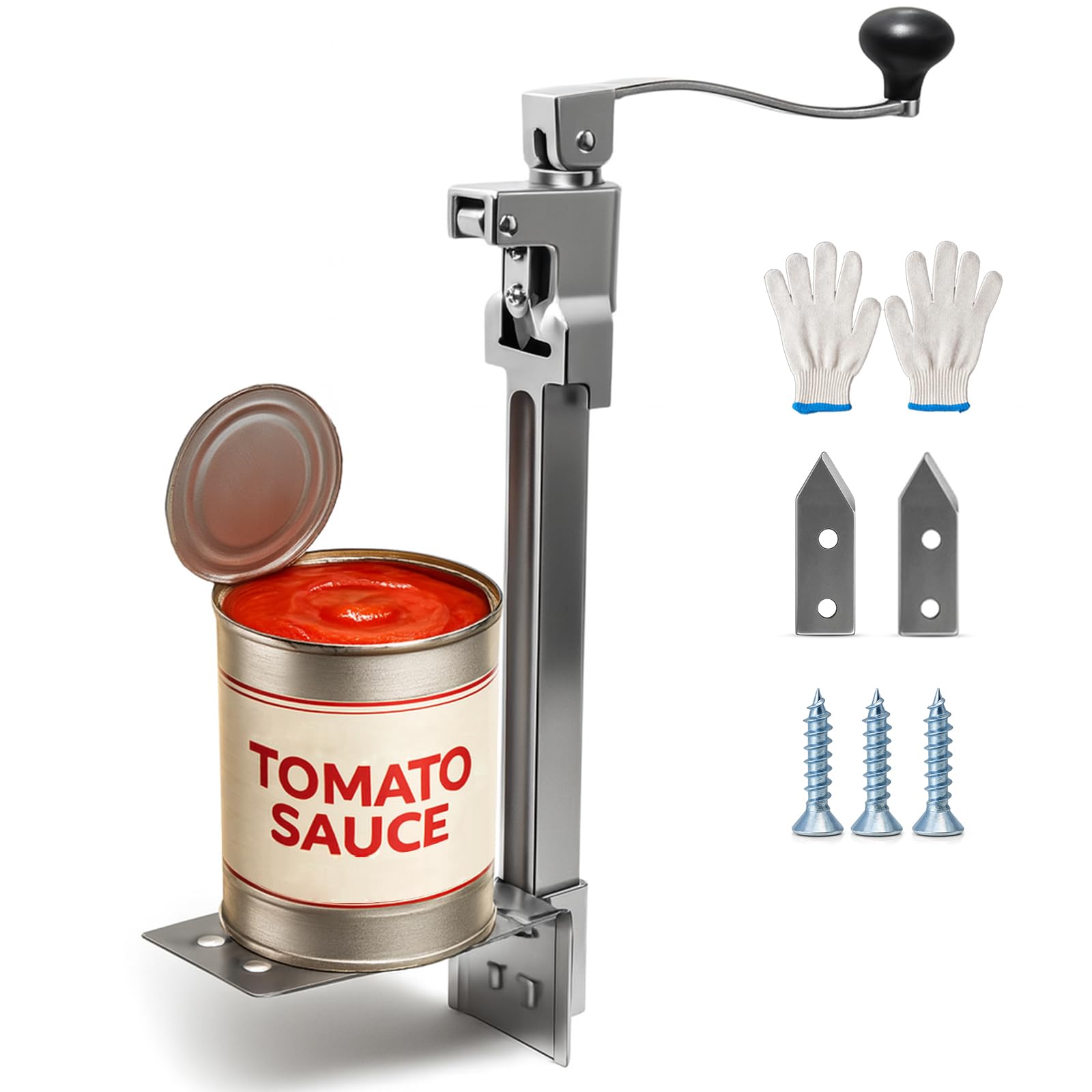
The Wadoy commercial opener differentiates itself by including a complete accessories kit: two stainless steel blades (one pre-installed and one spare), a pair of gloves, and three mounting screws. The spare blade is a practical addition because blade dulling is the primary reason manual openers lose cutting efficiency on large cans. The cast steel base resists corrosion and scratches reliably in a commercial dish pit.
The ergonomic handle and swivel blade cut through #10 cans in roughly 20 seconds per rotation, and the manufacturer claims a rate of 2 to 3 cans per minute. The 11-inch clearance covers standard large cans used in food service. The base screws securely into a countertop, but the unit can also be mounted to a tabletop if the screws are countersunk properly.
The main drawback is that the blade assembly produces metal shavings during cutting, which is a common problem with side-piercing openers. The included gloves hint at the potential for sharp edges on the can rim. The cast steel base is heavy at 3.36 kilograms, but the overall finish is slightly more utilitarian than the Edlund. For the spare blade and glove inclusion, however, the Wadoy offers strong component value.
Why it’s great
- Includes spare stainless blade and protective gloves
- Cast steel resists rust and dents
- Smooth crank with minimal fatigue
Good to know
- Produces metal shavings during cutting
- 11-inch max height limits very tall cans
- Finishing is more basic than premium brands
4. BeadChica Heavy Duty Commercial Can Opener
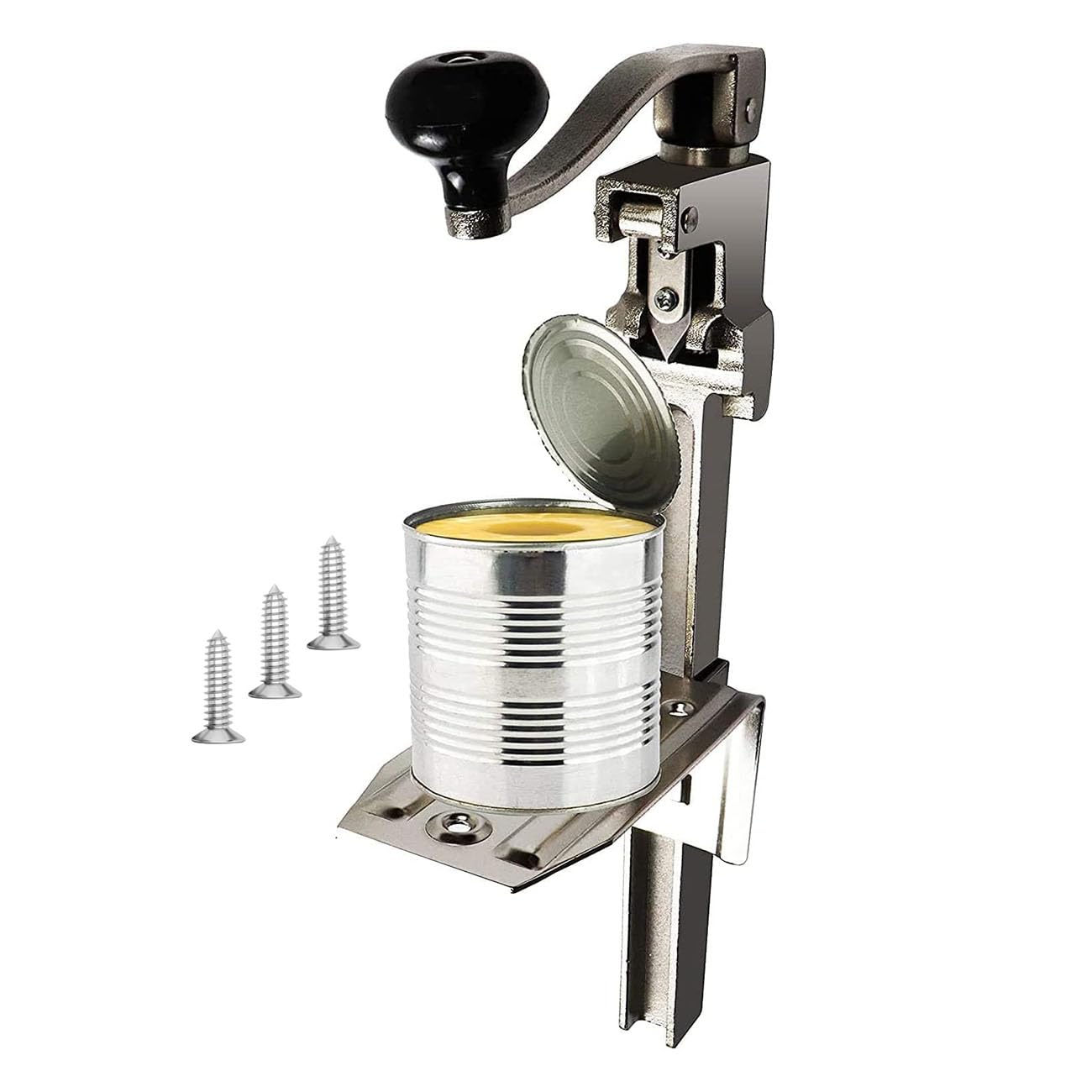
The BeadChica commercial opener presents a straightforward, no-frills approach to large cans. The 18.5-inch arm lifts high enough to clear cans up to 11 inches tall, covering the standard #10 diameter and most institutional sizes. The body is constructed from strong cast steel, which the manufacturer states has been tested for consistent performance. The blade is steel, and the hand crank is designed for easy clockwise rotation.
A plastic insert in the slide mechanism reduces friction and smooths the motion, which is a minor but noticeable difference compared to all-metal sliders that can bind over time. The blade assembly can be disassembled by hand for thorough cleaning without tools, a feature that helps maintain hygiene in a kitchen that cycles through many cans daily. The base screws into the counter with the included plated steel hardware.
The BeadChica uses a traditional piercing cut, so metal shavings are a concern during the initial puncture. The steel blade is not identified as stainless, meaning it will require thorough drying to prevent rust. The 2-pound weight is significantly lighter than the cast iron units, which can be an advantage for portability but reduces stability during aggressive turning. It is a competent mid-range option for users who need a simple mounted opener.
Why it’s great
- Plastic friction insert for smooth cranking
- Tool-free disassembly for cleaning
- Lightweight at 2 pounds compared to cast iron
Good to know
- Steel blade may rust if not dried promptly
- Light base can shift if not mounted tightly
- Produces metal shavings during cut
5. Canslab Ultrablade PRO Rechargeable Electric Can Opener

The Canslab Ultrablade PRO shifts from manual cranking to a rechargeable motor, which is a major advantage for anyone with arthritis, reduced grip strength, or carpal tunnel. The 2000mAh lithium battery opens approximately 120 standard cans per charge via USB-C, and the side-cut mechanism severs the lid below the rim, leaving a smooth edge on the can. The built-in magnetic lid retainer and retractable picker help remove the lid cleanly.
The smart chip auto-stops the cutter when the lid is fully separated, so you press the button and walk away. The motor is 28% quieter and 28% faster than earlier battery-operated models, according to the manufacturer’s lab data. The unit includes a magnetic wall holder for storage, and the compact size (2.6 by 2.09 inches) means it can be mounted vertically or kept in a drawer. It works on both small and large cans, though the side-cut design is limited to cans with a rolled rim — rimless soda cans are not compatible.
The one-touch operation is genuinely convenient, but the plastic housing and battery dependency mean the Canslab is not a commercial-duty tool. If the battery depletes mid-session, you need to wait for a recharge before opening more cans. The plastic motor housing is also less durable than a cast steel manual unit. For a home cook or an elderly user who struggles with manual cranking, however, the Canslab provides real usability gains.
Why it’s great
- Side-cut leaves a smooth, safe edge
- Hands-free auto shut-off operation
- Rechargeable with ~120 cans per charge
Good to know
- Not compatible with rimless soda cans
- Requires charging and battery management
- Plastic construction is not commercial-grade
6. EZ-DUZ-IT Deluxe Manual Can Opener (2-Pack)

The EZ-DUZ-IT Deluxe is a classic swing-style handheld opener with a heavy gauge chromed steel body and a carbon steel cutting blade. The gear-driven design provides more torque than a simple parallel blade opener, and the thick rubberized handles offer a secure grip even with wet hands. This 2-pack gives you two identical openers for separate kitchens or as a dedicated backup in a drawer.
The carbon steel blade holds an edge well for a handheld unit, and the swing mechanism locks tightly around the rim to prevent slipping. The opener is made in the USA and can be washed by hand with warm soapy water. The red and black color scheme makes it easy to spot in a cluttered drawer.
The EZ-DUZ-IT is not designed for commercial-speed opening of #10 cans; the swing mechanism requires manual repositioning for each can, and the gears can strip if forced through a particularly thick seam. The carbon steel blade will rust if left wet, so immediate drying is necessary. For home use or as a backup for occasional large cans, the value of two units at this price point is hard to beat.
Why it’s great
- Gear-driven design for smooth rotation
- Two openers for the price of one
- Thick rubber handles provide good grip
Good to know
- Carbon steel blade can rust if not dried
- Swing design is slower than tabletop models
- Gears can strip on very thick seams
7. Gisafai 20-Pack Manual Can Openers

The Gisafai 20-pack is not a serious contender for daily large-can opening, but it fills a specific role: high-volume gifting, dorm supply, or office pantry replenishment. Each opener features a stainless steel blade, an easy-turn knob, and a soft rubber coating on the oversized handles. The 20-count pack means you can distribute them to multiple locations or keep a stash for guests.
The stainless blade is rust-resistant, and the iron plating on the body provides basic durability. The opener includes a bottle cap opener on the handle, adding minor utility. The handle design reduces hand pressure, which is helpful for elderly users or those with arthritis who only need to open standard-sized cans occasionally.
These are not built for #10 cans. The blade is too small to grab the full rim of a 6.5-inch diameter commercial can, and the iron plating is thin enough to bend if excessive force is applied. The blades will also lose sharpness relatively quickly compared to a carbon steel or higher-grade stainless unit. If you need a single reliable large-can opener, skip this. If you are stocking a cafeteria or event space with disposable openers, the per-unit cost is extremely efficient.
Why it’s great
- Extremely low per-unit cost for bulk buying
- Stainless blade resists rust
- Soft grip handle improves comfort
Good to know
- Blade too small for reliable #10 can opening
- Iron plating can bend under heavy force
- Blade dulls faster than carbon steel alternatives
FAQ
Will a standard handheld opener work on a #10 can?
Why do some can openers produce metal shavings and others do not?
What is the difference between a smooth edge and a sharp rim cut?
How often should I replace the blade on a commercial can opener?
Can I mount a tabletop can opener without drilling into my counter?
Final Thoughts: The Verdict
For most users, the can opener for large cans winner is the Edlund 11100 Old Reliable #1 because its two-sided blade and 5,000-cut lifespan make it the only model in this roundup designed for daily commercial punishment. If you need a smooth-edge electric that works for arthritic hands, grab the Canslab Ultrablade PRO. And for taller cans beyond 11 inches, nothing beats the IRONWALLS Commercial with its 13-inch clearance.