A butcher block cutting board isn’t just a slab of wood — it’s the single most-used surface in your kitchen, taking the full force of every chop, slice, and cleaver strike you throw at it. The wrong board warps, cracks, or dulls your knives within months, while the right one becomes a durable workhorse that actually protects your blade edges and lasts for years. Choosing the correct wood type, grain orientation, and thickness determines whether you get a surface that stays flat or one that sends you shopping for a replacement before the season changes.
I’m Mohammad Maruf — the founder and writer behind AirfryerBite. I’ve spent years analyzing how different hardwoods respond to moisture, blade contact, and daily kitchen abuse, so I know exactly which specs separate a disposable cutting board from a true heirloom-grade block.
After comparing seven serious contenders across wood species, grain construction, and dimensional stability, this guide delivers the definitive verdict on the best butcher block cutting board for every kitchen setup and budget.
How To Choose The Best Butcher Block Cutting Board
A butcher block cutting board is an investment in your knife edges and your prep efficiency. Buyers who skip the grain orientation or wood species often end up with a warped, split, or bacteria-trapping surface within the first year. Here are the three factors that separate a board that lasts a decade from one that ends up in the garage workshop.
Grain Orientation — End Grain vs Edge Grain
End-grain construction means the wood fibers run vertically, so the knife blade slides between the fibers instead of cutting across them. This self-healing property keeps your knife sharp longer, though end-grain boards tend to weigh more and cost a bit more. Edge-grain boards have fibers running lengthwise — they are flatter and more stable against warping but they will scar more visibly over time. Serious home cooks who use high-carbon knives should prioritize end-grain; casual preppers can save money with a quality edge-grain board.
Wood Species — Hardness and Moisture Resistance
North American hard maple is the industry gold standard: it’s hard enough to resist deep cuts but still gentle on knife edges. Walnut is slightly softer, which makes it even more knife-friendly, and its dark chocolate color hides stains well. Teak has natural oils that resist moisture and bacteria — perfect for those who leave the board out on the counter — but its hardness sits between maple and walnut. Cherry and bamboo are less common in butcher blocks because bamboo is very hard on knives and cherry can dent more easily during heavy chopping.
Thickness and Dimensional Stability
Thickness is not just about aesthetics. A board under 1.5 inches can bow or cup over time, especially in humid kitchens or if you frequently cut wet ingredients like tomatoes and melons. Boards at 1.75 inches or thicker resist warping because the mass stays flat under repeated moisture exposure. Thicker boards also sit higher off the counter, which means less back strain during long prep sessions. Professionals and heavy users should aim for 1.5 inches minimum, with 1.75 inches preferred if the board is larger than 18 by 12 inches.
Quick Comparison
On smaller screens, swipe sideways to see the full table.
| Model | Category | Best For | Key Spec | Amazon |
|---|---|---|---|---|
| BABILONIA Black Walnut | Premium End Grain | Knife protection + serving versatility | 1.7″ thick, end-grain walnut | Amazon |
| Teakhaus Butcher Block | Premium Teak | Moisture resistance + eco-conscious buyers | 1.5″ thick, FSC-certified teak | Amazon |
| WoodForChef Maple | Premium Maple | Heavy daily chopping with deep juice groove | 1.5″ thick, edge-grain maple | Amazon |
| Winco Rubberwood | Commercial-Grade | Max surface area for bulk prep | 1.75″ thick, 18×24″ rubberwood | Amazon |
| Yes4All Teak End Grain | Mid-Range End Grain | End-grain durability at a mid-range price | 1.5″ thick, end-grain teak | Amazon |
| CONSDAN Walnut Edge Grain | Mid-Range Edge Grain | Walnut beauty with invisible handles | 1″ thick, edge-grain walnut | Amazon |
| John Boos Maple Square | Entry-Level Maple | Small-space prep and charcuterie display | 1.5″ thick, edge-grain maple | Amazon |
In‑Depth Reviews
1. BABILONIA American Black Walnut Cutting Board
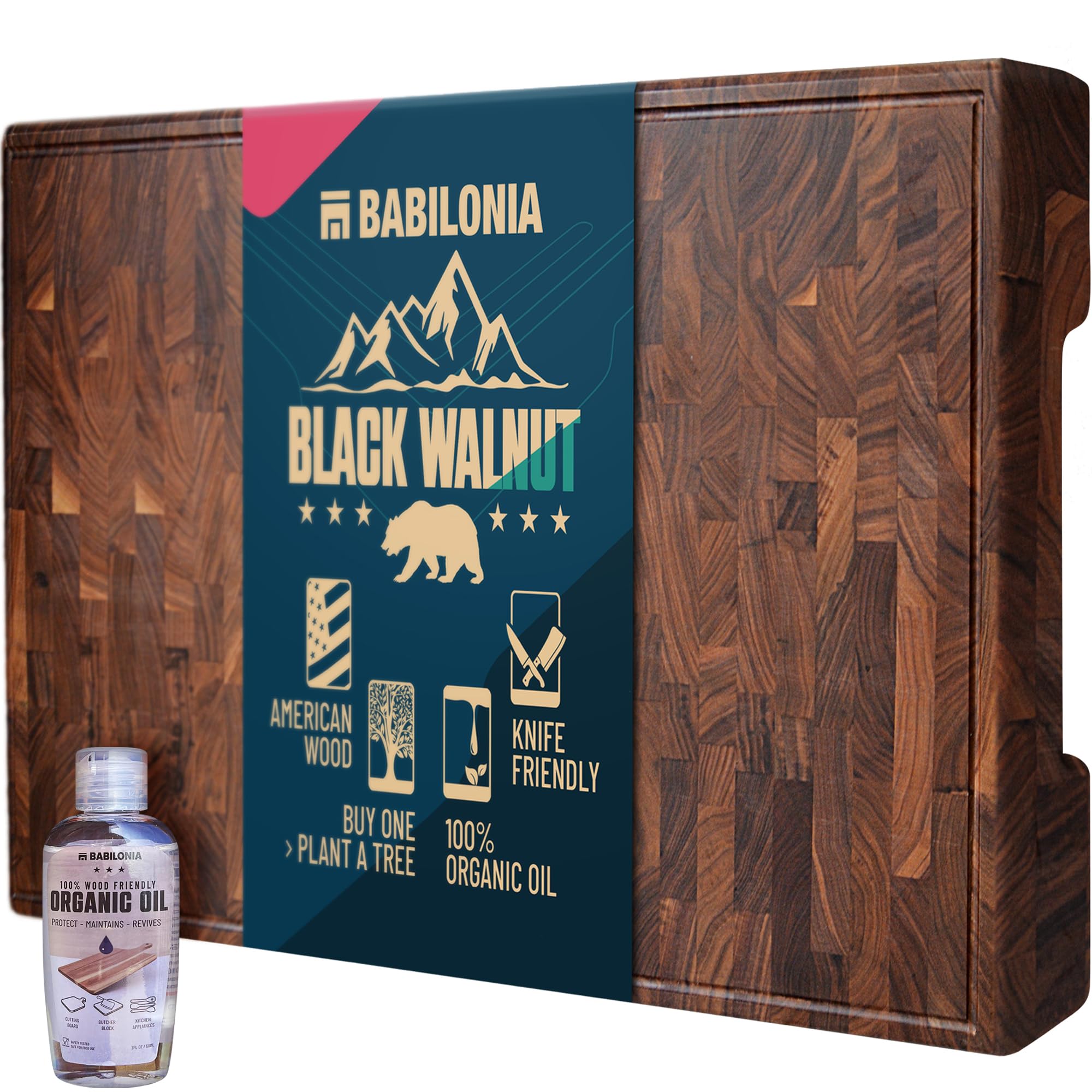
The BABILONIA board hits the ideal thickness for a butcher block at 1.7 inches, and the end-grain walnut construction means every knife stroke lands between the fibers rather than across them. At 19.7 by 12.2 inches, it provides ample space for breaking down a whole chicken or prepping a large batch of vegetables without feeling oversized on a standard counter. The included food-grade oil and stainless steel plate add immediate value — you can start seasoning the board on day one and use the plate as a slide-out for transferring chopped produce into a bowl or pot without lifting the board.
Walnut is naturally softer than maple, which makes this board exceptionally gentle on knife edges, but it still resists denting well because the end-grain orientation distributes impact across many small fiber ends. The reversible design means one side serves as a chopping surface while the other side functions as a charcuterie board, with hidden handles that keep the silhouette clean when you flip it for serving. The built-in juice groove runs deep enough to contain runoff from a sliced tomahawk steak or a pile of juicy heirloom tomatoes.
BABILONIA ships this board pre-seasoned with organic oil, so it arrives ready to use out of the box. The 2-year warranty and 24/7 customer support add confidence for a board in this price tier. The only trade-off is the slightly smaller width compared to full 15-inch boards, but most home cooks will find the 12.2-inch width perfectly adequate for standard prep tasks. If you want premium end-grain construction without the premium maple price tag, this walnut board is the smartest buy in the lineup.
Why it’s great
- End-grain walnut self-heals from knife cuts, extending blade life
- 1.7-inch thickness resists warping in humid kitchens
- Comes pre-seasoned with organic oil and includes a bonus plate
- Hidden handles keep the reversible design sleek for serving
Good to know
- Width at 12.2 inches is narrower than some 15-inch competitors
- Hand wash only — never submerge or put in dishwasher
2. Teakhaus Butcher Block Cutting Board

Teakhaus builds this butcher block from 100% FSC-certified teak, a wood species that naturally repels moisture and bacteria thanks to its high silica and oil content. The end-grain construction at 1.5 inches thick provides a forgiving surface that keeps your high-end chef knives sharp for longer between honing sessions. At 20 by 15 inches, this board offers a generous work zone that accommodates a full brisket or a large batch of mise en place, while the open design without a juice groove makes it equally suited for bread slicing and pastry rolling.
Teak’s natural hardness sits between walnut and maple, which means the board resists deep gouges better than walnut but still remains more knife-friendly than a hard maple board. The reversible design gives you two functional sides — use one for heavy chopping and flip to the other for serving cheese and charcuterie. The oil finish from the factory provides initial protection, but teak boards benefit from periodic mineral oil application to maintain that signature golden-brown hue and prevent drying in low-humidity environments.
This board weighs only 6.4 ounces according to the listing — a clear typo, as actual end-grain teak boards at this size typically land around 10 to 12 pounds. The lightweight feel compared to maple boards of the same dimension makes it easier to lift and rinse under running water. If you prioritize sustainability and moisture resistance in your butcher block, the Teakhaus board represents a responsible purchase that will outlast synthetic boards by decades while adding warmth to your kitchen counter.
Why it’s great
- FSC-certified teak with natural moisture and bacteria resistance
- End-grain surface is gentle on knife edges
- Large 20×15 inch work area for heavy prep
- Reversible design extends usable life
Good to know
- No juice groove — runoff may spill during wet chopping
- Requires periodic oiling to maintain teak’s natural color
3. WoodForChef Large Maple Cutting Board

WoodForChef sources its North American hard maple from FSC-certified forests and presses it into an edge-grain board that measures 20 by 16 inches with a full 1.5-inch thickness. The edge-grain construction provides a stable, flat surface that resists warping across seasonal humidity changes, and the deep juice groove around the perimeter traps liquids from roasted meats and juicy vegetables before they spill onto your countertop. The board arrives pre-seasoned with a blend of mineral oil and beeswax, so it’s ready for immediate heavy use straight out of the box.
Maple is the traditional choice for butcher blocks because its tight grain structure makes it hard enough to resist deep cuts without being so hard that it chips knife edges. At 16 inches wide, this board offers more lateral space than the BABILONIA or Teakhaus options, making it ideal for Chinese cleaver work or rolling out pie dough in addition to standard chopping. The 12.5-pound weight gives it reassuring heft — it stays planted on the counter without needing a silicone mat underneath, even during aggressive chopping motions.
The board is not reversible due to the juice groove, but that’s a fair trade for the liquid containment feature if you frequently cut proteins or water-heavy produce. The edge-grain surface will show knife scars over time more visibly than an end-grain board, but regular oiling helps minimize the appearance. If you prefer the classic maple butcher block look and prioritize a large work surface with a functional juice groove, this WoodForChef board delivers professional-grade performance at a competitive price point.
Why it’s great
- FSC-certified North American hard maple resists deep cuts
- Deep juice groove prevents countertop mess during wet prep
- Pre-seasoned with mineral oil and beeswax, ready immediately
- 16-inch width offers generous lateral space for cleaver work
Good to know
- Edge-grain shows knife scars more than end-grain boards
- Not reversible — juice groove limits to one functional side
4. Winco WCB-1824 Rubberwood Cutting Board

The Winco WCB-1824 is a commercial-grade rubberwood board built for volume — 18 inches by 24 inches with a massive 1.75-inch thickness that sits solidly on any countertop without shifting. Rubberwood is a sustainable hardwood harvested from rubber plantations after the trees stop producing latex, giving it a dense, tight grain structure comparable to maple at a lower weight. The tan color and smooth edge-grain surface make this board a common sight in restaurant kitchens where staff need a durable, sanitary prep surface that can handle thousands of pounds of produce each week.
At 17.8 pounds, this is the heaviest board on this list, and the thickness ensures it stays completely flat even when a full sheet tray of hot pans rests on one corner. The 1.75-inch thickness provides excellent thermal mass — the board won’t warp or cup from the heat of a just-roasted chicken or from repeated hot-water rinses. The eco-friendly rubberwood construction means you get a highly renewable wood species that performs almost identically to traditional maple butcher blocks in terms of knife impact absorption.
There is no juice groove and no handle cutouts, which reinforces the commercial design — flat surfaces are easier to sanitize and scrape clean during service. The board works best for cooks who have ample counter space and need a large, unbroken work surface for rolling dough, breaking down large cuts of meat, or prepping multiple ingredients simultaneously. Home kitchens with limited counter space might find the 18×24 footprint too large, but for serious cooks who want a true restaurant-grade board, the Winco delivers unbeatable surface area and stability.
Why it’s great
- 18×24 inch surface is the largest work area on this list
- 1.75-inch thickness resists warping like a professional block
- Rubberwood is eco-friendly and knife-friendly
- No grooves or handles — easy to scrape and sanitize
Good to know
- Very heavy at 17.8 pounds — not easy to move or flip
- No juice groove — liquid may pool on the surface
5. Yes4All 20×15 Teak End Grain Board

The Yes4All teak board brings end-grain construction to a 20 by 15 inch surface at 1.5 inches thick, offering the self-healing knife protection of end-grain teak at a price that undercuts most premium competitors. Teak wood naturally contains high levels of rubber and oil that make it resistant to moisture absorption, so this board is less likely to warp than maple or walnut boards of the same thickness in humid environments. The built-in handles on both sides make it easy to lift and carry the 11.24-pound board from counter to sink for cleaning.
The juice groove runs deep around the perimeter, and the slight inward slope directs liquids away from the edges, keeping your countertop dry when you slice into a watermelon or a freshly roasted leg of lamb. The reversible design means you can dedicate one side for raw meat prep and the other for produce and bread, reducing the risk of cross-contamination between meal components. Each piece is handcrafted, so the wood grain patterns and color tones vary slightly — a natural characteristic that adds uniqueness but means the board you receive won’t look identical to the product photo.
Teak end-grain boards require periodic oiling to maintain their golden-brown appearance, but the natural oil content means you can stretch the interval between treatments longer than with maple or walnut. The board is not dishwasher safe, but a quick hand wash with mild soap and warm water followed by a towel dry keeps it clean. If you want the knife-protecting properties of end-grain construction in a large format without paying for a brand name, the Yes4All teak board is a solid mid-range contender that balances performance and value effectively.
Why it’s great
- End-grain teak is naturally moisture-resistant and knife-friendly
- Built-in handles make lifting and turning easy
- Deep juice groove prevents countertop mess
- Reversible design for raw and cooked food separation
Good to know
- Wood grain varies per unit — no two boards look identical
- Requires periodic mineral oil to maintain appearance
6. CONSDAN Walnut Cutting Board 20×15

The CONSDAN walnut board uses edge-grain construction with a 1-inch thickness and a 20 by 15 inch surface, delivering the deep chocolate-to-espresso color of American black walnut at a mid-range price point. The invisible inner handles are milled into the underside edges, providing a comfortable grip for transporting the board without protruding handles that disrupt the clean rectangular silhouette. This design makes the board equally functional for countertop prep and table-side serving of cheese, charcuterie, or artisan bread.
Walnut’s naturally softer composition means this edge-grain board will show knife marks more readily than a maple board of the same thickness, but many users consider that patina part of the board’s character. The 1-inch thickness is lighter than the 1.5-inch boards on this list, which makes it easier to lift and store in a cabinet, but it also means the board is more susceptible to bowing over time if exposed to excessive moisture or heat. The deep juice groove runs close to the perimeter and effectively catches liquid runoff, though the groove is not as wide as the one on the Yes4All or WoodForChef boards.
CONSDAN pre-finishes the board with a food-grade wax oil that provides initial protection against moisture, and the lifetime warranty against defects in materials and workmanship adds long-term confidence. The board is not reversible, so you only get one usable side, and the 1-inch thickness means it may not sit as securely on the counter as thicker boards — pairing it with a non-slip mat or damp paper towel underneath solves this issue. For buyers who want the visual warmth of walnut without paying for a thick end-grain block, the CONSDAN board offers an attractive, functional surface for everyday prep.
Why it’s great
- Rich walnut color adds warmth to modern and rustic kitchens
- Invisible handles provide easy grip without breaking the silhouette
- Deep juice groove traps liquids during prep
- Lifetime warranty against manufacturing defects
Good to know
- 1-inch thickness is more prone to warping than 1.5-inch boards
- Edge grain shows knife scars — walnut is softer than maple
7. John Boos B12S Maple Square Board
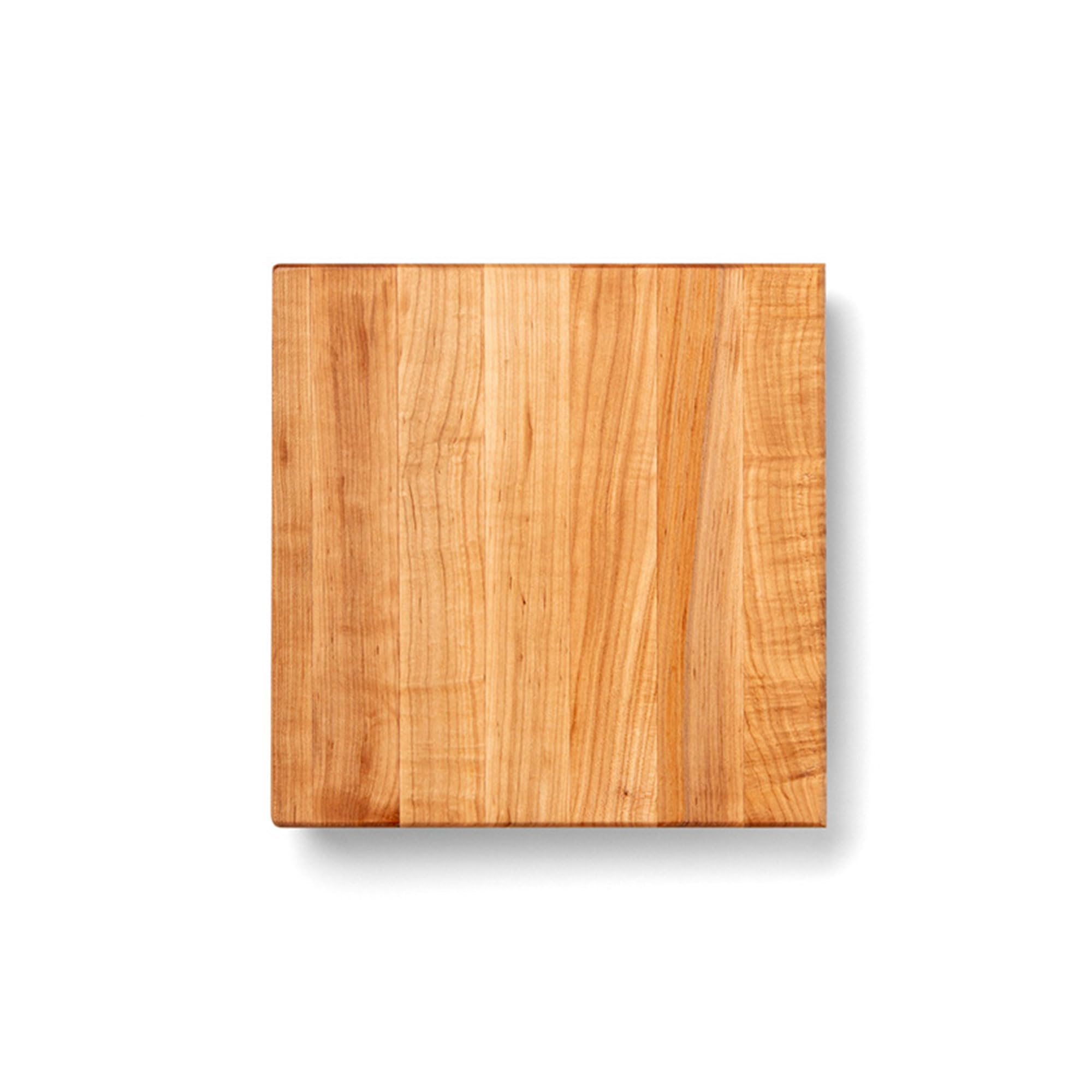
The John Boos B12S is a square 12 by 12 inch edge-grain maple board that stands 1.5 inches thick, weighing 6 pounds with raised bun feet that elevate the board for airflow and ease of pickup. John Boos has been manufacturing wood products since 1887, and the company is a trusted name among professional chefs for consistent grain quality and dimensional accuracy. The square shape makes this board particularly suited for charcuterie displays — place it in the center of a table with cheese, fruit, and bread, and the raised feet provide stability on any surface.
The edge-grain maple construction provides a flat, stable cutting surface that resists splitting, and the 1.5-inch thickness gives enough mass to stay put during moderate chopping. The board is not reversible — the feet are mounted on one side only — but the single surface is ample for a home cook who needs a small dedicated prep station for garlic, herbs, sandwiches, or a single portion of vegetables. The oil finish from the factory provides initial protection, but John Boos recommends periodic application of their Mystery Oil and Board Cream to keep the wood hydrated and prevent drying.
At 12 by 12 inches, this board is best suited for small tasks and serving rather than large-scale prep work. Users who need to break down a whole chicken or chop a large batch of onions will find the surface area limiting. The board’s compact size, however, makes it easy to store in a shallow drawer or lean against the backsplash when not in use. If you want a premium brand name in a small, versatile board that can transition from prep station to serving board without taking over your counter, the John Boos B12S is a well-built entry point into the butcher block world.
Why it’s great
- John Boos heritage — trusted by professional chefs since 1887
- 1.5-inch thickness provides stability despite the 12×12 footprint
- Raised bun feet allow airflow and easy pickup
- Square shape works well for charcuterie and appetizer displays
Good to know
- 12×12 inch surface is too small for large-scale meal prep
- Not reversible — bun feet limit to single-side use
FAQ
Why is end-grain better for my knives than edge-grain?
How thick should a butcher block cutting board be to avoid warping?
Can I put a butcher block cutting board in the dishwasher?
What is the best wood species for a butcher block cutting board?
Final Thoughts: The Verdict
For most users, the best butcher block cutting board winner is the BABILONIA American Black Walnut because its 1.7-inch end-grain construction provides optimal knife protection and warping resistance at a price that undercuts many maple competitors. If you want a board with natural moisture resistance and FSC certification, grab the Teakhaus Butcher Block. And for commercial-grade surface area in a home kitchen, nothing beats the Winco WCB-1824 Rubberwood Board.