Walking past the deli counter and wincing at the per-pound price of sliced roast beef or provolone is a weekly ritual for too many home cooks. The solution isn’t a cheaper butcher — it’s a dedicated machine that turns a whole pork loin into dozens of sandwich-ready portions in under two minutes. The catch is finding a slicer that doesn’t wobble, bind up mid-cut, or demand a second mortgage.
I’m Mohammad Maruf — the founder and writer behind AirfryerBite. I’ve spent thousands of hours analyzing the motor windings, blade geometries, and safety engineering that separate a reliable budget meat slicer from a frustrating countertop ornament.
This guide evaluates seven models that balance cost against real-world durability, sharpness, and cleanup ease so you can confidently choose the best budget meat slicer for your kitchen without wasting time on units that fold under pressure.
How To Choose The Best Budget Meat Slicer
A low price tag often hides weak motors, plastic internal gears, and blades that dull after a dozen uses. The trick is knowing which compromises are acceptable and which kill the machine’s usefulness entirely. Focus on these four variables before clicking add to cart.
Blade Diameter and Material
Nearly every budget-friendly model ships with a 7.5-inch blade — and that’s the sweet spot. Anything smaller forces you to trim meat to fit and requires more passes. The blade should be high-carbon stainless steel (SUS420 or equivalent), which holds an edge longer than basic 304 stainless. A serrated edge handles crusty bread and semi-frozen meat without stalling, while a smooth blade produces cleaner cuts on raw proteins and cheese. The best units in this tier include both blades in the box so you can swap based on the day’s menu.
Motor Wattage and Torque Curve
Watts alone don’t tell the full story. A 150W motor can manage sliced ham and soft cheese without complaint, but it will struggle with a semi-frozen flank steak or a dense salami log. Stepping up to a 200W motor — even on a budget machine — provides the reserve torque needed to maintain blade speed under load. Look for DC motors in this price range. They run quieter, run cooler, and deliver more usable torque at lower RPM than universal AC motors, which translates to smoother cuts and less vibration.
Thickness Adjustment Range and Precision
A stepless dial that adjusts from 0 mm to 15 mm gives you the range to shave prosciutto paper-thin or cut a 1/2-inch slice for a sandwich. Cheaper machines often use a stepped knob with only four or five positions, leaving you stuck between “too thin” and “too thick.” Verify that the adjustment mechanism moves smoothly without a sudden jump at the thin end — that’s where most budget slicers lose precision.
Cleanup and Safety Engineering
A meat slicer that takes twenty minutes to disassemble and scrub will end up in the back of a cabinet after three uses. Removable blades, food carriages, and pushers that are dishwasher-safe or at least easy to hand-wash are non-negotiable at this price. Safety features matter even more. Suction-cup feet keep the base anchored during use, and a blade guard that doubles as a food pusher protects your fingers without requiring awkward hand positioning. A recessed blade (at least 1 mm below the housing) prevents accidental contact when wiping down the machine.
Quick Comparison
On smaller screens, swipe sideways to see the full table.
| Model | Category | Best For | Key Spec | Amazon |
|---|---|---|---|---|
| TOKASS 200W | Premium | Two blades + child safety lock | 200W motor, 7.5″ high-carbon blade | Amazon |
| Borlebbi (Quiet) | Premium | Low noise, DC motor | 200W DC motor, 7.5″ dual blades | Amazon |
| FOHERE 200W | Mid-Range | Two blades + raw/cooked separation | 200W motor, 304 SS dual blades | Amazon |
| Valley Sportsman | Premium | ETL/CE safety certs | 180W motor, 7.5″ serrated blade | Amazon |
| VEVOR 200W | Mid-Range | Frozen meat, baguette slicing | 200W motor, 7.5″ SUS420 blade | Amazon |
| OSTBA 150W | Budget | Compact storage, deli basics | 150W motor, 6.7″ SS blade | Amazon |
| LEM Products | Mid-Range | Trusted brand, home deli use | 7.5″ serrated SS blade | Amazon |
In‑Depth Reviews
1. TOKASS 200W Meat Slicer

The TOKASS unit is the most complete package in the budget tier. It ships with a 200W motor that keeps blade speed steady through dense salami and semi-frozen ribeye, plus two 7.5-inch blades — a German high-carbon serrated edge for crusty bread and a non-serrated blade for clean raw-meat cuts. The stepless adjustment knob spans 0–15 mm without the stepped gaps that plague cheaper dials, so you can dial in exactly 1.5 mm for shaved roast beef.
The child-safety locking mechanism requires pressing the safety lock and power button simultaneously, which eliminates accidental startups but is slightly awkward during rapid-fire slicing sessions. All removable parts — carriage, pusher, and blade — detach without tools, and the metal cover wipes clean in seconds. The 12-month warranty and free parts-replacement policy add peace of mind that most budget models avoid offering.
Downsides include a manual that lacks detail on blade-swapping and a carriage that can tilt if you load uneven chunks of meat. For the price, though, the combination of motor power, dual blades, and safety engineering makes this the strongest all-around value.
Why it’s great
- High-carbon steel blade holds edge longer than 304 stainless
- 200W motor powers through frozen meat without stalling
- Child lock prevents accidental operation
Good to know
- Carriage can wobble with uneven meat loads
- Dual-blade swap requires careful alignment
2. Borlebbi 200W DC Motor Slicer

The Borlebbi slicer distinguishes itself with a 200W DC motor that produces noticeably less noise than the universal AC motors found on most budget competitors. During extended slicing sessions — think prepping a week’s worth of lunch meat — the lower decibel level makes a real difference in kitchen comfort. Customer reviews consistently highlight the quiet operation and the strong suction-cup feet that lock the 14.6-inch-long base firmly to the counter.
It comes with two removable 7.5-inch blades (serrated and non-serrated) and a stainless steel tray. The thickness dial adjusts smoothly from 0 to 15 mm, with no sudden jumps at the thin end where precision matters most. The blade lock is stiff out of the box but loosens after a few uses, and the detachable carriage makes post-slice cleanup straightforward. Several users report that partially freezing meat for 1–2 hours before slicing yields the cleanest results.
The main trade-off: the plastic housing around the motor feels less substantial than the die-cast aluminum body of the FOHERE unit. The included stainless steel tray is useful but small — you will still want a larger catch plate underneath. For shoppers who prioritize a quieter kitchen and have tried AC-motor slicers that rattle the counter, this model is a compelling step up.
Why it’s great
- DC motor runs much quieter than AC alternatives
- Suction feet grip firmly on smooth countertops
- Two blades included for raw and cooked food separation
Good to know
- Plastic housing feels less durable than metal-bodied units
- Included tray is smaller than desired
3. FOHERE 200W Meat Slicer

The FOHERE is the rare budget slicer that addresses the raw-vs-cooked cross-contamination problem head-on. It includes two 7.5-inch 304 stainless steel blades — one serrated for crusty bread and cooked meats, one smooth for raw proteins — so you can dedicate each blade to a food group and reduce the risk of bacterial transfer. The 200W motor delivers consistent torque, and the die-cast aluminum body gives it a rigidity that the plastic-shelled competitors cannot match.
The thickness knob adjusts from 0 to 15 mm with a smooth, continuous rotation that lets you dial in precise slices without fighting a detent. The non-slip suction feet and blade-guard pusher are standard safety features, but the inner ON/OFF switch provides an extra layer of shutdown security that many models in this tier omit. All parts that contact food are made from FDA-compliant materials, and the blades, carriage, and pusher are dishwasher-safe for thorough sanitization.
The main drawback is the blade speed — the FOHERE runs slower than some competitors to extend motor life and reduce vibration. This is fine for steady slicing but means you cannot rush through a large batch of semi-frozen meat. The machine measures 16.33 inches deep, so check your counter depth before buying.
Why it’s great
- Separate blades for raw and cooked food reduce cross-contamination
- Die-cast aluminum body resists flex under load
- Dishwasher-safe removable parts simplify cleaning
Good to know
- Slower blade speed requires patience with large batches
- 16.33-inch depth may exceed small counter spaces
4. Valley Sportsman Meat Slicer

The Valley Sportsman slicer targets buyers who want verified safety certifications — ETL, CE, GS, and EMC approvals are printed on the box, so you know the electrical engineering has passed third-party scrutiny. The 180W motor is slightly less powerful than the 200W units in this guide, but the 7.5-inch stainless steel serrated blade still handles bread, cheese, and most deli meats without hesitation. The real selling point is the compact footprint: the machine stows away easily in cabinets of any size.
The blade, food carriage, and pusher are all removable for cleaning, and the seamless blade housing prevents food debris from lodging in hard-to-reach crevices. Rubberized feet keep the unit planted during operation, and the blade guard provides adequate finger protection during use.
The 180W motor is the clear compromise here. It handles soft salami and cooked ham without issue, but a semi-frozen pork shoulder will slow the blade noticeably. If you primarily slice room-temperature deli meats and cheeses, the motor is sufficient. For frequent frozen-meat work, a 200W model is a better fit.
Why it’s great
- ETL, CE, GS, and EMC certified for safety compliance
- Compact design fits easily in small kitchens
- Seamless housing prevents food buildup
Good to know
- 180W motor struggles with frozen or dense meat
- Maximum slice thickness slightly less than 15 mm
5. VEVOR 200W Meat Slicer
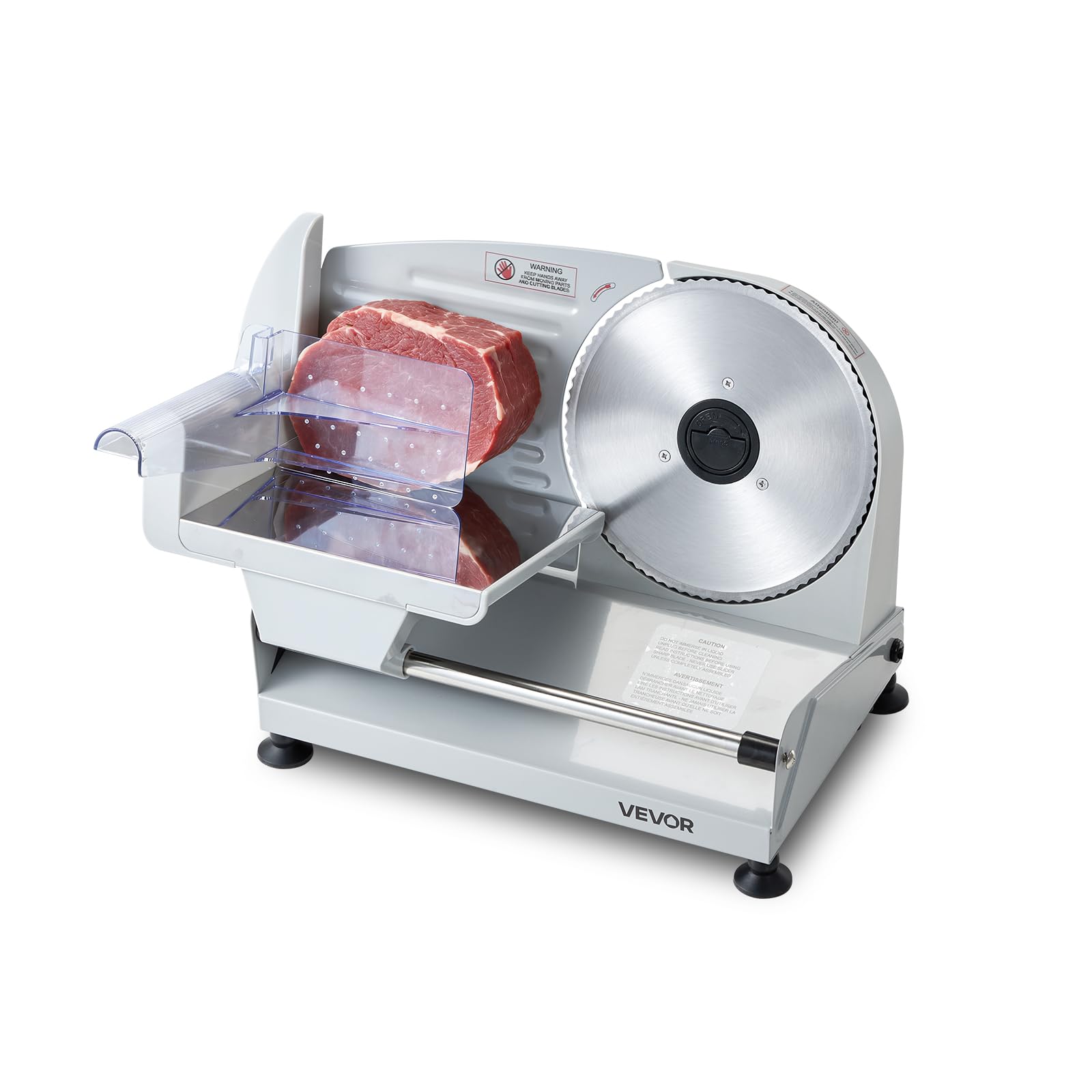
VEVOR’s 200W meat slicer is built for users who regularly slice semi-frozen meat, baguettes, or hard vegetables like carrots and potatoes. The 7.5-inch SUS420 stainless steel serrated blade cuts through tough textures without jamming, and the 200W motor maintains 70–100 RPM under load — fast enough to work through a frozen steak without stalling. The thickness knob adjusts from 0 to 0.6 inches (0–15 mm), and the adjustment mechanism feels sturdier than the plastic-dial designs on some cheaper models.
The blade is recessed 1 mm below the housing, a meaningful safety detail that reduces accidental fingertip contact during cleaning. The food pusher, blade, and slide-bar extender are removable, though the unit is marked “Hand Wash Only” — no dishwasher-safe claim here. Suction-cup feet keep the 15-inch-long base planted during vigorous slicing, and the reversible meat tray makes wiping down the top surface quick.
Compared to the FOHERE and TOKASS, the VEVOR lacks a second blade for raw/cooked separation, so you will need to wash the single blade between food types if cross-contamination is a concern. The motor is also louder than the Borlebbi’s DC unit. For cooks who prioritize raw-thawed slicing performance over quiet operation, the VEVOR delivers solid torque for the price.
Why it’s great
- 200W motor handles semi-frozen meat and hard vegetables easily
- 1 mm recessed blade design improves cleaning safety
- Sturdy thickness knob with 0.6-inch maximum range
Good to know
- Hand wash only — no dishwasher-safe parts
- No second blade for raw/cooked food separation
6. OSTBA 150W Meat Slicer

The OSTBA is the most space-conscious entry in this guide, with an 11.7-inch depth and a 6.7-inch blade that fits comfortably on a small counter or inside a crowded cabinet. The 150W motor is the lowest wattage of the seven models, and it shows — soft deli meats and room-temperature cheese slice cleanly, but any resistance from crusty bread or cold meat slows the blade significantly. For a home cook who only slices cooked ham or turkey for lunch wraps, it works fine.
The adjustable thickness dial spans 0–15 mm with a smooth turn, and the blade, food pusher, and carriage are all removable and dishwasher-safe — a rare convenience at this price point. Non-slip suction feet keep the lightweight 6.26-pound unit stable during operation, and the food pusher doubles as a blade guard for safe handling during cleaning. The compact footprint is the primary feature; it takes up barely more space than a toaster.
The 6.7-inch blade is the real limitation. You cannot slice a whole pork shoulder or large roast without trimming it first, and the smaller cutting surface means more individual passes per batch. If you slice in volume or need to process large cuts of meat, the extra dollars for a 7.5-inch blade are justified. For occasional, small-batch deli slicing, the OSTBA keeps the cost and footprint low.
Why it’s great
- Compact 11.7-inch depth fits in tight kitchens
- Dishwasher-safe parts simplify post-slice cleanup
- Lightweight at 6.26 pounds for easy storage
Good to know
- 150W motor lacks torque for frozen or dense foods
- 6.7-inch blade requires trimming large roasts to fit
7. LEM Products 7.5″ Electric Meat Slicer
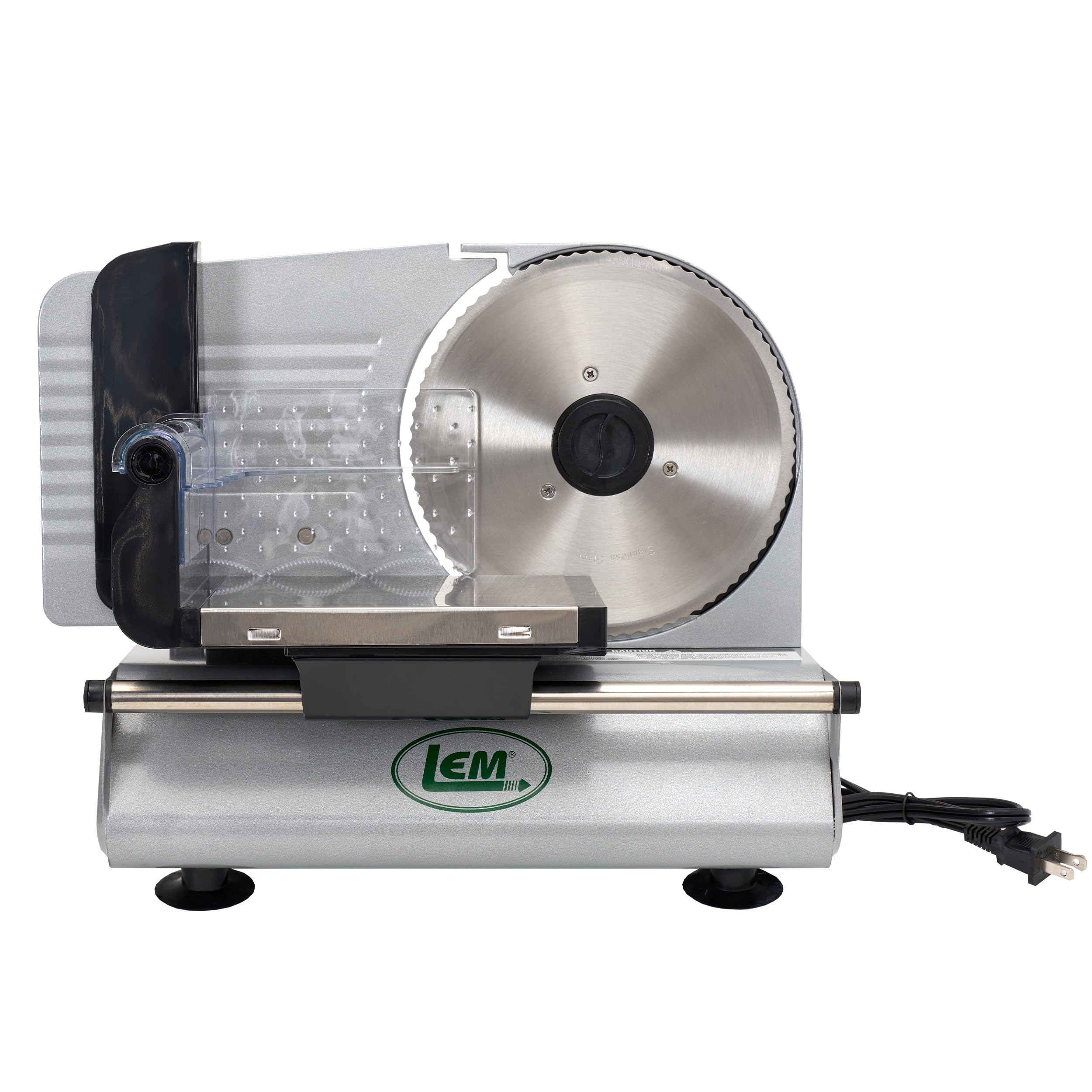
LEM Products has a strong reputation among home butchers and hunters for their meat grinders and processing gear, and this 7.5-inch slicer carries that brand trust into the budget-adjacent space. The serrated stainless steel blade handles bread, deli meat, cheese, and vegetables with consistent results, and the adjustable thickness knob provides fine-grained control over slice thickness. The build quality — a mix of metal and reinforced plastic — feels more substantial than the entry-level plastic units.
The machine does not include a second blade for raw/cooked separation, and the motor wattage is not explicitly listed in the standard specs, so performance comparison with the 200W units is harder to gauge. In practice, it slices cooked ham and turkey without complaint, but frozen or very dense items produce noticeable drag. The blade and carriage are removable for cleaning, though the unit is not dishwasher-safe.
The main knock against the LEM is that it sits at a price point where the TOKASS, Borlebbi, and FOHERE all offer more features — dual blades, higher wattage, or DC motor quietness — for a similar cost. You are paying a premium for the brand name and the assurance of decent quality control. If brand loyalty outweighs raw specs, the LEM is a safe but unremarkable pick.
Why it’s great
- LEM brand brings reliability and good customer support
- Serrated 7.5-inch blade handles bread and cheese well
- Adjustable thickness with fine control knob
Good to know
- Motor power is lower than 200W competitors
- No second blade for raw/cooked separation
FAQ
Why do budget meat slicers often have 150W motors instead of 200W?
Should I buy a serrated blade or a smooth blade for my meat slicer?
Is a DC motor worth paying extra for in a budget meat slicer?
How do I safely clean a meat slicer without cutting myself?
Final Thoughts: The Verdict
For most users, the budget meat slicer winner is the TOKASS 200W because it combines a 200W motor, two 7.5-inch high-carbon blades, a child safety lock, and a 12-month warranty at a price that undercuts the competition with fewer features. If you want a quieter kitchen, grab the Borlebbi DC Motor Slicer. And for raw-and-cooked separation with dual blades and a die-cast body, nothing beats the FOHERE 200W.