Walking past the bakery aisle for the last time feels like a small victory — no more paying four dollars for a loaf that goes stale in two days. A bread machine on a tight budget changes your pantry game, turning flour, water, and yeast into warm, crusty loaves with almost zero effort. But the budget aisle is crowded with plastic boxes that promise the world and deliver brick-like doorstops; the difference between a keeper and a dud comes down to how the machine handles the knead cycle and whether the pan can release a loaf without a fight.
I’m Mohammad Maruf — the founder and writer behind AirfryerBite. I’ve spent years dissecting small kitchen appliance specs, comparing motor wattage, pan materials, and heat distribution patterns to separate the machines that actually perform from the ones that just look good on a shelf.
Every model in this guide was chosen because it delivers real results for its price tier, and together they represent the clearest path to finding the truly best budget bread machine for your kitchen and your baking habits.
How To Choose The Best Budget Bread Machine
A cheap bread machine that bakes poorly is no bargain; the real value comes from understanding which corners can be cut safely and which specs are non-negotiable. Focus on these four areas and you will avoid the most common regret purchases.
Pan Material and Non-Stick Quality
The baking pan is the heart of the machine. A standard PTFE non-stick pan will release loaves easily for about a year before the coating starts to degrade. Ceramic pans, found on models like the VEVOR and KBS, resist scratching better and do not contain PTFE or PFOA, which matters if you bake frequently. Check whether the paddle shaft leaves a hole in the loaf and whether the sealing ring can be replaced — budget machines seldom offer replacement parts, so a well-made pan directly extends the machine’s usable life.
Preset Programs vs. Programmability
Fourteen presets sound generous, but most users cycle through only three or four: basic white, whole wheat, dough, and gluten-free. What really matters is whether the machine lets you adjust individual cycle times for kneading, rising, and baking. The KBS model’s fully programmable mode and the KITCHENARM’s “Home Made” menu give you the flexibility to adapt the machine to your own recipes — a feature that turns a budget appliance into a genuinely useful tool rather than a rigid one-trick box.
Motor Power and Build Stability
A 450-watt motor is adequate for 1-pound loaves, but kneading a stiff 2-pound whole wheat dough at speed can cause a lightweight machine to walk across the counter. The Hamilton Beach model has received feedback about excessive vibration during the knead cycle; heavier units like the OSIPOTO at over 11 pounds stay planted. For regular use, look for at least 550 watts measured at the motor and a unit weight above 9 pounds to keep the machine steady.
Heating Element Configuration
Single-bottom heaters are standard on entry-level machines, but they tend to produce loaves with a pale top crust. Dual-heater models — like the Rosewill with its 700-watt top and bottom elements — bake more evenly and create a darker, crispier crust without forcing you to flip the loaf. If crust color matters to you, a dual-heater machine is worth the slight premium even in the budget category.
Quick Comparison
On smaller screens, swipe sideways to see the full table.
| Model | Category | Best For | Key Spec | Amazon |
|---|---|---|---|---|
| KBS 19-in-1 | Premium | Full control & ceramic pan | 650W motor, ceramic pan | Amazon |
| Rosewill 25-in-1 | Premium | Dual heating & quiet run | 700W dual heater, <50dB | Amazon |
| Hamilton Beach 29987 | Mid-Range | Compact build & trusted brand | 14 presets, 2 lb capacity | Amazon |
| OSIPOTO BM8708 | Mid-Range | Stainless steel & starter kit | 17 presets, 11.35 lbs | Amazon |
| KITCHENARM 19-in-1 | Mid-Range | Custom recipes & all-purpose flour | 19 presets, Home Made cycle | Amazon |
| Elite Gourmet EBM8103B | Budget | Entry-level & 19 programs | 19 presets, 3 loaf sizes | Amazon |
| VEVOR MBF-020 | Budget | Ceramic pan on a budget | Ceramic inner pot, 19 presets | Amazon |
In‑Depth Reviews
1. KBS 19-in-1 Programmable Bread Maker

The KBS is the rare budget-adjacent machine that actually gives you professional-level control. Its fully programmable mode lets you set each phase — autolyse, rise, degas, second rise, reshape, final rise, bake — independently, which means you can adapt the machine to a stiff rye dough or a delicate brioche without guessing. The 360-degree planetary mixing paddle works the dough more thoroughly than the fixed paddles found on most budget units, and the 650-watt motor handles a full 2-pound whole wheat load without bogging down.
The ceramic pan is PTFE-, PFOA-, and PFAS-free, and the 3,000-degree Fahrenheit firing process gives it excellent thermal conductivity for even browning. The PID and NTC temperature control system locks the dough temperature near 100 degrees Fahrenheit during the rise, which directly translates to a taller, airier crumb structure rather than the dense bricks cheaper machines produce. The stainless steel build is heavy enough to stay planted during the knead cycle, and the 15-hour delay timer plus 60-minute keep-warm function cover the convenience bases competently.
At just over 12 pounds, this machine does not feel flimsy, and the 2-year after-sales service adds peace of mind that most budget brands skip entirely. The only real compromise is the relatively compact 8-inch depth, which limits the loaf shape slightly compared to a horizontal machine.
Why it’s great
- Fully programmable cycle times for custom recipes
- Ceramic non-stick pan with no PTFE or PFOA
- 650-watt motor and 360-degree planetary mixing
Good to know
- Compact footprint limits loaf shape options
- Higher price point than true entry-level machines
2. Rosewill 25-in-1 Automatic Bread Maker
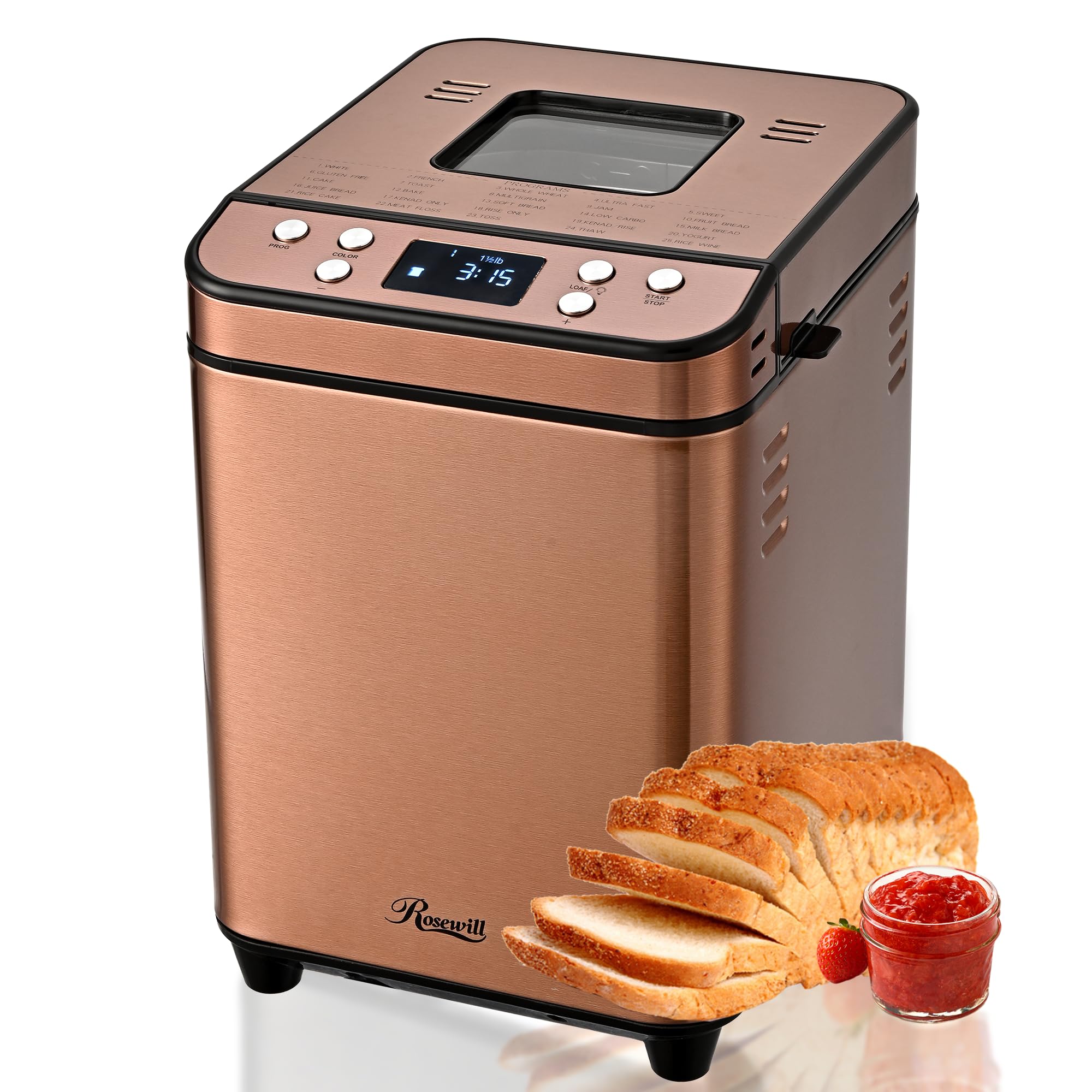
The Rosewill stands out because it packs dual top-and-bottom 700-watt heaters that deliver genuinely even browning across the entire crust — not just the bottom and sides. This matters for anyone who has pulled a loaf from a single-heater machine only to find a pale, soft top that collapses when sliced. The 25 preset programs include gluten-free, cake, yogurt, and jam, and the BPA-free non-stick pan makes cleanup straightforward.
Noise is a genuine pain point with many budget machines, but Rosewill claims motor operation below 50 decibels, which is quiet enough to run overnight without disturbing sleep. The 15-hour delay timer and 40-minute power recovery feature (if the power cuts for less than 40 minutes, the machine resumes the cycle from where it stopped) add real convenience for busy households. The cinnamon-colored finish is an unusual design choice that stands out on the counter, and the 8.8-pound weight is moderate — it won’t walk around as aggressively as a lighter plastic unit, but it’s still portable enough to store in a cabinet.
The machine supports three crust colors and three loaf sizes up to 2 pounds, and the dual-heater design means you can trust the dark crust setting to actually deliver a crunchy exterior rather than just a slightly darker top. The main tradeoff is that the pan is not dishwasher-safe — hand washing is required — and the plastic exterior feels less premium than the stainless steel on the KBS or OSIPOTO.
Why it’s great
- Dual top and bottom heaters for even browning
- Quiet operation below 50 decibels
- 40-minute power interruption recovery
Good to know
- Pan must be hand washed only
- Plastic body feels less durable than steel models
3. Hamilton Beach Digital Bread Maker (29987)

Hamilton Beach is a name that carries weight in the budget appliance space, and the 29987 model justifies the reputation with a straightforward, no-fuss design. The 14 presets cover the essentials — basic, French, whole grain, gluten-free, artisan dough, and a 1-pound express cycle that bakes a loaf in under an hour. The removable non-stick pan and kneading paddle are both dishwasher-safe, which makes this one of the easiest machines to clean in the entire guide.
At just over 9 pounds and with a compact footprint, this machine fits easily on a small counter or in a crowded cabinet. The delay timer lets you set the start up to 13 hours in advance, and the three crust shades (light, medium, dark) give you decent control over the final result. The express cycles are genuinely useful for last-minute bread needs, though the texture won’t match a full-length cycle loaf.
Some users report that the lightweight build causes the machine to vibrate noticeably during the knead cycle, especially with stiff doughs. The motor is not as powerful as the 650-watt units, so a 2-pound whole wheat loaf may struggle compared to a standard white loaf. It also runs louder than the Rosewill, which is a consideration if you plan to bake overnight.
Why it’s great
- Dishwasher-safe pan and paddle for easy cleanup
- Express cycles bake a loaf in under an hour
- Compact and lightweight for small kitchens
Good to know
- Vibrates significantly during kneading
- Motor struggles with dense whole wheat doughs
4. OSIPOTO 17-in-1 Bread Machine (BM8708)
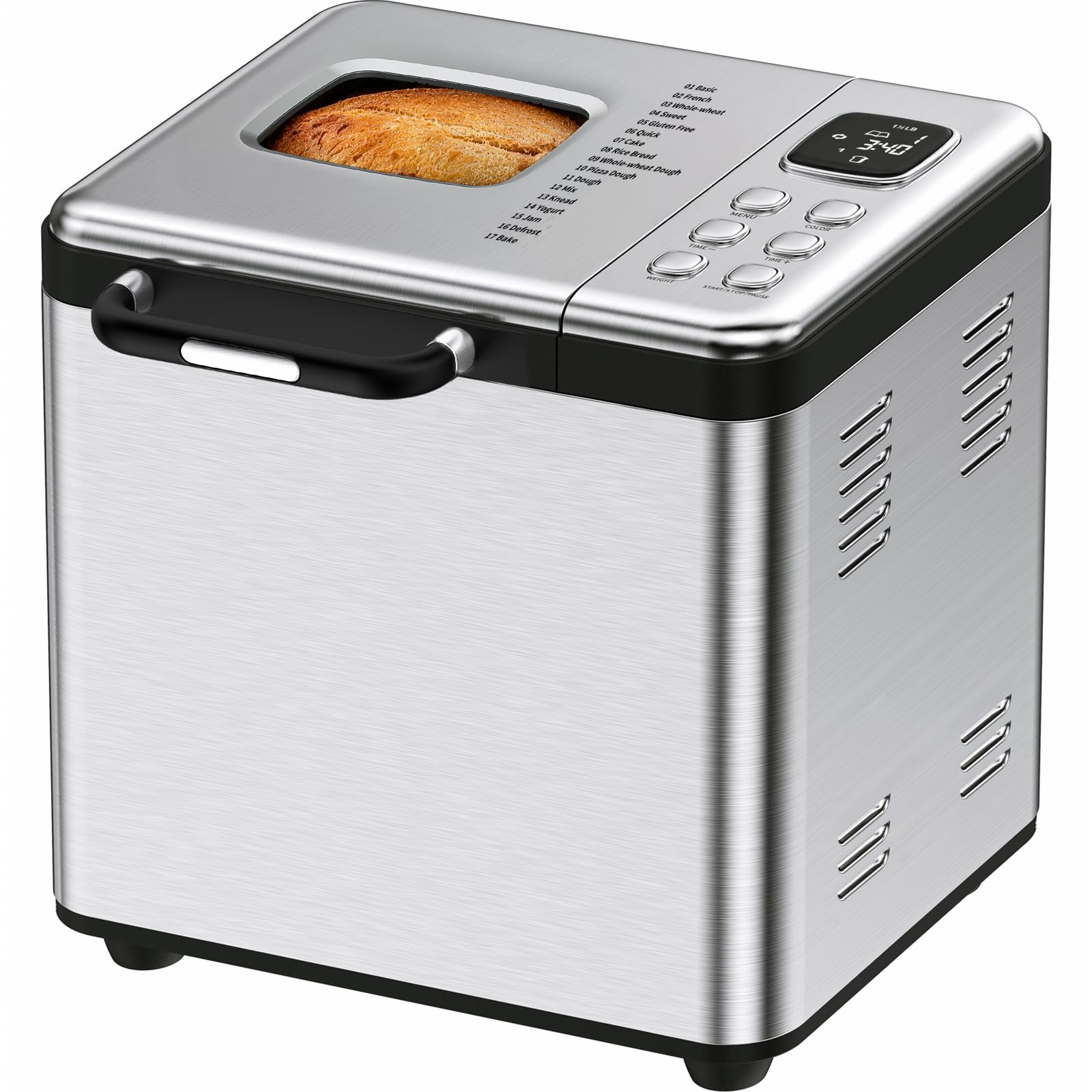
The OSIPOTO is built like a tank for its price tier — the stainless steel exterior and 11.35-pound weight give it a solid, premium feel that cheaper plastic machines lack entirely. The 17 preset programs include French, whole wheat, sweet, quick bread, pizza dough, cake, and jam, and the three crust shades (light, medium, dark) allow some customization. The non-stick pan is well-coated and releases loaves cleanly without scraping.
What sets this machine apart is the comprehensive starter kit: you get a measuring cup, a measuring spoon, a kneading paddle, a removable hook, and a recipe book tailored to the machine. This is a genuine help for first-time bread makers who do not want to guess ingredient quantities or cycle timings. The 15-hour delay timer and 60-minute keep-warm function work reliably, and the digital interface is intuitive enough that a novice can produce a decent loaf on the first try.
The motor is adequately powerful for standard 2-pound loaves, but the OSIPOTO lacks the dual-heater configuration found on the Rosewill, so the top crust may be paler than the sides and bottom. The machine is also fairly tall at nearly 14 inches, which could be an issue if you store it under low cabinets. The 2-year warranty is a nice bonus for a mid-range machine.
Why it’s great
- Heavy stainless steel build stays planted on counter
- Complete starter kit included
- Intuitive digital interface for beginners
Good to know
- Single heater yields pale top crust
- Tall profile may not fit under low cabinets
5. KITCHENARM 19-in-1 Handy Bread Machine
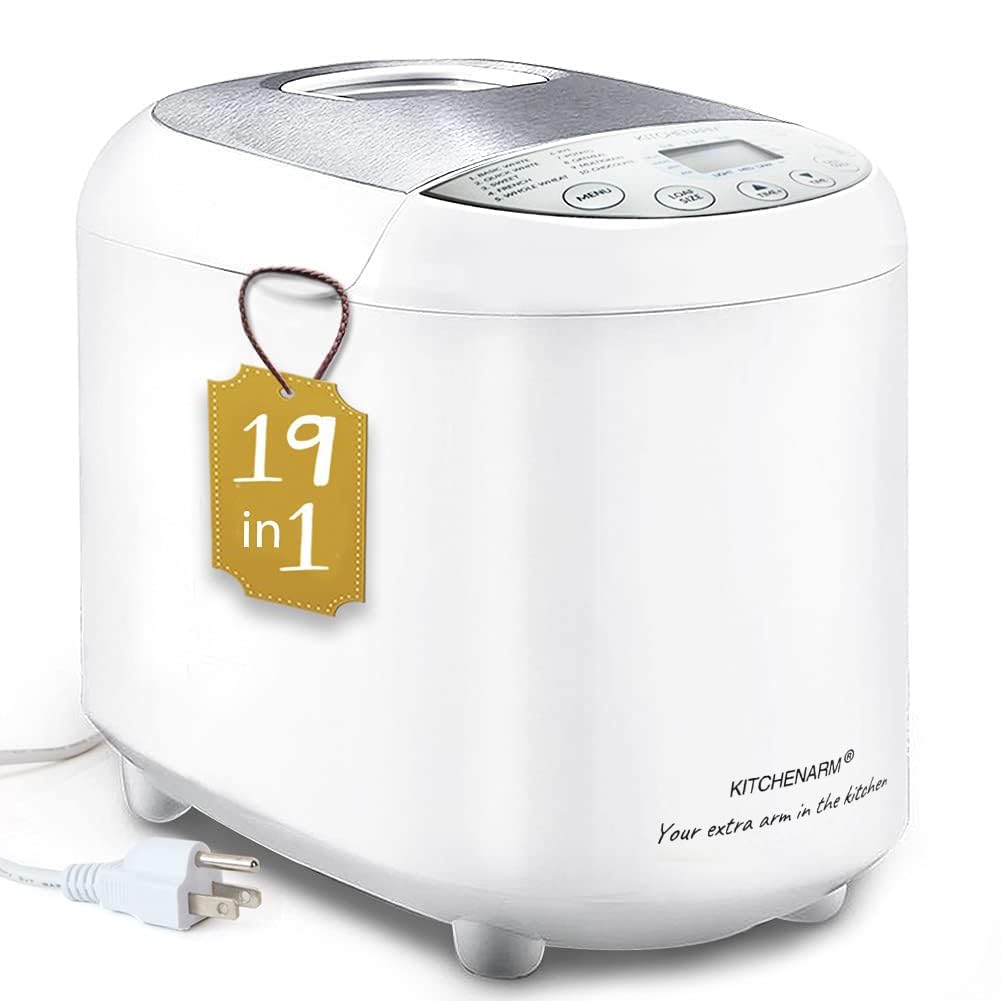
The KITCHENARM is designed for bakers who want to push past the standard recipes and experiment with fresh ingredients. The Home Made cycle (Menu 19) lets you set individual times for kneading, resting, rising, and baking, which opens the door to recipes that use fresh onions, potatoes, overripe bananas, or zucchini — ingredients that would throw off a fixed-cycle machine. The machine also supports all-purpose flour for lower-gluten loaves, which is a thoughtful addition for health-conscious users.
The 19 presets cover 11 bread menus (basic white, sweet, French, whole wheat, gluten-free, multigrain, sourdough) and 7 non-bread menus (cake, jam, yogurt, dough). The machine saves your most recent settings for one-press operation, which is a minor but appreciated convenience for repeat bakes. The stainless steel lid and silver control panel give it a clean, modern look that fits well in most kitchens.
One notable omission is the lack of a dual-heater configuration — this is a single-bottom heater machine, so the top crust will not be as deeply browned as on the Rosewill or the KBS. The Teflon-coated pan is functional but not as durable as a ceramic option, and the 2-year warranty is standard rather than exceptional. The plastic body feels less premium than the OSIPOTO or KBS, but the raw functionality is strong for the price.
Why it’s great
- Fully programmable Home Made cycle for custom recipes
- Supports all-purpose flour and fresh ingredients
- Settings memory for one-press repeat bakes
Good to know
- Single heater produces pale top crust
- Plastic body not as sturdy as steel alternatives
6. Elite Gourmet Programmable Bread Maker (EBM8103B)

The Elite Gourmet EBM8103B is the definition of a no-regret entry point into bread baking. For a very accessible price, you get 19 preset programs — including gluten-free, white, wheat, rye, French, sweet, quick bread, pizza dough, cake, and jam — plus three loaf size options (1, 1.5, and 2 pounds). The 15-hour delay timer and 60-minute keep-warm function mean you can set it up before bed and wake up to a warm loaf without any early-morning work.
The compact footprint at under 10 inches wide fits on crowded counters, and the aluminum body is light enough to move around easily. The non-stick pan and paddle are both dishwasher-safe, which removes the biggest friction point for new bakers who dread scrubbing dried dough. The US-based customer support team responds quickly, which is a rare perk at this price level.
The motor is adequate for white and light wheat loaves, but it will struggle with dense doughs like 100% whole wheat or rye at the 2-pound setting. The aluminum pan is basic and does not retain heat as evenly as a ceramic pan, which can lead to uneven browning. The build quality is functional rather than premium, and the machine may shift on the counter during the knead cycle.
Why it’s great
- 19 presets at an entry-level price point
- Dishwasher-safe pan and paddle
- Compact footprint for small kitchens
Good to know
- Motor struggles with dense doughs at 2 pounds
- Aluminum pan heats less evenly than ceramic
7. VEVOR 19-in-1 Bread Maker (MBF-020)

The VEVOR stands out in the budget segment for one specific reason: it uses a food-grade ceramic inner pot rather than the standard PTFE-coated aluminum pan. Ceramic is more scratch-resistant, does not release harmful substances at high temperatures, and remains non-stick even after extended use. For bakers who prioritize food safety or who have concerns about traditional non-stick coatings, this is a meaningful advantage at a price that undercuts most ceramic-pan competitors.
The machine offers 19 preset programs, three loaf sizes (1, 1.5, and 2 pounds), three crust colors, a 15-hour delay timer, a 1-hour keep-warm function, and a power interruption memory that resumes the cycle within 15 minutes of an unexpected outage. The ingredient addition reminder beeps when it is time to add mix-ins like nuts or dried fruit, which prevents the common mistake of ingredients being kneaded into mush.
The outer body is plastic rather than stainless steel, and the 9.4-pound weight is moderate but not heavy enough to fully suppress vibration during kneading. The mixing blades are made of food-grade Teflon rather than ceramic, which creates a mismatch in material quality. The instruction manual is sparse, so beginners may need to look up online resources for the first few bakes. The ceramic pan is dishwasher-safe, though hand washing is recommended to preserve the coating.
Why it’s great
- Food-grade ceramic pan at a budget price
- Ingredient addition reminder for mix-ins
- Power interruption recovery within 15 minutes
Good to know
- Plastic body feels less premium than steel
- Mixing blades are Teflon, not ceramic
FAQ
Can a budget bread machine handle gluten-free dough reliably?
Why does my budget bread machine produce a dense, short loaf?
Is a ceramic pan worth the extra cost on a budget machine?
What does the delay timer actually do, and is it reliable on cheap machines?
Final Thoughts: The Verdict
For most users, the best budget bread machine winner is the KBS 19-in-1 because it delivers a fully programmable cycle, a ceramic pan, and a strong 650-watt motor at a price that undercuts premium brands by a wide margin. If you want quiet operation and even dual-heater baking, grab the Rosewill 25-in-1. And for a compact, brand-trusted entry point with dishwasher-safe parts, nothing beats the Hamilton Beach 29987.