The difference between a bakery-quality loaf and a brick isn’t your recipe — it’s your gear. Dense dough, uneven slices, and a crust that shatters instead of cracks are the hard evidence of using the wrong tools. The right bread making tools solve for consistent fermentation, even heat distribution, and clean, uniform cuts every time.
I’m Mohammad Maruf — the founder and writer behind AirfryerBite. I’ve spent years analyzing the hardware behind artisan baking, from the thermal mass of cast iron to the tensile strength of proofing basket rattan, to find what actually produces repeatable results.
Whether you are perfecting a sourdough starter or slicing a fresh loaf for Sunday breakfast, having the best bread making tools means fewer failed bakes and more time enjoying the aroma of fresh bread in your kitchen.
How To Choose The Best Bread Making Tools
Bread making is an exercise in precision: hydration ratios, fermentation timing, and oven spring all depend on controlling variables. The wrong tool introduces a variable you didn’t plan for — a banneton that sticks, a lame that tears, or a slicer that crushes the crumb. Here’s what to look for when assembling your kit.
Proofing Basket Material and Construction
Not all bannetons are equal. Indonesian rattan or coiled cotton rope are the industry standards because they wick surface moisture from the dough, forming a dry skin that holds shape during the final proof. Avoid plastic-coated or heavily varnished baskets — they trap steam and cause dough to stick. Look for a liner included so high-hydration doughs (above 80%) release cleanly.
Bread Lame Blade Sharpness
Scoring depth and cleanliness determine oven spring. A lame with replaceable stainless steel razor blades that sit at a 15- to 20-degree edge angle cuts through the dough membrane without dragging. Avoid fixed-blade lames or those with dull serrations — they compress the gluten network before the cut, resulting in a ragged ear and reduced rise.
Dutch Oven Thermal Mass and Coating
A thick-walled cast iron dutch oven traps steam from the dough itself, replicating a professional steam-injected deck oven. The key spec is the enamel coating: bare cast iron requires meticulous seasoning and reacts with acidic preferments; enameled cast iron provides a non-reactive surface that is easier to clean and still retains heat evenly. Minimum thickness at the base should be 4.5 mm to avoid hot spots.
Slicer Build and Blade Material
A manual bread slicer must hold the loaf rigidly to prevent wobble. Look for a solid wood or aluminum base with an adjustable guide that can accommodate loaves up to 7 inches tall. The blade should be high-carbon stainless steel, replaceable, and sharpened to a serrated or scalloped edge that saws through a crusty exterior without compressing the interior crumb.
Quick Comparison
On smaller screens, swipe sideways to see the full table.
| Model | Category | Best For | Key Spec | Amazon |
|---|---|---|---|---|
| CRUSTLOVE Dutch Oven Kit | Prem. Kit | All-in-one baking | 5 QT cast iron dutch oven | Amazon |
| VORRINGARD Dutch Oven | Premium | Crispy crust loaves | 5 QT enameled cast iron | Amazon |
| Brvclon Manual Bread Slicer | Mid-Range | Uniform slicing | 0–0.9″ adjustable thickness | Amazon |
| HOSHANHO Bread Knife | Premium | Clean crust cutting | 8″ Japanese 10Cr15CoMoV steel | Amazon |
| KneadAce Sourdough Starter Kit | Mid-Range | Beginner sourdough | 24 oz jar + 2 cotton bannetons | Amazon |
| ABIOTO Sourdough Kit | Mid-Range | Complete artisan kit | 10″ round & 11″ oval bannetons | Amazon |
| Kiss Core Bread Slicer | Budget | Compact storage & slicing | 9L bread box + adjustable guide | Amazon |
In‑Depth Reviews
1. CRUSTLOVE Cast Iron Dutch Oven Bread Baking Kit

The CRUSTLOVE kit is the closest you can get to a full bakery setup in one box. The 5-quart pre-seasoned cast iron dutch oven provides the thermal mass required for a professional-grade oven spring — the thick walls trap steam from the dough, creating that signature crispy crust and open crumb structure. The kit also includes a 10-inch banneton proofing basket, a silicone bread sling for transferring high-hydration doughs without deflating them, and a scoring lame with replaceable blades.
The included stainless steel dough whisk and dual scrapers (metal and plastic) cover every stage of the process, from mixing to shaping to cleaning the work surface. The starter booklet includes both English and Spanish recipes, which is helpful for dialing in hydration levels and bake times. The 5-quart capacity handles standard 500-gram flour loaves with room to spare.
One trade-off: the cast iron is heavy at over 12 pounds, and the lid handle gets hot during the initial 500°F preheat. Use oven mitts rated for high heat. The bare cast iron interior requires seasoning maintenance if you bake acidic doughs frequently, though the pre-seasoning holds up well through the first several bakes.
Why it’s great
- Complete 11-piece kit eliminates piecemeal buying
- Pre-seasoned cast iron produces reliable oven spring
- Silicone sling prevents dough collapse during transfer
Good to know
- Heavy construction; requires care when handling hot
- Bare cast iron needs seasoning maintenance
2. VORRINGARD Enameled Cast Iron Sourdough Bread Oven
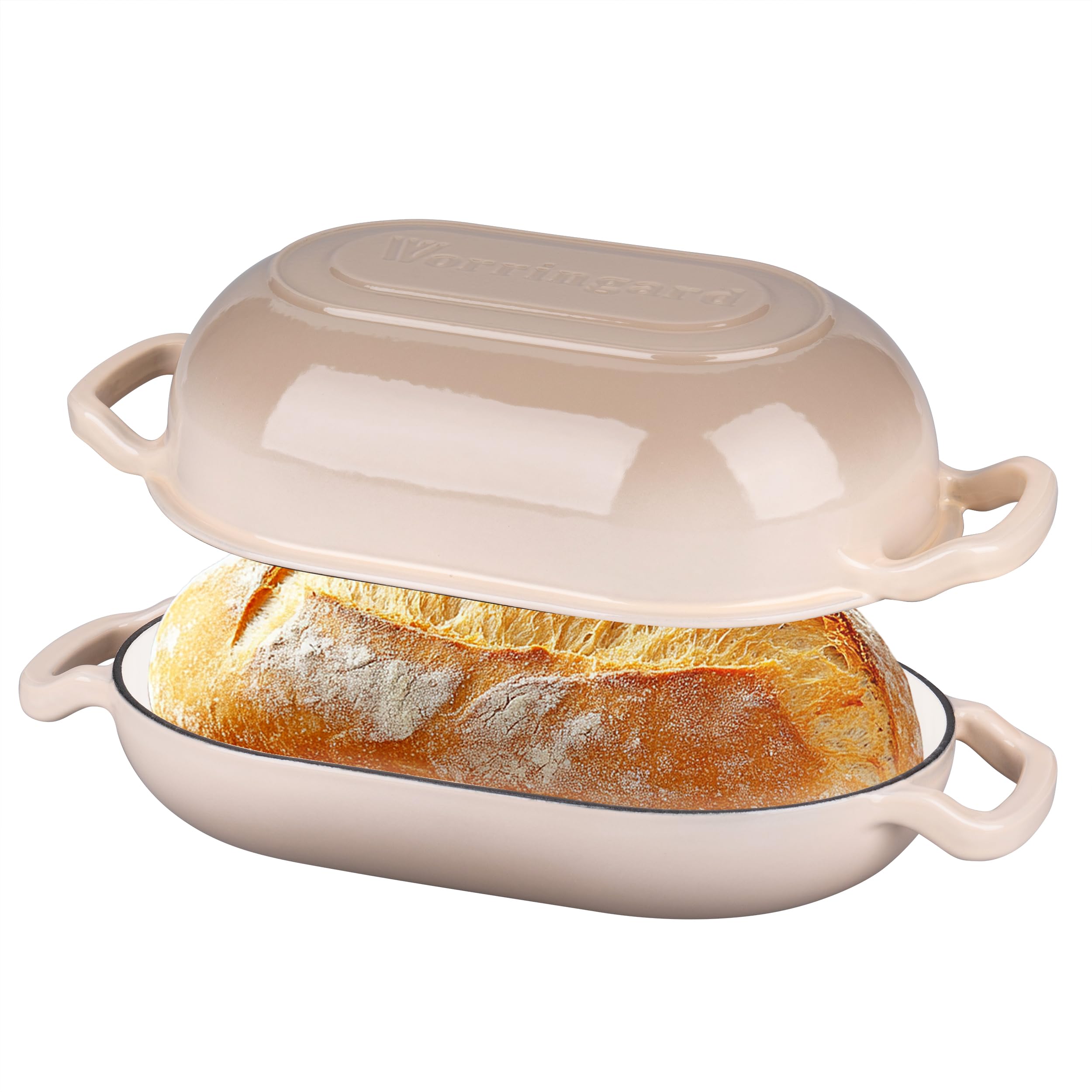
The VORRINGARD dutch oven solves a common problem for bakers who prefer acidic sourdough starters: enameled cast iron won’t react with the lactic and acetic acids produced during long fermentation. The 5-quart round pot with looped handles distributes heat evenly from base to rim, which is critical for avoiding a burnt bottom while the top remains underdone. The latte-colored enamel exterior looks clean on a counter and does not discolor over time.
Oven safety up to 500°F means you can preheat the pot empty to guarantee that the dough hits a hot surface immediately — the key to a dramatic oven spring. The lid traps steam efficiently, so you do not need to add ice cubes or spray water. The enamel interior rinses clean with warm soapy water, and metal utensils should be avoided to prevent chipping the coating.
Note that the 5.81-kilogram weight makes this a stationary pot — it is not practical to move it from stovetop to oven constantly. Use it as a dedicated bread baker: preheat, drop the dough in, cover, bake, then remove the lid for the final browning phase. The looped side handles are wide enough to grip with thick oven mitts.
Why it’s great
- Enameled interior is non-reactive with sourdough
- Even heat distribution prevents scorched crust
- Oven-safe to 500°F for steam-injection effect
Good to know
- Heavy; not ideal for frequent stove-to-oven moves
- Hand wash only; avoid metal utensils
3. Brvclon Manual Bread Slicer Adjustable Thickness
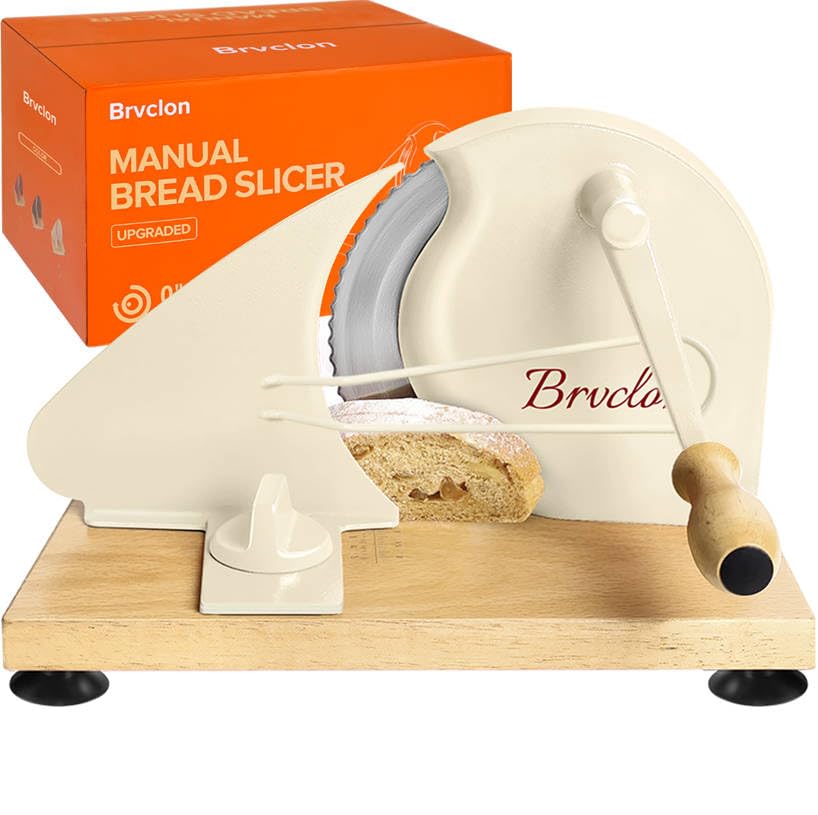
The Brvclon slicer addresses the most frustrating part of home bread making: cutting a freshly baked loaf without crushing the crumb. The hand-crank mechanism drives a stainless steel blade through the crust with a sawing motion rather than a pressing motion, preserving the air pockets in sourdough and sandwich loaves. The adjustable thickness guide goes from zero to 0.9 inches, with clear scale markings so you can repeat the same slice size every time.
The base is built from Southern Oak wood with an aluminum structure, giving it enough mass to stay put on the counter. Four suction cups on the bottom prevent sliding even when you apply force to crank through a crusty boule. The blade is removable and replaceable — after several months of weekly use, you can swap it out rather than replacing the whole unit. The compact footprint (13.8 x 11.3 inches) fits under standard upper cabinets.
The main limitation is that the slicer works best with loaves that fit within the guide width — baguettes or oversized batards may need to be sliced diagonally by hand. Hand wash only; the wood base should not be submerged. The included gift-level packaging makes it a strong option for gifting to a baker who already has a dutch oven but lacks consistent slicing.
Why it’s great
- Hand-crank mechanism prevents crumb compression
- Suction cups hold slicer stable during use
- Replaceable blade extends product lifespan
Good to know
- Not ideal for very long or odd-shaped loaves
- Wood base requires hand washing and drying
4. HOSHANHO Bread Knife 8 Inch Japanese Steel

The HOSHANHO bread knife is a precision tool built for bakers who refuse to settle for torn crusts. The blade is forged from Japanese 10Cr15CoMoV high-carbon stainless steel — a composition with added cobalt and molybdenum that increases edge retention significantly compared to standard 440-series steel. Each serration is ground to a 15-degree edge angle, meaning the scalloped teeth penetrate a hard crust without the lateral force that causes a loaf to squish or crack.
The 8-inch blade length is the sweet spot for standard sandwich loaves and boules up to 6 inches tall. The Pakkawood handle is shaped with an ergonomic curve that aligns the wrist naturally during a sawing motion. At only 8 ounces, the knife is light enough for extended slicing sessions without hand fatigue, but the full tang construction gives it enough heft to cut through dense rye or pumpernickel.
This knife is not dishwasher safe — the high-carbon steel can discolor and the Pakkawood handle will dry out with repeated machine washing. Hand wash and dry immediately. The blade does not come with a sheath, so store it in a knife block or magnetic strip to protect the serrated edge. It is a single-purpose tool but performs that purpose better than any multi-purpose chef’s knife.
Why it’s great
- Japanese high-carbon steel holds edge longer
- 15-degree serration cuts crust without crushing
- Lightweight ergonomic handle reduces fatigue
Good to know
- Hand wash only; not dishwasher safe
- No storage sheath included
5. KneadAce Sourdough Starter Kit
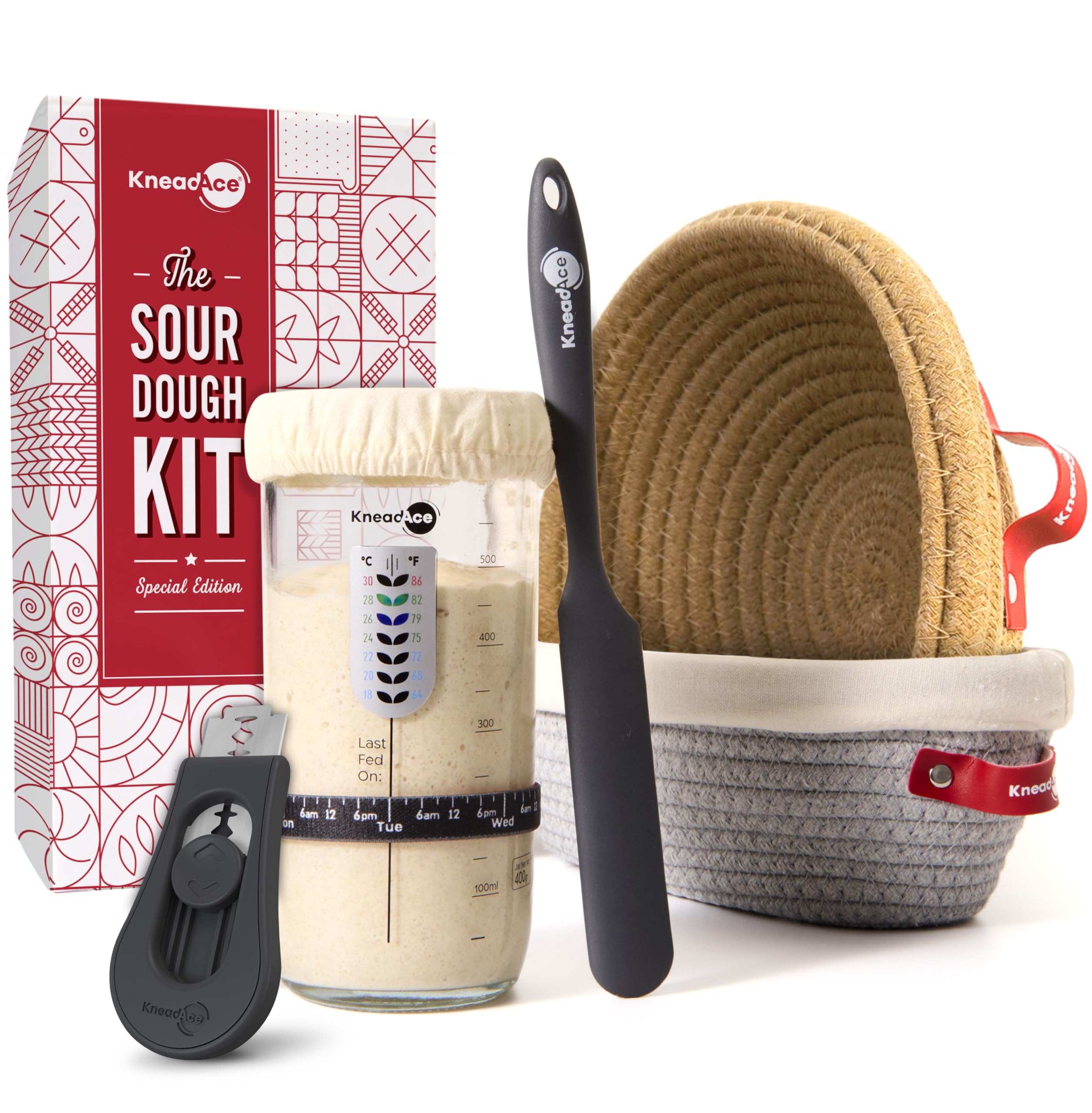
The KneadAce kit focuses on the two most critical phases of sourdough: maintaining a healthy starter and shaping the dough during the final proof. The 24-ounce glass jar includes a feeding day tracker and a thermometer strip on the side, so you can monitor starter activity without opening the lid. The cloth cover and aluminum lid allow you to switch between aerobic and anaerobic fermentation depending on your feeding schedule.
The two cotton rope bannetons (9-inch round and 10-inch oval) are machine washable, which is a significant advantage over rattan baskets that absorb moisture and can develop mold. The rope construction allows air circulation around the dough, forming a dry skin that holds the loaf shape during the final proof. The kit also includes a magnetic bread lame with razor-sharp replaceable blades for scoring, a silicone spatula, and an elastic band for tracking the jar.
The kit does not include a dutch oven or baking vessel, so you will need to source one separately for the actual bake. The cotton bannetons are softer than rattan and may not hold the shape of very high-hydration doughs as firmly. The included instructions are basic — absolute beginners may want to supplement with an online sourdough guide for hydration ratios and timing.
Why it’s great
- Starter jar includes thermometer and feeding tracker
- Bannetons are machine washable for easy maintenance
- Magnetic lame with replaceable blades included
Good to know
- Baking vessel not included
- Cotton bannetons less firm than rattan
6. ABIOTO Sourdough Kit with Professional Tools
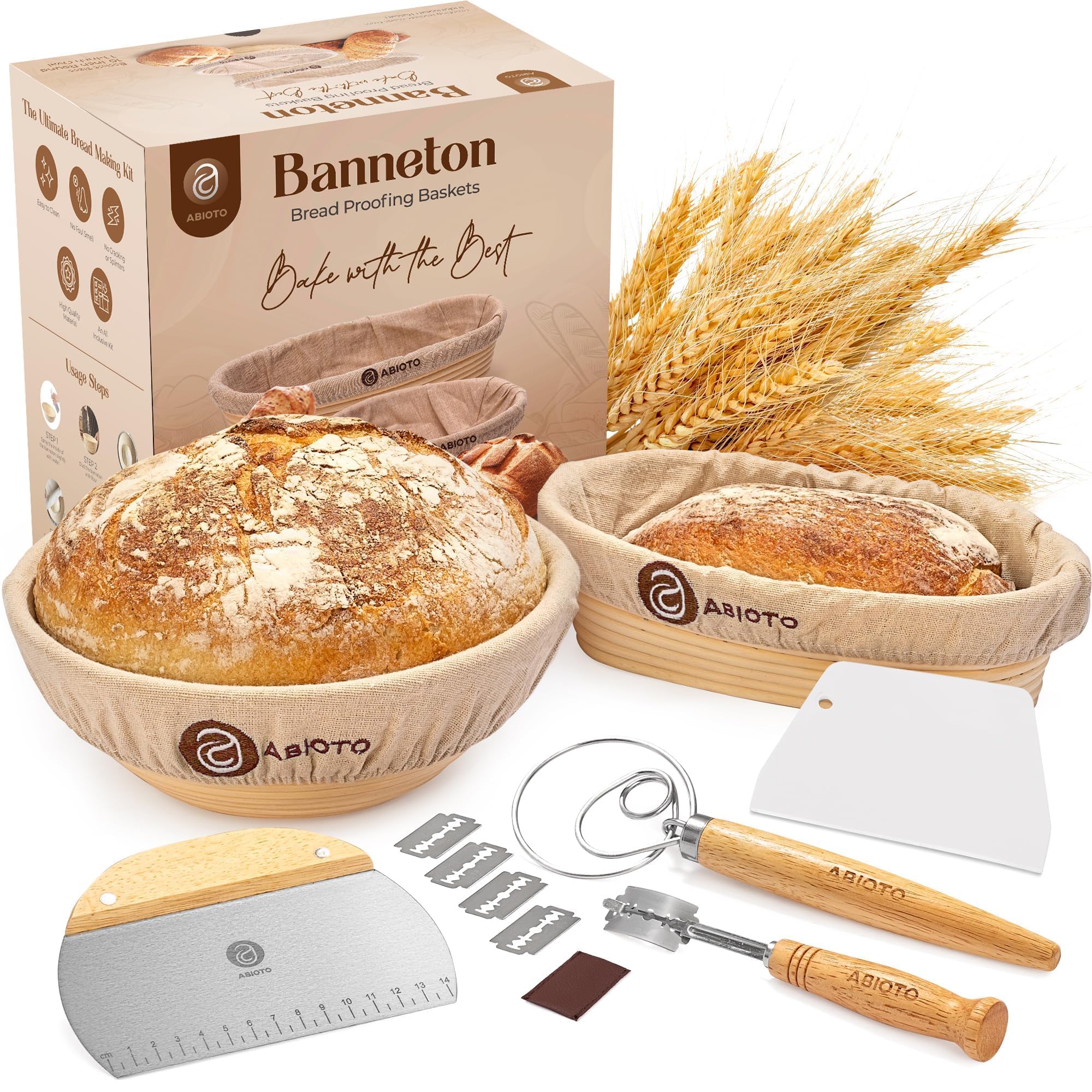
The ABIOTO kit leans into traditional craftsmanship with its Indonesian rattan proofing baskets. Rattan is the benchmark material for bannetons because its natural porosity wicks moisture from the dough surface, creating a thin skin that holds the loaf shape during the final proof and produces the characteristic flour rings on the baked crust. The kit includes both a 10-inch round and an 11-inch oval basket, each with a removable liner for easy cleaning.
The remaining tools cover every step of the sourdough process: a stainless steel bread lame with replacement blades for scoring, a stainless steel dough scraper for dividing and bench work, a plastic bowl scraper for folding dough inside the mixing bowl, and a Danish whisk with a wooden handle that mixes high-hydration doughs without the dough balling up around a traditional spoon. The wooden handle on the whisk provides a comfortable grip that does not conduct heat from your hand.
This kit is designed for bakers who prefer the traditional rattan experience and are willing to maintain it — rattan should be dried thoroughly after each use and never submerged in water. The kit does not include a starter jar or thermometer, so you will need to buy those separately if you are building a starter from scratch. The included instructions are straightforward but assume basic familiarity with sourdough terminology.
Why it’s great
- Natural Indonesian rattan wicks moisture effectively
- Two basket sizes for versatile loaf shapes
- Danish whisk handles sticky high-hydration doughs well
Good to know
- Rattan requires careful drying; not submersible
- No starter jar or thermometer included
7. Kiss Core Upgrade Bread Slicer with Bread Box

The Kiss Core bread slicer solves two problems at once with its 2-in-1 design: a foldable cutting guide that sits on top of a 9-liter bread box. The bread box stores a full loaf, bagels, or pastries on the counter or in the fridge, while the adjustable guide offers six width settings to accommodate baguettes, small loaves, or standard sandwich bread. The cutting area measures 12.8 inches long, which fits most homemade loaf shapes.
The guide is made of high-quality PP plastic that is heat-resistant and non-barbed — no sharp edges that could scratch countertops or cut your hands during assembly. The crumb tray doubles as the bread box lid, so crumbs from slicing drop directly back into the box for easy disposal. The entire unit is dishwasher safe, which simplifies cleanup after a sticky slicing session. At just 2 pounds, it is easy to move between counter and cabinet.
The plastic construction means this is not a heavy-duty slicer for dense rye or crusty artisan loaves — it works best with sandwich-style bread, soft sourdough, and cakes. The cutting guide produces a fixed slice thickness of roughly 0.47 inches per slot, which is consistent but not infinitely adjustable like a hand-crank slicer. The bread box itself is opaque, so you cannot see how much bread remains without opening the lid.
Why it’s great
- Stores and slices in one compact footprint
- Dishwasher safe for easy cleanup
- Lightweight and foldable for storage
Good to know
- Fixed slot thickness; not adjustable per slice
- Plastic build best for soft to medium-density loaves
FAQ
Do I need a separate dutch oven for bread baking or can I use any heavy pot?
How often should I replace the blade on a bread lame?
Can I use a serrated bread knife to slice a loaf that is still warm?
Final Thoughts: The Verdict
For most users, the best bread making tools winner is the CRUSTLOVE Dutch Oven Kit because it packs every essential — oven, proofing basket, lame, scrapers, and whisk — into a single purchase that takes a beginner from mixing to slicing. If you want enameled non-reactive performance for regular sourdough baking, grab the VORRINGARD Dutch Oven. And for consistent, crush-free slicing without a separate bread knife, nothing beats the Brvclon Manual Bread Slicer.