You’ve hiked six miles with a full pack, and all you want is a hot meal, but your stove struggles against the wind and eats through fuel before your water even reaches a simmer. The difference between a miserable trail meal and a satisfying backcountry dinner comes down to one piece of gear: the stove that lives in your pack. Choosing the right one means facing a maze of specs like boil time, BTU output, and fuel compatibility, while weighing ounces against durability.
I’m Mohammad Maruf — the founder and writer behind AirfryerBite. I’ve spent years analyzing outdoor gear hardware specifications, cross-referencing independent burn tests, and studying real-world user reports to separate marketing claims from genuine performance.
Building a reliable backcountry kitchen starts with finding the best backpacking camp stove for your specific style, from ultralight canister stoves to multifuel workhorses and wood-burning alternatives.
How To Choose The Best Backpacking Camp Stove
The ideal stove balances weight, fuel availability, boil speed, and wind resistance. A stove that performs on paper can fail when a gust hits your campsite. Focus on the three factors that actually determine trail success: fuel type, weight, and regulator design.
Fuel Type Determines Your Range
Isobutane-propane canisters offer instant lighting and clean burning but lose pressure below freezing. Liquid fuel stoves burn white gas, kerosene, or unleaded gasoline directly from a refillable bottle, delivering reliable performance in subzero conditions but requiring priming. Wood-burning stoves eliminate the need to carry fuel entirely at the cost of longer boil times and soot. Your decision should mirror your typical environment and trip length.
Weight vs. Stability Tradeoff
A sub-3-ounce canister stove saves ounces but often uses narrow pot supports that tip under larger cookware. Heavier designs with wider burner heads and integrated pot supports improve stability and wind resistance. Every ounce you add to the stove you must carry for every mile, so match the stove’s physical footprint to the pot size you actually bring.
Wind Resistance and Boil Time
Wind is the greatest thief of efficiency. A stove rated at 11,000 BTU can take four times longer to boil water in a 10-mph breeze without a windscreen. Pressure-regulated stoves maintain consistent output even when the canister is half empty or the temperature drops. Look for models with built-in wind protection or a concave burner design that shields the flame.
Quick Comparison
On smaller screens, swipe sideways to see the full table.
| Model | Category | Best For | Key Spec | Amazon |
|---|---|---|---|---|
| MSR PocketRocket Deluxe | Canister | Ultralight reliability with regulation | 2.9 oz, Pressure Regulated | Amazon |
| SOTO WindMaster with 4Flex | Canister | Extreme wind resistance | 2.3 oz, 11,000 BTU | Amazon |
| Jetboil MightyMo | Canister | Simmer control in small package | 2.1 oz, 4-Turn Regulator | Amazon |
| SOTO Amicus | Canister | Budget-friendly performance | 8.8 oz, 11,000 BTU | Amazon |
| Fire-Maple Blade 2 | Canister | Cold-weather remote canister use | 4.76 oz, Pre-Heat Tube | Amazon |
| Fire-Maple Star X2 Pro | Integrated System | All-in-one boil efficiency | 19.8 oz, 1L Pot Included | Amazon |
| Jetboil Flash | Integrated System | Fast, foolproof water boiling | 0.82 lb, 2-Minute Boil | Amazon |
| MSR WhisperLite International | Multifuel | Global fuel flexibility | 11.2 oz, Multi-fuel | Amazon |
| TOAKS Titanium Wood Stove | Wood Burning | Fuel-free ultralight trips | 7.9 oz, Titanium Build | Amazon |
In‑Depth Reviews
1. MSR PocketRocket Deluxe

The MSR PocketRocket Deluxe occupies the sweet spot where ultralight weight meets genuine performance features. At just 2.9 ounces, this canister stove packs a built-in pressure regulator that maintains consistent output when the canister is cold or partially empty — a feature typically reserved for heavier models. The push-start piezo igniter sits protected within the burner, so it won’t snap off when you jam the stove into a pot for storage.
MSR claims a 3.5-minute boil time for one liter, and independent tests consistently validate that number in calm conditions. The broad burner head improves wind resistance over the non-deluxe version, though you’ll still want a windscreen for anything beyond a light breeze. The folding pot supports grip smaller cookware securely, but the narrow stance can feel tippy with a 1.5-liter pot full of water.
This stove excels for the gram-conscious backpacker who refuses to sacrifice simmer capability and reliable cold-weather performance. The three-year warranty backs the investment, and the included stuff sack keeps everything organized. For the weight-to-performance ratio, this remains the benchmark that other canister stoves are measured against.
Why it’s great
- Pressure regulator delivers stable flame in cold temps and low fuel
- Durable, protected piezo igniter reduces field failures
- Excellent simmer control for a canister stove
Good to know
- Narrow pot supports can feel unstable with larger cookware
- Requires a windscreen for truly windy campsites
- Premium positioning compared to non-regulated competitors
2. MSR WhisperLite International

The MSR WhisperLite International is the expedition lifeline for trips where fuel availability is unpredictable. It burns white gas, kerosene, and even unleaded auto fuel through interchangeable injector jets, giving you the freedom to refuel at any roadside station or village shop. The Shaker Jet self-cleaning technology lets you clear carbon deposits by simply shaking the stove — no tools or disassembly required during a trip.
Weighing 11.2 ounces, this is not an ultralight choice, but the tradeoff becomes obvious when the temperature drops below freezing and canisters lose pressure. The included windscreen and heat reflector dramatically improve efficiency in exposed conditions. The stamped stainless steel legs provide a wide, stable platform that accommodates large pots for group cooking. Priming requires a brief learning curve, and the flame can flare during startup until you get the technique down.
The complete kit includes the pump, windscreen, heat reflector, small-parts repair kit, and a PFAS-free stuff sack. For mountaineers, international travelers, and winter campers who need a stove that runs on whatever fuel is available, the WhisperLite International remains the gold standard, made in the USA with a proven track record spanning decades.
Why it’s great
- Burns white gas, kerosene, or unleaded auto fuel
- Self-cleaning Shaker Jet prevents field clogs
- Stable wide stance supports large expedition pots
Good to know
- Requires priming before full burn
- Heavier than canister alternatives at 11.2 oz
- Fuel bottle sold separately
3. SOTO WindMaster with 4Flex
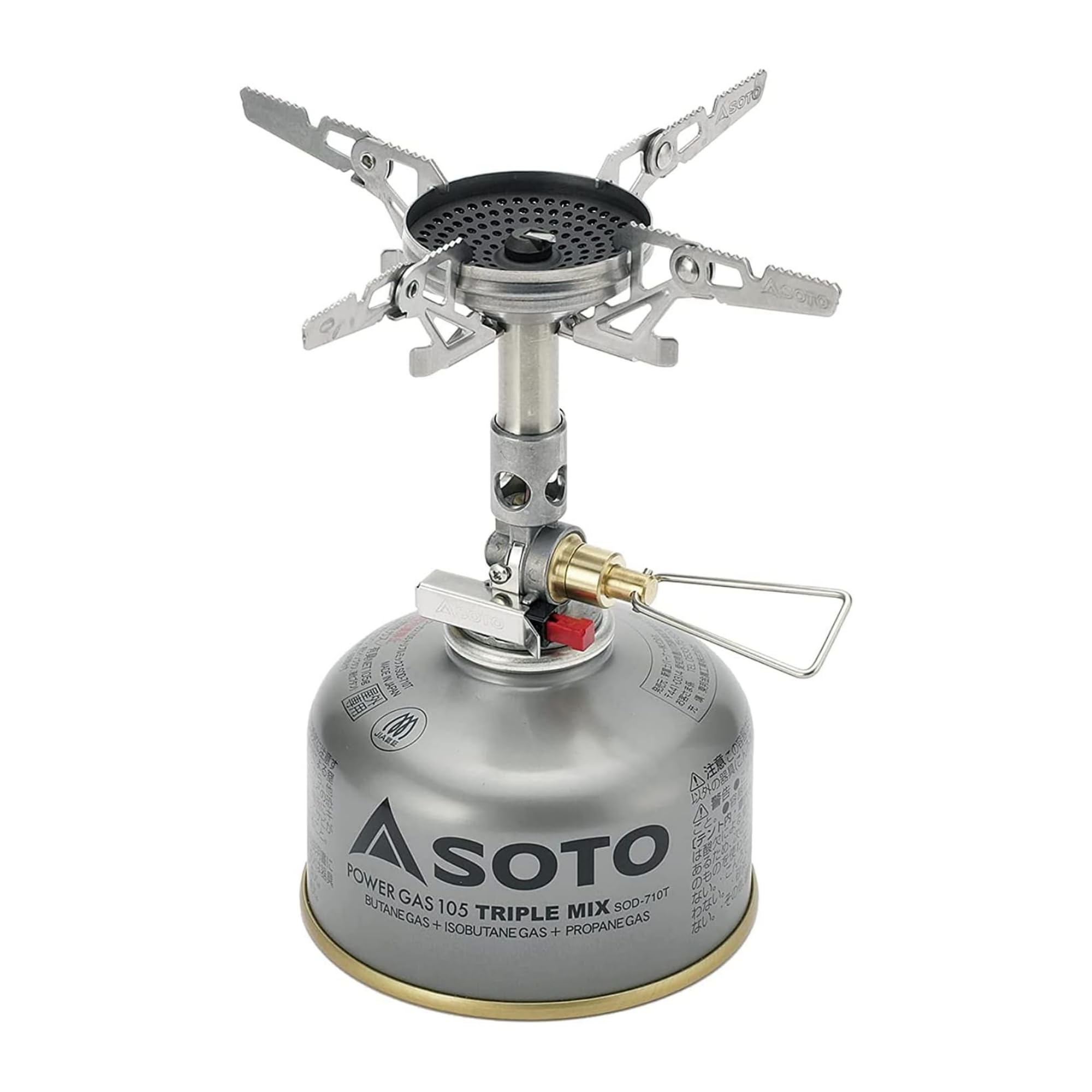
The SOTO WindMaster redefines what a sub-3-ounce canister stove can achieve in windy conditions. Its concave burner head pulls the flame inward, mimicking a built-in windscreen and reducing the flame flicker that plagues open-burner designs. The 4Flex pot support provides a wide, stable platform for larger cookware, while the optional TriFlex support (sold separately) trims weight for solo ultralight trips. At 2.3 ounces with the 4Flex attached, it’s among the lightest wind-resistant stoves you can buy.
Boil time for two cups of water clocks in under 2.5 minutes in calm conditions, and the pressure regulator maintains consistent output even as the canister pressure drops. The stealth igniter sits protected inside the burner post, reducing the risk of breakage compared to exposed piezo systems. The overall build quality from SOTO is exceptional, with tight tolerances on the folding arms and a secure canister connection that gives confidence during setup.
The one caveat is fuel compatibility: SOTO explicitly prohibits 100% propane, so stick with isobutane-propane blends. The burner also demands a clean valve system — always use the plastic cap on the canister when the stove is detached. For backpackers who regularly cook on ridgelines or exposed alpine campsites, this is the most capable wind-fighting stove at this weight class.
Why it’s great
- Concave burner head provides exceptional wind resistance
- 4Flex support handles large and small pots without tipping
- Protected igniter improves long-term reliability
Good to know
- Not compatible with 100% propane canisters
- Valve system requires cleanliness to avoid clogging
- TriFlex support sold separately for smaller pots
4. Jetboil MightyMo

The Jetboil MightyMo addresses the most common complaint against ultralight canister stoves: the inability to simmer. Jetboil’s four-turn regulator valve provides incremental heat adjustments from a gentle low to a roaring full boil, giving you genuine control for sautéing greens or simmering a sauce. At just 2.1 ounces, it’s lighter than most competitors in its class while still delivering a sub-3-minute boil time for one liter.
The open platform design works with Jetboil FluxRing pots and skillets without requiring a separate pot support, making it a versatile upgrade if you already own Jetboil cookware. The pushbutton igniter is reliable and protected, and the regulator maintains consistent performance down to 20 degrees Fahrenheit. Fuel consumption is notably efficient — users report getting more meals per canister compared to non-regulated stoves.
The downside is that the MightyMo is not an integrated system, so you need a stable pot and a windscreen for windy conditions. The included fuel can stabilizer helps, but the burner head itself offers minimal built-in wind protection. For the solo or duo backpacker who values genuine simmer capability and fuel efficiency above all else, the MightyMo delivers precision that few stoves at this weight can match.
Why it’s great
- Four-turn regulator enables true simmer control
- Weighs only 2.1 oz, among lightest regulated stoves
- Efficient fuel consumption extends canister life
Good to know
- Minimal built-in wind resistance
- Best performance with Jetboil FluxRing pots
- Windscreen not included
5. SOTO Amicus with Pot
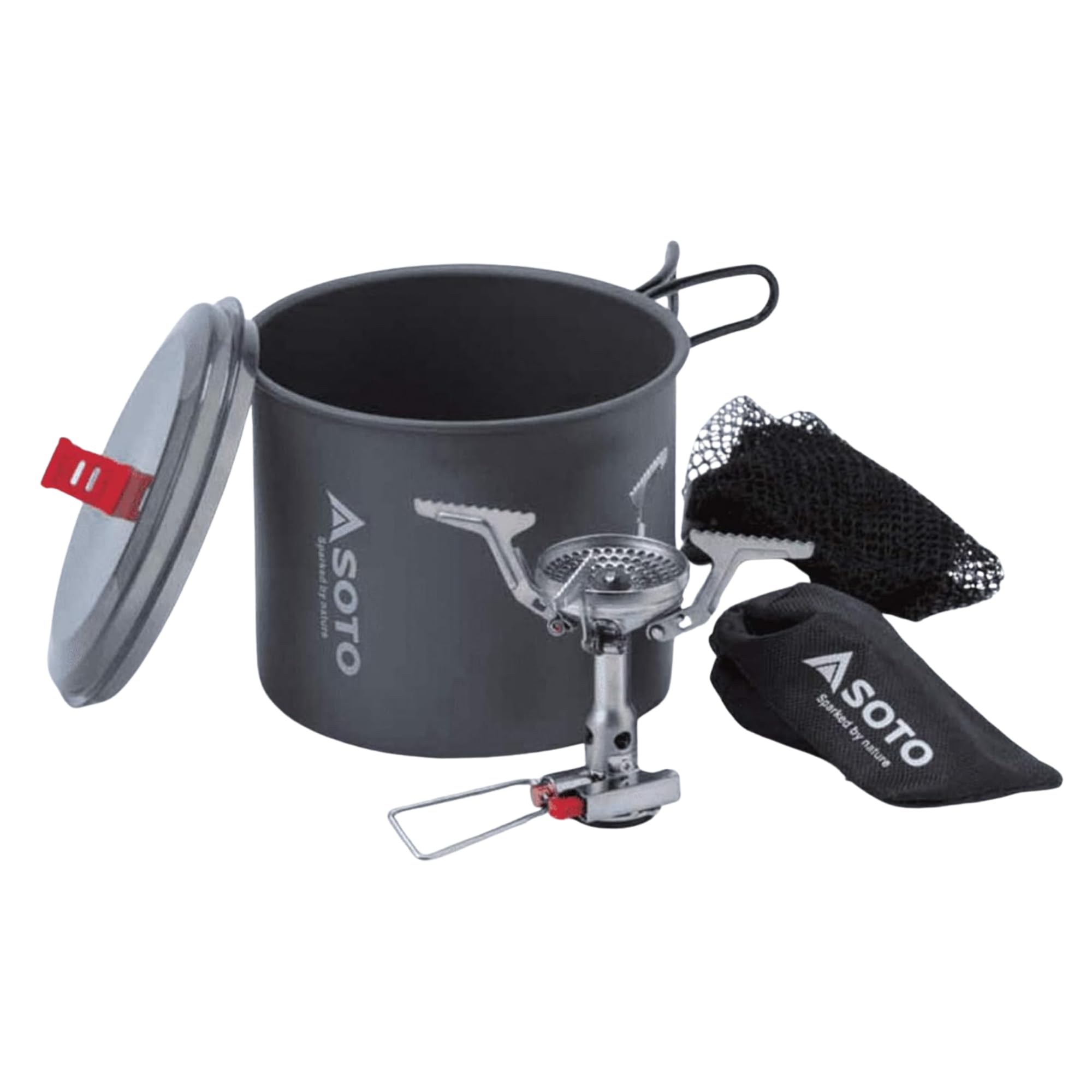
The SOTO Amicus package delivers impressive value by pairing a proven burner with a hard-anodized aluminum pot and translucent lid. The stove itself puts out 11,000 BTUs, boiling 500ml of water in roughly three minutes even in cold weather, according to user reports. The raised crown burner design provides better wind resistance than flat-burner alternatives, though a dedicated windscreen still helps in exposed conditions.
The included pot is lightweight and sized appropriately for solo or duo meals. The translucent lid lets you monitor your water without lifting the lid and losing heat. The piezo igniter works reliably on the first few strikes, though some users report the mounting screw loosening over time — a dab of Loctite solves that easily. The four-post pot support locks in solidly and provides a stable platform for standard cookware.
At this price point, the Amicus competes directly with the MSR PocketRocket 2 and often outperforms it in wind resistance and stability. The shock-resistant body holds up well to being stuffed in a pack. For the budget-conscious backpacker who wants a high-performance canister stove with a usable pot included, this is the strongest value proposition in the mid-range tier.
Why it’s great
- Includes a hard-anodized pot with translucent lid
- Raised burner crown improves wind resistance
- Shock-resistant body withstands pack abuse
Good to know
- Igniter screw may loosen with extended use
- Pot is sized for solo or small group meals
- Does not include a fuel canister
6. Fire-Maple Blade 2

The Fire-Maple Blade 2 stands out in the canister stove category because of its remote canister design and pre-heat tube. By keeping the fuel canister connected via a cable rather than screwing directly onto the burner, you can invert the canister in cold weather to draw liquid fuel rather than gas, maintaining performance when temperatures drop below freezing. The pre-heat tube vaporizes liquid fuel before it reaches the burner, preventing the sputtering that plagues standard canister stoves in winter conditions.
At 4.76 ounces, it’s heavier than ultralight screw-on stoves, but the weight brings genuine cold-weather capability. The titanium build keeps the overall weight reasonable while providing corrosion resistance. The output rating of 2,800 watts or 9,500 BTUs translates to fast boil times, and the pot rests support cookware up to 10 inches in diameter, making this suitable for small group cooking. The remote design also improves stability by lowering the center of gravity.
The folding titanium legs and pot rests pack down neatly, and the entire stove fits inside a one-liter pot for compact storage. The included LPG adapter adds versatility. For three-season backpackers who occasionally camp in shoulder-season cold, or for winter day-users who want a canister stove that doesn’t quit when the mercury drops, the Blade 2 offers a compelling mix of portability and cold-weather resilience.
Why it’s great
- Remote canister design allows inverted canister use in cold
- Pre-heat tube prevents flame sputtering
- 10-inch pot support handles group cookware
Good to know
- Heavier than screw-on canister stoves
- Cable adds setup complexity
- Windscreen recommended for windy conditions
7. Fire-Maple Star X2 Pro
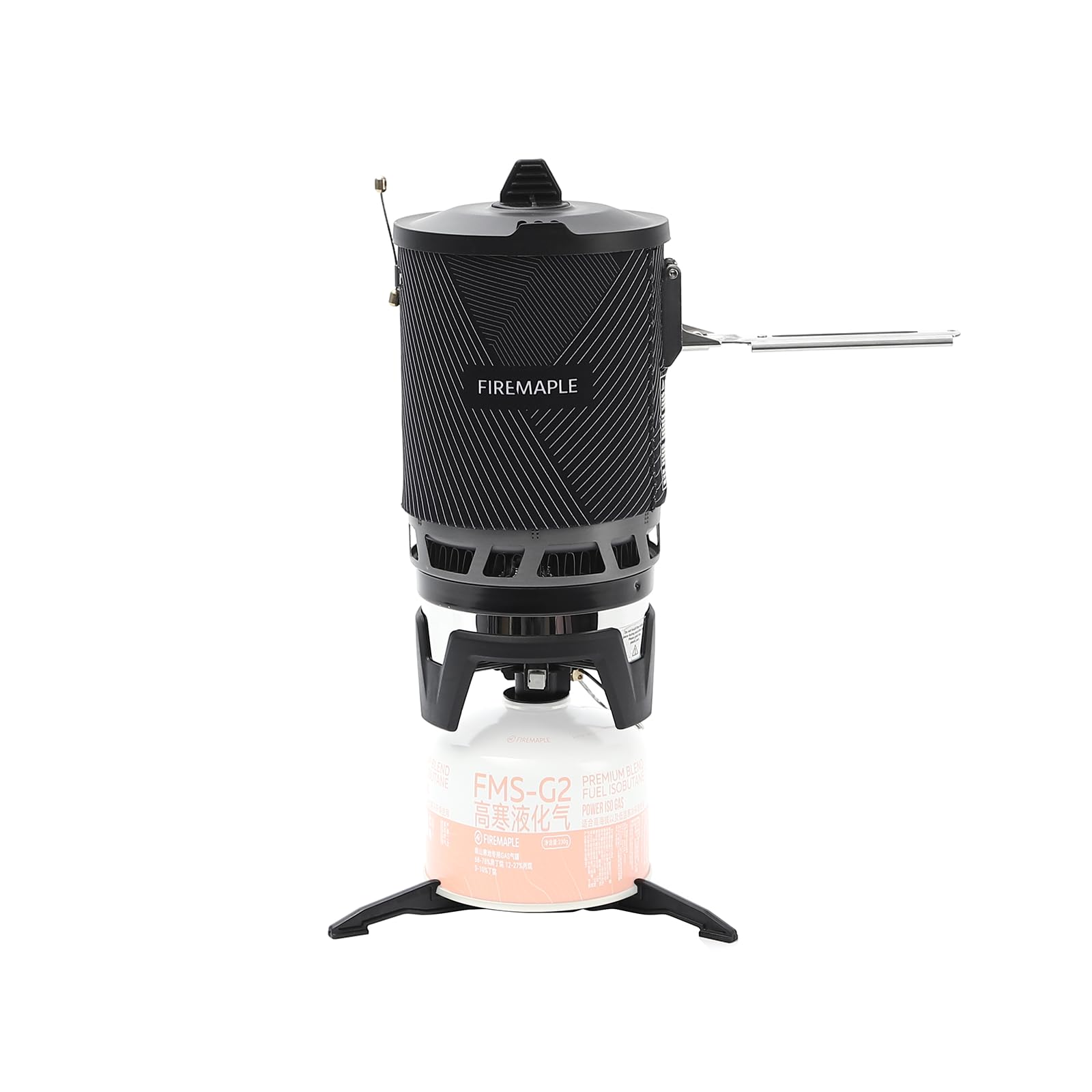
The Fire-Maple Star X2 Pro is an integrated cooking system that pairs a burner with a dedicated 1-liter hard-anodized aluminum pot, optimizing heat transfer in a compact package. The advanced heat exchange technology reduces boil times by up to 30% compared to using a standalone stove with a standard pot. The built-in piezoelectric igniter fires up instantly, and the locking stainless steel handle provides secure handling even when the pot is full.
Weighing 19.8 ounces, this is a heavier option reserved for those who prioritize boil speed and fuel efficiency over gram counting. The neoprene cozy insulates the pot during cooking and keeps food hot longer once the flame is off. The integrated design eliminates the need for a separate pot support and windscreen, since the burner and pot form a sealed unit that naturally resists wind. The reduced plastic construction aligns with sustainable design goals without sacrificing durability.
All accessories stow inside the pot for organized packing. This system is best suited for solo or duo backpackers who value efficiency and ease of use, want fast boil times, and are willing to carry a few extra ounces for an integrated solution. If you primarily boil water for dehydrated meals and want the fastest possible setup, the Star X2 Pro delivers that with minimal fuss.
Why it’s great
- Integrated design reduces wind impact and boil times
- Piezo igniter provides instant, matchless lighting
- All components stow together for compact carry
Good to know
- Heavier than standalone stove setups
- Pot capacity fixed at 1 liter
- Less versatile for different cookware sizes
8. Jetboil Flash
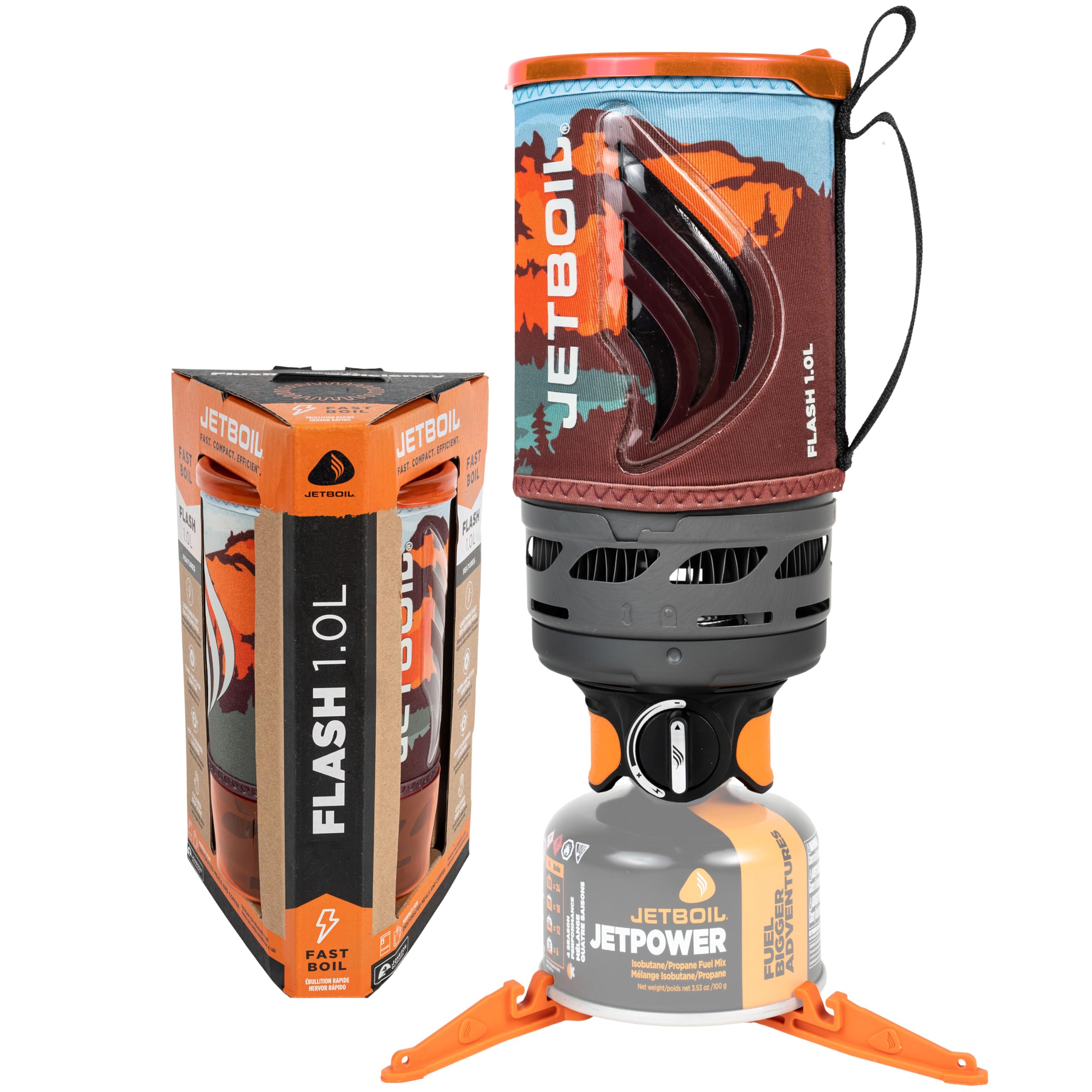
The Jetboil Flash is the benchmark for personal integrated stove systems, designed around one mission: boil water as fast as possible. The one-step auto ignition works like a home gas stove — turn and click to produce an immediate flame. The 1-liter FluxRing pot transfers heat efficiently, bringing 16 ounces of water to a rolling boil in just two minutes. The insulated cozy traps heat, keeping water hot long enough for multiple cups of coffee or a freeze-dried meal.
The updated design features color-coded Safe-Touch zones that stay cool during operation, giving you a secure grip even when the burner is running full blast. The three-point locking system with visual indicators ensures the pot is firmly attached to the burner before you ignite. The bottom cup doubles as a measuring cup or an eating bowl, maximizing the utility of every piece. The entire system, including a 100-gram fuel canister, packs into the pot itself for a tidy, protective storage solution.
The Flash is not designed for simmering or complex cooking — it’s optimized for boiling. If your backcountry menu consists of dehydrated meals, instant coffee, and oatmeal, this is the most efficient and user-friendly system available. The proprietary FluxRing pot means you’re locked into Jetboil cookware, but the speed and convenience are hard to beat for solo backpackers who want to go from pack to hot meal in under five minutes.
Why it’s great
- Boils 16 oz of water in just two minutes
- One-step auto ignition eliminates matches and lighters
- Safe-Touch zones prevent burns during operation
Good to know
- No simmer capability for real cooking
- Proprietary FluxRing pot limits cookware options
- Fuel canister sold separately
9. TOAKS Titanium Large Wood Stove

The TOAKS Titanium Large Collapsible Wood Stove completely eliminates the need to carry fuel, letting you burn twigs, pine cones, and other natural debris found on the trail. Weighing just 7.9 ounces and collapsing to a 4.13-inch square disc, it packs smaller than many canister stoves and weighs less than most multifuel options. The three-piece titanium construction is corrosion-resistant, incredibly strong, and cools down quickly after use, making it safe to pack away soon after cooking.
The smart vent system enables secondary combustion, burning both the wood and the wood gases for a cleaner, more efficient fire with less smoke. The spacious burning chamber measures 3.75 inches in diameter and 4 inches tall, providing room for steady heat output that can boil water in a reasonable timeframe — users report boiling water in about the same time as a small canister stove once the fire is established. The fully assembled height of 8 inches provides a stable cooking platform that works well with standard backpacking pots.
This stove is best suited for trips where dry wood is abundant and you want to minimize pack weight by eliminating fuel canisters. The tradeoffs include longer setup time, soot on the pot, and inconsistent performance in wet conditions. A couple of metal tent stakes can help stabilize skinny pots, and you’ll want to practice building a proper fire layout before relying on this as your primary cooking method. For ultralight purists and eco-conscious backpackers, the TOAKS delivers a sustainable, fuel-independent cooking solution.
Why it’s great
- No fuel canisters to carry or dispose of
- Titanium construction is ultralight and corrosion-proof
- Secondary combustion reduces smoke compared to open fires
Good to know
- Slower boil time compared to gas stoves
- Produces soot that coats your pot
- Requires dry wood fuel and fire-building skill
FAQ
How many ounces should a typical backpacking canister stove weigh?
Can I use a backpacking camp stove in subzero temperatures?
What does it mean when a stove is pressure regulated?
Do I need a windscreen for my backpacking stove?
How many meals can I cook with one 8-ounce isobutane canister?
Final Thoughts: The Verdict
For most users, the backpacking camp stove winner is the MSR PocketRocket Deluxe because it combines ultralight weight, pressure regulation, and reliable ignition in a proven package that performs across a wide range of conditions. If you want wind resistance without adding ounces, grab the SOTO WindMaster with 4Flex. And for global fuel flexibility and expedition-ready durability, nothing beats the MSR WhisperLite International.