Every time you fill a glass from the tap, you are trusting your municipal supply to stay free of lead, chlorine, and PFAS chemicals. The reality is that old pipes and treatment byproducts often slip through the system, leaving an aftertaste or, worse, trace contaminants that build up over time. A dedicated filtration setup removes this uncertainty, putting control of your drinking water back where it belongs — in your own kitchen.
I’m Mohammad Maruf — the founder and writer behind AirfryerBite. I have spent years analyzing filtration hardware across the full spectrum of countertop units, under-sink cartridges, and reverse osmosis systems, mapping contaminant reduction claims against independent certifications like NSF and IAPMO.
This guide breaks down the top performers based on certified reduction rates, flow consistency, filter longevity, and real-world installation ease, so you can confidently choose the best at home water filters that actually match your tap chemistry and household volume.
How To Choose The Best At Home Water Filters
The ideal at home water filter depends entirely on what is in your tap and how much counter or cabinet space you can spare. Before hunting for flow rates or micron ratings, you need to know two things: your incoming water source (municipal or well) and which contaminants you want removed. A carbon-block system handles chlorine and taste beautifully but does nothing for dissolved solids, while reverse osmosis strips everything, including beneficial minerals, unless a remineralization stage is included.
Filtration Technology — Carbon, UF, or RO
Activated carbon blocks are the workhorses of most mid-range systems, effectively trapping chlorine, volatile organic compounds (VOCs), and bad odors while preserving dissolved minerals. Ultra-filtration (UF) membranes with 0.01-micron pores push farther, removing bacteria, cysts, and sediment, yet they still allow mineral content to pass through. Reverse osmosis (RO) is the heavy lifter — a semi-permeable membrane at roughly 0.0001 microns rejects lead, arsenic, fluoride, nitrates, and PFAS chemicals. The trade-off is a slower flow rate, wastewater production (typical 3:1 pure-to-drain ratios are now common), and the need for more cabinet space.
Certifications That Matter
Blindly trusting a box that says “reduces lead” is a common mistake. Look for independent certifications from NSF International or IAPMO against specific standards. NSF/ANSI 53 covers health-related contaminant reduction (lead, mercury, VOCs), NSF/ANSI 58 applies to reverse osmosis system performance and TDS reduction, and NSF/ANSI 372 ensures lead-free construction materials. A filter that lists exact certification numbers on the product page has passed a third-party audit — flimsy generic claims without those numbers should raise suspicion.
Flow Rate vs. Filter Life
A system that delivers 1.6 gallons per minute can fill a standard 8-ounce cup in under three seconds, which is comfortable for a family kitchen. But that flow rate is not fixed — it drops as the filter media accumulates trapped particles. A filter rated for 8,000 gallons may last a full year for a two-person household, but a four-person home drinking 2 gallons per day will exhaust it in about 11 months. Always cross-reference the manufacturer’s gallon rating against your actual daily consumption rather than the “12 months” lifespan printed on the box.
Quick Comparison
On smaller screens, swipe sideways to see the full table.
| Model | Category | Best For | Key Spec | Amazon |
|---|---|---|---|---|
| SimPure V7 | Under Sink | No-drill mineral retention | 20,000 gal, 1.6 GPM, 304 SS | Amazon |
| Aquasana AQ-MF-1 | Under Sink | NSF-certified contaminant removal | Reduces 78 contaminants, retention | Amazon |
| Waterdrop TST-UF | Under Sink | Precision ultra-filtration | 0.01 μm membrane, 304 SS | Amazon |
| OEMIRY OM-CF04 | Countertop | Quick-install apartment use | 8,000 gal, 1.6 GPM, ABS body | Amazon |
| Purewell PW-KS | Gravity Countertop | Electricity-free camping | 0.01 μm UF, 2.25 gal tank | Amazon |
| AquaTru Carafe | Countertop RO | Portable RO, no plumbing | 64 oz glass, reduces TDS | Amazon |
| Waterdrop G3P800 | Under Sink RO | High-volume TDS reduction | 800 GPD, 3:1 drain ratio | Amazon |
In‑Depth Reviews
1. SimPure V7 Under Sink Water Filter System

The SimPure V7 packs a 5-stage filtration train — double sediment membranes, KDF-55, and dual activated carbon layers — into a 304 stainless steel housing that resists corrosion far better than plastic alternatives. Its 0.5-micron rating traps sediment and heavy metals like lead while leaving beneficial calcium and magnesium intact, making it a smart pick for anyone who wants cleaner water without stripping mineral content. The under-sink install requires no drilling and connects directly to a 3/8-inch or 1/2-inch cold water line, a major plus for renters who cannot modify the cabinetry.
At 20,000 gallons of capacity per filter set and a flow rate sustaining 1.6 GPM, this system handles a family of four for roughly a full year before replacement is needed. The stainless steel body not only feels premium but also eliminates the risk of plastic cracking under pressure. One practical detail that stands out is the included 3/8-to-1/2-inch converter fittings, which cover non-standard sink connections without requiring a separate trip to the hardware store.
The V7 does not reduce TDS, so if your tap water is extremely hard or you are concerned about fluoride, this unit is not the right tool for that job. Installation is straightforward for anyone moderately comfortable under a sink, but the hoses require a firm push to seat fully — a loose connection will drip. Overall, this is a durable, high-capacity under-sink option that delivers excellent value for standard municipal water improvement.
Why it’s great
- 20,000-gallon filter life reduces replacement frequency
- 304 stainless steel housing resists leaks and impact
- No-drill, no-plumber installation works for renters
Good to know
- Does not reduce TDS or remove fluoride
- Hoses need careful seating to prevent drips
2. Aquasana Claryum Direct Connect AQ-MF-1
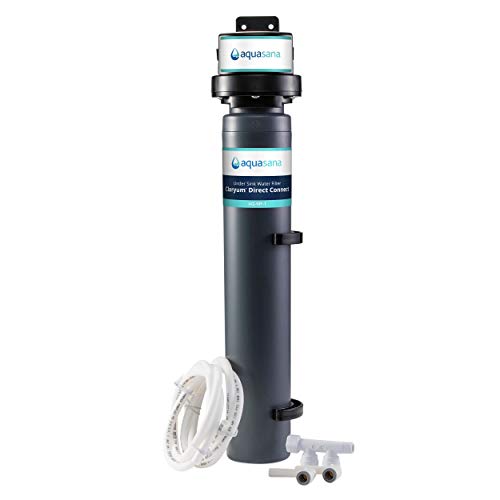
Aquasana’s AQ-MF-1 stands out because it publishes the exact list of 78 contaminants it reduces — including lead, mercury, asbestos, PFAS (PFOA and PFOS), herbicides, and pharmaceuticals — backed by NSF certification under standards 42, 53, and 401. This is not a generic “reduces chlorine” claim; the performance data is independently verified, a detail that matters when you are trying to address specific tap water test results. The Claryum carbon block filters down to a claimed 0.5-micron level while preserving calcium, magnesium, and potassium.
The direct-connect design eliminates the need for a separate faucet: it splices into the existing cold water line and delivers filtered water straight from your current sink spout. The installation kit includes a dual-port adapter for 3/8-inch hoses, and the whole process takes under 30 minutes without drilling. At roughly 4 inches in diameter and 17.8 inches tall, the cartridge fits most under-sink cabinets with a 3-inch clearance requirement for swapping filters.
Filter life is rated at 6 months or 800 gallons, which is shorter than many competitors that claim 12-month lifespans. The replacement cartridges cost more per gallon over time, pushing this into the mid-premium operational expense category. Users on well water may find the filter clogs faster than expected. For households that prioritize certified contaminant reduction over absolute filter longevity, this system is a strong choice.
Why it’s great
- NSF-certified reduction of 78 specific contaminants
- Direct-connect design needs no extra faucet hole
- Retains beneficial minerals after filtration
Good to know
- 600-800 gallon filter life is shorter than average
- Replacement cartridges cost more over time
3. Waterdrop TST-UF Under Sink Water Filter

Waterdrop’s TST-UF uses a 0.01-micron ultrafiltration membrane that catches bacteria, cysts, and most suspended solids while leaving behind the dissolved minerals that give water its natural taste. The 6-layer filter stack includes a PP sediment wrap, granular activated carbon, a carbon block, the UF fiber membrane, and additional polishing layers, all housed in a lead-free 304 stainless steel canister. The flow rate hits 1.59 GPM, filling a cup in about 2.3 seconds, which rivals many carbon-only systems.
Installation flexibility sets this model apart: you can hang it on the cabinet wall, place it upright on the cabinet floor, or even mount it directly to the faucet valve. The package includes a 3/8-to-1/2-inch converter and Teflon tape, and the company provides installation videos for DIY users. The staggered filter replacement cycle — PP filter every 6-8 months, UF membrane yearly, CT filter every 12-24 months — reduces the shock of buying a full set all at once.
This system is explicitly designed for municipal tap water only; it is not rated for well water or hot water sources. The TST-UF does not reduce TDS, so if you are chasing zero-dissolved-solids water, you need a reverse osmosis unit instead. The initial connection can feel tight on standard male NPT threads, but once seated, the thick sealing ring keeps the housing drip-free. A solid mid-range performer for homes that want UF-level bacterial protection without the expense of an RO system.
Why it’s great
- 0.01-micron UF membrane removes bacteria and cysts
- Multiple placement options for tight cabinets
- Staggered filter replacement reduces upfront cost
Good to know
- Not compatible with well water or hot water
- Does not reduce TDS or dissolved solids
4. OEMIRY Countertop Water Filter System OM-CF04

The OEMIRY countertop system targets the apartment and RV crowd who want filtration without modifying plumbing. It connects to the end of a standard faucet — not pull-out, spray, or sensor faucets — and switches between raw tap water and filtered water by twisting the diverter valve. The 3-stage alkaline filtration uses activated carbon and mineral media to reduce chlorine, heavy metals, and bad odor while boosting pH and adding calcium, potassium, and magnesium. Each filter is rated for 8,000 gallons or 12 months of use.
Flow performance is genuinely fast: the spec claims a 1.6 GPM rate, which translates to roughly two to three seconds to fill an 8-ounce glass. The ABS housing is lightweight and compact at 5.5 inches wide and 12.4 inches tall, and the system produces zero wastewater and draws no electricity. The twist-to-select mechanism is satisfyingly tactile, though the switching knob requires a firm quarter-turn to seal properly between modes.
The biggest limitation is compatibility: it only works with standard threaded faucets, so renters with spray-style heads or sensor taps cannot use it without replacing the faucet first. The system does not reduce TDS, and the manufacturer explicitly notes that users seeking TDS reduction should look at their RO line instead. For an entry-level countertop unit that improves taste and odor dramatically without drilling holes, the OEMIRY delivers reliable performance at a budget-friendly entry point.
Why it’s great
- Ultra-fast 1.6 GPM flow for immediate filling
- No electricity, no wastewater, zero drilling needed
- Compact footprint fits small kitchen counters
Good to know
- Incompatible with pull-out, spray, or sensor faucets
- Does not reduce TDS or fluoride
5. Purewell Gravity Water Filter System PW-KS

The Purewell PW-KS operates on pure gravity: pour untreated tap water into the upper chamber, and it passes through two black carbon filters containing a 0.01-micron hollow fiber UF membrane, a silver ion layer for bacteriostatic protection, and an activated carbon block, before collecting in the lower chamber. The transparent level window on the lower tank is a practical touch — you can see exactly how much filtered water remains without lifting the lid. The flow rate is 4 gallons per hour, steady enough to refill the 2.25-gallon tank within 35 minutes.
The stainless steel housing feels substantial on the counter, and the included metal stand elevates the lower chamber for easy access to the spigot. Each filter cartridge lasts up to 3,000 gallons (6,000 total for the pair), and replacement cartridges are inexpensive relative to the initial unit cost. Because the system requires no electricity and no plumbing connection, it works equally well in the kitchen, at a cabin, or during power outages. The spigot flow is moderate but adequate for filling pitchers.
The main consideration is speed: gravity filtration takes patience. You cannot draw water while the top chamber is refilling without the risk of cross-contamination if the valve seal is not tight. The unit is 20 inches tall, so it eats up vertical counter space. Users with very hard water may see scale buildup on the UF membrane over time. For off-grid scenarios or households that want a backup filter independent of pressure and power, the Purewell is a reliable, low-tech solution.
Why it’s great
- Gravity-fed filtration works without electricity or pressure
- Water level window offers clear visibility
- Long filter life at 6,000 total gallons
Good to know
- Gravity flow is slower than pressurized systems
- 20-inch height requires generous counter clearance
6. AquaTru Carafe Countertop RO Water Purifier
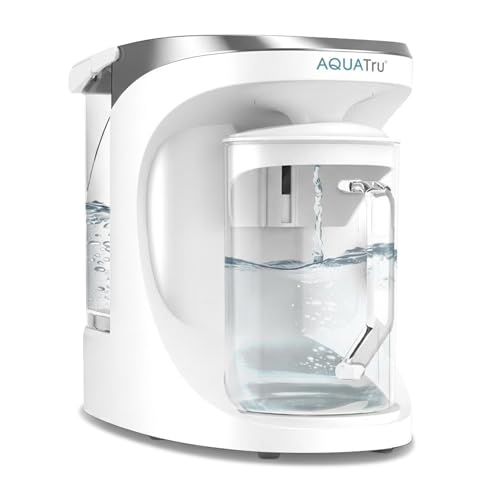
The AquaTru Carafe is a true 4-stage reverse osmosis system that fits entirely on the countertop — no plumbing, no drilling, no permanent installation. It reduces 84 contaminants including fluoride, lead, arsenic, microplastics, and PFAS (PFOA/PFOS), and it is certified by IAMPO against NSF standards 42, 53, 58, and 401. The borosilicate glass carafe holds 64 ounces of purified water, eliminating the plastic storage taste that plastic pitchers can develop over time. Because it is an RO system, it does reduce TDS, producing water that is functionally equivalent to distilled in purity.
The unit is self-contained: you fill the top reservoir, press a button, and the system cycles water through sediment, carbon, RO membrane, and post-carbon stages over 15 to 20 minutes per batch. The pump is audible but not disruptive, roughly the volume of a small refrigerator compressor. Filter replacement is tool-free, with the sediment and carbon filters needing change every 6 months and the RO membrane lasting up to 2 years. The 14.7-pound weight is manageable for moving between the kitchen and a pantry shelf.
Batch processing is the trade-off: the 0.5 GPM flow rate means you cannot get instant filtered water on demand. If you drink heavily throughout the day, you may need to refill and wait between batches. The initial investment is higher than carbon-only units, and replacement filter sets carry a recurring cost. For renters or homeowners who want RO-level purity without cutting into cabinetry, the AquaTru Carafe is the most practical countertop RO solution currently available.
Why it’s great
- True RO purity removes fluoride, lead, and PFAS
- No plumbing or drilling required
- Glass carafe avoids plastic leaching
Good to know
- Batch processing means waiting for filtered water
- Replacement filter sets add recurring cost
7. Waterdrop G3P800 Tankless RO System
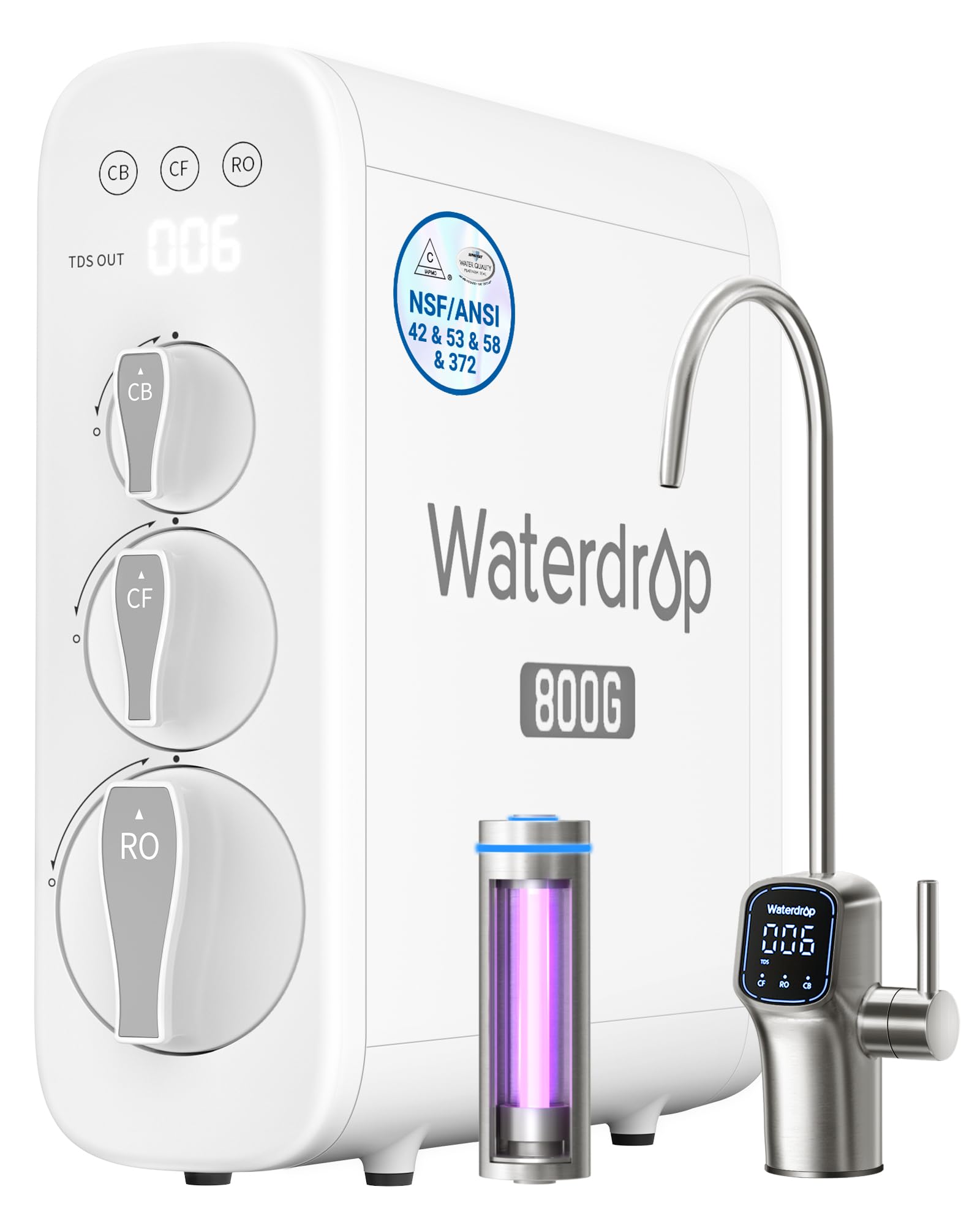
The Waterdrop G3P800 is a tankless under-sink reverse osmosis system that delivers 800 gallons per day through a 10-stage filtration train, certified by IAPMO against NSF/ANSI 42, 53, 58, and 372. It reduces PFAS, fluoride, lead, chromium, arsenic, nitrates, chloride, and radioactive substances like radium, all while maintaining a 3:1 pure-to-drain ratio that wastes only one cup of water for every three cups of purified output. The smart faucet integrates an LED display that shows the TDS level in real time, giving you instant feedback on water quality without needing a separate meter.
The tankless design saves significant under-sink space compared to traditional RO systems with pressurized storage tanks. The flow rate is genuinely fast — approximately 5 seconds to fill a standard cup — thanks to the high-capacity 800 GPD membrane. Installation requires drilling two holes: one for the dedicated RO faucet and one for the drain pipe connection. The 10-stage process includes PP sediment, pre-carbon, RO membrane, post-carbon, and multiple polishing stages, ensuring that the water is stripped of virtually all dissolved solids.
The LED faucet has a rated lifespan of up to 50 years for the sensor, though the electronics inside the faucet handle are the most likely failure point over the long term. Replacement filter packs are the most expensive in this lineup, and the system requires periodic RO membrane swaps (typically every 2-3 years) that add to the total cost of ownership. For households that want the highest level of contaminant reduction with a fast, continuous supply and TDS monitoring, the G3P800 represents the premium end of what an at-home RO system can deliver.
Why it’s great
- 800 GPD flow eliminates tank waiting time
- Smart faucet displays real-time TDS levels
- 10-stage filtration with multiple NSF certifications
Good to know
- Requires drilling two holes for installation
- Replacement filter packs carry a premium cost
FAQ
Does an ultra-filtration system remove fluoride from tap water?
Why do some manufacturers say their filter does not reduce TDS?
How do I know if my faucet is compatible with a countertop filter diverter?
What does the NSF/ANSI 58 certification actually guarantee for an RO system?
Final Thoughts: The Verdict
For most users, the best at home water filters category winner is the Aquasana AQ-MF-1 because it combines NSF-certified reduction of 78 contaminants with a direct-connect design that needs no extra faucet hole and preserves beneficial minerals. If you want ultra-filtration precision with a sturdy 304 stainless steel housing, grab the Waterdrop TST-UF. And for true reverse osmosis purity without drilling into countertops, nothing beats the AquaTru Carafe.