A tap water that tastes clean, smells fresh, and doesn’t leave you wondering what’s still in the glass shouldn’t be a luxury. The difference between average tap and great drinking water comes down to one decision: choosing a filtration system that removes the chlorine, heavy metals, and sediment without draining your wallet every month.
I’m Mohammad Maruf — the founder and writer behind AirfryerBite. I’ve spent years analyzing water filtration hardware, tracking NSF certifications, and comparing contaminant reduction claims across the most popular affordable pitcher and dispenser systems on the market.
Whether you are tired of buying plastic bottles or just want a better glass of water at the kitchen counter, the best affordable water filter strips out the impurities without stripping your budget.
How To Choose The Best Affordable Water Filter
Choosing a water filter on a budget means knowing where to focus your dollars. The right unit balances certified contaminant reduction, filter replacement cost, and daily capacity without overspending on features you will never use.
Certification Is Not Optional
Look for filters certified by NSF/ANSI Standard 42 (chlorine taste and odor reduction) and Standard 53 (contaminant reduction like lead, mercury, and VOCs). Some models also carry WQA or IAPMO certification. A filter without third-party testing is essentially an unproven plastic container.
Filter Lifespan And Replacement Cost
The sticker price of the pitcher is only half the equation. A filter rated for 40 gallons that costs fifteen dollars to replace works out to about thirty-eight cents per gallon. A filter rated for 200 gallons at the same price drops to under eight cents per gallon. Calculate the long-term per-gallon cost, not just the upfront purchase price.
Capacity And Flow Rate
A 6-cup pitcher works for a solo coffee drinker. A family of four needs at least 10 cups of capacity per cycle, ideally paired with a dispenser that holds 27 cups or more. Flow rate matters too — a slow filter that takes ten minutes to fill a pitcher will test your patience every single day.
Quick Comparison
On smaller screens, swipe sideways to see the full table.
| Model | Category | Best For | Key Spec | Amazon |
|---|---|---|---|---|
| ZeroWater ZD-010rp | Pitcher | Maximum contaminant removal | 5-Stage Ion Exchange / TDS Meter | Amazon |
| Waterdrop CTF-05 | Faucet | Heavy metals & chlorine reduction | 8000-Gallon Long Life / 1 Filter | Amazon |
| Brita UltraMax Dispenser | Dispenser | High-volume family use | 27-Cup Capacity / SmartLight | Amazon |
| Culligan ZeroWater 10-Cup | Pitcher | PFAS & dissolved solids | 5-Stage / TDS Meter / IAPMO | Amazon |
| AQUAPHOR 12 Cup Opal | Pitcher | Fast flow & dishwasher safe | 12-Cup / B15 Filter / BPA-Free | Amazon |
| Waterdrop WFD-40L-L | Dispenser | Long-life 200-gallon filter | 35-Cup / 200-Gal Long-Life / BPA Free | Amazon |
| HOMEWATER 10-Cup Pitcher | Pitcher | NSF/ANSI certified budget pick | 10-Cup / 160-Gal Filter Life / WQA | Amazon |
| PUR 4-Pack Filters | Replacement Filters | Refreshing an existing PUR system | 4-Pack / 8-Month Value / NSF | Amazon |
| Brita Metro 6-Cup Pitcher | Pitcher | Compact countertop & first-time buyer | 6-Cup / SmartLight / BPA-Free | Amazon |
In‑Depth Reviews
1. ZeroWater ZD-010rp 10 Cup Pitcher
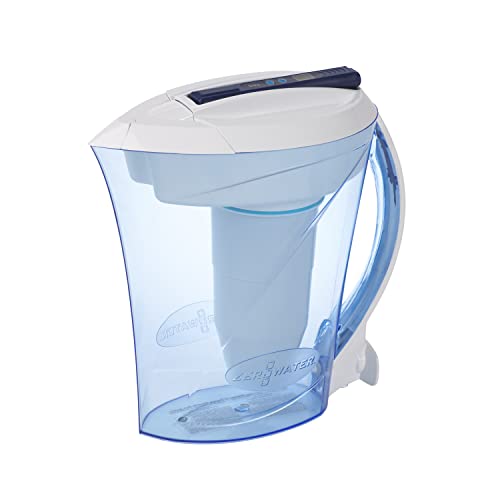
The ZeroWater ZD-010rp delivers the most aggressive filtration you will find in a pitcher at this level. Its five-stage ion exchange system strips out 99.6% of total dissolved solids, which is why it carries NSF certification for lead, chromium, and PFOA/PFOS reduction. The included TDS meter gives you a real-time numerical reading of your water purity — when it hits zero, you know the filter is doing its job.
Filtration speed is not this unit’s strong suit; the dense media pack slows flow noticeably compared to basic carbon pitchers. The 10-cup capacity is adequate for a couple or small family, but you will refill it frequently if you drink a lot of water. The Ready-Pour spout lets you dispense water while the top reservoir is still filtering, which helps compensate for the slower rate.
Replacement filters cost more than standard carbon blocks, so the per-gallon operating expense is higher than the average pitcher. For buyers who prioritize maximum contaminant removal over speed and running cost, the ZD-010rp is the most capable option in this price bracket.
Why it’s great
- NSF certified for lead, chromium, and PFOA/PFOS
- TDS meter provides quantitative purity feedback
- Five-stage filtration removes near-total dissolved solids
Good to know
- Flow rate is slower than carbon-only filters
- Replacement filters carry a higher per-gallon cost
- 10-cup capacity requires frequent refills for larger households
2. Waterdrop CTF-05 Countertop Faucet Filter

The Waterdrop CTF-05 shifts the value equation by attaching directly to your faucet rather than occupying counter space with a pitcher. Its single filter element is rated for an exceptional 8,000 gallons — that is years of use for most households before a replacement is needed. The system reduces 99% of chlorine along with heavy metals, bad odors, and sediment.
Installation requires no tools and works with standard threaded faucets. The filter life reminder built into the housing takes the guesswork out of replacement timing. Since it mounts on the faucet, filtered water flows on demand through a dedicated diverter lever, which eliminates the wait time of a pitcher refill cycle.
The CTF-05 does not remove dissolved solids the way ZeroWater’s ion exchange does, and the faucet mount design may not fit every non-standard or pull-out faucet. But for sheer longevity and per-gallon operating cost, this unit is hard to beat in the affordable filtration space.
Why it’s great
- 8,000-gallon filter life means years between replacements
- On-demand filtered water with no pitcher refill wait
- Tool-free installation on standard faucets
Good to know
- Does not reduce total dissolved solids
- Faucet mount may not work with pull-out or non-threaded faucets
- Single filter stage offers less depth than multi-stage pitchers
3. Brita UltraMax Large Water Dispenser
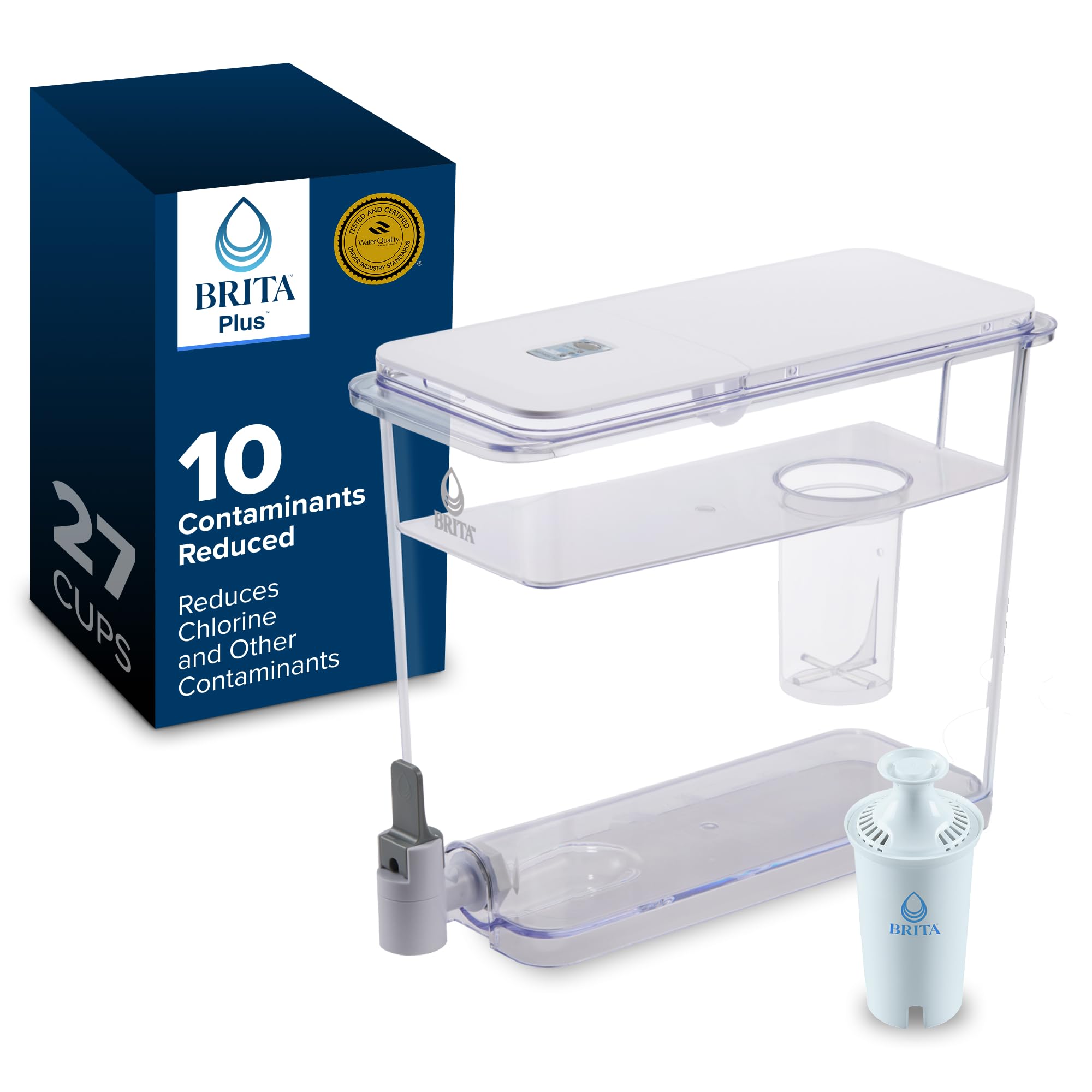
The Brita UltraMax is the dispenser you grab when your household drinks through a pitcher in a single afternoon. Its 27-cup reservoir sits in the refrigerator and dispenses through a spigot, so there is no tilting or lifting a heavy pitcher every time someone wants a glass. The included BritaPlus high-density filter traps twice the contaminants of the standard Brita filter, including chlorine, mercury, cadmium, copper, and zinc.
The electronic filter indicator tracks usage and alerts you when it is time for a replacement — roughly every 40 gallons or two months under normal use. Brita’s replacement filters are widely available and reasonably priced, keeping the long-term operating costs predictable. The dispenser footprint is larger than a pitcher, so it needs dedicated shelf space in the fridge.
For families that want cold, filtered water on demand without the refill chore, the UltraMax is the most practical choice. The carbon-based filtration does not remove dissolved solids like ion exchange filters, but it handles the everyday contaminants most people notice in taste and odor.
Why it’s great
- 27-cup capacity serves a family without constant refilling
- Dispenser spigot eliminates heavy pitcher lifting
- BritaPlus filter traps twice the contaminants of standard
Good to know
- Requires refrigerator shelf space for the large body
- Carbon filtration does not remove dissolved solids
- Filter indicator adds battery dependency
4. Culligan with ZeroWater Technology 10-Cup Pitcher
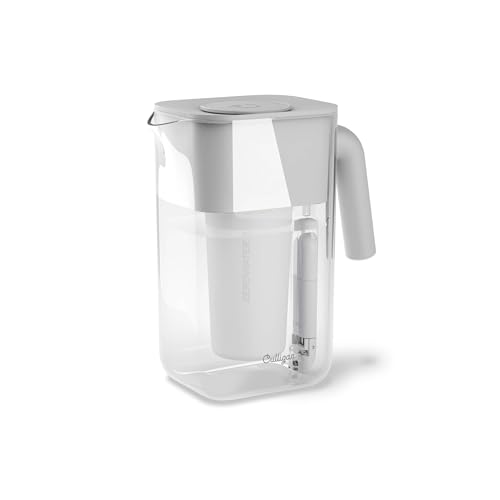
The Culligan variant of ZeroWater technology brings IAPMO certification to the table, specifically for reducing total PFAS — the “forever chemicals” that standard carbon filters cannot touch. The five-stage advanced filtration removes 99.9% of dissolved solids, and the built-in TDS meter gives you the same zero-readout confirmation that the ZeroWater brand is known for. For buyers concerned about emerging contaminants in municipal water, this pitcher offers verified peace of mind.
User feedback highlights the noticeable taste improvement and the satisfaction of seeing the TDS meter drop from tap readings in the 200s down to zero. The filter install requires a firm push and turn that some users found tricky at first, but once seated, the seal prevents unfiltered bypass. The 10-cup body is slightly heavier than standard pitchers due to the thicker plastic construction.
The downsides mirror the ZeroWater trade-offs: slower flow rate and higher filter replacement cost. The 5-stage media is consumed faster when starting with high-TDS tap water, so households with very hard water will cycle through filters more quickly. If PFAS reduction is your priority, this is one of the few affordable pitcher options that can prove it works.
Why it’s great
- IAPMO certified for total PFAS reduction
- TDS meter provides real-time purity verification
- High-quality build with improved durability
Good to know
- Filter replacement cost is higher than carbon-only pitchers
- Flow rate is slower due to dense multi-stage media
- Heavy body may be cumbersome for some users
5. AQUAPHOR 12 Cup Opal Pitcher

The AQUAPHOR 12 Cup Opal stands out with its dishwasher-safe design — a rare feature among filter pitchers that makes deep cleaning genuinely easy. The B15 filter uses a proprietary fiber-based media that delivers noticeably faster flow compared to many competitors in the same price tier. The 12-cup capacity splits into a 6-cup filtered reservoir and a 6-cup top basin, keeping the footprint manageable.
The filter reduces chlorine, heavy metals, and other common contaminants while maintaining a reasonable mineral balance so the water does not taste flat. The pitcher body is made from BPA-free materials and the locking lid helps prevent spills when pouring. The overall build quality feels more refined than the budget-standard plastic pitchers you often find at this level.
The main limitation is the distribution of replacement filters — they are less commonly stocked on store shelves than Brita or PUR cartridges, so you will likely need to order them online. The B15 filter lifespan is typical at around two months, but the faster flow means you waste less time waiting for water compared to slower ion exchange pitchers.
Why it’s great
- Dishwasher safe for easy cleaning
- Faster flow rate than many multi-stage pitchers
- Compact 12-cup design with good aesthetics
Good to know
- Replacement filters are less widely available in retail stores
- Mineral retention means some TDS remains in the water
- Not certified for PFAS or total dissolved solids removal
6. Waterdrop WFD-40L-L Dispenser

The Waterdrop WFD-40L-L is a large dispenser that prioritizes filter longevity over everything else. Each filter is rated for an impressive 200 gallons — roughly five times the lifespan of a standard Brita or PUR cartridge. The 35-cup total capacity makes it a serious contender for households that want to minimize both refills and filter changes.
The system reduces chlorine, PFOA/PFOS, and other common contaminants using an advanced carbon block, and the BPA-free construction ensures no plastic leaching into your drinking water. The dispenser-style spigot makes serving easy for kids and eliminates the weight of a full pitcher. The black finish blends into most kitchen and fridge environments without standing out.
The trade-off for that extended filter life is that the replacement filters are larger and cost more upfront than standard pitcher cartridges. The dispenser body also takes up significant fridge real estate. If you hate the hassle of frequent filter swaps and want a set-and-forget solution, this unit delivers the lowest annual filter replacement count in its class.
Why it’s great
- 200-gallon filter life drastically reduces replacement frequency
- 35-cup capacity handles heavy daily usage
- Dispenser spigot is convenient for all ages
Good to know
- Replacement filters cost more per cartridge
- Large body takes up substantial refrigerator space
- Not certified for dissolved solids removal
7. HOMEWATER 10-Cup Pitcher Filter
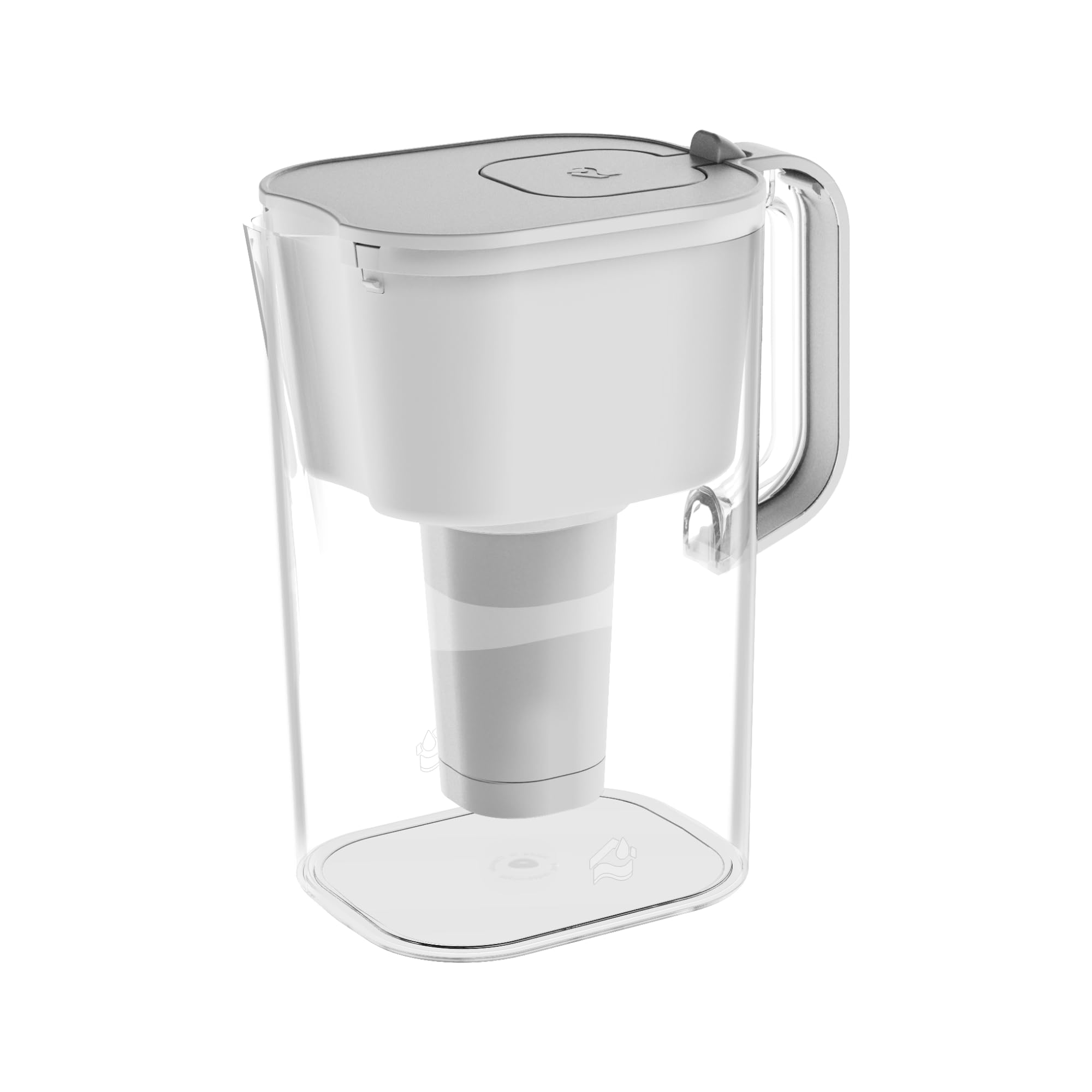
The HOMEWATER 10-Cup Pitcher hits a sweet spot for budget-conscious buyers who refuse to sacrifice certification. It carries WQA verification against NSF/ANSI Standards 42, 53, and 401 — covering chlorine taste and odor, lead, benzene, atrazine, and even pharmaceuticals like ibuprofen and naproxen. That level of independent testing is rare at this price point.
The filter is rated for 160 gallons or roughly three months of use, which outlasts most stock filter life claims. The Liquid-Lock lid design prevents spills when pouring, and the wide mouth makes refilling and cleaning straightforward. The pitcher is made from food-grade Tritan plastic and is fully dishwasher safe for hassle-free maintenance.
The fast-flow carbon cartridge delivers a respectable flow rate without the slowdown typical of multi-stage filters. The only real downside is that HOMEWATER is a smaller brand than Brita or PUR, so replacement filters are primarily available online rather than in local stores. If you plan ahead for refills, this unit offers exceptional certified protection for the money.
Why it’s great
- WQA certified to NSF 42, 53, and 401 standards
- 160-gallon filter life reduces replacement frequency
- Dishwasher-safe Tritan build with spill-proof lid
Good to know
- Replacement filters require online ordering
- Smaller brand means less retail availability
- Does not remove total dissolved solids
8. PUR Replacement Filter 4-Pack

The PUR PPF900Z4 4-pack exists specifically for users who already own a PUR pitcher or dispenser and need reliable, certified replacement cartridges. Each filter reduces twice the chemical and physical substances of Brita’s leading pitcher filter, according to PUR’s internal testing, and carries WQA certification for chlorine, mercury, copper, and zinc reduction. The 40-gallon lifespan per filter gives you about two months of standard use.
The LockFit design ensures the filter seats firmly in the reservoir, preventing the unfiltered bypass issue that can occur with loose-fitting knockoff cartridges. Users consistently note that these genuine PUR filters flow faster than the “Plus” variant, which uses a tighter media pack that slows down significantly after a few uses.
The primary consideration here is that this is a refill pack only — you need an existing PUR pitcher or dispenser body to use them. At a per-filter cost that works out to under half the price of buying singles, the 4-pack is the smart way to stock up. If you drink bottled water flavor now, this is your most direct upgrade path.
Why it’s great
- WQA certified for multiple common contaminants
- Faster flow than the PUR Plus version
- 4-pack offers significant per-filter savings
Good to know
- Requires an existing PUR pitcher or dispenser
- 40-gallon filter life is standard, not extended
- Carbon-only filtration with no dissolved solids removal
9. Brita Metro 6-Cup Pitcher
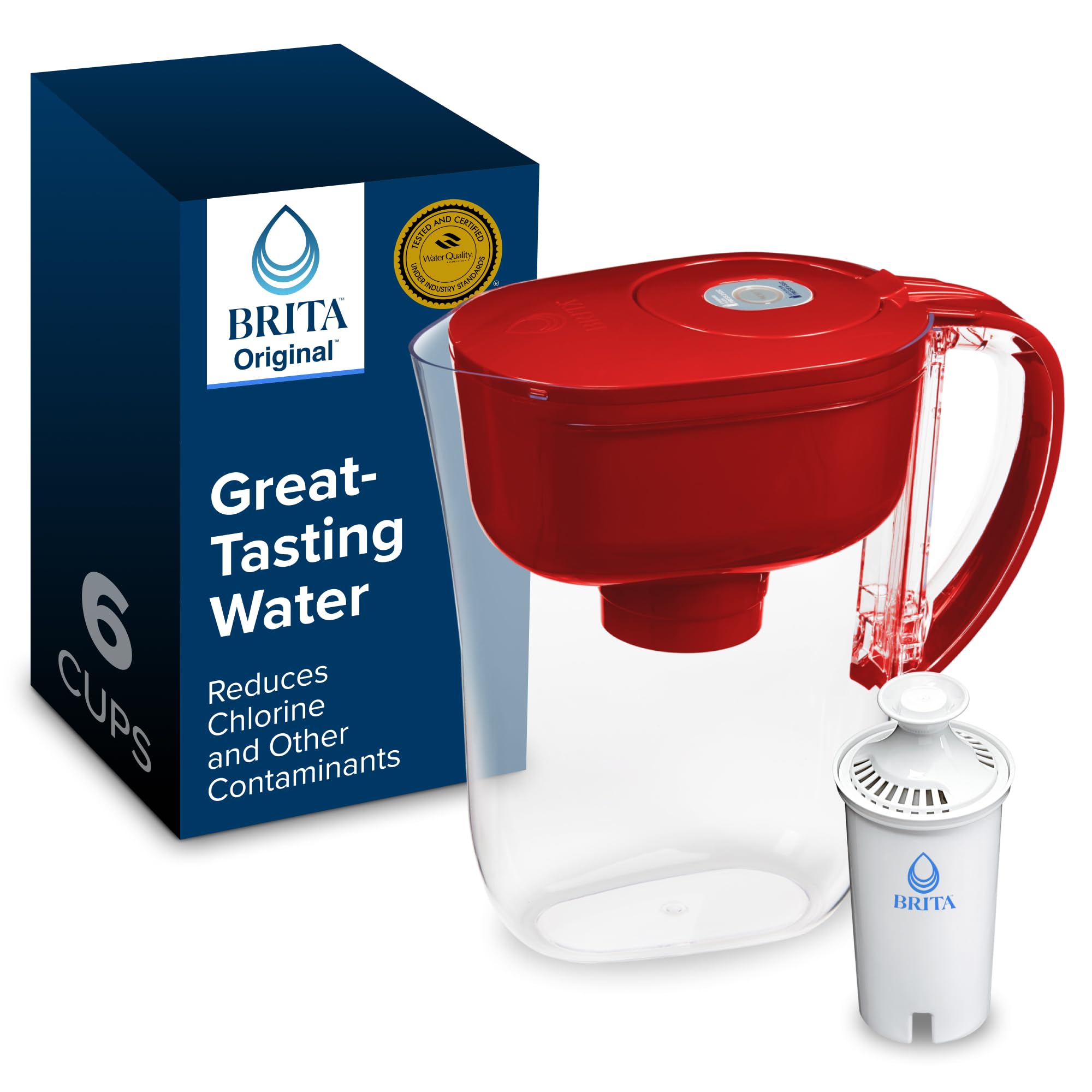
The Brita Metro is the entry point for anyone trying filtered water for the first time. Its 6-cup capacity is intentionally small — it fits neatly into a fridge door shelf and is light enough for a child to pour. The SmartLight electronic indicator tracks usage over 40 gallons and flashes when it is time to swap the filter, removing the guesswork that causes many new users to leave expired filters in place.
The filter reduces chlorine taste and odor, copper, cadmium, and mercury, hitting the contaminants that most noticeably affect tap water palatability. The easy-fill locking lid prevents spills during refilling, and the BPA-free body means no chemical leaching into the water. The Fiery Red color option makes the pitcher easy to spot in a crowded fridge.
The 6-cup reservoir will frustrate heavy drinkers — you will refill it two or three times a day if you go through the recommended eight glasses. The small size is a deliberate compromise for space savings. For a single person or occasional user who wants the lowest possible upfront cost and proven Brita reliability, this is the most accessible option available.
Why it’s great
- Ultra-compact size fits fridge door shelves perfectly
- SmartLight takes the guesswork out of filter changes
- Proven contaminant reduction with wide filter availability
Good to know
- 6-cup capacity requires multiple daily refills
- Only reduces chlorine, copper, cadmium, and mercury
- Not certified for lead, PFAS, or dissolved solids
FAQ
Will a carbon filter remove PFAS from my tap water?
How often should I replace a pitcher filter?
Is a faucet mount filter better than a pitcher?
Final Thoughts: The Verdict
For most users, the best affordable water filter winner is the ZeroWater ZD-010rp because it provides the most aggressive contaminant removal with NSF certification and a TDS meter for verification, all at a competitive upfront cost. If you want on-demand filtered water with the lowest per-gallon operating cost, grab the Waterdrop CTF-05. And for high-volume family use with no refill chore, nothing beats the Brita UltraMax Dispenser.