The search for an authentic Japanese steel blade that doesn’t demand a professional’s budget often ends in confusion — cheap knockoffs chip, forged steel is expensive, and the term “affordable” usually signals a compromise on edge retention. The real challenge is finding a knife that delivers the signature thin geometry and hard core of a Japanese Gyuto or Kiritsuke without forcing you to settle for a hollow grind or a soft stainless steel that dulls after one week.
I’m Mohammad Maruf — the founder and writer behind AirfryerBite. I have spent years analyzing blade metallurgy, handle ergonomics, and manufacturing tolerances across dozens of kitchen knife brands to understand what separates a genuine performance bargain from a pretty display piece.
After reviewing the VG-10 cores, layered Damascus cladding, Rockwell hardness ratings, and blade geometries of seven serious contenders, I compiled this guide to help you pick the affordable japanese chef knife that actually holds its edge during real prep work.
How To Choose The Best Affordable Japanese Chef Knife
Not every entry-level Japanese knife is a real Japanese knife. The market is flooded with stamped blades that imitate a hammered finish but lack the hard core and thin geometry that define the category. Focus on the steel composition, the construction method, and the blade profile before the visual pattern or handle color.
Steel Core and Rockwell Hardness
The core steel determines edge retention and ease of sharpening. VG-10 and AUS-10V are the most common premium alloys in the affordable range, hitting 58-62 HRC. A knife at 58 HRC is tougher and less prone to chipping, while a 62 HRC blade holds a razor edge longer but requires more care during cutting. Avoid blades that do not list the steel type or HRC rating.
Blade Construction: Forged vs. Stamped
A forged blade is shaped from a single billet of steel under high pressure, creating a denser grain structure and better balance. Stamped blades are cut from a rolled sheet of steel and heat-treated afterward — still functional but less durable. True affordable Japanese knives in this guide are hand-forged with multiple layers of Damascus cladding wrapping a hard steel core.
Blade Profile and Edge Angle
The Gyuto profile (8-inch chef knife) is the most versatile, handling slicing, chopping, and mincing across proteins and vegetables. A true Japanese edge is ground to 8-15 degrees per side, significantly thinner than a 20-degree Western edge. This geometry delivers cleaner cuts but also means the blade is more delicate — never use it on bones, frozen food, or hard squash seeds.
Quick Comparison
On smaller screens, swipe sideways to see the full table.
| Model | Category | Best For | Key Spec | Amazon |
|---|---|---|---|---|
| Kyoku Shogun Series | VG-10 Damascus | All-purpose home prep | VG-10 core, 67 layers, 58-60 HRC | Amazon |
| HOSHANHO Gyuto | 10Cr15CoMoV Core | Value-focused sharpness | 9-layer high carbon, 12-15° edge | Amazon |
| Fukep Damascus | VG-10 Damascus | Gifting and display | 66-layer Damascus, blue resin handle | Amazon |
| Mac Knife Chef Series | Molybdenum Steel | Lightweight daily driver | 2mm blade, hollow edge, Pakka wood | Amazon |
| MITSUMOTO SAKARI Kiritsuke | 440C Damascus | Premium Kiritsuke profile | 7-layer 440C, 13° edge, shadow wood | Amazon |
| Dalstrong Shogun Elite | AUS-10V Damascus | Pro-grade performance | 67-layer AUS-10V, 62+ HRC, G10 | Amazon |
| KAN Core Chef Knife | VG-10 Damascus | Balanced pro-level handling | VG-10 core, 60 HRC, ebony handle | Amazon |
In‑Depth Reviews
1. KYOKU Shogun Series Chef Knife – 8″

The Kyoku Shogun Series delivers the most balanced package of steel quality, edge geometry, and included accessories for the money. Its VG-10 core is cryogenically treated and clad in 67 layers of Damascus stainless steel, hitting a 58-60 HRC that resists chipping while maintaining a sharp 8-12 degree Honbazuke edge. The fiberglass handle with a mosaic pin provides a secure grip even when wet, and the included sheath and case protect the blade during storage.
Customer reviews consistently highlight the out-of-box sharpness and the knife’s ability to handle heavy weekly prep without requiring immediate honing. The 1.39-pound weight gives it a solid, well-balanced feel that reduces hand fatigue during longer cooking sessions. The combination of the case and sheath makes this a travel-friendly option for chefs who bring their own tools.
For a buyer seeking a true VG-10 Damascus knife that includes protective storage and delivers consistent performance across meat, fish, and vegetables, the Kyoku Shogun Series represents the most complete value in this category.
Why it’s great
- Cryogenically treated VG-10 core for long edge retention
- Includes both sheath and hard case for storage
- Well-balanced 1.39 lb design reduces wrist fatigue
Good to know
- Fiberglass handle may feel less organic than wood
- Hand wash only — dishwasher will damage the Damascus pattern
2. Dalstrong Shogun Elite Kiritsuke – 8.5″

The Dalstrong Shogun Elite series is engineered for users who demand professional-level edge retention and a more specialized blade profile. The 8.5-inch Kiritsuke shape combines the flat profile of a Nakiri with the curved tip of a Gyuto, making it excellent for both push-cutting vegetables and slicing meat. The AUS-10V Japanese super steel reaches 62+ HRC after nitrogen tempering, and the 67-layer tsunami-rose Damascus cladding adds corrosion resistance and aesthetic appeal.
The military-grade G10 handle is full-tang and triple-riveted, providing a secure, non-slip grip that remains stable even with oily hands. The knife is balanced at the pinch point, encouraging a proper blade grip that improves control and safety. The included sheath protects the razor edge during storage and transport.
This knife is best suited for experienced home cooks or professionals who want a harder steel that holds an edge for weeks of heavy use. The higher hardness means it will require a whetstone for sharpening rather than a pull-through sharpener.
Why it’s great
- AUS-10V steel at 62+ HRC for exceptional edge retention
- Nitrogen-tempered for superior flexibility and rust resistance
- Ergonomic G10 handle with full tang provides excellent control
Good to know
- Kiritsuke profile requires some adjustment for traditional rocking cuts
- Higher hardness increases risk of chipping if used on bones
3. MITSUMOTO SAKARI Kiritsuke – 8″

The MITSUMOTO SAKARI Kiritsuke knife distinguishes itself with a striking design collaboration — its shadow wood handle was created in partnership with a Japanese manga artist, giving the handle a flowing, colorful pattern that is genuinely unique in this price bracket. Under the visual appeal sits a 7-layer 440C Damascus steel blade that has been vacuum deep-cooled to improve edge stability, ground to a 13-degree angle for precision slicing.
The sandalwood gift box presentation makes this knife a strong candidate for gifting, but the performance is serious enough for daily kitchen use. The blade maintains a useful balance between hardness and toughness, and the shadow wood handle offers a warm, organic grip that many cooks prefer over synthetic materials. The included case provides proper protection during storage.
While the 440C steel does not reach the same theoretical hardness as VG-10 or AUS-10V, it is easier to sharpen at home and less likely to chip during beginner use, making this a great entry point for someone who values aesthetics and easy maintenance.
Why it’s great
- Unique shadow wood handle with artist-designed pattern
- Vacuum deep-cooled blade improves sharpness durability
- Includes premium sandalwood gift box for presentation
Good to know
- 440C steel is less hard than VG-10 (lower edge retention)
- Kiritsuke flat profile is less versatile for rocking cuts
4. KAN Core Chef Knife – 8″

The KAN Core Chef Knife is the upgraded VG-10 version of the company’s original line, and it shows a clear focus on balance and ergonomics. The knife is weighted precisely at the pinch point, which encourages a safer blade grip and reduces wrist strain during extended prep sessions. The VG-10 core is clad in 66 layers of Damascus stainless steel, achieving a 60 HRC that hits the sweet spot between toughness and hardness.
The dark ebony wood handle is dense, moisture-resistant, and visually understated — a refined choice for cooks who prefer natural materials over synthetic handles. The hammered finish on the blade reduces food sticking during slicing and adds a tactile quality that complements the professional double-bevel edge geometry.
This is an excellent choice for the home cook who wants a premium-feeling VG-10 knife without paying for a flashy design. The ebony handle and balanced weighting make it a tool you will reach for every day.
Why it’s great
- Precision balanced at the pinch point for fatigue-free use
- Ebony wood handle is dense, durable, and moisture-resistant
- Hammered finish reduces food sticking during slicing
Good to know
- No sheath or case included for storage
- Ebony wood requires occasional oiling to prevent drying
5. Mac Knife Chef Series Hollow Edge – 8″

The Mac Knife Chef Series is a long-standing benchmark for an affordable Japanese blade that prioritizes lightness and agility. The 2mm thick blade made of original Molybdenum steel is notably thinner than the Damascus competitors, resulting in a nimble feel that makes fine slicing and dicing effortless. The hollow edge design creates air pockets that prevent food from sticking to the blade during repetitive cuts.
The Pakka wood handle is lightweight and comfortable, though the overall 9.1-ounce weight is noticeably lighter than the forged Damascus knives in this roundup. This is not a negative — it makes the Mac Knife an ideal choice for cooks who prefer a nimble, quick-cutting tool for vegetables and boneless protein rather than a hefty blade for heavy chopping.
Made in Japan and backed by decades of reputation, the Mac Knife is the pragmatic choice for someone who values a proven, no-nonsense blade geometry over flashy Damascus patterns.
Why it’s great
- Ultra-thin 2mm blade for precise, agile cutting
- Hollow edge reduces food sticking during prep
- Proven Japanese Molybdenum steel with good edge retention
Good to know
- Lighter weight may feel insubstantial for heavy chopping
- Pakka wood handle is less durable than resin or G10
6. HOSHANHO Gyuto Chef Knife – 8″

The HOSHANHO Gyuto Chef Knife brings a 10Cr15CoMoV super steel core to the affordable segment, a high-carbon alloy that is comparable to VG-10 in hardness and edge stability. The blade is forged with 9 layers of high-carbon steel in a sandwich structure, where the hard core is protected by softer outer layers that add corrosion resistance. The wet V-shaped sharpening process creates a 12-15 degree edge that is capable of clean, resistance-free cuts.
The traditional Japanese octagonal rosewood handle is ergonomically shaped to fit the palm naturally, and the two copper wire inlays add visual detail without compromising grip. The 8.11-inch blade paired with a 6.1-inch handle achieves a near-golden ratio that balances the knife directly above the pinch grip, improving control during repetitive cutting tasks.
For the budget-conscious cook who still wants a hand-forged blade with a genuine high-carbon steel core, the HOSHANHO delivers impressive sharpness and balance at a very accessible entry point.
Why it’s great
- 10Cr15CoMoV super steel core matches VG-10 performance
- Octagonal rosewood handle offers comfortable, natural grip
- Near-golden ratio blade-to-handle balance improves control
Good to know
- Rosewood handle requires hand-washing and occasional oiling
- 9-layer construction is less durable than 67-layer Damascus
7. Fukep Damascus Chef Knife – 8″
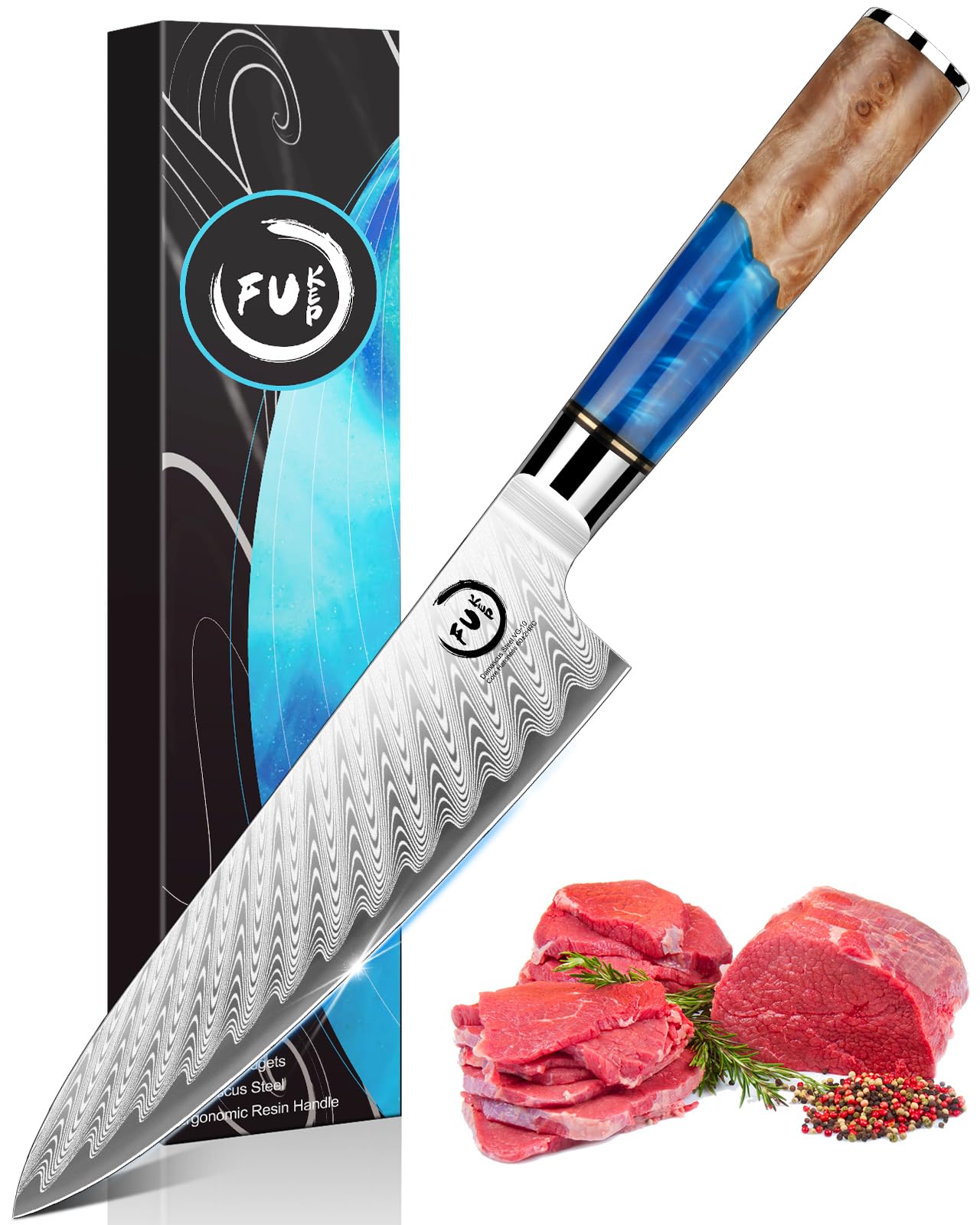
The Fukep Damascus Chef Knife is built around a VG-10 core clad in 66 layers of high-carbon steel, combining a legitimate Japanese steel center with a striking aesthetic package. The blue resin handle, accented with wood tones, creates a visual contrast that stands out on any knife block. Despite the decorative focus, the blade geometry is functional — the Damascus pattern is not just cosmetic but contributes to the blade’s overall strength and non-stick properties.
At 11.4 ounces, the knife is lightweight enough for comfortable daily use but still provides enough heft to drive through dense vegetables. The included gift box makes this an obvious choice for a birthday or holiday present, though the performance is solid enough for regular kitchen duty. The handle is comfortable for smaller hands, and the balance point sits near the bolster for controlled slicing.
The Fukep is best appreciated as a combination of functional VG-10 blade and high-impact design — ideal for the cook who wants a visually distinctive tool that does not sacrifice core steel quality.
Why it’s great
- Genuine VG-10 core under 66-layer Damascus cladding
- Stunning blue resin handle with wood accents
- Lightweight 11.4 oz design is comfortable for all-day use
Good to know
- Resin handle may feel less grippy when wet
- No sheath included for storage protection
FAQ
What does affordable mean for a Japanese chef knife under ?
Can I use a Japanese chef knife on bones or frozen food?
How do I maintain the edge on an affordable Japanese chef knife?
Final Thoughts: The Verdict
For most users, the affordable japanese chef knife winner is the Kyoku Shogun Series Chef Knife because it delivers a cryogenically treated VG-10 core, 67-layer Damascus cladding, and protective accessories at a price that undercuts competitors with similar specs. If you want pro-grade edge retention and a specialized Kiritsuke profile, grab the Dalstrong Shogun Elite. And for a lightweight, no-fuss daily driver with a proven blade geometry, nothing beats the Mac Knife Chef Series.