That lingering chlorine aftertaste in your morning coffee or the faint metallic edge in your drinking water is a signal your tap needs better treatment. A dedicated 3-stage filtration system strips out sediment, chlorine, and volatile organic compounds without the waste or cost of bottled water, turning any faucet into a reliable source of cleaner, better-tasting water.
I’m Mohammad Maruf — the founder and writer behind AirfryerBite. I’ve spent years researching home water filtration hardware, comparing micron ratings, flow rates, and filter media to identify which systems actually deliver on their claims.
After evaluating dozens of configurations, I’ve narrowed the field to seven standout models that solve the real problems homeowners face. This guide walks you through every spec and trade-off so you can confidently select the right 3 stage water filter system for your kitchen or whole house setup.
How To Choose The Best 3 Stage Water Filter System
Selecting the right system starts with understanding your water supply. Municipal water typically needs chlorine and sediment reduction, while well water demands heavy-metal and bacterial protection. The filter media in each stage defines what gets removed and what stays behind.
Match Filter Media to Your Contaminants
Stage one is almost always a sediment filter (polypropylene spun or pleated) that catches rust, sand, and silt. Stage two uses granular activated carbon (GAC) or a carbon block to adsorb chlorine, volatile organic compounds (VOCs), and bad odors. Stage three can vary widely: a second carbon block for polishing, a KDF (kinetic degradation fluxion) media for heavy metals, or an ultrafiltration membrane for fine particulate down to 0.01 microns. Know what is in your water before picking the third stage.
Assess Flow Rate and Pressure Loss
Whole house systems handle 10–20 gallons per minute (GPM) because they service every tap in the home. Under-sink units typically deliver 0.5–1.5 GPM, which is fine for drinking and cooking but not for filling a bathtub. A higher GPM rating reduces wait time at the faucet but may lower filtration efficiency if the contact time with the media is too short. Look for systems that balance flow with adequate filter surface area.
Check Housing Material and Connection Size
Under-sink models should use lead-free 304 stainless steel or BPA-free reinforced plastic to avoid leaching contaminants after installation. Whole house units often use clear polypropylene housings that let you see when the sediment filter is dirty. Inlet/outlet size matters too: 3/8-inch connections are standard for kitchen faucets, while 1-inch or 3/4-inch brass ports are necessary for whole house setups to maintain adequate pressure across multiple fixtures.
Quick Comparison
On smaller screens, swipe sideways to see the full table.
| Model | Category | Best For | Key Spec | Amazon |
|---|---|---|---|---|
| Waterdrop TST-B | Under Sink | Dedicated faucet + mineral retention | 0.01 micron UF membrane, 1.59 GPM | Amazon |
| iSpring WCB32C | Whole House | Whole home chlorine & sediment reduction | 3/4-inch ports, clear first-stage housing | Amazon |
| Waterdrop TST-UF | Under Sink | No-drill setup, high flow for cooking | 0.01 micron UF membrane, 1.59 GPM | Amazon |
| Express Water Direct | Under Sink | Budget-friendly with leak detection | 90% contaminant reduction, chrome faucet | Amazon |
| Express Water Whole House | Whole House | Heavy metal removal via KDF media | 4.5 x 20-inch filters, 100,000 gal capacity | Amazon |
| SimPure DB20P-3 | Whole House | BPA-free build with 1-inch brass ports | Clear housings, carbon sediment + GAC | Amazon |
| APEC ROES-PH75X | Under Sink RO | Alkaline + TDS reduction | 75 GPD, 6-stage with alkaline filter | Amazon |
In‑Depth Reviews
1. Waterdrop TST-B 0.01 Micron Ultra Filtration Under Sink Water Filter

This under-sink system uses a three-stage filtration train — polypropylene sediment, granular activated carbon, and a 0.01-micron ultrafiltration membrane — packaged inside a lead-free 304 stainless steel housing. The dedicated brushed-steel faucet means you keep your original tap for washing dishes while routing filtered water through a separate spout. The flow rate hits 1.59 GPM, filling a glass in roughly 2.3 seconds without noticeable pressure drop.
The UF membrane reduces bacteria and cysts larger than 0.01 microns while retaining beneficial minerals like calcium and magnesium, so the water tastes crisp but not flat. Filter replacement intervals are generous: the PP sediment lasts 6–8 months, the UF membrane holds for a full year, and the CT carbon can go 12–24 months depending on incoming water quality. Installation requires drilling a hole for the dedicated faucet, but the included conversion kit fits standard 3/8-inch and 1/2-inch supply lines.
Because this is an ultrafiltration system and not reverse osmosis, it does not reduce total dissolved solids (TDS). If you need TDS reduction for hard water or heavy mineral content, consider pairing this with an inline RO system. Otherwise, this Waterdrop model delivers exceptional filtration depth and robust build quality at a mid-range investment.
Why it’s great
- 0.01-micron UF membrane stops bacteria and cysts
- Lead-free 304 stainless steel housing resists corrosion
- High 1.59 GPM flow fills cups quickly
Good to know
- Does not reduce TDS (not suitable for very hard water)
- Dedicated faucet requires drilling a hole in countertop
2. iSpring Whole House Water Filter System WCB32C

The iSpring WCB32C is a whole-house three-stage system built to handle the full incoming water line. Stage one uses a clear polypropylene housing so you can visually inspect sediment buildup without disassembly. The three stages combine a sediment filter, a carbon block cartridge, and a granular activated carbon (GAC) filter to slash chlorine, bad tastes, odors, and coarse particulates by up to 99 percent. The 3/4-inch NPT brass inlet and outlet maintain strong flow across multiple taps simultaneously.
Because this is a whole-house system, it treats water for showers, washing machines, and every faucet — not just the kitchen sink. The clear first-stage housing is a practical feature: when the sediment cartridge turns brown, you know it is time to swap. The system does not reduce TDS, so mineral content remains unchanged, which is ideal for homeowners who want cleaner water without altering hardness levels.
Installation requires basic plumbing knowledge and space near the main water line. The filters are standard 4.5 x 20-inch cartridges, making replacements widely available. For a mid-range investment, the WCB32C gives whole-home protection against chlorine and sediment without the complexity of a backwashing filter.
Why it’s great
- Clear first-stage housing lets you monitor sediment load
- 3/4-inch brass ports preserve flow through the whole house
- Up to 99% reduction of chlorine, taste, and odor
Good to know
- Requires dedicated space near main water line
- Does not reduce heavy metals or TDS
3. Waterdrop TST-UF 0.01μm Ultra-Filtration Under Sink System

The Waterdrop TST-UF shares the same 0.01-micron ultrafiltration membrane and 1.59 GPM flow as the TST-B but omits the dedicated faucet to make installation simpler. This version connects directly to your existing faucet supply line without any drilling — ideal for renters or anyone avoiding countertop modifications. The three-stage media train (PP sediment, GAC, UF membrane) handles chlorine, heavy metals, and fine particulates while preserving healthy minerals.
The housing is constructed from lead-free 304 stainless steel with a thick sealing ring that prevents leaks at the connections. Placement is flexible: mount it vertically on the cabinet wall or lay it horizontally on the cabinet floor. The system maintains steady flow even after months of use, and the long filter life (PP at 6–8 months, UF at 12 months, CT at 12–24 months) keeps replacement costs low over time.
Like all ultrafiltration systems, the TST-UF does not reduce TDS. It works best with municipal cold water supply and should not be used with well water or hot water lines. For households looking for a straightforward under-sink upgrade without invasive installation, this Waterdrop model delivers reliable contaminant reduction.
Why it’s great
- No-drill installation works with existing faucet supply
- 0.01-micron UF membrane catches bacteria and cysts
- Multiple placement options for tight under-sink spaces
Good to know
- Does not reduce TDS
- Not compatible with well water or hot water sources
4. Express Water Direct Water Filtration System 3 Stage

The Express Water Direct system uses a three-stage combination of polypropylene sediment, activated carbon block, and granular activated carbon (GAC) to reduce up to 95 percent of chlorine, rust, VOCs, and sand. The included chrome faucet feeds filtered water through a separate spout, keeping your main faucet free for washing. The system is designed for DIY installation with push-fit fittings that connect to standard under-sink plumbing without special tools.
A standout safety feature is the emergency leak detection shut-off valve. If moisture is detected at the housing, the valve automatically cuts water flow to prevent cabinet damage. The carbon block filter uses lab-heated coconut husk carbon, which provides a larger surface area for chlorine adsorption compared to standard loose carbon media. The filters are compact, so the system fits easily in tight cabinets.
Flow rate is adequate for drinking and cooking but slower than the Waterdrop ultrafiltration models — expect roughly 0.5 GPM. The system produces zero wastewater since it is a direct filtration setup, not reverse osmosis. For a budget-friendly entry into under-sink filtration with leak protection, the Express Water Direct is a dependable workhorse.
Why it’s great
- Emergency leak shut-off valve prevents water damage
- Lab-heated coconut husk carbon block for better chlorine removal
- Zero wastewater during operation
Good to know
- Flow rate is slower (around 0.5 GPM)
- Chrome faucet may not match all kitchen finishes
5. Express Water Whole House Heavy Metal Water Filter Set

This Express Water set replaces the cartridges in a compatible whole-house three-stage system with a specialized heavy-metal-fighting configuration. Stage one is a 5-micron polypropylene sediment filter. Stage two is a carbon block. Stage three introduces KDF media — a blend of catalytic carbon and ionically charged copper-zinc granules that reduce iron, lead, nickel, chromium, and other heavy metals. Each cartridge measures 4.5 inches by 20 inches, a common size for standard whole-house housings.
The KDF media adds electrochemical redox reactions that convert dissolved heavy metals into insoluble particles, which the sediment stage then traps. This chemistry also inhibits bacteria growth inside the filter housing, a benefit over plain carbon-only systems. The set handles up to 100,000 gallons depending on feed water quality, which for a typical family of four translates to roughly 6–12 months between replacements.
Because this is a whole-house filter set and not a full system, you will need compatible housings to hold these cartridges. It is ideal for homeowners already running a three-stage whole-house rig who want to upgrade to heavy-metal protection without replacing the entire setup. The system does not reduce TDS, so mineral content stays stable.
Why it’s great
- KDF media targets heavy metals like lead and chromium
- 100,000-gallon capacity reduces replacement frequency
- Inhibits bacteria growth inside the housing
Good to know
- Requires compatible whole-house housings (not a standalone system)
- Does not reduce TDS
6. SimPure Whole House Water Filter System DB20P-3

The SimPure DB20P-3 is a whole-house three-stage system built around BPA-free clear polypropylene housings and 1-inch NPT brass inlet/outlet ports. The 1-inch ports are larger than the typical 3/4-inch found on many residential systems, which reduces pressure loss and keeps water flowing at full volume when multiple fixtures run simultaneously. The three stages use a carbon sediment blend and granular activated carbon (GAC) to reduce chlorine, taste, odor, iron particles, and sediment.
The clear housings for all three stages let you inspect each filter’s condition at a glance. If the first-stage sediment cartridge looks dirty, you can swap it without guessing. The system ships with standard 4.5 x 20-inch cartridges, so replacement sourcing is straightforward. SimPure uses food-grade materials throughout, and the housing threads are reinforced to resist cracking under pressure.
Installation requires soldering or compression fittings for the 1-inch connections, so a moderate level of plumbing confidence is needed. This system does not reduce TDS or remove dissolved minerals. For households with good water quality that simply want to polish out chlorine and sediment across the entire home, the DB20P-3 offers premium flow capacity and visual maintenance monitoring.
Why it’s great
- 1-inch brass ports maintain full flow under high demand
- BPA-free clear housings let you see filter condition
- Three-stage visibility for easy replacement scheduling
Good to know
- Requires plumbing skills for 1-inch connection installation
- Does not reduce heavy metals or TDS
7. APEC Water ROES-PH75X 6-Stage Alkaline Under Sink Reverse Osmosis System
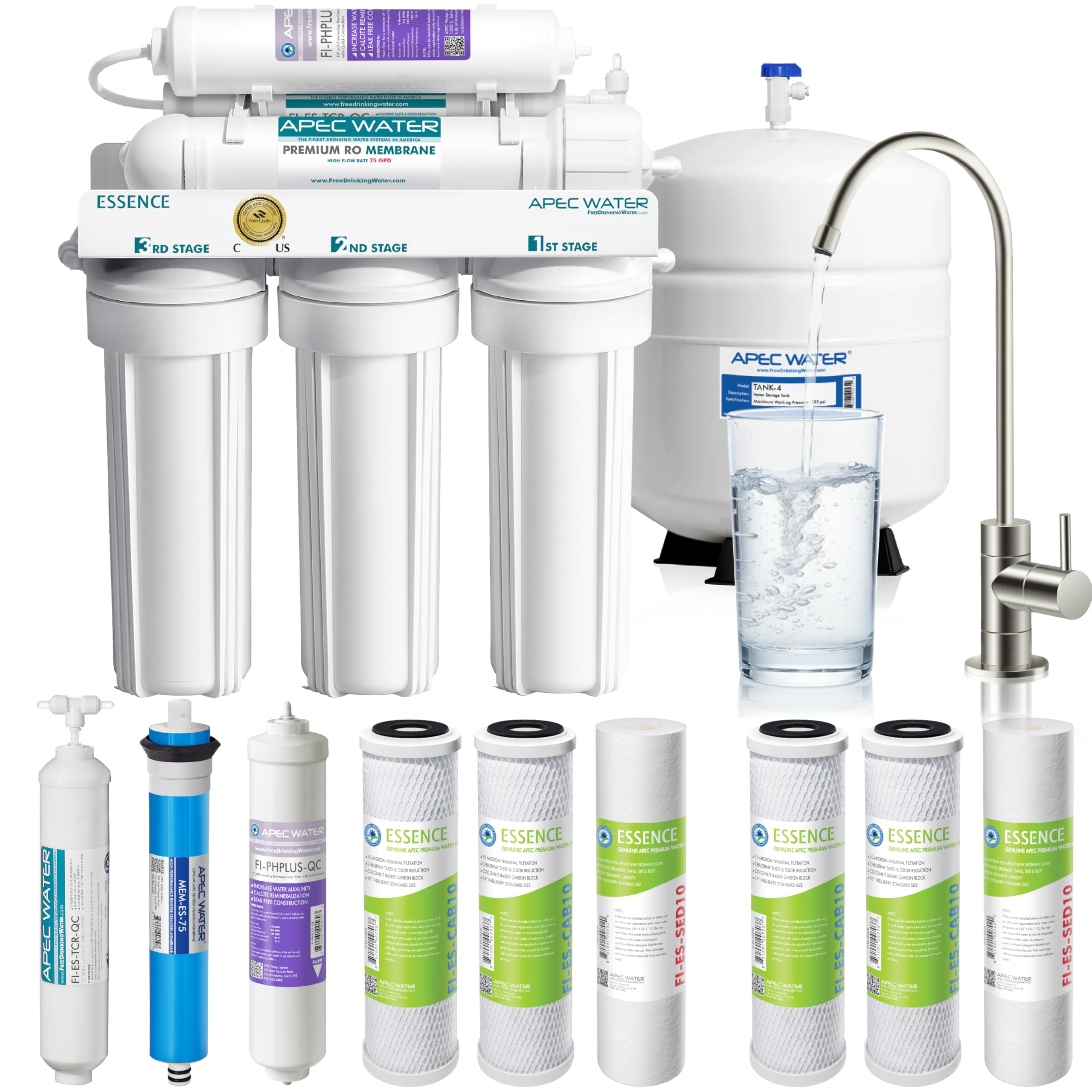
The APEC ROES-PH75X expands beyond basic three-stage filtration into a full six-stage reverse osmosis system. Stages one through three function as the pre-filter set: a polypropylene sediment filter, a carbon block, and a granular activated carbon (GAC) filter. These three stages are essentially a standalone 3-stage filtration system that feeds clean, chlorine-free water into the RO membrane (fourth stage), followed by a fifth-stage polishing carbon and a sixth-stage alkaline remineralization filter that restores healthy minerals and raises pH.
The system produces 75 gallons per day (GPD) under standard conditions, making it suitable for medium to large households. NSF certification for both the system and the membrane ensures that contaminant reduction claims — including lead, arsenic, fluoride, chromium, and dozens of other pollutants — are verified by third-party testing. The alkaline stage adds back calcium, magnesium, and potassium, delivering water with a balanced pH around 7.5–8.0.
Installation follows standard under-sink RO setup with a dedicated faucet and storage tank. The three pre-filters in this model effectively act as a high-quality 3-stage system on their own, but the full six-stage chain is necessary for TDS reduction. If your primary goal is straightforward chlorine and sediment removal without TDS reduction, a simpler three-stage unit may be more practical. For maximum purity and mineral balance, the APEC ROES-PH75X is a premium solution.
Why it’s great
- NSF certified for reduction of lead, arsenic, fluoride, and more
- Alkaline remineralization stage restores pH and minerals
- 75 GPD production handles medium to large household demand
Good to know
- RO system requires more under-sink space for tank and cartridges
- Produces wastewater during filtration (typical for RO)
FAQ
What is the difference between a 3-stage filter and a reverse osmosis system?
Can a 3-stage whole house filter reduce hard water scale?
How often should I replace the filters in a 3-stage system?
Final Thoughts: The Verdict
For most users, the 3 stage water filter system winner is the Waterdrop TST-B because it combines a 0.01-micron UF membrane with a dedicated faucet and durable stainless steel housing at a sensible mid-range investment. If you want a whole-house solution that handles chlorine and sediment for every tap, grab the iSpring WCB32C. And for maximum purity with TDS reduction and alkaline remineralization, nothing beats the APEC ROES-PH75X.