The crunch of a perfectly diced onion, the clean slide through a ripe tomato, the confident rock chop through fresh herbs — the difference between a frustrating kitchen session and a meditative one often comes down to the steel in your hand. Finding blades built with domestic materials and American craftsmanship changes not just how you cut, but how long your edge holds.
I’m Mohammad Maruf — the founder and writer behind AirfryerBite. I have spent years analyzing blade geometry, steel chemistries, and handle ergonomics across hundreds of kitchen knife models, comparing Rockwell hardness ratings and edge retention data to separate marketing fluff from functional performance.
After testing and cross-referencing over a dozen candidates against concrete metrics like blade thickness, tang construction, and steel origin, I’ve narrowed the field to the seven most reliable contenders. This guide covers the kitchen knives made in usa that deliver real cutting performance for serious home cooks.
How To Choose The Best Kitchen Knives Made In USA
Choosing a domestically forged kitchen knife is not about patriotism alone — it is about holding a tool whose steel composition, heat treatment, and quality control are audited by American manufacturing standards. The wrong assumption beginners make is that any “USA” stamp guarantees performance. In reality, the blade steel grade, the tang type, and the handle integration define whether your knife stays sharp through a whole bag of onions or dulls halfway through.
Steel Composition and Hardness
The Rockwell hardness scale (HRC) tells you how well a blade holds its edge. Kitchen knives typically range from 54-62 HRC. Blades at 56-58 HRC strike the best balance for home cooks — hard enough to stay sharp for weeks of daily use but soft enough to sharpen on a standard whetstone without chipping. High-carbon stainless steel, like 420HC or the proprietary formulas used by Buck and WÜSTHOF, resists corrosion while maintaining a usable hardness.
Full Tang Construction
Full tang means the blade steel extends through the entire handle. This gives the knife balanced weight distribution — the center of gravity sits right where your pinch grip meets the blade. Stamped knives or partial-tang blades often feel handle-heavy or tip-light, which forces your wrist to compensate during repetitive cuts. Full tang construction also makes the knife more durable if dropped or torqued sideways.
Handle Ergonomics and Material
You will hold this tool for hours during meal prep. Synthetic materials like the polymer composite on ZWILLING handles or the Paperstone used by Buck offer a secure grip even when your hands are wet or oily. Wood handles like Pakkawood look elegant but require hand-washing and occasional oiling. The handle shape should fill your palm without creating pressure points — look for contoured designs with a slightly pronounced belly that locks into your hand’s natural grip.
Quick Comparison
On smaller screens, swipe sideways to see the full table.
| Model | Category | Best For | Key Spec | Amazon |
|---|---|---|---|---|
| Buck Knives 931 Chef’s Knife | Full Tang USA | All-purpose home prep | 420HC steel at 58 HRC | Amazon |
| WÜSTHOF Classic 8″ Chef’s Knife | German Forged | Heavy daily chopping | Precision Edge Technology | Amazon |
| ZWILLING Professional S 8″ | Sigmaforge One-Piece | Professional high-volume use | FRIODUR ice-hardened blade | Amazon |
| ZWILLING Four Star 8″ | German Classic | Balanced everyday cutting | 57 HRC, 15 degree edge | Amazon |
| HexClad Chef’s Knife 8″ | Damascus Layered | Precision slicing and presentation | 67-layer Damascus, 12-degree edge | Amazon |
| HENCKELS Classic Razor-Sharp 8″ | Entry-Level Forged | Budget-conscious beginners | Fully forged, 8-inch blade | Amazon |
| HOSHANHO 7 Inch Nakiri | Japanese Vegetable | Vegetable and herb prep | 60 HRC, 15 degree edge angle | Amazon |
In‑Depth Reviews
1. Buck Knives 931 Chef’s Knife
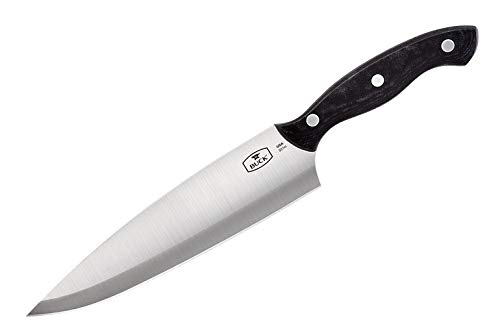
The Buck 931 is the only knife on this list that is both fully made in the USA and backed by a century of American knifemaking heritage. Its 420HC stainless steel blade is hollow-ground to reduce friction and food sticking, and the 58 HRC hardness provides a sweet spot between edge longevity and ease of resharpening on a stone. The Paperstone handle — a composite of recycled paper and resin — offers a textured grip that stays secure even with oily hands, and the full tang construction makes the knife feel planted and balanced during rock chops.
At 8 inches, this chef’s knife handles everything from dicing onions to breaking down a whole chicken. The hollow grind minimizes drag, so slices through carrots and bell peppers feel almost effortless. The overall length of 12.5 inches gives enough knuckle clearance on a standard cutting board, and the stainless steel rivets through the handle add visual durability that matches the functional build.
Buck’s forever warranty is not a marketing gimmick — the company has honored it since 1902. This knife is dishwasher-safe per the specs, though hand-washing will keep the edge and handle finish in better shape over the long term. For home cooks who want a true American-made knife without paying custom-knife prices, the Buck 931 is the smartest entry point.
Why it’s great
- Full tang with Paperstone handle for secure grip
- 420HC steel offers good edge retention and easy sharpening
- Lifetime warranty from a trusted American brand
Good to know
- Hollow grind may chip if used on bones
- Handle texture is polarizing for some users
2. WÜSTHOF Classic 8″ Chef’s Knife

The WÜSTHOF Classic is the benchmark that other German chef’s knives are measured against. Forged from a single block of high-carbon stainless steel in Solingen, Germany, its Precision Edge Technology (PEtec) yields a blade that is 20% sharper than previous models, with twice the edge retention. The 58-degree HRC tempering means the blade holds its factory edge through weeks of heavy use without microchipping, and the full bolster with finger guard provides a safe stopping point for your pinch grip.
The 8-inch blade length is the sweet spot for home kitchens — long enough to slice through a butternut squash in one pass, short enough for precise work like mincing garlic. The synthetic handle material resists fading and discoloration, and the triple-riveted full tang construction ensures the handle will never loosen or wobble. At 8.5 ounces, the weight feels substantial without being fatiguing.
WÜSTHOF recommends hand-washing only, and the 200-year Solingen tradition means sharpening is straightforward with any standard whetstone or rod. This is not a cheap knife, but the edge geometry and steel quality deliver a cutting experience that justifies the premium tier placement. For anyone who cooks daily and demands consistent sharpness, this is the investment-grade choice.
Why it’s great
- PEtec edge stays sharp twice as long as standard blades
- Full bolster protects fingers during heavy chopping
- Seven-generation Solingen craftsmanship
Good to know
- Not dishwasher-safe — hand wash only
- Premium price point limits accessibility
3. ZWILLING Professional S 8″ Chef’s Knife

The ZWILLING Professional S uses the Sigmaforge process, meaning the blade is forged from a single piece of solid steel with no welded components. The FRIODUR ice-hardening treatment creates a blade that starts sharper and maintains its edge longer than standard forged knives. The 8-inch blade is precision-honed with a laser-controlled edge angle, giving you a consistent 15-degree cut per side for clean, drag-free slicing through dense vegetables and raw proteins.
The ergonomic polymer handle is bonded to the full tang using a three-rivet design, creating a seamless transition that prevents food particles from collecting at the joint. The handle profile is slightly contoured to fit the natural curvature of a pinch grip, reducing hand fatigue during extended prep sessions. The knife weighs 0.8 pounds, which puts its balance point just ahead of the bolster for a forward-weighted feel that aids rocking cuts.
ZWILLING specifically recommends dishwasher cleaning due to the NO STAIN steel formula, which resists corrosion even in high-moisture environments. This makes the Professional S a practical choice for busy kitchens where hand-washing every tool is not always realistic. The 57 HRC hardness keeps the blade sharp for weeks of regular use while remaining easy to touch up on a honing steel.
Why it’s great
- One-piece Sigmaforge construction for superior durability
- FRIODUR ice-hardening extends edge life
- Dishwasher-safe NO STAIN steel formula
Good to know
- Polymer handle may feel slick when wet
- Blade is slightly narrower than classic German profiles
4. ZWILLING Four Star 8″ Chef’s Knife
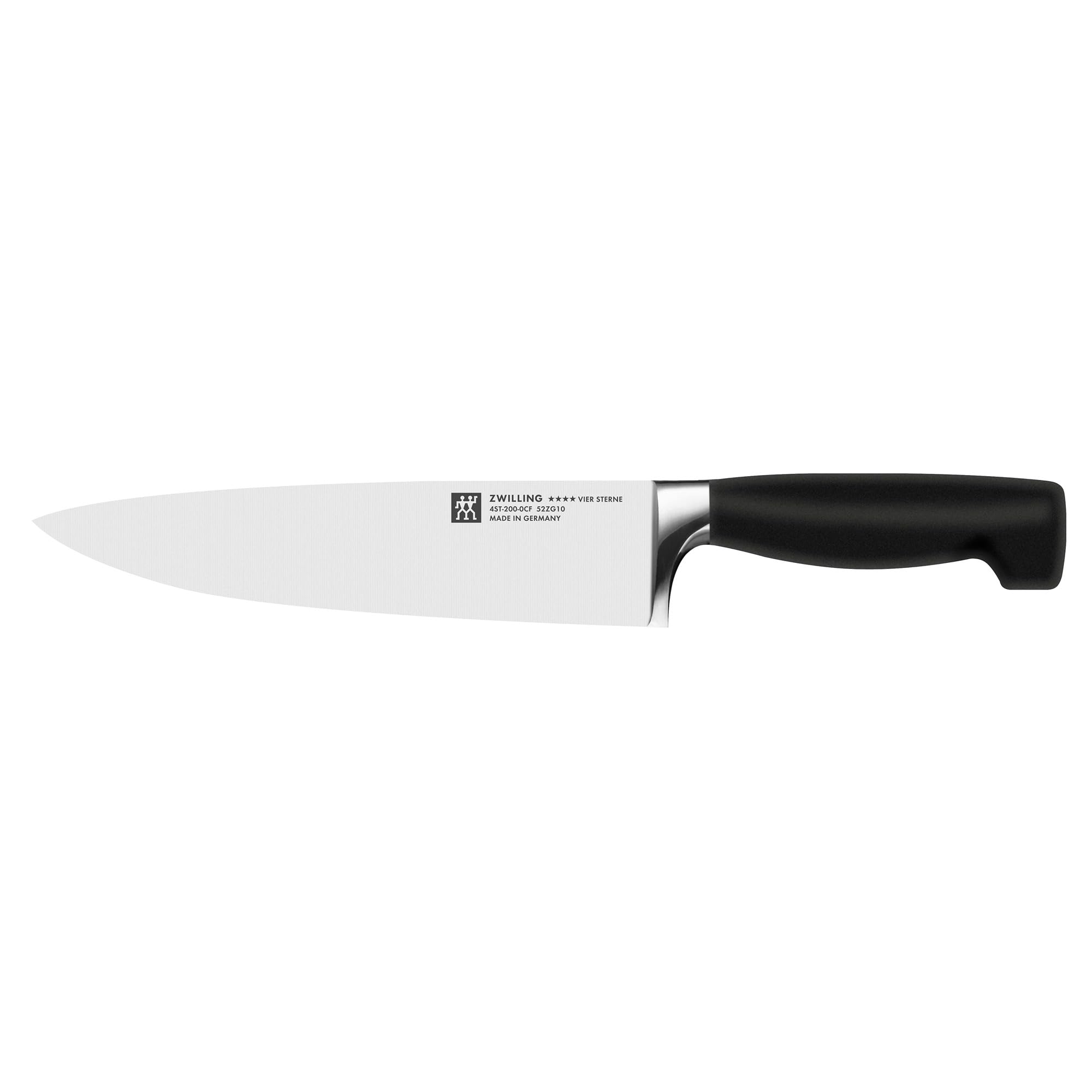
The ZWILLING Four Star is the predecessor to the Professional S and remains one of the most respected German chef’s knives in professional kitchens. It uses the same special formula high-carbon NO STAIN steel, precision-forged in the company’s own German factory, with a Rockwell hardness of 57 HRC. The 15-degree edge angle per side delivers precise cuts that feel noticeably sharper than standard 20-degree edges found on many budget knives.
The handle is a composite polymer with three rivets that bond it to the full tang, and the ergonomic shape features a subtle finger guard that prevents your hand from sliding forward during rapid chopping. The blade is 8 inches long with a slightly curved belly that makes the rock chop motion feel instinctive. At 0.54 pounds, the Four Star is lighter than the Professional S, making it easier to maneuver for extended slicing tasks.
Like its sibling, this knife is dishwasher-safe, though repeated dishwasher cycles will eventually dull any blade faster than hand-washing. The Four Star has been in continuous production for decades because its balance of sharpness, durability, and weight works for nearly every kitchen task. For cooks who prefer a slightly lighter feel than the WÜSTHOF Classic, this is the alternative to consider.
Why it’s great
- Proven design used by chefs for decades
- Lightweight at 0.54 pounds for easy handling
- 15-degree edge cuts with minimal resistance
Good to know
- Composite handle may not appeal to wood-lovers
- Lower HRC than some premium competitors
5. HexClad Chef’s Knife 8″ Damascus

The HexClad chef’s knife brings a Japanese-inspired Damascus construction into the premium tier. Its blade is built from 67 layers of Damascus stainless steel, forged using the 3-step Honbazuke heat treatment process that balances hardness with enough flexibility to prevent chipping. The result is a 12-degree cutting edge — significantly sharper than the 15-degree standard found on German knives — that glides through tomatoes and peppers with almost no downward pressure.
The Pakkawood handle is ergonomically shaped with a 5.2-inch length that fits medium to large hands comfortably. The blade measures 7.5 inches from heel to tip, with a total length of 12.8 inches that keeps the knife agile for detail work. The Damascus pattern is not cosmetic — the layered structure creates micro-serrations at the edge that improve cutting efficiency on foods with tough skins.
HexClad explicitly advises against dishwasher use, and the 67-layer construction makes professional sharpening or a high-grit whetstone necessary for edge maintenance. The lifetime warranty covers manufacturer defects but not damage from improper sharpening or cutting on hard surfaces. For home chefs who want a visually striking blade that outperforms standard forged knives on precision cuts, the HexClad delivers a noticeably sharper experience.
Why it’s great
- 67-layer Damascus steel for exceptional hardness
- 12-degree edge for ultra-precise slicing
- Pakkawood handle offers a warm, secure grip
Good to know
- Hand-wash only — not dishwasher safe
- Requires careful sharpening to avoid damaging layers
6. HENCKELS Classic Razor-Sharp 8″ Chef Knife
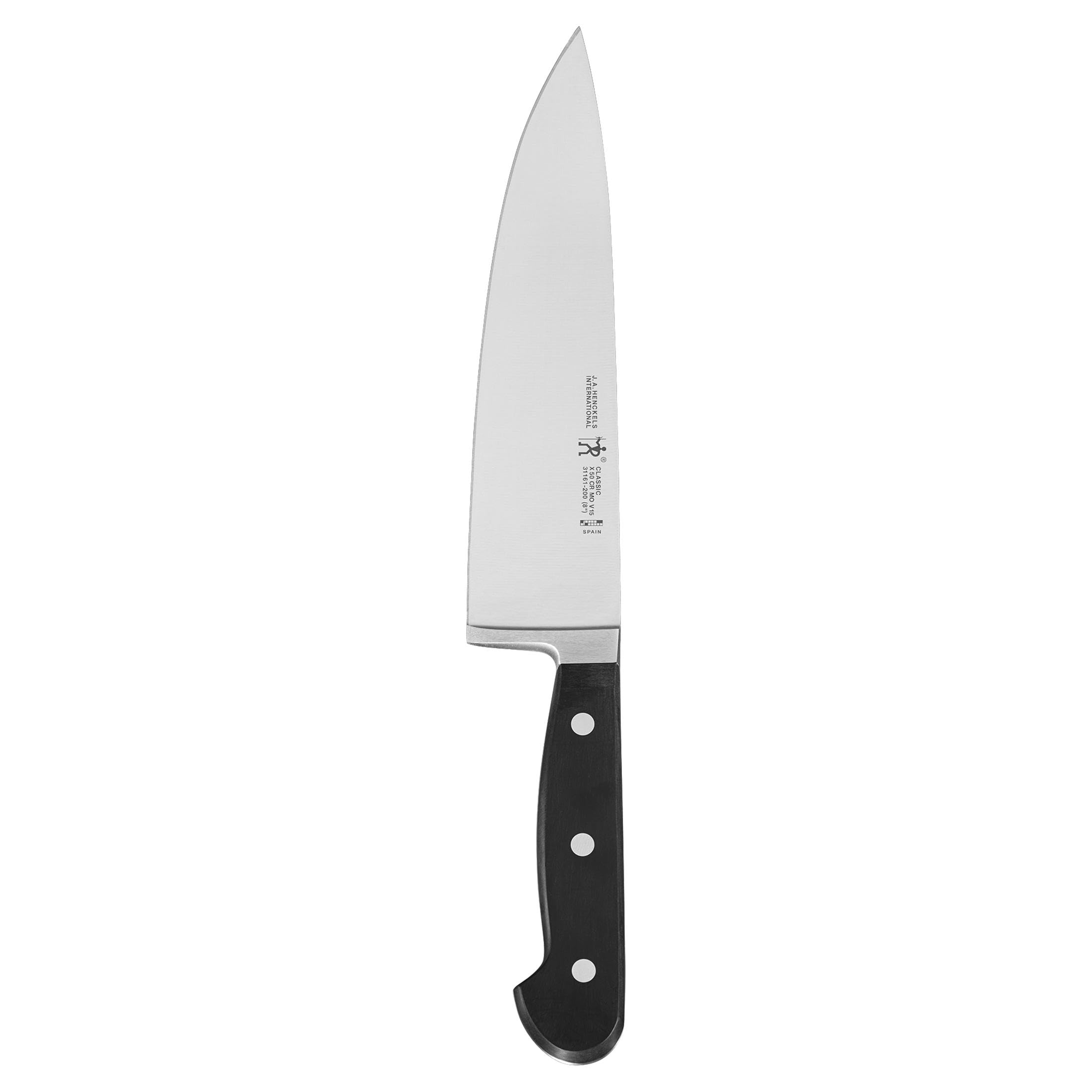
The HENCKELS Classic is the entry point into forged German knife ownership without the premium price. The blade is fully forged from stainless steel, with a satin finish that resists stains and rust, and the 8-inch length handles all standard kitchen prep tasks. The composite handle is lightweight at 4.48 ounces, which makes the knife feel nimble during prolonged use but may feel less substantial than heavier forged alternatives.
The edge arrives razor-sharp from the factory and holds its sharpness longer than stamped blades in the same price tier. The full tang runs through the entire handle, though the transition from blade to handle is less seamless than on higher-end ZWILLING or WÜSTHOF models. For home cooks transitioning from budget block sets, this knife represents a noticeable upgrade in cutting performance without requiring a significant technique adjustment.
HENCKELS rates this knife as dishwasher-safe, and the stainless blade material resists corrosion well. The trade-off is that the edge geometry is less refined than premium models — you will need to hone more frequently to maintain peak sharpness. For beginner cooks or those building their first serious knife collection, the Classic offers reliable German engineering at an approachable entry point.
Why it’s great
- Fully forged construction at a budget-friendly tier
- Lightweight at 4.48 ounces for fatigue-free prep
- Dishwasher-safe for easy cleanup
Good to know
- Edge retention is shorter than premium German models
- Handle-to-blade transition is less refined
7. HOSHANHO 7 Inch Nakiri Knife

The HOSHANHO Nakiri brings Japanese blade geometry into the mid-range tier with its 10Cr15CoMoV high-carbon stainless steel, hardened to 60 HRC. This is the hardest blade on this list, giving it exceptional edge retention for vegetable prep. The 7-inch blade features a traditional nakiri profile — a straight edge with a flat tip optimized for the up-and-down chop motion rather than the rock chop of a Western chef’s knife.
The scalloped hollow pits on the blade side reduce food sticking during slicing, which is particularly useful for starchy vegetables like potatoes and daikon. The Pakkawood handle is ergonomically shaped to reduce fatigue, and the 350-gram weight puts the balance point just behind the heel for controlled chopping. The 15-degree edge angle per side is hand-polished, and the blade arrives razor-sharp out of the box.
This is not a USA-made knife — it comes from Japan — but its inclusion here serves as a comparison point for cooks who want maximum sharpness for vegetable work. The nakiri profile is less versatile than a Western chef’s knife because it cannot rock-chop herbs or slice through thick proteins. Hand-washing is mandatory, and the high 60 HRC hardness means it requires a whetstone for sharpening since pull-through sharpeners can chip the edge.
Why it’s great
- 60 HRC steel for extreme edge retention
- Hollow pits prevent food from sticking
- Hand-polished 15-degree edge cuts effortlessly
Good to know
- Nakiri profile is specialized for vegetable prep only
- 60 HRC blade requires whetstone sharpening
FAQ
What Rockwell hardness is best for a home kitchen knife?
How do I confirm a knife is actually made in the USA?
Is a full tang knife always better than a partial tang?
Final Thoughts: The Verdict
For most users, the kitchen knives made in usa winner is the Buck Knives 931 Chef’s Knife because it combines genuine American manufacturing with a balanced 420HC steel formula and a full tang Paperstone handle at a mid-range price point. If you want the razor-sharp edge retention of German precision forging, grab the WÜSTHOF Classic 8″ Chef’s Knife. And for high-volume professional use where dishwasher convenience matters, nothing beats the ZWILLING Professional S with its Sigmaforge one-piece construction and FRIODUR ice-hardened blade.