Your tap water flows from a treatment plant, travels through miles of aging pipes, and arrives at your glass carrying chlorine, sediment, lead, and sometimes even microplastics. A countertop or under-sink filtration system is the single most effective upgrade you can make to reclaim control over what you and your family drink every single day.
I’m Mohammad Maruf — the founder and writer behind AirfryerBite. I’ve spent countless hours cross-referencing independent lab certifications, pore-size specifications, and real-world flow-rate data to separate marketing hype from genuine filtration performance in the water purification space.
After analyzing seven distinctly different models — from gravity-fed stainless steel countertop units to high-output under-sink reverse osmosis systems — this guide narrows down the field to the models that actually deliver on their claims. This is the most straightforward, spec-driven approach to finding the best in-home water purifier for your specific tap water situation and kitchen layout.
How To Choose The Best In-Home Water Purifier
Choosing the right water purifier starts with understanding your source water and your kitchen’s physical constraints. Municipal tap water, well water, and apartment plumbing each demand a different approach. You need to match the technology—gravity, ultra-filtration (UF), or reverse osmosis (RO)—to the specific contaminants present in your supply, not to the most aggressive marketing claim.
Match Filter Technology to Your Source Water
Gravity-fed systems like the Purewell rely on a 0.01-micron ultra-filtration membrane and an activated carbon block to reduce chlorine, sediment, and organic matter. They work well with municipal water that has already been treated but will not lower total dissolved solids (TDS). Reverse osmosis systems, such as the iSpring RO500AK-BN and Waterdrop G3P800, use a semi-permeable membrane to reduce TDS, fluoride, lead, and PFAS. These are the correct choice if your water has a high mineral content or you are concerned about specific heavy metals. Under-sink UF systems like the Waterdrop TST-UF sit in between—they remove particles down to 0.01 microns but leave beneficial minerals intact while not addressing dissolved solids.
Assess Installation Complexity and Space
Countertop units require no permanent modification to your kitchen. The AquaTru Carafe sits on your counter with a glass carafe and plugs into a standard outlet to power its four-stage reverse osmosis process. The Brondell H630 Cypress attaches directly to your faucet via a diverter valve. Under-sink models demand cabinet space and a cold water line connection. The Waterdrop G3P800 and iSpring RO500AK-BN are tankless designs that conserve under-sink space but require a dedicated faucet hole and access to electricity. The Brondell Coral UC300 and Waterdrop TST-UF are simpler to install—no electricity needed—but occupy more vertical cabinet space.
Verify Certifications, Not Just Claims
Certification from independent bodies like the Water Quality Association (WQA) or IAPMO against NSF/ANSI standards is the only reliable way to confirm a filter’s performance. The Brondell Coral UC300 holds WQA Gold Seal certification for NSF/ANSI standards 42, 53, and 372. The iSpring RO500AK-BN is NSF 58 certified for TDS reduction. The Waterdrop G3P800 carries NSF/ANSI 42, 53, 58, and 372 certifications. These marks guarantee that the unit reduces the specific contaminants listed on its data sheet. Manufacturer claims made without third-party certification should be treated as marketing statements, not performance guarantees.
Quick Comparison
On smaller screens, swipe sideways to see the full table.
| Model | Category | Best For | Key Spec | Amazon |
|---|---|---|---|---|
| Purewell 2.25G Gravity | Countertop Gravity | No-electricity household filtration | 0.01 micron UF membrane | Amazon |
| Waterdrop TST-UF | Under Sink UF | High-flow undersink mineral retention | 1.59 GPM flow rate | Amazon |
| Brondell Coral UC300 | Under Sink 3-Stage | WQA-certified family system | 600-gal filter capacity | Amazon |
| Brondell H630 Cypress | Countertop Faucet-Mount | Zero-install rental kitchens | 0.5 GPM service flow | Amazon |
| AquaTru Carafe | Countertop RO | Portable RO with glass carafe | 4-stage RO removal | Amazon |
| iSpring RO500AK-BN | Tankless Under Sink RO | High-output alkaline RO | 500 GPD / 2:1 ratio | Amazon |
| Waterdrop G3P800 | Tankless Under Sink RO | Maximum certification & smart display | 800 GPD / NSF 58 cert | Amazon |
In‑Depth Reviews
1. AquaTru Carafe Countertop Reverse Osmosis System
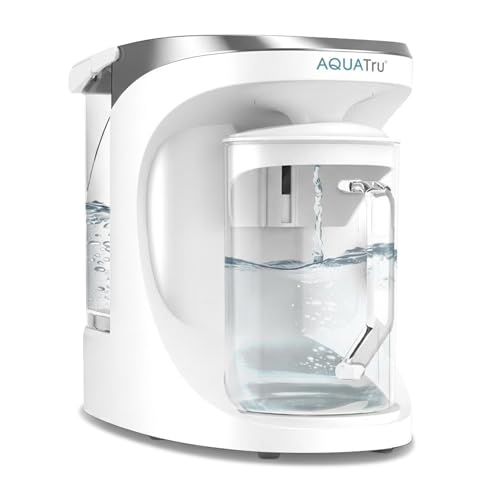
The AquaTru Carafe delivers real reverse osmosis performance without any permanent plumbing changes. Its four-stage system—certified by IAMPO to NSF standards—reduces 84 contaminants including fluoride, lead, chlorine, microplastics, and PFAS/PFOA forever chemicals. The 64-ounce borosilicate glass carafe eliminates the plastic aftertaste that plagues many pitcher-style filters and keeps your purified water in a non-reactive container.
This unit operates as a plug-in countertop appliance. A small pump pushes water through the RO membrane, which means you need counter space near an outlet. The system filters at a rate of about 0.5 gallons per minute, so the carafe fills in roughly two minutes. Each filter set lasts between six months to two years depending on usage volume, and AquaTru claims each set replaces up to 4,500 single-use plastic bottles.
The AquaTru Carafe is the strongest countertop option on this list if your priority is true RO-grade contaminant reduction without drilling or under-sink work. It costs more per filtered gallon than larger under-sink RO systems, but the zero-installation convenience and glass carafe design make it a compelling choice for renters or anyone who wants clean water without committing to a permanent kitchen modification.
Why it’s great
- Removes 84 contaminants including fluoride and PFAS
- Borosilicate glass carafe for pure storage
- No permanent installation or drilling required
- IAPMO certified to NSF standards for contaminant reduction
Good to know
- Requires counter space and nearby electrical outlet
- Slower flow rate than under-sink tankless RO systems
- Replacement filter packs cost more per gallon than larger systems
2. Waterdrop G3P800 Reverse Osmosis System
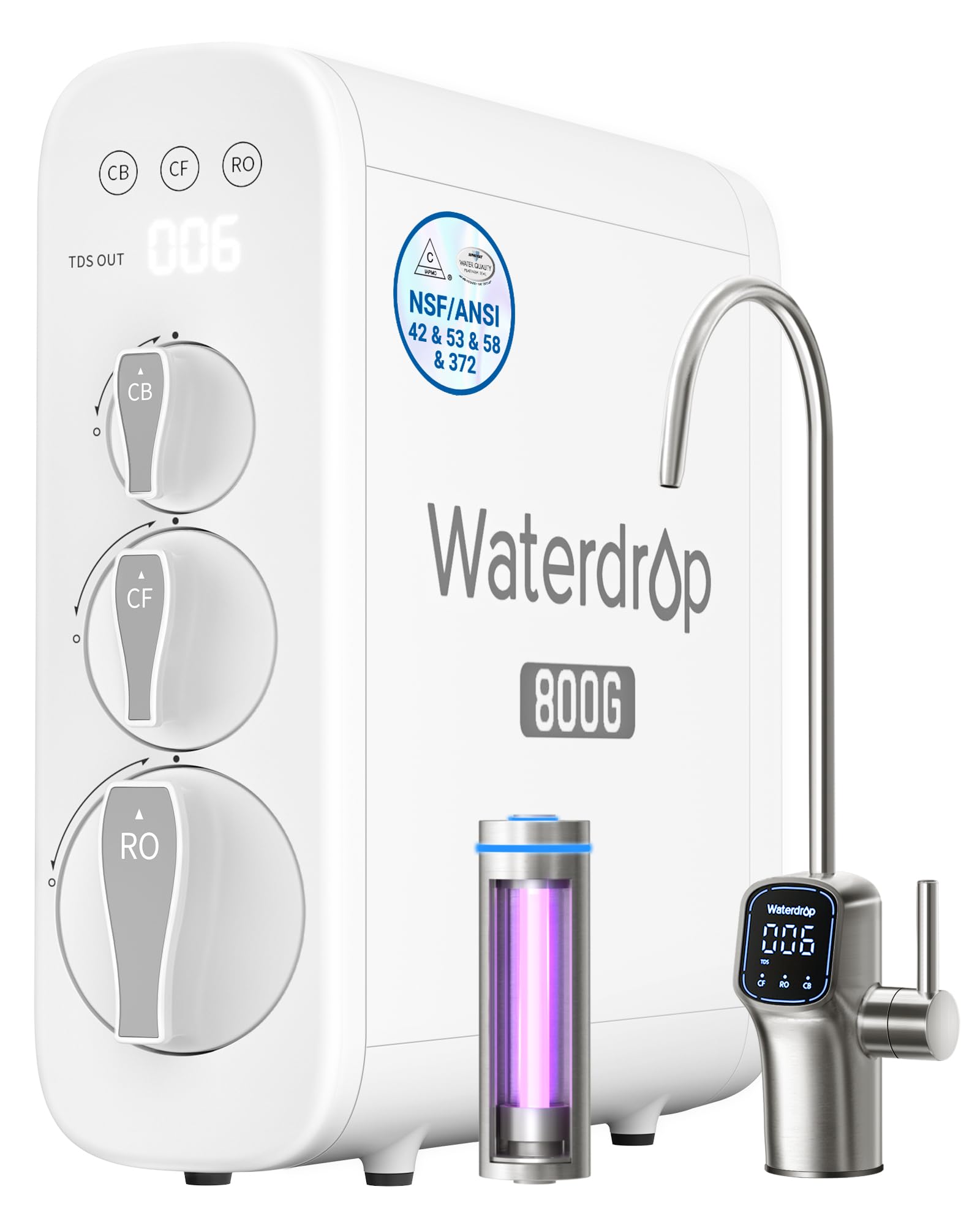
The Waterdrop G3P800 is the most comprehensively certified unit in this lineup, holding NSF/ANSI 42, 53, 58, and 372 marks. Its 10-stage filtration process—certified by SGS—reduces PFAS, fluoride, heavy metals like lead and chromium, salts, and radioactive substances such as radium. Ten stages may sound like overkill, but each layer targets a specific class of contaminant rather than relying on a single broad membrane.
At 800 gallons per day, this tankless under-sink system fills an eight-ounce cup in roughly five seconds. The 3:1 pure-to-drain ratio produces three cups of clean water for every one cup of wastewater, which is exceptionally efficient for a reverse osmosis system. The integrated smart faucet displays real-time TDS levels and water quality through an LED indicator with a rated lifespan of 50 years.
Installation requires two holes—one for the dedicated RO faucet and one for the drain line connection. The tankless design saves significant under-sink space compared to traditional bladder-tank RO units. Real-world user feedback consistently highlights the quiet pump operation and the accuracy of the TDS readout when compared to handheld testers. For households that want the highest certification standard and fastest output, the G3P800 sets the benchmark.
Why it’s great
- NSF/ANSI 42, 53, 58, and 372 certified
- 800 GPD flow delivers a cup of water in 5 seconds
- Smart faucet with real-time TDS monitoring
- Efficient 3:1 pure-to-drain ratio reduces wastewater
Good to know
- Requires two drilled holes for installation
- Needs under-sink electrical outlet for pump operation
- Premium price point for a home filtration system
3. iSpring RO500AK-BN Tankless Reverse Osmosis System

The iSpring RO500AK-BN delivers 500 gallons per day through a tankless design that saves roughly 70 percent of under-sink space compared to traditional RO systems. It is NSF 58 certified for TDS reduction, and the 2:1 pure-to-drain ratio cuts wastewater by up to 400 percent more than older RO units. The integrated carbon alkaline filter adds beneficial minerals back into the water and raises the pH after the RO membrane strips out dissolved solids.
The three-stage filtration process starts with a 2-in-1 composite sediment and carbon block filter to handle rust, sand, and chlorine. The advanced RO membrane then removes up to 99 percent of over 1,000 harmful contaminants including 98 percent of lead, fluoride, arsenic, and asbestos. The final carbon alkaline stage balances pH and improves taste. The brushed nickel faucet included with this model matches modern kitchen fixtures cleanly.
Installation is designed for DIY and compatible with both 1/2-inch and 3/8-inch supply lines. The system features an automatic self-cleaning function that activates after 24 hours of inactivity to flush the RO membrane and extend its service life. Replacement filter packs provide up to two years of use. For households that want certified RO performance with alkaline remineralization at a lower per-gallon operating cost, the RO500AK-BN is a smart mid-to-premium choice.
Why it’s great
- NSF 58 certified with 2:1 pure-to-drain ratio
- Alkaline remineralization stage balances pH
- Tankless design saves significant under-sink space
- Automatic self-cleaning extends RO membrane life
Good to know
- Requires access to an under-sink electrical outlet
- Slower flow rate than 800 GPD competitors
- May require professional installation for complex plumbing
4. Brondell Coral UC300 Under Sink Water Filtration System

The Brondell Coral UC300 brings WQA Gold Seal certification for NSF/ANSI standards 42, 53, and 372 to the under-sink category at a price that undercuts most RO systems. Its three-stage setup—a sediment filter, a pre-carbon filter, and a carbon block filter—targets physical sediment, chemical contaminants like chlorine, and biological impurities while preserving beneficial minerals. This system does not use a drain line or produce wastewater, which makes it a drop-in upgrade rather than a plumbing overhaul.
The Twist & Seal filter change system allows cartridge swaps without tools. The designer chrome faucet includes an integrated LED filter change indicator that lights up when replacement is due. Each filter set has a 600-gallon capacity and lasts approximately 12 months under normal household usage. The double O-ring filter seal is a thoughtful detail that reduces leak risk compared to single-seal designs.
The Coral UC300 is not a reverse osmosis unit, so it will not reduce TDS or remove dissolved minerals. It is best suited for municipal water where chlorine taste, sediment, and odor are the primary complaints. The combination of third-party certification, easy maintenance, and a dedicated designer faucet makes this the most accessible certified under-sink option for homeowners who do not need the aggressive removal power of an RO membrane.
Why it’s great
- WQA Gold Seal certified under NSF/ANSI 42, 53, and 372
- Twist & Seal tool-free filter changes
- LED indicator reminds you when to replace filters
- 600-gallon capacity per filter set lasts 12 months
Good to know
- Does not reduce TDS or remove dissolved solids
- Requires under-sink cabinet space (24.38 x 34.04 inches)
- Not suitable for well water with high mineral content
5. Waterdrop TST-UF Under Sink Water Filter System

The Waterdrop TST-UF employs a 0.01-micron precision ultrafiltration membrane across six layers of filter media, reducing impurities larger than 0.01 microns including chlorine, heavy metals, rust, sediment, and organic compounds. Unlike reverse osmosis, this system retains beneficial minerals such as potassium, calcium, sodium, and magnesium. It is specifically designed for municipal tap water and must not be used with well water or hot water sources.
The flow rate of 1.59 gallons per minute—one of the fastest in this comparison—fills an eight-ounce cup in roughly 2.3 seconds. The housing is constructed from lead-free 304 stainless steel with a thick sealing ring to prevent leaks. Installation offers flexibility: you can hang the unit on the cabinet wall or place it on the floor. The three-filter set has staggered lifespans: the PP filter lasts 6-8 months, the UF filter lasts 12 months, and the CT filter lasts 12-24 months.
This system is ideal for households that want high-volume filtered water without losing the natural mineral profile of their tap water. The no-drill installation, multiple filter longevity, and eco-friendly design that reduces plastic casing changes make it a practical mid-range option. Just be aware that it will not reduce TDS numbers, so if you are dealing with hard water or dissolved heavy metals, you need an RO system instead.
Why it’s great
- 0.01 micron UF membrane reduces chlorine, sediment, and heavy metals
- 1.59 GPM flow rate is among the fastest in its class
- Retains beneficial minerals for taste and health
- Lead-free 304 stainless steel housing resists leaks
Good to know
- Does not reduce TDS or remove dissolved solids
- Not compatible with well water or hot water
- Requires 3/8 or 1/2 inch female NPT faucet thread
6. Purewell 2.25G Gravity Water Filter System

The Purewell 2.25G is a gravity-fed stainless steel countertop system that requires zero electricity. It uses a composite black carbon filter with a 0.01-micron hollow fiber UF membrane, a silver ion membrane, and an activated carbon block to reduce chlorine, rust, sediment, organic matter, and heavy metals. A transparent water level window on the upper chamber lets you see exactly how much unfiltered water remains without lifting the lid.
The two included filters provide a combined 6,000 gallons of filtration capacity—each filter is rated for up to 3,000 gallons. Despite the microscopic pore size, the system maintains a flow rate of 4 gallons per hour, which is respectable for a passive gravity design. The stainless steel body and polypropylene components are durable enough for both indoor kitchen use and outdoor scenarios like camping or emergency preparedness.
This system will not lower TDS values, and the manufacturer explicitly states this. It works best with municipal tap water where the goal is to remove sediment, chlorine taste, and organic particulates without changing the mineral composition. The gravity design means you pour water into the top chamber and wait for it to filter through to the bottom. It is slower than a pressurized system, but for households that want a simple, electricity-independent solution, the Purewell delivers reliable performance at a moderate price.
Why it’s great
- 0.01 micron UF membrane filters 99.99 percent of particulates
- No electricity required for operation
- Transparent water level window for easy monitoring
- Two filters provide 6,000 gallons total capacity
Good to know
- Does not reduce TDS or remove dissolved solids
- Gravity filtration is slower than pressurized systems
- Not suitable for high-contaminant well water
7. Brondell H630 Cypress Countertop Water Filter System
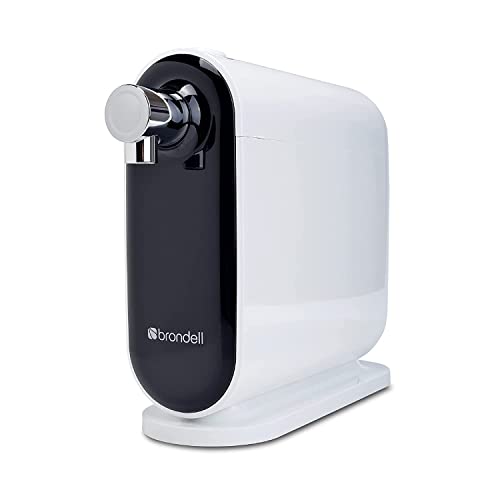
The Brondell H630 Cypress is a countertop water filter that attaches directly to your kitchen faucet via a diverter valve. It filters water on-demand with a three-stage process: a Composite Plus filter, a patented Nanotrap filter, and a carbon block filter. The system holds WQA Gold Seal certification under NSF/ANSI standards 42, 53, and 372, matching the Coral UC300 in independent verification.
Water is dispensed continuously at the push of a button at a rated service flow of 0.5 gallons per minute. Unlike reverse osmosis systems, the Cypress does not produce wastewater. The filter replacement schedule staggers the three cartridges: the Composite Plus and Carbon Block filters need changing every six months, while the Nanotrap filter lasts 12 months. The unit measures 3.75 inches wide by 13.5 inches deep, occupying minimal counter space.
The Cypress does not work with pullout or adjustable spray-type faucets, so verify your faucet compatibility before purchasing. The included adapter kit fits most standard threaded faucets. For renters or anyone who wants certified filtration without drilling or modifying cabinets, this is the simplest installation option on the list. The ongoing cartridge cost is higher per gallon than under-sink systems, but the zero-permanence setup may be worth the premium for specific living situations.
Why it’s great
- WQA Gold Seal certified for NSF/ANSI 42, 53, and 372
- Zero-installation faucet diverter attachment
- Continuous filtered water on demand with no wastewater
- Compact countertop footprint fits small kitchens
Good to know
- Not compatible with pullout or spray-type faucets
- Ongoing cartridge costs are higher per gallon than under-sink systems
- Does not reduce TDS or remove dissolved minerals
FAQ
How do I know if I need a reverse osmosis system or an ultra-filtration system?
Can I install an under-sink water purifier in an apartment without permanent modification?
What does a 3:1 pure-to-drain ratio mean on a reverse osmosis system?
Why does my countertop gravity filter system not reduce TDS?
Final Thoughts: The Verdict
For most households, the in-home water purifier winner is the Waterdrop G3P800 because it combines the broadest certification set with 800 GPD output, a 3:1 efficiency ratio, and a smart faucet that gives you real-time water quality data. If your priority is a zero-installation countertop unit with true RO performance, grab the AquaTru Carafe. And for an electricity-free gravity system with the highest total filter capacity, nothing beats the Purewell 2.25G.