A standard chef’s knife rocks, but a Nakiri blade drops—flat, straight, and devastatingly efficient through dense squash, leafy greens, and fragile tomatoes. That dead-flat cutting edge and blunted tip define a pure vegetable-chopping tool, one that transfers the full force of your arm directly into the cut with zero wasted motion.
I’m Mohammad Maruf — the founder and writer behind AirfryerBite. I spent weeks cross-referencing blade steel chemistry, edge geometry, handle ergonomics, and real-world feedback from home cooks and professionals to separate the genuinely sharp from the marketing.
Whether you are upgrading from a Western chef’s knife or building your first dedicated vegetable blade, understanding the differences in steel hardness (HRC), blade height, and handle material matters more than brand hype. This guide covers the best japanese nakiri knife options across every budget tier so you can chop with confidence.
How To Choose The Best Japanese Nakiri Knife
A Nakiri knife is defined by its straight, rectangular blade that cuts in a pure up-and-down motion—no rock-chop, no curved belly. That geometry makes it the most efficient tool for vegetable prep, but the differences in steel, handle, and construction determine whether it becomes a daily driver or a drawer ornament.
Blade Steel and Hardness (HRC)
Japanese Nakiri knives typically use high-carbon stainless steels such as VG10 or AUS-10V, which hold a very fine edge (often 12–15 degrees per side) for longer than softer German steels. Hardness is measured on the Rockwell scale (HRC): 60–62 HRC is the sweet spot for a knife that sharpens easily yet resists dulling. Go higher than 63 HRC and the blade becomes brittle—chips may appear if you cut on bamboo boards or hard end-grain surfaces.
Blade Height and Knuckle Clearance
Standard Nakiri blades range from 6.5 to 7 inches in length, but blade height (the vertical distance from edge to spine) matters just as much. A height of roughly 1.75 to 2 inches gives your knuckles enough room to clear the cutting board without scraping. Taller blades also help you scoop food onto the knife for transfer to a pan or bowl, a task Nakiri users do dozens of times each prep session.
Handle Shape and Material
Japanese-style handles (wa-handles) are octagonal or D-shaped and lighter, while Western-style handles (yo-handles) with full tangs provide a heavier, more balanced feel. Material choice—Pakkawood, Micarta, G10, or polypropylene—determines how the handle holds up to moisture and repeated washing. None of these knives belong in a dishwasher, but a sealed Pakkawood or epoxy-impregnated Micarta handle resists cracking better than raw wood.
Quick Comparison
On smaller screens, swipe sideways to see the full table.
| Model | Category | Best For | Key Spec | Amazon |
|---|---|---|---|---|
| Dalstrong Shogun Series Elite | Premium | Pro-grade edge retention | AUS-10V core, 62+ HRC | Amazon |
| HexClad Nakiri | Premium | Honbazuke heat treatment | 67-layer Damascus | Amazon |
| Yoshihiro VG10 Hammered | Premium | Handcrafted authenticity | VG10 core, 60 HRC | Amazon |
| Enso HD Series VG10 | Premium | Hammered finish & balance | 37-layer VG10, 61 HRC | Amazon |
| Mac Knife Japanese Series | Mid-Range | High-end feel at mid price | Molybdenum steel | Amazon |
| KYOKU Shogun Series | Mid-Range | Introducing Damascus layering | VG10 core Damascus | Amazon |
| SHAN ZU Damascus | Mid-Range | Real Damascus at budget price | 67 layers, 62 HRC | Amazon |
| Kai Wasabi Nakiri | Entry-Level | Traditional handle, safe blunt tip | High-carbon stainless | Amazon |
| Mercer Culinary Genesis | Budget | Affordable forged German steel | High-carbon German steel | Amazon |
In‑Depth Reviews
1. Dalstrong Shogun Series Elite Nakiri

The Dalstrong Shogun Series Elite sits at the top of this list for one reason: its AUS-10V super steel core, nitrogen-cooled to 62+ HRC, delivers edge retention that rivals knives costing twice as much. The 66-layer Damascus cladding isn’t cosmetic hype—the layers create a micro-serrated effect that helps the blade slide through dense root vegetables without wedging.
At 8–12 degrees per side, the edge is ruthlessly fine but not fragile, thanks to the 3-step Honbazuke heat treatment that balances hardness with flexibility. The hammered tsuchime finish reduces food sticking, a common annoyance with taller blades. The G10 handle is fully sealed, meaning it won’t swell or crack if you occasionally miss a drying step.
One detail that stands out: the spine and choil are polished smooth, eliminating hot spots during extended prep sessions. If you are looking for a single Nakiri that performs at a professional level without moving into true artisan pricing, this is the one.
Why it’s great
- Extremely sharp out of the box with long-lasting edge retention
- G10 handle is durable, grippy, and moisture-resistant
- Hammered finish minimizes food sticking
Good to know
- Requires careful hand washing and drying
- Not ideal for cutting bones or frozen foods
2. HexClad Nakiri Knife

HexClad applies the same 3-step Honbazuke method used by high-end Japanese smiths to its 67-layer Damascus Nakiri, creating a 12-degree cutting edge that feels laser-sharp from the first chop. The high-carbon stainless steel core resists staining while the outer layers add corrosion protection without compromising hardness.
Pakkawood handles—layers of birch veneer impregnated with epoxy—offer the warmth of natural wood with the dimensional stability of a synthetic. The octagonal profile suits both pinch grips and handle-forward chopping. At 6.5 inches, the blade is light enough for precise work on herbs yet tall enough for large cabbage quarters.
HexClad backs this knife with a lifetime warranty against manufacturer defects, though the warranty explicitly voids dishwasher use and cutting on hard surfaces like glass or stone boards. Stick to wooden or synthetic cutting boards and the edge will stay true for months between honing sessions.
Why it’s great
- 12-degree edge from Honbazuke treatment is exceptionally sharp
- Pakkawood handle is comfortable and durable
- Lifetime warranty adds peace of mind
Good to know
- Hand wash only—no dishwasher
- Edge can chip if used on bamboo boards frequently
3. Yoshihiro VG10 Hammered Damascus Nakiri

Yoshihiro’s Nakiri is forged in Seki, Japan—the traditional home of Japanese cutlery—using a VG10 core clad in 16 layers of hammered Damascus. The resulting blade hits 60 HRC, a hardness that balances exceptional sharpness with enough toughness to handle daily vegetable prep without micro-chipping.
The Western-style mahogany handle is full-tang and triple-riveted, offering a heavier, more balanced feel than a wa-handle. The hammered tsuchime texture is not just aesthetic: it creates air pockets between the blade and the food, reducing suction that causes slices to stick. This is especially helpful when fine-dicing onions or mincing garlic.
Yoshihiro recommends sharpening only with water whetstones, not pull-through sharpeners or honing rods, to preserve the edge geometry. If you already own whetstones or are willing to learn, this knife will reward you with years of precise cuts.
Why it’s great
- Handcrafted in Seki, Japan with traditional methods
- Hammered finish reduces food sticking effectively
- Full-tang Western handle provides balanced weight
Good to know
- Requires water whetstone sharpening
- Mahogany handle needs occasional oiling to prevent drying
4. Enso HD Series VG10 Nakiri

The Enso HD Series combines 37 layers of VG10 stainless steel with a hammered tsuchime finish that is as functional as it is beautiful. The VG10 core reaches 61 HRC, and the blade is hand-ground to approximately 12 degrees on each side—a double-bevel edge that works equally well for right- and left-handed users.
What sets the Enso apart is the black canvas Micarta handle. Micarta—layered canvas or linen bonded with resin—becomes more grippy when wet, making this knife a strong choice if your prep sessions involve frequent hand-washing mid-task. The three stainless steel rivets and end cap reinforce the full-tang construction without adding unnecessary weight.
The blade spine is 2 mm at the heel, thinner than many German-style vegetable knives, which translates to less resistance when push-cutting through dense sweet potatoes or hard squashes. Enso backs every knife with a lifetime warranty, and each one is handcrafted in Seki City, Japan.
Why it’s great
- Micarta handle improves grip when wet
- Thin 2 mm spine reduces cutting resistance
- Lifetime warranty from a Japanese maker
Good to know
- Dishwasher safe claim contradicts typical care—hand wash recommended
- Edge is delicate; avoid cutting boards harder than wood or synthetic
5. Mac Knife Japanese Series Vegetable Cleaver

The Mac Knife Japanese Series Nakiri has been a Cook’s Illustrated recommended pick for years, and for good reason: the molybdenum steel blade, at 2.5 mm thick, provides a solid feel without the heft of a traditional Chinese cleaver. The 6.5-inch length hits a sweet spot for home cooks who want precision without intimidation.
Mac uses a proprietary hardening process that brings the steel to a fine edge straight from the factory, and users consistently report that the blade stays sharp for months of regular use. The horizontal finish on the blade face creates micro-grooves that significantly reduce food sticking—one of the most appreciated features in real-world reviews.
The Pakkawood handle is fitted with a traditional Western bolster, giving the knife a familiar feel for cooks transitioning from German-style knives. It is lighter than the full-tang premium knives but heavier than stamped entry-level blades, making it a balanced middle-ground option that excels through high-volume vegetable prep.
Why it’s great
- Molybdenum steel offers good edge retention at a mid-range price
- Horizontal blade finish minimizes sticking
- Lightweight and comfortable for extended use
Good to know
- Not dishwasher safe despite some listing ambiguity
- Blade is slightly thicker than premium Japanese options
6. KYOKU Shogun Series Nakiri
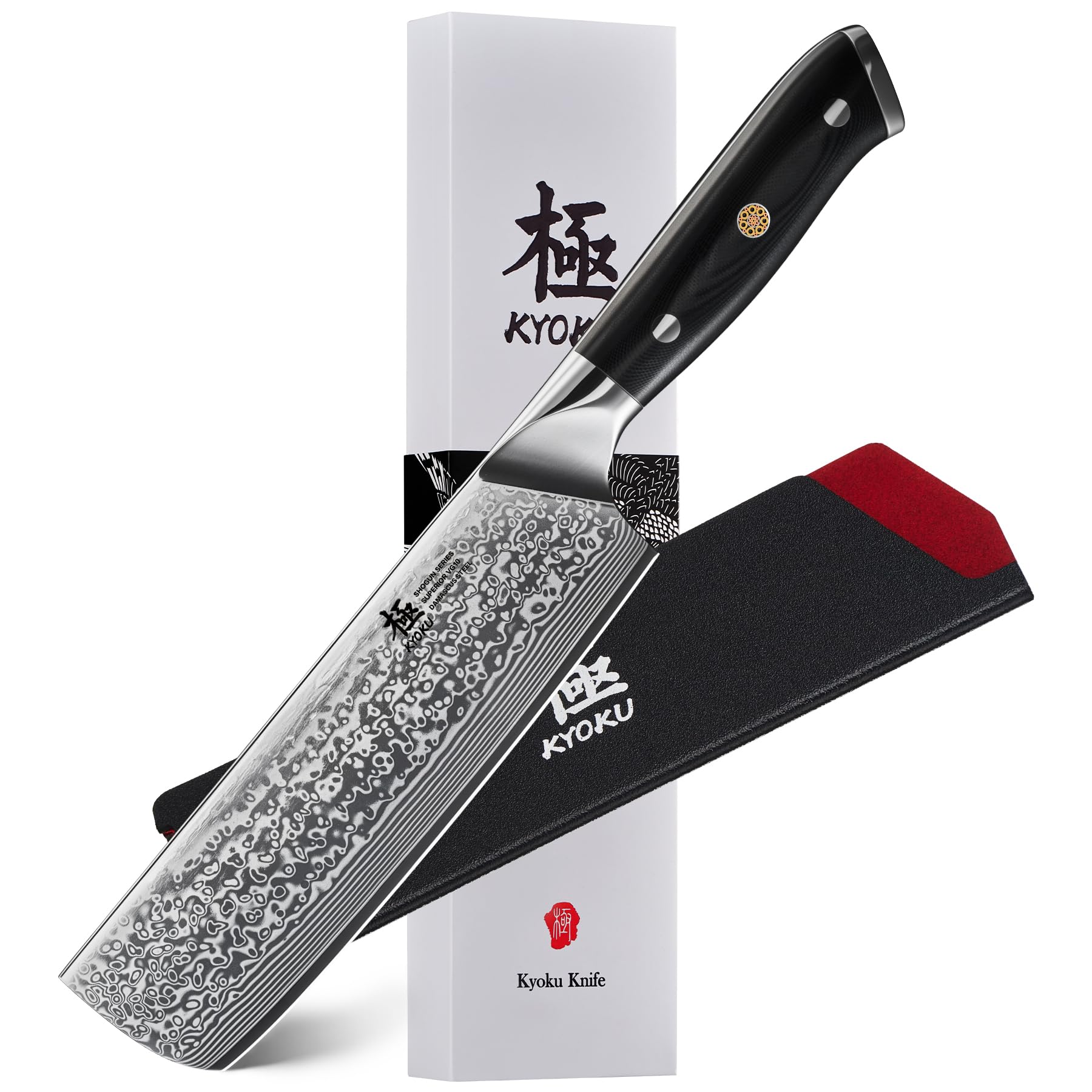
KYOKU’s Shogun Series Nakiri delivers VG10 Damascus performance with a G10 handle and a full-tang construction that feels more substantial than the price suggests. The 7-inch blade is slightly longer than typical Nakiri offerings, giving extra leverage when breaking down large cabbage heads or slicing wide strips of bell pepper.
The Damascus pattern on the blade is genuine—layered steel folded during forging—and the G10 handle is textured for a secure grip even with oily hands. Users note the knife comes extremely sharp out of the box, with a profile that cuts cleanly through tomato skins without squashing the flesh underneath.
One practical consideration: the included sheath, while protective for storage, has a design that some users find cuts easily if handled carelessly. Grabbing a magnetic strip or blade guard may be a smarter long-term storage solution. The knife itself, however, punches above its price point in raw cutting performance.
Why it’s great
- Genuine Damascus layering with VG10 core
- 7-inch blade offers extra reach for large produce
- G10 handle is durable and slip-resistant
Good to know
- Included sheath design can be a safety hazard
- Weight distribution leans blade-heavy for some users
7. SHAN ZU Damascus Nakiri

SHAN ZU uses 10Cr15Mov Japanese steel—a close cousin to VG10 in composition—hardened to 62 HRC, which puts this knife in the same hardness range as options costing three times as much. The 67-layer Damascus cladding is real, not laser-etched, and the acid-etch process reveals the pattern clearly.
The G10 glass fiber handle is frosted for grip and ergonomically shaped to reduce fatigue during long prep sessions. The blade is 7 inches long and 2.2 mm thick, with a 15-degree cutting angle that offers a nice balance of aggressiveness and stability. Users consistently mention the knife’s ability to shave arm hair straight from the box.
One construction note: the blade is welded to the tang rather than being a single solid piece of Damascus. This is not a practical issue for vegetable cutting, but purists may prefer a full monosteel or integral construction. For the price, the edge geometry and steel quality are genuinely impressive.
Why it’s great
- Real 67-layer Damascus at a budget-friendly price point
- 62 HRC hardness holds an aggressive edge
- G10 handle provides a secure, comfortable grip
Good to know
- Blade is welded to the tang, not full integral
- No blade guard or sheath included
8. Kai Wasabi Nakiri Knife

The Kai Wasabi Nakiri is a no-nonsense entry point into the Nakiri world. The high-carbon stainless steel blade is stamped rather than forged, but the straight edge and spine geometry deliver the pure push-cut motion that defines the Nakiri style. The blunt tip adds safety for cooks who are still adjusting to a rectangular blade profile.
The polypropylene handle is a traditional wa-style shape—symmetric, lightweight, and easy to clean. It does not have the heft of Micarta or G10, but it is comfortable in a pinch grip and very affordable. This is the knife to buy if you are not sure whether the Nakiri shape suits your cutting style and want to test the waters.
Kai is a well-established brand from Seki City, Japan, and the edge comes hand-sharpened from the factory. Edge retention is decent but not exceptional; expect to hone more frequently than with VG10 or AUS-10V options. Still, for a first Nakiri, it punches well above its cost.
Why it’s great
- Traditional Japanese wa-handle is light and easy to control
- Blunt tip adds safety for new Nakiri users
- Entry-level pricing makes it a low-risk trial
Good to know
- Stamped blade lacks the rigidity of forged options
- Edge dulls faster than VG10 or Damascus knives
9. Mercer Culinary Genesis 7-Inch Nakiri

The Mercer Genesis Nakiri is a precision-forged high-carbon German steel blade with a taper-ground edge—a rarity at this price point. Most budget Nakiri knives are stamped; the Genesis is forged, giving it better edge stability and a thicker spine that handles harder vegetables without flexing.
The Santoprene handle is ergonomically contoured and non-slip, even when wet, making it a practical choice for busy kitchen environments. The 7-inch blade sits at the longer end of the Nakiri spectrum, and the black handle maximizes contrast against ingredients for clearer visibility during precision cuts.
One clear trade-off: this is not a Japanese steel knife. The German high-carbon steel is softer (around 55-57 HRC), which means it sharpens easily but dulls faster than VG10. For cooks who prefer a quick steeling pass to maintain the edge, this forgiving steel is actually an advantage. It is also the most affordable forged Nakiri in this guide.
Why it’s great
- Forged construction at a budget price is unusual and valuable
- Non-slip Santoprene handle performs well when wet
- 7-inch blade offers good reach for a Nakiri
Good to know
- Softer German steel requires more frequent honing
- Not a traditional Japanese profile or steel type
FAQ
Can I use a Nakiri knife to cut meat or fish?
How should I sharpen a Japanese Nakiri knife?
Is a Nakiri knife the same as a Chinese cleaver (caidao)?
Why is my Nakiri knife sticking to vegetables?
Final Thoughts: The Verdict
For most users, the best japanese nakiri knife winner is the Dalstrong Shogun Series Elite because the AUS-10V core at 62+ HRC combined with the Honbazuke edge treatment delivers professional-grade sharpness and longevity at a price that undercuts many comparable Japanese artisan knives. If you want a hammered finish with a more traditional Seki-forged pedigree, grab the Yoshihiro VG10 Hammered Damascus. And for a budget-friendly entrance that still offers real forged construction, nothing beats the Mercer Culinary Genesis.