The quiet ritual of hand-grinding coffee is a direct path to better flavor, but not all manual burr grinders deliver on their promise of consistent particle size. Many models introduce fines, wobble, or uneven extraction that quietly ruins a great bean before it ever hits the water. The right grinder should feel like an extension of your hand, not a chore.
I’m Mohammad Maruf — the founder and writer behind AirfryerBite. I’ve spent years parsing the engineering nuances of kitchen hardware, from burr geometry and bearing tolerances to grind uniformity tests that separate the truly precise tools from the marketing noise.
The goal is simple: find the best manual burr grinder that reliably delivers uniform grounds for your brew method without breaking your routine or budget.
How To Choose The Best Manual Burr Grinder
The manual burr grinder world looks simple — a crank, a burr, a jar. But the difference between a frustrating grind session and a rewarding ritual comes down to four specific engineering choices. Ignore these and you risk buying a coffee crusher in disguise.
Burr Material and Geometry
SUS420 stainless-steel conical burrs with a hardness rating of 55-58 HRC resist dulling far longer than ceramic alternatives. CNC-cut burrs with a defined cutting geometry generate fewer fines and more uniform boulders, directly affecting the clarity and sweetness of your cup. Look for 5-axis machining references — that level of precision is the hallmark of a serious grinder.
Adjustment Mechanism and Click Resolution
Fine internal threading with audible clicks per rotation determines how precisely you can dial in the grind size. A coarser system of 6 total settings may work for French press but fails for espresso, where a single click can under- or over-extract a shot. Aim for 30 to 60 clicks per full rotation — the higher the count, the finer your control between filter and pressurized brew methods.
Bearing Quality and Shaft Stability
Double-bearing central shaft alignment minimizes wobble as you crank, which directly translates to particle size consistency. Single-bearing designs tend to introduce eccentric movement, creating a bimodal grind distribution where fines mix with large chunks. A grinder that wobbles even slightly will produce muddled, uneven extraction no matter how good your beans are.
Build Material and Portability Trade-Offs
Full metal unibody construction (aluminum or stainless steel) adds heft and longevity but weighs closer to 700 grams, making it less ideal for backpacking. ABS-hybrid bodies cut weight to around 330 grams but can introduce flex under heavy torque. Decide whether your grinder lives on the kitchen counter or rides in a duffel bag — that choice dictates the right material balance.
Quick Comparison
On smaller screens, swipe sideways to see the full table.
| Model | Category | Best For | Key Spec | Amazon |
|---|---|---|---|---|
| TIMEMORE S3 | Premium | Espresso precision | 0.015mm per grid external adjustment | Amazon |
| 1Zpresso J | Premium | Long-term durability | 48mm stainless steel burrs | Amazon |
| KINGrinder K6 | Premium | Full metal portability | 16 micron per click adjustment | Amazon |
| TIMEMORE Chestnut C2S | Mid-Range | Pour-over daily driver | 38mm CNC S2C burr, 36 clicks | Amazon |
| OXO Brew | Mid-Range | Camping & day trips | 40 grind size settings | Amazon |
| Vivaant | Mid-Range | Glass jar storage | 32g capacity, dragon tooth burr | Amazon |
| KINGrinder P2 | Entry-Level | Ultralight travel | 330g weight, 30 clicks per rotation | Amazon |
| Alpaca Ventures | Entry-Level | Budget intro to burr | Dual bearing design | Amazon |
| Popsweeter C38 | Entry-Level | Multi-purpose grinding | 38mm 420 SS burr, 36+ clicks | Amazon |
In‑Depth Reviews
1. TIMEMORE S3

The TIMEMORE S3 is the current flagship that redefines what a hand grinder can achieve, especially for espresso enthusiasts who demand sub-millimeter precision. Its patented S2C890 steel burr, a step up from the standard S2C, delivers noticeably higher grind uniformity with visibly fewer boulders, translating to a cleaner, sweeter cup across brew methods from Turkish to French press. The external point-to-point digital adjustment ring uses a 0.015mm grid that clicks precisely without requiring you to count clicks or guess positions — a genuine workflow upgrade for anyone switching between brew methods daily.
The full metal unibody eliminates the plastic top-cap fragility seen in earlier generations, and the customized high-precision bearing reduces shaft tolerance from 7 microns to 5 microns, meaning the rotational wobble is virtually zero. At 1 kg, the S3 is the heaviest grinder on this list, but that heft translates to absolute stability during grinding — it sits planted on your counter without sliding. The spring-assisted foldable handle folds flush against the body, preventing tip-overs during use and making storage dead simple.
Users report that the S3 performs exceptionally well for pour-over, Aeropress, and even coarse espresso, with many noting a pronounced “juicy” clarity in light roast coffees that was previously only achievable with electric grinders costing three times as much. While the investment is significant for a manual grinder, the S3 represents the ceiling of current hand-grind technology, making it the top pick for anyone who treats coffee as a precision craft rather than a morning chore.
Why it’s great
- External digital adjustment dial with 0.015mm per grid precision eliminates guesswork
- Customized high-precision bearing (5 micron tolerance) reduces wobble to near zero
- Patented S2C890 burr delivers exceptional uniformity for espresso and filter
- Full metal unibody with foldable, spring-assisted handle for stable storage
Good to know
- Heaviest in this comparison at 1 kg, less suited for travel
- Premium price point reflects flagship engineering
2. 1Zpresso J

The 1Zpresso J is built around a 48mm stainless steel conical burr — the largest burr set in this lineup — which translates to faster grinding with less effort per revolution. The oversized burr diameter means each turn engages more bean surface, reducing total grind time by roughly 20-30% compared to 38mm burr grinders. Factory calibration ensures the burr alignment stays within spec from the first use, so you get consistent particle distribution without needing to shim or re-adjust the central shaft.
Internal adjustment via 30 clicks per rotation provides reliable step increments for pour-over, French press, and cold brew, though the lack of external adjustment means you need to unscrew the bottom nut to change settings — a minor inconvenience that many users accept for the added burr stability. The compact foldable handle pushes, twists, and tucks away against the body to prevent tipping, making the J a strong contender for small kitchens or countertops with limited clearance. The aluminum body keeps the weight manageable at roughly 600 grams without sacrificing structural rigidity.
Engineered for 100-200 kg of grinding life, the 1Zpresso J is one of the few grinders on the market that comes with a stated lifespan metric, reflecting the manufacturer’s confidence in the burr steel longevity. Early adopters report that even after a year of daily dual-purpose use (pour-over and occasional espresso), the burrs show no visible wear and the adjustment threads remain smooth. The included cleaning brush and tool-free disassembly make routine maintenance fast, though the wider body diameter of 2.24 inches may feel less ergonomic for users with smaller hands.
Why it’s great
- Largest burr set at 48mm reduces grind effort significantly
- Factory calibration ensures burr alignment out of the box
- Stated lifespan of 100-200 kg of grinding indicates exceptional durability
- Foldable handle prevents tipping during storage and use
Good to know
- Internal adjustment requires unscrewing the bottom nut to change grind size
- Wider body may feel less comfortable for smaller hands
3. KINGrinder K6

The KINGrinder K6 brings a 16-micron-per-click internal adjustment mechanism that puts it in direct competition with grinders costing significantly more. At 60 clicks per rotation, this resolution allows you to dial in grind size with precision that rivals espresso-dedicated electric grinders. The interior adjustment dial keeps the burr alignment locked while you turn, and the full metal body (aluminum with stainless steel burr set) eliminates the flex and cracking issues common in hybrid plastic designs. The dual bearing design further enhances concentricity during high-torque grinding for dark roasts.
The burr set uses SUS420 stainless steel, chosen for its balance between hardness and corrosion resistance. The straight handle is detachable and provides solid leverage without requiring a bear grip. With a hopper capacity of 25-35g, the K6 is designed for single-session grinding — enough for a standard V60 batch or two Aeropress brews. The external appearance is a muted iron gray with subtle knurling on the adjustment ring, appealing to users who prefer a minimalist aesthetic that doesn’t scream “gadget” on the counter.
Field testing notes from users highlight that the K6 produces especially clean cups with light-roasted single origins, where burr alignment and particle uniformity matter most. The tool-free disassembly remains intuitive: the bottom cup unscrews, the burr comes out via a threaded collar, and the brush included with the unit sweeps out retained grounds from the burr teeth effectively. The main trade-off is that the internal adjustment system means you cannot see the grind size indicator while grinding — you set the number on the dial before attaching the handle, then commit. For most brew methods this is a minor friction, but for espresso tinkerers who adjust mid-session, it adds an extra step.
Why it’s great
- Ultra-fine 16-micron-per-click adjustment for high-precision dialing
- Full metal aluminum body with dual bearings for burr stability
- 60 clicks per rotation for near-continuous grind size selection
- Tool-free disassembly and included brush for easy maintenance
Good to know
- Internal adjustment requires setting grind size before attaching the handle
- Capacity maxes out at 35g, adequate for single sessions only
4. TIMEMORE Chestnut C2S

The Chestnut C2S is the direct successor to the wildly popular C2, addressing the primary complaint of the original: a plastic top cover prone to cracking under torque. The C2S upgrades to a full metal unibody construction while retaining the same proven 38mm CNC-machined S2C conical burr that made the C2 a favorite among pour-over enthusiasts. The 5-axis CNC machining yields a burr hardness of 55-58 HRC, ensuring the cutting edges stay sharp through hundreds of grinding cycles. The double bearing central shaft provides smooth rotation with minimal wobble, producing a surprisingly uniform grind for the price range.
With 36 click settings via the bottom adjustment nut, the C2S covers the full spectrum from fine espresso to coarse French press, though the step size is a bit wide for espresso dialing — you may land between clicks that are either too fine or too coarse for pressurized portafilters. Where the C2S truly shines is medium-fine to medium-coarse settings for V60, Chemex, and Kalita Wave, producing a clean bed with minimal sludging. The compact 52mm body diameter is easy to grip even for smaller hands, and the 700g weight provides enough heft for stable cranking without feeling burdensome.
Disassembly requires no tools: unscrew the adjustment nut, pull the shaft and burr, and rinse or brush clean. Users upgrading from ceramic burr grinders consistently report that the C2S cuts grind time roughly in half for the same dose, a direct result of the sharp stainless steel geometry. The main limitation is the 25g capacity, which forces a refill for larger batches. If your daily routine involves a single 15-18g pourover or Aeropress, the C2S hits a sweet spot where price meets professional-grade grind quality better than anything else in this mid-range bracket.
Why it’s great
- Full metal unibody fixes the plastic top cover issue of the C2
- 5-axis CNC S2C burr delivers uniform grind for pour-over methods
- Double bearing shaft nearly eliminates wobble during grinding
- Compact 52mm body fits small hands comfortably
Good to know
- Step size between clicks is wide for fine espresso adjustment
- 25g capacity requires a refill for large brewing sessions
5. OXO Brew Manual Burr Coffee Grinder

OXO brings its user-centric design philosophy to the manual burr grinder category with a unit that prioritizes ergonomics and convenience over raw burr size. The stainless steel conical burrs produce a consistent grind across 40 settings, and the wide hopper top allows for easy bean pouring without spillage. The comfort-grip handle rotates outward when in use and tucks back into a recessed slot for compact storage, a thoughtful detail for anyone with limited kitchen drawer space. The plastic-and-stainless construction keeps the weight manageable for camping and day trips.
At 40g capacity, the OXO holds nearly double the beans of most competitor grinders in this mid-range bracket, making it ideal for brewing a full 8-cup French press from a single load. The grind adjustment dial is located on the bottom of the grinding mechanism, offering click feedback that is audible and tactile enough to set without looking. The internal threading captures a range from fine enough for AeroPress to coarse enough for cold brew steep, though the transition between clicks is slightly wider than enthusiasts running espresso might prefer.
Cleaning requires pulling the burr out via the central screw — a tool-free process that takes about thirty seconds. Users note that the OXO performs best when the beans are fed slowly; dumping the full 40g at once can cause the burr to choke momentarily. The main trade-off for the higher capacity is the plastic housing: while impact-resistant ABS handles drops better than glass, the body does flex slightly under heavy torque, especially when grinding very light-roast dense beans. Overall, the OXO is a smart choice for casual brewers who want reliable burr grinding without the learning curve of boutique brands.
Why it’s great
- Large 40g hopper capacity for French press or multi-cup batches
- Stowable handle design saves counter and drawer space
- 40 grind settings offer broad adjustments for most brew methods
- Tool-free burr removal simplifies cleaning routine
Good to know
- Plastic body can flex under high torque with very dense beans
- Wide click spacing limits fine-tuning for espresso brewing
6. Vivaant Coffee Grinder Manual

The Vivaant manual grinder stands out by pairing a “dragon tooth” stainless steel conical burr with a tempered glass collection jar, a design that prioritizes static reduction and visual measurement of your dose. The burr geometry is advertised as grinding twice as fast as ceramic equivalents, and real-world testing confirms that a 15g dose of medium-roast beans finishes in roughly 40 seconds of steady cranking — noticeably faster than many entry-level steel burr competitors. The 6 adjustability settings cover the basic brew methods, though each step represents a relatively large jump, making it less suitable for espresso dialing.
The 32g capacity is one of the highest among compact manual grinders, and the glass jar features measurement markings so you can skip an extra scale step for approximate dosing. The clear jar also lets you see the grind particle distribution, which is helpful for confirming consistency before you brew. Assembly and disassembly take seconds: the handle connects via a magnetic spring clip, and the jar screws onto the grinding chamber. The silicone grip sleeve adds a layer of shock absorption and prevents the grinder from slipping on smooth countertops.
The main drawback is the plastic coupling between the handle and the central shaft; under heavy use with extremely dense light roasts, some users report that the hex coupling can strip over time. The included lifetime warranty mitigates this concern, but it’s worth noting that the Vivaant is best suited for medium to medium-dark roasts that require less torque. For travel, the glass jar introduces a fragility risk that metal catch cups avoid. Still, for home users who brew French press, Chemex, or cold brew, the Vivaant offers exceptional speed and visual feedback at a mid-range price point.
Why it’s great
- Glass jar with measurement markings simplifies dosing without a scale
- Dragon tooth burr grinds noticeably faster than ceramic alternatives
- Magnetic handle attachment and tool-free disassembly for fast setup
- 32g capacity handles larger single-batch brewing
Good to know
- Only 6 grind settings with wide steps, not suitable for espresso fine-tuning
- Glass jar is fragile compared to metal catch cups for travel
7. KINGrinder P2

The KINGrinder P2 is purpose-built for the traveler: at 330 grams and barely 5 inches tall, it’s the smallest and lightest grinder in this entire guide. The ABS hybrid body contains a SUS420 conical burr with 30 clicks per rotation, giving it far more adjustment resolution than its compact form factor suggests. Each click represents 0.0333mm of burr movement, enabling fine-tuning for everything from Moka pot to French press, despite the 20g dose cap. The silicone grip sleeve wraps the circumference, ensuring you maintain control even when your hands are damp.
The burr design is notably consistent for a sub-60-dollar grinder, producing particle distributions that compare well to heavier all-metal units when used for medium-coarse grind sizes. The included cleaning brush reaches the burr teeth easily after unscrewing the bottom cup. The handle uses a two-pin drive system that engages directly with the burr shaft, minimizing slippage. Despite the plastic chassis, the internal bearing system keeps the shaft aligned well enough that boulder production stays low for filter brew applications.
The main limitation is the 20g maximum capacity — sufficient for a single 12-15g pour-over or Aeropress, but requiring a refill for larger batches. The ABS body also transmits more vibration to the hand during grinding compared to metal units, though this is partially mitigated by the silicone grip. Users coming from the James Hoffman recommendation trail consistently report that the P2 delivers grind quality that punches well above its price tier, especially for light-to-medium roasts where particle consistency matters most. For campers, hikers, and office workers who want genuinely good coffee without hauling a heavy brick, the P2 is the clear choice.
Why it’s great
- Extremely lightweight at 330g for ultralight packing
- 30-click resolution with 0.0333mm per step for fine dialing
- Compact form factor fits inside an Aeropress or mug
- Silicone grip sleeve ensures stable handling during grinding
Good to know
- 20g capacity forces a refill for large brewing sessions
- ABS body transmits more vibration than all-metal grinders
8. Alpaca Ventures

The Alpaca Ventures manual grinder is a budget-friendly entry point that does not compromise on the core physical experience: a dual bearing central shaft and a lengthened stainless steel crank reduce the elbow grease required to turn dense beans. The 420 stainless steel conical burr is comparable to what you find in grinders at twice the price, and the all-metal grinding chamber (aluminum body with steel burr) feels reassuringly solid for its cost. The grind adjustment dial is a stepless design, allowing infinite variability between fine and coarse rather than forcing you into preset clicks.
The detachable crank connects via a magnetic snap, making storage simple and reducing the risk of losing the handle during travel. Disassembly for cleaning requires no tools: a simple twist separates the top burr and the catch cup, and the included brush sweeps out leftover grounds from the burr teeth effectively. The Alpaca Ventures measures 5.5 by 1.9 inches, making it slim enough to fit inside a standard backpack side pocket. The capacity is not explicitly stated in the specs, but user reports suggest it handles roughly 20-25g per load — adequate for single servings.
One common user note is that the stepless adjustment ring can drift slightly during grinding if not tightened fully, a quirk that is manageable once you learn to apply a quarter-turn of firm pressure before cranking. The grind uniformity is good for the price, though it produces slightly more fines than the higher-end steel burr units when set very fine. For someone making the jump from a blade grinder to their first burr grinder, the Alpaca Ventures offers a significant upgrade in particle consistency at a minimal cost, and the dual bearing system ensures smoother grinding than similarly priced single-bearing designs.
Why it’s great
- Dual bearing shaft makes grinding noticeably smoother than single-bearing designs
- Lengthened handle provides good leverage for dense beans
- Stepless adjustment offers infinite grind size variability
- Magnetic handle attachment and tool-free disassembly for easy cleaning
Good to know
- Adjustment ring can drift during grinding if not fully tightened
- Produces slightly more fines than higher-end steel burr grinders
9. Popsweeter C38
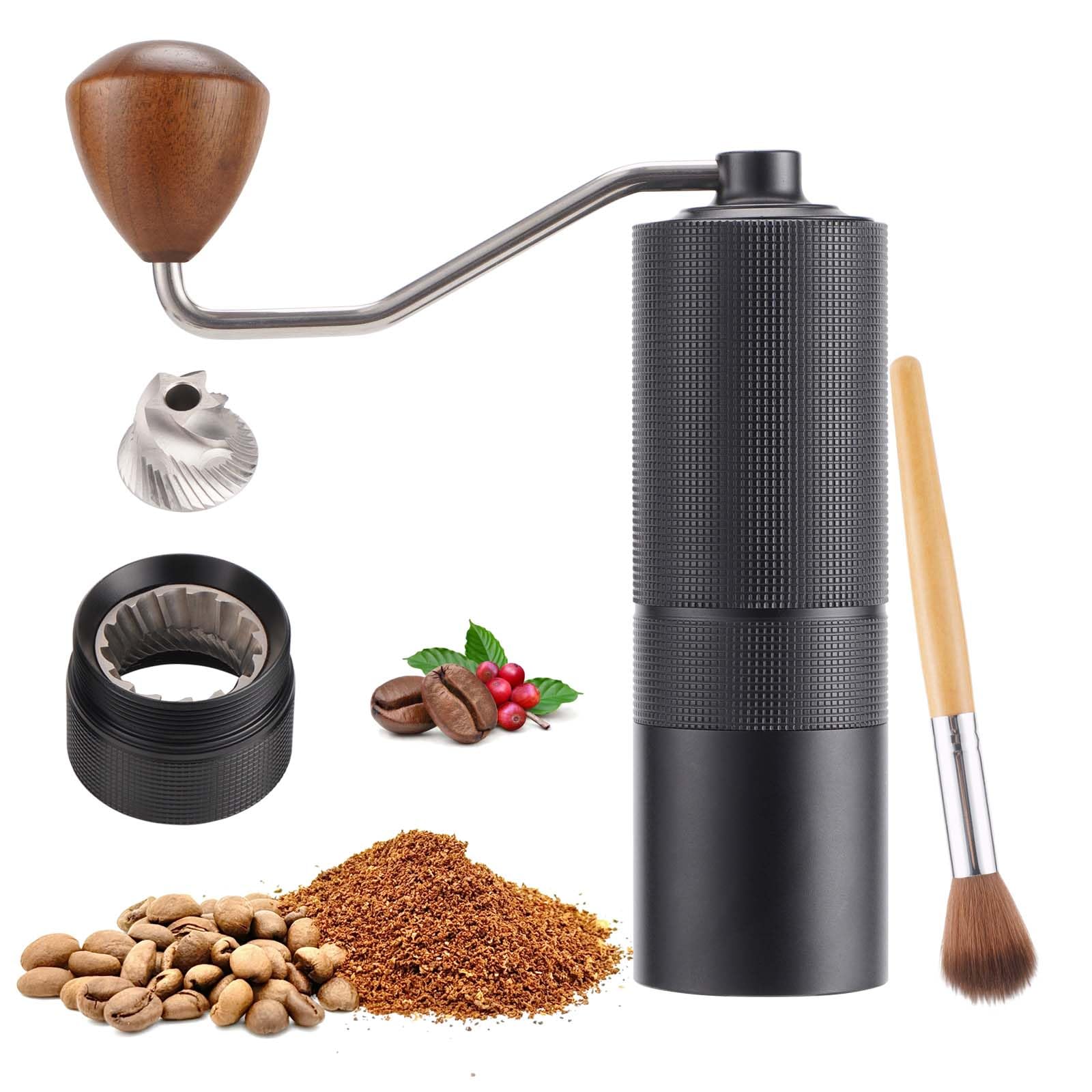
The Popsweeter C38 distinguishes itself with a fully all-metal construction — zero plastic parts anywhere in the grinding path — and a 38mm 420 stainless steel burr with 55-58 HRC hardness. The CNC-cut burr geometry and precision double-bearing central shaft deliver consistent grind quality across 36+ click settings, covering everything from Turkish powder to coarse French press. At 1 pound, the C38 strikes a balance between portability and stability, with the metal body providing enough mass to stay planted on the counter during rapid cranking.
Beyond coffee, the C38 is explicitly designed to handle spices, herbs, grains, nuts, and salt, making it a versatile tool for kitchens where a dedicated spice grinder is not available. The detachable outer ring burr can be fully disassembled without tools for thorough cleaning of deep-roasted coffee oils or residual spice aromas. The manual operation produces near-silent grinding — a genuine advantage for early-morning prep when family members are still asleep. The included brush and carrying bag add practical value for travel and daily maintenance.
User feedback highlights the C38’s strong performance for pour-over and French press, where the uniform grind contributes noticeably cleaner cups compared to blade grinders. A small number of users note that the catch cup, while metal, has a narrow opening that makes emptying grounds a bit fiddly — you may need a small funnel or steady hand. The 25g capacity is adequate for most single-brew methods. For the price-conscious buyer who wants a metal-bodied grinder that can also handle cumin seeds or black peppercorns, the Popsweeter C38 offers remarkable versatility without sacrificing burr quality.
Why it’s great
- Fully all-metal construction with zero plastic components
- Versatile grinding capability for coffee, spices, herbs, and grains
- 36+ click settings with double bearing for consistent grind
- Near-silent operation ideal for early-morning brewing
Good to know
- Narrow catch cup opening can make emptying grounds a bit messy
- 25g capacity requires refilling for larger brewing sessions
FAQ
How many clicks per rotation do I need for espresso grinding?
Is a ceramic burr or stainless steel burr better for a manual grinder?
What does a double bearing shaft do in a hand grinder?
Can I use a manual burr grinder for spices and herbs?
How do I clean a manual burr grinder without damaging the burrs?
Final Thoughts: The Verdict
For most users, the best manual burr grinder winner is the TIMEMORE S3 because it delivers espresso-grade adjustment precision and burr uniformity that rivals electric grinders costing three times as much, all in a robust full-metal chassis. If you want a lighter, travel-friendly option that still punches above its weight, grab the KINGrinder P2 — it tucks into any bag without sacrificing grind consistency. And for the budget-conscious buyer who needs a versatile metal-bodied grinder that handles both coffee and spices, nothing beats the Popsweeter C38.