Whether you’re dodging the plastic waste of jugs or tired of waiting for a pitcher filter to trickle through, a dedicated filter tap delivers crisp, contaminant-reduced water straight from the same spout you use for washing dishes. The catch? Not all systems handle the same contaminants, and the difference between an under-sink carbon block and a reverse osmosis setup is measured in microns, flow rate, and what stays in your glass.
I’m Mohammad Maruf — the founder and writer behind AirfryerBite. For the past several years, I’ve analyzed filtration hardware across hundreds of product listings, comparing micron ratings, NSF certifications, flow rates, and installation complexity to identify which systems actually perform as claimed under real kitchen conditions.
This guide breaks down the top under-sink and countertop models by their actual filtration specs, not marketing fluff. Whether you need to reduce lead, chlorine taste, PFAS, or just want mineral-rich water without the bottle habit, here is the complete breakdown of the best filter taps on the market today.
How To Choose The Best Filter Taps
Filter taps are plumbing fixtures, not countertop appliances, which means installation requirements and compatibility with your existing setup matter just as much as the filter media inside. Before clicking “buy,” you need to weigh filtration type, flow rate, NSF certifications, and whether you want a dedicated spout or a combined 2-in-1 faucet.
Filtration Type: Carbon Block vs. Ultra-Filtration vs. Reverse Osmosis
Carbon block systems are the entry-level standard for filter taps — they reduce chlorine, taste, and odor at a high flow rate but leave dissolved solids (TDS) untouched. Ultra-filtration membranes push finer at 0.01 microns, removing sediment, rust, and most bacteria while preserving beneficial minerals. Reverse osmosis (RO) goes further, stripping virtually everything including fluoride, nitrates, and heavy metals, but produces wastewater and typically requires a dedicated faucet hole. If your tap water comes from a municipal supply and tastes fine, carbon or UF is sufficient. For well water or known contaminants like PFAS, RO is the only reliable option.
NSF Certifications — The Only Proof That Matters
A filter tap’s marketing can claim anything. NSF/ANSI Standard 42 covers aesthetic improvements (chlorine, taste, odor). Standard 53 addresses health-related contaminants like lead, cysts, and VOCs. Standard 58 applies specifically to reverse osmosis systems. Standard 372 certifies lead-free construction of the faucet itself. A system that lists these certifications on its spec sheet has passed independent lab testing — skip any product that only uses vague phrases like “tested to NSF standards” without the actual seal. This is the single most reliable shortcut to separating legit hardware from overpriced plastic.
Flow Rate, Filter Life, and Installation Realities
Under-sink filter taps typically deliver 1.5–2.5 gallons per minute — fast enough to fill a pot without frustration. Slower flow often indicates a tighter membrane (RO units can drop below 1 GPM). Filter lifespan ranges from 6 months to 2 years depending on capacity (measured in gallons) and your water quality. Installation complexity varies wildly: basic direct-connect carbon filters take 10 minutes with a wrench, while under-sink RO systems may require drilling a second hole for the dedicated faucet and a drain line. Measure the space under your sink before ordering — tall filter housings can conflict with garbage disposals or storage bins.
Quick Comparison
On smaller screens, swipe sideways to see the full table.
| Model | Category | Best For | Key Spec | Amazon |
|---|---|---|---|---|
| Waterdrop G3P800 | Under-Sink RO | High-capacity whole-kitchen filtration | 800 GPD, 10-stage RO, smart faucet | Amazon |
| FORIOUS 2-in-1 Black Faucet | All-in-One Faucet | Combining main tap and filter in one unit | 1.8 GPM, SUS 304 steel, 3 spray modes | Amazon |
| Aigerri UV Countertop RO | Countertop RO | No-install portable pure water | 5:1 pure-to-drain, 5L tank, UV | Amazon |
| DREO Countertop RO | Countertop RO | Smart monitoring for small households | 3:1 ratio, real-time TDS, auto-fill pitcher | Amazon |
| Waken Electric C11S Countertop RO | Countertop RO | High efficiency with 4:1 pure-to-drain | 8-stage, 4:1 ratio, UV, 180oz tank | Amazon |
| Waterdrop TST-UF | Under-Sink UF | Mineral retention with stainless build | 0.01 μm UF, 1.59 GPM, 304 steel | Amazon |
| Ecoviva UF800G | Under-Sink UF | Zero-waste ultra-fast filtration | 800 GPD, 0.01 μm, no electricity | Amazon |
| Frizzlife SW10 | Under-Sink Carbon | Quick-install value for rental kitchens | 0.5 micron, brass fittings, 8K gal | Amazon |
| Mist Under Sink Filter | Under-Sink Carbon | Lowest cost per gallon for basic taste improvement | 20K gal capacity, 0.5 micron | Amazon |
In‑Depth Reviews
1. Waterdrop G3P800 Reverse Osmosis System
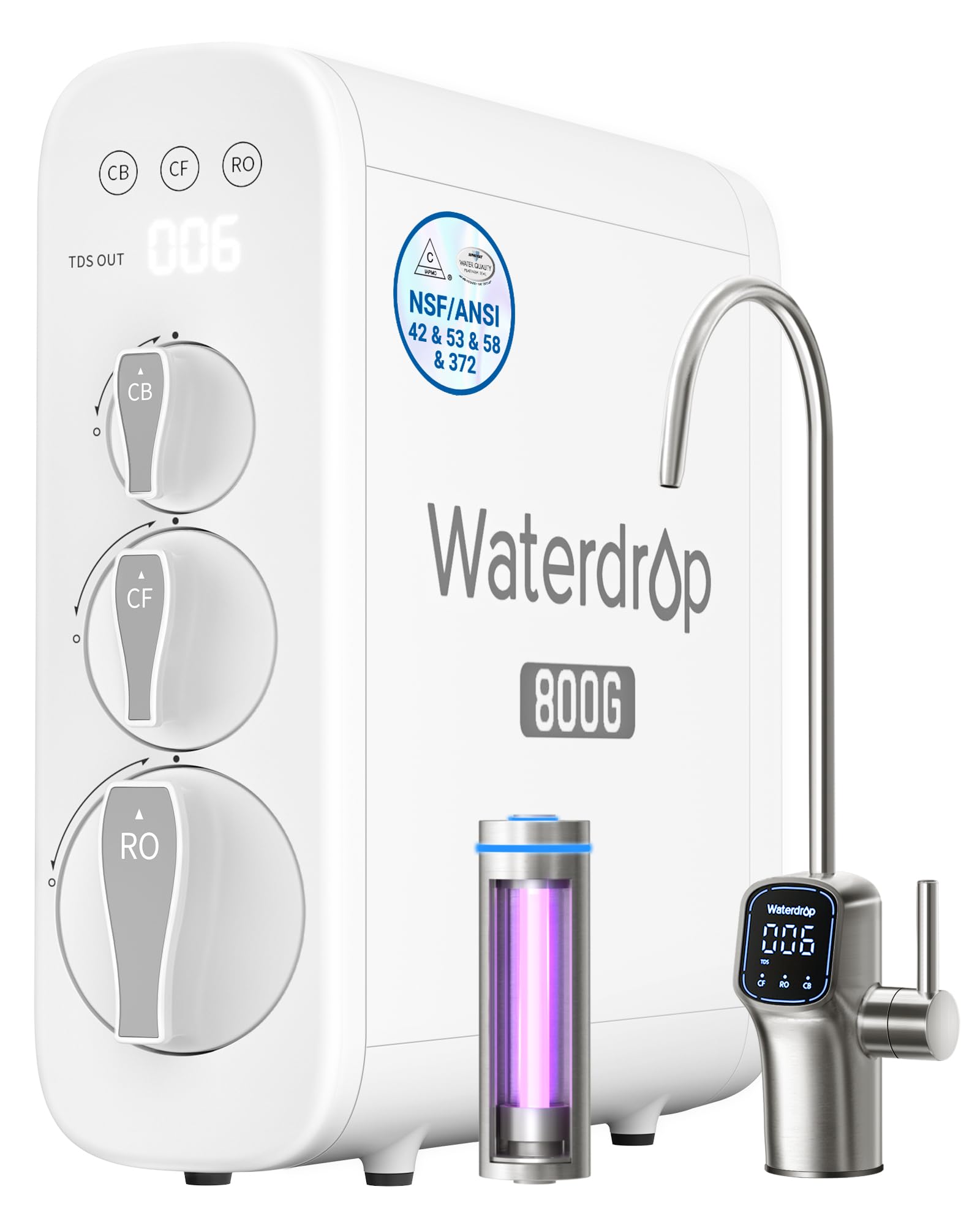
The Waterdrop G3P800 is the closest thing to a commercial-grade filter tap for residential kitchens. Its 800-gallon-per-day capacity and 10-stage filtration stack — including a reverse osmosis membrane, carbon block, and PP cotton — earn NSF/ANSI certifications 42, 53, 58, and 372, meaning it has independently verified reductions for chlorine, lead, fluoride, PFAS, and TDS. The tankless design saves under-sink space and eliminates standing water, while the smart LED faucet displays real-time TDS levels so you always know what’s coming out of the tap.
Flow rate is genuinely impressive for an RO system: the pump pushes filtered water at a pace that fills a cup in about 5 seconds, and the 3:1 pure-to-drain ratio keeps wastewater manageable. Installation requires drilling two holes — one for the dedicated RO faucet and one for the drain saddle connection — so this is a permanent fixture, not a rental-friendly add-on. The metal construction and smart faucet justify the premium price bracket, but you’re paying for a system that will outlast several filter cartridge changes without losing performance.
If your water report shows dissolved solids above 300 ppm or you want guaranteed PFAS reduction, this is the system that eliminates the guesswork.
Why it’s great
- NSF 58 certified for TDS reduction — uncommon in residential RO units
- Smart faucet with LED TDS display removes uncertainty about water quality
- Tankless design prevents bacterial growth in stored water
Good to know
- Requires drilling two holes for installation — not suitable for renters
- Premium initial investment compared to carbon block filter taps
2. FORIOUS Black 2-in-1 Kitchen Faucet with Water Filter
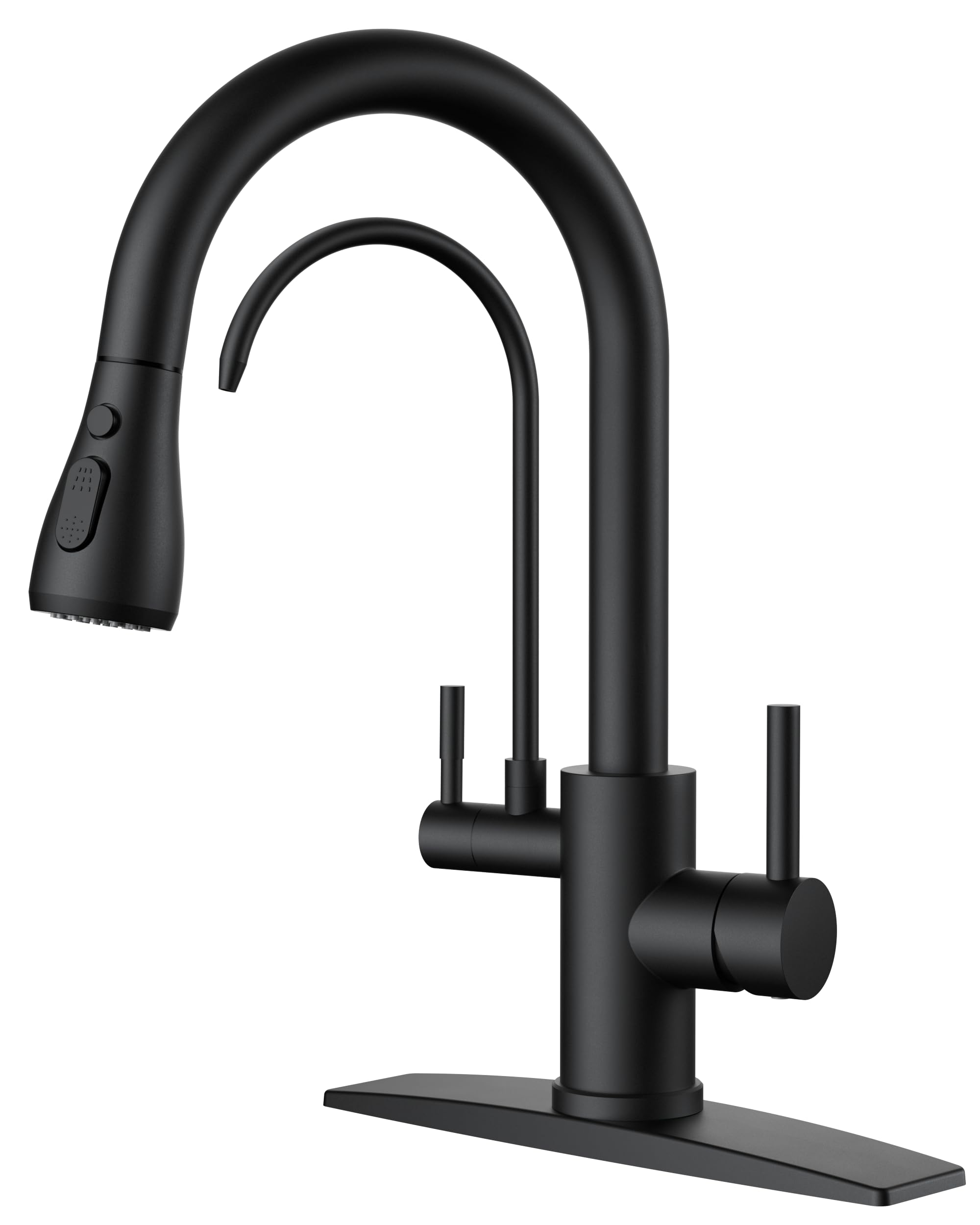
FORIOUS solves the biggest aesthetic complaint about filter taps — the need for a separate, ugly spout mounted next to your main faucet. This 2-in-1 unit combines a pull-down sprayer kitchen faucet with a dedicated purified water line in a single, matte-black stainless steel body. The construction is no-lead SUS 304 stainless steel with a drip-free ceramic cartridge, and it carries DOE and NSF/ANSI/CAN 61 lead-free certification. You get stream, spray, and pause modes on the main faucet via an 18-inch retractable hose with 360-degree swivel, plus a separate filtered water path that connects to your under-counter RO or carbon filter system.
Installation fits a single hole (or three-hole with the included deck plate) and takes under 15 minutes for a DIY homeowner. The flow rate on the unfiltered side hits 1.8 GPM at max pressure, while the filtered path’s speed depends entirely on the under-sink system you pair it with. The black matte finish resists fingerprints better than chrome, and the compact deck eliminates the need for extra drilling. The trade-off is that FORIOUS sells the faucet body only — you must purchase the filtration unit separately, so the total cost depends on what you choose to connect underneath.
This is the ideal solution for anyone remodeling a kitchen or replacing an old faucet who wants a clean, integrated look. It does not include a filter cartridge, so your water quality ceiling is defined by the under-sink system you attach. If you want the sleekest installation without sacrificing filtered water access, this faucet body is the best platform to build on.
Why it’s great
- Single-faucet design eliminates the need for a secondary spout
- Certified lead-free 304 stainless steel construction resists corrosion
- Retractable sprayer with three modes adds kitchen versatility
Good to know
- Filter system sold separately — this is only the faucet body
- Maximum filtered water flow depends on the under-sink unit you pair it with
3. Aigerri UV Countertop Reverse Osmosis Water Filter

The 5-liter raw water reservoir and 2-liter purified tank deliver 529 gallons of filtered water per filter set, with an industry-leading 5:1 pure-to-drain ratio that wastes far less water than traditional RO systems. The 5-stage filtration includes a UV sterilization stage, which adds a layer of microbial protection that most countertop units skip. SGS testing confirms compliance with NSF/ANSI 372 for lead-free materials, and the system reduces PFAS, fluoride, and heavy metals.
The unit measures 16.4 inches tall with the lid closed and 21.7 inches open, so it fits under most standard cabinets as long as you have 22 inches of vertical clearance. The control panel is straightforward: select your water volume, and the system dispenses into the included pitcher or your own container. Real-time TDS monitoring and separate filter life indicators for each stage remove the guesswork from maintenance. The 5-liter raw tank is large enough for a family of three to get through a day without constant refilling, but you do need to refill it manually.
The key limitation is that this is not a filter tap in the traditional plumbing sense — it is a countertop appliance that dispenses water, not an inline system. If you want filtered water on demand without calling a plumber, and you have counter space near an outlet, this delivers RO-quality water with the lowest installation friction of any system in this lineup. The 5:1 ratio also makes it far more eco-conscious than older RO units that dump 3 gallons down the drain for every 1 they produce.
Why it’s great
- 5:1 pure-to-drain ratio wastes minimal water compared to older RO systems
- UV stage adds microbial reduction that carbon-only filter taps cannot provide
- Zero installation — fill the tank and plug in
Good to know
- Requires manual refilling of the 5L raw water tank
- Not a true inline tap — it occupies countertop space near an outlet
4. DREO Reverse Osmosis Water Filter Countertop
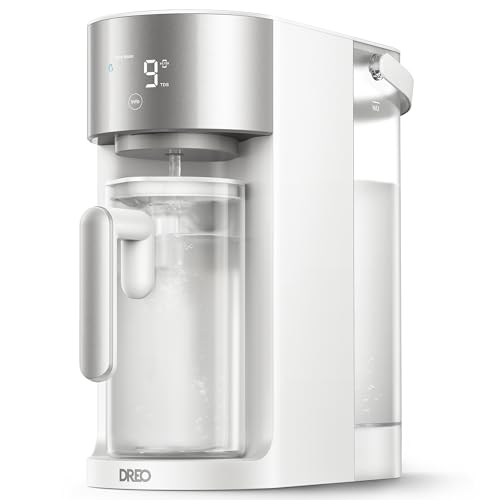
DREO brings the convenience of countertop RO filtration with a focus on real-time monitoring and automated maintenance. The 7-in-1 filter is SGS tested against NSF/ANSI 58 standards and removes 99.99% of 1,000+ contaminants including PFOA, PFOS, chlorine, and fluoride. The standout feature is the dual-lens display showing TDS values for both incoming and outgoing water — a transparency level usually reserved for much more expensive lab-grade systems. The auto-fill sensor on the included 1.1-liter pitcher refills hands-free when you place it under the dispenser, and the self-cleaning cycle automatically flushes the internal tubing to prevent biofilm buildup.
The 3:1 pure-to-drain ratio is solid but not class-leading — the Aigerri hits 5:1 for comparison. Filter life spans 6 to 12 months, and replacement filters are quick-swap with a twist-lock mechanism. The compact footprint (14.5 by 6.7 inches) fits narrow countertops, and the 3-liter internal tank combined with the pitcher gives you about a gallon of purified water ready at any time. DREO also includes a filter change reminder based on actual usage rather than a fixed calendar schedule, which prevents premature replacement.
The primary trade-off is capacity: the 3L tank plus 1.1L pitcher is ideal for 1–2 people but requires more frequent refilling for larger households. Like all countertop RO units, this is an appliance rather than a plumbed filter tap, so it works best for those who rent, move frequently, or simply want to avoid drilling holes under the sink. For a single person or couple who values data-driven water quality feedback, the DREO is the most informative option in the countertop category.
Why it’s great
- Real-time TDS display shows exact contaminant reduction — no guesswork
- Self-cleaning auto-flush keeps internal lines free of biofilm
- Twist-lock filter replacement takes seconds with no tools
Good to know
- 3L tank capacity best suited for 1–2 person households
- Pure-to-drain ratio of 3:1 is less water-efficient than the 5:1 competition
5. Waken Electric C11S Countertop Reverse Osmosis System
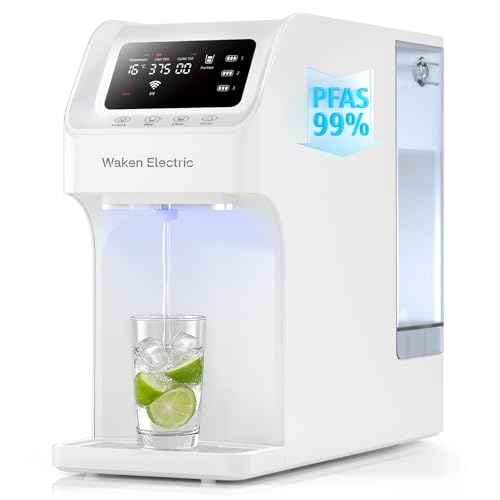
Waken Electric targets the efficiency gap with a 4:1 pure-to-drain ratio that beats most countertop RO units without sacrificing filtration depth. The 8-stage system uses Sri Lankan coconut shell activated carbon for the carbon stages, a UV light for microbial kill, and a high-rejection RO membrane that reduces TDS by roughly 90–95%. The 180-ounce purified water tank holds enough for moderate daily use, and the 418-gallon-per-day flow rate dispenses a cup in about 14 seconds — competitive for a countertop unit that doesn’t rely on a pressure tank.
The smart display panel shows TDS levels in real time, tracks each of the three filter stages individually, and alerts you when the waste tank needs emptying to prevent secondary contamination. SGS testing confirms compliance with NSF/ANSI 58 and 372, plus EPA and FCC certifications. The unit measures 7.28 by 18.3 inches, which is a tall footprint — you need stable counter space and clearance above for the lid. No installation is required beyond plugging it in and filling the raw water reservoir.
The drawback is that the 4:1 ratio, while better than many RO systems, still produces wastewater that must be manually emptied from the waste tank — there is no direct drain line. This makes the Waken a zero-installation solution but also means you are responsible for disposing of the reject water. For apartment dwellers who want RO-level purity without a plumber or a hole in the countertop, the C11S is the best balance of efficiency and filter stage count in its price tier.
Why it’s great
- 4:1 pure-to-drain ratio wastes less water than typical 1:1 or 2:1 systems
- UV stage adds an extra microbial barrier beyond standard RO
- Individual filter life tracking prevents guessing on replacement timing
Good to know
- Wastewater tank requires manual emptying — not a true drain-and-forget system
- Tail footprint demands stable counter space with overhead clearance
6. Waterdrop TST-UF Under Sink Ultra-Filtration System

Waterdrop’s TST-UF stands apart from the plastic-bodied under-sink filters lining the market by using a lead-free 304 stainless steel housing that will not crack, leak, or discolor over time. The 0.01-micron ultrafiltration membrane reduces sediment, rust, chlorine, heavy metals, and most bacteria while leaving beneficial minerals like calcium and magnesium intact — meaning your water tastes crisp and natural rather than flat like stripped RO water. The flow rate is a fast 1.59 GPM, filling an 8-ounce cup in about 2.3 seconds, and the unit can be placed on the cabinet floor or hung on the wall with the included bracket.
This is not a TDS-reducing system, and Waterdrop explicitly states that on the product page — buyers expecting distilled-level purity need an RO system. The filter set lasts 6–24 months depending on the stage (PP pre-filter, UF membrane, CT carbon block), and replacements are modular so you only swap the exhausted stage rather than the whole housing. Installation is direct-connect to 3/8-inch or 1/2-inch cold water lines with standard quick-connect fittings, and no drilling is required if you have an existing dedicated faucet hole.
The stainless steel construction carries a notable environmental benefit: Waterdrop estimates the recyclable housing saves over 500,000 pounds of plastic waste annually across their product line. For anyone who wants filtered water without losing the mineral profile of their tap water, and who values a fixture that will outlive a plastic alternative by years, the TST-UF is the most tank-like build in the under-sink carbon/UF category.
Why it’s great
- 304 stainless steel housing is far more durable than standard plastic filter housings
- 0.01-μm membrane removes bacteria while preserving beneficial minerals
- Fast 1.59 GPM flow rate eliminates the wait for a glass of water
Good to know
- Does not reduce TDS — mineral content and dissolved solids remain unchanged
- Not compatible with well water or hot water sources
7. Ecoviva UF800G Under Sink Ultra-Filtration System
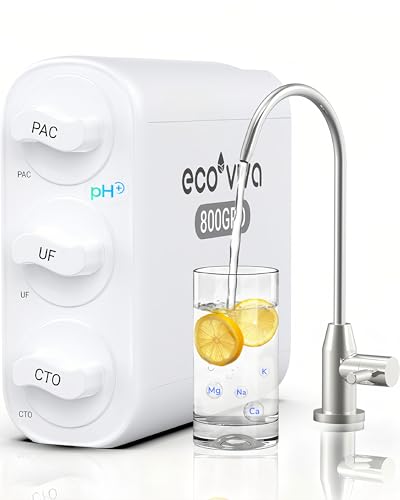
Ecoviva’s UF800G delivers ultra-filtration at a throughput that rivals basic RO systems — 800 gallons per day — without a drop of wastewater or a watt of electricity. The 0.01-micron hollow fiber membrane removes sediment, rust, chlorine taste and odor (over 99.99% reduction), while allowing calcium and magnesium to pass through for natural mouthfeel. The compact main unit is shorter than two smartphones stacked, tucking into tight under-sink corners without crowding storage space. No storage tank, no drain line, no pump noise — just a simple 1/4-inch tubing connection.
Installation is DIY-friendly with a T-connector, tubing, and illustrated manual — no special tools or pipe modification required. The included modern faucet finishes the look and connects directly to the UF output. Filter cartridges last 6 to 24 months depending on incoming water quality, and the annual maintenance cost is a fraction of bottled water. Because the system does not reduce TDS, it won’t trigger the sensor errors that some refrigerator ice makers experience with pure RO water, and it won’t cause leaf tip burn when used for houseplants.
The limitation is the same as any UF system: it does not remove dissolved solids, fluoride, or nitrates. If your water report lists high TDS or specific chemical contaminants, you need RO. But for municipal water that already meets safety standards and just needs chlorine reduction, sediment removal, and better taste, the Ecoviva UF800G offers the fastest flow, smallest footprint, and lowest environmental impact of any under-sink system in its price bracket.
Why it’s great
- Zero wastewater and no electricity — purely pressure-driven operation
- Ultra-compact unit fits in tight under-sink spaces with no storage tank
- High flow rate fills pots and pitchers faster than typical UF systems
Good to know
- UF membrane does not reduce TDS — dissolved minerals and potential nitrates remain
- Not suitable for well water with high sediment or bacterial loads without pre-filtration
8. Frizzlife SW10 Under Sink Water Filter System

Frizzlife designed the SW10 for the renter or first-time buyer who wants filtration without commitment. The 3-minute installation connects directly to your existing faucet cold water line using included braided hoses and lead-free brass fittings — a meaningful upgrade over the plastic compression fittings found on budget filter taps. The multi-layer composite filter combines sediment filtration with coconut carbon block at 0.5-micron accuracy, reducing chlorine, lead, fluoride, heavy metals, VOCs, and bad taste. It is NSF 42 and 53 certified, so the reduction claims for lead and chlorine have been independently verified.
The standout convenience feature is the auto shut-off design that lets you replace the filter cartridge in about three seconds without shutting off the water supply — just twist the old cartridge off and twist the new one on (search B081TJ3Q7M for replacements). Each cartridge lasts 12–16 months or 8,000 gallons, roughly double the lifespan of many carbon block systems. The flow rate reaches 2 GPM at 60 PSI, so there is no noticeable reduction in water pressure compared to running unfiltered water. The SW10 also pairs with an optional ice maker kit to supply filtered water to your refrigerator.
The housing is plastic, not metal, which keeps costs down but lacks the longevity of stainless steel units. Some users in our research reported minor dripping at the connection points that required an extra quarter-turn on the fittings. For the price, the SW10 delivers certified filtration, brass fittings, and tool-free cartridge swaps — a compelling package for anyone who wants a proven, maintenance-friendly under-sink filter without drilling or professional help.
Why it’s great
- 3-second cartridge swap with auto shut-off — no water shut-off needed
- Lead-free brass fittings are more durable than typical plastic connectors
- NSF 42 and 53 certified for chlorine and lead reduction
Good to know
- Plastic housing is less durable than stainless steel alternatives
- Not certified for PFAS or TDS reduction — carbon block only
9. Mist Under Sink Water Filter System

Mist cuts through the complexity with the simplest proposition in this lineup: a 20,000-gallon filter capacity that effectively covers about two years of household use for an entry-level price. The 0.5-micron activated coconut carbon block reduces PFAS, PFOA/PFOS, lead, chlorine, and bad taste/odor, and the system is NSF/ANSI 42 certified for the claims that matter most to municipal water drinkers. The under-sink body is compact at 3.5 by 12 inches, fitting easily into tight cabinets without hogging space, and the included installation kit comes with teflon tape, mounting screws, a template, and a quick-connect tubing release tool.
Flow rate lands at up to 2.5 GPM at 60 PSI, which is the fastest raw throughput in this review — you will not notice a pressure drop between filtered and unfiltered operation. The universal design kit includes adapters for most standard plumbing configurations, and Mist provides US-based support for questions about unique parts. The 0.5-micron rating is coarser than the 0.01-micron UF membranes found in mid-range systems, meaning it filters sediment and chlorine effectively but does not remove bacteria or viruses.
For anyone on municipal water that is already biologically safe but tastes or smells like a swimming pool, the Mist delivers two years of chlorine-free, better-tasting water for the absolute lowest per-gallon cost in this guide. It is the ideal budget-friendly entry point for a first-time filter tap buyer who wants to test the waters without a significant financial commitment.
Why it’s great
- 20,000-gallon capacity means infrequent replacements — roughly 2 years of use
- Highest flow rate in the review at 2.5 GPM — no noticeable pressure drop
- NSF 42 certified with universal adapters for quick DIY installation
Good to know
- 0.5-micron filter does not remove bacteria, viruses, or dissolved solids
- Plastic housing lacks the structural durability of stainless steel models
FAQ
Can a filter tap remove PFAS chemicals from drinking water?
Do I need a plumber to install an under-sink filter tap system?
Will a filter tap reduce the water pressure at my kitchen sink?
How often should I replace the filter cartridge in my tap system?
Can I use a filter tap with a refrigerator ice maker or water dispenser?
Final Thoughts: The Verdict
For most users, the best filter taps winner is the Waterdrop G3P800 because its 10-stage RO filtration with NSF 58 certification and smart TDS faucet delivers the broadest contaminant reduction without sacrificing flow rate. If you want a sleek, integrated look without a second spout, grab the FORIOUS 2-in-1 Faucet and pair it with your chosen under-sink filter. And for zero-installation RO purity that you can move between apartments, nothing beats the Aigerri UV Countertop RO with its 5:1 pure-to-drain ratio.