A chef’s knife is the single most-used tool in any kitchen, yet most home cooks settle for blades that crush rather than slice. A properly balanced, razor-sharp 8-inch knife transforms meal prep from a chore into a fluid, precise motion — dicing onions without tears, slicing proteins with a single draw, and mincing herbs so fine they practically dissolve. Finding a blade that holds its edge, feels balanced in the hand, and fits your grip is the difference between cooking with joy and fighting your equipment.
I’m Mohammad Maruf — the founder and writer behind AirfryerBite. I’ve spent years analyzing blade geometry, steel composition, handle ergonomics, and heat-treat processes to understand what separates a budget compromise from a genuine kitchen workhorse.
Whether you are upgrading from a dull block set or building your first serious collection, this guide cuts through the marketing noise to deliver the best home chef knife recommendations backed by real specs, real steel grades, and real user experience.
How To Choose The Best Home Chef Knife
Selecting a chef knife is not about picking the most expensive or the prettiest blade — it is about matching steel composition, heat treatment, handle ergonomics, and blade geometry to your actual cutting habits. Here are the critical factors that separate a lifelong companion from a frustrating return.
Steel Type and Hardness (HRC)
The blade steel determines how long the edge stays sharp and how difficult it is to resharpen. High-carbon stainless steel (like German 1.4116 or Japanese VG10) offers a sweet spot between corrosion resistance and edge retention. Look for a Rockwell hardness of 56-62 HRC — anything below 56 dulls quickly, while above 62 becomes brittle and prone to chipping on hard ingredients like squash or bone.
Blade Construction: Forged vs. Stamped
Forged blades are shaped from a single heated billet of steel, resulting in a thicker spine, better distal taper, and superior grain structure. Stamped blades are cut from a steel sheet, making them lighter and more affordable but often less balanced. For daily home use, a well-made stamped knife (like the Victorinox Fibrox Pro) can outperform a poorly forged one, but a properly forged full-tang knife offers the best weight distribution and durability.
Handle Material and Ergonomics
The handle is your primary interface with the blade. Synthetic materials like POM resin and Fibrox provide excellent non-slip grip when wet and are virtually maintenance-free. Natural options like wenge wood or pakkawood offer beautiful aesthetics but require occasional oiling and should never go in the dishwasher. A full tang with a triple-riveted handle signals durability, while a bolster prevents your hand from sliding onto the edge.
Edge Angle and Bevel Type
Japanese knives typically feature a 15-degree edge angle (double bevel) for extreme sharpness, while German knives often use a 20-degree angle for more edge durability. For home cooks cutting mostly vegetables and boneless proteins, a 15-16 degree edge offers the best balance. A plain edge (non-serrated) allows for the cleanest cuts and easiest sharpening.
Quick Comparison
On smaller screens, swipe sideways to see the full table.
| Model | Category | Best For | Key Spec | Amazon |
|---|---|---|---|---|
| KYOKU Shogun Series | Premium Japansese | Damascus precision & daily workhorse | VG10 Core, 67-layer Damascus | Amazon |
| Shun Classic 8″ | Premium Japanese | Long-term investment & superior sharpness | VG-MAX steel, 68-layer Damascus | Amazon |
| KAWAHIRO VG10 | Premium Japanese | Artisan craftsmanship & gift quality | VG10 Stainless, Octagonal Handle | Amazon |
| Atumuryou JPCK Damascus | Premium Japanese | Traditional black-forged finish & gift presentation | VG10 Core, 62 HRC | Amazon |
| WÜSTHOF Gourmet | Premium German | Heavy-duty chopping & professional reliability | German High Carbon Steel | Amazon |
| Victorinox Fibrox Pro | Mid-Range Stamped | Budget-friendly daily driver & first good knife | 8-inch, TPE non-slip handle | Amazon |
| SCOLE 7-Piece Set | Mid-Range Forged | Complete knife set on a mid-range budget | German 1.4116, 58±2 HRC | Amazon |
| Kimura Gyuto | Mid-Range Japanese | Entry-level Japanese Gyuto from Seki, Japan | High Carbon Molybdenum SS | Amazon |
| SYOKAMI Kiritsuke | Value Forged | Budget Kiritsuke with wood handle & sharp tip | High Carbon German Steel | Amazon |
In‑Depth Reviews
1. KYOKU Shogun Series 8″ Chef Knife

The KYOKU Shogun Series hits the sweet spot where premium materials meet real-world usability. Its 67-layer Damascus cladding over a VG10 core delivers exceptional edge retention at 58-60 HRC, while the 8-12 degree Honbazuke edge glides through produce with almost no resistance. The blade is forged, not stamped, giving it a substantial feel that remains agile for both fine mincing and heavy dicing.
The fiberglass G10 handle is a standout feature — it resists moisture, temperature swings, and corrosion far better than standard synthetics. A full tang and mosaic pin ensure the handle will never separate from the blade. The included sheath and storage case add practical protection, making this a complete package that punches well above its price tier.
Users consistently praise its out-of-box sharpness and how well it holds that edge through months of daily use. The balance point sits right at the bolster, reducing wrist fatigue during extended prep sessions. For any home cook ready to move beyond entry-level knives, the Shogun Series represents a genuine performance leap without crossing into luxury pricing.
Why it’s great
- VG10 core with 67-layer Damascus offers superior edge retention and corrosion resistance
- G10 fiberglass handle is impervious to moisture and provides a secure, non-slip grip
- Includes a protective sheath and a storage case for safe portability
Good to know
- Not dishwasher safe — hand wash and dry immediately to protect the Damascus pattern
- The 8-12 degree edge is extremely sharp but requires careful handling and a proper honing rod
2. Shun Classic 8″ Chef’s Knife

The Shun Classic is the benchmark that other Japanese chef knives measure themselves against. Its proprietary VG-MAX steel core (an evolution of VG10) is clad in 68 layers of Damascus stainless steel, achieving a Rockwell hardness of approximately 61 HRC. The 16-degree double-bevel edge is factory-sharpened using Shun’s multi-stage waterstone process, resulting in a hair-splitting edge that holds for weeks of heavy use.
The D-shaped Pakkawood handle is ergonomically contoured for both left and right-handed users, offering a warm, stable grip that improves with moisture absorption. This knife is fully forged with a seamless bolster-to-blade transition, providing excellent balance and a smooth pinch-grip platform. Shun also offers free sharpening and honing services, which adds significant long-term value.
Professionals and serious home cooks will appreciate how the Shun Classic handles delicate tasks like slicing raw fish or paper-thin garlic, yet it is robust enough for processing vegetables and boneless meats. The edge geometry minimizes wedging on dense ingredients, and the thin spine allows for precise accordion cuts. It is a lifetime knife if cared for properly.
Why it’s great
- VG-MAX steel core provides exceptional hardness and edge retention with easier sharpening than standard VG10
- Free sharpening service from Shun adds long-term value and convenience
- Pakkawood handle is comfortable, warm, and develops a better grip with use
Good to know
- Premium price point — a serious investment for a single chef knife
- Pakkawood handle requires occasional oiling and should never be soaked or put in a dishwasher
3. KAWAHIRO VG10 8″ Chef Knife
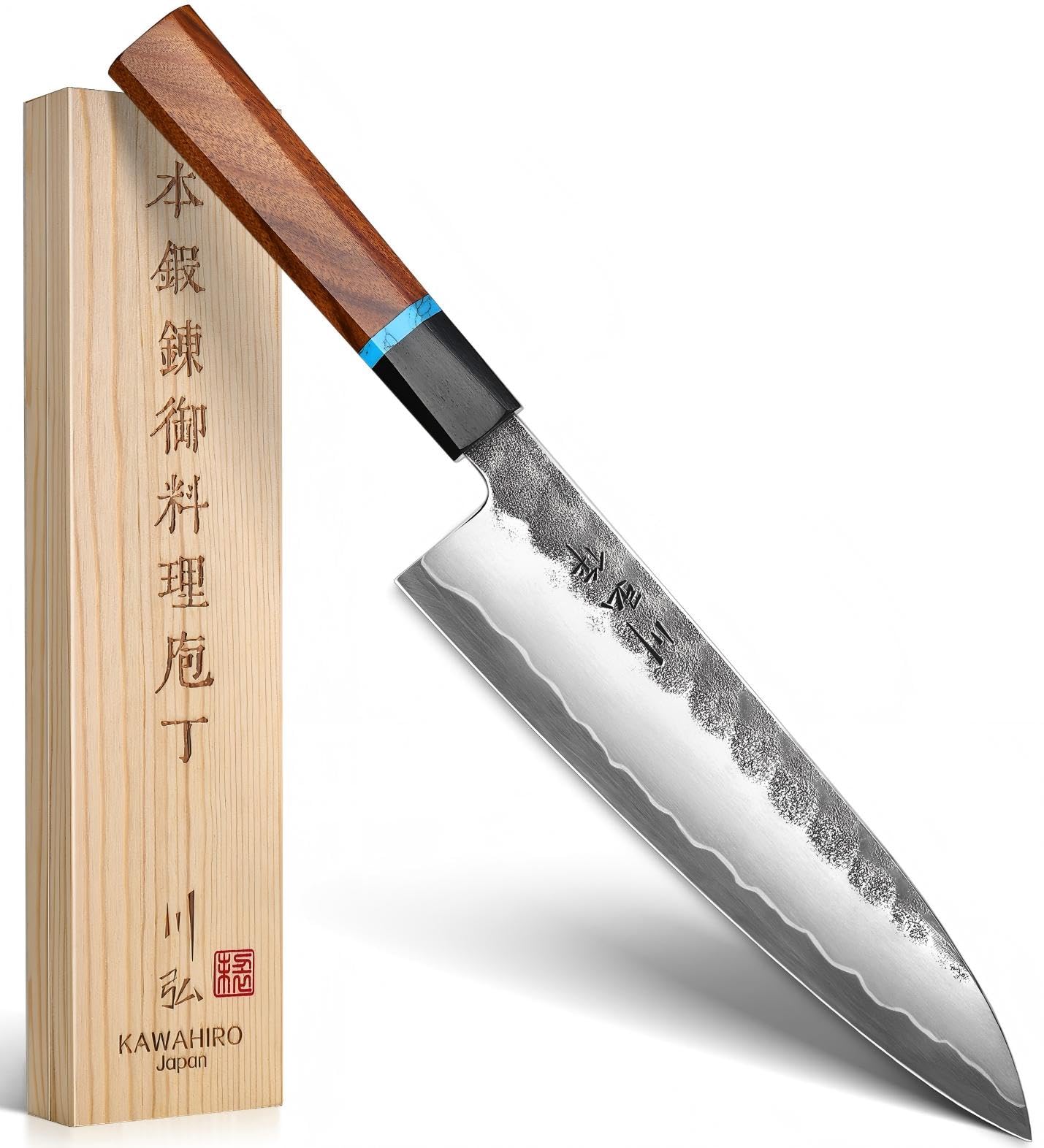
The KAWAHIRO KH-6601 is a hand-forged masterpiece that pairs a VG10 stainless core with an octagonal handle crafted from ebony, turquoise, and premium ruby wood. The black-forged finish on the blade is not just aesthetic — it reduces surface drag when cutting through sticky ingredients like potatoes or squash. The 3-layer composite steel construction (VG10 core sandwiched between softer stainless layers) provides a hard cutting edge with a more forgiving, less brittle overall blade.
The octagonal (hachikaku) handle is a traditional Japanese design that offers eight distinct gripping positions, allowing you to rotate the knife in your hand for different cuts without adjusting your hold. This reduces fatigue during long prep sessions. The handle materials are sealed and stabilized, but they still require hand-washing and occasional conditioning to maintain their rich coloration.
Customer feedback highlights the out-of-box sharpness and how the blade glides through meat and vegetables with minimal force. The knife arrives in a premium wooden case with a certificate of authenticity, making it a strong contender for a meaningful gift. It is lighter than a German-style chef knife, which some cooks prefer for speed-oriented cutting.
Why it’s great
- Octagonal ebony/turquoise handle provides exceptional control and reduces fatigue
- 3-layer VG10 composite steel offers a hard edge with improved toughness over single-layer VG10
- Presentation-grade wooden case and certificate make it an ideal gift
Good to know
- Natural handle materials require more care than synthetic handles — hand wash and dry immediately
- The black-forged finish may show scratches over time (purely cosmetic, does not affect performance)
4. Atumuryou JPCK Damascus 8″ Chef Knife
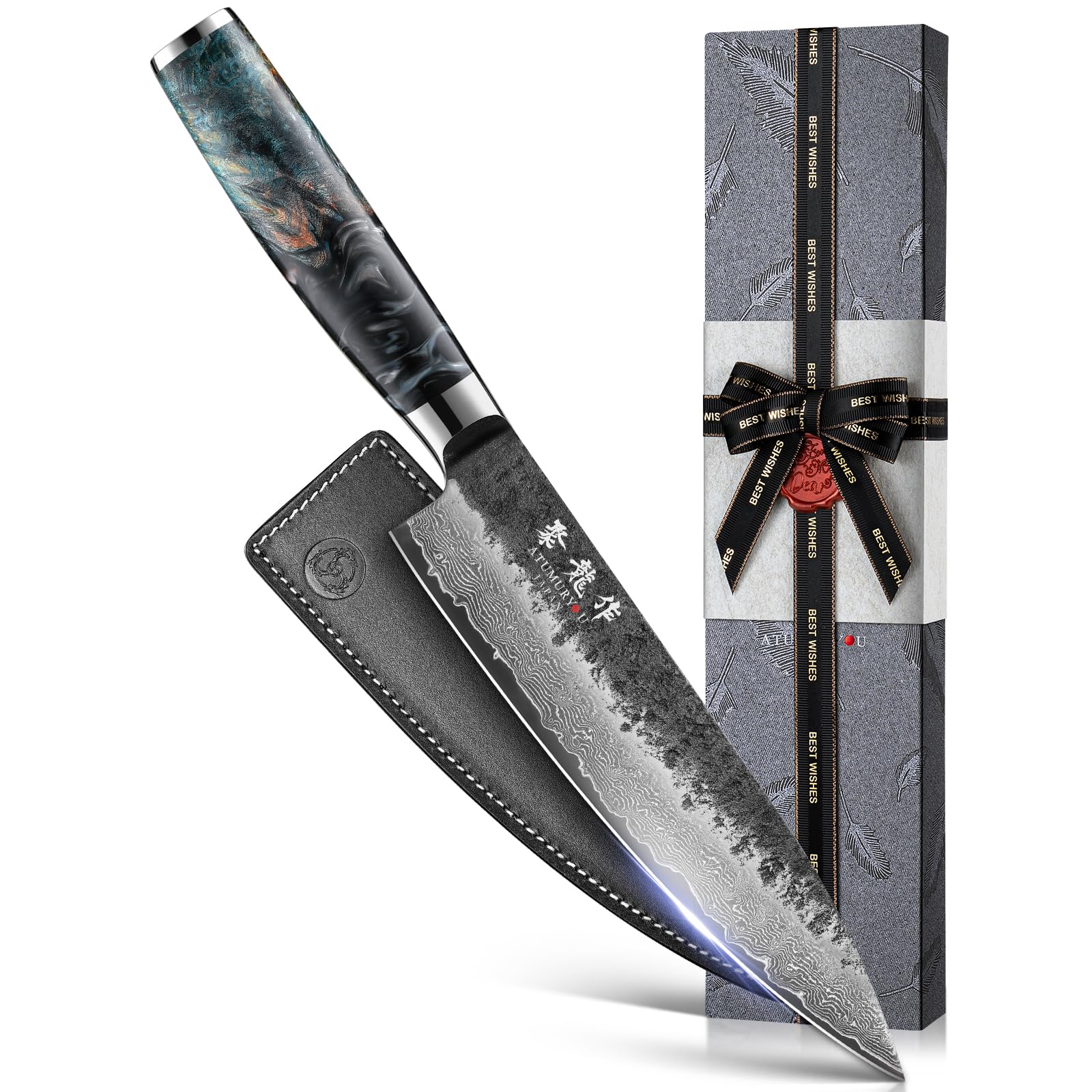
Atumuryou JPCK delivers a VG10 Damascus chef knife with a Rockwell hardness of 62 HRC — one of the hardest edges at this level. The 67-layer construction (33 layers on each side sandwiching a VG10 core) creates a striking Damascus pattern that is not just for looks; the alternating layers improve edge stability and corrosion resistance. The black-forged finish gives the blade a sophisticated, non-reflective surface that reduces glare during precision work.
The handle is a blend of stabilized wood and resin, resulting in a dense, moisture-resistant grip that will not warp or crack over time. A full tang runs through the handle for perfect balance, and the included genuine leather sheath adds a touch of class while protecting the blade. The packaging — a black gift box with feather patterns and a golden butterfly knot — elevates the unboxing experience significantly.
Users report that the blade retains its factory sharpness through weeks of regular use with only occasional stropping. The 62 HRC hardness means it will hold an edge longer than many competitors, but it also requires a diamond or ceramic sharpener when it eventually dulls — standard honing rods may not be sufficient. For the price, the materials and fit-and-finish are remarkable.
Why it’s great
- 62 HRC VG10 core offers exceptional edge retention and long intervals between sharpening
- Genuine leather sheath and premium gift box packaging add significant value
- Stabilized wood/resin handle is dense, comfortable, and moisture-resistant
Good to know
- At 62 HRC, the edge is hard but can chip if used on bones or frozen foods
- Requires diamond or ceramic sharpening stones — standard steel rods will not effectively sharpen it
5. WÜSTHOF Gourmet 8″ Chef’s Knife

The WÜSTHOF Gourmet series represents the German brand’s precision-stamped line, offering many of the same design principles as its forged Classic line at a lower investment. The blade is laser-cut from high-carbon stainless steel and precision-honed to a 20-degree edge — slightly more obtuse than Japanese knives, which makes it more resistant to chipping during heavy tasks like breaking down butternut squash or slicing through thick-skinned melons.
The synthetic polypropylene (POM) handle is ergonomically shaped and textured for a secure grip even when wet. It is fully heat- and impact-resistant, and unlike many synthetic handles, it resists fading and discoloration over time. The blade is stamped, not forged, making it lighter (just 6.56 ounces) — an advantage for cooks who prefer agility over heft. A full tang and triple-rivet construction ensure the handle stays permanently attached.
WÜSTHOF’s reputation for consistency and quality control means every Gourmet knife has a precisely ground edge and uniform blade geometry. The 20-degree edge is easy to maintain with a standard honing steel, and the steel composition resists staining and pitting with proper care. For home cooks who occasionally cut through cartilage or hard squash, this German design offers a margin of forgiveness that a thinner Japanese edge cannot.
Why it’s great
- 20-degree edge angle provides excellent durability for heavy-duty cutting tasks
- Lightweight design (6.56 oz) reduces wrist strain during extended use
- Polypropylene handle is impervious to heat, impact, and kitchen oils
Good to know
- Stamped blade is lighter than forged alternatives — some cooks prefer the heft of a forged knife
- Not dishwasher safe despite being a synthetic handle material
6. Victorinox Fibrox Pro 8″ Chef’s Knife
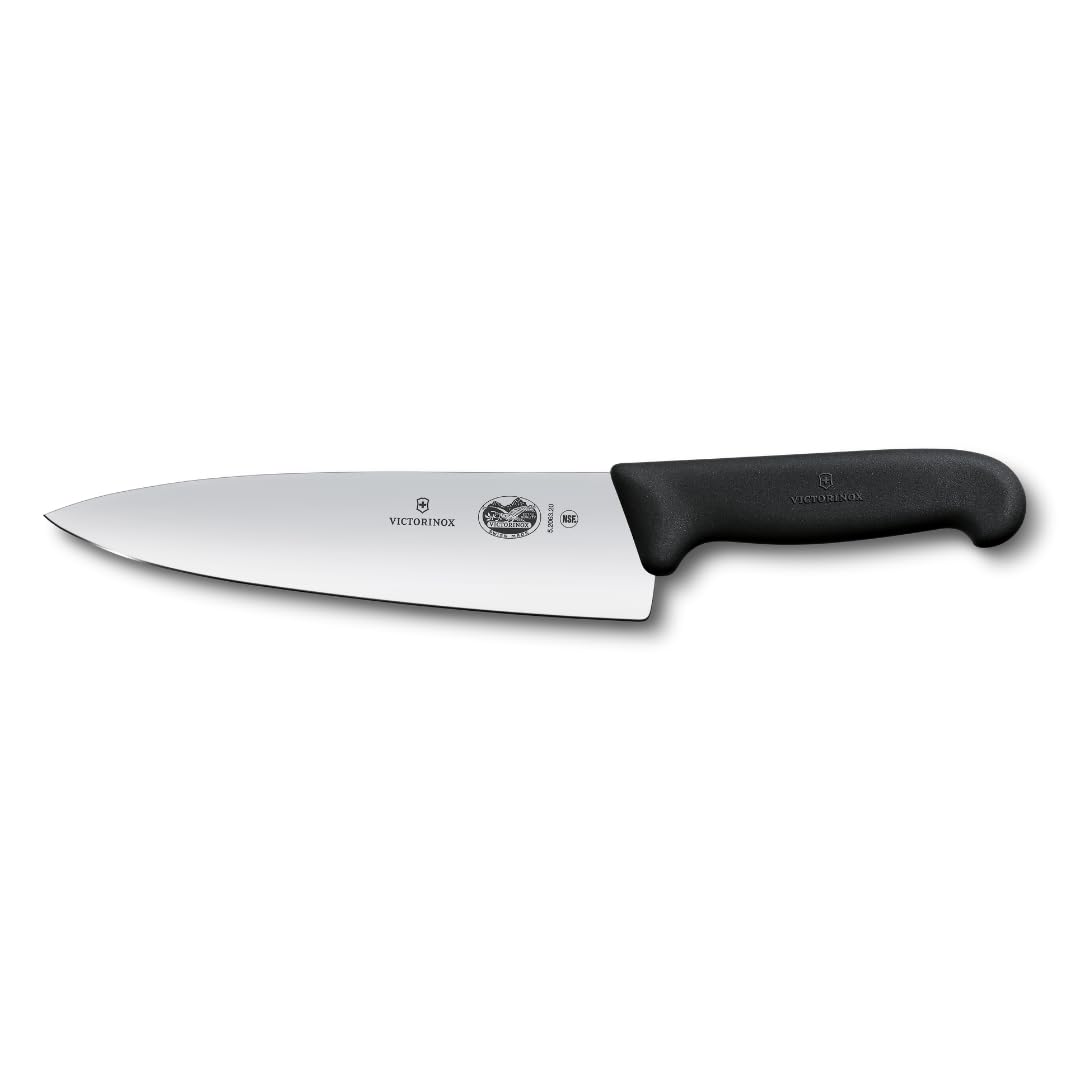
The Victorinox Fibrox Pro is the most recommended budget chef knife for one simple reason: it consistently outperforms knives costing several times as much. The 8-inch blade is stamped from high-carbon stainless steel with a tapered edge that is laser-tested for consistency. It arrives sharp enough to slice tomatoes to paper-thinness and can be maintained with a few passes on a honing steel.
The Fibrox handle is made from thermoplastic elastomer (TPE), a material that provides a non-slip grip even with wet, oily hands — a feature that professional kitchens value highly. The handle is ergonomically shaped with a slight curve that fits the palm naturally. Unlike most chef knives, this one is certified dishwasher safe, though hand washing will extend its life. The blade is lightweight and nimble, making it ideal for cooks who prioritize speed and maneuverability.
This knife has been a staple in culinary schools and commercial kitchens for decades because it delivers reliable performance at a price that makes replacing it painless. The edge angle is around 20 degrees, which provides a good balance of sharpness and durability. If you are buying your first serious chef knife or outfitting a vacation kitchen, the Fibrox Pro is the pragmatic choice that will not let you down.
Why it’s great
- Exceptionally affordable with performance that rivals mid-range forged knives
- TPE handle offers best-in-class non-slip grip when wet or oily
- Dishwasher safe for effortless cleaning (though hand washing is recommended)
Good to know
- Stamped blade lacks the heft and balance of forged knives — some users find it too light
- The Fibrox handle texture can feel slightly rubbery to some users
7. SCOLE 7-Piece Kitchen Knife Set

The SCOLE 7-piece set offers a complete knife collection at a price that undercuts most single premium knives. The set includes an 8-inch chef knife, 8-inch slicing knife, 8-inch bread knife, 5-inch santoku, 5.5-inch serrated utility knife, 5-inch utility knife, and a 3.5-inch paring knife — covering virtually every cutting task a home kitchen demands. The blades are forged from German 1.4116 high-carbon stainless steel with a Rockwell hardness of 58±2, hand-polished to a 14-degree edge per side.
Each knife features a full-tang construction with an ABS handle triple-riveted for durability. The handles are ergonomically designed to reduce hand fatigue during extended prep sessions. The set comes in a gift-box presentation, making it a strong option for new homeowners or as a wedding gift. All knives are dishwasher safe, though hand washing will preserve the edge longer.
Users consistently note that the knives arrive sharp out of the box and maintain their edge well with basic honing. The set’s value proposition is clear: instead of buying one premium chef knife, you get a full range of specialized blades. The bread knife’s serrated edge and the slicing knife’s granton edge are genuine additions, not filler pieces. For cooks building their first real knife collection, this set provides a solid foundation.
Why it’s great
- Seven knives cover every kitchen task from bread to paring to slicing
- Forged full-tang construction with German 1.4116 steel at a competitive price
- Includes specialized knives (bread, slicing, santoku) that are genuinely useful
Good to know
- Individual knife quality does not match a single premium chef knife at the same total investment
- ABS handles, while durable, lack the warmth and feel of natural wood or premium synthetics
8. Kimura Gyuto 8″ Chef Knife

The Kimura Gyuto is manufactured in Seki, Japan — a city renowned for its centuries-old sword-making tradition. The blade is crafted from high-carbon chrome molybdenum stainless steel, heat-treated to 57 HRC, and hand-sharpened to a 15-degree angle by skilled Kimura craftsmen. The steel composition offers a balanced mix of edge retention and corrosion resistance, making it suitable for cooks who want a Japanese-style knife without the extreme hardness of VG10.
The handle is made from POM resin with a full bolster and triple-riveted full-tang construction. The POM material is non-slip and easy to grip, providing comfort for both pinch-grip and pointed-finger techniques. The Gyuto profile — the Japanese equivalent of a Western chef knife — features a slight curve along the belly that facilitates a smooth rocking motion for chopping herbs and mincing garlic.
This knife arrives in a premium gift box with traditional Japanese Kanji design. The lifetime warranty from Kimura adds peace of mind for buyers concerned about durability. At 57 HRC, the edge is hard enough for excellent sharpness but soft enough to be easily touched up with a ceramic honing rod or fine whetstone. For home cooks wanting authentic Japanese craftsmanship without the premium price, the Kimura Gyuto is a solid entry point.
Why it’s great
- Made in Seki, Japan, with genuine regional sword-making heritage
- 57 HRC offers a forgiving hardness suitable for easy maintenance with standard tools
- POM resin handle provides excellent grip and requires zero maintenance
Good to know
- Stamped blade construction rather than forged, which affects overall weight distribution
- At 57 HRC, edge retention is adequate but not exceptional compared to high-hardness alternatives
9. SYOKAMI 8.2″ Kiritsuke Chef Knife
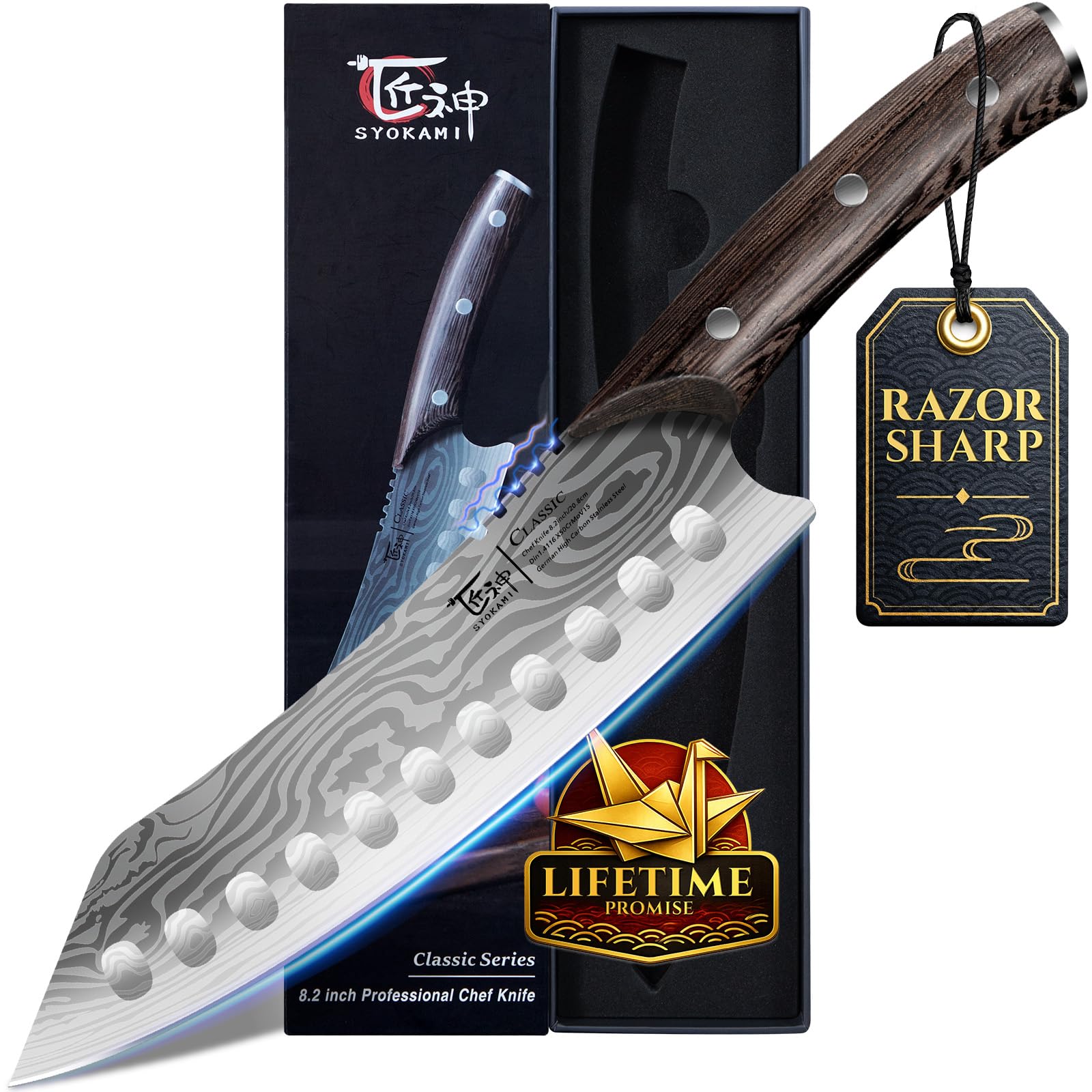
The SYOKAMI Kiritsuke brings a flat-ground Japanese profile to a price point usually reserved for basic stamped blades. The 8.2-inch blade is made from high-carbon German steel with a Rockwell hardness rating of 56+ HRC and a hand-polished edge at 14-16 degrees per side. The Kiritsuke shape — a flat edge with a sharp angled tip — is designed for precise push-cutting and detail work, making it particularly effective for fine vegetable julienne and aquatic finishing.
The handle is crafted from FSC-certified wenge wood, a dense African hardwood known for its striking dark grain and natural water resistance. A guarded grip design prevents the hand from sliding onto the blade, and the full-tang construction with triple rivets ensures structural integrity. The handle’s surface incorporates gear-tooth texturing that improves grip security when your hands are wet — a thoughtful detail for busy kitchens.
Customers consistently remark that this knife performs well above its budget-tier price, with many comparing it favorably to far more expensive German brands. The 60-degree sharp tip is designed to generate localized pressure that separates muscle fibers cleanly rather than tearing them. The wenge handle requires occasional oiling and should never be soaked, but with basic care, this knife can serve as a reliable secondary blade or a first step into Japanese-style cutting.
Why it’s great
- Budget-friendly entry to a traditional Kiritsuke profile with a full-tang forged blade
- FSC-certified wenge wood handle provides natural grip and unique aesthetics
- Guarded grip design adds a safety layer not common at this price
Good to know
- Wenge wood handle requires periodic oiling and cannot be submerged or dishwashed
- At 56+ HRC, edge retention is serviceable but will require more frequent honing than premium steels
FAQ
What does full tang mean and why does it matter for a chef knife?
Can I use a Japanese VG10 chef knife to cut through chicken bones?
How often should I sharpen my home chef knife?
What is the difference between a Gyuto and a Kiritsuke chef knife?
Final Thoughts: The Verdict
For most users, the best home chef knife winner is the KYOKU Shogun Series 8″ Chef Knife because it delivers VG10 Damascus performance at a mid-range price, with a G10 handle that outlasts natural wood. If you want a proven German workhorse with a slightly heavier edge for tougher ingredients, the WÜSTHOF Gourmet 8″ is the reliable choice. And for the budget-conscious cook who refuses to compromise on sharpness, nothing beats the value of the Victorinox Fibrox Pro — the knife that professional kitchens have trusted for decades.