A hand-forged kitchen knife isn’t just a tool; it’s a precision instrument shaped by heat, hammer, and the steady hand of a craftsman. The difference between a stamped blade and a forged one reveals itself the first time you slice through a ripe tomato or break down a chicken — the balance, the edge retention, and the sheer authority of the cut are unmistakable.
I’m Mohammad Maruf — the founder and writer behind AirfryerBite. I’ve spent years analyzing metallurgy reports, blade geometry, and heat-treatment processes to separate the real hand-forged knives from the impostors that merely look the part.
After evaluating dozens of options across steel types, layer counts, and handle materials, I’ve narrowed the field to the models that truly deliver on their forging claims. This guide focuses on the hand forged kitchen knives that earn their place through measurable craftsmanship and real-world performance.
How To Choose The Best Hand Forged Kitchen Knives
Not every knife sold as “forged” has seen a hammer or an open flame. The real ones carry telltale signs — a visible tang, a distinct spine taper, and edge geometry that can only come from manual grinding. Here’s what separates the authentic forged blade from the marketing copy.
Steel Core and Hardness Rating
The steel composition dictates how long the edge stays sharp and how easily it can be restored. VG10, SG2 powder steel, and 9CR18MOV are common high-carbon alloys in this category. Look for a Rockwell hardness of 58 HRC or higher for a blade that resists dulling during heavy prep. A rating above 62 HRC, as seen in premium VG10 Damascus cores, delivers exceptional edge retention but requires a diamond stone for sharpening.
Damascus Layer Count and Construction
True Damascus steel involves folding and forge-welding multiple layers of carbon steel to create a pattern that is structural, not cosmetic. A 67-layer blade uses 33 layers on each side sandwiching a VG10 core, providing both toughness and corrosion resistance. Laser-etched patterns on budget blades mimic this look but offer none of the mechanical benefits. Always verify that the pattern runs through the entire blade thickness, not just the surface.
Handle Material and Tang Design
A full-tang blade — where the steel extends through the entire handle — is the hallmark of a serious forged knife. Stabilized wood, resin-infused maple, and micarta offer moisture resistance and a secure grip even with wet hands. Octagonal or D-shaped profiles reduce wrist fatigue during extended use, while brass or stainless steel bolsters add counterbalance at the choil. Avoid hollow handles or partial tangs in this price tier; they compromise the knife’s leverage and durability.
Quick Comparison
On smaller screens, swipe sideways to see the full table.
| Model | Category | Best For | Key Spec | Amazon |
|---|---|---|---|---|
| SHAN ZU Chef Knife | Premium | Edge retention and collectible quality | SG2 Powder Steel at 64 HRC | Amazon |
| Tenkumun Gyutou Pro | Premium | Traditional hand-forging with VG-10 MAX | 67-layer Damascus, VG-10 MAX core | Amazon |
| MITSUMOTO SAKARI 4-Piece Set | Premium | Complete set with rosewood handles | 9CR18MOV steel, 58±2 HRC | Amazon |
| Dalstrong Valhalla Chef Knife | Premium | Unique celestial resin handle and 8–12° edge | 9CR18MOV steel, 60+ HRC | Amazon |
| KAWAHIRO Gyuto Knife | Mid-Range | Artisan handle and black forged finish | VG10 core, 3-layer composite | Amazon |
| MITSUMOTO SAKARI Kiritsuke | Mid-Range | Japanese hand-forged with sandalwood case | 440C Damascus, 7-layer | Amazon |
| Atumuryou JPCK Chef Knife | Mid-Range | Authentic 67-layer VG10 with leather sheath | VG10 core, 62 HRC | Amazon |
| Dalstrong Gladiator Santoku | Mid-Range | Compact 5-inch Santoku with G10 handle | German HC steel, 56+ HRC | Amazon |
| SYOKAMI 7-Piece Set | Budget | Full set with foldable acacia wood block | HC stainless steel, 56+ HRC | Amazon |
In‑Depth Reviews
1. SHAN ZU Damascus Chef Knife
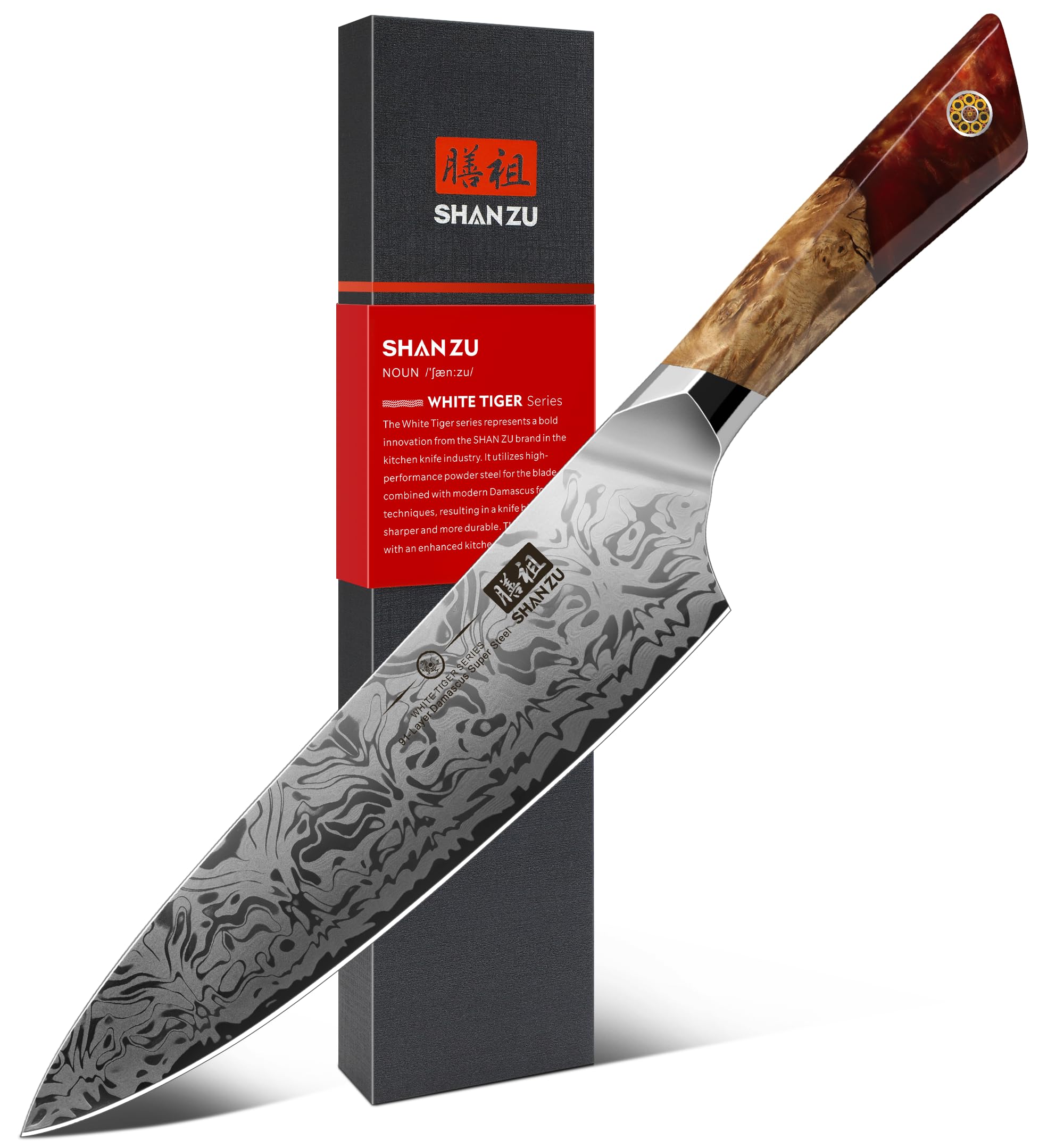
The SHAN ZU earns the top spot because it hits a rare sweet spot — genuine 91-layer Damascus forging with a Japanese SG2 powder steel core that reaches 64 HRC. That hardness level puts this blade in the same conversation as custom knives costing twice as much. The 12-degree cutting angle allows it to glide through dense squash and paper-thin raw fish with equal ease, and professional users who tested it in 10-hour commercial shifts confirm the edge retention is exceptional. The natural maple handle, fused with resin and eco-friendly pigments, offers a grip that improves with moisture rather than becoming slippery.
Unlike many Damascus knives that only etch a pattern onto a monosteel blade, SHAN ZU employs the real forging process — layering carbon steel sheets, applying excessive heat, and folding the stack until the pattern becomes structural. This 91-layer build improves rust resistance and toughness significantly over single-alloy blades. The 5-year warranty provides peace of mind that the brand stands behind the forging process.
One practical note: the knife does not include a sheath or blade guard, so you will need to purchase one separately if you plan to store it in a drawer. The handle aesthetics are striking, but some users may prefer a more traditional octagonal shape over the contoured maple profile. For the combination of steel pedigree, layer count, and hardness, this remains the most technically impressive option in the entire lineup.
Why it’s great
- SG2 powder steel core at 64 HRC outperforms most VG10 and German steel blades
- 91-layer genuine Damascus improves fatigue resistance and edge stability
- Natural maple resin handle provides durable, moisture-resistant grip
Good to know
- No sheath included; a separate blade guard is recommended for drawer storage
- High hardness means you need diamond stones for sharpening, not standard whetstones
2. Tenkumun Japanese Gyutou Pro

The Tenkumun Gyutou Pro is a testament to traditional Japanese hand-forging where the blade is subjected to extreme temperature quenching exceeding 1000 degrees centigrade and hammered over 1000 times. This process creates a 67-layer Damascus structure with a VG-10 MAX core that balances hardness with enough toughness to resist chipping during heavy prep. The elongated taper of the blade gradually thins toward the edge, maximizing cutting efficiency while maintaining a robust spine for knuckle clearance.
Each knife leaves the grinding process with unique marks from the artisan’s hand, meaning no two blades are identical. The 0-degree razor-sharp edge, achieved through traditional hand grinding, allows the knife to bite into ingredients immediately without wedging. The red wood handle option provides a comfortable, secure grip, though the octagonal profile may take some adjustment if you are accustomed to Western-style contoured handles.
The knife comes well-balanced right out of the box, with the weight centered exactly at the pinch grip. Users transitioning from German-style blades will notice the lighter overall weight and the more acute edge angle, which rewards precise technique. The included documentation and certification of authenticity are a nice touch for those who value provenance in their kitchen tools.
Why it’s great
- Authentic 1000-plus hammer forging with VG-10 MAX core for superior edge retention
- Unique hand-ground finish ensures no two knives look identical
- Elongated taper reduces slicing resistance through dense ingredients
Good to know
- Octagonal handle profile may feel unfamiliar to Western cooks initially
- High hardness requires careful cutting technique to avoid micro-chipping on bones
3. MITSUMOTO SAKARI Chef’s Knife Set 4 Pcs

For cooks who want a complete forged knife arsenal rather than a single blade, the MITSUMOTO SAKARI 4-piece set delivers real value. Each knife is hand-forged using traditional Japanese methods over a 45-day process, with a 3-layer construction built around a 9CR18MOV high-carbon steel core. The hardness rating of 58±2 HRC offers a practical sweet spot — the edge stays sharp through a full week of dinner prep but remains easy to touch up on a standard whetstone without specialized diamond abrasives.
The 2.5mm ultra-thin blade profile allows the knife to pass through fruits and vegetables cleanly, preserving their structural integrity for precise cuts. The rosewood octagonal handles come from Southeast Asian summer sourwood and are designed to minimize wrist tension by offering multiple grip positions. The sandalwood presentation box and included knife blade oil make this set feel substantially more premium than its position in the market suggests.
Experienced chefs who tested this set noted that the balance favors the blade slightly, which provides good cutting momentum once you adjust your pinch grip. The set includes a gyuto chef knife, a utility knife, and additional blades that cover most daily tasks from slicing proteins to mincing herbs. The 30-year cooking veteran who reviewed this set called it the best they had ever used, which is high praise from someone familiar with both German and Japanese traditions.
Why it’s great
- Complete 4-piece set with sandalwood case and blade oil for long-term care
- Rosewood octagonal handles reduce wrist fatigue during extended prep sessions
- 9CR18MOV steel at 58 HRC balances edge retention with easy sharpening
Good to know
- Blade-forward balance may feel unfamiliar to those used to handle-heavy German knives
- High-carbon steel is not stainless; requires immediate drying after hand washing
4. Dalstrong Valhalla Chef Knife
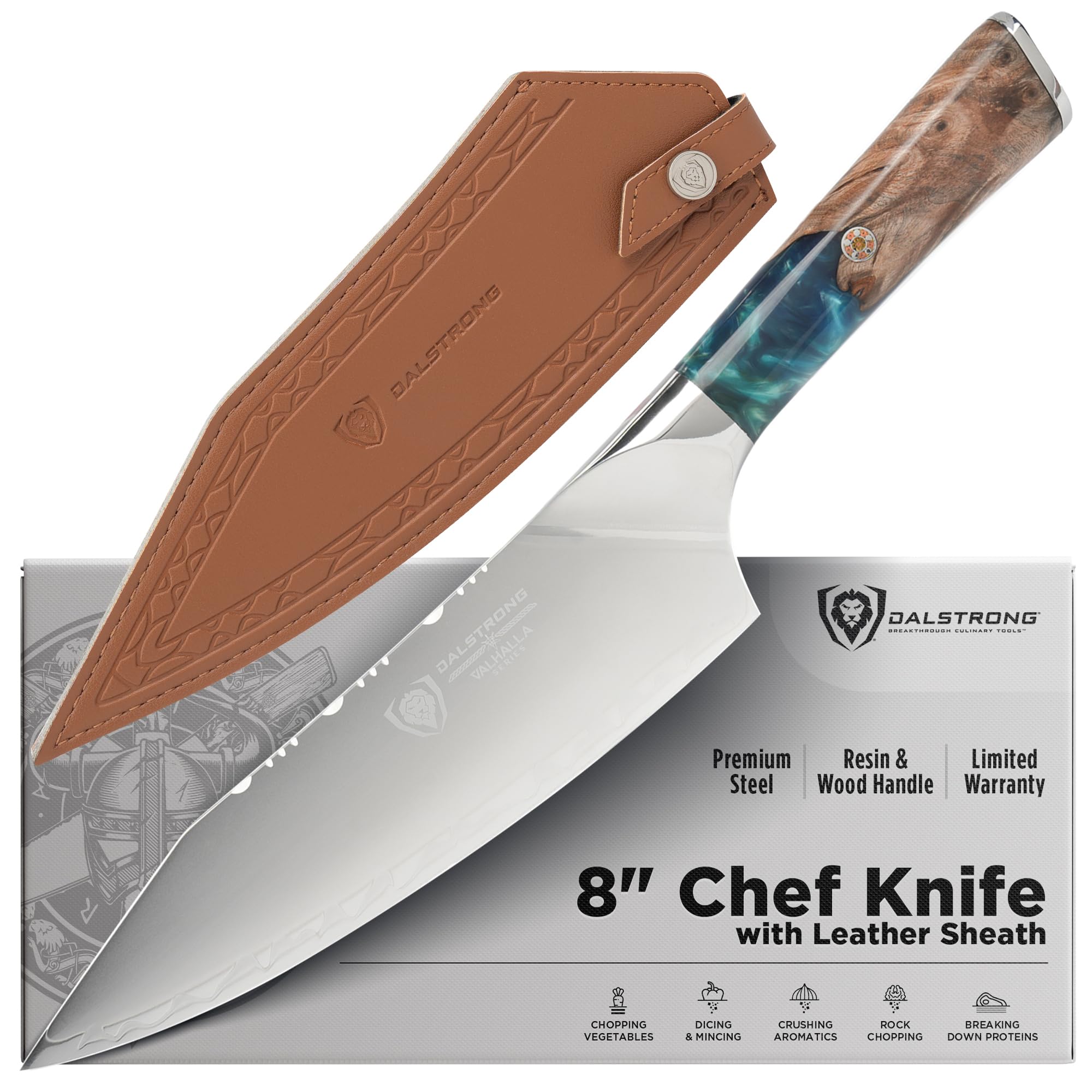
Dalstrong’s Valhalla series is where steel performance meets artistic handle design. The 8-inch blade uses 9CR18MOV stainless steel forged to 60+ HRC and enhanced with Dalstrong’s proprietary Lionshield heat and cold treatment. The hand-sharpened edge lands at an aggressive 8 to 12 degrees per side, making it one of the sharper factory edges in this lineup. The celestial resin and stabilized wood handle is individually cast, so every knife carries a unique pattern that ranges from deep blue swirls to earthy mineral tones.
The Norse-inspired design extends to the stainless steel bolster, which provides a rock-solid balance point at the heel. During testing, the knife handled a full Sunday prep session — three pounds of onions, a flat of tomatoes, and a full chicken breakdown — without needing to hit the steel once. The included Valhalla-embossed leather sheath is a functional addition that protects the edge during drawer storage and makes the knife feel complete out of the box.
The handle shape is contoured and may feel full in smaller hands, but the bolster placement allows for a comfortable pinch grip that keeps your fingers clear of the blade path. Dalstrong’s lifetime warranty and US-based customer support add a layer of confidence that is rare at this price tier. The only real caveat is that the resin handle can show fingerprints and smudges more readily than solid wood or micarta options.
Why it’s great
- Individually cast celestial resin handle makes each knife visually unique
- Lionshield heat treatment pushes 9CR18MOV steel to 60+ HRC for long edge life
- Hand-sharpened 8–12° edge cuts with minimal resistance through dense produce
Good to know
- Contoured handle may feel large for users with smaller hands
- Resin handle surface shows fingerprints and smudges easily
5. KAWAHIRO Japanese Gyuto Knife
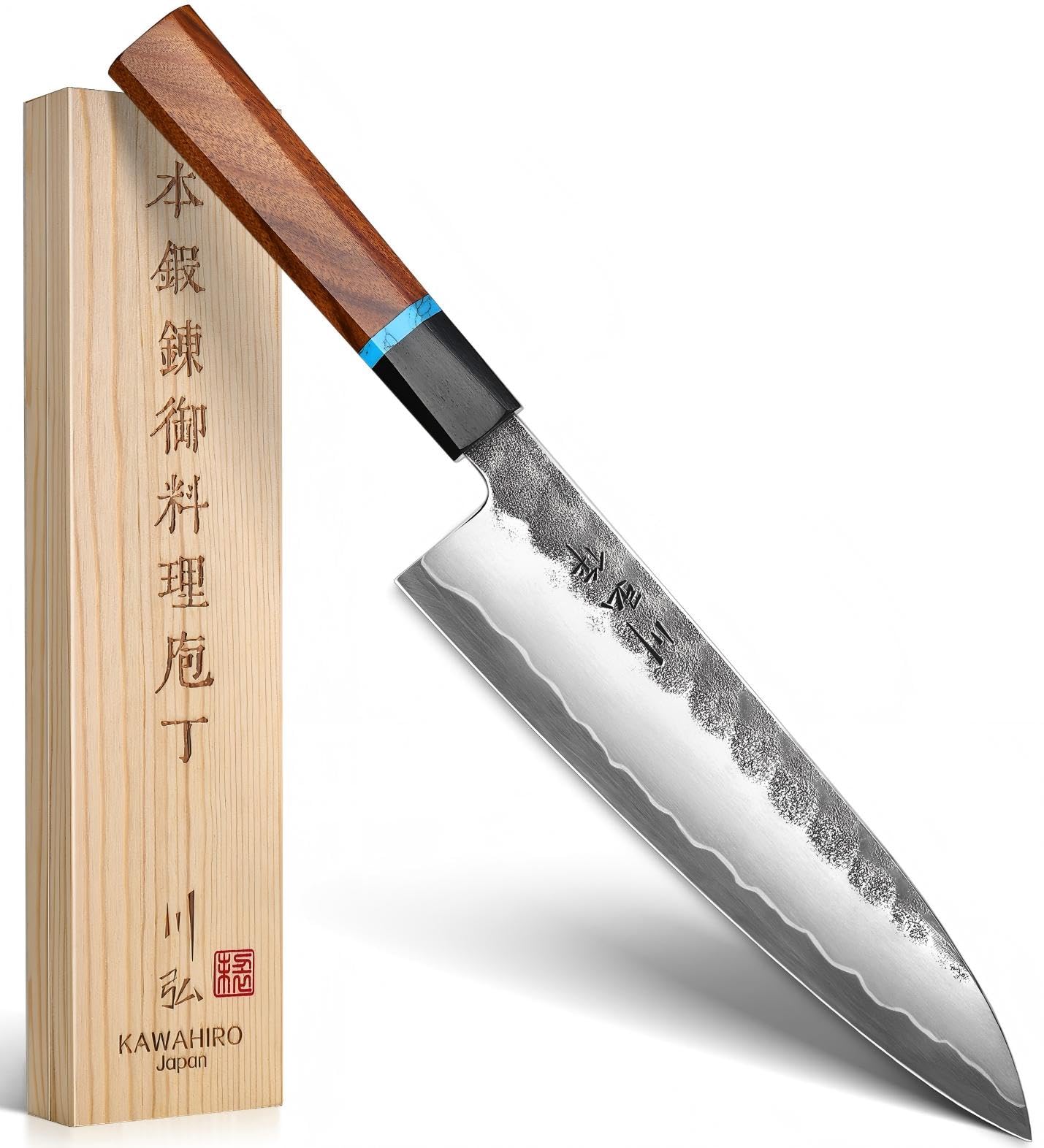
The KAWAHIRO Gyuto is built for cooks who appreciate a multi-material handle as much as the blade. The handle is composed of premium ruby wood, turquoise, and ebony — a combination that produces a rich, layered aesthetic while providing excellent grip stability. The blade uses a 3-layer composite with a Japanese VG10 stainless steel core clad between softer stainless steel layers, giving you the hardness of the VG10 edge with the toughness and corrosion resistance of the outer cladding. The black forged finish adds a non-reflective surface that eliminates glare during precise work.
At 8.24 inches, the blade offers a touch more length than a standard 8-inch chef knife, which is noticeable when slicing large proteins or melons. The ergonomic handle contours naturally to the hand, and the balance point sits comfortably at the pinch grip area. The included premium wooden case and certificate of authenticity make this a strong gift option for someone who values both performance and presentation.
The knife arrives exceptionally sharp out of the box, with a factory edge that glides through bell peppers and raw meat without tearing. During extended prep sessions, the handle materials absorb some moisture without becoming slippery, thanks to the porosity of the stabilized wood components. The primary consideration is maintenance — the black forged finish requires gentle hand washing with mild soap to preserve its appearance over time.
Why it’s great
- Ruby wood, turquoise, and ebony handle provides exceptional grip and visual appeal
- 3-layer composite with VG10 core delivers hardness and corrosion resistance
- Black forged finish reduces reflection and glare during precision slicing
Good to know
- Black forged finish may show scratches over time if not handled carefully
- Multi-material handle requires gentle cleaning to prevent component separation
6. MITSUMOTO SAKARI Kiritsuke Knife

The MITSUMOTO SAKARI Kiritsuke stands out for its collaboration with a Japanese manga artist on the handle design, resulting in the “Sky Feather Dazzle” finish that brings vibrant patterns to the shadow wood pomegranate handle. The blade itself is forged from 7 layers of 440C Damascus steel using traditional Japanese hand-forging and vacuum deep cooling treatment. The 13-degree edge curvature is optimized for the signature flat profile of a Kiritsuke, which excels at push-cutting vegetables and making clean slices through proteins.
The blade arrives with the signature flat tip that distinguishes a Kiritsuke from a standard gyuto or chef knife — this flat profile allows for precise decorative cuts and scooping chopped ingredients. The sandalwood case provides a storage solution that also functions as a display piece. Professional chefs who tested this knife noted that it is slightly blade-heavy, which can take some adjustment if you are coming from a balanced Western chef knife, but once adapted, the forward weight adds momentum to slicing motions.
The 440C steel holds an edge well for its hardness range and responds predictably to honing rods between sharpenings. The knife performed admirably during a busy restaurant service, with one sous chef noting that after dropping the knife, only the very tip suffered minor damage, which speaks to the toughness of the 7-layer construction. The steel handle is durable but can feel cold in the hand during extended use in air-conditioned kitchens.
Why it’s great
- Unique manga artist collaboration handle patterns make each knife distinctive
- Sandalwood case provides premium storage and display functionality
- Kiritsuke flat tip design ideal for decorative cuts and ingredient scooping
Good to know
- Blade-heavy balance may feel unfamiliar to those used to neutral-weight knives
- Steel handle can become cold in cooler kitchen environments
7. Atumuryou JPCK 8-Inch Chef Knife
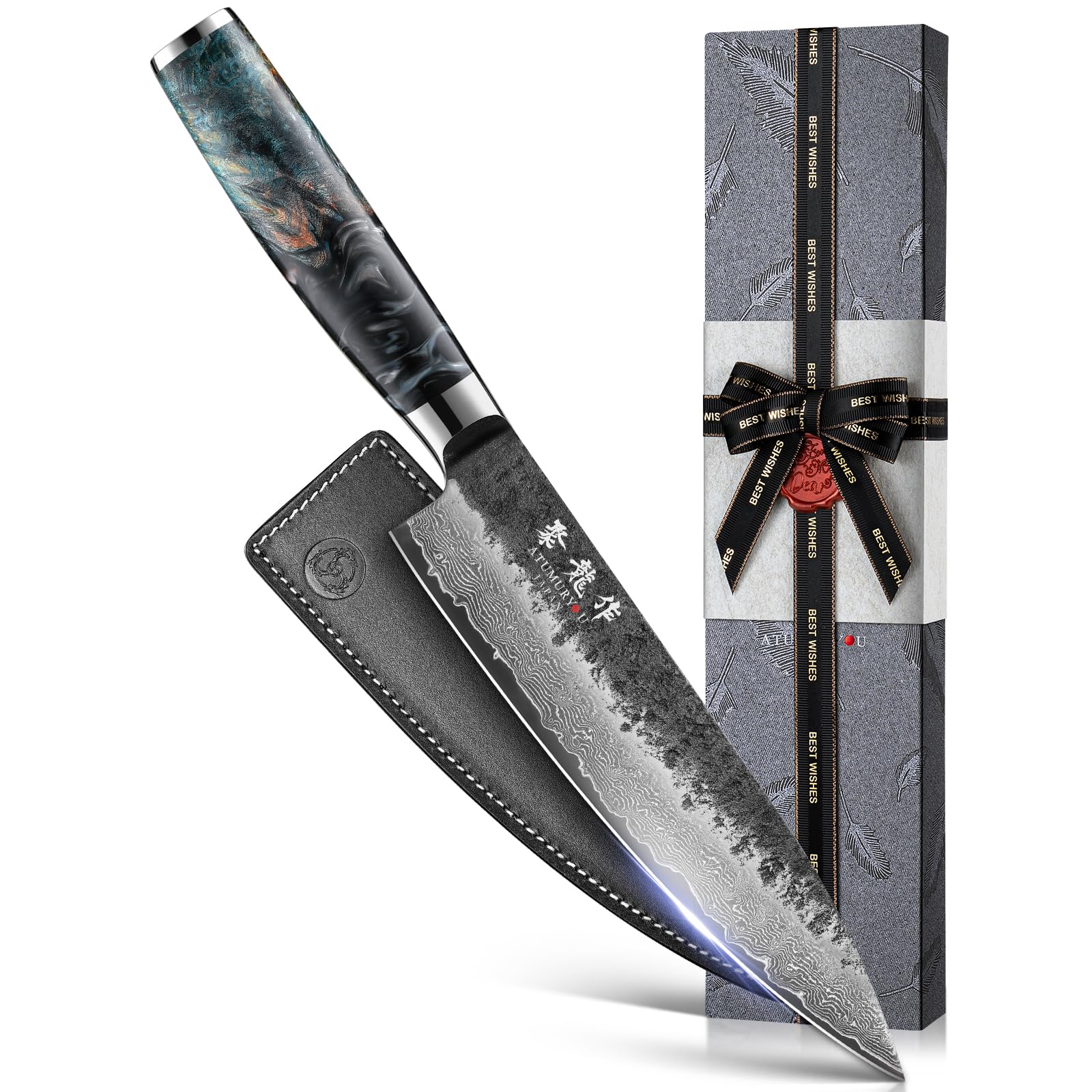
The Atumuryou JPCK Chef Knife represents the purest VG10 Damascus offering in this lineup, with a 67-layer construction that uses 33 layers of Damascus steel on each side sandwiching a single VG10 core layer. The Rockwell hardness of 62 HRC places this blade firmly in the high-end edge retention category while maintaining enough toughness for daily home and professional use. The black forged finish gives the blade a stealthy appearance that contrasts beautifully with the natural stabilized wood and resin handle.
The handle is where this knife shows its character — each handle is unique, combining multicolor resin with stabilized wood in a full-tang design that provides perfect balance. The ergonomic shape ensures fatigue-free comfort even during extended prep sessions, and the full tang offers a smooth, secure grip. The included genuine leather sheath is a practical addition that protects the blade during transport and storage, making this knife suitable for chefs who travel with their tools.
The knife arrives in an exquisite black gift box adorned with elegant feather patterns and a golden butterfly knot, which elevates the unboxing experience significantly. During testing, the 62 HRC edge maintained its sharpness through multiple prep sessions without noticeable degradation. The primary consideration is that the high hardness means you must use a diamond abrasive for sharpening rather than a traditional water stone, and the knife should never be used on hard surfaces like ceramic plates or frozen foods.
Why it’s great
- Genuine 67-layer Damascus with VG10 core at 62 HRC for exceptional edge retention
- Each stabilized wood and resin handle is a unique, non-repeating piece
- Includes leather sheath, certificate of authenticity, and premium gift box
Good to know
- 62 HRC requires diamond sharpening stones; standard whetstones are ineffective
- Black forged finish requires careful hand washing to maintain appearance
8. Dalstrong Gladiator Santoku 5-Inch

The Dalstrong Gladiator Santoku brings NSF certification to a hand-forged blade, which is a meaningful distinction for cooks who work in commercial kitchens or simply want a knife that meets professional sanitation standards. The 5-inch blade uses imported high-carbon German steel with a hand-polished edge at 14-16 degrees per side, and the oval-shaped hollow divots along the blade minimize suction of stuck-on food, allowing for faster and cleaner slicing. The G10 handle material is a glass-fiber reinforced laminate that is resistant to moisture, heat, and impact, making it one of the most durable handle options in this lineup.
At 5 inches, this Santoku is more compact than the standard 7-inch versions, which makes it ideal for cooks with smaller hands or those who prefer a nimble blade for precision vegetable work. The full-tang construction and triple-riveted handle provide a satisfying heft that belies the compact size. The hand-polished satin finish on the blade reduces drag through ingredients and makes cleanup straightforward.
The included blade sheath adds safety for drawer storage, and the knife is backed by Dalstrong’s 100% satisfaction guarantee. Over seventy-five thousand professional chefs and home cooks have purchased from the Gladiator series, which speaks to the consistency of the product. The main trade-off is the lower Rockwell hardness of 56+ HRC compared to the VG10 and SG2 options in this guide, which means the edge will require more frequent honing during heavy use, though it will also be easier to sharpen when needed.
Why it’s great
- NSF certified for commercial kitchen sanitation standards
- G10 handle is highly durable, moisture-resistant, and impact-resistant
- Oval hollow divots reduce food sticking for cleaner slicing
Good to know
- 56+ HRC requires more frequent honing than higher-hardness options
- 5-inch length may feel too small for cooks who prefer a full-sized chef knife
9. SYOKAMI 7-Piece Knife Set
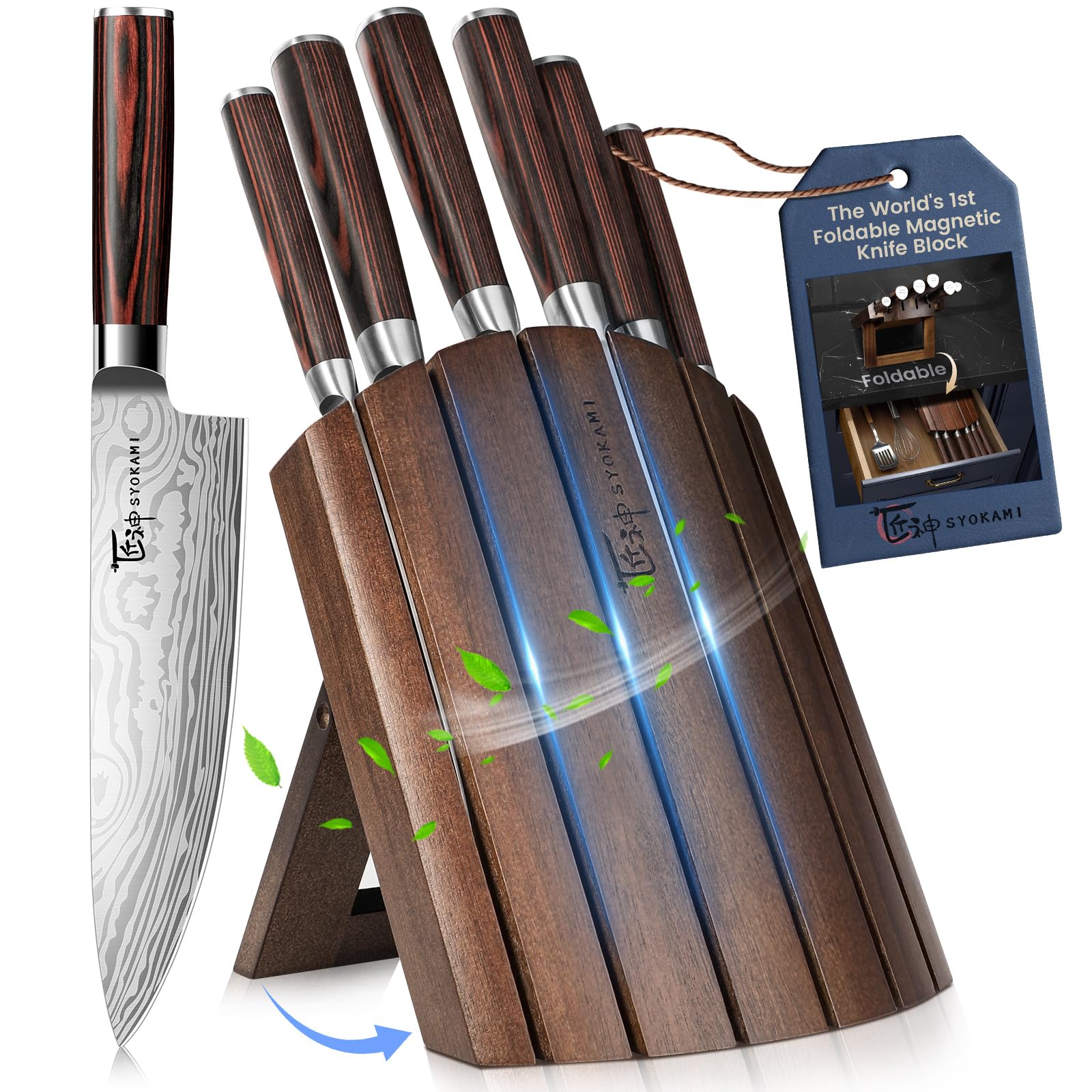
The SYOKAMI 7-Piece Set is the entry-level gateway into hand-forged knives, offering a complete 7-knife collection with a foldable acacia wood magnetic block at a price that undercuts most single premium blades. The knives are made from high-carbon stainless steel with a 56+ Rockwell hardness and a hand-sanded 15-degree edge. The set includes an 8-inch chef’s knife, 7-inch Santoku, 8-inch slicing knife, 8-inch bread knife, 6-inch utility knife, and a 3.8-inch paring knife — covering essentially every task a home cook needs.
The standout feature is the foldable acacia wood block, which can be collapsed flat for drawer storage to keep the knives away from children and pets. When deployed, the block stands securely on the counter with magnetic slots that hold each knife firmly. The acacia wood is FSC-certified and treated for moisture and corrosion resistance. The ergonomic handle design with reserved finger positions makes it easy to pull each knife from its slot without adjusting your grip.
The set arrives in exquisite gift packaging, making it an ideal entry point for someone building their first forged knife collection. Customer reviews consistently praise the razor-sharp factory edge and the beautiful presentation. The primary limitation is the 56+ HRC steel, which will require more frequent sharpening than the higher-end VG10 options, and the magnetic strength in the foldable block could be stronger to prevent the heavier knives from shifting when the block is moved.
Why it’s great
- Complete 7-knife set covers all kitchen tasks from paring to bread slicing
- Foldable acacia wood block provides safe drawer storage away from children
- Hand-sanded 15-degree edge delivers impressive sharpness out of the box
Good to know
- 56+ HRC steel requires more frequent honing and sharpening than premium options
- Magnetic strength in foldable block may not hold heavier knives securely during transport
FAQ
What Rockwell hardness should I look for in a hand forged kitchen knife?
How can I tell if a Damascus pattern is real or laser-etched?
Is a 67-layer Damascus knife better than a 7-layer one?
Why are hand forged knives not dishwasher safe?
What is the difference between VG10 and SG2 powder steel?
Final Thoughts: The Verdict
For most users, the hand forged kitchen knives winner is the SHAN ZU Damascus Chef Knife because its SG2 powder steel core at 64 HRC with genuine 91-layer Damascus construction delivers professional-grade performance that rivals custom blades at a fraction of the cost. If you want a complete set with premium rosewood handles and a sandalwood case, grab the MITSUMOTO SAKARI 4-Piece Set. And for an heirloom-quality single blade with a unique artisan handle and VG-10 MAX core, nothing beats the Tenkumun Gyutou Pro.