A dull knife is the single biggest hindrance to efficient meal prep. When the blade fails to bite and instead crushes herbs, shreds tomatoes, or slips off an onion’s skin, the frustration compounds with every passing minute. The right set of kitchen blades transforms chopping from a chore into a rhythmic, near-effortless process. The market is flooded with look-alikes, but the gap between a blade that performs and one that merely exists is defined by steel composition, edge angle, and handle ergonomics.
I’m Mohammad Maruf — the founder and writer behind AirfryerBite. I have spent years dissecting knife metallurgy, edge retention data, and handle material trade-offs to separate genuine workhorses from marketing-driven duds in the sub- everyday carry segment.
Whether you are upgrading a mismatched drawer full of generic blades or building your first serious set from scratch, identifying the everyday kitchen knives that blend lasting sharpness with balanced weight and a comfortable grip is the only path to consistent cut quality.
How To Choose The Best Everyday Kitchen Knives
An everyday kitchen knife must bridge two competing demands: it must arrive razor-sharp out of the box and hold that edge through weeks of vegetable chopping, protein slicing, and herb mincing without requiring a mid-week steel session. The decision narrows to steel grade, handle architecture, and the blade profile that matches your dominant cutting motion.
Steel Composition and Hardness
High-carbon stainless steel is the baseline for any serious everyday blade. Look for a Rockwell hardness between 56 and 62 HRC. Softer steel (below 56 HRC) is easier to sharpen but loses its edge faster. Harder steel (above 62 HRC) holds an edge longer but becomes brittle and can chip under lateral stress. VG10 and premium German steels sit in the sweet spot of edge retention with enough toughness to survive home-kitchen use.
Blade Geometry and Edge Angle
The edge angle per side dictates how aggressively the knife bites into food. A 12–15 degree edge per side glides through tomatoes and boneless proteins with minimal resistance. Wider angles (17–20 degrees) produce a more durable edge that handles heavy chopping and bone contact but feels less sharp during fine slicing. Everyday knives benefit from a 15-degree angle because it balances slicing ease with edge stability.
Handle and Balance
A full-tang blade — steel running the entire length of the handle — provides the weight distribution necessary for controlled cuts. Look for handles made from Fibrox, Pakkawood, or high-grip synthetics that remain secure when wet. Octagonal or contoured profiles reduce hand fatigue during long prep sessions. A knife that feels handle-heavy will tire your forearm; a blade-heavy knife will steer your cuts unpredictably.
Quick Comparison
On smaller screens, swipe sideways to see the full table.
| Model | Category | Best For | Key Spec | Amazon |
|---|---|---|---|---|
| WÜSTHOF Classic 2-Piece Set | Premium German Forged | Long-term daily use | 58 HRC Precision Edge Technology | Amazon |
| HexClad Chef’s Knife 8-Inch | Damascus Forged | Protein and hard vegetable prep | 67-layer 12-degree edge | Amazon |
| KAWAHIRO Gyuto 8-Inch | VG10 Japanese Forged | Precision vegetable slicing | VG10 core 3-layer construction | Amazon |
| KnifeSaga 14-Piece Set | Japanese High Carbon Set | Complete kitchen upgrade | 10° hand-polished blade edge | Amazon |
| SYOKAMI 7-Piece Set | Japanese Foldable Block | Compact storage / families | 56+ HRC 15-degree edge | Amazon |
| Victorinox Wood 8-Inch Chef | Swiss Classic Rosewood | Lightweight traditional feel | Forged stainless with wood handle | Amazon |
| Victorinox Fibrox Pro 8-Inch | Stamped Swiss Workhorse | Budget-friendly daily driver | TPE non-slip handle, dishwasher safe | Amazon |
| Sunnecko 8-Inch Chef Knife | Japanese-Style Budget | Entry-level sharp edge | 12-15° hand-sharpened edge | Amazon |
| Astercook 14-Piece Set | Full Stainless Block Set | Style-driven full kitchen set | High-carbon full tang blades | Amazon |
In‑Depth Reviews
1. WÜSTHOF Classic 2-Piece Chef’s Knife Set

WÜSTHOF’s Classic series has served as the benchmark for home kitchens for decades, and this two-piece starter set delivers the core pair an everyday cook actually needs: an 8-inch chef’s knife and a 3.5-inch paring knife. Both blades are forged from a single billet of high-carbon stainless steel and tempered to a consistent 58 HRC, then finished with the company’s Precision Edge Technology that yields 20% sharper geometry than previous generations. The full-tang design is secured with three rivets into a synthetic polypropylene handle that resists heat, moisture, and impact without becoming slippery.
The chef’s knife handles 95% of daily prep — onion dice, carrot julienne, chicken breast slice — with a balanced weight that keeps the blade feeding naturally through food. The paring knife tackles coring, peeling, and detail work with equal authority. Both blades arrived shaving-sharp out of the box and maintained usable edges for weeks of continuous use without stropping. The synthetic handle, while less warm than wood, provides consistent grip even when wet and will not warp or crack over time.
The set’s primary limitation is its price point, which reflects German-forged craftsmanship. These knives are listed as dishwasher safe, but hand washing preserves the edge longer and prevents the synthetic handle from exposure to harsh detergents. The polypropylene handle also lacks the artisan feel of wood or the heft of metal handles found in Japanese-forged rivals. For a cook who wants a single purchase that covers the two most important knife roles with lifetime-backed German engineering, this set is the gold standard.
Why it’s great
- Precision Edge Technology delivers a 20% sharper blade with twice the edge retention of older WÜSTHOF models
- Full-tang triple-riveted handle provides exceptional balance during heavy chopping tasks
- Two-piece set covers the essential chef and paring roles without redundant blades
Good to know
- Premium price reflects German forging heritage and Solingen-quality standards
- Synthetic polypropylene handle lacks the tactile warmth of wood or resin handles
- Listed dishwasher safe but hand washing is strongly recommended to protect edge integrity
2. HexClad Chef’s Knife, 8-Inch

HexClad brings its hybrid cookware reputation to cutlery with an 8-inch chef’s knife built from 67 layers of Damascus stainless steel. The blade undergoes a three-step Honbazuke heat treatment that balances hardness and flexibility, yielding a 12-degree cutting edge — among the most aggressive angles in this lineup. The Pakkawood handle is contoured for a natural pinch grip, and the total 12.8-inch length places the balance point just forward of the bolster for controlled rocking motion.
In testing, the HexClad knife glided through sweet potatoes and butternut squash with minimal resistance, and its thin profile allowed paper-thin tomato slices without crushing. The Damascus layering is not purely cosmetic; the alternating steel hardness levels create micro-serrations that help the blade bite into smooth-skinned produce. Edge retention proved strong over a month of daily use, though the thin edge requires a honing rod before heavy prep sessions to maintain peak performance.
The knife is listed as dishwasher safe, but the Pakkawood handle will degrade with repeated exposure to high heat and moisture — hand washing is the only sensible approach. The price sits at the upper end for a single chef’s knife, and the lack of a full set means you will need to buy additional blades separately. For cooks who prioritize edge aggression and aesthetic craftsmanship in their primary cutting tool, this is a strong daily driver.
Why it’s great
- Aggressive 12-degree edge, among the sharpest angles found in production chef knives
- 67-layer Damascus construction provides both visual appeal and micro-serrational cutting assistance
- Pakkawood handle offers comfortable ergonomic contour for extended prep sessions
Good to know
- Thin edge requires regular honing to maintain peak sharpness during heavy use
- Pakkawood handle will degrade in dishwasher despite the product being listed dishwasher safe
- Single knife purchase requires separate investment for additional blade types
3. KAWAHIRO Japanese Chef Knife, 8-Inch VG10 Gyuto
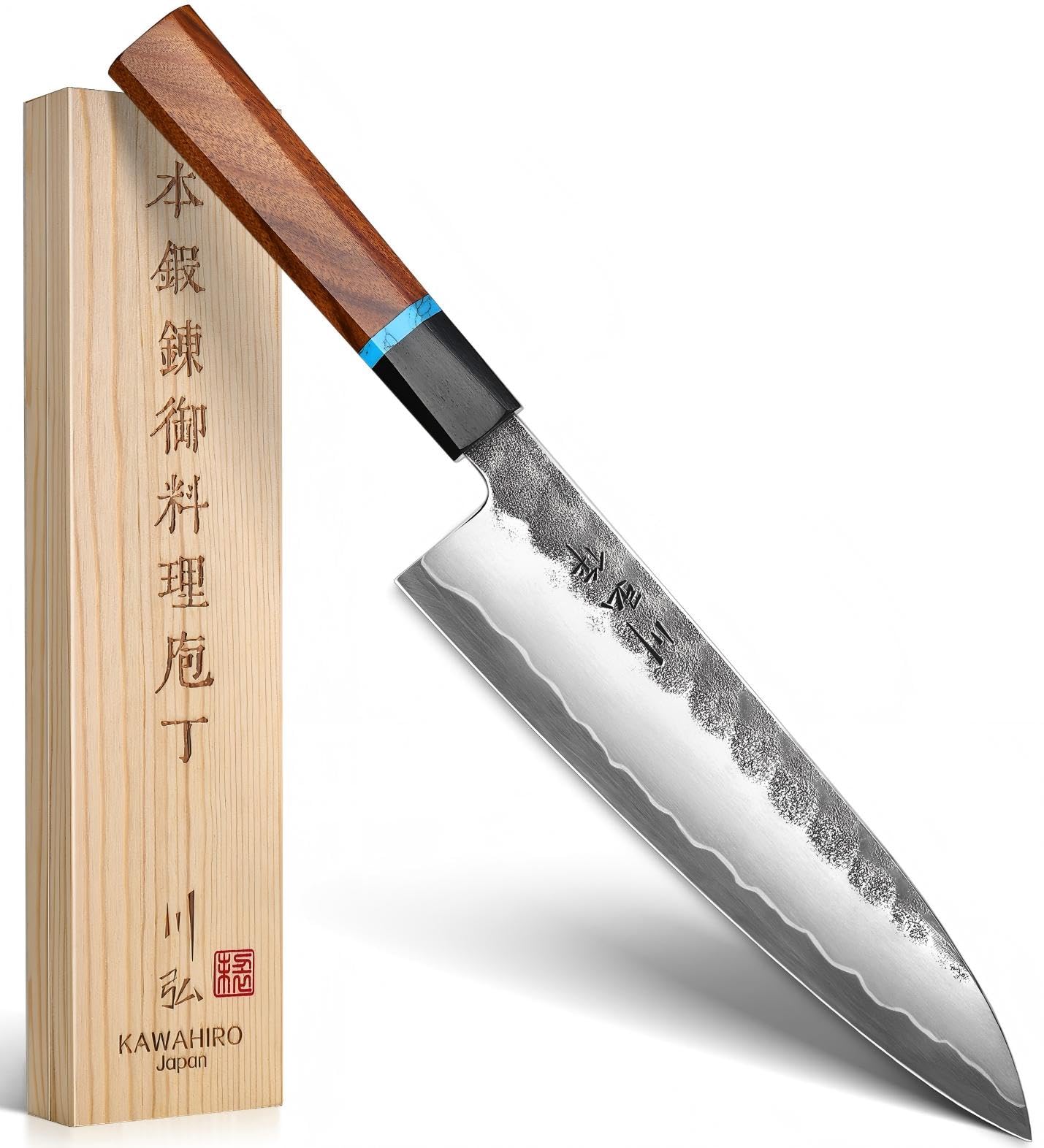
The KAWAHIRO Gyuto exemplifies the Japanese approach to kitchen cutlery: a VG10 stainless steel core clad between two layers of softer stainless steel for a balance of razor-sharp edge retention and impact resistance. The 8.24-inch blade is hand-forged and features a black-forged finish that reduces food drag while presenting a layered pattern unique to each knife. The handle is an octagonal wa-style construction composed of ebony, turquoise, and ruby wood — an unusual combination that provides both visual distinction and a secure, fatigue-reducing grip.
The blade arrives exceptionally sharp, cutting through paper towel rolls and over-ripe tomatoes with zero effort. The VG10 core at approximately 60–61 HRC holds its edge noticeably longer than German stainless steels, which means fewer sharpening sessions over a typical month of home cooking. The thin blade geometry excels at precise vegetable work — fine brunoise, chiffonade, and batonnet cuts — where edge accuracy matters more than raw chopping force. The octagonal handle encourages a pinch grip that transfers control directly to the blade.
This knife is not dishwasher safe, and the layered steel construction requires hand washing and thorough drying to prevent any moisture from seeping between cladding layers. The handle’s mixed wood materials also demand occasional oiling to maintain their luster. The price is comparable to entry-level Japanese blades but notably below artisan makers like Shun or Miyabi, making it a compelling mid-point for cooks who want VG10 performance without the luxury markup.
Why it’s great
- VG10 core delivers exceptional edge retention at 60–61 HRC hardness
- Octagonal wa-handle with mixed exotic woods provides superior grip and reduced fatigue
- Hand-forged black finish reduces food sticking during precision vegetable cuts
Good to know
- Not dishwasher safe — hand wash and dry immediately to protect layered steel
- Mixed wood handle requires periodic oiling to prevent drying and cracking
- Thin blade geometry is not ideal for heavy bone or dense squash chopping
4. KnifeSaga Kitchen Knife Set 14-Piece
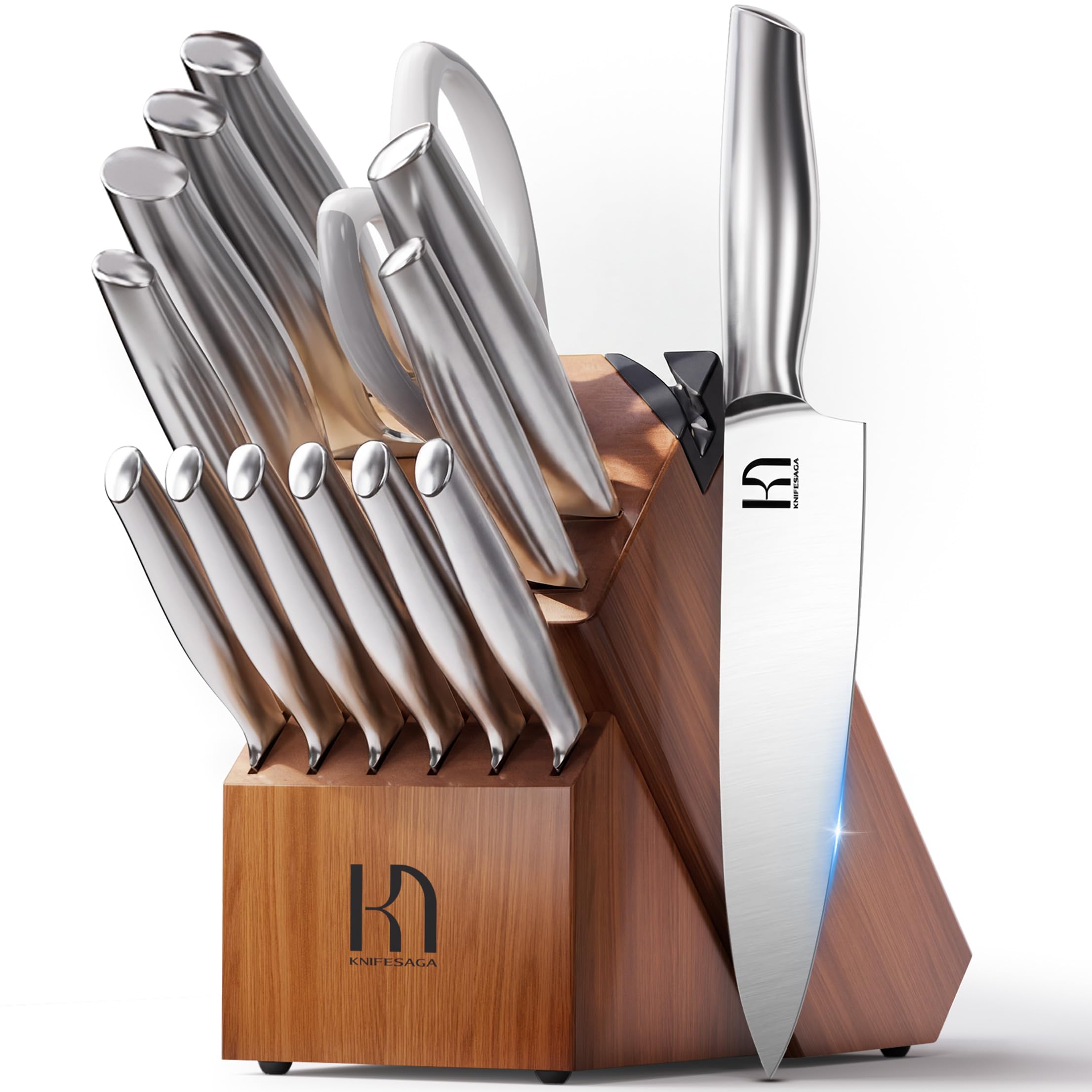
KnifeSaga’s 14-piece set is designed as a comprehensive kitchen solution, including an 8-inch chef, 8-inch bread, 8-inch slicing, 7-inch santoku, 5-inch utility, 3.5-inch paring knife, six 4.5-inch steak knives, kitchen shears, and a built-in sharpener housed in an angled solid acacia wood block. The blades are forged from high-carbon stainless steel and hand-polished to a 10-degree edge per side — among the sharpest factory edges in this comparison. The handles are stainless steel with a textured bolster for secure pinch gripping.
The 10-degree edge makes the chef and santoku knives exceptionally aggressive on soft produce. The stainless steel handles are fully sealed and resist moisture absorption, making them easier to clean than wood-handled alternatives, but they lack the warmth and grip texture of Pakkawood or Fibrox. The built-in sharpener in the block is a practical addition for quick edge touch-ups, though it removes more metal than a honing rod and should be used sparingly. The angled block design reduces the footprint on the counter and includes a non-slip bottom.
Customer feedback consistently praises the sharpness out of the box and the modern appearance of the block. The set is not dishwasher safe, and the fine 10-degree edge will require careful cutting technique to avoid chipping on hard ingredients like nut shells or frozen foods. The inclusion of six steak knives makes this set a strong candidate for households that entertain frequently. The price positions it as a premium set without crossing into luxury-brand territory.
Why it’s great
- 10-degree hand-polished edge delivers unmatched slicing aggression straight from the factory
- 14-piece set covers all essential kitchen roles including six steak knives
- Angled acacia wood block with built-in sharpener saves counter space
Good to know
- Ultra-fine 10-degree edge is more susceptible to chipping on hard or frozen ingredients
- Stainless steel handles can feel slick without the texture of wood or synthetic materials
- Built-in sharpener removes blade metal — use it sparingly to extend knife lifespan
5. SYOKAMI 7-Piece Japanese Style Knife Set
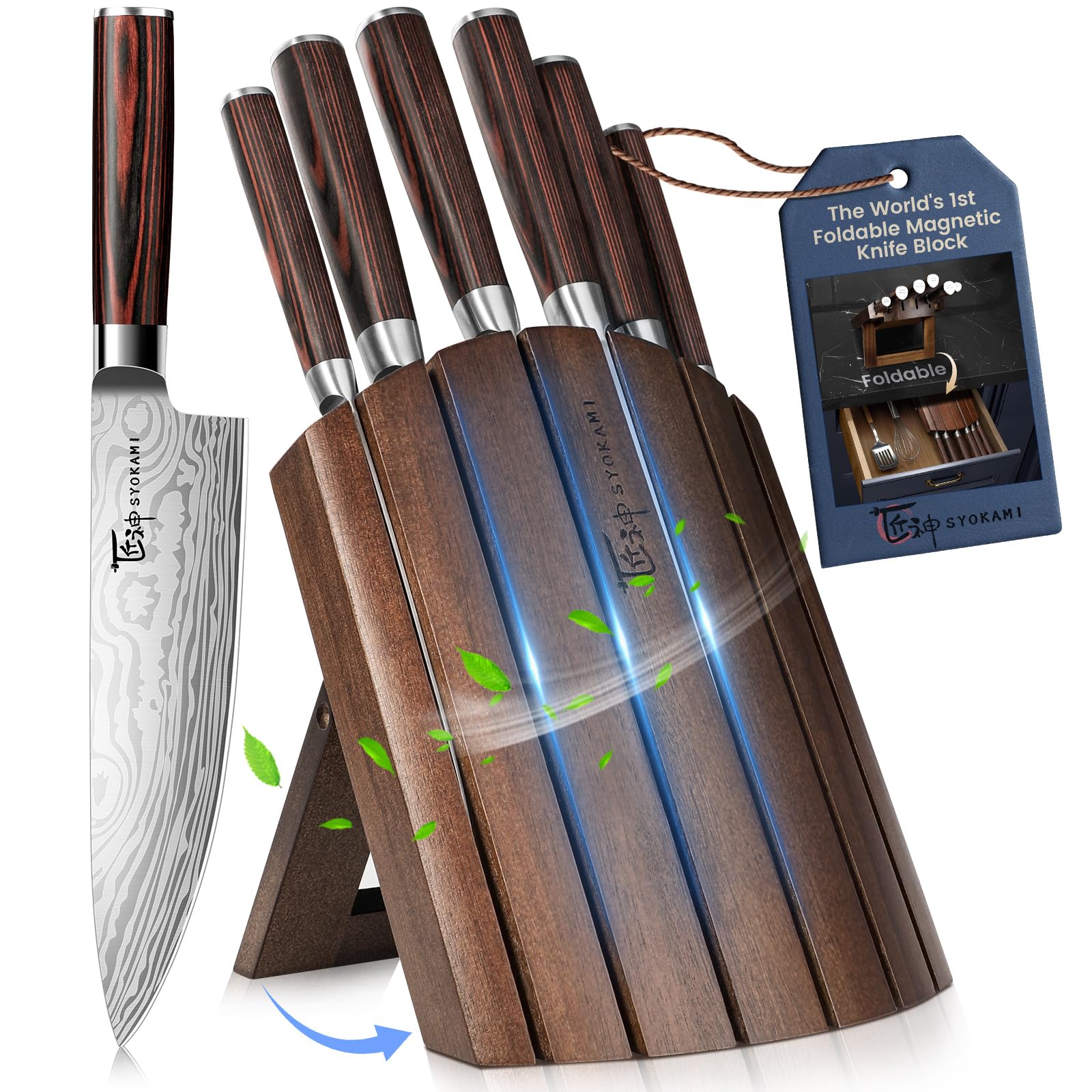
The SYOKAMI set solves a specific storage problem: its acacia wood block folds flat for drawer storage, eliminating the countertop footprint required by traditional knife blocks. The set includes an 8-inch chef, 7-inch santoku, 8-inch slicing, 8-inch bread, 6-inch utility, and 3.8-inch paring knife — seven pieces that cover the core cutting tasks for most home cooks. The blades are forged from high-carbon stainless steel rated at 56+ HRC with a 15-degree hand-sanded edge. Each slot in the block uses magnets to hold knives securely during transport.
The 15-degree edge is a practical everyday compromise — sharp enough for clean tomato and pepper cuts but tough enough to handle light bone contact without chipping. The santoku knife’s flat profile excels at push-cutting vegetables, while the chef’s knife covers rock-chopping duties. The acacia block folds completely flat via a hinge mechanism, and when deployed on the counter, it tilts slightly for easy knife access. The magnetic retention system prevents rattling when stored in a drawer, which is a meaningful safety upgrade over loose-blade storage.
The wood handle is comfortable but lacks the ergonomic contour found in Fibrox or Pakkawood handles, which may cause fatigue during long prep sessions. These knives are not dishwasher safe, and the acacia block should be wiped rather than soaked. The overall hardness at 56+ HRC is on the lower end of the sweet spot, meaning the edge will require honing more frequently than VG10 or German forged blades. For cooks who need a space-efficient set with solid daily performance, the SYOKAMI delivers unique utility.
Why it’s great
- Foldable acacia block stores flat in a drawer, ideal for small kitchens or limited counter space
- Magnetic slot retention keeps knives secure during transport and drawer storage
- Seven-piece set covers all essential cutting roles at a mid-range price point
Good to know
- 56+ HRC hardness requires more frequent honing than harder steel alternatives
- Wood handle lacks the ergonomic shaping found in Fibrox or Pakkawood handles
- Not dishwasher safe — hand wash and dry knives and block separately
6. Victorinox Wood 8 Inch Chef’s Knife

Victorinox, the Swiss maker of the iconic Fibrox line, also produces a wood-handled version of its classic 8-inch chef’s knife that appeals to traditionalists who prefer natural materials. The blade is stamped from high-carbon stainless steel rather than forged, which keeps the weight low and the price accessible. The handle is made from rosewood and attached via three rivets to a full-tang blade — a construction method more common on forged knives than stamped ones. The result is a lightweight chef’s knife that balances well and feels lively in hand.
Users consistently report that the knife arrives sharper than expected, rivaling significantly more expensive Japanese blades in out-of-box cutting performance. The rosewood handle warms up to hand temperature quickly and provides a secure grip through its natural wood texture, though it will swell if left wet. The blade’s stamped construction means it is thinner and lighter than forged knives, which reduces arm fatigue during long prep sessions but also makes it less suitable for heavy chopping of dense root vegetables or split poultry.
This knife is not dishwasher safe — the rosewood handle will absorb water and eventually crack. The stamped blade also lacks the edge retention of forged German or Japanese steels, so regular honing is required to maintain peak performance. The price sits at a mid-range point that undercuts the WÜSTHOF and HexClad options while delivering a tactile, natural-handle experience. For cooks who value a light, nimble blade with a warm wood handle, this is a strong everyday choice.
Why it’s great
- Lightweight stamped blade reduces arm fatigue during extended prep sessions
- Rosewood handle with full-tang construction provides natural grip warmth and balance
- Out-of-box sharpness rivals premium Japanese knives at a lower price point
Good to know
- Rosewood handle will absorb moisture and crack if exposed to dishwasher cycles
- Stamped blade loses edge faster than forged German or VG10 Japanese steel
- Not ideal for heavy chopping of dense squash or poultry joints
7. Victorinox Fibrox Pro Chef’s Knife, 8 Inch
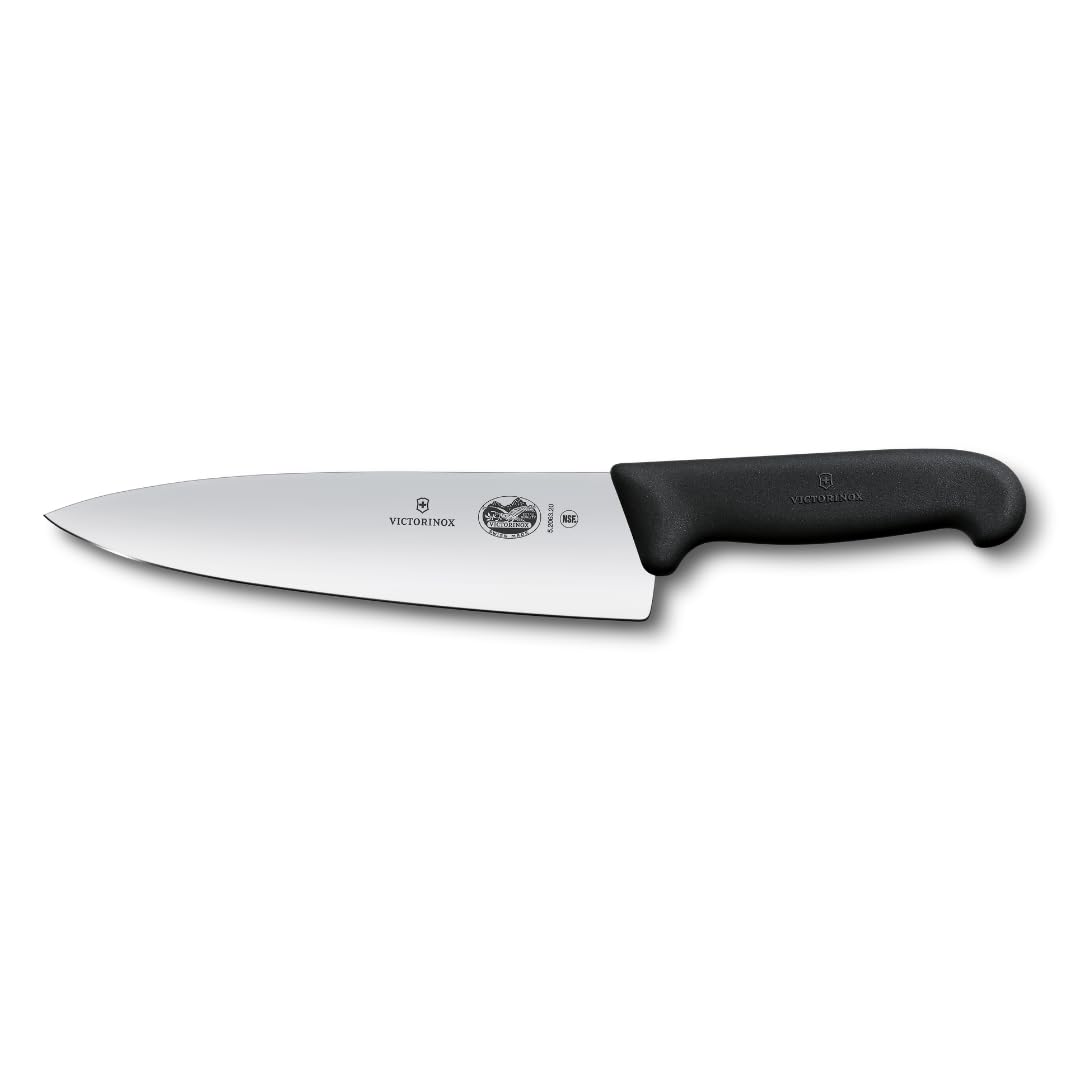
The Victorinox Fibrox Pro is the most widely recommended budget chef’s knife in professional culinary circles for a simple reason: it performs well above its price tier. The 8-inch blade is stamped from high-carbon stainless steel and laser-tested for a consistent plain edge. The Fibrox handle is made from thermoplastic elastomer, a material that provides outstanding grip even when wet or greasy — a feature that commercial kitchens rely on. The knife is fully dishwasher safe, making cleanup effortless for home cooks who prioritize convenience.
The blade geometry is thinner than forged knives, which allows it to slice through produce with minimal resistance. The edge holds up well for routine home cooking tasks — onion dicing, herb chopping, chicken slicing — though it will dull faster than VG10 or forged German steel under heavy daily use. The Fibrox handle is ergonomically shaped and textured, reducing slippage during high-moisture prep. The knife’s lightweight construction (22.68 grams) means it feels almost delicate, but the balance is neutral enough for controlled rocking cuts.
The primary trade-off is edge retention: expect to sharpen the Fibrox Pro every few weeks if you cook daily. The stamped construction also means the blade is less rigid than forged alternatives, so it may flex slightly when cutting through hard squash. The budget-friendly price makes it an ideal starter knife, a backup blade, or a gift for someone who needs a reliable tool without worrying about delicate maintenance routines.
Why it’s great
- TPE Fibrox handle is among the grippiest in the market, performing well when wet
- Fully dishwasher safe for effortless cleaning — a rare feature in quality knives
- Budget-friendly price with professional-grade cutting performance out of the box
Good to know
- Stamped blade requires more frequent sharpening than forged alternatives
- Lightweight construction may feel insubstantial to cooks who prefer heft
- Blade can flex slightly when cutting dense winter squash
8. Sunnecko 8 Inch Chef Knife

The Sunnecko 8-inch chef knife is a budget-friendly entry into the Japanese-style knife world, offering a hand-sharpened 12–15 degree edge on a high-carbon stainless steel blade with an attractive Pakkawood handle. The blade is forged rather than stamped, which is unusual at this price point, and it includes a PVC sheath for safe storage. The laser-etched pattern on the blade mimics traditional Japanese Damascus aesthetics, giving it a premium visual appearance despite the low cost.
The knife cuts well out of the box, handling tomatoes, onions, and boneless meats with clean slices. The Pakkawood handle is comfortable for medium-sized hands and provides decent grip, though it is not as securely textured as the Fibrox handle. The blade’s edge retention is acceptable for intermittent home use but will require sharpening sooner than mid-range options from Victorinox or WÜSTHOF. The forged construction gives the blade more heft than a stamped knife, which helps with push-through cuts on dense ingredients.
The knife is not dishwasher safe, and the PVC sheath should be replaced if it becomes loose over time. The aesthetic etching, while visually appealing, is purely cosmetic and does not affect cutting performance. The budget-friendly price makes this an attractive option for cooks who want a full-tang Japanese-style knife without committing to premium steel. It works best as a secondary knife or as a first step into sharper-angle blades.
Why it’s great
- Forged blade with hand-sharpened 12-15 degree edge at an accessible price point
- Pakkawood handle provides comfort and visual appeal in a budget-tier knife
- Includes PVC sheath for safe drawer storage and blade protection
Good to know
- Edge retention is below average — expect to sharpen more often than mid-range options
- Decorative laser etching adds visual appeal but does not improve cutting performance
- Not dishwasher safe; Pakkawood handle requires hand washing and thorough drying
9. Astercook Kitchen Knife Set 14-Piece
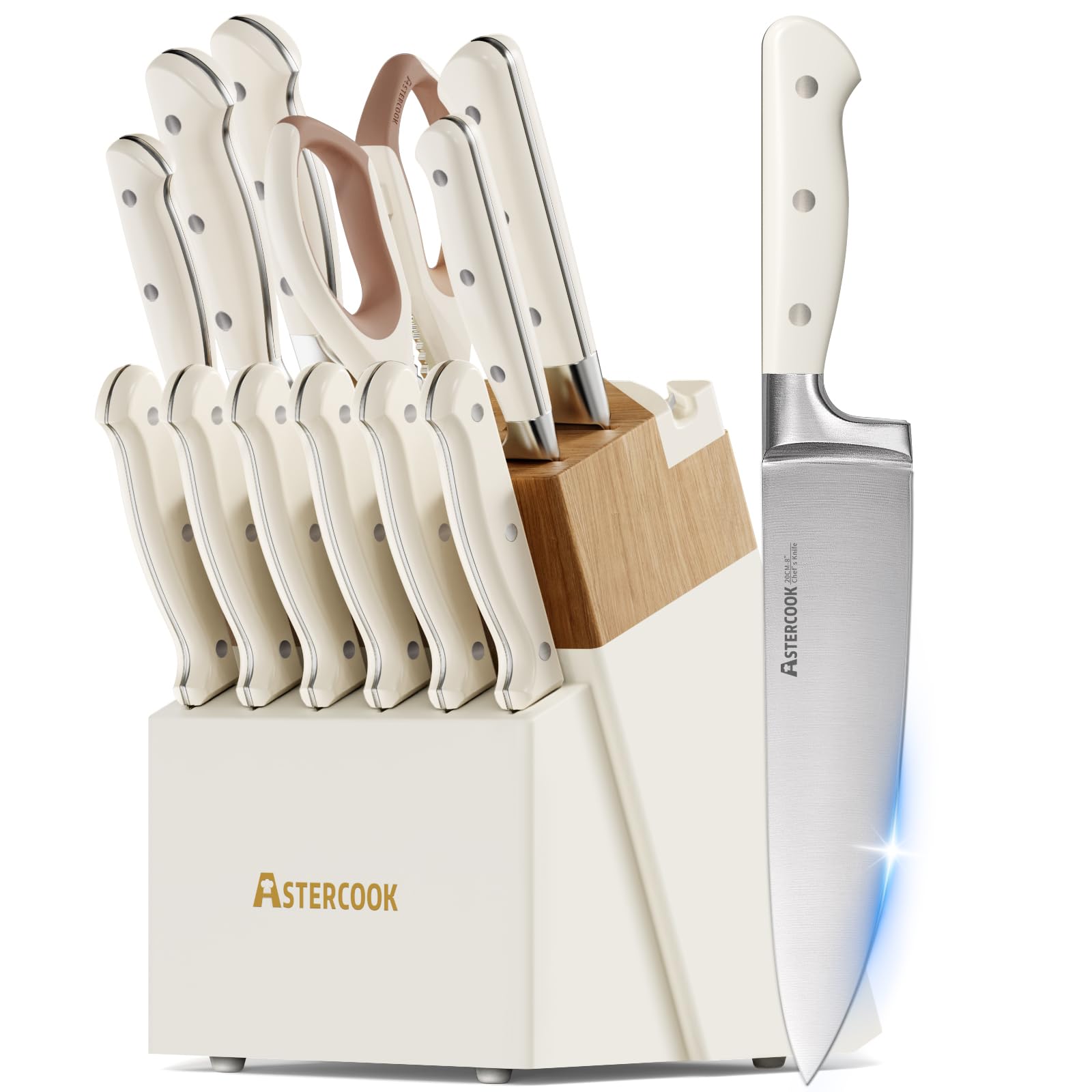
The Astercook 14-piece set is built around aesthetics and convenience, offering a cream-white aesthetic that stands out against standard black and silver knife blocks. The set includes an 8-inch chef, 8-inch slicing, 8-inch serrated bread, 5-inch utility, 3.5-inch paring knife, six 4.5-inch serrated steak knives, kitchen shears, and a hardwood block with a built-in sharpener. All blades are full-tang high-carbon stainless steel, and the handles are engineered stainless steel rather than wood or synthetic — a design choice that enables the clean, modern look.
The knives are dishwasher safe according to the manufacturer, which simplifies cleaning, though the serrated steak knives and bread knife are the most practical daily users in the set. The full-tang construction provides decent balance across the blade sizes. Customer reviews consistently praise the visual appeal of the cream-white finish and report that the knives arrive sharp enough for routine cutting tasks. The built-in sharpener in the block is functional for quick edge maintenance.
The stainless steel handles are smooth and can feel slippery when wet, lacking the grip texture of Fibrox or the warmth of wood. The edge geometry is not specified with the precision of higher-end blades, so sharpness consistency varies between knives in the same set. The set is best suited for cooks who prioritize kitchen aesthetics and want a complete knife collection in a cohesive style, rather than those seeking maximum cutting performance from each individual blade.
Why it’s great
- Cream-white aesthetic provides a distinctive modern look that complements bright kitchens
- 14-piece set covers all knife roles including serrated steak knives and shears
- Full-tang construction offers balanced weight across all blade sizes
Good to know
- Smooth stainless steel handles can become slippery during wet prep tasks
- Edge geometry is generic — sharpness consistency varies between knives in the set
- Dishwasher safe but hand washing preserves the aesthetic finish longer
FAQ
How often should I sharpen everyday kitchen knives?
Is a 15-degree edge better than a 20-degree edge for everyday use?
Can I put my everyday kitchen knives in the dishwasher?
What is the difference between forged and stamped knives?
Final Thoughts: The Verdict
For most users, the everyday kitchen knives winner is the WÜSTHOF Classic 2-Piece Set because its Precision Edge Technology and full-tang forged construction deliver consistent sharpness and balance that will last for decades with proper care. If you want a single aggressive chef knife that excels on vegetables and proteins, grab the HexClad Chef’s Knife. And for the best budget-friendly daily driver that you can throw in the dishwasher without worry, nothing beats the Victorinox Fibrox Pro.