Walking up to a competition judges’ table with dry brisket or a rubbery rib is every pitmaster’s nightmare. The difference between a ribbon and a loss often comes down to the machine that did the work—a competition smoker that holds steady temperature, distributes even smoke, and can handle long overnight cooks without constant babysitting.
I’m Mohammad Maruf — the founder and writer behind AirfryerBite. I’ve spent years analyzing smoker hardware, poring over temperature variance data, fuel efficiency specs, and real-world burn test results from competitive barbecuing circles.
Whether you are chasing a perfect smoke ring for a KCBS event or just aiming to feed a crowd with championship-caliber flavor, this guide lays out the top performers. Selecting the best competition smoker means dialing in on heat retention, capacity, fuel type, and the kind of airflow engineering that turns raw meat into show-stopping barbecue.
How To Choose The Best Competition Smoker
The right competition smoker is a balance of three things: temperature precision, fuel endurance, and airflow design. Beginners often over-value cooking area while ignoring how the smoker actually distributes heat and smoke across that space. Here is what actually matters.
Fuel Type: Charcoal, Electric, or Pellet?
Charcoal offsets and kamados dominate competition circuits because they produce the authentic smoke profile judges expect. Electric smokers like the SmokinTex are convenient but rarely produce the layered flavor needed for championship-level brisket. Gravity-fed charcoal units offer a middle ground—they burn real fuel but use a fan to stabilize temperature, reducing the manual feeding required with a traditional offset.
Airflow Architecture: Reverse Flow vs. Traditional Offset
In a traditional offset, heat enters from the firebox on one side and exits the smokestack on the opposite side, creating a temperature gradient that can be 30°F to 50°F across the chamber. Reverse-flow smokers (like the Oklahoma Joe’s Longhorn) route the smoke under a steel plate before it flows back across the food, dramatically reducing that gradient. For competition cooks who need consistent results from rack to rack, reverse flow is the smarter investment.
Cooking Capacity vs. Fuel Efficiency
More cooking space sounds better, but every extra cubic inch of chamber volume demands more fuel and longer recovery time when the lid opens. A 1,000 square-inch unit like the Masterbuilt Gravity Series 1050 can hold six pork shoulders comfortably. An 18-inch kamado like the Classic Joe III manages around 250 square inches but sips charcoal for 18-hour burns. Match your capacity to the size of your competition team—not your ambitions.
Quick Comparison
On smaller screens, swipe sideways to see the full table.
| Model | Category | Best For | Key Spec | Amazon |
|---|---|---|---|---|
| Masterbuilt Gravity Series 1050 | Gravity-Fed | Digital precision with real charcoal | 1,050 sq. in., 225°F in 8 min | Amazon |
| Kamado Joe Big Joe III | Ceramic Kamado | Maximum heat retention for long cooks | 24-inch, 450 sq. in., SlōRoller | Amazon |
| Weber Summit Kamado S6 | Steel Kamado | Durable dual-walled insulation | 24-inch, 14,176 W heating power | Amazon |
| Kamado Joe Classic Joe III | Ceramic Kamado | Championship smoke in a smaller footprint | 18-inch, SlōRoller, 750°F sear | Amazon |
| Oklahoma Joe’s Longhorn Reverse Flow | Reverse Flow Offset | Even heat across a massive chamber | 1,060 sq. in., 4 baffles | Amazon |
| Oklahoma Joe’s Highland Offset | Traditional Offset | Entry-level offset for budget-minded teams | 900 sq. in., porcelain-enamel | Amazon |
| SmokinTex Lil’ Tex Electric | Electric | Portable smokers for convenience | 23 lbs. capacity, 350 W | Amazon |
In‑Depth Reviews
1. Masterbuilt Gravity Series 1050

The Masterbuilt Gravity Series 1050 redefines what a charcoal smoker can do by merging a gravity-fed hopper with an electronically controlled fan. You load lump charcoal or briquettes into the vertical hopper (10 lbs. lump / 16 lbs. briquettes), set a target temperature on the digital panel, and the fan maintains it automatically—no damper adjustments, no waking up at 3 AM to reload fuel. The unit hits 225°F in roughly eight minutes and can climb to 700°F for searing, giving you two cooking modes in one chassis.
Reversible cast iron grates let you switch between high-heat searing and low-and-slow smoking without changing hardware. The included meat probe and built-in temperature gauge are useful, but the real advantage is the Masterbuilt app: you can monitor pit temp and probe temps from your phone, adjust set points, and even trigger a shutdown if the cook finishes while you are away. Stainless steel front and side shelves provide solid prep space, and the two porcelain-coated warming racks keep finished meats ready during a long cook.
Assembly requires attention to the U-bolt clasps—several users report adjusting them after break-in to ensure a tight seal. The grease collection system can drip on the lower shelf if not aligned properly. Still, for a competition team that wants real charcoal flavor without the babysitting, this is the most versatile unit in the mid-range tier.
Why it’s great
- Reaches 225°F in 8 minutes and holds automatically
- Digital fan and app control eliminate temperature swings
- Reversible cast iron grates for smoking and searing
Good to know
- U-bolt clasps may need tightening after initial use
- Grease drip system requires careful alignment
2. Kamado Joe Big Joe III

The Kamado Joe Big Joe III is the flagship of the ceramic-smoker world, and for good reason. The 24-inch ceramic shell retains heat so effectively that once you hit 225°F, the unit may burn through only a pound and a half of charcoal over an entire 18-hour brisket cook. The SlōRoller Hyperbolic Smoke Chamber—developed with input from Harvard—creates rolling, recirculating waves of smoke that deposit flavor evenly across three tiers of cooking space, virtually eliminating the hot spots that plague traditional offsets.
The 3-Tier Divide & Conquer system uses half-moon grates that allow you to set up direct heat on one side for searing and indirect heat on the other for smoking, all in the same cook. The Kontrol Tower Top Vent maintains a consistent air setting even when you open the dome, preventing the temperature spikes that ruin competition meat. The Air Lift Hinge reduces the heavy ceramic dome to a single-finger lift, which matters when you are checking food repeatedly during a 14-hour shift.
At roughly 450 square inches of cooking area, the Big Joe III is generous but not massive—you can fit four full packer briskets if you use the second and third tiers. Assembly requires two reasonably strong people to lift the ceramic body into the galvanized steel cart. The price places it firmly in premium territory, but owners consistently report it lasting a decade or more with proper care.
Why it’s great
- SlōRoller technology delivers unmatched smoke distribution
- Ceramic insulation holds 225°F for 18+ hours on minimal fuel
- 3-Tier Divide & Conquer system for multi-zone cooking
Good to know
- Heavy ceramic body—two people needed for assembly
- Premium price reflects long-term durability
3. Weber Summit Kamado S6

The Weber Summit Kamado S6 takes a different approach to insulation than ceramic kamados: dual-walled steel with a porcelain-enameled finish. This construction delivers the same thermal stability as ceramic—the interior holds low-and-slow temperatures without drifting—but at a fraction of the weight. The 24-inch cooking area is generous, and the Gourmet BBQ System (GBS) cookware, sold separately, includes options like a pizza stone or griddle that snap into the center grate.
The RapidFire lid damper boosts airflow to take the Summit from smoking to searing temperatures quickly, while the built-in diffuser plate ensures consistent low heat for long smokes. The One-Touch cleaning system simplifies ash removal—a single lever dumps ash into a removable bucket below, saving time during multi-day competition events. The Char-Basket charcoal holders organize fuel for direct or indirect cooking without needing to dump coals onto the grate.
Weber rates the heating power at 14,176 watts (roughly 48,000 BTU), which is enough to recover dome temperature quickly after lid openings. The porcelain-enameled finish resists rust significantly better than painted steel, making the Summit S6 a strong option for teams that cook in wet or coastal environments. The price is slightly below premium ceramic units, positioning it as a high-value mid-range option with professional-grade performance.
Why it’s great
- Dual-walled steel insulation equals ceramic stability, less weight
- One-Touch ash cleaning system saves competition-day prep time
- RapidFire damper boosts airflow for quick temperature changes
Good to know
- Gourmet BBQ System cookware sold separately
- Charcoal basket capacity suits cooks up to 12 hours
4. Kamado Joe Classic Joe III

The Classic Joe III brings the same SlōRoller smoke technology and Air Lift Hinge found on the Big Joe III but in an 18-inch form factor that is better suited for smaller teams or cooks who value fuel efficiency over sheer capacity. The ceramic shell retains heat superbly—you can smoke at 225°F for well over 12 hours on a single load of lump charcoal, and the unit can reach 750°F for high-heat searing when the Kontrol Tower Top Vent is opened fully.
The 3-Tier Divide & Conquer cooking system is identical to the Big Joe’s, meaning you still get the flexibility to smoke ribs on one tier while searing steaks on another. The difference is raw real estate: about 250 square inches of primary cooking space. That is enough for two packer briskets or three racks of ribs, making it ideal for a two-person competition team or backyard cooks who want championship-quality results without feeding 50 people every weekend.
The included cart, side shelves, Grill Gripper tool, and ash tool mean you have everything you need out of the box. The powder-coated aluminum Kontrol Tower resists rain and mold, a small but important detail for smokers stored outdoors. The Classic Joe III sits in premium territory but undercuts the Big Joe III by a considerable margin, making it the sweet spot for serious hobbyists stepping into competition terrain.
Why it’s great
- Full SlōRoller system in a more compact, fuel-efficient size
- Reaches 750°F for searing without losing low-temp stability
- Includes tool set and cart—ready to cook out of box
Good to know
- Primary cooking area (~250 sq. in.) limits large-volume cooks
- Ceramic body requires careful transport to avoid cracking
5. Oklahoma Joe’s Longhorn Reverse Flow Offset Smoker

The Oklahoma Joe’s Longhorn Reverse Flow is built for volume. With 751 square inches of primary cooking space and 309 square inches of secondary space (total 1,060), it can handle six full packer briskets, ten racks of ribs, or a combination of competition categories on a single fire. The reverse-flow design routes heat and smoke from the firebox under a steel baffle plate before flowing back across the food, reducing the typical temperature gradient found in traditional offsets to within 10°F across the entire chamber.
The four internal baffles beneath the cooking grates further distribute heat evenly—a critical advantage when you need every rib to cook at the same rate for a turn-in box. The smokestack location is switchable between reverse-flow and traditional offset configurations, giving you a choice of cooking profiles. The firebox door provides direct access for adding charcoal or wood splits without opening the main chamber, preserving heat during long cooks.
Heavy-gauge steel construction makes the Longhorn weigh roughly 226 pounds, which means it does not warp or lose seal integrity over time. Buyers consistently note that adding high-temperature gaskets around the lid and firebox further improves temperature consistency. The wagon-style wheels handle this massive unit without complaint, but you will need at least two people for assembly. The Longhorn sits firmly in mid-range pricing and offers the best capacity per dollar for competition teams that need maximum throughput.
Why it’s great
- Reverse-flow design cuts temperature gradient to ~10°F
- 1,060 total sq. in. handles six briskets comfortably
- Switchable smokestack for reverse or traditional flow
Good to know
- High-temp gasket recommended for tighter lid seal
- Weighs 226 pounds—two-person assembly required
6. Oklahoma Joe’s Highland Offset Smoker

The Highland Offset is Oklahoma Joe’s entry-level traditional offset smoker, offering 619 square inches of primary cooking space and 281 square inches of secondary space. The firebox is offset to the side, so heat and smoke travel across the chamber and out the smokestack on the opposite end. The multiple adjustable dampers let you regulate intake and exhaust to hold steady temperatures, though this requires more active monitoring than reverse-flow units.
Porcelain-enameled bowl and lid construction provides better heat retention and rust resistance than painted steel, and the porcelain-coated wire cooking grates are easy to clean after a competition event. The professional temperature gauge gives you a ballpark reading, but experienced users typically upgrade to a Tel-Tru thermometer for greater accuracy. The firebox door with built-in air damper simplifies ash cleanup and fuel adjustment without losing all your heat.
Large wagon-style wheels and a total listed weight of roughly 100 pounds make the Highland easier to move around a competition site than the 226-pound Longhorn. The 2-year warranty on all parts is standard for the price point. The Highland is a solid entry point for new competition smokers who want to learn offset fire management before investing in a reverse-flow or gravity-fed system.
Why it’s great
- Porcelain-enamel construction resists rust better than painted steel
- Firebox door with damper simplifies ash removal and fuel loading
- Lighter weight (~100 lbs.) makes site transport manageable
Good to know
- Traditional offset design requires active temperature monitoring
- Temperature gauge upgrade recommended for precision cooking
7. SmokinTex Lil’ Tex Electric Smoker
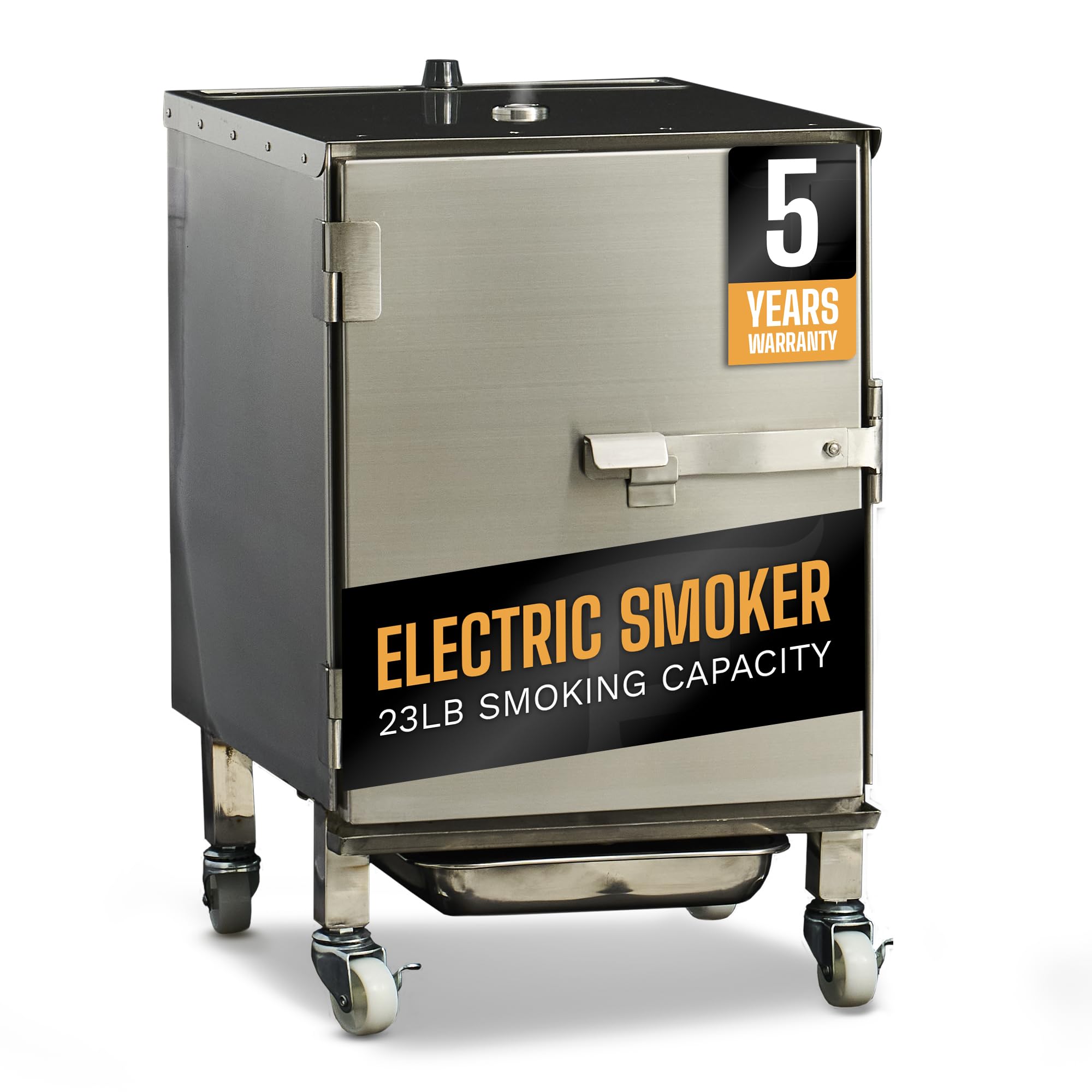
The SmokinTex Lil’ Tex takes a different path: a compact electric smoker with a 350-watt heating element and a temperature range of 100°F to 250°F. The unit measures just 14.75 by 18.75 by 21.25 inches and weighs 45 pounds, making it genuinely portable for tailgating, camping, or backyard patios. Three rack positions hold roughly 23 pounds of food, which is enough for a single competition entry or a small backyard gathering.
Full stainless steel construction includes an insulated body (excluding the bottom) that stays cool to the touch during operation. The wood chip tray slides out for refilling, and the simple temperature dial mimics a slow cooker interface—no digital panels, no app connectivity. The unit arrives fully assembled; you just attach the wheels, load chips, and plug it in. The 5-year warranty and free lifetime technical support are unusual for an electric smoker.
The Lil’ Tex cannot deliver the smoky depth of a charcoal offset or kamado, and temperature control is purely passive (set it and leave it). For competition teams, this unit works best as a secondary smoker for jerky, fish, or vegetables while the main rig handles brisket and ribs. It is the budget-friendly, entry-level option in this lineup, suitable for teams who prioritize convenience over smoke profile authenticity.
Why it’s great
- Fully assembled out of box—zero setup time
- Stainless steel body stays cool to the touch
- 5-year warranty and lifetime technical support
Good to know
- Electric heating limits smoke depth compared to charcoal units
- Temperature control is passive, not digitally regulated
FAQ
What is the difference between reverse flow and traditional offset smokers for competition?
How much cooking space do I need for a competition team of four people?
Can I use an electric smoker for competition barbecue?
Why do competition smokers use ceramic insulation instead of double-walled steel?
Final Thoughts: The Verdict
For most users, the best competition smoker winner is the Masterbuilt Gravity Series 1050 because it delivers genuine charcoal flavor with digital precision—no temperature babysitting required, and enough capacity for a full competition entry list. If you want the most consistent smoke distribution possible in a premium ceramic package, grab the Kamado Joe Big Joe III. And for budget-conscious teams who need maximum capacity per dollar, nothing beats the Oklahoma Joe’s Longhorn Reverse Flow.