Dragging a dull chef’s knife through a ripe tomato only to watch it squish instead of slice is a kitchen failure that repeats every single day. An automatic knife sharpener removes the guesswork and wrist fatigue of whetstones, delivering a consistent, factory-fresh edge with a simple pull-through motion that takes seconds instead of a dedicated sharpening session.
I’m Mohammad Maruf — the founder and writer behind AirfryerBite. I’ve spent the last 15 years researching kitchen hardware, breaking down motor specs, abrasive materials, and angle systems so home cooks don’t have to guess which sharpener actually restores a blade versus one that just polishes the metal.
Whether you maintain a block of German steel or a set of hard ceramic kitchen knives, the right sharpener cleans up the entire process. This guide walks through the top models available today so you can confidently pick your best automatic knife sharpener.
How To Choose The Best Automatic Knife Sharpener
Not every automatic sharpener treats your blade the same way. Some simply remove material aggressively to create an edge, while others guide the knife through a precise angle that preserves steel for years. Understanding the abrasive system, the stage count, and the angle guide design will keep you from burning through your knife collection.
Abrasive Type: Diamond vs. Sapphirite vs. Ceramic Wheels
Diamond abrasives are the hardest natural substance and cut through high-carbon stainless and ceramic blades efficiently. Sapphirite wheels, found on the Presto 08800, offer a professional-grade medium that runs cooler than standard aluminum oxide stones. Ceramic wheels handle softer steels well but wear faster on harder alloys.
Stage Count: What You Actually Need
A 2-stage system handles coarse grinding and fine honing. A 3-stage system adds a polishing or stropping slot that refines the edge to a razor finish. If you own high-end knives, the extra stage reduces micro-burrs that cause premature dulling. For budget or beater knives, a 2-stage unit is perfectly adequate.
Angle Guide Design: Fixed vs. Flexible Spring
Fixed angle guides lock the blade into a predetermined position, which is simple and repeatable. Flexible spring guides, common on mid-to-premium models like the Chef’sChoice, self-adjust to the blade’s curve and ensure the entire length — including the belly curve — receives uniform sharpening.
Quick Comparison
On smaller screens, swipe sideways to see the full table.
| Model | Category | Best For | Key Spec | Amazon |
|---|---|---|---|---|
| Chef’sChoice 15XV | Premium 3-Stage | Professional home kitchens | 15-degree Trizor XV edge conversion | Amazon |
| Work Sharp Ken Onion Mk.2 | Belt-Driven | Edge enthusiasts & re-shaping | Flexible abrasive belt system | Amazon |
| Work Sharp E5 Culinary | Vacuum-Integrated | Clean countertop operation | Built-in vacuum for debris | Amazon |
| Chef’sChoice UltraHone | 2-Stage Diamond | Straight & serrated maintenance | Micron-size diamond stage 2 | Amazon |
| Homly 3-Stage | Mid-Range 3-Stage | Everyday steel knife sets | 100% diamond abrasives | Amazon |
| VIDOME 3-Stage | 15-Degree Angle | Ceramic & straight-edge knives | 15-degree ultra-sharp edge | Amazon |
| BLACKBADGE 3-Stage | Diamond Abrasive | Repair & restore dull blades | Flexible spring guides | Amazon |
| Presto 08800 | 2-Stage Sapphirite | Budget-friendly kitchen use | Sapphirite sharpening wheels | Amazon |
| Narcissus S867 | Entry-Level Electric | First-time electric users | Diamond wheels & dust box | Amazon |
In‑Depth Reviews
1. Chef’sChoice 15XV Professional Electric Knife Sharpener

The Chef’sChoice 15XV sits at the top of the automatic sharpener hierarchy because it converts standard 20-degree household edges into a 15-degree Trizor XV edge — sharper than factory without sacrificing durability. The brushed metal upper housing weighs 5 pounds, giving it a stable footprint that doesn’t slide across the counter during use. Each of the three stages uses plated diamond abrasives, and the flexible spring guides automatically track the blade’s curve so the entire cutting edge receives uniform treatment.
First-time sharpening takes roughly one minute per blade, and subsequent touch-ups complete in about 10 seconds. The 3-stage EdgeSelect system lets you choose between coarse grinding for badly damaged edges, medium honing for daily maintenance, and a patented flexible abrasive stropping stage that polishes serrated and straight edges alike. Noise output stays between 65 dB and 75 dB — conversational volume.
If you own Wusthof, Zwilling, or Shun knives and want to preserve their geometry instead of grinding them down into butter knives, this model pays for itself in the first year by eliminating professional sharpening fees. The metal housing also handles daily commercial use, so home kitchens get a machine that will outlast multiple knife sets.
Why it’s great
- Converts standard 20-degree edges to sharper 15-degree XV geometry
- Metal housing provides professional durability and weight stability
- Three dedicated stages handle coarse restoration through fine stropping
Good to know
- Larger footprint at 12 x 6.25 inches requires dedicated counter space
- Not ideal for single-bevel Japanese blades without careful handling
2. Work Sharp Ken Onion Knife Sharpener Mk.2

The Work Sharp Ken Onion Edition Mk.2 departs from the pull-through wheel design and instead uses flexible abrasive belts — the same method knife manufacturers use to create factory edges. This design allows you to re-profile a blade from a thick 30-degree edge down to a razor-thin 15-degree edge, which no fixed-wheel pull-through can accomplish. The electronic speed control lets you dial in the belt speed depending on whether you are grinding out a chip or polishing a nearly-sharp blade.
Designed in partnership with knife-maker Ken Onion, the Mk.2 accepts multiple grit belts (P80 through 6000 grit available separately) so you can move from aggressive material removal to mirror-finish polishing without switching machines. The stainless steel construction and 3-year warranty reflect Work Sharp’s Oregon-based manufacturing standards. It also sharpens scissors, serrated blades, and even tools like garden pruners with the appropriate belt.
This is the best choice for cooks who maintain a mixed collection of high-hardness steels (S30V, VG-10, etc.) and need to restore a damaged tip or completely re-shape a blade profile. The learning curve is slightly higher than a standard pull-through, but the edge quality you can achieve rivals manual whetstone work with half the time investment.
Why it’s great
- Belt-driven system can re-profile blades from thick to ultra-thin edges
- Variable speed control matches belt speed to blade hardness
- Accepts multiple grit belts for coarse repair through fine polishing
Good to know
- Requires purchasing additional belts separately for full grit range
- Belt-driven operation produces more learning friction than wheel-based models
3. Work Sharp Professional Electric Culinary E5

The Work Sharp E5 is the only automatic knife sharpener on this list that integrates a vacuum directly into the housing, capturing metal dust and abrasive debris before it settles on your counter. That feature alone makes it the cleanest option for kitchens where a sharpening session shouldn’t require a full wipe-down afterward. The E5 uses flexible sharpening belts pre-programmed with three settings: shape (for damaged edges), sharpen (for dull knives), and hone (for touch-ups).
Each sharpening cycle runs in under 90 seconds and the unit automatically shuts off at the end — no counting passes or guessing when to stop. The 5.48 x 10.22 x 5.74-inch footprint is compact enough to store in a drawer, and the machine accommodates kitchen scissors and poultry shears in addition to straight and serrated knives. The 1.26-kilogram weight provides enough stability to stay planted during use.
Home cooks who prioritize a clean workspace and want a nearly foolproof experience will appreciate the E5’s one-button operation. The pre-programmed cycles eliminate the variance that comes with manual pull-through systems, so every blade gets the same treatment regardless of who runs the machine.
Why it’s great
- Built-in vacuum captures metal dust for a clean sharpening session
- Pre-programmed cycles with auto shut-off remove user guesswork
- Compact size fits easily into kitchen storage
Good to know
- Belt replacement requires ordering proprietary Work Sharp belts
- Pre-programmed cycles limit custom angle adjustments
4. Chef’sChoice UltraHone 2-Stage

The Chef’sChoice UltraHone delivers the same diamond abrasive technology as the 15XV but in a lightweight, 2-stage format that weighs only 16 ounces. Stage 1 uses 100% diamond abrasives for the initial edge formation, while Stage 2 employs advanced micron-size diamonds to hone and polish. The precision angle guides lock the blade at a consistent 20-degree angle, making it a straightforward option for maintaining both straight-edge and serrated knives.
The 11.81 x 3.94 x 4.25-inch body takes up minimal counter space, and the white plastic housing keeps the weight low enough to move between kitchen and outdoor prep station. The sapphirite-like diamond wheels run cooler than standard abrasives, reducing the risk of overheating the blade edge during prolonged sharpening sessions. This model handles the full range of household steel knives and can refresh a set of 8 to 10 blades in under 5 minutes.
For cooks who don’t need the 15-degree conversion or the metal housing of the 15XV, the UltraHone provides a clean, repeatable sharpening routine at a lower weight and smaller footprint. It works especially well for households with mixed knife quality levels where consistent maintenance matters more than specialized edge geometry.
Why it’s great
- Ultra-light 16-ounce build for easy portability
- Micron-size diamonds in stage 2 produce a polished edge
- Handles both straight and serrated blades without adjustment
Good to know
- Only 2 stages limit coarse restoration capability
- Plastic housing feels less durable than metal alternatives
5. Homly Professional 3-Stage Sharpener

The Homly 3-Stage sharpener uses 100% diamond abrasives across its first two stages and a polishing stage for finishing, mirroring the abrasive architecture of premium models at a mid-range price point. The 12.2 x 4.8 x 4.8-inch body includes a double-layer shell paint and electroplating finish that resists kitchen grease and wipes clean easily. The flexible spring guide rods keep the blade at the ideal angle across the entire cutting length, creating a uniform arch-shaped edge rather than just a sharp tip.
The 3-pound weight and non-slip base keep the unit stable during operation, and the motor is designed with noise-reduction features that keep the sound level lower than many competitors in its tier. Homly backs the unit with a 2-year warranty and lifetime customer service response within 15 hours. The sharpener accepts all metal steel knives including chef knives, Santoku, boning knives, and pocket blades.
This is the right pick for households that sharpen a dozen knives at once and want a wide slot design that doesn’t require slow, careful insertion. The wider guide slot reduces the friction of pulling thicker blades through, making it faster to process an entire block in one session.
Why it’s great
- Wider slot design handles thick chef knives without jamming
- Double-layer paint finish resists grease buildup
- 2-year warranty with responsive customer service
Good to know
- Polishing stage wears faster than diamond stages
- Motor lacks vacuum or dust collection features
6. VIDOME Professional 3-Stage Sharpener

The VIDOME sharpener distinguishes itself with a proprietary 15-degree edge system that converts standard 20-degree knives to a finer angle for easier cutting. It also handles ceramic knives natively — a rare feature among automatic sharpeners because ceramic requires diamond abrasives to cut effectively without chipping. The three-stage system uses 100% diamond abrasives in stages 1 and 2, with safe stropping disks in stage 3 that restore the blade surface to a near-factory appearance.
The 9.46 x 2.91 x 2.76-inch chassis includes a magnetic debris collection tray that catches metal dust for quick disposal. The German-imported motor is rated for energy efficiency and operates within a 60 dB to 80 dB range. First-time sharpening takes roughly 30 seconds, while resharpening drops to about 10 seconds. For ceramic knives specifically, the recommended pass count is 6 to 10 seconds per slot.
Cooks who keep both traditional steel and ceramic blades in their kit will find the VIDOME’s dual-material capability a genuine space-saving advantage. The 15-degree conversion also makes it a strong option for anyone transitioning from 20-degree factory edges who wants an immediate improvement in cutting performance.
Why it’s great
- Sharpens ceramic knives without chipping using diamond wheels
- Converts 20-degree factory edges to finer 15-degree cutting angle
- Magnetic debris tray simplifies cleanup
Good to know
- Left-side stage 3 slot has limited clearance for small blades
- First-time ceramic sharpening requires careful timing to avoid over-grinding
7. BLACKBADGE Professional 3-Stage Sharpener

The BLACKBADGE sharpener focuses on blade restoration — the first two stages use 100% diamond abrasives designed to remove material aggressively for repairing chipped or rounded edges. Stage 3 employs resin disks for polishing and finishing, producing a smoother surface than standard felt wheels. The 20-degree angle guide ensures consistent geometry along the entire blade length, and the flexible spring guides maintain contact even on curved belly sections.
The 10.43 x 3.54 x 2.76-inch housing sits firmly on four anti-slip pads, and the DC motor runs cool enough to handle back-to-back sharpening of up to 10 knives without overheating. The pass recommendation is 3 to 6 strokes per slot for restoring sharpness. The unit’s 1.2-kilogram weight provides enough heft to resist sliding during aggressive pulls.
This is the sharpener to reach for when your knives have been neglected for months and need a heavy initial grind rather than a light touch-up. The aggressive diamond stage can re-establish an edge on blades that fail the paper-slice test entirely, making it a practical choice for rental kitchens or inherited knife collections.
Why it’s great
- Aggressive diamond stages restore heavily damaged blade edges
- Flexible spring guides ensure full-length contact on curved blades
- DC motor runs cool for extended sharpening sessions
Good to know
- Aggressive grinding can remove more metal than necessary for routine maintenance
- Resin polishing disks wear faster than diamond stages
8. Presto 08800 EverSharp Electric Knife Sharpener

The Presto 08800 is a long-running household staple that uses Sapphirite sharpening wheels — the same ultra-hard material found in professional sharpening shops — rather than standard aluminum oxide stones. The 2-stage system grinds a precisely angled edge in stage 1, then fine-hones and polishes in stage 2. The precision blade guides lock the knife at the ideal angle automatically, eliminating the angle-guessing that frustrates beginners.
At 9.9 x 7.2 x 4.8 inches and 2.95 pounds, the Presto is neither the smallest nor lightest unit, but its all-plastic body keeps the weight manageable. The 120-volt motor runs reliably for years with minimal maintenance, and replacement Sapphirite wheels are available cheaply. Customer reviews consistently highlight how quickly the unit restores dull knives — typically 3 to 4 passes through the fine wheel per blade.
The Presto is the entry-level champion for a reason: it does not require deep pockets to deliver consistent, repeatable sharpening that matches the performance of units costing several times more. It handles most non-serrated steel blades well, and its simple slot design means any household member can use it without instruction.
Why it’s great
- Sapphirite wheels deliver professional-grade sharpening at a low entry cost
- Automatic angle guides remove all sharpening guesswork
- Replacement wheels are inexpensive and widely available
Good to know
- Not designed for ceramic or serrated blades
- Plastic construction lacks the rigidity of metal-housed units
9. Narcissus S867 Electric Knife Sharpener
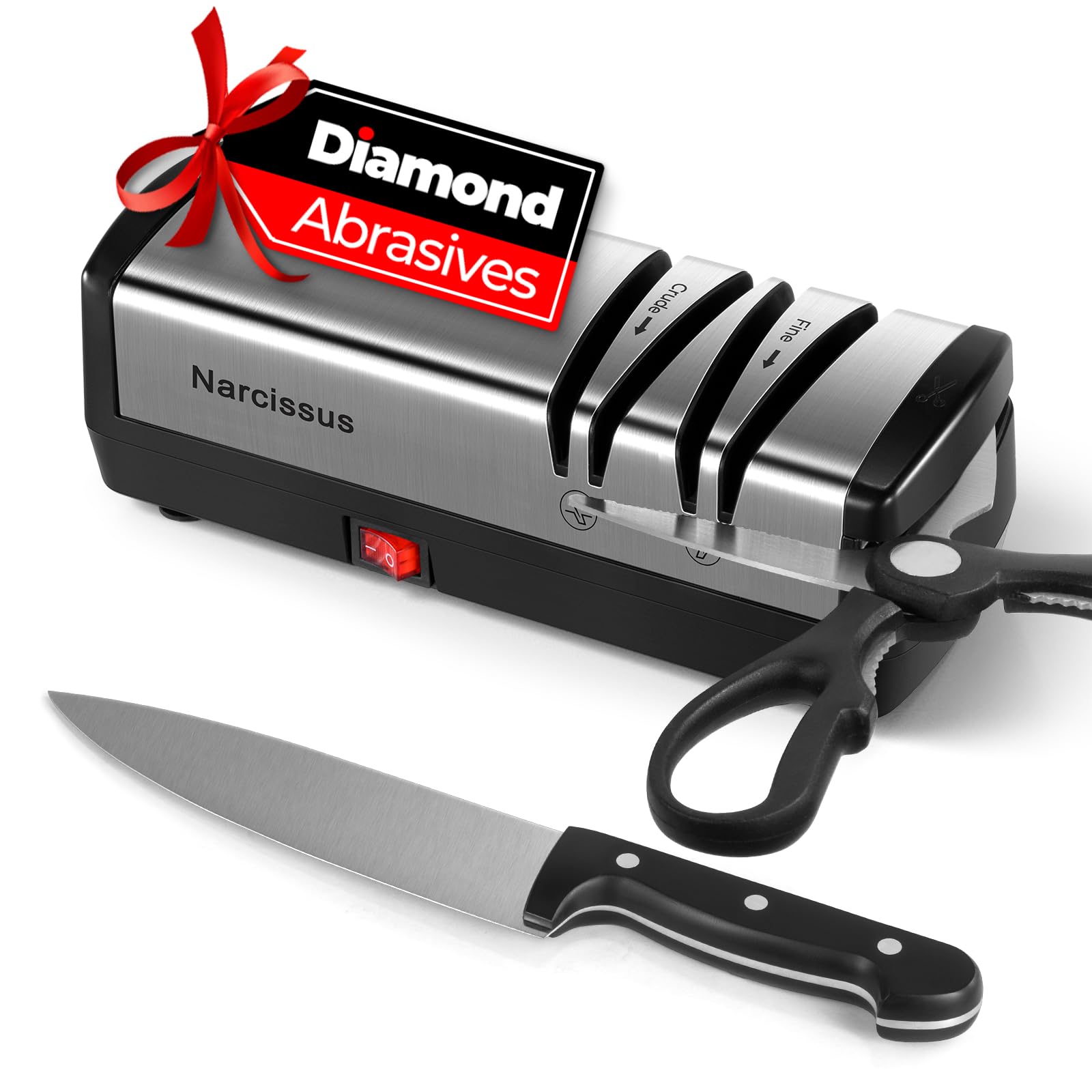
The Narcissus S867 is a compact electric sharpener that fits into a 8.2 x 2.9 x 2.7-inch body and uses diamond abrasive wheels for both the coarse and fine slots. The lower center of gravity combined with four anti-slip foot pads minimizes vibration during operation.
A built-in metal dust collection box catches sharpening debris, keeping the counter clean through the session. The unit also includes a dedicated scissors sharpening slot, making it a genuinely multifunctional tool despite its compact footprint. The 100-240V wide voltage design means it works in different regions without a step-down transformer.
The S867 is an excellent starting point for anyone new to electric sharpeners who wants diamond abrasive capability without the mid-range price tag. The included 12-month replacement policy and 24-month after-sales service provide a safety net for first-time buyers who are uncertain about long-term reliability.
Why it’s great
- Diamond wheels at an entry-level price point
- 30W DC motor runs continuously for over an hour
- Integrated dust collection box and scissor slot
Good to know
- Smaller slot width may not accommodate very thick chef knives
- 12-month warranty is shorter than some competitors
FAQ
Can an automatic knife sharpener damage expensive Japanese blades?
How many passes should I make through each slot?
Will a 3-stage sharpener make my knives sharper than a 2-stage model?
Final Thoughts: The Verdict
For most users, the best automatic knife sharpener winner is the Chef’sChoice 15XV because its 3-stage diamond system, metal housing, and 15-degree edge conversion deliver professional-grade results without requiring any skill. If you want a belt-driven system that can re-profile damaged blades, grab the Work Sharp Ken Onion Mk.2. And for a budget-friendly entry point that still uses professional Sapphirite wheels, nothing beats the Presto 08800.