Well water comes with its own set of challenges — iron stains, sulfur odors, sediment that clogs fixtures, and heavy metals that make their way from the ground into your glass. A standard municipal water filter often falls short when the source is a private well, because the contaminant profile is fundamentally different. You need a system designed to handle high sediment loads, aggressive rust particles, and that unmistakable rotten-egg smell.
I’m Mohammad Maruf — the founder and writer behind AirfryerBite. I have spent countless hours analyzing whole house water filtration systems, comparing media types, flow rates, and contaminant-reduction certifications to determine what actually works for homes drawing water from a private well.
After evaluating dozens of models across performance, durability, and real-world customer feedback, I’ve assembled the most practical guide to the best whole house water filter for well water that targets the specific contaminants well owners face every day.
How To Choose The Best Whole House Water Filter For Well Water
Well water is untreated groundwater that picks up a unique mix of contaminants as it travels through soil and rock. Unlike municipal water which is already disinfected, private well water often contains sediment, iron, manganese, hydrogen sulfide gas, and sometimes bacteria. A system that works on city water can fail on a well if it doesn’t address these specific problems. Here are the key factors to consider.
Contaminant Profile — Know What You’re Dealing With
Before buying any filter, get your well water tested. The most common well water issues are iron (causes orange staining), manganese (black staining), hydrogen sulfide (rotten egg smell), and sediment like sand or silt. A standard carbon block filter won’t remove dissolved iron or sulfur gas. You need a system that combines sediment filtration with KDF, catalytic carbon, or air injection media specifically designed for these well water contaminants.
Flow Rate and Capacity — Match Your Household Size
Whole house filters are rated by maximum flow rate in gallons per minute (GPM). A 1-2 bathroom home typically needs 10-12 GPM, while a 3-4 bathroom home needs 15-20 GPM. If your well pump can’t keep up, the filter becomes a bottleneck. Also consider filter life — measured in months or gallons. Systems with 4.5″x20″ cartridges generally last 3-12 months depending on water quality, while backwashing tanks can go years between media replacements.
Media Type — Carbon, KDF, or Air Injection
Activated carbon removes chlorine, taste, and odor but does little for iron. KDF media (Kinetic Degradation Fluxion) reduces iron, manganese, and heavy metals while inhibiting bacteria growth. Air injection systems use a pocket of compressed air to oxidize dissolved iron and hydrogen sulfide, then filter out the solid particles. For heavy iron loads, a dedicated iron filter with air injection or KDF is often necessary, sometimes paired with a sediment pre-filter.
Installation and Maintenance Requirements
Some systems are simple wall-mount units with a bypass valve that an experienced DIYer can install in an afternoon. Others — especially backwashing iron filters and UV sterilizers — require a drain line for regeneration and may need professional plumbing. Always check whether the system requires electricity. UV systems need a 120V outlet. Air injection tanks need a control head that regenerates automatically. Factor in the cost and frequency of replacement cartridges or media.
Quick Comparison
On smaller screens, swipe sideways to see the full table.
| Model | Category | Best For | Key Spec | Amazon |
|---|---|---|---|---|
| iSpring WGB32B | 3-Stage | High chlorine reduction | 15 GPM, 100K gallon capacity | Amazon |
| PRO+AQUA PRO-100-E | 3-Stage | Heavy metals & sediment | 15 GPM, built-in gauges | Amazon |
| Express Water WH300SCKP | 3-Stage | Scale & heavy metal defense | 17 GPM, freestanding frame | Amazon |
| iSpring WCB32C-KS | 3-Stage | Budget-friendly multi-contaminant | 12 GPM, 30K gallon capacity | Amazon |
| SimPure DB20P-3 | 3-Stage | Sediment & odor removal | 15 GPM, clear housings | Amazon |
| SimPure DB20P-3KDF | 3-Stage | Iron & heavy metal reduction | 15 GPM, KDF + CTO filters | Amazon |
| HQUA-TWS-12 | UV System | Bacteria and microbe control | 12 GPM, 55W UV lamp | Amazon |
| DuraWater Black Series | Air Injection | High iron & sulfur removal | 12 ppm iron, 10 ppm sulfur | Amazon |
| Aquasure AS-WHF72D | Bundle System | Complete filtration + softening | 72K grain softener + RO | Amazon |
In‑Depth Reviews
1. iSpring WGB32B 3-Stage Whole House Water Filter

The iSpring WGB32B is a street-fighter in the whole house filtration space, using industrial-standard 20×4.5-inch big blue filters that deliver up to 15 GPM. Its three-stage setup pairs a 5-micron sediment pre-filter with two coconut shell carbon block filters, targeting 99% of chlorine, sediment, rust, taste, and odor. For well water users, the sediment stage is critical for catching sand and silt before it reaches the carbon media.
This system has proven itself over the long haul — verified purchasers report 5-10 years of reliable service on well water, with one reviewer noting that after 5 years of continuous use a cracked filter cap was replaced by iSpring’s support team free of charge, even beyond warranty. The 1-inch NPT inlet/outlet maintains strong water pressure even during peak demand, and the individually wrapped cartridges ensure freshness when you pop them in.
One trade-off: the WGB32B uses CTO carbon block filters rather than KDF media, so it is not optimized for dissolved iron or hydrogen sulfide reduction. Well owners with iron issues will want a dedicated iron filter downstream or in the third stage. The system also does not reduce TDS, which is intentional for mineral retention, but something to be aware of if you’re after completely demineralized water.
Why it’s great
- Exceptional build quality with heavy-duty filter housings and brass ports
- Easy DIY installation with comprehensive manual and video guides
- Long filter life of up to 1 year under normal well water conditions
- Top-rated U.S.-based customer support that stands behind the product
Good to know
- Does not include KDF media for iron or hydrogen sulfide removal
- Filter housings are opaque — no visual monitoring of cartridge condition
- Requires two wrenches to unscrew the blue filter canisters
2. PRO+AQUA Elite Series GEN2 PRO-100-E
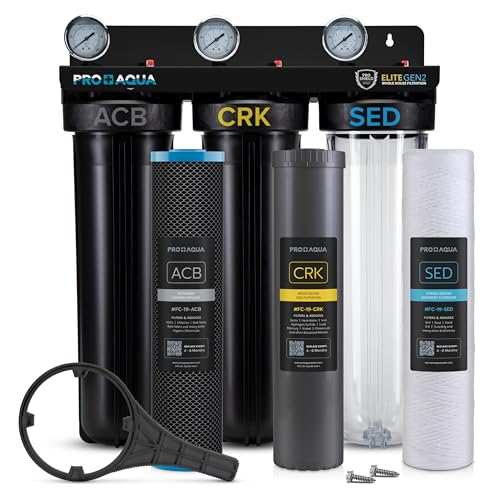
The PRO+AQUA PRO-100-E is designed from the ground up for both well and city water, with a three-stage sequence that directly addresses common well water problems. Stage one is a clear-housing sediment filter that captures rust, dust, and silt — visible inspection lets you know exactly when to change it. Stage two uses a CRK filter that combines KDF media with catalytic carbon to reduce heavy metals like lead, iron, and mercury while also tackling hydrogen sulfide odors.
Owners consistently praise the difference in water quality, reporting that iron stains on fixtures disappear within weeks and that skin feels noticeably softer after showering. The stainless steel pressure gauges let you monitor filter loading in real time — when the differential pressure climbs, you know it’s time for a swap. The system includes 1-inch brass ports with adapters down to 0.75-inch, making it adaptable to most home plumbing configurations.
The trade-off is that the 20×4.5-inch replacement cartridges are proprietary to PRO+AQUA, and the six-month filter change interval combined with cartridge cost can add up over time. Some users note a slight drop in water pressure after installation, especially in homes with smaller well pumps. Despite that, the five-year manufacturer warranty and lifetime tech support provide excellent peace of mind for the price.
Why it’s great
- Clear sediment housing for easy visual inspection of filter condition
- CRK media blend effectively captures iron, lead, mercury, and sulfur odors
- Stainless steel pressure gauges with robust build quality
- Includes 1-inch and 0.75-inch brass adapter fittings
Good to know
- Replacement filters are proprietary and cost more than generic options
- May reduce water pressure in homes with weaker well pumps
- Professional installation recommended for optimal performance
3. Express Water WH300SCKP 3-Stage Whole House Filter

The Express Water WH300SCKP stands out for its comprehensive three-stage filtration that specifically targets the heavy metals and scale buildup common in well water. The system uses a sediment filter, a KDF/granular activated carbon hybrid, and a catalytic carbon stage — delivering up to 17 GPM of flow, which is enough for a 3-bathroom home running multiple outlets simultaneously. The heavy-duty stainless steel stand makes it a freestanding unit rather than wall-mounted, which simplifies installation in basements or utility rooms.
Customer feedback on well water is overwhelmingly positive, with users reporting that the system eliminated the rotten egg smell within hours of installation and stopped iron staining on toilets and sinks. The three pressure gauges are a genuinely useful feature — you can instantly see when any stage is clogging, which helps avoid surprise pressure drops. The anti-scale polyphosphate media protects pipes and water heater elements from calcium buildup, which is a hidden cost of hard well water.
The main downside is the physical footprint — at 63 pounds and 30 inches tall, this is not a small system that tucks away easily. The replacement filter sets cost around per year, which is mid-range for a system this capable. Some users mention that the instructions could be clearer for the initial setup, but Express Water’s customer support is responsive and helpful for troubleshooting.
Why it’s great
- KDF + catalytic carbon media for iron, lead, arsenic, and sulfur reduction
- Anti-scale protection extends the life of pipes and water heaters
- Three pressure gauges for real-time system monitoring
- High 17 GPM flow rate handles peak household demand
Good to know
- Large and heavy — needs dedicated floor space
- Annual replacement filter cost runs around per set
- Not designed for TDS removal; consider a separate RO if needed
4. iSpring WCB32C-KS 3-Stage Whole House Filter

The iSpring WCB32C-KS is a more affordable entry point into whole house filtration that still tackles the fundamentals well water demands. Its three-stage sequence uses a 5-micron PP sediment filter, a GAC/KDF composite filter, and a CTO carbon block filter. The KDF media in the second stage makes it more effective against iron and hydrogen sulfide than the standard WGB32B, which is a meaningful difference for well owners on a tighter budget.
Verified well water users emphasize that this system catches impressive amounts of rust and iron sediment, with one user reporting that the pre-filter turns orange within three weeks — a clear sign that the system is doing its job. The transparent first-stage housing lets you monitor sediment accumulation without disassembly. At 30,000 gallons capacity, a family of four can expect about six months between full filter changes, though heavy iron loads may require more frequent pre-filter swaps.
The limitation here is the 12 GPM flow rate, which is adequate for a 1-2 bathroom home but may struggle during simultaneous shower and laundry operation. The plastic housing connections are functional but less robust than the brass ports found on more expensive systems. Some users report that overtightening the filter housings can cause cracks, so the included wrench should be used with care rather than brute force.
Why it’s great
- KDF composite media helps reduce iron and sulfur odors
- Transparent first-stage housing for visual sediment monitoring
- Excellent value for a three-stage system with mixed media
- iSpring’s customer support is responsive and helpful
Good to know
- 12 GPM flow rate is lower than many competing systems
- Plastic filter housings can crack if overtightened
- 30K gallon capacity is modest compared to 100K+ alternatives
5. SimPure DB20P-3 3-Stage Whole House Filter
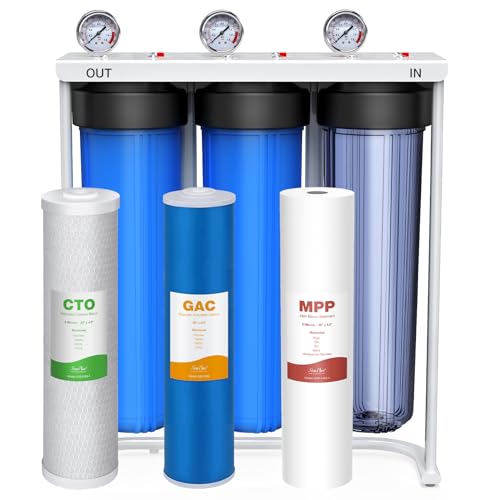
The SimPure DB20P-3 is built around visible clarity — two of its three filter housings are transparent, letting you see exactly when the sediment and carbon cartridges need replacement. The three-stage media includes an MPP sediment filter for particles, granular activated carbon for taste and odor, and a CTO carbon block for fine polishing. This system is specifically marketed for well water users, and the feedback from rural homeowners confirms it: red clay and iron sediment that previously stained sinks is captured cleanly.
One of the strongest features for diy installers is the dual o-ring seal design with brass fittings, which significantly reduces the risk of leaks at connection points. The system comes with all necessary mounting hardware and a bypass valve, though some users note that the mounting bracket doesn’t align with standard 16-inch stud spacing. The 15 GPM flow rate is enough for most households, and the 150,000-gallon annual capacity means you won’t be changing cartridges every few weeks under moderate sediment loads.
The main consideration is that the DB20P-3 does not include KDF media, so it won’t reduce dissolved iron or hydrogen sulfide as effectively as dedicated iron filter systems. Well owners with heavy iron loads may find themselves swapping the pre-filter very frequently. Some users also report that the included drywall anchors are inadequate, so a more robust mounting solution is recommended for the 48.5-pound filled system.
Why it’s great
- Double clear housings for easy visual filter inspection
- Dual o-ring seals and brass fittings minimize leak points
- High annual throughput of 150,000 gallons per year
- Compact design with smaller footprint than many big blue systems
Good to know
- No KDF media — dissolved iron reduction is limited
- Mounting bracket does not align with 16-inch stud spacing
- Drywall anchor kit is not strong enough for full weight
6. SimPure DB20P-3KDF 3-Stage Whole House Filter
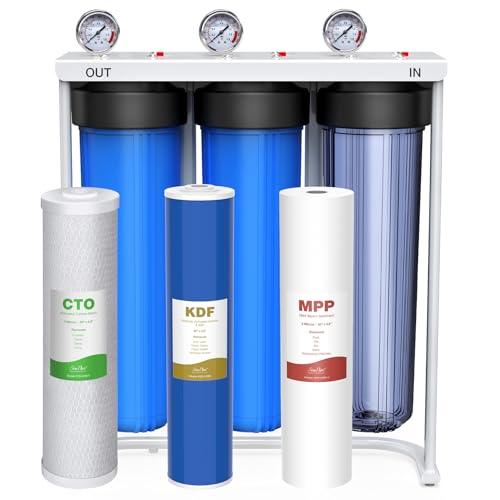
The SimPure DB20P-3KDF takes the same robust platform as the DB20P-3 but swaps the media blend to include KDF in the second stage, making it significantly more effective for well water with iron, manganese, and heavy metals. The KDF media targets dissolved iron, lead, mercury, and chromium, while the 5-micron CTO carbon block polishes the water for taste and clarity. This is a meaningful upgrade for well owners whose water tests show elevated metal content.
Well water users report that iron staining on toilets and laundry is eliminated within weeks of installation, and the water tastes noticeably cleaner without the metallic aftertaste. The system retains the same dual clear housing design, so you can see the sediment load accumulating and plan changes accordingly. The carbon filter is rated for 3-6 months and the sediment filter for 6-12 months, with the KDF media lasting the longest of the three stages.
One issue that appears in customer feedback is that while the system handles basic well water problems well, it may not fully resolve high concentrations of hydrogen sulfide or tannins. Some users with very challenging well water reported that after 30 days, sulfur odors began to return, suggesting that a dedicated air injection or catalytic carbon filter may be needed for extreme cases. The 15 GPM flow is adequate for most homes, but heavy simultaneous demand can cause noticeable pressure drop.
Why it’s great
- KDF media actively reduces dissolved iron, lead, and manganese
- Clear housings allow visual monitoring of all filter stages
- Compatible with standard 20×4.5-inch replacement cartridges
- Reliable 15 GPM flow rate for average households
Good to know
- May not fully remove hydrogen sulfide in high-sulfur wells
- Pressure drop possible during peak simultaneous demand
- Heavy annual throughput requires stable well pump output
7. HQUA-TWS-12 Ultraviolet Water Purifier

The HQUA-TWS-12 is not a filter in the traditional sense — it uses ultraviolet light to neutralize bacteria, viruses, and other microorganisms without adding chemicals or altering water chemistry. For well water users, this is especially valuable when the source is a shallow well or one that has tested positive for coliform bacteria. The system delivers 12 GPM of sterilized water using a 55W UV lamp housed in a 304 stainless steel chamber.
Customers consistently report that this UV system works as intended when paired with a pre-filter to remove sediment that could shield microbes from the UV light. The included 1 extra UV lamp and quartz sleeve help offset replacement costs, as the bulb needs to be changed annually. Installation is straightforward for anyone comfortable with basic plumbing, though the instructions could be more detailed about wiring the ballast and connecting the 4-prong lamp connector.
The critical limitation is that UV treatment only addresses biological contamination — it does not remove sediment, chemicals, heavy metals, or dissolved minerals. It must be used in conjunction with a sediment and carbon filtration system for comprehensive well water treatment. The UV chamber is also fragile — the quartz sleeve can crack if handled roughly during installation or cleaning. Despite these caveats, it remains one of the most cost-effective ways to ensure microbiologically safe well water.
Why it’s great
- Destroys bacteria and viruses without chemical additives
- No change to water taste, odor, or pH levels
- Includes one extra UV lamp and quartz sleeve
- Compact 304 stainless steel chamber fits tight spaces
Good to know
- Requires pre-filtration to remove sediment that blocks UV light
- UV bulb needs annual replacement for continued effectiveness
- Quartz sleeve is fragile and must be handled with care
8. DuraWater Black Series Air Injection Iron Filter
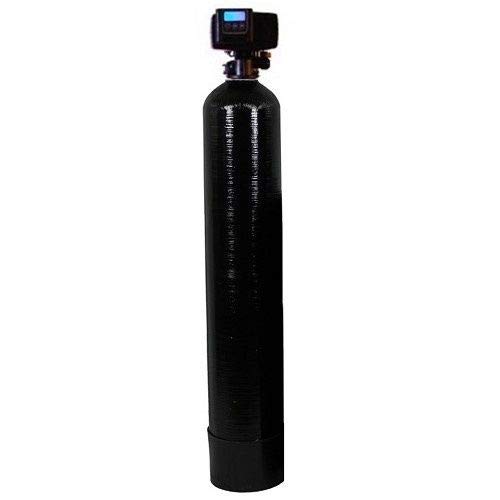
When well water contains serious iron levels — 5, 10, or even 12 parts per million — standard cartridge filters struggle to keep up. The DuraWater Black Series uses air injection technology that creates a pocket of compressed air inside the tank, super-oxidizing dissolved iron and hydrogen sulfide so they precipitate into solid particles that can be filtered out and flushed away during regeneration. This system is rated for iron up to 12 ppm, sulfur up to 10 ppm, and manganese up to 2 ppm.
Owners with notoriously problematic well water report immediate and dramatic results: orange stains on toilets disappear, metallic taste vanishes, and the rotten egg smell is gone after just a few regeneration cycles. The Fleck control head is programmable and handles automatic backwashing, typically every 3 days depending on water usage and contamination levels. The 10×54-inch tank has a relatively small footprint for the capability it provides.
The system requires a drain line for the regeneration cycle, and the tank needs a 30-gallon drain capacity for backwashing — this must be planned into the installation location. Some users reported initial issues with the Fleck control head’s gear mechanism, but DuraWater’s customer service was responsive in providing replacement parts. The unit does emit a slight gurgling sound during regeneration, which is normal but worth noting if the tank is installed near living spaces.
Why it’s great
- Air injection technology handles high iron loads up to 12 ppm
- Automatic regeneration removes trapped contaminants without manual work
- Fleck control head is programmable for customized backwash scheduling
- Eliminated iron stains and sulfur odors in verified well water installations
Good to know
- Requires a 30-gallon drain line for backwashing regeneration
- Some users reported faulty control head gears needed replacement
- Emits gurgling noise during the regeneration cycle
9. Aquasure AS-WHF72D Bundle with Water Softener & RO

The Aquasure AS-WHF72D is the most comprehensive solution in this guide, combining a whole house water filter, a 72,000-grain water softener, and a 75 GPD reverse osmosis system into one integrated bundle. For well owners with hard water and complex contamination, this eliminates the need to piece together multiple components. The pre-filter stage uses a sediment/GAC/zinc cartridge to catch sediment and chlorine, the softener removes calcium and magnesium, and the RO system polishes drinking water at the kitchen sink.
Customers with hard well water report that their water becomes noticeably soft and silky within a week, and the RO system produces drinking water measuring as low as 16 ppm TDS — effectively bottled water quality. The digital metered control head automatically tracks water usage and initiates regeneration only when needed, saving water and salt compared to timer-based units. The system is rated for households with 1-6 bathrooms, making it suitable for larger families.
The installation is not for the faint of heart — it involves integrating a whole house filter, a large brine tank, a softener unit, and an under-sink RO system. Many users recommend professional installation, which can add significantly to the overall cost. The RO system’s feed water adapter may not include the correct valve fitting for all setups, requiring a separate purchase. Despite these complexities, the all-in-one approach is often more cost-effective than buying separate components for comprehensive well water treatment.
Why it’s great
- All-in-one solution for iron, hardness, sediment, and drinking water
- 72,000-grain capacity handles large households with high water usage
- Digital metered control head regenerates based on actual consumption
- RO system produces drinking water at 16 ppm TDS or lower
Good to know
- Complex installation typically requires professional plumbing services
- RO system may not include the correct feed water adapter
- Large footprint requires significant floor space
FAQ
Do I need a UV sterilizer for well water with bacteria?
What is the difference between a 3-stage and a 10-stage whole house filter?
How often do I need to replace filters on a whole house well water system?
Can a whole house filter remove iron from well water completely?
Will a whole house filter lower my water pressure?
Final Thoughts: The Verdict
For most users, the whole house water filter for well water winner is the Express Water WH300SCKP because it combines KDF media for heavy metal reduction, anti-scale protection for hard water, and a high 17 GPM flow rate in a freestanding frame with real-time pressure monitoring. If you want targeted iron and sulfur removal without the complexity of a backwashing tank, grab the PRO+AQUA PRO-100-E with its CRK media and visible sediment housing. And for tackling extreme iron loads above 10 ppm, nothing beats the DuraWater Black Series air injection system for its ability to oxidize and flush away iron and hydrogen sulfide that standard cartridge filters cannot handle.