A professional chef knife lives or dies by its edge geometry and steel composition — two specs that separate a nimble tool from a frustrating wedge. The wrong blade turns prep work into a battle against resistance, bruised ingredients, and constant re-sharpening.
I’m Mohammad Maruf — the founder and writer behind AirfryerBite. I track the global cutlery market, analyze blade hardness (HRC) ratings, edge retention data, and cladding quality to separate marketing fluff from genuine professional-grade performance.
This guide focuses on the specific steel alloys, blade construction methods, and handle ergonomics that define the rated professional chef knives worth your investment.
How To Choose The Best Rated Professional Chef Knives
Selecting a professional chef knife means decoding steel type, blade construction, edge angle, and handle ergonomics — not chasing brand names or fancy patterns. These four factors determine whether a knife performs under daily prep volume or dulls within weeks.
Steel Alloy and Hardness (HRC)
The steel core dictates edge retention and ease of sharpening. VG-10 (58-60 HRC) offers a solid balance of toughness and corrosion resistance. SG2 micro-carbide powder steel (63 HRC) holds a finer edge longer but requires diamond abrasives for sharpening. High-carbon stainless steel from Solingen (56-58 HRC) is more ductile and forgiving for heavy chopping. Choose based on whether you prioritize edge longevity or ease of maintenance.
Blade Construction: Forged, Full-Tang, and Cladding
Fully forged blades from a single steel billet provide superior balance and durability compared to stamped alternatives. Full-tang construction — steel running through the entire handle — prevents breakage under lateral stress. Damascus cladding (68+ layers) adds visual appeal and some rust resistance, but the core steel is what determines cutting performance. A knife with a 8–12 degree edge angle delivers precision slicing; 15–20 degrees offers more chip resistance for heavy-duty work.
Quick Comparison
On smaller screens, swipe sideways to see the full table.
| Model | Category | Best For | Key Spec | Amazon |
|---|---|---|---|---|
| Miyabi Birchwood SG2 | Premium | Precision slicing | 9.5–12° Honbazuke edge | Amazon |
| Shun Classic Kiritsuke | Premium | Versatile all-purpose | VG-MAX + 68-layer Damascus | Amazon |
| WÜSTHOF Classic 2-Piece Set | Premium | Durable daily driver | PEtec 20% sharper edge | Amazon |
| ZWILLING PROFESSIONAL S | Mid-Range | Heavy chopping | Sigmaforge, FRIODUR ice-hardened | Amazon |
| Zwilling Chef’s Knife | Mid-Range | Ergonomic comfort | FRIODUR ice-hardened blade | Amazon |
| KYOKU Shogun Series | Mid-Range | Value with Damascus look | VG-10 core, 67-layer Damascus | Amazon |
| KnifeSaga 15-Piece Set | Budget | Complete starter kit | 10° edge, full-tang construction | Amazon |
In‑Depth Reviews
1. Miyabi Birchwood SG2 Japanese Chef’s Knife

The Miyabi Birchwood SG2 represents the upper limit of production chef knife performance, with SG2 micro-carbide powder steel hardened to 63 HRC. The three-step Honbazuke sharpening process produces a 9.5 to 12 degree edge — among the sharpest out-of-box edges available — that passes through tomatoes and bell peppers with almost zero resistance.
The 100-layer flower Damascus pattern is not decorative alone; the alternating layers improve corrosion resistance around the SG2 core. The Karelian birch handle is ergonomically contoured and treated with oil, though it requires routine conditioning to prevent staining. At 1.18 pounds, the knife feels light and nimble for extended prep sessions.
This knife is not for beginners or anyone who uses a dishwasher. The thin blade profile demands careful cutting technique — no prying, no bones, no frozen ingredients. For chefs who prioritize surgical precision and are willing to maintain the birch handle, this is a benchmark choice.
Why it’s great
- SG2 steel holds a razor edge significantly longer than VG-10
- Hand-honed edge angle delivers ultra-precise cuts
- Lightweight and perfectly balanced at the bolster
Good to know
- Birch handle requires oiling to maintain appearance
- No sheath included for storage
- Very brittle edge — not suitable for chopping bone or hard squash
2. Shun Classic 8″ Kiritsuke Knife

The Shun Classic Kiritsuke combines the flat profile of a nakiri with the curved tip of a chef knife, creating a versatile blade shape that excels at both push-cutting vegetables and rocking through herbs. The VG-MAX core — a proprietary vanadium-enriched steel — runs at 60 HRC and is clad in 68 layers of stainless Damascus for added toughness and visual depth.
The 16-degree edge angle is slightly more durable than the ultra-fine Miyabi edge while still delivering razor-sharp slices out of the box. The D-shaped Pakkawood handle fills the palm comfortably, and the knife weighs just 0.6 pounds, making it one of the lightest full-size chef knives in this class.
Shun offers free sharpening and honing services for the lifetime of the knife, which offsets the higher initial cost. The kiritsuke profile does have a mild rock curve that some Western cooks may find limiting for large-volume chopping, but it handles precise vegetable work and boneless protein portioning with ease.
Why it’s great
- VG-MAX core provides superior edge retention over standard VG-10
- Lifetime free sharpening from Shun adds long-term value
- Lightweight and nimble for extended prep sessions
Good to know
- Kiritsuke profile has limited rock for heavy chopping
- Hard edge can chip if used on bones or frozen food
- Hand wash only — Pakkawood handles warp in dishwashers
3. WÜSTHOF Classic 2-Piece Chef’s Knife Set

The WÜSTHOF Classic Series has been a benchmark for German knife-making for generations, and the 2-piece starter set delivers the same forged high-carbon stainless steel construction as the full line. Precision Edge Technology (PEtec) yields a blade that cuts 20 percent sharper than previous models and maintains that edge twice as long — a measurable improvement for daily commercial use.
The 8-inch chef knife and 3.5-inch paring knife cover 90 percent of kitchen prep tasks. The polypropylene handle is triple-riveted to the full tang, resists fading and heat, and offers a slightly heavier feel (0.85 pounds for the set) that helps power through root vegetables and dense squash. The 58 HRC hardness makes the edge less brittle than Japanese alternatives, so it withstands minor abuse without chipping.
The set is labeled dishwasher safe, though hand washing preserves the edge longer. The paring knife is often overlooked but functions well for peeling and detail work. For cooks who prefer a durable, less-fussy workhorse over a delicate slicer, WÜSTHOF remains a reliable choice.
Why it’s great
- PEtec edge stays sharp 2x longer than standard WÜSTHOF blades
- Full-tang, triple-riveted handle withstands heavy use
- Includes paring knife for complete prep coverage
Good to know
- Heavier than Japanese knives — may fatigue some users
- Out-of-box sharpness is good but not ultra-fine like Shun or Miyabi
- Polypropylene handle feels less premium than wood or Micarta
4. ZWILLING PROFESSIONAL S 8-Inch Chef’s Knife

The ZWILLING PROFESSIONAL S is forged from a single piece of special-formula high-carbon stainless steel using the Sigmaforge process, which ensures uniform density and balance throughout the blade. The FRIODUR ice-hardening treatment stabilizes the steel at -70°C, creating a blade that starts sharper and maintains its edge longer than standard heat-treated knives.
The ergonomic polymer handle with three rivets is bonded to the full tang and contours naturally to the palm. At 12.8 ounces, the knife has a substantial heft that powers through butternut squash and cabbage without excessive force. The laser-controlled edge angle (approximately 15 degrees) offers a practical balance of sharpness and durability for high-volume kitchens.
User feedback consistently highlights the handle fit and the knife’s ability to handle everything from garlic to chicken breakdown. The bolster at the blade heel provides a safe pinch-grip but creates a small gap that requires careful cleaning. For chefs who prefer a forged German profile with a thicker spine, this knife delivers reliable performance.
Why it’s great
- Sigmaforge one-piece construction ensures perfect balance
- FRIODUR treatment extends edge retention significantly
- Comfortable handle shape fits medium to large hands well
Good to know
- Bolster creates a gap that traps food particles
- Not the sharpest out of box; benefits from initial honing
- Heavier than many Japanese alternatives
5. Zwilling 31071-201-0 Chef’s Knife

This Zwilling model uses the same FRIODUR ice-hardening technology as the PROFESSIONAL S but in a stamped (not forged) construction, which reduces cost without sacrificing edge quality. The 7.87-inch blade is slightly shorter than the standard 8-inch, making it maneuverable for cooks with smaller hands or tighter cutting boards.
The plastic handle is ergonomically shaped to reduce fatigue during long prep sessions, though it lacks the full-tang feel of forged models. The stainless steel blade resists corrosion well and sharpens easily on standard whetstones. At just 308 grams, the knife is noticeably lighter than the PROFESSIONAL S. Users report it holds an edge well with regular honing and occasional sharpening.
The blade geometry features a slight belly that allows a comfortable rock chop, and the spine thickness is moderate — stiff enough for dense vegetables but not as robust as the forged Zwilling line. This knife is best suited for home cooks who want Zwilling reliability at a lower investment.
Why it’s great
- FRIODUR ice-hardened edge stays sharp with routine honing
- Lighter weight reduces wrist fatigue during long prep
- Ergonomic handle is comfortable for smaller hands
Good to know
- Stamped construction lacks the balance of forged knives
- Not as sharp out of box as Japanese alternatives
- Plastic handle feels less durable than full-tang designs
6. KYOKU Shogun Series VG-10 Damascus Chef Knife

The KYOKU Shogun Series delivers a VG-10 steel core clad in 67 layers of Damascus — a construction typically found in knives costing double. The blade is cryogenically treated at low temperatures to refine the steel grain structure, which improves edge stability and wear resistance. The 8–12 degree Honbazuke-style edge makes it extremely sharp out of the box, easily slicing through tomato skin without pressure.
The G10 fiberglass handle with a mosaic pin is moisture-resistant and withstands temperature swings better than untreated wood. At 1.39 pounds, the knife has a solid, balanced feel that inspires confidence during chopping. The included sheath and presentation case add value for gifting or storage.
Customer feedback over a year of use confirms the edge stays sharp with regular stropping. The blade clearance is sufficient for knuckle clearance during chopping, though the handle shape takes some adjustment for cooks used to Western curves. It is not dishwasher safe and requires hand washing to preserve the Damascus finish.
Why it’s great
- VG-10 core with 67-layer Damascus at a mid-range price point
- Cryogenic treatment improves edge stability
- Includes sheath and case for safe storage
Good to know
- G10 handle feels different from traditional wood or polymer
- Damascus pattern requires hand washing to avoid dulling
- Heavier than many Japanese knives of similar length
7. KnifeSaga 15-Piece Kitchen Knife Block Set
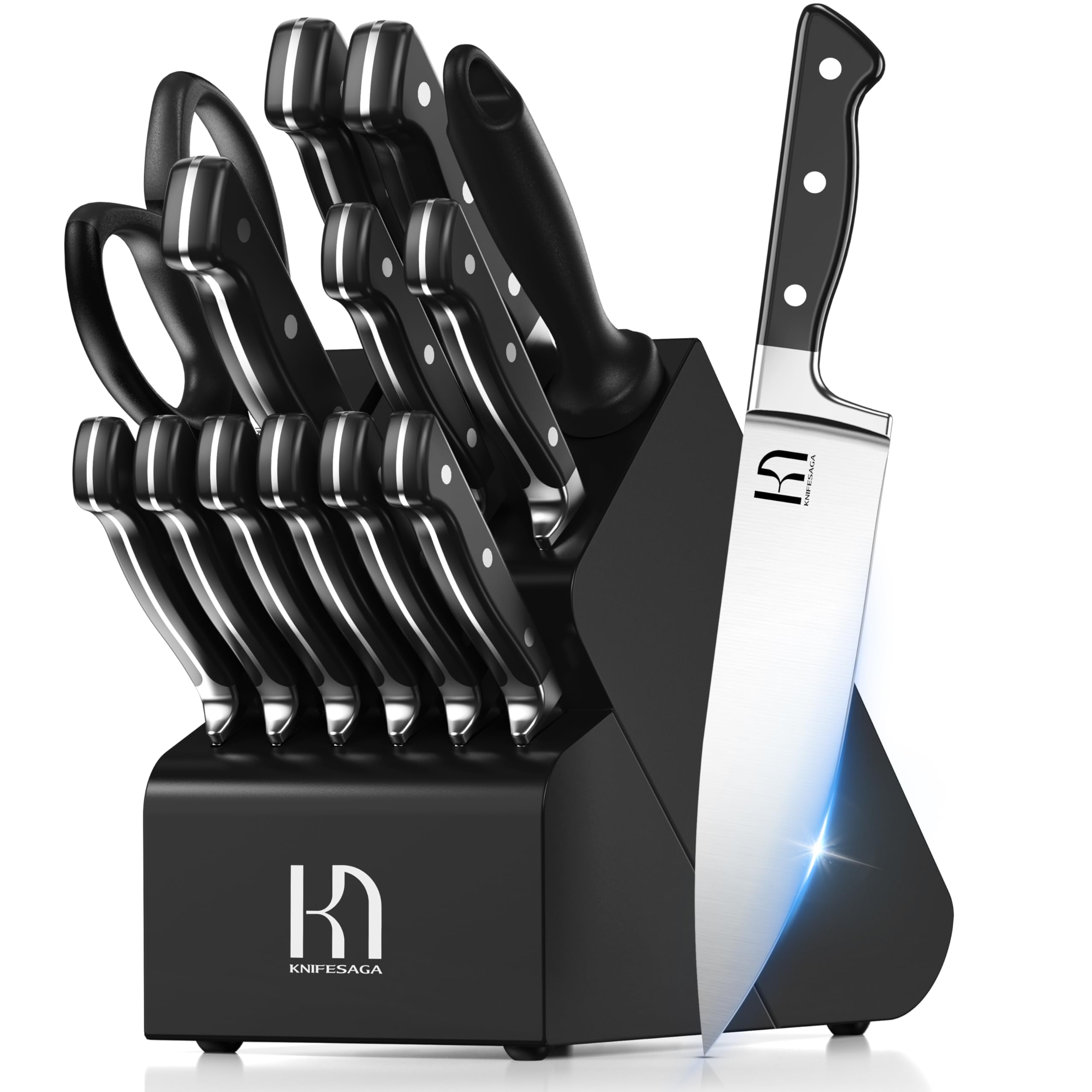
The KnifeSaga set provides 15 pieces including an 8-inch chef knife, 7-inch santoku, bread knife, boning knife, utility knife, paring knife, six steak knives, shears, and a sharpening steel — all housed in a solid wood block. The blades use high-carbon stainless steel with a 10-degree edge, cryogenic tempering, and full-tang construction, which is uncommon in a set at this tier.
Users consistently report the knives are very sharp out of the box and maintain their edge through several weeks of daily home use. The ergonomic handles with a non-slip bolster offer secure grip even with wet hands. The set covers nearly every kitchen task, making it a practical choice for cooks building a kit from scratch.
The knives are not dishwasher safe and the block takes up significant counter space (5 x 9.5 x 11 inches). The steak knives are non-serrated, which some users prefer for clean cuts, though they may require more frequent sharpening than serrated alternatives. The manufacturer offers a 100-day return policy and lifetime assurance, which adds confidence.
Why it’s great
- Full-tang construction and 10° edge at an entry-level price
- Covers 15 pieces including steak knives and shears
- Solid wood block keeps tools organized and accessible
Good to know
- Block occupies substantial counter space
- Not dishwasher safe; hand washing required
- Steel quality does not match forged VG-10 or SG2 knives
FAQ
Is a 60 HRC blade too brittle for professional kitchens?
What is the difference between VG-10, SG2, and high-carbon stainless steel?
Does Damascus cladding actually improve cutting performance?
Final Thoughts: The Verdict
For most users, the rated professional chef knives winner is the Shun Classic Kiritsuke because it combines a premium VG-MAX core, lightweight handling, and lifetime free sharpening in a versatile blade shape. If you want surgical precision and are willing to maintain a birch handle, grab the Miyabi Birchwood SG2. And for a durable, no-fuss workhorse that stands up to heavy chopping, nothing beats the WÜSTHOF Classic 2-Piece Set.