A knife that won’t cut is not just frustrating — it’s dangerous. Prying, sawing, and forcing a dull blade through an onion or a tomato is how most kitchen accidents happen. The fix isn’t buying a new knife; it’s owning the right sharpening system. A quality whetstone delivers the controlled abrasion needed to reshape and polish a blade’s apex, turning a push-cutter into a laser-slicer.
I’m Mohammad Maruf — the founder and writer behind AirfryerBite. I’ve spent years analyzing the engineering, grit composition, and real-world wear patterns of dozens of sharpening systems to separate the stones that actually hold their shape from those that dish out after a few passes.
Whether you’re maintaining a set of German-steel workhorses or a collection of high-hardness Japanese gyutos, the best whetstone knife sharpener balances grit range, structural integrity, and ease of use to keep every blade in your block at peak performance.
How To Choose The Best Whetstone Knife Sharpener
A whetstone is a simple slab of abrasive material, but the wrong choice leads to uneven wear, slow cutting, or edges that feel rough. Focus on these three factors to match a stone to your blade hardness and sharpening frequency.
Grit Range and Progression
A single stone rarely covers all tasks. Coarse grits (200–400) repair chips and set bevels. Medium grits (800–2000) refine the edge. Fine grits (3000–6000) polish and remove burrs. Ultra-fine grits (8000+) create a mirror finish. A dual-sided stone like 1000/6000 covers the most common sharpening and honing cycle without needing multiple stones.
Stone Composition and Hardness
Water stones (typically aluminum oxide or ceramic bond) cut fast and release fresh abrasive as they wear, but they dish quickly and require flattening. Oil stones (corundum or novaculite) are harder, wear slower, and need oil lubricant for best results. Softer water stones work well for high-hardness blades (above 60 HRC) because they cut without burning the edge. Harder stones suit carbon steel and softer stainless blades.
Included Accessories and Stabilization
A non-slip base or silicone mat prevents dangerous sliding during sharpening. Angle guides help beginners maintain a consistent 15° to 20° bevel. A flattening stone or dressing stone keeps the surface true. Complete kits that include a leather strop and polishing compound allow you to refine the edge beyond the stone’s finest grit.
Quick Comparison
On smaller screens, swipe sideways to see the full table.
| Model | Category | Best For | Key Spec | Amazon |
|---|---|---|---|---|
| Work Sharp Benchtop Whetstone | Water Stone System | Beginners needing angle guides | 1000 / 6000 grit, 15°/17° guides | Amazon |
| Goodjob Complete Kit | Multi-Stone Kit | Versatile edge progression | Four grits: 400/1000 + 3000/8000 | Amazon |
| King KDS 1000/6000 | Japanese Water Stone | High-hardness steel (60+ HRC) | 8″ x 2″ double-sided stone | Amazon |
| King 6000 Grit | Single Fine Stone | Honing and polishing | 6000 grit ceramic stone | Amazon |
| Norton Combination Oil Stone | Oil Stone | Durable, low-wear sharpening | 100 / 280 grit corundum | Amazon |
In‑Depth Reviews
1. Work Sharp Benchtop Whetstone Knife Sharpener

The Work Sharp Benchtop system is the closest thing to a complete sharpening station built around a water stone. The 1000-grit side sets a clean bevel quickly on carbon and stainless blades, while the 6000-grit side refines that edge to a hair-popping polish. What separates this from a standalone stone is the integrated water control base: it keeps the stone saturated, contains the slurry mess, and doubles as storage.
The magnetic angle guides lock onto the blade at 15° or 17° — the two most common kitchen knife bevels — which eliminates the guesswork that trips up beginners. The included anti-skid mat holds everything in place during aggressive passes. At roughly mid-range pricing, this kit delivers a level of consistency that typically requires buying a stone, a separate base, and a guide system.
Experienced sharpeners can remove the guides entirely and use the stone freehand. The aluminum oxide stone is softer than many oil stones, meaning it cuts fast and releases fresh grit, but it will dish over time and needs periodic flattening. Work Sharp’s limited lifetime warranty adds long-term confidence for a tool that sees frequent use.
Why it’s great
- Magnetic angle guides lock firmly at 15° or 17° for repeatable bevels
- Water control base reduces mess and keeps stone wet during sharpening
- Dual 1000/6000 grit covers the full sharpen-to-hone cycle
Good to know
- Base is plastic; feels less premium than the stone itself
- Stone requires flattening over time as it dishes unevenly
2. Goodjob Premium Whetstone Kit

The Goodjob kit is built for the cook who wants every grit step in one box. Two dual-sided stones deliver four grit levels: 400 for heavy repair, 1000 for bevel setting, 3000 for edge refinement, and 8000 for a polished, near-mirror finish. The 400 side chews through damaged edge profiles quickly, while the 8000 side produces the kind of slick edge that glides through tomato skin without pressure.
Beyond the stones, the kit includes a bamboo base with a silicone non-slip pad, a honing guide with an angle guide, cut-resistant gloves, two leather strops, and green polishing compound. The bamboo base is wider than most aftermarket stands, giving you a stable platform that won’t slide during the push stroke. The honing guide is a simple clip-on that works well for standard-width kitchen blades.
The white corundum stones are fired using Japanese production techniques, and they resist dishing better than softer King stones. The 8000-grit surface does need a brief soak before use, but it releases abrasive fast enough to polish a blade in under a dozen passes. This is a strong mid-range option for anyone who wants a complete sharpening ecosystem without buying components separately.
Why it’s great
- Four distinct grits allow full edge repair through mirror polishing
- Bamboo base with silicone pad provides excellent non-slip stability
- Leather strops and green compound included for finishing burr removal
Good to know
- Brand logo on stone surface creates slight roughness; light sanding helps
- Medium stones cut slower on softer stainless kitchen knives
3. King KDS Whetstone 1000/6000 Grit

The King KDS is a benchmark Japanese water stone that has earned a loyal following among home cooks and professional sharpeners alike. The 1000-grit side is aggressive enough to raise a burr on dull German and Japanese knives in a few minutes, and it generates a beneficial slurry that speeds cutting. The 6000-grit side operates as a splash-and-go stone — no soaking required — and produces a bright, near-mirror finish that reduces drag through food.
At 8 inches long and 2 inches wide, the KDS has more surface area than smaller King models, making it easier to sharpen long blades like 10-inch chef’s knives and 12-inch slicers. The stone is softer than oil stones, which means it cuts fast but dishes more quickly. Frequent flattening with a dressing stone is necessary to maintain a flat working surface, especially if you sharpen multiple knives per session.
The KDS requires a brief soak for the 1000-grit side — usually until bubbles stop — while the 6000 side needs only a splash of water. The stone has a distinct mineral smell when wet that fades over time. For mid-range pricing, this is the most proven dual-grit water stone available for users who already have a non-slip base and angle guide.
Why it’s great
- Large 8″ x 2″ surface accommodates long chef’s knives easily
- 6000 side splash-and-go — no soaking for quick honing
- Proven soft bond cuts fast on high-hardness steel (60+ HRC)
Good to know
- Soft stone dishes quickly; requires regular flattening
- Chemical/mineral smell during use can be unpleasant for some
4. King 6000 Grit Whetstone
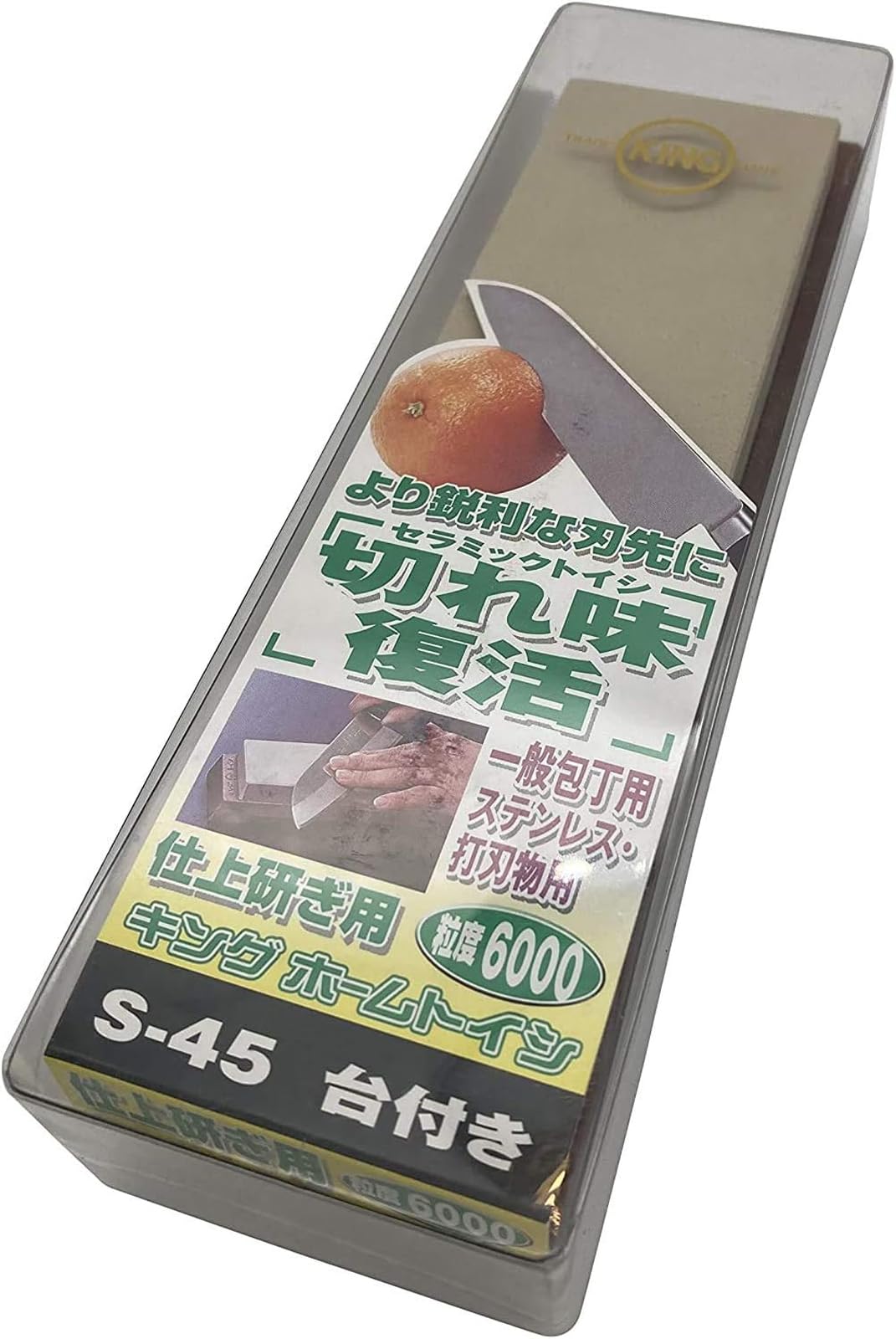
The King HT-43 is a dedicated 6000-grit ceramic water stone built for one job: turning a sharp edge into a buttery-smooth polished apex. After bevel-setting on a coarser stone, the King 6000 refines the scratch pattern and removes the burr left by medium grits. The result is an edge that slices paper with zero snag and deflects light evenly along the entire bevel.
This is not a stand-alone sharpening stone — you need a lower-grit stone (1000 or 2000) to establish the bevel first. But as a finishing stone, it excels on high-carbon and stainless kitchen blades. The ceramic bond is consistent, and the stone releases abrasive steadily without glazing. It requires soaking until bubbles stop, then produces a slurry that polishes as it cuts.
The stone measures 7 inches by 1 inch, so it’s narrower than the King KDS. You will need to use the full length of the stone for each stroke on larger knives. The included non-slip base helps stabilize the stone, though some users add a damp rag underneath for extra grip. At entry-level pricing for a dedicated fine stone, this is an economical way to upgrade your edge finish without buying a full multi-stone system.
Why it’s great
- Produces a mirror-like polish that reduces cutting drag
- Removes burrs from 1000–2000 grit sharpening effectively
- Budget-friendly way to add a fine finishing stone to an existing setup
Good to know
- Requires full soaking; not a splash-and-go stone
- Stone is narrow (1 inch); slower for wide chef’s knives
5. Norton Combination Oil Stone

The Norton Combination Oil Stone is a traditional sharpening tool that uses oil as lubricant instead of water. The 100-grit coarse side removes metal aggressively — ideal for repairing chipped edges, resetting bevels on heavily damaged knives, or sharpening thick blades like hatchets and hunting knives. The 280-grit fine side refines the edge to a working sharpness suitable for most kitchen tasks.
Unlike water stones, the Norton corundum stone is extremely hard and wears slowly. It does not need soaking or drying; you simply apply a thin layer of honing oil or even WD-40 and start sharpening. The lack of slurry means less mess, and the steel swarf wipes off easily with a rag. For users who process game, butcher regularly, or maintain outdoor tools, this stone’s durability outlasts soft water stones many times over.
The trade-off is speed: oil stones cut slower than water stones of equivalent grit, so you will spend more time on the 280 side to achieve a keen edge. The fine side is closer to a medium finish, and most users follow up with a 1000-grit stone and a strop for a truly sharp kitchen edge. At entry-level pricing for a stone that resists dishing nearly indefinitely, this is a strong choice for high-volume or heavy-duty sharpening.
Why it’s great
- Extremely hard stone resists dishing and surface wear
- No soaking required; use with oil or WD-40 and wipe clean
- 100-grit side repairs chips and sets new bevels quickly
Good to know
- 280 side is not fine enough for a polished kitchen edge alone
- Cuts slower than water stones; needs more passes for same result
FAQ
Do I need to soak a water stone before using it?
Can I use a 6000-grit stone as my only sharpening stone?
What is the difference between a water stone and an oil stone?
How often should I flatten my whetstone?
Is a whetstone better than an electric knife sharpener?
Final Thoughts: The Verdict
For most users, the best whetstone knife sharpener winner is the Work Sharp Benchtop Whetstone because it bundles a quality 1000/6000 water stone with magnetic angle guides and a water control base — removing the biggest barriers beginners face while still permitting freehand sharpening as skills improve. If you want a full progression from coarse repair to mirror polishing in one kit, grab the Goodjob Premium Whetstone Kit. And for pure polishing power at an entry-level price, nothing beats the King 6000 Grit Whetstone as a finishing stone alongside a medium grit setup.