A sourdough loaf pan is not just a baking vessel—it is the single variable separating a flat, dense brick from a tall, airy loaf with a shattering crust. The thermal mass of the pan, the lid’s ability to trap steam, and the material’s heat conductivity determine whether your starter’s labor pays off. A standard aluminum pan cannot replicate the steam-baking environment that yields professional crumb structure.
I’m Mohammad Maruf — the founder and writer behind AirfryerBite. I cross-reference tensile strength ratings, seasoning protocols, and real-world oven-spring outcomes from hundreds of verified baking reviews to isolate the pans that deliver consistent results batch after batch.
Choosing the wrong pan means wasting time, ingredients, and a mature starter you have fed for weeks. This guide cuts through the marketing noise to deliver the definitive best sourdough loaf pan selections based on measurable thermal performance and durability.
How To Choose The Best Sourdough Loaf Pan
A sourdough loaf pan is a thermal chamber. The material, wall thickness, and lid mechanism dictate how much steam stays trapped during the first 20 minutes of baking—the critical window for oven spring. Prioritize mass over marketing: a lightweight pan cannot hold enough heat to maintain a steady internal temperature when the cold dough hits it.
Material Matters: Cast Iron vs. Stainless Steel vs. Enameled
Cast iron dominates sourdough because its volumetric heat capacity prevents temperature drop when loaded with cold dough. Stainless steel heats faster but loses thermal energy faster, often producing a paler bottom crust. Enameled cast iron offers the same thermal performance as bare cast iron but eliminates the need for seasoning—though the enamel rim can chip over time if not handled carefully.
Lid Design and Steam Trapping
An uncovered loaf pan releases steam into the oven cavity, preventing the crust from staying supple during the spring phase. A tight-fitting lid creates a micro-environment where the dough’s own moisture creates a humid atmosphere. This steam delays crust set, allowing the loaf to expand upward and outward before the outer layer hardens. Without a lid, expect a shorter, denser final loaf.
Dimensions and Dough Capacity
A standard 9×5 inch pan works for recipes using 400 to 500 grams of flour. For higher-hydration doughs or larger batches, seek deeper pans with taller sidewalls—at least 3 inches deep. The inner bottom width matters more than the top rim: a narrow base restricts lateral expansion and forces the dough to rise upward only, which can produce a mushroom-top loaf if the dough exceeds the pan’s capacity.
Quick Comparison
On smaller screens, swipe sideways to see the full table.
| Model | Category | Best For | Key Spec | Amazon |
|---|---|---|---|---|
| KooK Dutch Oven | Enameled Cast Iron | Batch bakers who want dishwasher convenience | 3.4 qt / oven-safe to 500°F | Amazon |
| Navaris Long Bread Pan | Bare Cast Iron | Traditionalists who want tall, narrow sandwich loaves | 13.4″ long x 5.3″ tall | Amazon |
| AILITOR 2-Piece Set | Bare Cast Iron | Bakers who want two pans for the price of one | 10.4 lb total / includes gloves + recipe book | Amazon |
| Articasting Cast Iron Loaf Pan | Bare Cast Iron | Entry-level cast iron adopters wanting a lid | 5.8 qt / pre-seasoned | Amazon |
| LIANYU 4-Pack Stainless | Stainless Steel | Cottage bakers needing multiple pans on a budget | 2.5″ deep / dishwasher safe | Amazon |
In‑Depth Reviews
1. KooK Dutch Oven, Enameled Cast Iron

The KooK Dutch oven is built around the specific needs of sourdough bakers: a 3.4-quart capacity with high vertical walls and a domed lid that traps steam without restricting upward expansion. The enameled interior eliminates the need for seasoning while still delivering the heat retention of cast iron—it reaches and holds 500°F without thermal shock. Multiple verified bakers report achieving a full 30% oven spring when using the cold-start method, loading the dough into a room-temperature pot and placing it directly into a preheated oven.
The included lid lever is a thoughtful addition that prevents steam burns when releasing pressure mid-bake. The oval shape accommodates batard-style loaves better than square pans, and the smooth enamel surface means cleanup requires only a quick soak—the manufacturer confirms dishwasher safety, though hand-washing extends the enamel lifespan. One minor drawback: the enamel rim is uncoated, which can show minor cosmetic wear over years of use, but this does not affect baking performance.
For batch bakers who want consistent results without the ritual of seasoning, this pan is the most turnkey solution on the market. It also doubles as a stovetop braiser, making it a multi-functional investment rather than a single-purpose tool.
Why it’s great
- Enameled surface resists sticking without seasoning
- Domed lid creates superior steam environment for oven spring
- Dishwasher safe for fast cleanup between batches
Good to know
- Oval shape doesn’t fit standard Pullman-style sandwich slices
- Enamel rim can develop cosmetic wear over time
2. Navaris Long Bread Pan, Bare Cast Iron

The Navaris pan is engineered for bakers who prioritize height over width: its narrow 5.1-inch width forces the dough to rise vertically rather than spread, producing dramatically tall sandwich loaves with a tight, even crumb. The bare cast iron interior, when properly seasoned, builds a natural non-stick patina that improves with each bake—users report that after five to six uses, loaves release without any parchment or oil. The lid fits snugly, creating a sealed chamber that holds steam for the first 25 minutes of baking.
The elongated shape (13.4 inches long) is ideal for large batches of sandwich bread or for stretching out high-hydration doughs that need lengthwise expansion. The pan’s weight—over 11 pounds—means it will not warp or buckle even at 475°F. The trade-off is storage: this pan takes up significantly more cabinet space than a standard 9×5, and the narrow interior can be difficult to clean by hand if residue builds up in the corners. Multiple reviewers who have baked hundreds of loaves in this pan confirm it holds its seasoning better than cheaper cast iron alternatives.
If your goal is the tallest sourdough sandwich loaf your oven can produce, this pan is the format you need. It also works well for German rye breads that require long, slow bakes in a humid environment.
Why it’s great
- Narrow width forces tall, even vertical rise
- Seasoning improves with each use for non-stick release
- Lid creates full steam chamber for maximum oven spring
Good to know
- Large footprint requires dedicated storage space
- Heavy construction makes handling awkward for some users
3. AILITOR Cast Iron Loaf Pan with Lid 2-Piece Set

The AILITOR set provides two identical 9×5-inch cast iron pans that can be used independently or stacked together to form a single Dutch oven-style baking chamber. Each pan weighs approximately five pounds—heavier than standard cast iron loaf pans but still manageable for most bakers. The pre-seasoned vegetable oil coating provides decent initial release, though multiple users recommend one additional home-seasoning cycle with flaxseed oil before the first bake to maximize non-stick performance for high-hydration sourdough.
When stacked lid-style, the two pans create a sealed environment that traps steam as effectively as a dedicated Dutch oven, producing a deep golden crust with a soft, aerated crumb. The set includes a recipe book and protective oven mitts, which add practical value for bakers new to cast iron. The primary limitation is the internal height: at 3.15 inches deep, very large boules or high-hydration batters may touch the lid during the spring phase, slightly flattening the top crust. Reviewers who bake standard 450-gram flour recipes report no such issues.
This set is the most cost-effective way to equip a kitchen with two cast iron loaf pans without buying separate lids. The dual functionality—two pans for simultaneous baking or one stacked chamber for steam—makes it adaptable to different recipes and batch sizes.
Why it’s great
- Two pans for price of one with stacking lid option
- Pre-seasoned base reduces initial setup work
- Includes oven mitts and recipe book for beginners
Good to know
- Internal depth limits very large loaf sizes
- Requires thorough drying to prevent rust spots
4. Articasting Cast Iron Loaf Pan with Lid
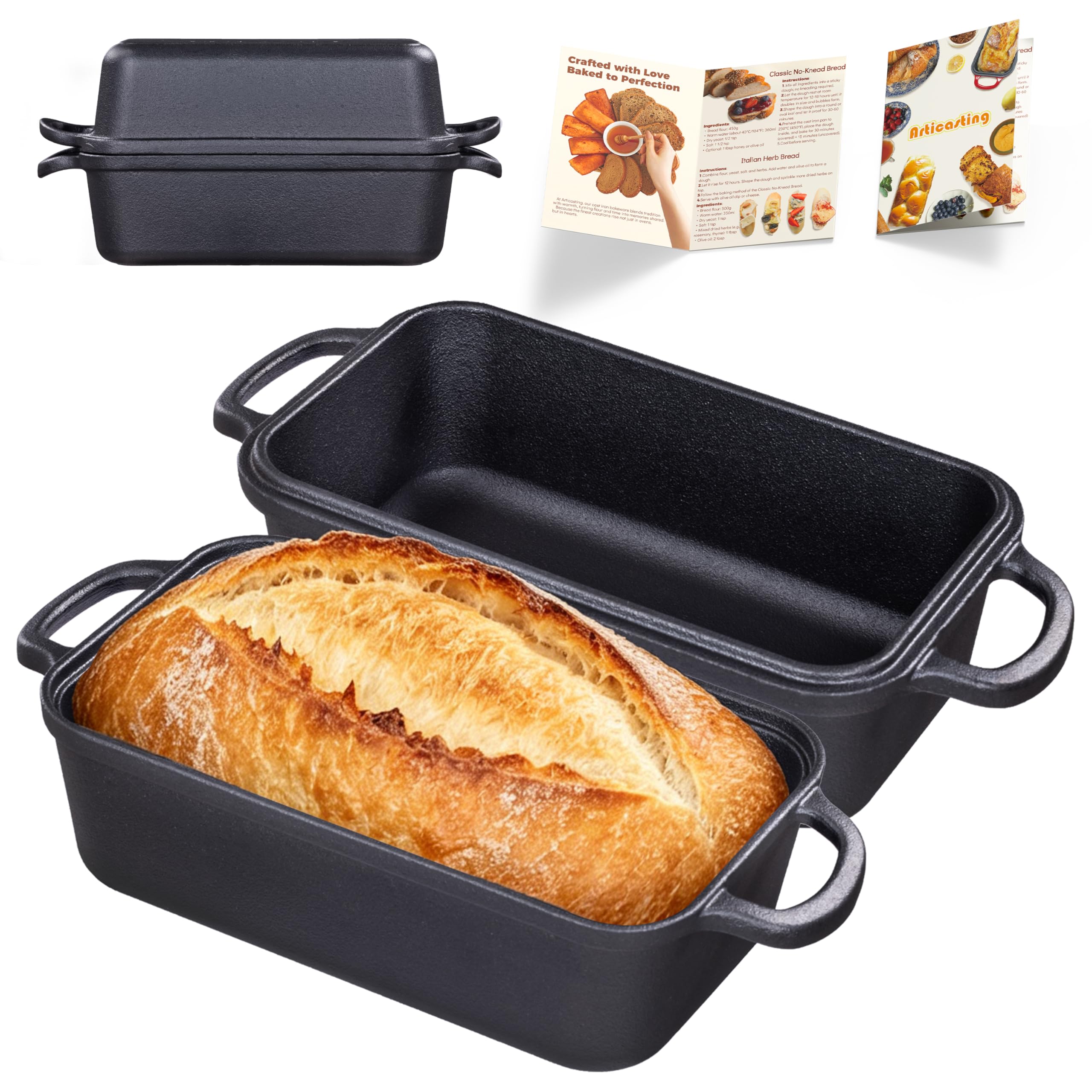
The Articasting pan is the lowest-cost entry point into the world of cast iron loaf pans with a dedicated lid. The 5.8-quart capacity is generous enough for large boules or loaves made with 600 grams of flour, and the pre-seasoning provides adequate release for most sourdough recipes out of the box. The lid fits securely with integrated handles that make it easy to maneuver the heavy pan in and out of the oven without dropping the lid.
Customer feedback consistently highlights the even browning across the bottom and sides of the loaf—a result of the thick cast iron construction that eliminates hot spots. The main caveat is that the pre-seasoning is minimal; multiple reviewers noted that the first few bakes required liberal parchment paper use to prevent sticking, and the pan benefits from an additional round of seasoning in a 400°F oven with a thin layer of vegetable oil. The pan is also not dishwasher safe and requires hand washing with immediate thorough drying to avoid surface rust.
For bakers who want to test cast iron without investing in premium enamel or multiple pans, this unit delivers the essential thermal performance at a low barrier to entry. The lid alone is worth the price—it transforms any standard loaf into a steam-baked artisan product.
Why it’s great
- Large 5.8 qt capacity fits big sourdough boules
- Integrated lid handles simplify oven handling
- Pre-seasoned base ready for immediate use with parchment
Good to know
- Pre-seasoning is light—additional conditioning recommended
- Not dishwasher safe; requires thorough hand drying
5. LIANYU 4-Pack Stainless Steel Loaf Pans

The LIANYU 4-pack offers the lowest per-pan cost for bakers who need multiple vessels simultaneously—cottage bakers running four loaves at once, or home bakers prepping different breads for a single bake day. The 18/0 stainless steel construction is nickel-free and non-toxic, with no chemical coating that could peel or off-gas at high temperatures. The pans measure 9x5x2.5 inches, a standard format that fits most recipes calling for 400 to 450 grams of flour.
Stainless steel cannot match cast iron for thermal mass, so these pans will produce a slightly paler bottom crust and less pronounced oven spring. The manufacturer explicitly recommends using grease or parchment paper to prevent sticking, as the bare steel surface lacks any non-stick properties. The reinforced rolled edges resist warping under standard oven temperatures, and the pans stack neatly for compact storage. Verified buyers running small bakeries report baking up to 12 loaves in a single rotation across multiple pans without any structural failure.
This set is the right choice when budget dominates and the volume of output matters more than achieving the ultimate crust texture. The dishwasher-safe construction drastically reduces cleanup time for high-volume bakers.
Why it’s great
- Four pans included for simultaneous large-batch baking
- Nickel-free stainless steel—no chemical coating risk
- Dishwasher safe for fast bulk cleanup
Good to know
- Lower thermal mass means reduced oven spring vs. cast iron
- No non-stick surface—parchment paper recommended every time
FAQ
Can I use a standard Pullman pan for sourdough?
How do I prevent my sourdough from sticking to a bare cast iron pan?
Final Thoughts: The Verdict
For most users, the best sourdough loaf pan winner is the KooK Dutch Oven because it combines the thermal performance of cast iron with a maintenance-free enamel surface and a lid designed specifically for steam baking. If you want the tallest possible sandwich loaves with dramatic vertical rise, grab the Navaris Long Bread Pan. And for high-volume bakers who need multiple pans at the lowest cost, nothing beats the LIANYU 4-Pack for raw throughput.