A paring knife is the extension of your fingertips—the tool for every delicate task a chef’s knife is too bulky to handle. Peeling an apple, deveining shrimp, or hulling strawberries, this short-blade companion determines whether prep work feels like a chore or a craft. The wrong choice leaves you fighting a dull edge or an unbalanced handle; the right one disappears into your hand and makes every cut effortless.
I’m Mohammad Maruf — the founder and writer behind AirfryerBite. I’ve spent years analyzing kitchen hardware specifications, cross-referencing blade geometry, steel composition, handle ergonomics, and real-world performance data to separate marketing claims from genuine quality in the cutlery market.
This guide presents a carefully curated selection of the best paring knives across different categories, focusing on edge retention, balance, and handle comfort. Whether you need a workhorse for daily meal prep or a precision tool for intricate garnishes, you’ll find your ideal paring knife here.
How To Choose The Best Paring Knife
Selecting a paring knife involves more than picking the sharpest-looking blade. The interplay of steel composition, handle shape, weight distribution, and blade geometry determines whether the knife becomes a daily favorite or a drawer dweller. These are the critical factors to evaluate before buying.
Blade Steel and Edge Retention
The steel composition dictates how often you sharpen and how fine an edge you can achieve. High-carbon stainless steel offers the ideal balance: it’s hard enough to hold a razor edge for extended use but resists corrosion better than pure carbon steel. Look for blades stamped with X50CrMoV15 or similar German cutlery steel—these alloys include vanadium and molybdenum to refine grain structure and improve wear resistance. Japanese stainless steels like the molybdenum/vanadium alloy used by Global deliver exceptional hardness (around HRC 58-60) but require more careful maintenance to avoid chipping.
Handle Ergonomics and Grip
A paring knife is used with the blade tip pointing toward the user and the handle resting in the palm—precision work that demands a secure, non-fatiguing grip. Thermo-elastic rubber handles like Victorinox’s Fibrox provide excellent slip resistance even when wet. Delrin or polypropylene handles, like those on the WÜSTHOF Gourmet, are less grippy but highly durable and easy to keep clean. For cooks who prefer a full-metal handle, the one-piece stainless steel construction of Global knives eliminates crevices where food debris can hide but can become slippery when wet and more fatiguing during long sessions.
Blade Length and Shape
Standard paring knife blades range from 2.5 to 4 inches. A 3-inch blade is ideal for fine tasks like coring strawberries, peeling shallots, and trimming green beans—the shorter edge gives maximum control. A 4-inch blade offers more coverage for larger fruits and vegetables, making it a better choice for peeling apples or slicing medium-sized produce. Clip-point blades, like the WÜSTHOF Gourmet’s design, add a curved tip that excels at carving and peeling around curved surfaces. Spear-point or sheepsfoot blades are better for slicing against a cutting board without piercing the tip through the food.
Quick Comparison
On smaller screens, swipe sideways to see the full table.
| Model | Category | Best For | Key Spec | Amazon |
|---|---|---|---|---|
| Mercer Culinary Renaissance 3.5″ | Forged | Overall value & professional feel | 3.5″ high-carbon German steel blade | Amazon |
| Victorinox Fibrox 4″ | Stamped | Dishwasher-safe & heavy daily use | 4″ stainless steel, NSF certified | Amazon |
| WÜSTHOF Gourmet 3″ | Punched | Premium precision & clip-point | 3″ high-carbon stainless clip point | Amazon |
| Rada Cutlery 4-Piece Set | Stamped | Variety with left-friendly edges | 3″ hollow-ground, T420 steel | Amazon |
| Global GSF-46 3″ | Stamped | Lightweight finesse & Japanese steel | 3″ molybdenum/vanadium stainless | Amazon |
In‑Depth Reviews
1. Mercer Culinary Renaissance 3.5-Inch Forged Paring Knife

The Mercer Culinary Renaissance 3.5-inch paring knife delivers a forged build and high-carbon German steel at a price that undercuts premium brands by a wide margin. The triple-riveted handle combines Delrin with a Santoprene inlay—the Santoprene provides a tactile, cushioned grip along the spine while the Delrin frame resists moisture absorption and physical wear. The blade is precision-stamped from X50CrMoV15 steel, then full-tang forged to create a seamless transition between blade and bolster, giving the knife a balanced heft that feels far more expensive than its mid-range price tag.
Edge performance is where this knife earns its reputation. Out of the box, the blade arrives shaving-sharp, and owners report it maintains its factory edge for months of daily use. The 3.5-inch length is a practical compromise between the maneuverability of a 3-inch blade and the coverage of a 4-inch, making it equally adept at coring tomatoes, trimming green beans, and slicing mangoes. The rounded spine reduces pressure points during extended prep sessions—a detail often overlooked in budget knives.
The knife is not dishwasher safe, which is standard for forged blades, but the handle’s smooth surfaces make hand-washing straightforward. For home cooks who want professional-grade edge retention and balanced ergonomics without spending on German flagship lines, this Renaissance knife is the logical choice. It consistently outlasts stamped alternatives in edge longevity and feels more substantial during heavy use.
Why it’s great
- Forged high-carbon steel holds a razor edge for months with minimal maintenance
- Santoprene-inlay handle offers secure grip even when handling oily or wet ingredients
- Price-to-performance ratio rivals knives costing twice as much
Good to know
- Not dishwasher safe—requires hand-washing to preserve the blade and handle integrity
- Heavier than stamped alternatives, which some users with smaller hands may find fatiguing
2. Victorinox Fibrox 4-Inch Paring Knife

The Victorinox Fibrox 4-inch paring knife is the most widely recommended budget-friendly option in commercial kitchens, and for good reason. Its stamped stainless steel blade is thin enough for precise slicing yet rigid enough to handle dense produce like butternut squash or potatoes. The Fibrox handle is made from thermoplastic rubber that becomes more grippy when wet—an important safety feature when your hands are covered in fruit juice or grease. The entire knife is NSF certified and dishwasher safe, making it the rare paring knife that can survive repeated commercial sanitization cycles without degrading the handle material.
At 4 inches, the blade provides more cutting surface than typical paring knives. This extra length is especially useful for peeling larger fruits like apples and pears, where you want a single, continuous stroke from stem to base. The edge arrives factory-sharp and responds well to honing steel. Users who own the matching Fibrox boning knife note that both blades stay sharp for weeks of heavy use before needing a touch-up on whetstone. The stamped construction keeps the knife lightweight—just over 2.5 ounces—which reduces wrist strain during long prep sessions.
The trade-off is that the Fibrox lacks the heft and premium feel of forged knives. The handle profile is wide and utilitarian, not ergonomically contoured for small hands. But for cooks who prioritize durability, easy maintenance, and a slip-resistant grip above all else, this Victorinox delivers consistent performance that has made it an industry standard. It is not the knife you reach for when you want a luxurious cutting experience; it is the knife you reach for when you need reliable results every single day.
Why it’s great
- Dishwasher-safe construction with NSF certification for commercial-grade hygiene
- Thermoplastic rubber handle becomes more grippy when wet, reducing slip accidents
- 4-inch blade provides extra coverage for larger fruits and vegetables
Good to know
- Stamped blade lacks the heft and balance of forged alternatives
- Handle profile is wide and may feel bulky for users with smaller hands
3. WÜSTHOF Gourmet 3-Inch Clip Point Paring Knife

The WÜSTHOF Gourmet 3-inch clip-point paring knife represents German engineering refined through seven generations of knife-making. The blade is crafted from high-carbon stainless steel, precision-punched from a single sheet, then laser-cut and honed to a razor edge. The clip-point design—where the blade’s spine curves downward near the tip—creates a sharp, acute angle that excels at carving into curved surfaces. This makes it especially effective for peeling apples, coring peppers, and trimming the membrane off citrus segments without shredding the flesh.
The handle is made from polypropylene and is noticeably lighter than WÜSTHOF’s Classic line, which features a full metal bolster. Some users accustomed to the heavier Classic series note that the Gourmet feels almost airy in comparison, but this lightness translates to reduced wrist fatigue during extended fine-dicing sessions. The 3-inch blade length is ideal for intricate tasks: hulling strawberries, deveining shrimp, or making decorative garnishes. The edge arrives extremely sharp and, with proper honing, retains its aggression through months of home use before requiring a full sharpening.
One trade-off is that the stamped construction means the blade is thinner than fully forged options, which can flex slightly under heavy lateral pressure—not ideal for prying apart chicken bones or splitting hard squash. The handle’s polypropylene surface is less grippy than rubberized alternatives when wet. Still, for cooks who want the precision of a short, razor-sharp clip-point blade backed by WÜSTHOF’s lifetime warranty, this Gourmet knife delivers a level of control that justifies its premium mid-range price.
Why it’s great
- Clip-point blade excels at peeling and carving around curved produce surfaces
- Laser-cut edge arrives exceptionally sharp and holds aggression with regular honing
- Lightweight handle reduces wrist fatigue during extended precision work
Good to know
- Stamped blade can flex under heavy lateral pressure—avoid prying tasks
- Polypropylene handle lacks wet-grip performance compared to rubberized alternatives
4. Rada Cutlery 4-Piece Paring Knife Set
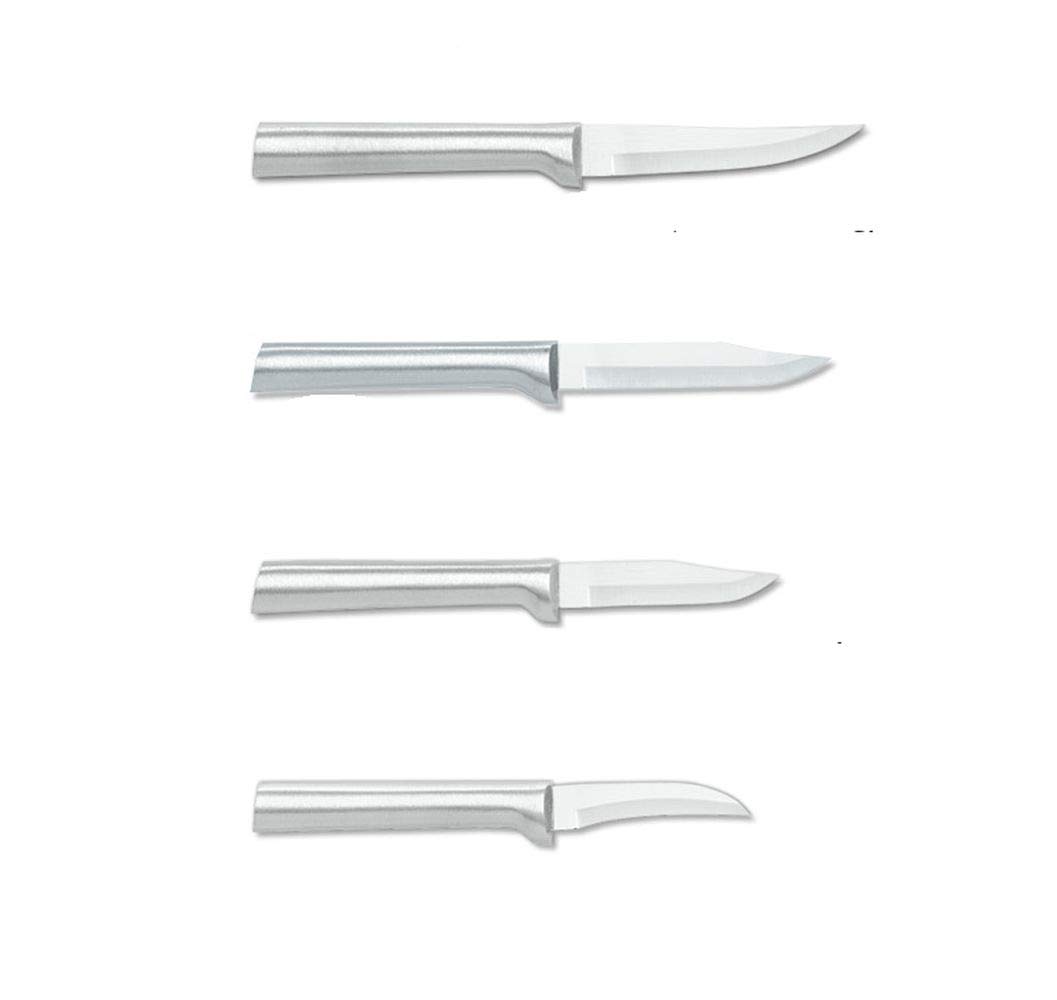
Rada Cutlery’s 4-piece paring knife set offers a unique value proposition: four different blade shapes—granny, regular, peeling, and heavy-duty—each specialized for a specific paring task. All blades are made from T420 high-carbon stainless steel, hollow-ground to create a concave bevel that produces an exceptionally sharp edge. The handles are permanently cast brushed aluminum with a satin finish, a design that has remained largely unchanged for decades. This set is made entirely in the USA, from raw material sourcing through final assembly, an increasingly rare claim in the cutlery industry.
The hollow-ground geometry means the blade is thin behind the edge, which reduces friction when slicing through soft fruits like tomatoes or peaches. The granny knife, with its curved blade, is particularly effective for peeling round produce in a single motion. The heavy-duty knife has a thicker spine for tasks like splitting small avocados or cutting through cheese. The aluminum handles are rigid and easy to clean but have no grip texture; they can become slippery when wet, and the metal conducts temperature, making them cold to the touch straight from the drawer.
These knives are hand-wash only—dishwashing erodes the hollow-ground edge and dulls the aluminum finish. Users with small hands note that the handles are proportionally slim, which improves control for delicate work. The set is especially popular among left-handed users because the double-filed edge is symmetrical, providing an even cut regardless of hand orientation. For cooks who want a range of specialized blades in one purchase, this Rada set delivers versatility that single-knife purchases cannot match.
Why it’s great
- Four specialized blade shapes cover every paring task from peeling to heavy-duty cutting
- Double-filed edge is equally effective for left- and right-handed users
- American-made construction with high-carbon stainless steel and hollow-ground edge
Good to know
- Aluminum handles become slippery when wet and conduct cold from the drawer
- Not dishwasher safe; hollow-ground edge degrades rapidly in a dishwasher cycle
5. Global GSF-46 3-Inch Paring Knife
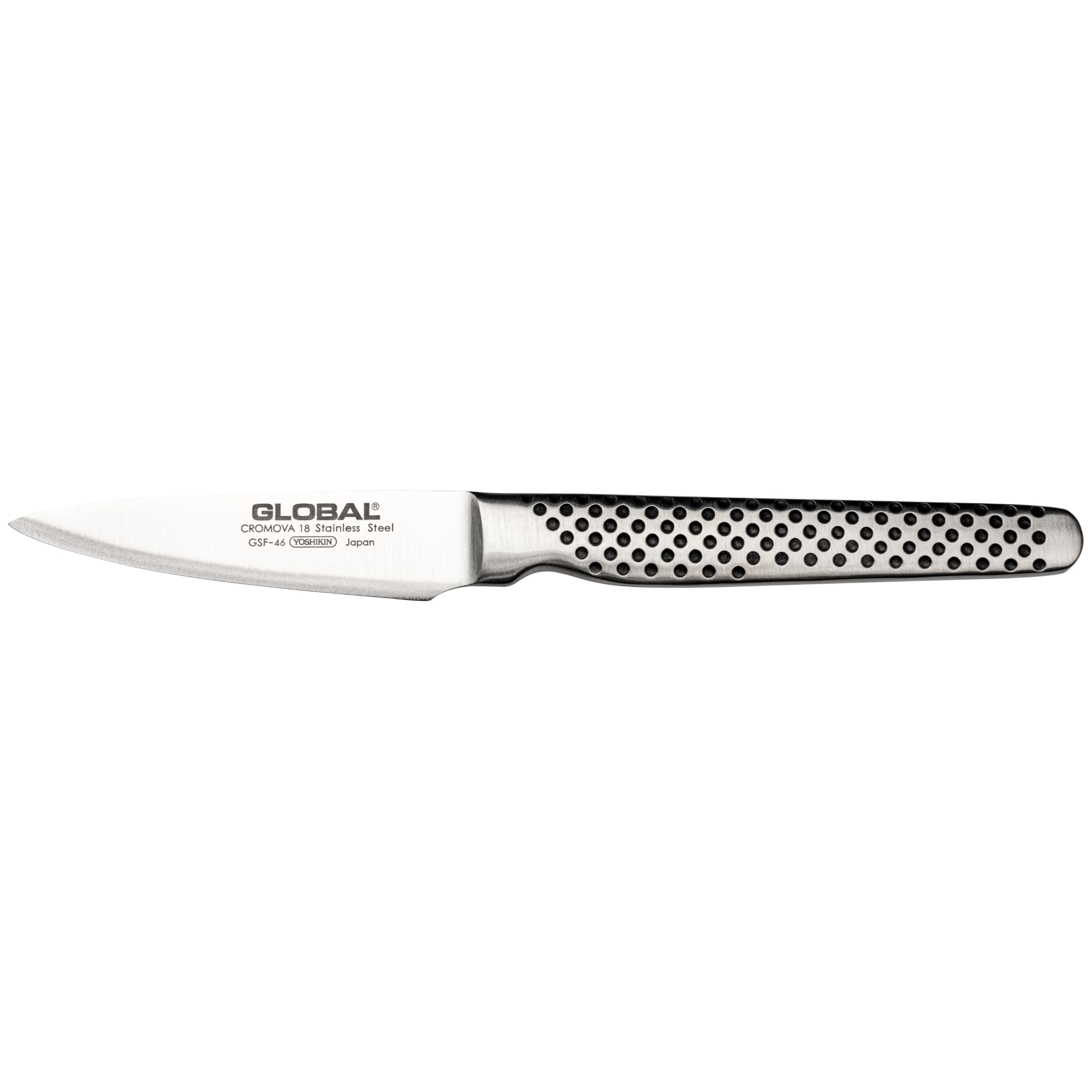
The Global GSF-46 3-inch paring knife is a study in minimalist Japanese design. The entire knife—blade and handle—is stamped from a single piece of molybdenum/vanadium stainless steel. There are no rivets, no seams, no crevices where food debris or moisture can accumulate. The handle features a distinctive pattern of recessed dimples that provide grip points without adding bulk. This one-piece construction makes the knife exceptionally lightweight—about 2.5 ounces—and gives it a remarkably low center of gravity that feels almost weightless in the hand.
The 3-inch blade is ground to a 15-degree edge angle on each side, creating a very acute profile that slides through ingredients with minimal resistance. The molybdenum and vanadium alloy delivers hardness around HRC 58-60, which means the blade holds its edge significantly longer than standard 400-series stainless steel. Users report that the knife arrives screaming sharp and requires only occasional honing to maintain its performance for months. The narrow handle is ideal for finesse tasks like hulling strawberries, seeding jalapeños, or scoring decorative patterns into vegetable skins.
The trade-offs are significant for some users. The full-metal handle offers zero thermal insulation—it becomes uncomfortable in cold hands and can feel slick when wet. The dimples help with grip but do not provide the secure purchase of a rubberized handle. The thin blade edge is vulnerable to chipping if twisted against hard surfaces like cutting board edges or bone. And the premium price places it firmly in the luxury tier of paring knives. For cooks who prioritize precision and lightweight agility above all else, and who are willing to handle their knives with care, the Global delivers a cutting experience that few other paring knives can match.
Why it’s great
- One-piece stainless steel construction eliminates crevices for easy cleaning
- Molybdenum/vanadium alloy holds a sharp edge significantly longer than standard steel
- Featherweight 2.5-ounce design reduces fatigue during long, intricate prep sessions
Good to know
- Full-metal handle conducts cold and becomes slippery when wet
- Thin 15-degree edge is vulnerable to chipping if used against bone or hard surfaces
FAQ
Can I put a paring knife in the dishwasher?
How often should I sharpen a paring knife?
What is the best blade length for a paring knife?
Final Thoughts: The Verdict
For most users, the paring knife winner is the Mercer Culinary Renaissance 3.5-Inch because it delivers forged German steel, a comfortable ergonomic handle, and outstanding edge retention at a mid-range price that rivals premium knives costing twice as much. If you want a dishwasher-safe blade that can survive heavy daily use without fuss, grab the Victorinox Fibrox 4-Inch. And for precision-focused finesse work where lightweight agility and razor-sharp Japanese steel matter most, nothing beats the Global GSF-46 3-Inch.