Municipal water treatment plants across the country add fluoride to the public supply, yet a growing body of research suggests that ingesting this industrial byproduct — originally a waste product from fertilizer manufacturing — may contribute to thyroid dysfunction, bone fragility, and developmental neurological issues. The only reliable defense against consuming this additive at the tap is a filtration system specifically engineered to capture fluoride ions, which are among the most difficult contaminants to remove due to their small molecular size and negative charge.
I’m Mohammad Maruf — the founder and writer behind AirfryerBite. I’ve spent thousands of hours analyzing water filtration hardware, cross-referencing NSF performance data, and studying the actual contaminant reduction claims of over 150 household filter models to separate genuine engineering from marketing gloss.
This guide evaluates seven dedicated systems — from countertop gravity units to under-sink carbon blocks and RO machines — each tested against the specific challenge of fluoride reduction. If you are searching for a true water filter for fluoride removal, the analysis below will help you match the right filtration technology to your tap water chemistry and household volume.
How To Choose The Best Water Filter For Fluoride Removal
Fluoride is a negatively charged ion approximately 0.13 nanometers in diameter — smaller than most bacteria, viruses, and heavy metal complexes. Standard faucet-attached carbon cartridges and refrigerator filters rely on activated carbon’s high surface area to adsorb chlorine and volatile organic compounds, but carbon alone has virtually no affinity for fluoride unless it is chemically modified. The three viable technologies are reverse osmosis, activated alumina, and specialty gravity filters that combine silver-impregnated carbon with dedicated fluoride-reduction media.
Reverse Osmosis: The Gold Standard
RO systems force water through a semipermeable membrane with pore sizes around 0.0001 microns — small enough to reject 85-95 percent of dissolved fluoride ions. The trade-off is waste water: for every gallon of purified output, a typical RO unit sends 3 to 4 gallons down the drain. Countertop RO models like the DREO listed below eliminate the need for under-sink drilling and tank storage but still require an electrical outlet for the booster pump and self-cleaning cycle. If your tap TDS exceeds 500 ppm, a pre-filter sediment stage is essential to protect the RO membrane from premature fouling.
Activated Alumina and Specialty Media
Activated alumina (aluminum oxide) has a high surface area and a positive surface charge at neutral pH, which attracts and binds the negatively charged fluoride ion. Some gravity systems embed this media — or proprietary blends like silver-impregnated activated carbon plus ion-exchange resin — into dedicated white cartridges. These cartridges typically last 500 to 1,000 gallons before saturation, and performance depends heavily on contact time; faster flow rates reduce removal efficiency. Always look for a NSF/ANSI 58 or NSF/ANSI 53 certification specifically listing fluoride reduction, not just a generic “heavy metals” claim.
Carbon Block and Gravity Systems: Know the Limits
Standard coconut-shell carbon blocks (0.5 micron or larger) do not remove fluoride at meaningful levels. Some gravity-fed units advertise “8-stage filtration” or “fluoride reduction” but the only stage that actually targets fluoride is a separate white filter containing alumina or a specialty adsorption medium. If a product does not explicitly state the fluoride reduction medium and does not reference an NSF standard test for fluoride, assume the fluoride claim is unverified. The Purewell and Waterdrop King Tank systems below both include dedicated secondary fluoride cartridges — that is the minimum threshold for a purchase worth considering.
Quick Comparison
On smaller screens, swipe sideways to see the full table.
| Model | Category | Best For | Key Spec | Amazon |
|---|---|---|---|---|
| DREO Countertop RO | Reverse Osmosis | Verified fluoride rejection with TDS monitoring | 3:1 pure-to-drain ratio | Amazon |
| Waterdrop King Tank | Gravity | NSF 42 certified fluoride and chlorine reduction | 2.25 gal capacity | Amazon |
| Purewell PW-KS-CF | Gravity UF | 90% fluoride reduction with 0.01μm UF | 8-stage ultra-filtration | Amazon |
| Frizzlife SW10F | Under Sink | High-flow carbon block with dedicated faucet | 0.5 micron composite | Amazon |
| ICEPURE WFS5300A | Under Sink | 5-year, 40,000-gallon filter life | NSF 42 & 372 certified | Amazon |
| Waterdrop TST-UF | Under Sink UF | Ultra-filtration with 0.01μm membrane | 1.59 GPM flow rate | Amazon |
| IceJoy 3-Gallon Gravity | Gravity | Budget countertop with 8-stage media | 3.0 gal stainless steel | Amazon |
In‑Depth Reviews
1. DREO Reverse Osmosis Water Filter Countertop
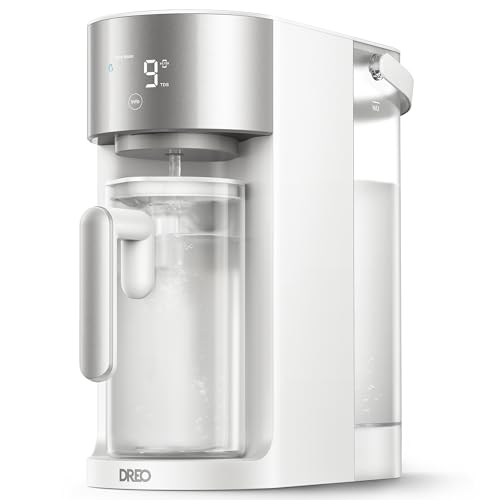
The DREO is the only unit on this list that combines a true RO membrane with real-time TDS monitoring, giving you a numeric readout of exactly how much dissolved solids — including fluoride — remain in the output water. The SGS testing against NSF/ANSI 58 standards covers fluoride removal directly, so you are not relying on an inferred “heavy metals” claim. Users report raw TDS dropping from 375-450 ppm down to 12-50 ppm, which correlates with 85-95 percent fluoride rejection.
The 3:1 pure-to-drain ratio is better than most under-sink RO systems that waste 4 gallons for every 1 gallon produced. A 3-liter tank plus a separate 1.1-liter auto-fill pitcher lets you rotate batches through the refrigerator. The self-cleaning cycle flushes the internal tubing automatically, reducing biofilm buildup without manual intervention. Installation is truly plug-and-play — no plumbing connections whatsoever.
One concession: the filter requires four initial flush cycles before first use, and the auto-fill sensor triggers a periodic backflush dump that some users find wasteful. At 9.5 pounds and a footprint of 14.5 x 6.7 inches, it occupies permanent counter space rather than hiding under the sink. For households of 1-2 people who want the highest certified fluoride removal rate without drilling into cabinetry, this is the benchmark.
Why it’s great
- NSF 58-tested for fluoride removal with live TDS verification
- Self-cleaning cycle and auto-fill pitcher reduce daily maintenance
- 3:1 water efficiency beats typical under-sink RO units
Good to know
- Requires electrical outlet and permanent countertop space
- Periodic backflush dump consumes some water during the cycle
- Filter replacement cost averages about 5 per bottle over 6-12 months
2. Waterdrop King Tank Gravity Water Filter System

The Waterdrop King Tank is a gravity-fed countertop system that includes two black carbon filters for chlorine/taste reduction and two dedicated white fluoride filters packed with specialty adsorption media. The carbon blocks carry NSF/ANSI 42 certification for chlorine and taste reduction, and the overall build uses food-grade 304 stainless steel. The 2.25-gallon capacity serves a family of four comfortably without requiring electricity or plumbing connections.
Silver ions are embedded into the carbon media to inhibit bacterial growth inside the filter cartridges during extended storage — a genuine advantage for households that do not empty the tank daily. The stainless steel spigot includes a lock-open continuous-flow feature that is more convenient than the push-button faucets found on many Berkey-style units. Users report that the filtered water is completely free of the chlorine aftertaste that lingers in standard Brita pitchers.
One nuance: the black carbon cartridges are rated for 6,000 gallons, but the white fluoride cartridges are limited to about 1,000 gallons. That means you will replace the fluoride cartridges roughly six times for every carbon change, increasing long-term consumable cost. The system is also taller than most countertop pitchers — 15.75 inches — so verify your cabinet clearance if storing it under an upper shelf.
Why it’s great
- Separate NSF 42-certified carbon and fluoride cartridges for targeted reduction
- Silver ions keep stored water fresh and inhibit bacterial growth
- 2.25-gallon capacity fits family-sized daily drinking needs
Good to know
- Fluoride cartridges need replacement every 1,000 gallons — about six times per carbon filter change
- Height of 15.75 inches may not fit under all upper cabinets
- Does not reduce TDS; retains beneficial minerals but also any non-fluoride dissolved solids
3. Purewell 2.25G Gravity Water Filter System

The Purewell system brings an 8-stage composite filter design that includes a 0.01-micron hollow-fiber ultrafiltration membrane integrated into the black carbon block. This UF membrane physically blocks particles as small as bacteria and cysts — a layer of protection absent from standard gravity filters. The white fluoride cartridges use a proprietary fluoride reduction membrane that the manufacturer claims achieves up to 90 percent removal without relying on aluminum oxide media.
A transparent viewing window on the lower chamber lets you check the water level at a glance without lifting the lid, which reduces the chance of airborne dust contamination. The spigot includes a silicone washer and priming cup for flushing new filters — a detail that makes initial setup less messy. Users consistently report that the chlorine smell and taste disappear entirely, and the filtered water tastes noticeably fresher than tap.
The practical trade-off is low output flow: the manufacturer rates it at just 0.05 gallons per minute, and the filters in the lower chamber displace some of the rated 2.25-gallon capacity, so actual usable volume is closer to 1.8 gallons. The assembly instructions are printed for a slightly different model iteration, so you may need to reference online videos for the correct metal-cap orientation on the outflow pipe.
Why it’s great
- 0.01μm UF membrane intercepts bacteria and cysts in addition to fluoride reduction
- Water level window eliminates guesswork and reduces contamination risk
- Fluoride media is alumina-free, avoiding potential aluminum leach concerns
Good to know
- Flow rate is slow at 0.05 GPM — filling a full pitcher takes several minutes
- Actual capacity is less than 2.25 gallons due to filter cartridge displacement
- Assembly instructions may not match the exact model shipped; online video recommended
4. Frizzlife SW10F Under Sink Water Filter System
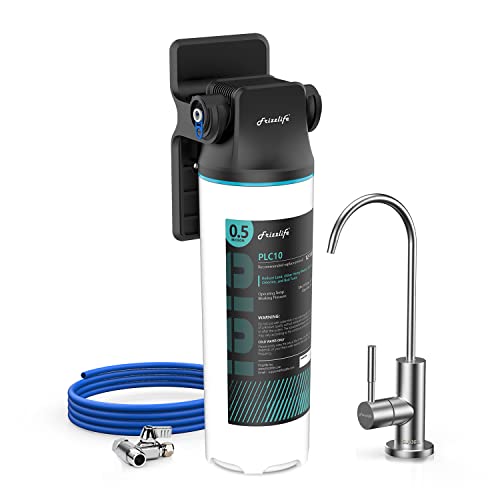
The Frizzlife SW10F is an under-sink carbon block system that incorporates a composite sediment-and-coconut-carbon filter with 0.5-micron precision. The manufacturer specifically lists fluoride among the targeted contaminants, though this claim is backed by NSF/ANSI 42 and 53 certification for lead, chlorine, taste, and odor — not explicitly for fluoride. The dedicated brushed nickel faucet is lead-free, and the twist-and-lock filter housing allows cartridge swaps without shutting off the water supply.
Flow rate is impressive for an under-sink carbon unit: 1.5 gallons per minute at 60 psi, which fills a 12-ounce cup in under four seconds. The housing is made from fiberglass-reinforced plastic rather than all-metal, but the quick-disconnect fittings are standard 1/4-inch push-fit and have not shown leak problems in user reports. The filter cartridge lasts 12-16 months or 8,000 gallons — about twice the life of typical inline carbon filters.
Installation requires basic plumbing skills: the system connects to the cold water line and includes Teflon tape and mounting screws, but some users found the included o-rings on the quick disconnects split during tightening. The manual does not mention the plastic shipping plugs inside the filter head, and several users nearly broke the housing trying to force water flow without removing them. For fluoride specifically, the carbon composite has limited adsorption capacity unless the water pH is below 7 — a condition not always present in municipal supplies.
Why it’s great
- Fast 1.5 GPM flow rate with low restriction for daily cooking and drinking
- Tool-free filter swaps with auto-shutoff design for no-mess replacement
- Composite filter packs sediment and carbon into a single cartridge, reducing housing footprint
Good to know
- Fluoride reduction is not specifically NSF certified; effectiveness drops at higher pH levels
- Packaging o-rings may split during installation; careful inspection recommended
- Fiberglass-reinforced plastic housing feels less robust than stainless steel alternatives
5. ICEPURE 21″ WFS5300A Under Sink Water Filtration System

The ICEPURE WFS5300A is a high-capacity under-sink filter built around a 21-inch coconut shell carbon block rated for 40,000 gallons — roughly five years of typical family use. The cartridge is NSF/ANSI 42 certified for chlorine, taste, odor, sediment, and heavy metals, and NSF/ANSI 372 certified for lead-free materials. The direct-connect design feeds filtered water to the existing kitchen faucet, eliminating the need for a second hole in the countertop.
Installation is genuinely simple: the system uses plug-and-play push-fit connectors that mate with standard 3/8-inch or 1/2-inch cold water lines. Users report the process taking under 10 minutes, and the water pressure remains high — the tested flow rate is 2.5 GPM at 60 psi. The coconut shell carbon block adsorbs chlorine effectively, and five-minute flushing produces clear, odor-free water.
The critical limitation for fluoride seekers is the lack of any dedicated fluoride reduction medium. The carbon block alone will not remove fluoride at meaningful levels unless the manufacturer specifically impregnates the carbon with activated alumina — and ICEPURE does not claim fluoride reduction in the product literature. The unit is also 21.1 inches tall, which can be tight in shallow under-sink cabinets, and some users report a gradual flow-rate drop after three weeks due to sediment loading in areas with higher turbidity.
Why it’s great
- 40,000-gallon capacity translates to 5 years between cartridge changes
- Direct-connect design preserves countertop space and requires no extra faucet
- High 2.5 GPM flow rate with zero pressure loss for everyday use
Good to know
- No certified fluoride reduction capability despite NSF 42 listing
- 21.1-inch height may not fit all under-sink cabinets — measure before purchase
- Flow rate can drop noticeably after a few weeks in areas with high sediment
6. Waterdrop TST-UF Under Sink Ultra-Filtration System

The Waterdrop TST-UF uses a 0.01-micron ultrafiltration membrane housed in a lead-free 304 stainless steel body. This is a true physical barrier that blocks particles, bacteria, and protozoan cysts larger than 0.01 microns — far finer than the 0.5-micron carbon blocks found in most under-sink filters. The system includes three filter stages: a PP sediment filter (6-8 months), a UF membrane (12 months), and a coconut carbon block (12-24 months) that reduces chlorine and improves taste.
The flow rate of 1.59 GPM is excellent for an ultrafiltration system, filling an 8-ounce cup in 2.3 seconds. The stainless steel housing is notably more robust than the plastic canisters common at this price tier, and the thick sealing ring has prevented leaks in user reports. Installation can be done on the cabinet wall or floor, and the quick-connect fittings work with standard 3/8-inch or 1/2-inch cold water lines.
The critical asterisk for fluoride: the TST-UF does not reduce TDS and does not contain any fluoride-specific adsorption media. The UF membrane rejects particles by size, but dissolved fluoride ions (0.13 nm) are 100 times smaller than the 0.01-micron (10 nm) membrane pores. If your primary goal is fluoride removal, this system will not achieve it. It is better suited for households that want to eliminate chlorine taste, sediment, and microbial contaminants while preserving the mineral profile.
Why it’s great
- 0.01μm UF membrane removes bacteria and cysts without chemical media
- 304 stainless steel housing is durable and leak-resistant
- Fast 1.59 GPM flow with low maintenance — sediment filter changes only twice a year
Good to know
- Does not remove fluoride — UF pores are too large for dissolved ions
- Blue push-fit clips can be difficult to install correctly; may require silicone grease on threads
- No adapter included for connecting to a separate dedicated faucet; extra parts required
7. IceJoy 3-Gallon Gravity Water Filtration System

The IceJoy 8-stage gravity system offers the largest capacity on this list — 3 gallons — in a compact 9.84 x 9.84-inch footprint that fits on most countertops. The filtration media includes silver ions, carbon rods, KDF55, ion exchange resin, PP cotton, carbon granules, and non-woven fabric layered across four filters (two black carbon, two white fluoride cartridges). The sight-glass spigot lets you monitor the water level in the lower chamber without lifting the lid.
Assembly is straightforward, though the instructions reference a slightly different model iteration — you need to install the metal cap and silicone washer on the outflow pipe before attaching the spigot. The black carbon filters are rated for up to 3,000 gallons, and the white fluoride filters for about 1,000 gallons. The gravity-fed design requires no electricity, making it suitable for RVs, cabins, and emergency preparedness kits.
The significant caveat is that the IceJoy system is not NSF certified for fluoride reduction. The product listing mentions “99.9% chlorine reduction” and includes a fluoride filter, but the certification cited is NSF/ANSI 42 for aesthetic chlorine reduction — not for fluoride. One user specifically tested for lead and found no removal, raising broader questions about whether the heavy metal claims are independently verified. For buyers who prioritize a certified fluoride standard, the Waterdrop King Tank or Purewell provide more verifiable performance at a comparable investment.
Why it’s great
- 3-gallon capacity is the largest of any gravity countertop unit on this list
- Durable 304 stainless steel build with compact 9.84-inch footprint
- No plumbing or electricity required; works off-grid for RVs and emergencies
Good to know
- Fluoride reduction claims lack NSF certification — consider unverified
- Assembly instructions do not match the exact model; watch an online setup video
- White fluoride filters last only ~1,000 gallons; replacement frequency is high relative to capacity
FAQ
Do standard Brita or PUR pitcher filters remove fluoride?
How much fluoride does reverse osmosis actually remove?
Can an under-sink carbon block filter remove fluoride if it says “fluoride reduction” on the box?
Final Thoughts: The Verdict
For most users, the water filter for fluoride removal winner is the DREO Countertop RO because it combines SGS-tested NSF 58 certification with live TDS monitoring, giving you verifiable proof of fluoride rejection at every pour. If you want a gravity system that fits a larger family without electricity, grab the Waterdrop King Tank — its dual carbon and dedicated fluoride cartridges with silver-ion protection offer the best balance of certified performance and capacity. And for a budget-conscious countertop option that includes a UF membrane for bacteria protection alongside fluoride media, nothing beats the Purewell 2.25G.