That orange-brown tint in your sinks, the metallic taste in your morning coffee, and the constant scrubbing of rust-stained toilets aren’t bad luck — they’re the calling cards of iron-rich well water. A dedicated whole house iron water filter tackles this at the main supply line, saving your clothes, fixtures, and sanity. I’m Mohammad Maruf — the founder and writer behind AirfryerBite. I’ve spent years analyzing water filtration hardware, from the media bed densities in high-output backwashing systems to the micron ratings on cartridge-style housings, helping homeowners match the right spec to their specific well-water chemistry. You need a system that handles your exact iron concentration (measured in parts per million), flow rate requirements, and maintenance tolerance, and this guide will walk you through the top contenders that actually deliver whole house iron water filter results without drowning you in operational complexity.
How To Choose The Best Whole House Iron Water Filter
Iron in well water isn’t a single problem — it comes in three forms (ferrous, ferric, and bacterial) and each demands a different filtration strategy. Choosing the wrong media or undersizing the tank leads to premature fouling, pressure loss, and wasted money. Here are the four factors that separate effective systems from expensive paperweights.
Know Your Iron Form and Concentration
Ferrous iron (clear water iron) is dissolved and invisible until it oxidizes and turns rusty. Ferric iron (red water iron) is already precipitated as visible particles. Bacterial iron (iron bacteria) creates a slimy red-brown sludge. A home water test is non-negotiable before buying. For levels under 3 ppm, a cartridge-style system with specialty iron-reducing media often works. For 3 to 12 ppm, an air-injection or chemical-oxidation backwashing tank is typically required. Anything above 12 ppm may need a combination system or a regenerative media bed designed for higher loading.
Flow Rate vs. Household Demand
Iron filters restrict water flow to varying degrees. A system rated for 15 GPM at 40 psi may drop to 8 GPM under heavy sediment load or with a partially clogged cartridge. For a 3-bathroom home running a shower and washing machine simultaneously, you need a sustained flow of at least 10 GPM. Backwashing tanks often maintain higher peak flows than cartridge housings because their media beds are cleaned periodically by the regeneration cycle. Check the rated service flow, not just the peak flow, when matching a system to your household size.
Maintenance Style: Cartridge vs. Backwashing Tank
Cartridge-based systems (like the iSpring 2-stage or Waterdrop 3-stage) are simpler to install but require physical filter replacements every 6-12 months. Backwashing tanks (like the Air Injection Iron Eater or Fleck 5600 SXT) use a control valve to automatically flush the media bed, extending media life to 5-10 years. The trade-off is higher upfront cost, the need for a drain line for regeneration wastewater, and occasional valve programming. If you want set-and-forget operation, a backwashing system is worth the premium. If you prefer lower initial investment and don’t mind annual filter swaps, a cartridge system is viable for lower iron levels.
Media Type and Compatibility
Not all iron removal media are created equal. Catalytic carbon (like Centaur) oxidizes iron and hydrogen sulfide simultaneously. KDF (kinetic degradation fluxion) reduces iron, chlorine, and heavy metals. Specialty iron-reducing resin acts like a softener resin but is recharged with potassium permanganate or salt. Some systems also incorporate air injection to pre-oxidize iron before it hits the media bed, dramatically improving removal efficiency for higher concentrations. Match the media to your specific contaminant profile — a system that removes iron but ignores manganese or H2S leaves you with a partial solution.
Quick Comparison
On smaller screens, swipe sideways to see the full table.
| Model | Category | Best For | Key Spec | Amazon |
|---|---|---|---|---|
| Air Injection Iron Eater (Black Series) | Backwashing Tank | Heavy iron (up to 12 ppm) | 10×54″ tank, 12 ppm iron removal | Amazon |
| Fleck 5600 SXT Air Injection Iron Eater | Backwashing Tank | Medium-large homes with H2S | 1.5 cu ft Centaur carbon, 12 ppm iron | Amazon |
| Aquasana Rhino EQ-1000 | Carbon/KDF Tank | 10-year, 1M-gallon capacity | 1,000,000 gallon capacity | Amazon |
| Express Water WH300SCKP | 3-Stage Freestanding | Heavy metal reduction | 17 GPM flow rate | Amazon |
| APEC CB3-SED-IRON-CAB20-BB | 3-Stage Cartridge | Light sediment & iron stains | 4 GPM, 30-micron sediment | Amazon |
| PRO+AQUA Elite PRO-100-E | 3-Stage Cartridge | City & well water, 1-3 baths | 15 GPM, stainless steel gauges | Amazon |
| Express Water ESSENTIAL | 3-Stage Cartridge | Chlorine & sulfur odor removal | 100,000 gallon capacity | Amazon |
| iSpring WGB32B | 3-Stage Cartridge | Chlorine & sediment reduction | 15 GPM, 5-micron sediment | Amazon |
| HQUA WF3-01 | 3-Stage Cartridge | Heavy metals & chlorine, 20″ BB | 15 GPM, 180-day timers | Amazon |
| iSpring WGB22BM | 2-Stage Cartridge | Iron & manganese up to 3 ppm | 15 GPM, 100,000 gallon capacity | Amazon |
| Waterdrop WHF3T-FG | 3-Stage Cartridge | Well water with iron & manganese | 15 GPM, NSF/ANSI 372 certified | Amazon |
In‑Depth Reviews
1. DuraWater Air Injection Iron Eater Filter (Black Series)
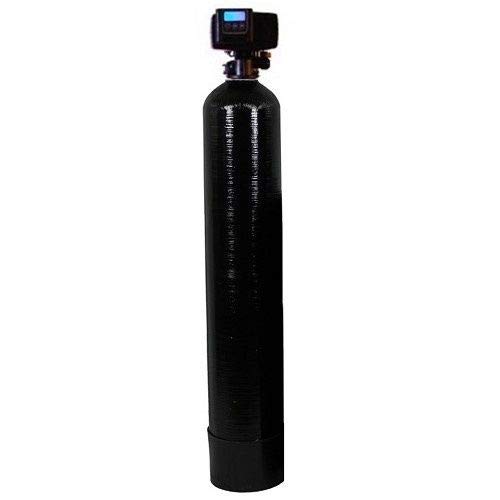
The DuraWater Black Series is purpose-built for homeowners battling high iron concentrations — up to 12 ppm — alongside hydrogen sulfide (H2S) and manganese up to 2 ppm. Its air injection technology pre-oxidizes dissolved ferrous iron before it reaches the catalytic carbon media bed, which dramatically boosts removal efficiency compared to passive cartridge systems. The 10×54-inch tank provides ample media volume for a 3-4 bedroom home, and the digital control head automates the backwashing cycle so you don’t have to remember to flush the bed manually.
Users consistently report immediate elimination of orange staining on fixtures and the elimination of rotten-egg odors from water after a short settling period. The system does require a drain line for regeneration — typically 75-120 gallons per cycle — and some initial milky appearance from air bubbles for the first few weeks. Once the media bed stabilizes, water clarity and taste improve dramatically. The Fleck-style valve used in newer units is serviceable and widely supported, making repairs straightforward if any component wears out over the 10+ year lifespan.
Installation is DIY-friendly for those comfortable with basic plumbing, though the tank’s 54-inch height demands a dedicated floor space away from water heaters or electrical panels. The unit does not require electricity for the air injection head, which simplifies setup. This is the go-to choice when iron levels exceed what cartridge-based systems can handle without constant filter changes.
Why it’s great
- Handles iron up to 12 ppm without media exhaustion
- Air injection pre-oxidizes iron for superior removal
- Automated backwashing extends media life to 5+ years
Good to know
- Requires a drain line for regeneration water
- 54-inch height needs floor space; not wall-mountable
- Initial milky water from air bubbles for 2-3 weeks
2. Fleck 5600 SXT Air Injection Iron Eater Filter (1.5 cu ft)
The Fleck 5600 SXT is widely regarded as the gold standard control valve in the residential water treatment industry — durable, programmable, and serviceable with off-the-shelf parts. This Black Series system pairs that valve with 1.5 cubic feet of Centaur catalytic carbon media in a 12×48-inch tank, giving it a higher media volume than the standard 10×54 model. More media means longer contact time for oxidation and reduction, which translates to better performance against iron (up to 12 ppm), sulfur (up to 10 ppm), and manganese (up to 2 ppm).
Real-world feedback from well owners highlights the immediate elimination of orange staining in toilets and laundry, and the complete removal of hydrogen sulfide smell that previously made tap water undrinkable. The 5600 SXT valve allows fine-tuning of regeneration timing, duration, and frequency via its digital display — critical for balancing water conservation with media performance. Some users note that the default daily 15-minute regeneration cycle uses significant water (75-120 gallons), so adjusting to every-other-day regeneration is recommended for those on septic systems.
The installation is comparable to the standard DuraWater unit, but the larger tank and heavier media (65 pounds dry weight) make it a two-person job. The Centaur carbon also handles chloramines and organic compounds better than standard catalytic carbon, making this a strong choice for homes that switch between well and municipal water supplies. Expect media replacement at 5-7 years, far longer than the 6-12 month cycle of cartridge filters.
Why it’s great
- Fleck 5600 SXT valve is industry-standard for reliability
- 1.5 cu ft Centaur carbon handles H2S and iron together
- Programmable regeneration saves water and septic capacity
Good to know
- Heavy tank requires two people for installation
- Default regeneration cycle wastes 75-120 gallons per night
- Valve programming can be confusing without the manual
3. Aquasana Rhino EQ-1000 Whole House Water Filter
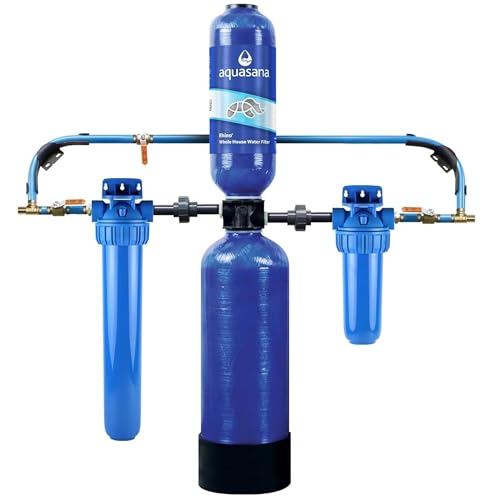
The Aquasana Rhino EQ-1000 takes a different approach from iron-specific tanks — it’s a carbon and KDF media tank rated for an enormous 1,000,000 gallons or 10 years of use, whichever comes first. The KDF component reduces iron, hydrogen sulfide, chlorine, and heavy metals through oxidation-reduction, while the catalytic carbon layer polishes taste and odor. This isn’t a dedicated iron buster like the DuraWater units, but for homes with iron levels under 3 ppm, it provides comprehensive whole-house filtration with a single tank and minimal maintenance.
Users consistently praise the zero-pressure-drop performance — the divider valve and 1-inch connections maintain full flow even during simultaneous showers and laundry. The system includes a 20-inch pre-filter and a post-filter that must be swapped every 2 months, which adds a modest recurring cost. Installation is straightforward with the included brass fittings, though some users report that the plastic 1-inch to 3/4-inch adapters can crack if over-tightened. Replacing them with metal adapters is a cheap insurance upgrade.
The 44-inch height and 46-pound dry weight make it manageable for a single installer, and the tank doesn’t require a drain line or backwashing — a significant advantage if your plumbing layout doesn’t accommodate regeneration discharge. The 10-year media lifespan translates to roughly half the cost per gallon of cartridge-based systems, but note that this system does not reduce TDS or soften water, so pairing with a softener may still be necessary for hard water.
Why it’s great
- 10-year, 1M-gallon media lifespan — set and forget
- No backwashing or drain line required
- Zero noticeable pressure drop at peak usage
Good to know
- Pre/post filters need replacement every 2 months
- Plastic adapters prone to cracking; plan for metal upgrades
- Not designed for iron above 3 ppm
4. Express Water WH300SCKP 3-Stage Whole House Water Filter System

The Express Water WH300SCKP is a heavy-duty 3-stage freestanding system that integrates a sediment pre-filter, a KDF/carbon composite cartridge for heavy metals (lead, arsenic, chromium), and an anti-scale polyphosphate cartridge. With a rated flow of 17 GPM — among the highest in this category — it supports even large 4-5 bathroom homes without noticeable pressure drops. The stainless steel frame provides a stable base and eliminates the need for wall mounting, which is a practical advantage when dealing with concrete or brick utility walls.
Users switching from well water report immediate improvements in taste, skin feel, and the disappearance of orange-brown staining on fixtures. The three pressure gauges give real-time feedback on filter status — a pressure drop of 8-10 psi between inlet and outlet signals it’s time for a cartridge swap. The system does require 6-12 month filter replacements, and the anti-scale cartridge uses polyphosphate, which adds a tiny amount of phosphate to the water — something to consider if you have a strict pure-water philosophy.
Installation involves connecting the freestanding frame to your main water line with the included 1-inch fittings, then mounting the three filter housings onto the bracket. The 63-pound weight makes it a two-person task, and you’ll want to place it on a level floor with clearance for cartridge changes. The clear housings on the first two stages let you visually monitor sediment loading, which helps plan replacement timing. This is a strong mid-premium pick for those who want heavy metal reduction alongside iron control.
Why it’s great
- 17 GPM flow rate supports large households
- Stainless steel frame — no wall mounting needed
- Three pressure gauges simplify filter change timing
Good to know
- Filter replacements every 6-12 months add recurring cost
- Anti-scale cartridge adds polyphosphate to water
- Heavy unit requires two people to position
5. APEC CB3-SED-IRON-CAB20-BB 3-Stage Whole House Iron Filter

APEC Water Systems has a strong reputation in the water filtration space, and their CB3-SED-IRON-CAB20-BB is a dedicated 3-stage cartridge system optimized for iron removal. The first stage uses a 30-micron reusable sediment filter to catch larger particles; the second stage is the specialty iron filter designed to reduce red/orange stains and metallic taste; the third stage is a 25-micron carbon filter to polish chlorine and improve overall taste. This sequence is specifically engineered for water with light sediment, moderate iron staining, and chlorine concerns.
Users on well water with iron levels in the 1-3 ppm range report complete elimination of rust stains in toilets and a dramatic reduction in metallic taste within days of installation. The 4 GPM flow rate is noticeably lower than other systems — this is not a high-flow design suitable for simultaneous heavy usage. It’s best placed before a water softener or on a dedicated line serving a 1-2 bathroom home. The 80,000-gallon capacity means filter swaps every 6-9 months for an average family of four.
Installation is straightforward for DIYers with basic soldering or PEX experience, but the plastic housings require careful tightening to prevent leaks — overtightening can crack the threads. Users report that the included mounting bracket is adequate but feels flimsy when loaded with water-filled housings. APEC’s customer support is responsive, though replacement O-rings and gaskets should be kept on hand for maintenance. This is a solid mid-range option for homes with low to moderate iron levels that don’t need high flow rates.
Why it’s great
- Dedicated iron-reducing cartridge in stage 2
- 30-micron sediment pre-filter catches large debris
- 80,000 gallon capacity per set of filters
Good to know
- 4 GPM flow rate is low; not for large homes
- Plastic housings prone to leaks if overtightened
- Mounting bracket feels under-specked for weight
6. PRO+AQUA Elite Series GEN2 PRO-100-E 3-Stage Whole House Filter
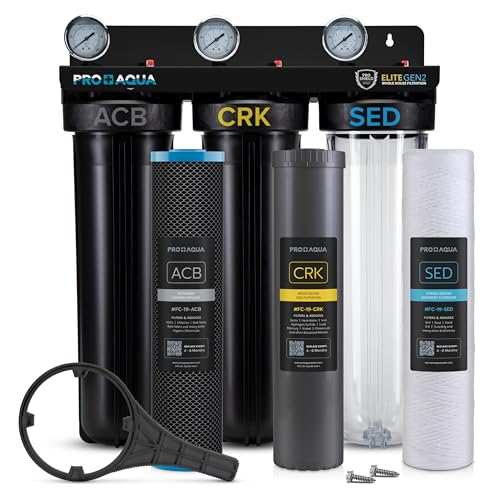
The PRO+AQUA Elite Series GEN2 PRO-100-E is a 3-stage system that targets small to medium households (1-3 bathrooms) on both well and city water. Stage 1 uses a clear sediment housing (visible monitoring) to catch rust, dirt, and silt. Stage 2 is the CRK (composite resin KDF) filter that reduces heavy metals including lead, iron, mercury, nickel, and chromium, while also tackling hydrogen sulfide odors. Stage 3 is activated coconut shell carbon (ACB) with 5-micron filtration to remove chlorine, VOCs, and bad taste. The stainless steel pressure gauges on each housing let you track when each filter is loaded.
Users switching from city water with high chlorine report immediate improvements in taste and a reduction in skin dryness after showering. The 15 GPM flow rate maintains pressure for most 2-3 bathroom homes, though some users with 3+ simultaneous showers note a slight drop. The system does not require electricity, backwashing, or drain lines — just periodic filter replacements every 6 months. The included 1-inch and 3/4-inch adapters simplify connection to existing plumbing without additional parts.
Installation is DIY-rated by the manufacturer, but many users recommend having a plumber handle the main water line connection to avoid leaks. The plastic fittings on some units can be fragile, so using Teflon tape generously and avoiding over-tightening is critical. PRO+AQUA offers a 5-year warranty and lifetime US tech support, which adds peace of mind. The filter replacement cost (search B0BQ9HXV38) is competitive at roughly per set. This is a good mid-range choice for homes with moderate iron and heavy metal concerns.
Why it’s great
- CRK stage reduces heavy metals including iron and lead
- Clear sediment housing allows visual monitoring
- 5-year warranty and lifetime US tech support
Good to know
- Plastic fittings can crack if over-tightened
- Professional install recommended despite DIY rating
- Filter cost adds up over multiple years
7. Express Water ESSENTIAL 3-Stage Whole House Water Filter System

The Express Water ESSENTIAL system is a 3-stage whole house filter built around a heavy-duty stainless steel bracket that can be wall-mounted or freestanding. The first stage is a 5-micron sediment filter, the second is a GAC (granular activated carbon) filter for chlorine and odor reduction, and the third is an ACB (activated carbon block) filter for polishing taste. While not specifically marketed as an iron filter, the GAC and ACB stages — combined with the sediment pre-filter — effectively reduce iron-related staining in homes with levels under 2 ppm, especially when the iron is larger-particle ferric iron.
Users with well water report immediate elimination of brown discoloration and rotten-egg odor after installation. The system includes pressure release buttons on each housing, making filter changes less messy, and the three pressure gauges let you track when each stage is approaching its limit. The 100,000-gallon capacity translates to roughly 12 months of service for a family of four, with filters costing around per replacement set. The 1-inch NPT connections and 15 GPM peak flow maintain pressure for most homes.
Installation is manageable for experienced DIYers, though the housing threads are notoriously tight and require a filter wrench included in the box. Some users report that the initial carbon flush can send black particles into downstream plumbing for the first few days, so connecting the system with a bypass valve is recommended. The stainless steel bracket is well-built, but the system is heavy (62 pounds) and needs secure anchoring to studs if wall-mounted. This is a solid mid-range option for homes needing general sediment and odor control with light iron reduction.
Why it’s great
- Stainless steel bracket supports wall or floor placement
- Pressure gauges and release buttons simplify maintenance
- 100,000-gallon capacity with 12-month filter life
Good to know
- Initial carbon flush can release black particles
- Heavy unit needs secure wall anchoring
- Not a dedicated iron filter; best under 2 ppm
8. iSpring WGB32B 3-Stage Whole House Water Filter System

The iSpring WGB32B is a 3-stage cartridge system that targets chlorine, sediment, taste, and odor rather than iron specifically. Its first stage uses a 5-micron sediment filter, followed by two stages of CTO (chlorine, taste, odor) carbon block filters made from coconut shell carbon. For homes with iron levels under 1.5 ppm where the primary complaint is rusty color and bad taste from chlorine reaction, this system works exceptionally well. It is not designed for high iron concentrations, but it polishes the secondary effects of iron in municipal or treated well water.
Long-term users (5-10 years) consistently praise iSpring’s customer support — multiple reviews describe free replacement of manifolds and housings long after the warranty expired. The system is relatively simple to install with the included wrench and manual, and the 100,000-gallon capacity means filter swaps once per year for an average family. The 15 GPM maximum flow ensures no noticeable pressure drop during normal household usage. The system does not require electricity or a drain line, making installation straightforward on any main water line.
The main limitation is that without an iron-specific media stage, this system won’t remove dissolved ferrous iron (clear water iron) that hasn’t yet oxidized. It will catch precipitated ferric iron particles in the sediment stage, but the carbon blocks are not designed for reduction of dissolved metals. Users with visible rusty water report good results; those with clear water that turns rusty after standing will need a different approach. This is a top choice for municipal water with chlorine and sediment issues, and a viable entry point for well water with very low iron.
Why it’s great
- Exceptional customer support with free replacement parts
- 5-micron sediment stage catches iron particles
- Simple installation, no electricity or drain needed
Good to know
- No iron-specific media; limited to ferric iron only
- Not suitable for dissolved ferrous iron above 1.5 ppm
- Carbon filters can be prone to channeling if flow rate is too high
9. HQUA WF3-01 3-Stage Whole House Water Filtration System

The HQUA WF3-01 is a 3-stage big blue system that uses 20-inch by 5.5-inch filter housings — larger than the standard 20×4.5-inch format, providing more media volume and longer service life. The first stage is a sediment filter, the second is a GAC+KDF composite for heavy metal reduction (lead, mercury, arsenic, cadmium, chromium), and the third is a carbon block for chlorine and odor. The KDF component also reduces iron and hydrogen sulfide through redox reactions, making this effective for iron levels up to 2-3 ppm combined with other heavy metal concerns.
Users report immediate improvement in water clarity, taste, and odor after installation. The system includes multiple pressure gauges to monitor filter loading, 180-day countdown timers on each housing to remind you of replacement timing, and pre-installed pressure relief and drain valves that simplify cartridge changes. The included cleaning brush and maintenance record card show attention to long-term usability. The flexible pipe fittings allow conversion between 3/4-inch and 1-inch NPT connections, accommodating different plumbing configurations.
Installation is rated as DIY-friendly, but users note that the included thread tape is insufficient for leak-free connections — upgrading to high-quality Teflon tape with pipe dope is strongly recommended. The larger housings mean the overall system is bulkier (31 inches tall, 23 inches wide) and requires adequate wall space. The bracket-mounted design can be freestanding if you build a support frame. This system offers excellent value for the hardware included — pressure gauges, timers, cleaning brush, and multiple adapters — making it one of the best-equipped mid-range options for comprehensive contaminant reduction including light iron.
Why it’s great
- 20×5.5-inch big blue housings maximize media volume
- KDF stage handles iron, heavy metals, and H2S
- Includes timers, gauges, drain valves, cleaning brush
Good to know
- Large footprint requires significant wall space
- Included thread tape is inadequate; upgrade recommended
- Not suitable for iron above 3 ppm
10. iSpring WGB22BM 2-Stage Whole House Water Filter System
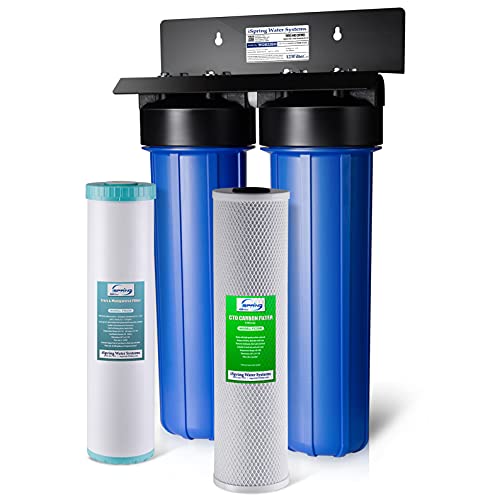
The iSpring WGB22BM earns the top spot because it directly addresses the specific iron and manganese problem that drives most searches for a whole house iron water filter. Unlike general-purpose carbon systems, this 2-stage commercial-grade unit pairs a coconut shell carbon block filter (stage 1) with a dedicated iron and manganese reducing filter (stage 2) — the FM25B cartridge. The FM25B is designed to handle iron up to 3 ppm and manganese up to 1 ppm, which covers the vast majority of residential well-water scenarios. The 20×4.5-inch industry-standard filters ensure easy replacement from multiple suppliers.
Users on well water with moderate iron load report reduction from 5 ppm to 0 ppm in some cases, along with complete elimination of the rotten-egg sulfur smell when paired with the carbon pre-filter. The 15 GPM flow rate supports typical 2-3 bathroom homes without pressure complaints. Installation is DIY-friendly with 1-inch NPT connections and a comprehensive manual plus YouTube support. iSpring’s customer support — frequently mentioned by name in reviews — stands out for sending replacement parts and upgraded filters at no charge, even for units outside the warranty period.
The system has a 100,000-gallon capacity, meaning the filters last roughly one year for a family of four under normal usage. The 2-stage design is simpler and less bulky than 3-stage systems, but it does mean you won’t have a dedicated sediment stage for catching larger particles — a spin-down pre-filter is recommended if your well produces sandy or silty water. Some users report that the mounting bracket feels light-duty for the weight of water-filled housings, so secure wall anchoring is essential. This is the pragmatic, best-balanced choice for the majority of homeowners dealing with iron up to 3 ppm.
Why it’s great
- Dedicated FM25B iron and manganese reducing cartridge
- Handles iron up to 3 ppm — covers most residential wells
- Industry-standard 20×4.5″ filters, widely available
Good to know
- No separate sediment stage; pre-filter recommended for sandy wells
- Mounting bracket feels under-sized for 40-pound loaded weight
- 2-stage design may need frequent carbon changes if chlorine is high
11. Waterdrop WHF3T-FG 3-Stage Whole House Water Filter System
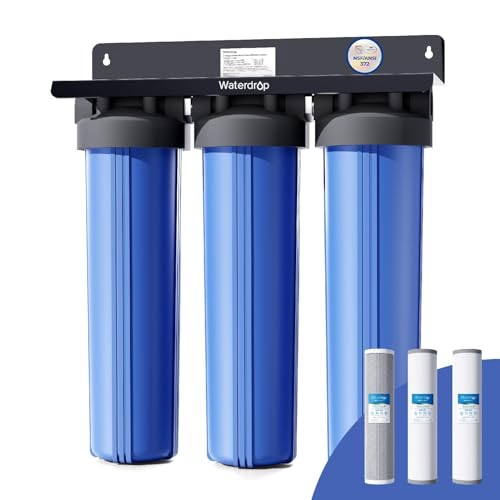
The Waterdrop WHF3T-FG is a 3-stage system engineered with a dual-iron-and-manganese removal cartridge as its centerpiece. SGS testing confirms 95.9% iron reduction and 99.7% manganese reduction, making this one of the few cartridge systems with published third-party performance data for those specific contaminants. The first stage is a sediment filter for large particles, the second is the dual iron/manganese cartridge (backed by a carbon fiber layer for double the filtration area), and the third is a GAC (granular activated carbon) filter for chlorine and odor polishing. The NSF/ANSI 372 certification for lead-free materials adds an extra layer of safety credibility.
Users transitioning from well water with visible iron staining report that toilets now need cleaning monthly instead of weekly, and the rotten-egg smell disappears immediately. The 15 GPM flow rate maintains adequate pressure for typical households, and the system has passed 100,000+ water hammer tests for durability. Installation is straightforward with the included 1-inch fittings and clear instructions, though users strongly recommend using thread sealant instead of Teflon tape for a leak-free connection. Waterdrop’s customer service (frequently praised in reviews) is responsive to any issues.
The dual iron/manganese cartridge is expected to last 6-12 months, while the GAC filter lasts up to 12 months, keeping replacement costs manageable. The system does not require electricity or a drain line, simplifying installation. One consideration: the iron removal efficiency is tested at specific conditions, and real-world performance may vary with your water chemistry. Waterdrop recommends water testing before purchase, which is standard advice for any iron filter. This is an excellent entry-level-to-mid-range choice for homeowners who want verified performance data and a brand with strong support.
Why it’s great
- SGS-tested 95.9% iron and 99.7% manganese reduction
- NSF/ANSI 372 certified for lead-free materials
- Dual iron/manganese cartridge with carbon fiber layer
Good to know
- Iron removal efficiency depends on exact water chemistry
- Thread sealant recommended over included Teflon tape
- Not designed for iron above 3 ppm
FAQ
What is the difference between ferrous and ferric iron for filter selection?
How many ppm of iron can a whole house iron water filter remove before it needs regeneration or media replacement?
Do I still need a water softener if I have a whole house iron water filter?
Can I install a whole house iron water filter myself, or do I need a plumber?
How often do I need to replace filters or media in a whole house iron water filter?
Final Thoughts: The Verdict
For most users, the whole house iron water filter winner is the iSpring WGB22BM because its dedicated iron and manganese reducing cartridge handles the 1-3 ppm range that covers the vast majority of residential well-water issues, at a price point that undercuts larger backwashing systems while maintaining 15 GPM flow. If you want a system that handles heavy iron (up to 12 ppm) and hydrogen sulfide simultaneously with automated regeneration, grab the Fleck 5600 SXT Air Injection Iron Eater — the industry-standard Fleck valve and 1.5 cubic feet of Centaur carbon will serve you for a decade. And for a budget-friendly, verified-performance entry point, the Waterdrop WHF3T-FG offers SGS-tested iron reduction and NSF-certified materials at a lower upfront investment.