Indoor gardening hinges on one variable that is impossible to fake: light. Without enough intensity or the correct wavelength, seedlings stretch, foliage yellows, and flowering plants refuse to bloom. A dedicated fixture solves this by delivering targeted photons that mimic the sun’s spectrum, giving your plants the energy they need to photosynthesize regardless of your window orientation.
I’m Mohammad Maruf — the founder and writer behind AirfryerBite. I’ve spent years analyzing the hardware specifications of indoor horticulture gear, from PPFD maps and LED junction temperatures to driver efficiency and spectral distribution curves, to separate fixtures that actually move a plant needle from those that are little more than fancy desk lamps.
This guide breaks down the key specs, real-world trade-offs, and top performers across several form factors for anyone looking for the best plant grow lights available today.
How To Choose The Best Plant Grow Lights
Selecting a grow light for indoor plants means moving past simple wattage claims and evaluating the spectral quality, coverage pattern, and thermal management that directly affect how your plants respond. Below are the factors that separate a useful fixture from an expensive nightlight.
Full Spectrum vs. Blurple
Older LED fixtures used only red and blue diodes, producing a harsh magenta glow that made it difficult to inspect plants for pests or deficiencies. Modern full-spectrum fixtures use white LEDs with a Kelvin temperature around 3500K to 5000K combined with specific red (660nm) and far-red (730nm) diodes. This blend creates a natural-looking light that supports photosynthesis across every growth stage while allowing you to see true leaf color.
PPFD and Coverage Area
Wattage tells you how much electricity the fixture consumes, but PPFD (measured in μmol/s/m²) tells you how many photons actually reach your plant canopy. A light that draws 150 watts is useless if its PPFD drops below 200 at the edges of a 2×2 area. Look for published PPFD maps from the manufacturer that show readings at multiple distances and corners to confirm even coverage across your specific grow tent or shelf dimensions.
Dimmability and Timer Functions
Seedlings need low light intensity — often 25% of maximum — while flowering and fruiting plants demand full power. A fixture with a built-in dimmer lets you match intensity to the growth phase without moving the light up and down. Adding a timer that cycles on and off each day creates a consistent photoperiod, which is critical for triggering the bloom response in many flowering plants.
Heat Output and Thermal Management
LEDs generate heat at the junction level. A fixture with a large aluminum heatsink or ceramic substrate dissipates that heat efficiently, keeping diode temperatures low and preventing light degradation over time. High heat also stresses plants — especially in small tents or enclosed shelves. A bar-style or panel light with passive cooling is generally safer than a bulb with a tiny heatsink that runs hot to the touch.
Quick Comparison
On smaller screens, swipe sideways to see the full table.
| Model | Category | Best For | Key Spec | Amazon |
|---|---|---|---|---|
| VIPARSPECTRA XS1500 Pro | Premium Panel | 2×2 blooming / 3×3 veg | 150W actual draw, 120° beam angle | Amazon |
| VIVOSUN LumaLight 200W | Smart Panel | 2×4 / 3×3 tents, app control | 200W actual, IP65 waterproof | Amazon |
| chiphy 85″ Tall Floor Light | Tall Stand | Large houseplants & trees | 60W, 85″ max height, remote | Amazon |
| GLOWRIUM Floor Lamp Stand | Stand Lamp | Medium floor plants, living room | 20W, 63″ max height, 6-level dim | Amazon |
| SANSI Dimmable Bulb 40W | Screw-in Bulb | Single potted plants, desktops | 40W actual, 345 μmol/s/m² @1ft | Amazon |
| SANSI Pot Clip 4-Pack | Clip-on Light | Small pots, shelves, succulents | 5V USB, 4 dim levels, gooseneck | Amazon |
| Uallhome Panel 2-Pack | Budget Panel | Seedlings, supplemental side light | 200W equivalent each, <1″ thin | Amazon |
In‑Depth Reviews
1. VIPARSPECTRA XS1500 Pro

VIPARSPECTRA engineered the XS1500 Pro with an optical lens design that concentrates light into an even PPFD distribution across a 2×2 bloom footprint, measured at over 747 μmol/s/m² in real user PAR tests at 13 inches. The white 3000K and 5000K diodes are supplemented by red 660nm and IR 730nm channels, giving seedlings, vegging plants, and flowering specimens the specific wavelengths they require at each stage.
The dimming daisy chain capability is a standout feature for serious growers — you can link up to 20 units and control intensity from a single knob, which makes scaling from a 2×2 tent to a 4×2 or 3×3 arrangement seamless. The aluminum heatsink keeps junction temperatures low even when running at full 150W for 18 hours a day, and the rope hangers make height adjustment quick without tools.
Several users noted that the fixture has no dedicated on/off switch — you either unplug it or turn the dimmer all the way down — and the mounting brackets feel a little basic for a fixture at this level. Still, for a premium panel that delivers legitimate PAR output and daisy-chain expandability, the XS1500 Pro punches well above its mid-range sticker.
Why it’s great
- Optical lens provides exceptionally uniform PPFD with minimal hot spots
- Daisy-chain dimming lets you scale without buying a separate controller
- Full spectrum with specific 660nm red diodes for bloom phase
Good to know
- No physical on/off switch — requires dimmer adjustment to power down
- Mounting brackets are basic; some users upgrade to aftermarket hangers
- Exposed LED array isn’t water resistant
2. VIVOSUN LumaLight 200W
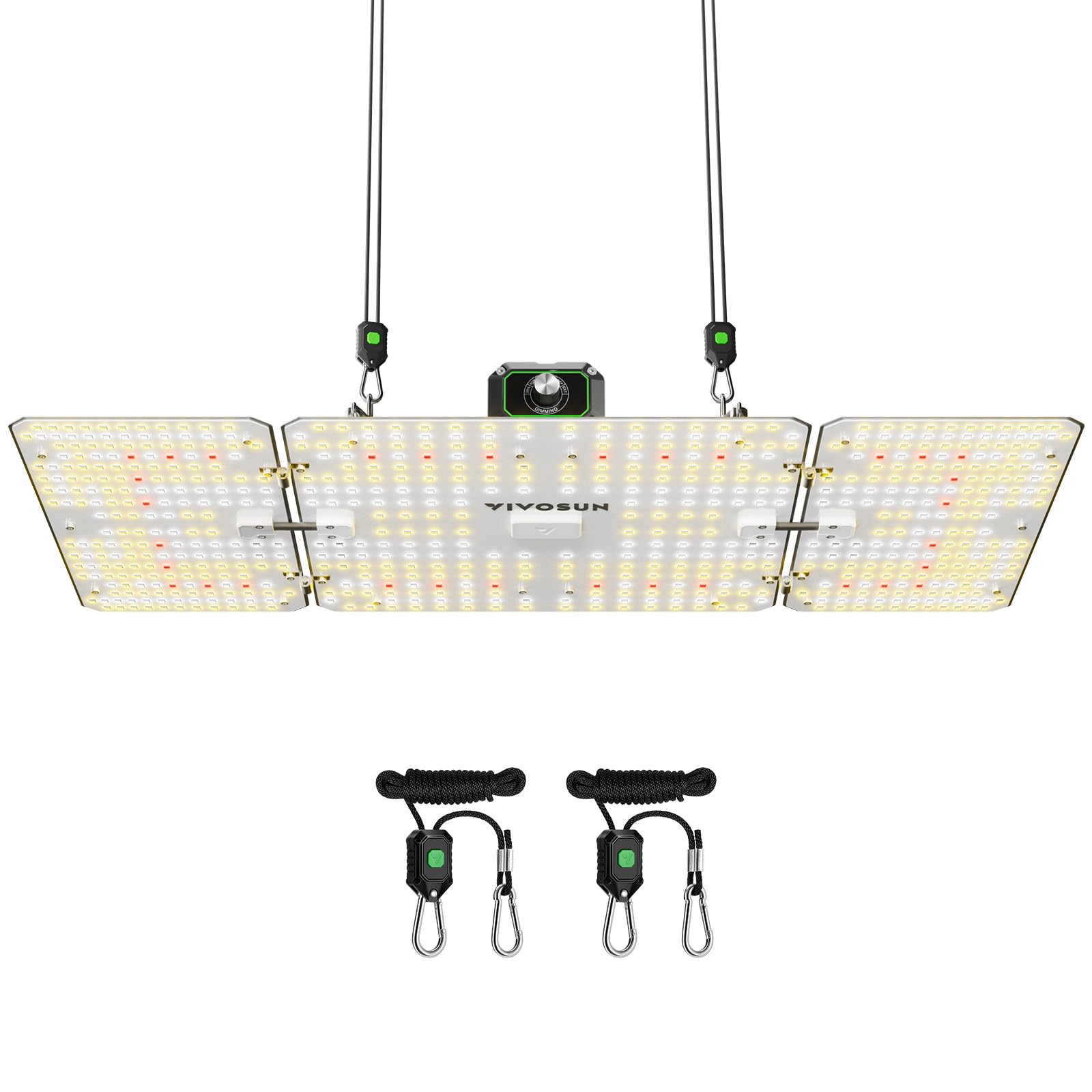
VIVOSUN’s LumaLight 200W is a high-intensity panel built for growers who want app-based automation via the optional GrowHub controller. The diode layout pairs white 3000K and 5000K LEDs with red 660nm and far-red 730nm emitters, delivering a full spectrum that accelerates flowering and increases harvest weight according to multiple user reports comparing against previous HPS setups.
The 4-level dimming knob lets you step from 25% to 100%, but where this unit separates from the pack is its IP65 rating — you can spray water, nutrient solution, or cleaner directly onto the fixture without worrying about moisture damage, making it a legitimate choice for high-humidity tent environments. The aluminum housing and passive heatsink manage thermal output well enough that the panel remains cool to the touch even at full power.
A notable user caveat: the power connection from the driver to the light board feels slightly flimsy for a fixture of this price tier, and a few customers reported that a slight bump caused the connection to cut out temporarily. Additionally, at 200W draw, this panel generates enough intensity to scorch seedlings if hung too close — maintain the manufacturer’s recommended height, and start at 50% for young plants.
Why it’s great
- IP65 waterproof rating allows direct spraying in humid grow tents
- Compatible with VIVOSUN GrowHub for remote app-based scheduling
- Strategic diode layout delivers balanced PPFD from center to edge
Good to know
- Power connector from driver to board can be dislodged by accidental contact
- No gradual dimming — only four fixed steps with non-linear spacing
- Runs noticeably warmer than lower-wattage panels, requiring good tent ventilation
3. chiphy 85″ Tall Grow Light

The chiphy 85” floor light solves a specific but common problem: how to illuminate a mature fiddle-leaf fig or monstera that already stands six feet tall without cluttering the room with hanging pendants or shelf-mounted bars. The 5-section aluminum pole adjusts from 22” to a full 85”, and the lamp head tilts 90 degrees so you can aim light at both the upper canopy and lower leaves that would otherwise remain shaded.
Its 288 LEDs span a color temperature range from 2300K to 6500K, with 10 dimmable brightness levels from 1% to 100%, controlled via an included remote or the touch panel on the pole. Users consistently praise the sturdy cast-iron base — because the pole extends seven feet, a lightweight base would be a safety hazard, but the chiphy feels planted and stable even with the head fully extended and tilted sideways.
The 4, 8, and 12-hour auto on/off timer creates a consistent photoperiod, and the 10.5-foot power cord is generous enough to reach most room corners without needing an extension. The trade-off is light intensity: at 60W total draw, this fixture is not a replacement for a 150W panel in a grow tent — it is a supplemental source designed to keep large ornamental houseplants healthy, not to push heavy flowering or fruiting.
Why it’s great
- Reaches 85″ to properly light tall indoor trees and plants
- Stable cast-iron base prevents tipping even at full extension
- Remote control with 10-level dimming and timer scheduling
Good to know
- 60W output is low for flowering or high-light plants like tomatoes
- Designed for ornamental houseplants, not dense grow tent canopies
- Slightly premium-feeling price for the relatively modest wattage
4. GLOWRIUM Floor Lamp Stand
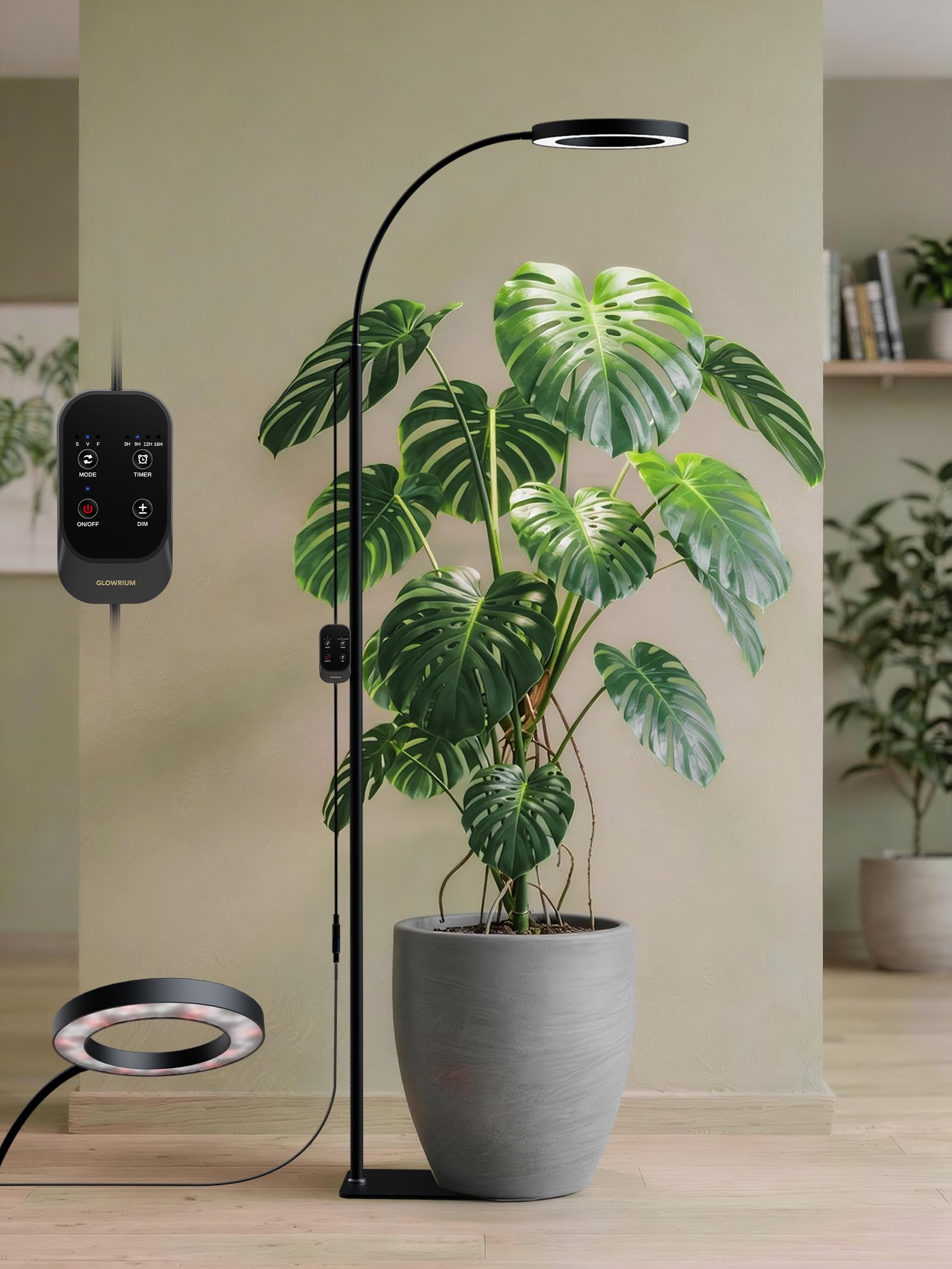
GLOWRIUM’s floor lamp bridges the gap between a decorative household light and a functional grow fixture. Its 66-LED head delivers full-spectrum illumination at 20W, and the head rotates 360 degrees, letting you direct light precisely onto nearby plants. The three-section aluminum pole clicks into three height settings — 32, 47, and 63 inches — accommodating everything from a low succulent arrangement to a chest-high peace lily.
The lamp offers three spectral modes: white light for germination, white plus red for enhanced photosynthesis, and full white-plus-red for the complete growth cycle. This flexibility, combined with an anti-slip base and 13-foot power cord, makes it easy to position in living rooms, bedrooms, or offices without needing to rearrange furniture. Users also compliment the tool-free assembly, which takes under five minutes.
The main limitation is the 20W power ceiling — adequate for low to medium light plants like pothos, snake plants, and philodendrons, but insufficient if you are trying to keep high-light species like cannabis or tomatoes thriving through flower. The lamp also lacks a dimmer function within each spectral mode; you select the mode and get whatever brightness the manufacturer set for that channel.
Why it’s great
- Stylish floor-lamp design blends into home decor naturally
- Three spectral modes with timer for 3, 9, or 12 hours
- 13-foot power cord gives flexible placement options
Good to know
- 20W output limits use to low/medium-light houseplants only
- No continuous dimming — brightness is fixed per spectral mode
- Needs to be placed very close (within 12–18 inches) for best results
5. SANSI Dimmable 40W Grow Light Bulb

SANSI’s 40W dimmable bulb uses the company’s patented ceramic technology that replaces the traditional MCPCB aluminum substrate with a non-conductive ceramic heatsink. The result is dramatically faster heat conduction from the LED PN junction to the surface, which allows this BR30-shaped bulb to push 3800 lumens from a 40W actual draw while running cooler than many 20W bulbs. At 1 foot, it delivers 345 μmol/s/m² PPFD — enough to support flowering in a single large potted plant.
The bulb screws into any standard E26 socket and includes a remote control that handles 4-level dimming (25%, 50%, 75%, 100%) and timer presets of 4, 8, or 12 hours. The 4000K color temperature and 90 CRI rating mean the light appears natural and easy on the eyes, making it a viable choice for a desk lamp or pendant fixture where the bulb is visible. Users report seeing real growth acceleration in monstera, snake plants, and basil within two weeks of switching to this bulb.
Because the beam angle is a relatively tight 60 degrees, this bulb functions as a spotlight rather than a flood — it works well for a single plant or a tight grouping, but you cannot cover a wide shelf or a 2×2 tray with one unit. Multiple bulbs wired into separate sockets would be needed to expand coverage, which can get pricier than a single panel.
Why it’s great
- Ceramic substrate technology provides superior heat dissipation and efficiency
- Remote control dimming and timer for hands-free photoperiod management
- High 90 CRI and natural 4000K color that looks pleasant in living spaces
Good to know
- 60-degree beam angle covers only one plant; poor for trays or shelves
- Screw-in form factor limits placement to existing lamp sockets
- No memory function — bulb resets to 100% after a power interruption
6. SANSI Pot Clip 4-Pack
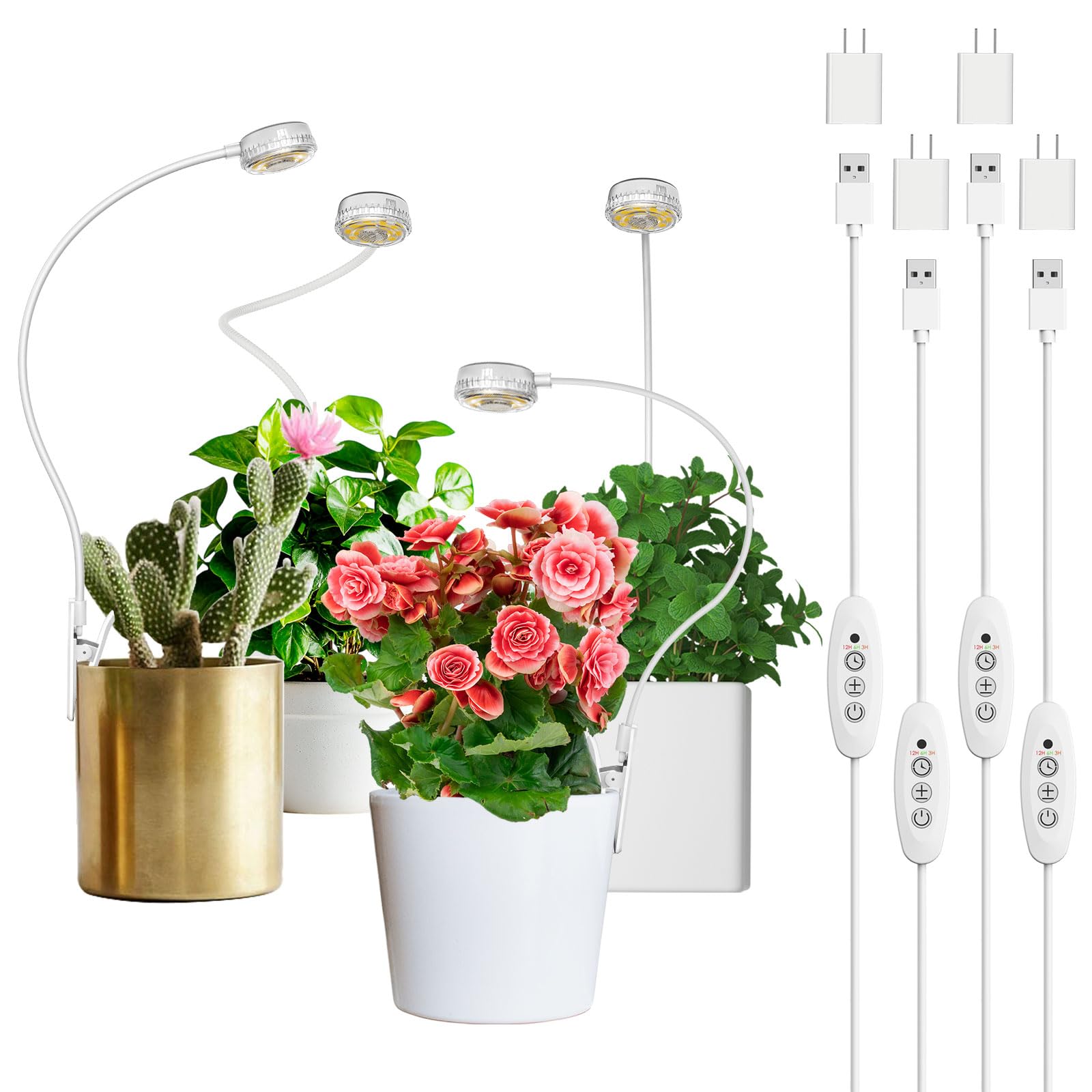
For anyone maintaining a collection of small potted plants on shelves, windowsills, or desks, the SANSI pot clip 4-pack is a clean solution. Each unit draws only 5W via USB power, outputs 35.78 μmol/s/m² at 6 inches, and clips directly onto the rim of a standard nursery pot. The flexible gooseneck holds its position firmly, letting you direct light precisely at the crown of a small succulent or a dish of germinating seeds.
The 4-level dimming (25% to 100%) and 3/6/12-hour timer cycle make it easy to set a consistent photoperiod without needing a separate smart plug. The 4000K natural white light does not produce the harsh magenta blurple that makes a plant shelf look like a nightclub — it blends into a desktop or bookshelf environment cleanly. A 4-pack covers four plants, and because each unit runs on 5V, you can power them all from a standard USB hub or power bank.
The clips themselves are the weak link — several users report that the plastic clamp feels less robust than the light head deserves. While the grip is sufficient for pots with a thick rim, thin nursery pots or glass containers may cause the clip to slide off over time. Additionally, the USB power cable is relatively short, which may require a nearby outlet or a multi-port adapter.
Why it’s great
- Ultra-low 5V USB power draw is safe and can run from a power bank
- Flexible gooseneck holds position for targeted light on small plants
- 4-pack covers multiple plants with consistent full-spectrum light
Good to know
- Plastic clips feel flimsy and may not grip thin pot rims securely
- Short USB cable length may require a nearby power source or extender
- Light output is low — only suitable within 6–10 inches of the canopy
7. Uallhome LED Panel 2-Pack

The Uallhome 2-pack offers the most accessible entry point to full-spectrum lighting for growers starting on a tight budget. Each panel is rated at 200W equivalent while drawing much less actual power, and the ultra-thin 1-inch profile means these panels can be mounted on tent poles, shelf undersides, or ceiling hooks without eating into vertical grow space. The included suspension kit assembles without tools — just hook the panels to the included hanging hardware and plug them in.
The light includes white, blue, red, UV, and IR diodes to cover the full spectrum from seedling to bloom. Users growing cannabis, tomatoes, and houseplants report solid results, especially when using two panels per 4×4 tent for supplemental side lighting during flower. Heat output is minimal — the aluminum backing acts as a heatsink, and you can safely place the panel within a few inches of the top canopy without burning leaves.
The biggest missing feature is any form of dimming, timer, or remote control — it is an on/off fixture only. The 6-foot power cord is also on the shorter side, and the included hanging hardware can be tricky to balance because the cord weight tends to tilt the panel slightly forward. For the price of a two-pack, however, these panels deliver decent light output that gets the job done for seed starting and vegetative growth.
Why it’s great
- Excellent value for a two-pack — covers a larger area for minimal cost
- Ultra-thin 1-inch profile fits in tight shelf or tent spaces
- Low heat output allows placement close to plant canopy
Good to know
- No dimmer, timer, or remote control — on/off operation only
- Short 6-foot power cord limits placement options
- Hanging hardware can tilt the panel if not carefully balanced
FAQ
Can I use a standard LED bulb as a plant grow light?
How close should I hang my LED grow light to the canopy?
What is the difference between blurple and full-spectrum LED grow lights?
Do I need a separate timer for my grow lights?
Final Thoughts: The Verdict
For most users, the best plant grow lights winner is the VIPARSPECTRA XS1500 Pro because it balances true 150W power draw with optical-lens-controlled PPFD uniformity and daisy-chain dimming that scales from a single tent to a multi-unit grow. If you want smart automation and IP65 water resistance for a high-humidity tent, grab the VIVOSUN LumaLight 200W. And for keeping tall ornamental houseplants alive and thriving in your living room with a fixture that doubles as decor, nothing beats the chiphy 85″ Tall Floor Light.