The biggest mistake succulent owners make is reaching for the same liquid fertilizer they pour on their ferns. That high-nitrogen formula pushes soft, leggy growth on plants built to stay compact. What these slow-growing xerophytes actually need is a low-nitrogen, micronutrient-rich feed that mirrors the lean soil of their native desert and rocky environments. Picking the wrong bottle can distort a rosette Echeveria into a stretched mess in under two months.
I’m Mohammad Maruf — the founder and writer behind AirfryerBite. Over the last five years, I’ve cross-referenced hundreds of technical datasheets, analyzed NPK profiles, and tracked real-world customer feedback across dozens of houseplant fertilizer lines to understand exactly why some formulations cause more harm than good for succulents and cacti.
This guide breaks down the five most effective liquid formulas I’ve found that actually respect how a succulent takes up nutrients. If you want a precise, beginner-proof starting point, this roundup of the best succulent plant food options on the market will help you match the right NPK ratio to your specific collection without guessing.
How To Choose The Best Succulent Plant Food
Succulents aren’t heavy feeders. They evolved to survive on sparse nutrients, and applying a general-purpose plant food can poison the soil biology they rely on. The right formulation targets root density, color vibrancy, and bloom production without forcing soft top-growth. The three specs below separate safe, effective formulas from the ones best left on the shelf.
NPK Ratio — Low Nitrogen is Non-Negotiable
The three-number ratio on the label tells you everything. A succulent-specific food should have the first number (nitrogen) lower than the second (phosphorus) and third (potassium). Nitrogen above 3 or 4 encourages rapid leaf and stem elongation, which makes your plant look stretched and pale. Look for a ratio like 2-7-7 or 1-2-2. Phosphorus supports root architecture and bloom development, and potassium bolsters cell wall strength against drought stress. A balanced low-N formula keeps the plant compact and the colors deep.
Form — Ready-to-Use vs. Concentrate
Ready-to-use liquids let you apply with a pump or sprayer immediately, ideal for five to fifteen pots where you want no math involved. Concentrates offer a lower cost per dose and let you dial in a weaker solution for sensitive varieties like Lithops or Haworthia. If you choose a concentrate, the dilution ratio should be listed in milliliters per gallon. Too many beginners ignore the mixing direction and burn the feeder roots. Start with half the recommendation on your first two applications to gauge the plant’s reaction.
Micronutrients and Additives
Succulents absorb minerals differently than tropical houseplants. A good plant food will include calcium, magnesium, zinc, manganese, and iron. Calcium promotes cell wall stability, which prevents split leaves and rotting stems. B1 (thiamine) reduces transplant shock when repotting. Glucose appears in some formulas as an immediate energy source for stressed plants. Avoid formulas with added urea or high chloride levels — they can accumulate in dry soil mixes and damage delicate root hairs over time.
Quick Comparison
On smaller screens, swipe sideways to see the full table.
| Model | Category | Best For | Key Spec | Amazon |
|---|---|---|---|---|
| Cute Farms Succulent Fertilizer | Mid-Range | Monthly feeding with included sprayer | NPK 0.02-0.02 | Amazon |
| Gardenera Plant Superfood | Mid-Range | Stressed or newly potted succulents | B1, Glucose, Zinc | Amazon |
| Schultz Cactus Plus 2-7-7 | Mid-Range | Root and bloom support for cacti | NPK 2-7-7 Concentrate | Amazon |
| Gardenera Organic Superfood | Premium | Organic feeding with 18 nutrients | 18 Vitamins & Minerals | Amazon |
| Growth Technology GT Succulent Focus | Premium | Precision hydroponic and soil feeding | pH Buffered, 12 Minerals | Amazon |
In‑Depth Reviews
1. Cute Farms Succulent, Cacti, & Aloe Fertilizer
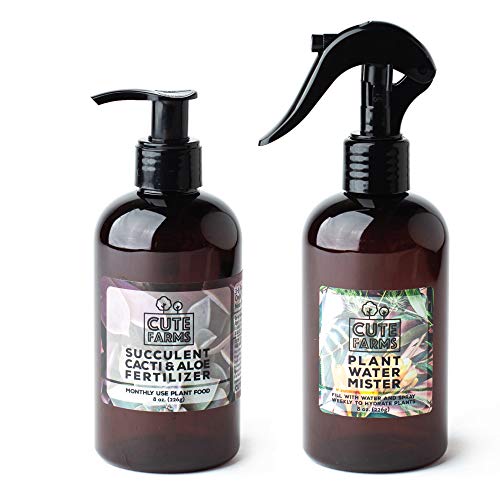
The Cute Farms formula uses an NPK of 0.02-0.02, the lowest concentration in this roundup, which mirrors the near-zero nutrient density of natural succulent soil. This isn’t a fast-acting blast — it is a gentle monthly tonic that prevents salt accumulation in the pot. The dispensing pump locks to avoid leaks, and each pump delivers a measured dose so you don’t have to guess. One bottle feeds a small collection for roughly twelve months.
Buyers consistently report new root growth and deeper green coloration within three weeks of the first application. The included 8 oz mister bottle ships empty, letting you use your own water source for the fine mist that Aloe and Haworthia prefer. The formula covers most common xerophytes including Aeonium, Echeveria, Jade, and String of Pearls. It works equally well in glass terrariums and traditional clay pots.
The ultra-low NPK means it won’t correct severe nutrient deficiencies quickly. If you have a succulent that is already pale and dropping leaves, you may need a more concentrated option or a smaller dose applied weekly instead of monthly. The formula is best suited as a maintenance feed rather than a rescue aid.
Why it’s great
- Near-zero NPK prevents accidental overfeeding
- Locking pump and mist bottle included
- One year supply for average collections
Good to know
- Too weak for severely deficient plants
- Only 2.5 sq ft coverage per bottle
2. Gardenera Plant Superfood for Succulents & Cactus
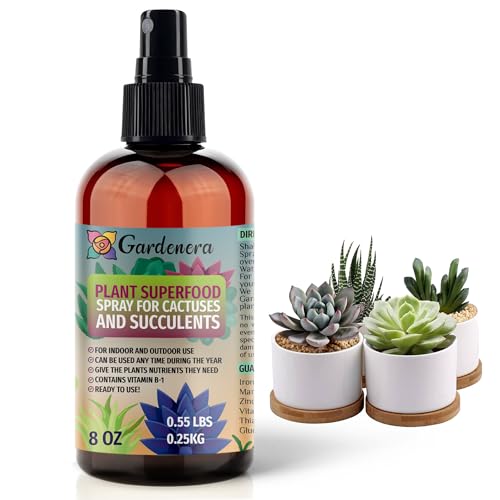
Gardenera takes a different approach by adding Vitamin B1 and glucose alongside the basic NPK. The B1 reduces transplant shock when you move a succulent into a new pot or a different light environment. The glucose supplies a rapid carbohydrate boost for plants that are struggling to photosynthesize due to low winter light or root damage. The micronutrient lineup includes iron, manganese, and zinc — each essential for leaf pigmentation and resisting fungal stress.
Users report that the spray formula works well on Fiddle Leaf Fig, Avocado, and Lemon Meyer trees in addition to succulents, but the label is specifically targeted at cacti and succulents. The 8 oz bottle requires only two or three sprays at the base and a few more on the leaves every nine to ten days. Customers with rescued plants that were close to dying saw measurable greening within days of the first application.
The spray nozzle can sometimes stiffen after a few weeks of use, requiring you to clean the tip with warm water. Some users noted that the label ink fades after a few weeks on the shelf. The formula is not organic and does contain synthetic glucose, so purists may prefer a soil-drench concentrate instead.
Why it’s great
- B1 helps stressed or repotted succulents recover
- Glucose provides an immediate energy lift
- Works as both a soil drench and foliar spray
Good to know
- No precise NPK ratio listed on label
- Spray nozzle may clog if not rinsed
3. Schultz Cactus Plus 2-7-7 Liquid Plant Food
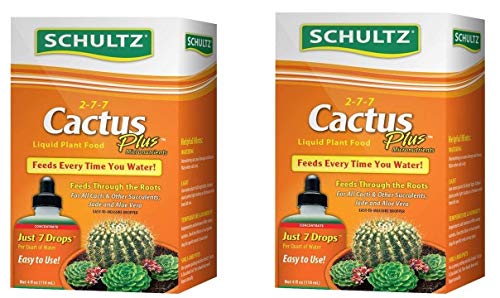
Schultz has been a staple in the houseplant fertilizer world for decades, and their Cactus Plus 2-7-7 formula remains one of the most respected options for growers who want deliberate control over their feeding schedule. The low nitrogen content prevents etiolation — that spindly, stretched look that happens when the plant reaches for light after too much N. The higher phosphorus and potassium numbers promote dense roots and reliable bloom cycles. Each 4 oz bottle yields around 24 gallons of mixed feed, making it one of the most concentrated liquid options available.
Users with Christmas Cactus and Barrel Cactus report that consistent monthly feeding with Schultz triggers flower bud formation in late fall. The recommended dilution is one teaspoon per gallon of water, but experienced growers often halve that to half a teaspoon per gallon for sensitive species like Lithops. The formula is completely synthetic and fast-acting, so you will see results within one growing cycle. The small bottle size is ideal for shelf storage and travel.
Because it is a concentrate, you must measure and mix each time. The bottle does not include a measuring dropper, so you will need your own teaspoon or syringe. Over-mixing by even a small amount can burn tender roots, especially in terracotta pots where salts concentrate at the rim. Always water the soil before applying Schultz to avoid root shock.
Why it’s great
- 2-7-7 ratio is ideal for compact growth and blooms
- Extremely concentrated — up to 24 gallons per bottle
- Proven trigger for Christmas Cactus flowering
Good to know
- No included measuring device
- Requires careful dilution to avoid root burn
4. Gardenera Organic Superfood for Succulents & Cactus
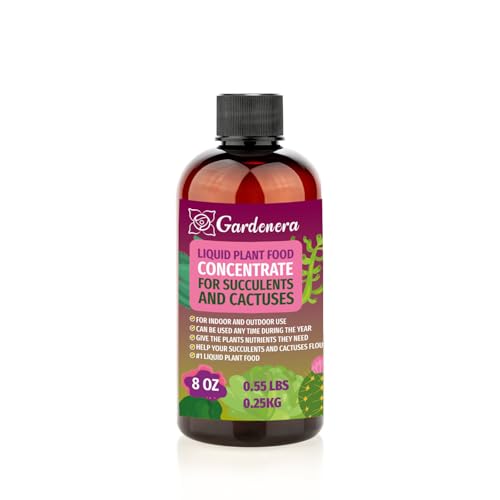
Gardenera’s Organic Superfood is the only formula on this list that sources nutrients from poultry litter, rabbit manure, bat guano, cricket frass, worm castings, oyster shell, kelp meal, and mycorrhizae. That organic diversity means the plant doesn’t just get NPK — it receives a full microbial index that rebuilds the soil food web, particularly important for succulents grown in reused or depleted commercial mixes. The dilution ratio is 1:128, meaning one tablespoon per two gallons of water.
Customers who switched from synthetic fertilizers to this organic concentrate noticed better bloom size and more intense leaf coloration, especially on Echeveria and Graptopetalum varieties. The Zymology process breaks the ingredients down into readily absorbable elements, and the formula never expires in either concentrated or diluted form. It also works in hydroponic and semi-hydro setups where soil biology is absent. The bottle is safe for pets, fish, and reptiles — a strong advantage for terrarium owners.
The eight-ounce bottle requires two tablespoons per gallon, meaning heavy users with large collections will go through the bottle faster than expected. The natural ingredients can produce a mild earthy odor when first mixed, though it dissipates quickly after application. Owners of very small collections with two or three pots may find the bottle lasts longer than the plant’s winter dormancy period.
Why it’s great
- 18 organic nutrient sources including mycorrhizae
- 100% safe for terrariums with reptiles or fish
- Non-expiring formula for long storage
Good to know
- Consumes quickly at 2 tbsp per gallon
- Slight natural odor when mixed
5. Growth Technology GT Succulent Focus
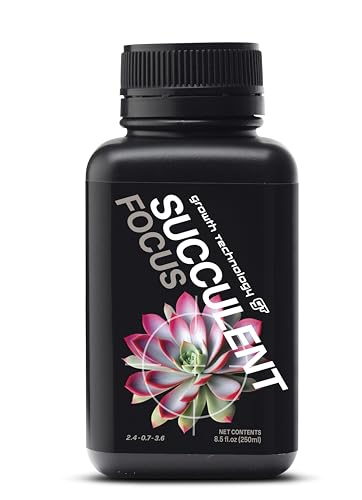
GT Succulent Focus is formulated by Growth Technology, a British brand that specializes in precision hydroponic nutrient systems. The liquid concentrate contains twelve essential minerals — including calcium — blended into a pH-buffered solution that keeps every element available for uptake across a wide pH range. This matters for succulents in soil mixes that lean alkaline from added perlite or pumice. The specific 3–5ml per liter for soil and 5–7ml per liter for hydroponics gives you granular control over feed strength.
Users with Alocasia, Monstera, and other aroids also report excellent results, though the label is built for succulents and cacti. The low nitrogen and phosphorus profile matches the slower metabolism of xerophytes, while the absence of sodium, chlorides, urea, cobalt, and nickel means zero risk of toxic salt buildup in containers without drainage holes. The bottle is small at 8.45 fl oz, but each liter of mix requires only 3 to 5 ml, so a single bottle stretches across dozens of watering cycles.
The price sits well above entry-level options, and the bottle design has been reported to leak during shipping if the cap loosens in transit. Make sure to check the seal on arrival. The instructions recommend applying with every watering, which can feel wasteful for owners who water sparingly during winter dormancy. Use at half strength in cooler months to match the plant’s reduced nutrient demand.
Why it’s great
- pH buffered for stable nutrient uptake in alkaline soil
- No sodium, chlorides, or urea — safe for drainage-free pots
- High concentration means dozens of feedings per bottle
Good to know
- Premium price compared to other liquid options
- Bottle cap may loosen during shipping
FAQ
Can I use all-purpose plant food on my succulents?
How often should I feed my succulents with liquid food?
What causes white crust on the soil surface after feeding?
Is it safe to use organic plant food in a terrarium with reptiles?
Final Thoughts: The Verdict
For most users, the best succulent plant food winner is the Cute Farms Succulent Fertilizer because its ultra-low NPK ratio eliminates the risk of overfeeding while the included mist sprayer makes application effortless for first-time and seasoned growers alike. If you want a concentrated feed that triggers deeper root systems and reliable blooms, grab the Schultz Cactus Plus 2-7-7. And for an organic, pet-safe formula that rebuilds soil biology, nothing beats the Gardenera Organic Superfood.