A smoke detector that screams at burnt toast but sleeps through a real fire is worse than no alarm at all. The right unit for your house needs to catch flames fast, ignore your cooking, and never chirp at 3 AM because a battery is dying. This guide cuts through the noise to find the detectors that actually do their job.
I’m Mohammad Maruf — the founder and writer behind AirfryerBite. My research focuses on sensor accuracy, nuisance alarm reduction rates, and compliance with the latest UL 217 standards across battery and hardwired smoke detector models.
After combing through hundreds of verified customer experiences and spec sheets, I’ve identified the models that deliver real protection without the headaches. These are the best smoke detectors for house safety today.
How To Choose The Best Smoke Detectors For House
Choosing a smoke detector used to be simple — you grabbed the cheapest white circle. Today, you need to weigh sensor type, power source, interconnect options, and nuisance alarm resistance. Here is what actually matters.
Ionization vs. Photoelectric Sensors
Ionization sensors are faster at detecting fast-flaming fires — think a grease fire or a curtain catching a spark. Photoelectric sensors respond quicker to smoldering fires, like a cigarette falling into a couch. For maximum coverage, dual-sensor alarms give you both, but ionization units are the standard choice for most houses due to their sharper response to common household fires.
Hardwired vs. Battery-Powered Installation
Hardwired detectors connect to your home’s electrical system and typically include a battery backup. They are required by code in many new builds and allow interconnectivity — one alarm triggers all others. Battery-powered units are easier to retrofit and avoid wiring work, but you must stay disciplined about battery swaps. A 10-year sealed lithium battery eliminates that hassle entirely for the life of the alarm.
Interconnectivity and Coverage Limits
Interconnected alarms mean that when a fire starts in the basement, the unit in your bedroom also blasts the 85 dB warning. Hardwired models like the Kidde I12040 allow up to 24 linked devices, while some battery-powered units can connect wirelessly. Check your square footage — a 2,000-square-foot house usually needs at least one detector per floor plus one in each bedroom hallway.
Quick Comparison
On smaller screens, swipe sideways to see the full table.
| Model | Category | Best For | Key Spec | Amazon |
|---|---|---|---|---|
| First Alert SMI105-AC | Hardwired | Whole-house interconnect | 10-Year sealed battery backup | Amazon |
| Kidde 20SDR | Battery | Simple retrofit install | 2 AA battery operation | Amazon |
| Kidde I12040 | Hardwired | Multi-unit interconnect | Up to 24 linked devices | Amazon |
| First Alert SMICO100 | Combo Battery | 2-in-1 smoke & CO protection | 9V battery powered | Amazon |
| First Alert SMCO100 | Combo Battery | False alarm reduction | Precision Detection tech | Amazon |
In‑Depth Reviews
1. First Alert SMI105-AC

The First Alert SMI105-AC is the benchmark for whole-house hardwired smoke detection. Its Precision Detection technology is designed to meet the latest UL 217 standards, reducing nuisance alarms from cooking while providing early warning for a real fire. The 10-year sealed battery backup ensures that even during a power outage, this unit keeps scanning — no chirping, no mid-night battery swaps.
Users replacing older Kidde detectors praised the easy plug-and-play installation using the existing wiring harness. The interconnect feature links all compatible alarms so that when one finds smoke, every unit in the house sounds off. The green LED backlight provides a subtle visual confirmation that the unit is powered and working.
The ionization sensor is ideal for fast-flaming fires, but if you need photoelectric coverage for smoldering fires, you may want a dual-sensor unit in certain rooms. For most homeowners looking for a code-compliant, dependable hardwired solution, this is the clear starting point.
Why it’s great
- 10-year sealed battery backup eliminates chirping.
- Interconnect triggers all alarms when one detects smoke.
- Precision Detection reduces cooking false alarms.
Good to know
- Ionization sensor only — less responsive to smoldering fires.
- Requires existing hardwiring for install.
2. Kidde 20SDR

The Kidde 20SDR is the ideal retrofit detector if you want to skip the electrician entirely. It runs on two AA batteries (included), so there is zero wiring — just mount the base, twist on the unit, and pull the battery tab. Despite the battery simplicity, it meets UL 217 10th Edition standards and claims to detect smoke over 25% faster than previous models.
An 85-decibel alarm with a flashing red LED provides both audio and visual warnings. The Test & Hush button lets you silence nuisance alarms from cooking or steam without disabling the detector. Users coming from 9V-powered units found the AA battery tray more convenient and appreciated the included dust cover to protect the sensor during construction.
Be aware that this is not a hardwired unit — buyers expecting to connect to home wiring will be disappointed. For renters or anyone adding protection to garages, basements, or bedrooms without wired pre-wiring, this is a solid, code-compliant pick.
Why it’s great
- No hardwiring required — installs in minutes.
- Faster smoke detection than previous models.
- Hush feature silences false alarms safely.
Good to know
- Not interconnectable with other units.
- AA batteries need replacement every year or so.
3. Kidde I12040
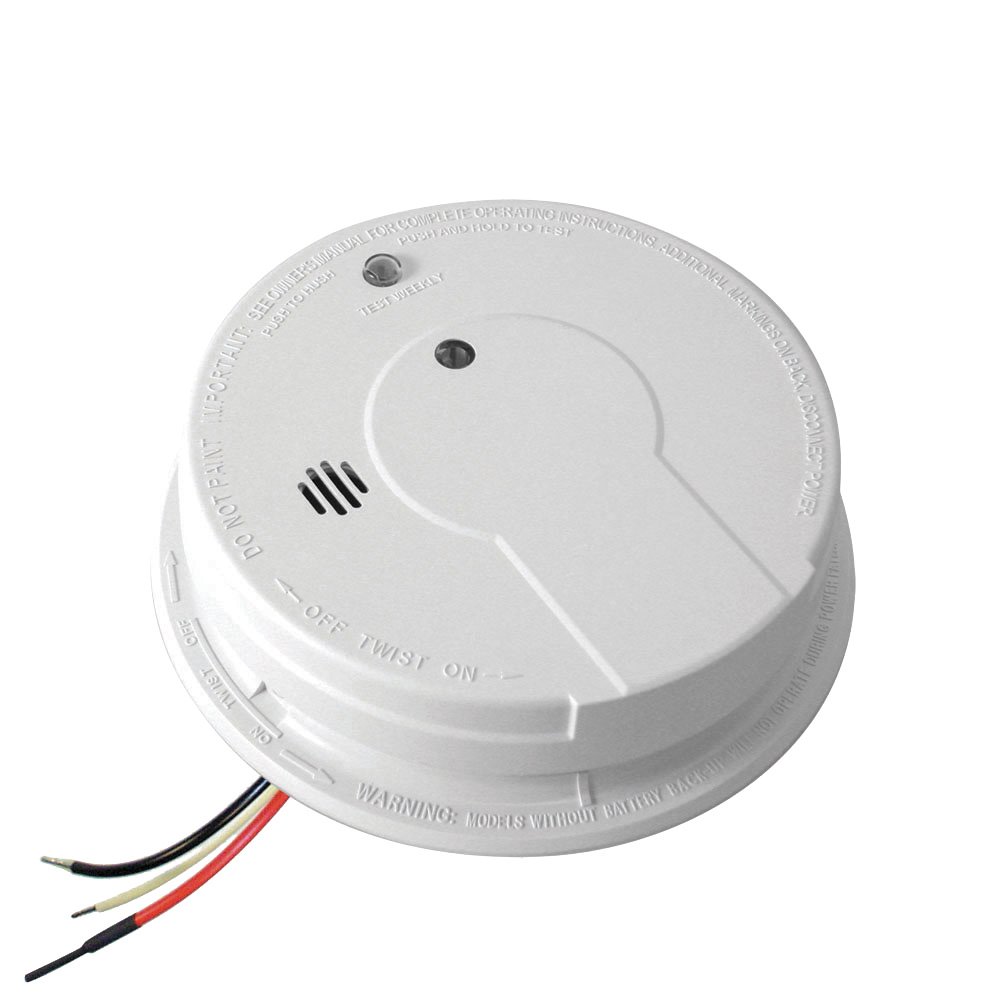
The Kidde I12040 is the workhorse for large interconnected systems. It can connect up to 24 devices — including smoke, CO, and heat alarms — so a single detector in the basement can wake the entire household. The ionization sensor focuses on fast-flaming fires, and the 9V battery backup keeps it running during power failures.
Installation is simplified by the pre-stripped wiring harness and easy-off cap — no wire stripper needed. The front battery pull tab lets you activate the battery without removing the alarm from the bracket. Users replacing 6 to 12-year-old units noted it was a direct plug-in replacement with the same 3-prong connector, stopping false alarms immediately.
Some users reported a shorter lifespan than the advertised 10-year window, with nuisance alarms appearing after 4 years. Regular vacuuming to clear dust and cobwebs can extend the life. For homes with multiple floors and a robust interconnected system, this Kidde model is a proven, code-compliant choice.
Why it’s great
- Interconnects up to 24 devices for whole-house alerting.
- Easy plug-in replacement for older Kidde units.
- Pre-stripped wiring saves installation time.
Good to know
- Ionization only — not ideal for smoldering fire detection.
- Some units may see reduced life before the 10-year mark.
4. First Alert SMICO100

The First Alert SMICO100 packs both smoke and carbon monoxide detection into a single battery-operated unit. This is a space-saver for rooms where you would otherwise need two separate alarms. Powered by a standard 9V battery, it is easy to install anywhere — no wiring, no electrician needed.
It uses the same Precision Detection technology found in the hardwired SMI105-AC, meaning it reduces nuisance alarms from cooking while still providing early fire warning. The end-of-life chirp lets you know when the entire unit needs replacing. Users found it easy to mount with the existing screw holes from their old detectors and appreciated the dual-function value.
One caveat: it uses an ionization sensor for smoke detection, so it may be less responsive to smoldering fires. Also, the 9V battery will need replacement roughly once a year. For a simple, reliable combo alarm that covers two threats at once, this is a strong entry-level pick.
Why it’s great
- Combines smoke and CO detection in one unit.
- Easy battery-powered installation.
- Reduces nuisance alarms with Precision Detection.
Good to know
- Ionization sensor limited to fast-flaming fires.
- 9V battery requires annual replacement.
5. First Alert SMCO100

The First Alert SMCO100 is a sibling to the SMICO100 but runs on AA batteries instead of a 9V. This small change means finding replacements is easier — AA batteries are everywhere. Like its stablemate, it combines smoke and carbon monoxide detection with Precision Detection technology to cut down on false alarms from cooking and steam.
Users specifically praised this model for eliminating the nightly false alarms they had tolerated for months with older detectors. The test/silence button works reliably, and the end-of-life chirp ensures you know when to swap out the unit. It fits existing First Alert mounting bases, making it a straightforward swap for homes already in that ecosystem.
If you already have a First Alert hardwired system and want battery-powered units for areas without wiring — like a finished basement or attic — the SMCO100 matches the look and feel. Its slim 1.9-inch profile sits flush against the ceiling, and the AA batteries should offer a longer service interval than a 9V.
Why it’s great
- AA batteries are easier to find and replace than 9V.
- Precision Detection nearly eliminates nuisance alarms.
- Fits existing First Alert mounting bases.
Good to know
- Ionization sensor only — slower on smoldering fires.
- Not interconnectable with hardwired units.
FAQ
How many smoke detectors do I need in a 2,000-square-foot house?
Can I mix ionization and photoelectric detectors in the same system?
What does the end-of-life warning chirp mean?
Final Thoughts: The Verdict
For most households, the best smoke detectors for house winner is the First Alert SMI105-AC because it combines hardwired reliability, a 10-year sealed battery backup, and Precision Detection that cuts nuisance alarms without sacrificing early fire warning. If you want a simple battery-powered retrofit with zero wiring, grab the Kidde 20SDR. And for whole-house interconnected protection with support for up to 24 devices, nothing beats the Kidde I12040.