A wooden carving board isn’t just a slab of wood—it’s the platform where your Sunday roast, holiday turkey, or brisket meets the knife. Pick the wrong one, and you get warped wood, dull blades, and a countertop swimming in meat juice. Get it right, and the board becomes a tool that enhances every slice while protecting your knife edge for years.
I’m Mohammad Maruf — the founder and writer behind AirfryerBite. I’ve spent years analyzing the grain structure, thickness tolerances, and moisture resistance of dozens of wooden boards, comparing edge-grain vs. end-grain construction, and tracking how acacia, maple, and bamboo hold up under daily carving abuse.
After evaluating the market across multiple price tiers, I’ve narrowed the field to the seven models that genuinely earn a spot in a serious kitchen. This guide delivers the best wooden carving board for every budget, carving style, and counter scenario.
How To Choose The Best Wooden Carving Board
A carving board must handle heavy knives, catch running juices, and stay flat on your counter through years of hot roasts. Here are the specific specs and design features that separate a weekend-warrior board from a lifelong kitchen partner.
Wood Species: Acacia vs. Maple vs. Bamboo
Acacia offers natural water resistance and a striking grain pattern at a mid-range price, making it the most common choice for large carving boards. Maple is harder, denser, and more knife-friendly, but costs notably more. Bamboo is budget-friendly and eco-friendly, but its silica content can dull blades faster and it tends to crack in dry environments. For weekly heavy carving, acacia or maple is the better long-term bet.
Thickness and Stability
A carving board below 1.2 inches thick risks warping under the weight of a large roast or the heat of a freshly cooked turkey. Boards at 1.5 inches or thicker provide the mass needed to stay planted on the counter and the clearance to allow knife tips to pass through without striking the surface below. Thicker boards also resist the seasonal humidity changes that cause thinner wood to cup.
Juice Management: Grooves, Wells, and Channels
A standard perimeter juice groove works for everyday slicing, but dedicated carving boards often feature a central grip pad surrounded by a juice well or a sloped surface leading to a collection reservoir. These designs keep the meat stable while capturing the runoff from a brisket or roast turkey. Look for grooves that are at least ¼ inch deep to avoid overflow during a big carve.
Edge Grain vs. End Grain
Edge-grain boards are lighter, easier to maintain, and more affordable—ideal for most home carvers. End-grain boards are significantly heavier and more expensive, but the butcher-block style is self-healing against knife marks and keeps blades sharper longer. For a carving board used primarily for meat, edge grain provides the best balance of durability and care simplicity.
Quick Comparison
On smaller screens, swipe sideways to see the full table.
| Model | Category | Best For | Key Spec | Amazon |
|---|---|---|---|---|
| Ironwood Gourmet Kansas City | Premium | Large roasts & juice collection | 22 x 15 x 2.5 inches (with feet) | Amazon |
| Ironwood Gourmet Hudson | Premium | Carving with grip pad stability | 15 x 20 x 1 inch | Amazon |
| WoodForChef Maple Board | Premium | Knife-friendly edge grain | 16 x 12 x 1.5 inches | Amazon |
| FANICHI Acacia Board | Mid-Range | All-purpose carving & serving | 17 x 13 x 1.5 inches | Amazon |
| GAOMON XXL Board | Mid-Range | Extra-large prep & stovetop cover | 24 x 18 x 1.2 inches | Amazon |
| Fashionwu Acacia Board | Mid-Range | Big meat cuts & family feasts | 24 x 18 x 1.2 inches | Amazon |
| ROYAL CRAFT WOOD Set | Budget | Variety prep & budget entry | 3 boards, 15 x 10 max | Amazon |
In‑Depth Reviews
1. Ironwood Gourmet Kansas City Large Carving Board
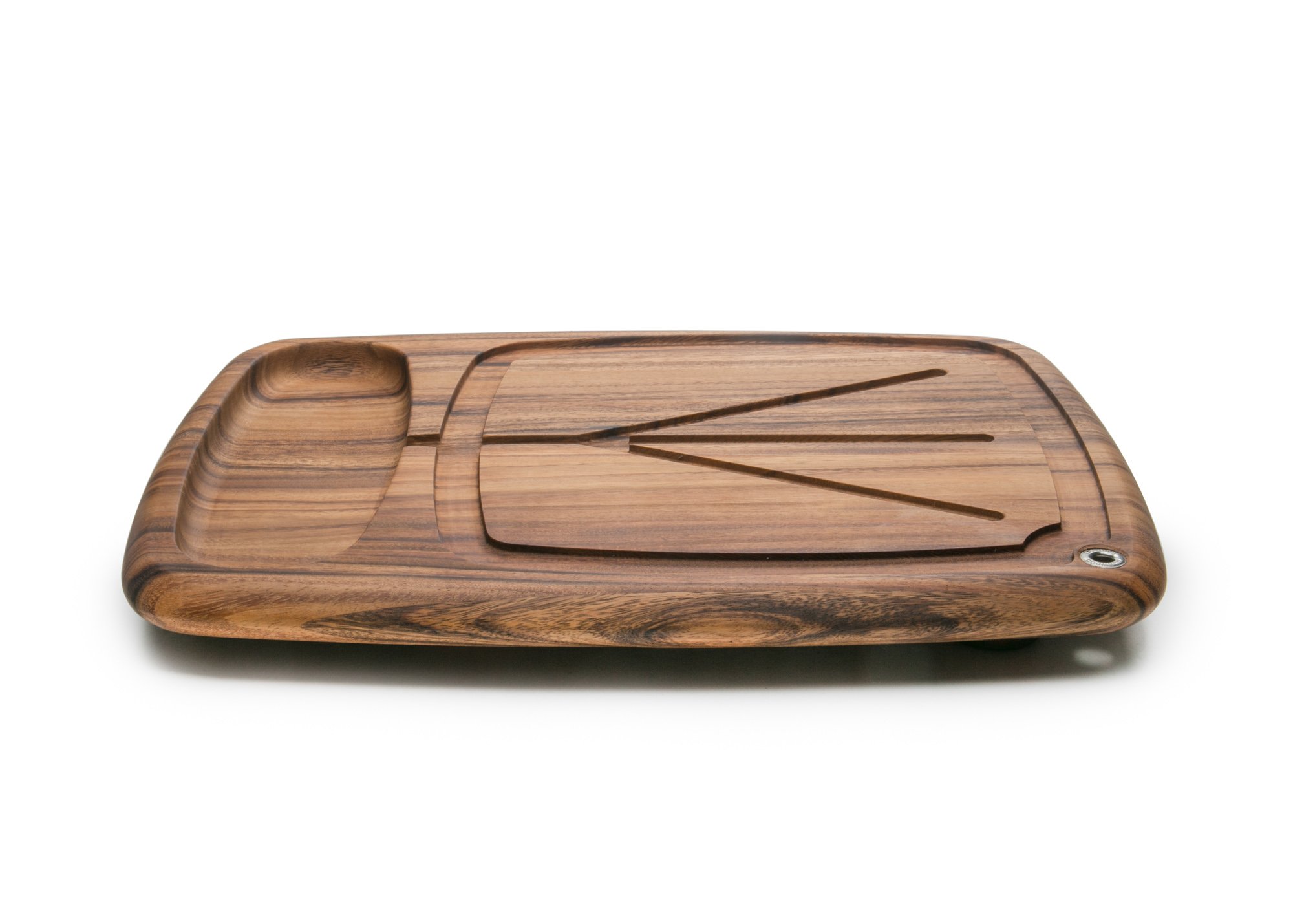
The Kansas City board is purpose-built for the biggest carves: whole turkeys, standing rib roasts, and packer briskets. Its 22 x 15 inch surface sits 2.5 inches high on neoprene-coated feet, with a sloped design that channels juices into a reservoir at one end. The acacia construction is sustainably harvested, and the naturally contrasting grain gives each board a unique look.
Unlike standard flat boards with a simple perimeter groove, this model uses a two-foot tilt design that lets you direct the flow of runoff. The stainless steel grommet allows hanging for air drying, which is crucial for preventing moisture entrapment. Multiple long-term users report the surface remains unscarred after five years of daily cutting, with only occasional mineral oil conditioning needed.
The large juice well does reduce the usable flat carving area slightly, and the grooved surface texture takes some adjustment for clean knife strokes. Some units arrived with raised grain after the first wash, but the manufacturer’s customer support proactively offered replacement boards and oil. For anyone who regularly carves large, juicy meats, this board eliminates countertop mess at the cost of a smaller carving zone.
Why it’s great
- Sloped juice reservoir collects volumes that overflow standard grooves
- Neoprene feet provide slip-free stability on any counter
- Exceptional manufacturer support and warranty coverage
Good to know
- Large well reduces usable carving surface area
- Grooved texture can be slightly harder to cut on initially
- Requires hand washing and regular oiling to prevent grain raising
2. Ironwood Gourmet Hudson Carving Board
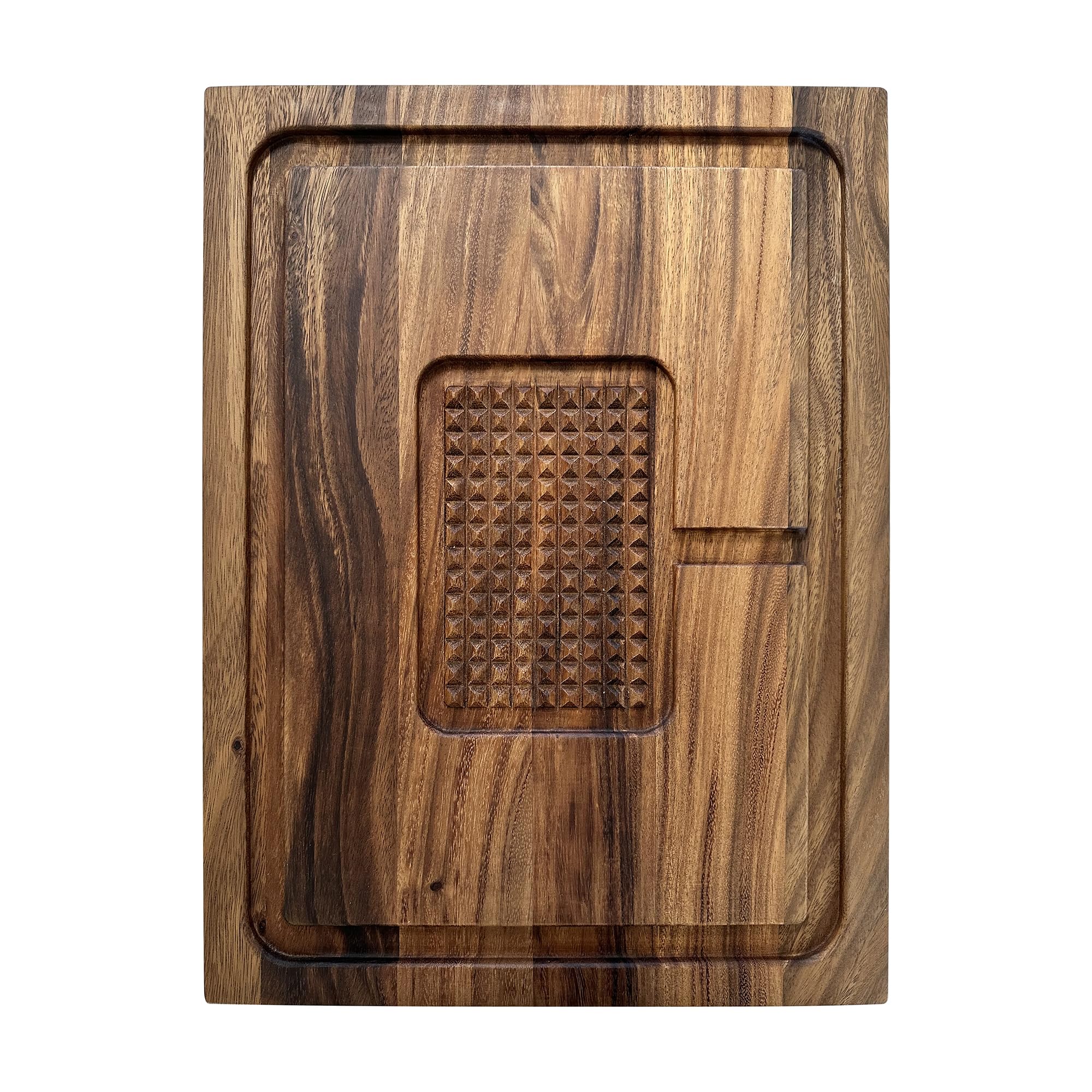
The Hudson model takes a different approach to juice management: a carved grip pad in the center holds the meat steady, while a surrounding juice well collects runoff without the meat sitting in its own liquid. At 15 x 20 inches with a 1-inch thickness, it’s slightly thinner than the Kansas City but remains light enough for easy transport from counter to table.
The acacia wood is sustainably sourced and shows natural contrasting patterns unique to each board. The reversible design means you can use one side for carving and the other for general prep, extending the board’s life. The grip pad genuinely helps keep a roast from sliding during aggressive slicing, and the juice well is deep enough to handle a full turkey carve without overflow.
Some users noted the grain lifted slightly after the first wash, which resolved with a board wax treatment rather than mineral oil. The juice well does reduce the total carving area, and the grooved surface texture requires a slightly different cutting technique. For the price, the combination of grip pad, juice well, and reversible acacia construction makes this a strong mid-to-premium choice for carvers who want stability and liquid control in one board.
Why it’s great
- Center grip pad prevents meat sliding during carve
- Deep juice well captures runoff without meat sitting in liquid
- Reversible for separating carving and general prep
Good to know
- 1-inch thickness is thinner than some premium competitors
- Juice well reduces available flat carving area
- Grain may raise after first wash; requires wax treatment
3. WoodForChef Medium Maple Cutting Board

For cooks who prioritize blade longevity above all else, the WoodForChef maple board is the standout. Made from Canadian maple with FSC certification, this 16 x 12 x 1.5 inch edge-grain board is pre-seasoned with a mineral oil and beeswax blend, ready to use out of the box. Maple is notably harder than acacia, which translates to less visible scarring and a surface that stays smooth for years.
The deep juice groove runs along one edge, adequate for standard meat prep though not as elaborate as the well-based designs. The 1.5-inch thickness gives substantial weight—8 pounds—keeping the board planted during heavy carving. Multiple users report the board arrived flat with no rocking, and the edge-grain construction resists warping better than many acacia alternatives at this price point.
The board does require initial conditioning with additional oil—three to four coats with one-hour soak intervals—to reach peak water resistance. The maple surface is dense enough to show cut marks on the end grain of the edge-grain pattern, but the marks are superficial and do not affect function. For knife enthusiasts who want a dense, stable, long-lasting board that will not dull their edge, this maple board delivers premium performance at a mid-tier price.
Why it’s great
- FSC-certified Canadian maple is denser and more knife-friendly than acacia
- Pre-seasoned with mineral oil and beeswax for immediate use
- 1.5-inch thickness provides excellent warp resistance and stability
Good to know
- Requires several conditioning oil coats before peak performance
- 8-pound weight is heavier to move around the kitchen
- Edge grain shows superficial marks from heavy use
4. FANICHI Acacia Wood Cutting Board
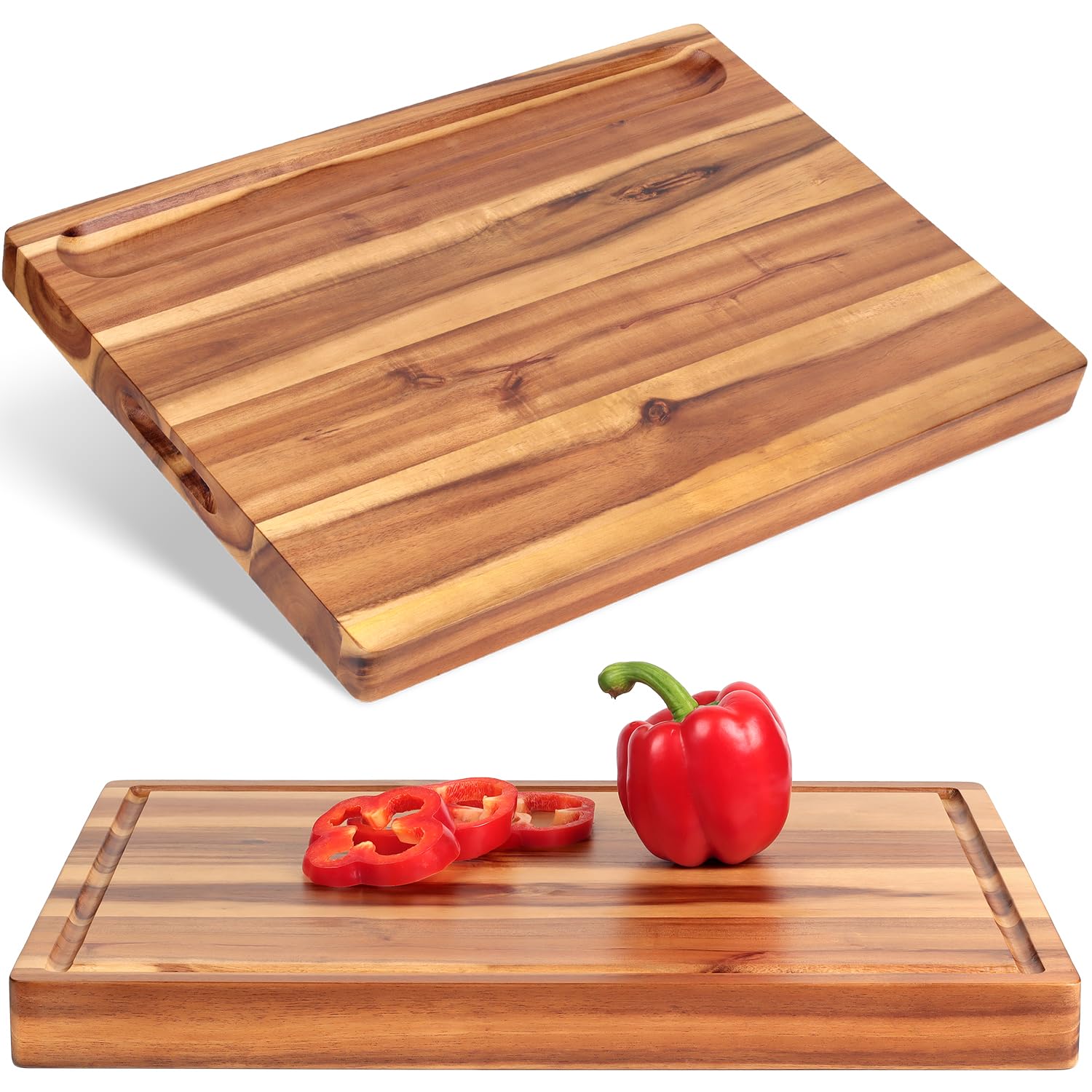
The FANICHI board hits the sweet spot of size, thickness, and versatility at a mid-range price. At 17 x 13 inches with a full 1.5-inch thickness, it offers enough surface for a large roast while remaining manageable on standard countertops. The acacia construction is 100% natural with no paint or chemical treatments, and the reversible design gives you a juice-groove side for meat and a flat side with a cracker-and-cheese holder for serving.
The juice groove is expertly carved around the edge, catching runaway liquids without feeling shallow. The inner side handles make it easy to lift and carry, and the dark wood grain adds a rustic elegance that works as a serving board at the table. Users praise the board’s durability with Damascus knives, noting it protects blade sharpness while showing minimal cosmetic wear from daily use.
The board is heavy at 3.22 kilograms—about 7 pounds—so it stays put during carving but can feel unbalanced on a slick counter without a towel underneath. A few users reported slight teetering on uneven surfaces. For the price, this board delivers professional-grade thickness, a reversible multi-use design, and acacia durability that outclasses most options in its tier. It is the all-around best choice for the home carver who wants one board to do it all.
Why it’s great
- 1.5-inch thickness provides superior warp resistance and knife clearance
- Reversible with juice groove on one side and holder on the other
- Natural acacia with no paints or chemical treatments
Good to know
- Heavy at 7 pounds; may teeter on uneven counters without a towel
- Shows cut marks over time despite good durability
- Not dishwasher-safe despite general wood board care rules
5. GAOMON 24 x 18 In Acacia Cutting Board

The GAOMON XXL board is massive at 24 x 18 inches, with a 1.2-inch thickness that keeps it surprisingly light for its size. This board functions as both a carving station and a stovetop cover, instantly adding counter space in cramped kitchens. The acacia wood shows a dark, visible grain that develops character with use, and the juice groove around the edge prevents liquids from spilling onto the counter.
Users consistently highlight the board’s dual-role capability: it fits perfectly over gas stovetops for buffets and dough rolling, and it is large enough for two people to prep simultaneously. The recessed handholds make lifting and carrying manageable despite the size. The smooth reversible surface allows one side for meat and the other for vegetables, reducing the need to clean between tasks.
The board shows cut marks immediately, which is expected for a softer acacia surface, and the edge indentations can feel slightly coarse to the touch. The 1.2-inch thickness is adequate for most carving but less warp-resistant than thicker boards. For home cooks who need maximum surface area without maximum weight, this GAOMON board provides an excellent value for large-batch prep and family-style carving.
Why it’s great
- 24 x 18 inch surface is one of the largest at this price point
- Light enough for one person to move despite its size
- Fits over gas stovetops for additional prep space
Good to know
- Shows cut marks more readily than harder wood species
- 1.2-inch thickness offers less warp resistance than thicker boards
- Edge indentations may feel unfinished to the touch
6. Fashionwu 24 x 18 Inch Acacia Cutting Board

The Fashionwu board mirrors the GAOMON in dimensions at 24 x 18 inches but uses a slightly thicker 1.2-inch slab that feels solid under a heavy knife. The acacia surface is smooth and flat, resistant to scratches and damage, and the juice groove sits close to the edge to maximize the usable cutting area. At 4.08 kilograms (about 9 pounds), it has substantial heft that helps it stay in place during aggressive carving.
Users praise the board for handling whole chickens, brisket, and ribs without the mess spilling over. The large surface is wide enough to accommodate two cutting stations, and the natural color variations in the wood give each board a unique personality. The board comes pre-oiled and ready to use, though some users recommend additional conditioning for optimal water resistance.
The groove is narrower than on some competitors—a few users modified it with a router—and the board lacks non-slip feet, so a towel underneath is necessary on smooth counters. The 1.2-inch thickness is adequate but not overbuilt; boards thinner than 1.5 inches are more prone to cupping in humid environments. For those who want a budget-friendly giant board for occasional large carves, this Fashionwu model delivers usable space at a very accessible price.
Why it’s great
- Massive 24 x 18 inch surface handles whole turkeys and briskets
- Juice groove positioned close to edge to maximize cutting area
- Pre-oiled acacia ready for immediate use
Good to know
- Narrow juice groove may require user modification for heavy flow
- No non-slip feet; needs a towel underneath on smooth surfaces
- 1.2-inch thickness is more prone to warping than thicker boards
7. ROYAL CRAFT WOOD Bamboo Cutting Board Set

The ROYAL CRAFT WOOD set offers three bamboo boards—15 x 10, 12 x 8, and 9 x 6 inches—covering everything from a small fruit prep to a medium meat carve. Bamboo is budget-friendly and eco-friendly, with a non-porous surface that resists water absorption and odors. The boards feature built-in side handles and deep juice grooves, making the largest board functional for moderate carving tasks.
The bamboo construction is carbonized for moisture resistance, and the smooth surface is gentle on knife blades compared to plastic alternatives. Users note the boards are sturdy without being heavy, easy to clean with a quick hand wash, and attractive enough to leave on the counter as serving platters. The set includes a 1-year warranty and money-back guarantee from the manufacturer.
Bamboo is harder than acacia and contains natural silica that can dull knife edges faster over time. The boards require regular oiling to maintain appearance and prevent cracking, and the 0.6-inch thickness of the largest board is noticeably thinner than dedicated carving boards, providing less stability for heavy meat work. For the budget-conscious cook who wants multiple boards for different tasks—and is willing to accept slightly faster knife wear—this set offers exceptional versatility at a very low entry point.
Why it’s great
- Three boards cover all prep sizes for maximum versatility
- Carbonized bamboo resists moisture absorption and odors
- Side handles and juice grooves on all boards for convenience
Good to know
- Bamboo silica content can dull knife edges faster than acacia or maple
- 0.6-inch thickness on the largest board offers less carving stability
- Requires regular oiling to maintain appearance and prevent cracking
FAQ
Can I use a bamboo carving board for large roasts?
How often should I oil my wooden carving board?
What is the minimum thickness for a turkey carving board?
Final Thoughts: The Verdict
For most users, the best wooden carving board winner is the FANICHI Acacia Wood Cutting Board because it delivers a perfect 1.5-inch thickness, reversible design, and natural acacia construction at a mid-range price that outperforms everything in its tier. If you want a dedicated juice-collection system for large roasts, grab the Ironwood Gourmet Kansas City with its sloped reservoir and stable feet. And for knife-edge preservation above all else, nothing beats the WoodForChef Maple Board with its dense FSC-certified surface that keeps your blades sharper longer.