The air you breathe indoors is often dirtier than the air outside, loaded with dust mites, pet dander, pollen, and volatile organic compounds that settle into your lungs and trigger allergies or asthma. A proper air purifier isn’t a luxury; it’s the primary line of defense against the microscopic particulates that your HVAC system never catches.
I’m Mohammad Maruf — the founder and writer behind AirfryerBite. I’ve spent years dissecting Clean Air Delivery Rate (CADR) figures, HEPA classifications, and real-world noise ratings to separate the machines that genuinely scrub a room from those that just move air around.
Whether you’re battling seasonal allergies, wildfire smoke, or persistent pet odors, this guide to the best rated air purifiers will help you match a unit’s filter stack and motor output to the specific square footage and contaminant load of your space.
How To Choose The Best Rated Air Purifiers
Buying an air purifier based on price or brand alone often leads to disappointment. You need to match the machine’s internal engineering—its filter media, motor wattage, CADR numbers, and noise floor—to your room size and specific air quality enemies. Here are the three critical factors that separate effective purifiers from countertop decorations.
Match CADR to Your Room Size
CADR (Clean Air Delivery Rate) is the only standardized metric that tells you how many cubic feet of air the unit can scrub per minute for smoke, dust, and pollen. A common mistake is buying a purifier that only cycles the room’s air once per hour; the industry standard for allergy relief is four to five air changes per hour (ACH). To calculate, multiply your room’s square footage by the ceiling height, then divide by the CADR number. If the result is above 12 minutes, you need a higher CADR unit.
Know Your Filter Stack
A single-stage HEPA filter isn’t enough for homes with pets, smokers, or strong cooking odors. The best rated air purifiers use a three-stage system: a washable pre-filter to catch hair and large debris, a True HEPA membrane to capture particles as small as 0.3 microns at 99.97% efficiency, and an activated carbon layer to adsorb VOCs and odors. Beware of purifiers that skip the carbon layer or use a thin carbon sheet that saturates quickly.
Evaluate Noise at Your Sleep Level
An air purifier is only effective if you run it continuously, and that means it must be quiet enough not to disturb your sleep. Look at the low-speed dB rating—anything below 30 dB is essentially a whisper. Units with a dedicated Sleep Mode often drop fan speed and dim all indicator lights. Also check whether the unit has a Display Off button, because LED glare from a sensor light can be as disruptive as fan noise for light sleepers.
Quick Comparison
On smaller screens, swipe sideways to see the full table.
| Model | Category | Best For | Key Spec | Amazon |
|---|---|---|---|---|
| Winix 5510 | Premium | Whole-home smart control | 1881 sq ft / 1 hr, 23.5 dB Sleep | Amazon |
| Clorox Turbo | Mid-Range | Quick odor removal | 1000 sq ft, Turbo Timer | Amazon |
| LEVOIT Core 300-P | Mid-Range | AHAM-verified all-around | 143 CFM CADR, 24dB Sleep | Amazon |
| LEVOIT Core 200S-P | Entry-Level | Smart compact bedroom | 140 ft² room, 27dB Sleep | Amazon |
| DAYETTE AP303 | Mid-Range | Pet homes with dual H14 | 2x H14 HEPA, 22dB Sleep | Amazon |
| GermGuardian AC4825E | Mid-Range | UV-C germ reduction | 743 sq ft, UV-C + HEPA | Amazon |
| Amazon Basics AC2224A | Budget | Value-first small spaces | 1067 sq ft, 32dB Sleep | Amazon |
In‑Depth Reviews
1. Winix 5510 Air Purifier

The Winix 5510 represents a significant engineering upgrade over its predecessor, the 5500-2, with the addition of app support and a refined auto-mode algorithm. Its 1881 sq ft coverage means it can cycle the air in a large living room or open-concept space in one hour, and the AHAM Verifide CADR numbers back up that claim with real-world test data rather than marketing speculation.
What sets this unit apart in the premium tier is the four-layer filtration stack: a washable fine-mesh pre-filter, an advanced odor-control carbon filter that handles VOCs and cooking smells, a True HEPA membrane capturing 99.99% of particles down to 0.01 microns, and the Plasmawave ionizer that can be toggled on or off. The auto-mode sensor is responsive enough to detect a gas stove being turned on from across the room, and the light-automated sleep mode kicks in when the lights go out.
The 13.3-pound chassis feels dense and well-constructed, and the magnetic front panel makes filter access tool-free. The vertical side intakes are an unusual design choice that some users feel slightly reduces intake efficiency, but in practice the unit moves enough air to compensate. If you want one machine that can intelligently handle an entire floor of a home, this is the benchmark.
Why it’s great
- Smart app and voice control via Alexa/Google
- Ultra-quiet sleep mode at 23.5 dB
- Thick 1-inch HEPA and carbon filters last 12 months
- Responsive auto-mode with real-time air quality LED
Good to know
- Vertical side openings may slightly reduce intake efficiency
- Larger footprint at 15.9 inches wide
- Premium price point compared to mid-range competitors
2. Clorox Turbo Air Purifier
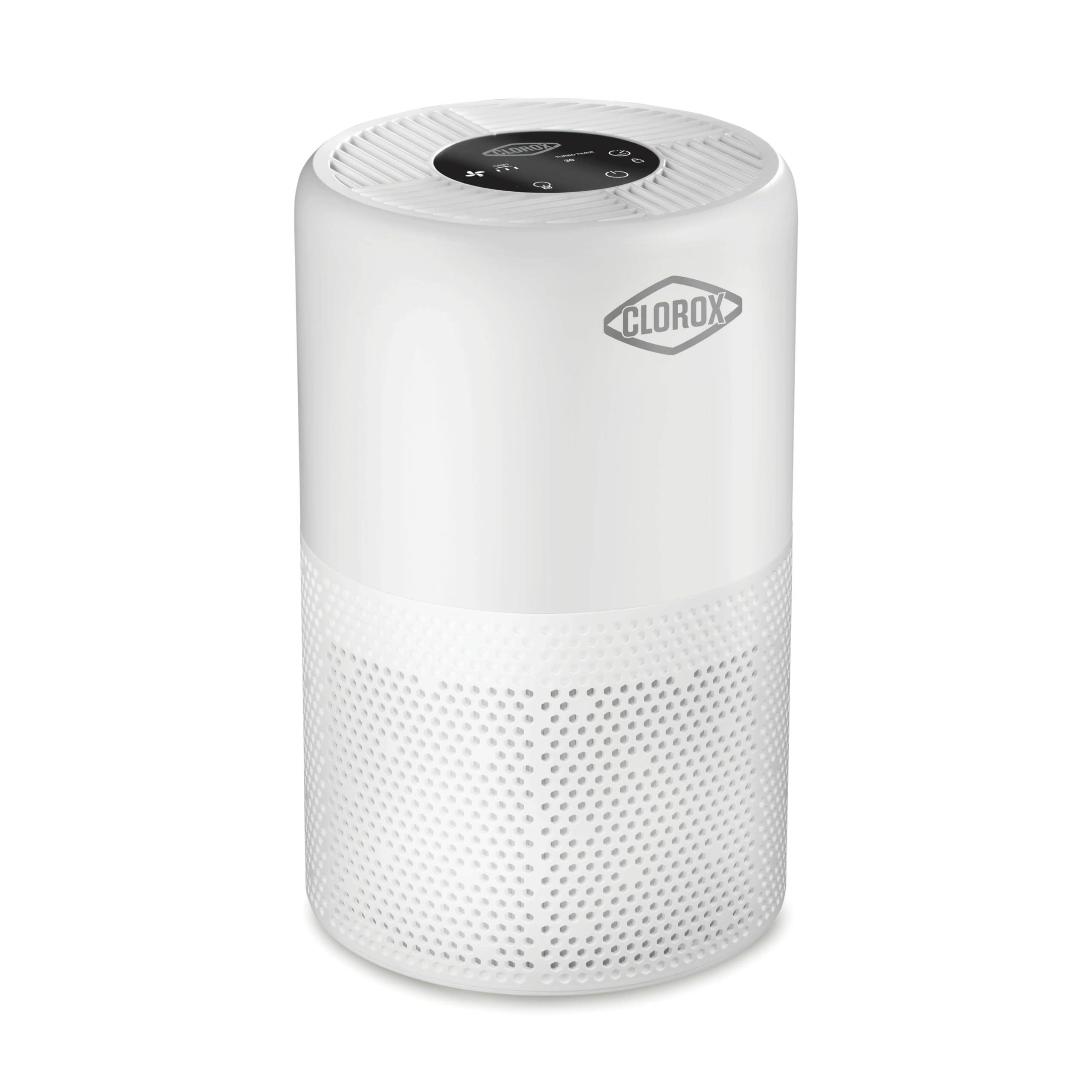
Clorox brings a focused approach to the mid-range segment with the Turbo Air Purifier, a unit designed specifically for burst cleaning rather than continuous silent operation. The 360-degree intake pulls air from all directions, and the Turbo Timer lets you run a 10-, 20-, or 30-minute high-speed cycle to quickly clear smoke after cooking or airborne particulates during wildfire events.
The three-stage filter stack includes a pre-filter for large particles, a True HEPA layer that captures 99.97% of allergens, and an activated carbon filter that reduces VOCs and odors. At 5.2 pounds and a compact 8.46-inch diameter, this is one of the lightest and most portable units in its coverage class, making it easy to move from kitchen to bedroom as needed.
Where the Clorox loses points is the lack of an air quality indicator light—users coming from units with color-coded PM2.5 sensors will miss the real-time feedback on whether the room actually needs cleaning. It also lacks smart app connectivity, relying instead on manual 4-speed controls. But for someone who wants a simple, powerful, no-appliance-app machine that works when you need it, this is a strong contender.
Why it’s great
- Turbo Timer for fast odor and smoke removal
- Very light at 5.2 pounds, easy to move rooms
- Quiet operation even on medium speeds
- Simple controls with no smartphone required
Good to know
- No air quality indicator or color-coded LED sensor
- No smart app or voice assistant support
- Carbon layer is relatively thin compared to premium units
3. LEVOIT Core 300-P Air Purifier

The LEVOIT Core 300-P is the most popular air purifier in its segment for a reason: it combines a 56-watt high-torque motor with a 143 CFM CADR rating that’s independently verified by AHAM. That 143 CFM applies to smoke, with even higher ratings of 153 CFM for dust and 167 CFM for pollen, meaning this unit can refresh a 222-square-foot room 4.8 times per hour with real, measurable performance.
What makes the Core 300-P particularly versatile is LEVOIT’s ecosystem of filter options. You can swap the standard 3-in-1 filter for a Toxin Absorber filter targeting VOCs and smog, a Smoke Remover filter designed for wildfire particulates, or a Pet Allergy filter with extra dander-trapping capacity. The QuietKEAP technology delivers a near-silent 24 dB in Sleep Mode, and the display-off button eliminates light pollution at night.
The 8.7-inch square footprint is compact enough for a nightstand or desk, and the 7.9-pound weight makes it easy to reposition. The only drawback is that replacement filters—especially the specialized variants—are not cheap, and users report needing to vacuum the pre-filter monthly to maintain airflow. But for a mid-range unit that delivers premium CADR numbers, the Core 300-P is a proven workhorse.
Why it’s great
- AHAM Verifide with industry-standard CADR numbers
- Interchangeable filters for smoke, VOCs, or pet allergies
- QuietKEAP technology at 24 dB in Sleep Mode
- Compact 8.7-inch footprint fits tight spaces
Good to know
- Genuine replacement filters are relatively expensive
- High speed can be loud at close range
- No built-in PM2.5 sensor for real-time air quality reading
4. LEVOIT Core 200S-P Air Purifier

The Core 200S-P is essentially a smaller, smarter sibling to the Core 300-P, designed for bedrooms, nurseries, and dorm rooms where space is tight and voice control matters. The 360-degree air intake and compact 8.07-inch diameter body make it one of the most unobtrusive units on this list, yet it still manages 4.8 air changes per hour in a 140-square-foot room.
LEVOIT added Alexa and Google Assistant compatibility, so you can adjust fan speed or check filter life without leaving your bed. The 3-in-1 filter uses a nylon pre-filter, a high-efficiency activated carbon layer for odors, and a main HEPA filter that captures 99.97% of particles 0.3 microns in size. The noise floor drops to 27 dB on Sleep Mode, quieter than a library, and the Display Off button kills all LEDs for true dark-room operation.
The compromise comes in raw air-moving capacity—the 200S-P is strictly a small-room machine, and users trying to use it in open living areas will be underwhelmed. Also, the smart features require the LEVOIT app, and some users find the Wi-Fi setup slightly fiddly. For its intended purpose—a quiet, voice-controlled purifier on a nightstand—it’s hard to beat.
Why it’s great
- Voice control via Alexa and Google Assistant out of the box
- Very compact at 8.07 x 8.07 inches
- Quiet Sleep Mode at 27 dB with full LED disable
- AHAM Verifide for proven small-room performance
Good to know
- Only suitable for rooms up to 140-200 sq ft
- Smart features require app and Wi-Fi setup
- No built-in air quality sensor or auto mode
5. DAYETTE AP303 Air Purifier
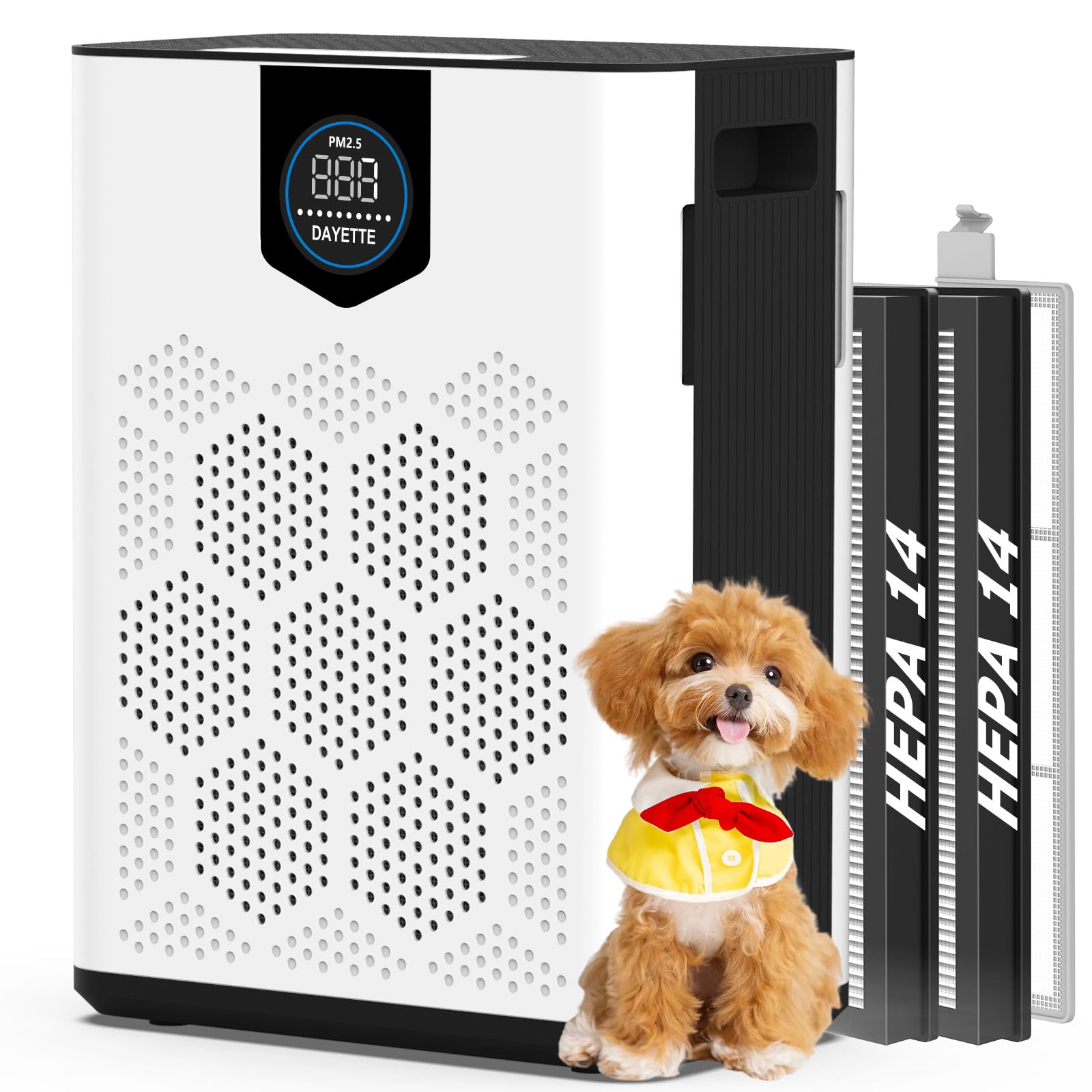
DAYETTE takes an aggressive approach to pet-home air quality with the AP303, packing two advanced H14 HEPA filters into a single chassis. H14 is a step above the more common H13 grade, capturing 99.997% of particles as small as 0.1 microns—including the ultrafine dander and mite debris that trigger the worst allergy responses. The dual-sided intake system claims to purify up to 3000 square feet per hour in Turbo mode.
The real-world differentiator here is the washable fine-mesh pre-filter, which catches pet hair and larger debris before they reach the HEPA media. This extends filter life significantly, and the unit includes an aromatherapy box where you can add essential oils for scent-neutralizing. The built-in PM2.5 smart detector provides both color-coded and numerical air quality readings, so you can watch the numbers drop as the unit runs.
There are some caveats: customer reviews note inconsistencies between the ad copy and the actual model specifications, and replacement filter availability has been unreliable for some users. The 22 dB Sleep Mode is genuinely whisper-quiet, and the auto mode adjusts fan speed responsively based on the sensor data. If you have multiple shedding pets in a medium-to-large home, the dual HEPA stack makes a tangible difference in sniffle frequency.
Why it’s great
- Dual H14 HEPA filters capture 99.997% of 0.1 micron particles
- Washable pre-filter saves money on replacements
- Built-in PM2.5 sensor with color and numerical display
- Aromatherapy box for optional scent diffusion
Good to know
- Ad specifications have been reported as inconsistent
- Replacement filter availability is uncertain
- Larger footprint at 13 x 6 x 16 inches
6. GermGuardian AC4825E Air Purifier

The GermGuardian AC4825E is one of the longest-running, most-reviewed air purifiers available, and its staying power comes from a simple, effective design philosophy. The 22-inch tower form factor with a 6.75-inch depth makes it one of the slimmest units in the mid-range, while the three-stage filtration combines a True HEPA layer, an activated carbon pre-filter, and an optional UV-C light that reduces airborne germs, bacteria, and mold spores.
The UV-C bulb is the key differentiator here: it’s independently certified as Zero Ozone, meaning you get germicidal protection without the ozone emissions that some ionizers produce. The rotary dial control is refreshingly analog—three speeds plus an on/off button for the UV-C—and the washable pre-filter extends the life of the main HEPA element. Users consistently report significant reductions in asthma symptoms and dust accumulation over multi-year ownership.
The trade-offs are mostly about polish: the tower’s air blows at an angle rather than straight up, which some users find less effective for room circulation. On the highest speed, the noise level is noticeable, though the low setting serves as gentle white noise. Replacement filters and UV-C bulbs are widely available and reasonably priced, and the build quality is solid enough that many households own multiple units that have run continuously for years.
Why it’s great
- UV-C light reduces bacteria and mold without ozone
- Slim 6.75-inch depth fits narrow spaces
- Easy rotary controls with no complex app setup
- Proven multi-year durability with widely available filters
Good to know
- High speed is noticeably loud
- Air blows at an angle, not straight upward
- No air quality sensor or auto mode
7. Amazon Basics AC2224A Air Purifier

Amazon Basics enters the air purification category with the AC2224A, a budget-oriented unit that punches above its weight class in raw coverage. The 31-watt DC motor is Energy Star certified, and the unit claims coverage up to 1067 square feet—though that’s at one air change per hour, so realistic effective coverage for allergy relief is closer to 210 square feet at five air changes per hour.
The standout feature at this price point is the built-in PM2.5 smart sensor, which uses red/orange/green LED indicators to show real-time air quality. The auto mode adjusts fan speed based on the sensor reading, and the Sleep Mode drops noise to 32 dB. The 3.02-pound weight and 9.6-inch footprint make it the lightest and most portable unit in the lineup, ideal for moving between a desk and a nightstand.
The compromises are exactly what you’d expect at this price: the activated carbon layer is thin and will saturate quickly in smelly environments, and the build quality doesn’t match the heft of a Winix or a GermGuardian. Some users received units where the filter was still wrapped in plastic, so check that before running. For a first-time buyer on a tight budget who wants a sensor and auto mode, this unit delivers the essentials without the premium markup.
Why it’s great
- Built-in PM2.5 sensor with color-coded air quality display
- Energy Star certified 31W DC motor
- Very lightweight at 3.02 pounds for easy portability
- Auto mode adjusts fan speed based on sensor readings
Good to know
- Thin carbon layer saturates quickly with strong odors
- Some units ship with plastic still sealed around filter
- Aluminum build quality feels less substantial than mid-range models
FAQ
How often should I replace the HEPA filter in my air purifier?
Is a higher CADR always better for my bedroom?
Do air purifiers with UV-C light produce harmful ozone?
Can an air purifier help with pet odors or should I get a separate deodorizer?
Final Thoughts: The Verdict
For most users, the best rated air purifiers winner is the Winix 5510 because it combines whole-home coverage with smart features and a near-silent sleep mode that doesn’t compromise on CADR. If you want a proven AHAM-verified all-arounder at a mid-range price, grab the LEVOIT Core 300-P. And for pet owners dealing with heavy dander and odor loads in a multi-room home, nothing beats the dual H14 HEPA stack of the DAYETTE AP303.