The flavor hiding inside a bag of specialty beans is only unlocked by a grinder that treats every particle with mechanical precision. A blade-based chopper pulverizes coffee into uneven fragments, extracting bitterness from over-extracted fines and sourness from under-extracted boulders. A professional-grade burr grinder fractures beans between two precisely spaced surfaces, delivering narrow particle distribution that lets you taste the origin instead of the machine.
I’m Mohammad Maruf — the founder and writer behind AirfryerBite. I track burr geometry, motor torque curves, and retention data across the – market to separate genuine engineering from marketing hype.
Whether you are dialing in espresso for a cafe pop-up or seeking clarity from a pour-over, this guide covers the ten best options currently available to help you find the right professional coffee grinder for your specific brewing style and budget.
How To Choose The Best Professional Coffee Grinder
The gap between a good cup and a great one is measured in microns. A professional coffee grinder is a dose-metering instrument first and an appliance second — every decision about burr geometry, adjustment mechanism, and motor type directly affects what ends up in your cup.
Burr type: conical vs. flat
Conical burr grinders (1Zpresso, Baratza Sette, De’Longhi Dedica) typically produce a particle distribution with a higher proportion of fines, which can add body and texture to espresso shots. Flat burr grinders (Fellow Ode, Timemore Sculptor 064S/078S, Baratza Forte BG) generate a more uniform particle size that emphasizes clarity and flavor separation — ideal for filter coffee and lighter roasts. Professional espresso workflows increasingly favor 64mm or larger flat burrs for their repeatability and headroom.
Adjustment resolution and range
Look for a grinder that can move the burrs in increments of 30 microns or less. Stepped adjustments are acceptable if the steps are tight (8 microns per click on the 1Zpresso J-Ultra is exceptional). Stepless systems (Timemore Sculptor 064S/078S, Baratza Forte) allow infinite fine-tuning, which matters when a single notch shifts extraction time by several seconds.
Motor performance and thermal stability
For electric models, a brushless DC motor with PID speed control (Timemore Sculptor series, Baratza Forte) provides consistent RPM under load, reducing heat transfer to the beans and extending burr life. Gear-driven motors with plastic transmission parts (Baratza Sette 30) are serviceable but louder and less durable. Manual grinders like the 1Zpresso J-Ultra eliminate motor heat entirely, a legitimate advantage for single-dose espresso.
Retention, static, and workflow design
Workflow friction kills consistency. A grinder that retains more than 0.3g of grounds between doses forces you to purge before each shot and stale fines end up in your next brew. Anti-static ionizers (Fellow Ode Gen 2), magnetic catch cups (1Zpresso, Timemore), and rotary knockers (Timemore Sculptor) reduce mess and improve dose accuracy. Consider whether you want to single-dose or use a hopper — the Breville Dose Control Pro and De’Longhi Dedica are designed for timed dosing, while the Fellow Ode and 1Zpresso excel at single-dosing.
Quick Comparison
On smaller screens, swipe sideways to see the full table.
| Model | Category | Best For | Key Spec | Amazon |
|---|---|---|---|---|
| Baratza Forte BG | Premium | High-volume pro brewing | 54mm steel flat burrs, 260 settings | Amazon |
| Timemore Sculptor 078S | Premium | Espresso + filter versatility | 78mm flat burrs, stepless, 800–1400 RPM | Amazon |
| Timemore Sculptor 064S | Mid-Range | Espresso + pour-over hybrid | 64mm flat burrs, stepless, 800–1200 RPM | Amazon |
| Fellow Ode Gen 2 | Premium | Filter coffee clarity | 64mm flat burrs, 31 settings, anti-static | Amazon |
| KitchenAid KCG0702CS | Mid-Range | Countertop durability | 15 settings, die-cast metal, low RPM | Amazon |
| Baratza Sette 30 | Mid-Range | Entry-level espresso | 30 settings, 5 g/second throughput | Amazon |
| Breville Dose Control Pro | Mid-Range | Timed dosing with variety | 60 settings, 12 oz hopper, 1-sec timer | Amazon |
| De’Longhi Dedica | Mid-Range | Portafilter direct grind | 18 settings, LCD, 3 strength levels | Amazon |
| 1Zpresso J-Ultra | Portable | Manual espresso precision | 8-micron steps, 35–40g catch cup | Amazon |
In‑Depth Reviews
1. Baratza Forte BG

With 260 grind settings spread across macro and micro levers, the Forte BG is a true commercial-class instrument that handles everything from fine espresso to coarse French press. The 54mm flat steel burrs — engineered by Ditting in Germany — deliver tight particle distribution with the throughput capacity of up to 5 lb per day, making it equally suited for a low-volume cafe or a serious home enthusiast. The all-metal grinding chamber eliminates the plastic flex that plagues lower-priced grinders, and the integrated digital scale or programmable timer gives you two independent ways to dose by weight or time with 0.1-gram resolution.
Workflow is exceptional: built-in presets store up to three dose profiles, and the shut-off hopper lets you swap beans without dumping the entire hopper. Users who upgraded from the Baratza Vario-W note that the metal construction, machined burr carrier, and reinforced drive train feel substantially more rigid. The DC motor runs cool and quiet at 130W, and the gearbox is designed for straightforward field servicing. While the touchscreen interface has shown vulnerability on older units (Baratza support replaced cracked screens free of charge), the core mechanics — belt drive, burr alignment pins, and ground-bin lighting — hold up well under daily commercial use.
One valid criticism: the grind chamber is not entirely static-free, and very light retention (0.2–0.3 g) can accumulate in the chute over several doses if not brushed weekly. For an all-in-one grinder that bridges café workflow and home countertop footprint, the Forte BG remains the benchmark that other pro-grade electrics are measured against. The 1-year warranty is short for this price tier, but Baratza’s parts ecosystem and responsive support mitigate the risk.
Why it’s great
- 260 grind settings with micro-adjust lever for espresso dial-in
- 54mm German steel flat burrs maintain sharpness after years of use
- Digital scale or timer — dual dosing modes with 3 presets
Good to know
- Retention of 0.2–0.3 g requires weekly chute cleaning
- Touchscreen interface is the most failure-prone component
- 1-year warranty is shorter than typical for this price range
2. Timemore Sculptor 078S
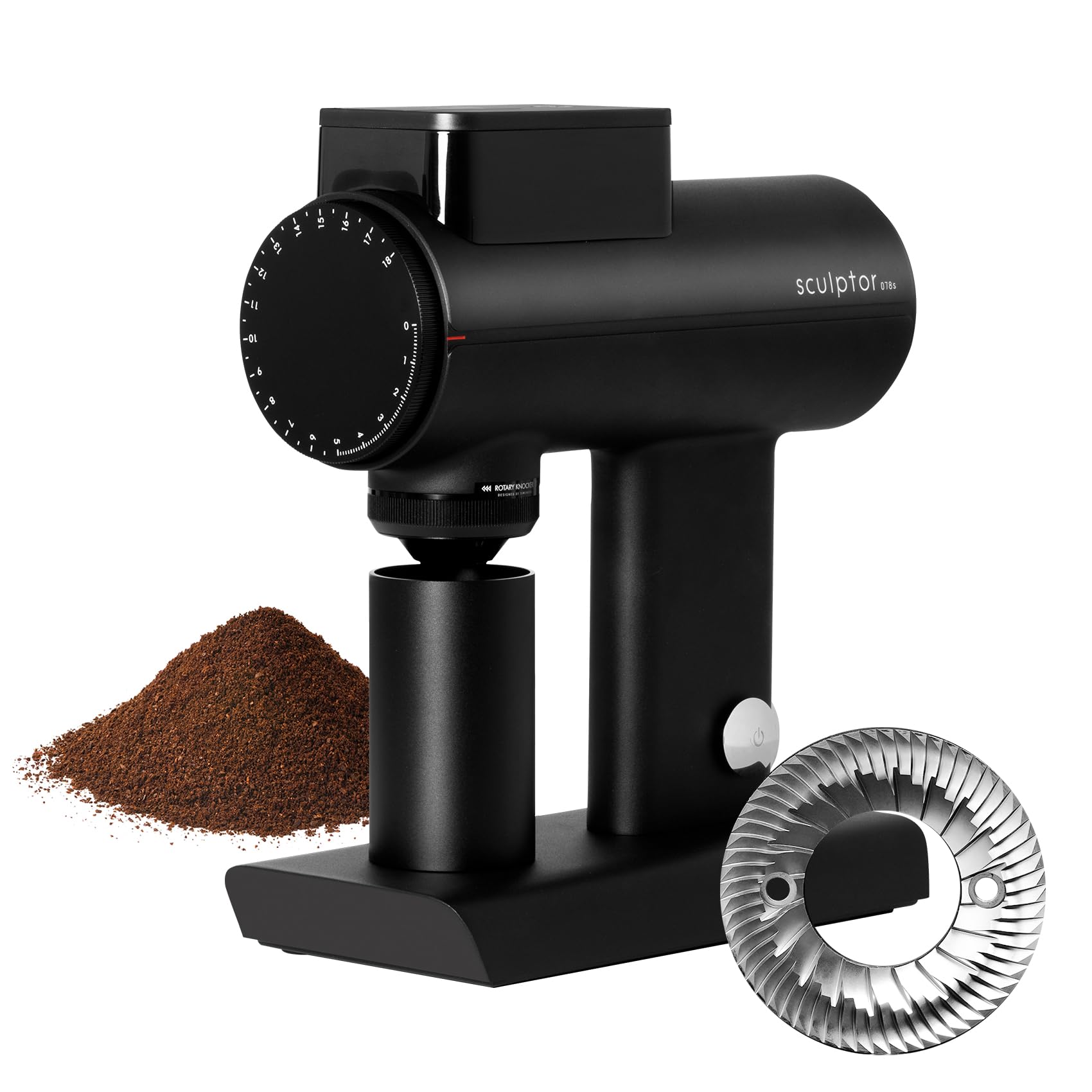
The 078S is Timemore’s response to the question “what happens when you scale a 64mm flat burr platform up by 22%?” The answer is significantly higher throughput and a dramatically wider particle distribution sweet spot. The 78mm flat burrs spin at 800–1400 RPM via a zero-friction brushless motor with PID speed control, and the stepless grind adjustment collar lets you make micro-corrections without any detent click. In practice, the 078S grinds 18 g of espresso-fine coffee in roughly 15 seconds with near-zero retention — the patented rotary knocker actively dislodges residual fines from the chute after every dose.
Build quality is exceptional for the price: an all-aluminum body with magnetic powder barrel alignment, a magnetic lid over the bean hopper, and a motor that maintains consistent torque whether you are grinding 12 g for a single pour-over or 55 g for a batch brew. Users report that the burrs came aligned out of the box with no shimming required, and the seasoning period is negligible — coffee quality was immediately better than the Breville Smart Grinder Pro it replaced in multiple reviews. The 078S covers espresso, pour-over, French press, and cold brew with equal fluency; the stepless adjustment combined with the 14–20 RPM range gives you enough resolution to chase extraction curves across light, medium, and dark roasts.
The only workaround required: the flat hopper pitch means oily beans can stall slightly without a gentle push, and red alignment markers on the collar are fiddly to read in low light. Static in the dosing cup is minor but present — a spritz of water on the beans before grinding eliminates it entirely. At this price point, the 078S directly challenges grinders that cost twice as much, offering café-caliber particle uniformity in a quiet, single-dosing package.
Why it’s great
- 78mm flat burrs with stepless adjustment — exceptional for espresso and filter
- Brushless DC motor with PID maintains RPM under heavy load
- Patented rotary knocker reduces retention to near zero
Good to know
- Oily beans may stall in the hopper without a manual push
- Static buildup in dosing cup requires wet-drip mitigation
- Warranty voided if user opens burr carrier — must return for service
3. Timemore Sculptor 064S

The 064S shares the same brushless motor, stepless adjustment, rotary knocker, and magnetic alignment system as the 078S, but wraps it around a smaller 64mm flat burr set that still outperforms most conical burrs under . The 800–1200 RPM range provides sufficient speed for espresso without generating objectionable heat, and the PID control keeps the burrs spinning at your chosen RPM regardless of bean density. Users report that grind times for 16–21 g of espresso run 15–20 seconds, and retention rarely exceeds 0.1 g after the knocker is actuated.
Flavor clarity is the headline: the 64mm flat burrs emphasize sweetness and body without suppressing acidity, making them a natural fit for medium-roast Colombians and naturals that you want to showcase in a pour-over. The magnetic catch cup snaps into place with satisfying precision, and the bean hopper lid aligns automatically with a magnetic guide ring. Seasoning creates a modest amount of fine dust that collects in the hopper — the manual recommends discarding the first few batches, but several users report skipping seasoning entirely with no negative impact on taste.
The main compromises vs. the 078S: slightly lower maximum throughput (the smaller burrs spin faster but process less coffee per revolution), and the RPM dial is hard to read at a glance. Popcorning — where whole beans bounce out of the burrs — occurs occasionally with lighter roasts, though a gentle push with the included tamper resolves it. For the price, the 064S offers genuine pro-grade particle distribution, a silent motor, and a workflow so smooth that you will stop thinking about the grinder and start thinking about the coffee.
Why it’s great
- Stepless flat burr adjustment — true infinite resolution for dialing in
- Brushless motor with PID delivers consistent RPM under load
- Magnetic catch cup and rotary knocker keep workflow clean and fast
Good to know
- Seasoning creates mess — fines collect in hopper initially
- Popcorning with light roasts may require a gentle bean push
- RPM dial is hard to see in typical kitchen lighting
4. Fellow Ode Gen 2

The Ode Gen 2 is not an espresso grinder — Fellow explicitly states that the 64mm flat burrs are tuned for filter coffee, and the finest setting still produces particles that choke a standard espresso basket. For pour-over, French press, and cold brew, however, the Gen 2 Brew Burrs deliver exceptional clarity with a two-stage grinding geometry that cracks the bean first before crushing it to the target size. The 31 grind settings are stepped but well-spaced, and the magnetic catch cup with anti-static ionizer keeps your countertop virtually dust-free.
Noise level is the lowest among electric flat burr grinders in this price bracket — Fellow removed the gearbox entirely and direct-drives the burrs via a quiet motor. Users switching from a Baratza Encore report a 40–50% reduction in grind noise. The automatic shut-off stops the motor within half a second once the beans pass through, and the grind-knocker tab on the side taps the chute to release retained grounds. With light-to-medium roast beans, retention sits at 0.2–0.3 g; darker, oilier beans may require the knocker after every dose to prevent chute clogging.
The main criticism centers on the chute design: some users experience recurring clogs that require disassembly every few days — Fellow’s customer service has handled these cases unevenly. If your primary brew method is V60, Chemex, Kalita Wave, or AeroPress, and you value quiet operation with clean workflow over espresso capability, the Ode Gen 2 produces some of the most transparent cups you can get without stepping into commercial-tier pricing.
Why it’s great
- Exceptionally quiet operation — no gearbox, direct motor drive
- Anti-static ionizer and magnetic catch cup minimize mess
- 64mm flat burrs deliver unparalleled filter-coffee clarity
Good to know
- Cannot grind fine enough for any espresso method
- Reports of chute clogging requiring frequent disassembly
- Customer service quality is inconsistent per user accounts
5. KitchenAid KCG0702CS
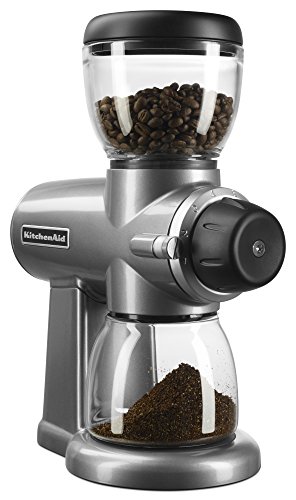
The KitchenAid KCG0702CS is a response to the industry trend of plastic-bodied burr grinders: its die-cast metal housing and glass hopper weigh nearly 10 lb, anchoring it solidly on the counter without vibration. The 15 grind settings are controlled by a simple dial on the side, and the low-RPM motor (significantly slower than the first-generation model) generates minimal heat and static.
Glass bean hopper and grind jar are dishwasher-safe — a rare convenience at this price. The low-RPM operation means grinding takes longer than higher-speed competitors, but the trade-off is noticeably quieter operation (the current model is much quieter than the earlier generation) and less static buildup over time. Clogging in the discharge port was a documented issue in older units, but the revised motor torque and grind path appear to have mitigated the problem in current production.
Standard operating protocol: run the grinder empty before adding beans and after grinding to clear the chute. Oily beans may stall in the hopper, but the manual advises simply clearing them by hand — the motor does not burn out. The 15 grind settings cover drip to French press adequately, but espresso dial-in is marginal — the gaps between steps are too wide for fine-tuning extraction. If you primarily brew drip, French press, or cold brew and value a metal-and-glass build that will outlast plastic competitors, the KitchenAid is a durable, low-maintenance choice.
Why it’s great
- Die-cast metal and glass construction — minimal plastic, exceptional longevity
- Low-RPM motor runs quietly and produces very little static
- Dishwasher-safe glass components simplify cleaning
Good to know
- 15 grind steps are too wide for precise espresso dial-in
- Requires running empty before and after each use to prevent clogging
- Oily beans may stall in hopper — need manual clearing
6. Baratza Sette 30

The Sette 30 was designed to get people into espresso without requiring a second mortgage. Its 30 grind settings span from fine enough for pressurized portafilters up to medium-coarse for AeroPress and V60, and the direct-drive gear system grinds at up to 5 g/second — one of the fastest throughputs at this price. The digital timer resolves to 0.1 seconds, letting you dial in dose weight with surprising accuracy. The straight-through grind path means very low retention, typically under 0.3 g, which is exceptional for an entry-level electric.
Baratza’s support is a genuine differentiator: the company offers parts diagrams and phone repair guidance, and users report receiving replacement gearboxes free of charge even after the warranty expires. The Sette 30 is also the only grinder at this price that can be upgraded over time — you can install the Sette 270 adjustment ring later for finer control. The 40 mm conical burrs are manufactured in Europe and produce a good particle distribution for the price, though the plastic gearbox is the common failure point around the 3–4 year mark for heavy daily use (3–4 grind cycles per day).
Noise is the most frequent complaint: the gear-driven mechanism produces a whine that some users find intrusive, and the plastic housing transmits vibration to the countertop. The grind adjustment collar sits at the bottom of the hopper, making it awkward to reach when the hopper is full. If espresso is not your primary goal and you prefer a quieter, more refined workflow, the Breville Dose Control Pro or Fellow Ode are better choices. But for dedicated espresso beginners on a tight budget who value serviceability, the Sette 30 is a capable gateway.
Why it’s great
- Fastest throughput in its class — up to 5 g/second
- Low retention and straight-through design for dose consistency
- Outstanding manufacturer support and field-serviceable parts
Good to know
- Plastic gearbox is the most common failure point after 3–4 years
- Very loud — the gear whine is intrusive in a quiet kitchen
- Only 30 settings with no micro-adjustment for espresso fine-tuning
7. Breville Dose Control Pro

The Dose Control Pro occupies a sweet spot in the mid-range: 60 grind settings — 15 macro steps with 4 micro clicks each — give you enough resolution to tune in espresso, pour-over, and French press without needing a second grinder. The 40mm stainless steel conical burrs are designed to run at a lower temperature than the original Dose Control, protecting volatile coffee oils. The precision electronic timer adjusts in 1-second increments, and the 12 oz locking bean hopper removes easily for bean swaps.
Users consistently highlight consistent particle size as the strongest attribute — reviews mention that coffee from the Dose Control Pro eliminates the harsh bitterness they experienced with blade grinders and reveals flavor notes (some report tasting raspberry) that were previously undetectable. The plastic housing is the main concession to cost, but Breville uses thick ABS with a brushed-metal front panel that looks more substantial than the price suggests. The portafilter cradle is adjustable but sits low — some users report spills when grinding directly into larger portafilters.
The Dose Control Pro has one of the widest grind ranges in its price bracket, and it handles oily beans without jamming as long as the burrs are cleared after each use. Static buildup is present but manageable — the included anti-static lid helps, and using a spritz of water on beans eliminates the issue. Several users have owned the unit for 5+ years without mechanical failure. If you want one grinder that can transition from espresso Sunday morning to French press weekday without recalibration drama, the Dose Control Pro delivers consistent performance at a reasonable outlay.
Why it’s great
- 60 grind settings — broadest range in the mid-price tier
- Stainless steel conical burrs minimize heat transfer to grounds
- Precision timer with 1-second increments for repeatable dosing
Good to know
- Plastic housing feels less premium than metal-bodied competitors
- Portafilter cradle sits low — can cause spills with deep baskets
- Static buildup in the grind container is moderate
8. De’Longhi Dedica
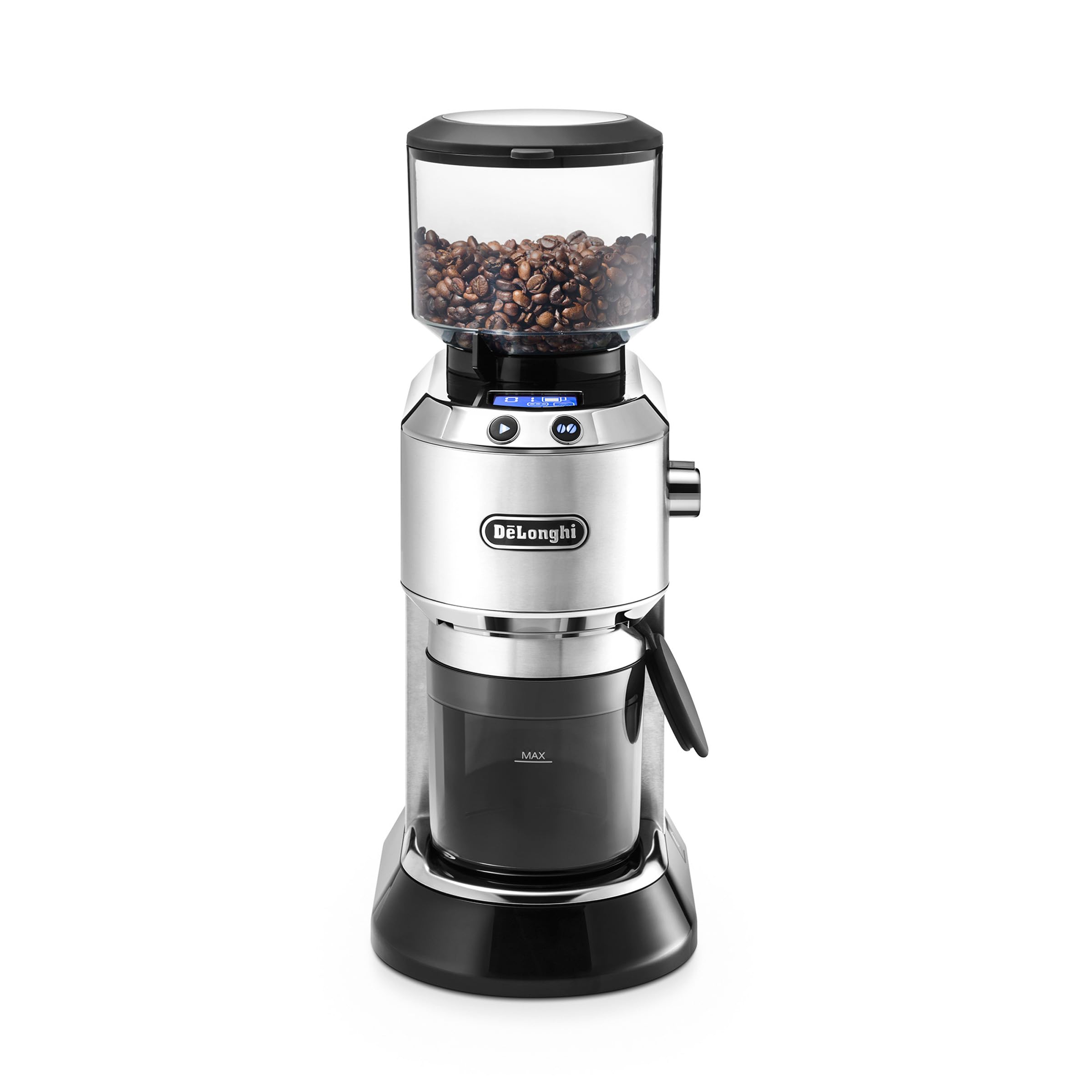
The De’Longhi Dedica is built around convenience: its cascading grind system feeds coffee directly into the espresso portafilter, bypassing the need for a separate dosing cup. The 18 grind settings are divided into 6 fine, 6 medium, and 6 coarse, with three strength levels (light, normal, strong) that adjust grind volume rather than coarseness. The LCD display provides clear feedback on settings, and the upper burrs pop out for cleaning without tools.
Users moving up from blade grinders report a dramatic quality improvement — espresso becomes smooth with genuine crema, and the harsh bitterness that characterized pre-ground shots disappears. The Dedica pairs naturally with De’Longhi espresso machines, but the portafilter cradle fits many 51mm filters from other brands. The unit is quiet for an electric burr grinder, and the auto shut-off stops the motor after grinding completes.
The main drawback is static: beans and chaff cling to the transparent grind container, and opening it releases a puff of fines across the counter. Users note that this improves slowly over time as the plastic builds a static charge counter-balance. The 18 settings are sufficient for entry-level espresso and drip, but French press users will find the coarsest setting still produces a slightly finer grind than ideal, leading to sludge in the cup. For the price, the Dedica delivers competent espresso-focused grinding with a workflow that is friendly to beginners, though it does not match the adjustability or build quality of higher-tier grinders like the Breville Dose Control Pro or Timemore 064S.
Why it’s great
- Grinds directly into espresso portafilter — no extra cup needed
- Upper burrs are removable for tool-free cleaning
- Quiet operation and auto shut-off for convenience
Good to know
- Significant static — chaff and fines stick to the container
- 18 settings are limited; coarsest grind is still too fine for French press
- Only grinds a single dose at a time — no hopper capacity for batch brewing
9. 1Zpresso J-Ultra

The J-Ultra is a manual grinder that matches or exceeds the grind quality of electric grinders costing twice as much. Its coated conical burr is precision-machined to a tolerance that produces 8-micron click increments — enough resolution to dial in espresso by taste, not guesswork. The 35–40 g magnetic catch cup snaps into place with a satisfying grip, and the folding handle tucks away to prevent tipping during transport. Grinding 18 grams for espresso takes under 45 seconds (faster than many budget electrics), and the smooth bearing rotation requires far less effort than cheaper hand grinders.
Flavor output is classically conical: chocolatey body with moderate fines that suppress channeling in espresso. Users pair the J-Ultra with machines like the Bambino Plus and report pulling shots that rival their local coffee shop. The built-to-last claim is backed by factory-calibrated burrs tested for 100–200 kg lifetime, and the tool-free disassembly makes cleaning simple — an included brush and air blower keep the burrs free of trapped fines. The travel case turns it into a portable setup for anyone who refuses to drink bad coffee on the road.
The catch cup does not fit standard 58mm dosing rings, and the handle position can tip the grinder over on uneven surfaces if you let go while grinding. A minority of users find the turning resistance too high for comfortable daily use — grip strength becomes a real factor with light-roast beans that are harder to fracture. If you are physically unable to exert the necessary torque, an electric grinder is the better choice. For anyone who values absolute grind precision, zero retention, and zero motor noise, the J-Ultra is the finest manual espresso grinder available near the mark.
Why it’s great
- 8-micron click adjustment — finer resolution than most electrics under
- Coated conical burr produces sweet, syrupy espresso with low channeling
- Magnetic catch cup and folding handle make it truly portable
Good to know
- Requires significant hand strength — not suitable for all users
- Catch cup does not fit standard 58mm dosing rings
- Handle position can tip grinder over if left unattended
FAQ
What burr size do I need for pro-level espresso?
How much retention is acceptable in a professional grinder?
Can a professional grinder handle both espresso and French press?
Do I need a brushless motor in a coffee grinder?
How often should I replace burrs on a professional grinder?
Final Thoughts: The Verdict
For most users, the professional coffee grinder winner is the Timemore Sculptor 064S because it delivers genuine 64mm flat burr particle distribution, stepless adjustment, and a quiet brushless motor at a price that undercuts every comparable electric grinder. If you want the absolute best clarity for filter coffee and do not need espresso capability, grab the Fellow Ode Gen 2. And for manual espresso precision that packs into a travel case, nothing beats the 1Zpresso J-Ultra.