The right meat cleaver turns a dreaded butchering task into a fluid, satisfying process—a single clean strike splitting a chicken joint or smashing through pork ribs without a second swing. The wrong one leaves you with ragged cuts, bruised palms, and a chipped edge that forces you back to the store within weeks. This tool lives at the intersection of raw force and precise geometry, and buying blindly in this category means sacrificing either safety or efficiency.
I’m Mohammad Maruf — the founder and writer behind AirfryerBite. I’ve spent years analyzing knife metallurgy reports, heat-treatment protocols, and edge-retention data from major kitchen brands to understand exactly what separates a cleaver that lasts a decade from one that ends up as a pry bar.
After comparing seven real-world models by steel hardness, weight distribution, handle ergonomics, and actual customer feedback on bone-in poultry and dense winter squash, the best meat cleaver title belongs to the model that marries mass with a razor-ready edge and a handle that doesn’t punish your wrist after the third chop.
How To Choose The Best Meat Cleaver
A meat cleaver is a simple tool by design, but a few non-negotiable specs separate a trusted kitchen workhorse from a dangerous paperweight. Focus on these four factors before you add anything to your cart.
Steel Type and Hardness (HRC)
The blade steel determines how long the edge stays sharp and whether it chips or rolls when it meets a bone. High-carbon stainless steel alloys—especially 7Cr17MoV and 7Cr18MoV—deliver a balance of corrosion resistance and edge hardness in the 56-60 HRC range. A cleaver rated below 55 HRC will dull noticeably after a single chicken quartering session. Above 62 HRC, the edge becomes brittle and prone to chipping on hard tasks. The sweet spot for a bone-splitting cleaver is 58-60 HRC, which gives you the strength to survive repetitive impacts without constant honing.
Weight and Full-Tang Construction
Cleavers rely on momentum, not arm strength. A heavy blade—1.8 to 2.2 pounds—lets gravity do the work when you swing through a pork shoulder or a beef rib. The handle attachment method matters just as much. A full-tang cleaver runs a single piece of steel from tip to butt, with handle scales bolted or riveted on each side. This design transfers every ounce of force directly into the cut and prevents the handle from snapping under impact. Cleavers with a hidden or partial tang should only be considered for light vegetable work.
Blade Geometry and Purpose Fit
Not all cleavers are designed to tackle bone. Traditional Chinese cleavers feature a thinner, taller blade (around 7 to 8 inches) with a fine edge that excels at slicing, dicing, and garlic smashing but risks rolling on dense cartilage. Western-style butcher cleavers and axe-shaped models use a thicker spine, a heavier grind, and a shorter blade (6 to 6.5 inches) optimized for splitting through bone and frozen meat. If you plan to break down whole poultry or cut through beef knuckles, buy an axe-profile cleaver. If your work is mostly trimming, slicing, and veg prep, a thinner Chinese-style cleaver will feel more nimble.
Handle Material and Ergonomics
Wet hands and greasy chicken skin make handle grip a safety issue. Pakkawood and ebony handles offer moisture resistance and a secure texture, while thermoplastic rubber (like Victorinox’s Fibrox) provides a slip-proof surface even under running water. Stainless steel handles look clean but become slick when oily and can cause hand fatigue during extended use. Test the handle shape in your grip: a slightly curved or tapered handle reduces wrist strain, while a perfectly straight cylinder forces your hand to work harder on each chop.
Quick Comparison
On smaller screens, swipe sideways to see the full table.
| Model | Category | Best For | Key Spec | Amazon |
|---|---|---|---|---|
| MAD SHARK 7.5″ Pro | Premium Axe | Heavy bone chopping | German alloy steel, 60+ HRC | Amazon |
| Victorinox Fibrox 7″ | Classic Utility | All-day veg & meat prep | Swiss stamped, 0.27 lbs | Amazon |
| Henckels Classic 6″ | Forged Precision | Joint cuts & cabbage | German forged, 6″ blade | Amazon |
| Kitory 6.3″ Axe | Heavy Duty | Big bones & frozen meat | 7Cr18MoV, 60 HRC | Amazon |
| BLADESMITH 6.3″ | Bone Breaker | Butchering & hunting | 7Cr17MoV, 1.83 lbs | Amazon |
| PAUDIN 7″ | Entry Value | Budget multi-purpose prep | HC stainless, 56 HRC | Amazon |
| ROCOCO 8.66″ | Labor-Saver | Light slicing & gift giving | 60 HRC, 0.4 lbs | Amazon |
In‑Depth Reviews
1. MAD SHARK Professional 7.5 Inch Meat Cleaver
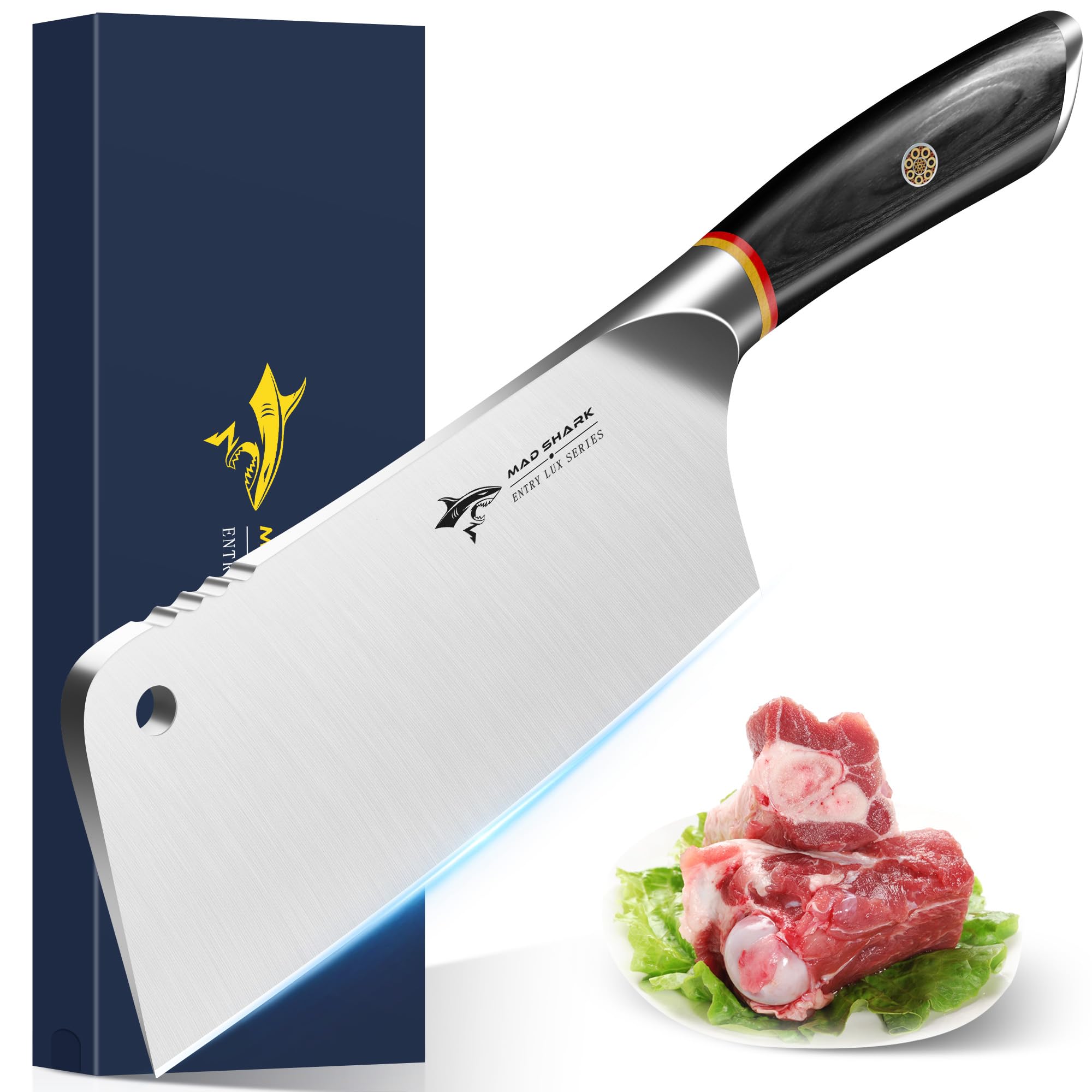
The MAD SHARK cleaver is engineered around military-grade composite German steel—an alloy blend rich in carbon, chromium, molybdenum, vanadium, and cobalt that pushes hardness well past 60 HRC without becoming brittle. The 7.5-inch blade has the heft and spine thickness to smash through beef knuckles and pork ribs, yet the V-shaped edge is sharp enough to slice raw brisket cleanly. Owners consistently report that this cleaver outperforms knives that cost twice as much, with factory edges that survive the first dozen chops without immediate honing.
Full-tang construction with an ebony wood handle and carved rivets provides a secure, balanced grip even after repeated contact with greasy meat. At 1.26 pounds, the weight sits forward enough to drive through bone on the downswing without feeling like you’re fighting the handle after thirty minutes of quartering chickens. The included white gift box makes this a strong candidate for gifting to serious home cooks or hunters.
Some users note that the factory edge, while extremely sharp, may benefit from a quick session on a fine-grit stone to reach a true razor finish. The blade is not designed for delicate slicing work like tomatoes or boneless fish—this is a cleaver built for force, not finesse. Hand washing and immediate drying are required to protect the high-carbon alloy from moisture spots.
Why it’s great
- German composite steel delivers exceptional edge retention at 60+ HRC
- Full-tang ebony handle offers secure grip and excellent forward balance for bone chopping
- Premium packaging and build quality exceed expectations for the mid-premium price tier
Good to know
- Factory edge may need a light pass on a whetstone for true razor sharpness
- Not ideal for fine slicing or tomato prep; purpose-built for heavy butchering
- Requires hand washing and thorough drying to maintain the alloy’s corrosion resistance
2. Victorinox Fibrox 7 Inch Swiss Made Cleaver

The Victorinox Fibrox cleaver occupies a unique space in this category: it is a stamped Chinese-style knife, not a forged axe, but it has earned a cult following among professional cooks for its razor-straight edge and near-perfect weight distribution. The 7.1-inch blade is made from Swiss stainless steel with a plain edge that arrives incredibly sharp, and the Fibrox handle provides a slip-proof grip even when your hands are wet from washing leafy greens or raw protein. At just 0.27 pounds, this is the lightest cleaver on this list, designed for fast, repetitive chopping rather than bone-splitting force.
Chefs love using this as a one-knife solution for prep-heavy kitchens: smashing garlic, slicing bell peppers, dicing onions, and even scraping diced ingredients from the cutting board using the flat of the blade. The tall blade profile provides ample knuckle clearance, and the straight edge allows for precise, clean cuts through chicken breast and fish fillet. A small number of users report that the edge can roll if driven straight into duck or pork bones, so this cleaver is best reserved for meat trimming and vegetable work.
The Fibrox handle is dishwasher safe, a rare feature among cleavers, though hand washing is recommended to preserve the blade’s sharpness. Immediate drying is still advised because the stainless steel can develop water spots. For cooks who need a light, nimble cleaver for daily prep without the fatigue of a heavy butchering tool, the Victorinox represents a proven, decades-old standard that restaurants trust.
Why it’s great
- Extremely sharp factory edge with excellent retention for a stamped blade
- Fibrox thermoplastic handle offers superior slip resistance in wet conditions
- Lightweight design (0.27 lbs) prevents fatigue during extended prep sessions
Good to know
- Not built for heavy bone chopping; edge may roll on dense cartilage or poultry bones
- Light weight means less momentum for splitting through tough joints
- Stainless steel can develop spots if not dried immediately after washing
3. Henckels Classic 6-inch Meat Cleaver

Henckels Classic cleavers are forged in Spain from German stainless steel, using a fully forged construction that creates a seamless transition from blade spine to triple-riveted handle. The 6-inch blade is shorter than most Chinese-style cleavers, but the increased thickness and weight give it the authority to cut through turkey joints, pork ribs, and dense winter squash with minimal effort. Owners consistently praise the balance—the knife feels heavier in the blade than the handle, which creates a natural pivot point that guides each swing straight through the target.
The satin-finished blade arrives extremely sharp and holds its edge well through heavy use. Home cooks report excellent results breaking down whole chickens, slicing through kabocha squash, and even splitting small frozen items. The triple-rivet handle provides a secure grip, and the overall length (just over 15 inches) offers enough reach for large cuts while remaining compact enough for controlled detail work. Some users note that the tang edge where the handle meets the blade can feel slightly sharp on certain units, which may be a minor manufacturing inconsistency.
This cleaver is dishwasher safe by the manufacturer’s specification, though the high-carbon German steel is best maintained with hand washing and immediate drying to preserve the satin finish and edge geometry. For cooks who want a forged, name-brand cleaver that can handle both bone-in poultry and heavy vegetable prep without the exaggerated weight of an axe-style knife, the Henckels Classic offers a polished middle ground.
Why it’s great
- Fully forged German stainless steel with a seamless blade-to-handle transition for durability
- Well-balanced weight distribution makes controlled chopping feel natural
- Versatile enough for poultry bones, squash, and general prep tasks
Good to know
- Some units have a slightly sharp tang edge where the handle meets the blade
- 6-inch blade is shorter than typical Chinese cleavers, limiting slicing capacity on large vegetables
- Hand washing recommended despite dishwasher-safe rating to protect the finish
4. Kitory 6.3 Inch Heavy Duty Meat Cleaver

Kitory’s meat cleaver is built with 7Cr18MoV high-carbon stainless steel, a formula that combines elevated chromium for corrosion resistance with a hardness rating of 60 HRC for sustained edge durability. The axe-shaped profile and full 1.8-pound weight make this one of the most aggressive bone-splitting tools on this list, designed to cut through beef knuckles, pork leg bones, and frozen meat with the momentum of its own mass. Customers frequently describe it as a cleaver that “cuts bones like butter” right out of the box, with a factory edge that requires minimal adjustment for heavy-duty tasks.
The pakkawood handle offers a comfortable grip that improves with use—the wood absorbs natural oils from the hand, creating a non-slip surface over time. The full-tang construction and triple-riveted handle ensure that no amount of repetitive impact will loosen the scales. Kitory employs a traditional hot forging process followed by a specialized cold forging step that increases the steel’s grain density, which contributes to both edge sharpness and blade toughness. At this price point, the fit and finish rival cleavers that cost several times more.
Because this cleaver is optimized for maximum chopping force, it is not suited for precision tasks like mincing garlic or slicing soft fruits. The thick spine and heavy blade make fine control difficult, and some owners report that the factory edge arrives slightly blunt and requires a session on a coarse stone before it performs at its peak. Hand washing is mandatory, and the blade should be dried immediately to protect the high-carbon steel from moisture damage.
Why it’s great
- 7Cr18MoV steel with 60 HRC delivers outstanding edge retention and chip resistance
- Heavy 1.8-pound full-tang design powers through large bones and frozen cuts effortlessly
- Hot and cold forging process creates a dense, durable blade grain structure
Good to know
- Factory edge may arrive slightly blunt and needs initial sharpening for true bone-splitting performance
- Axe shape and heavy weight make fine slicing and delicate prep difficult
- High-carbon steel requires immediate drying after washing to prevent corrosion
5. BLADESMITH 6.3 Inch Meat Cleaver Butcher Axe

The BLADESMITH butcher axe uses 7Cr17MoV carbon stainless steel rated at 58±2 HRC, a well-tested balance that provides sufficient hardness for bone-work without the brittleness that plagues harder steels. The 6.3-inch blade is designed with a thick V-shaped grind that cuts cleanly through poultry carcasses, rib sections, and even small beef bones. At 1.83 pounds, this is the heaviest cleaver in the lineup, and that weight works in your favor: the momentum carries the blade through dense material with less effort from your arm.
The pear wood handle is a distinctive feature—its porous surface actually absorbs a thin layer of grease and oil from the meat being cut, which improves grip rather than making it slippery. This is a clever design detail that butchers and hunters will appreciate during long processing sessions. The full-tang construction ensures that the handle won’t separate from the blade, even under repeated heavy impacts. Owners consistently praise the knife’s heavy-duty feel and the comfortable grip that remains secure even with greasy hands.
Understand that this is a dedicated bone breaker, not a multi-purpose kitchen knife. The edge geometry is too thick for slicing tomatoes, and the spine is designed to smash bone, not glide through a bell pepper. Some customers report that the factory edge needs a stone to reach full sharpness, and the included edge may feel slightly uneven out of the box. Storing the blade in its included box is essential given the dangerous weight and sharpness of the tool.
Why it’s great
- Pear wood handle absorbs grease naturally, improving grip during continuous butchering sessions
- Heavy 1.83-pound total weight provides bone-shattering momentum with minimal arm effort
- 58 HRC hardness rating offers a good balance between edge retention and impact toughness
Good to know
- Factory edge often requires a sharpening stone before reaching optimal performance
- Thick blade grind makes precise slicing of soft items nearly impossible
- Requires safe storage—the weight and sharpness make it dangerous if handled carelessly
6. PAUDIN 7 Inch Cleaver Knife

PAUDIN positions this cleaver as a budget-friendly entry point for cooks who want the versatility of a Chinese-style blade without spending premium money. The 7-inch high-carbon stainless steel blade is stamped and hand-sharpened to a V-shaped edge with a 15-degree angle on each side, giving it a sharpness that punches above its price tier. The pakkawood handle provides a comfortable grip that feels more expensive than the price suggests, and the included sheath protects the blade during storage. Users who primarily cut chicken parts, slice vegetables, and mince herbs report satisfaction with its performance after six months of daily use.
The blade measures 2.3mm at the spine, which is thin enough for precise cutting but not thick enough to survive hard bone-chopping. The manufacturer recommends this cleaver for disjointing cuts, carving thicker meat, and breaking down heavy ingredients, but customer feedback indicates that the edge can roll when driven into duck bones or large cartilage sections. The 15-degree edge is optimized for slicing, not splitting, and users who try to use it as an axe-style bone breaker will be disappointed by edge damage.
The balance leans handle-heavy, which some users find fatiguing during extended prep sessions. The pakkawood handle is heavier than the blade, creating a top-heavy feel that requires more wrist effort to control. For light to medium kitchen tasks—chicken breast, onion, pepper, squash—the PAUDIN delivers excellent value. For heavy butchering, look to the heavier axe-style models on this list.
Why it’s great
- Hand-sharpened 15-degree V-edge cuts cleanly through chicken and vegetables right out of the box
- Pakkawood handle provides a comfortable, secure grip with an upscale look
- Included sheath and gift box add value for gifting or safe storage
Good to know
- Handle-heavy balance creates fatigue during extended use and reduces control for precise cuts
- Thin 2.3mm spine is not designed for bone chopping; edge rolls on dense cartilage
- Hand wash only—pakkawood handle will degrade in the dishwasher
7. ROCOCO 8.66 Inch Meat Cleaver Knife
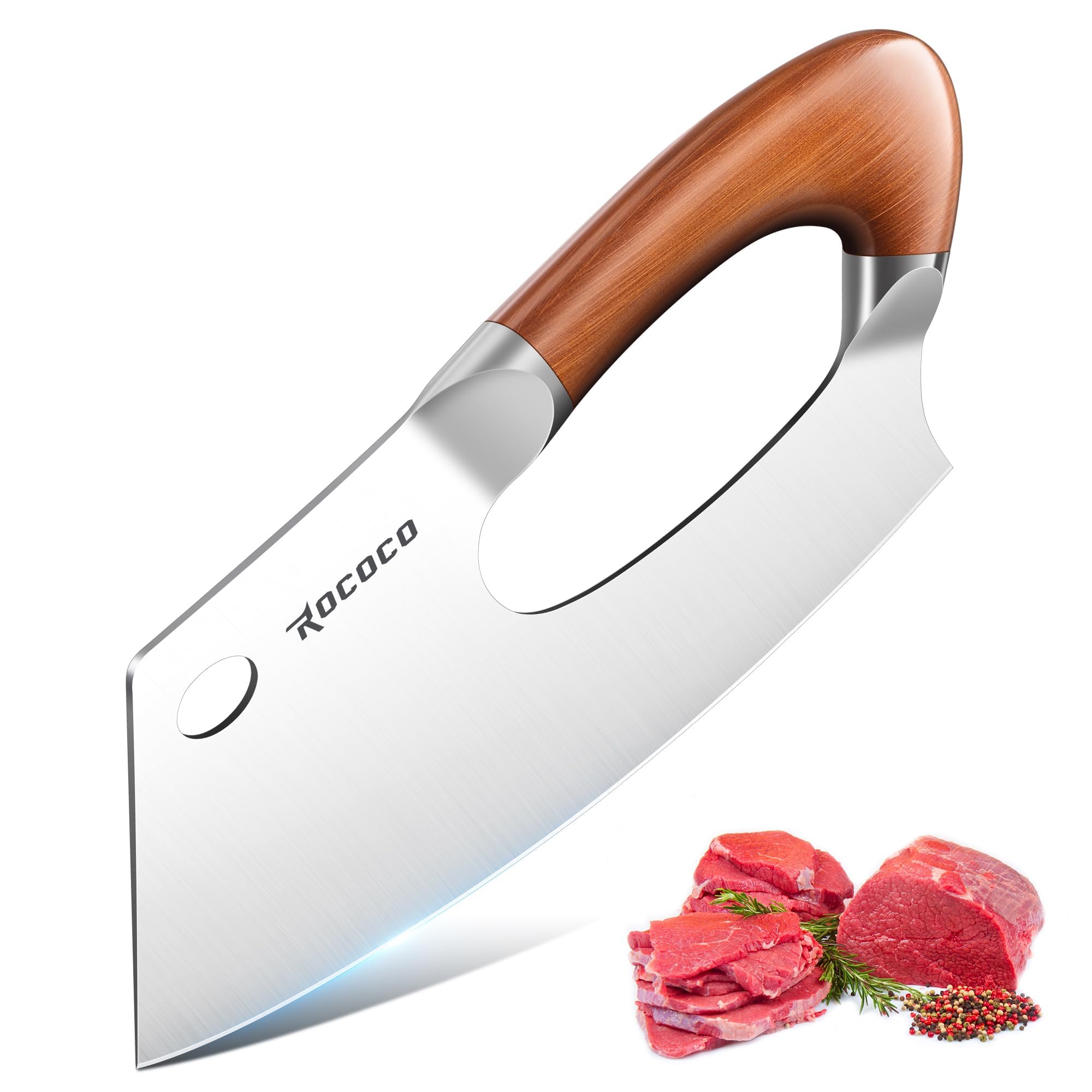
ROCOCO’s cleaver brings a unique design to the budget tier: a curved bronze-finished handle with a forward grip that shortens the force distance, theoretically reducing wrist strain during repetitive cuts. The blade is forged from premium stainless steel and hardened to 60±2 HRC, a spec that usually belongs to knives costing two to three times as much. The 8.66-inch blade length makes this the longest cleaver in the test, offering maximum slicing surface for large cuts of meat and wide vegetables. The hand-polished 15-degree V-edge minimizes resistance on each pass, making it effective for slicing raw proteins and dense produce.
Customer feedback consistently highlights the knife’s sharpness and the comfortable finger-hole handle, which gives a secure grip that prevents the hand from sliding forward during use. Multiple owners report buying additional units as gifts, which speaks to the visual appeal of the bronze handle and the polished blade. The magnetic strip compatibility is a practical bonus, allowing countertop storage without taking up drawer space.
The manufacturer explicitly states that this cleaver is not designed for bone cutting. The thin 15-degree edge geometry, while excellent for slicing and dicing, will chip or roll if driven into bone. The included box does not include a sheath, and owners report that the extreme sharpness requires careful storage. The stainless steel handle, while visually striking, can feel slick when wet, which is a safety concern during heavy use. This is a light-prep and gift cleaver, not a butchering tool.
Why it’s great
- 60 HRC hardness and 15-degree edge provide exceptional sharpness at a budget-friendly price point
- Curved bronze handle with finger hole reduces wrist fatigue and improves grip security
- Long 8.66-inch blade offers superior slicing surface for large cuts and vegetables
Good to know
- Not designed for bone cutting despite its cleaver shape; thin edge will chip on hard material
- Stainless steel handle becomes slippery when wet, requiring careful grip during use
- No sheath included—the extreme sharpness demands safe storage
FAQ
Can I use a meat cleaver to cut through frozen meat and bones?
What is the difference between a Chinese cleaver and a Western butcher cleaver?
How do I sharpen a cleaver that has chipped or rolled edges?
Why do some cleavers have a hole in the blade near the handle?
Final Thoughts: The Verdict
For most users, the best meat cleaver winner is the MAD SHARK Professional 7.5 Inch because its German composite steel and balanced full-tang design deliver bone-splitting power without sacrificing the precision needed for everyday prep. If you want a nimble, versatile cleaver that handles 90% of kitchen tasks with zero fatigue, grab the Victorinox Fibrox 7 Inch. And for heavy-duty butchering where only raw mass and a high-HRC edge will do, nothing beats the Kitory 6.3 Inch for its brute-force bone-splitting ability at a reasonable investment.