Finding an organic oolong that delivers that signature floral aroma, smooth body, and clean finish without a trace of bitterness requires more than just grabbing a random box off the shelf. Most mass-market teas cut corners on harvest altitude, oxidation consistency, and the integrity of their organic certification, leaving you with a brew that tastes flat or faintly metallic.
I’m Mohammad Maruf — the founder and writer behind AirfryerBite. I’ve spent the last year analyzing oxidation levels, origin altitudes, and third-party organic certifications in the oolong category to separate the genuinely premium leaf from the overpriced filler.
This guide evaluates five contenders across loose-leaf and bagged formats to help you pick the exact best organic oolong tea for your daily ritual and personal taste preferences.
How To Choose The Best Organic Oolong Tea
Organic oolong spans a wide range from light, floral Formosa styles to darker, roasted Chinese varieties. Before you buy, these three factors will narrow your options faster than reading ingredient labels.
Leaf Format: Whole Loose Leaf vs. Tea Bags
Whole or broken loose leaves retain the oil glands that carry the oolong’s signature orchid-like fragrance. Tea bags, especially the pillow-style ones, typically contain fannings or dust that degrade the flavor profile and limit you to a single steep. If you value multiple infusions from the same serving, seek out whole-leaf loose varieties or pyramid sachets that give the leaf room to unfurl.
Origin Territory: High Mountain vs. Low Elevation
Tea grown above 1,000 meters in regions like Taiwan’s Alishan District or Japan’s Miyazaki Prefecture develops a denser, sweeter liquor because the plants grow slower and concentrate more amino acids. Lower-elevation oolongs tend to be astringent and lack the creamy mouthfeel that high-mountain growers prize. An origin statement like “High Mountain” or “Gokase Town” signals premium leaf structure.
Organic Certification and Processing Integrity
Not all “organic” labels carry the same weight. USDA Organic certification requires third-party auditing, while foreign certifications like JAS (Japan) or Chinese Organic differ in enforcement rigor. Equally important is the oxidation level — lightly oxidized (15-25%) oolongs taste floral and green, while heavily oxidized (50-70%) oolongs lean toward nutty and woody. Choose based on your preference for brightness versus depth.
Quick Comparison
On smaller screens, swipe sideways to see the full table.
| Model | Category | Best For | Key Spec | Amazon |
|---|---|---|---|---|
| ZONE – 365 Oolong Loose Leaf Tea | Loose Leaf | Premium daily ritual with multiple steeps | Taiwan Alishan high mountain, 150 g | Amazon |
| YAMASAN KYOTO UJI Organic Oolong | Loose Leaf | Japanese-grown single-estate purity | 100 g, 0 kcal brew, JAS organic | Amazon |
| VAHDAM High Mountain Oolong Tea Bags | Tea Bags | Convenient bagged quality with floral notes | 30 count, pyramid bags, medium caffeine | Amazon |
| Prince of Peace Organic Oolong Tea | Tea Bags | Bulk bag supply for daily drinking and kombucha | 300 count, mild flavor, string & tag bags | Amazon |
| Fusion Select 200 Counts Organic Oolong | Tea Bags | Budget-friendly pantry staple | 200 individually wrapped bags, smooth | Amazon |
In‑Depth Reviews
1. ZONE – 365 Oolong Loose Leaf Tea from Taiwan Alishan District
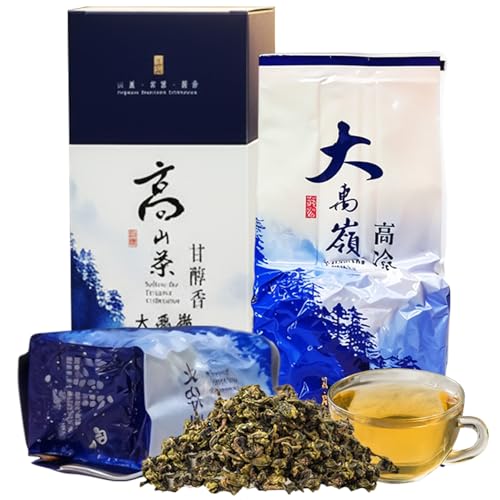
Sourced from the Alishan District in Taiwan — a high-mountain region above 1,000 meters — this loose-leaf oolong offers the creamy mouthfeel and honeyed osmanthus finish that serious tea drinkers chase. The vacuum-sealed packaging preserves the leaf’s natural oil content, which is essential for achieving that sweet floral aroma over multiple steeps. Reviewers consistently report that the liquor stays vibrant across five infusions, confirming the whole-leaf integrity.
The dry leaf appears tightly rolled into dark, jade-colored balls that unfurl fully during steeping — a visual benchmark of proper semi-oxidation. At a suggested water temperature of 195°F and a steeping time of 3 to 4 minutes, the brew yields a golden-amber cup with no bitter tail. The 150-gram canister holds approximately 70 cups, making the cost-per-cup very reasonable for a single-origin high-mountain tea.
The manufacturer’s “Formosa Fresh” sourcing ensures the leaf originates from the same estates that supply Taiwan’s domestic teahouses. Buyers who have compared this tea directly against other Da Yu Ling varieties note that it sits slightly below the absolute peak of Taiwanese oolong but remains a superb everyday premium pick.
Why it’s great
- High altitude Alishan origin delivers smooth, sweet body with no astringency
- Vacuum-sealed tin preserves leaf freshness for up to two years
- Gongfu-grade whole leaf supports 5+ steeps per serving
Good to know
- Larger upfront container cost compared to bagged alternatives
- Requires a strainer or gaiwan for loose-leaf brewing
2. YAMASAN KYOTO UJI Organic Oolong Tea Loose Leaf
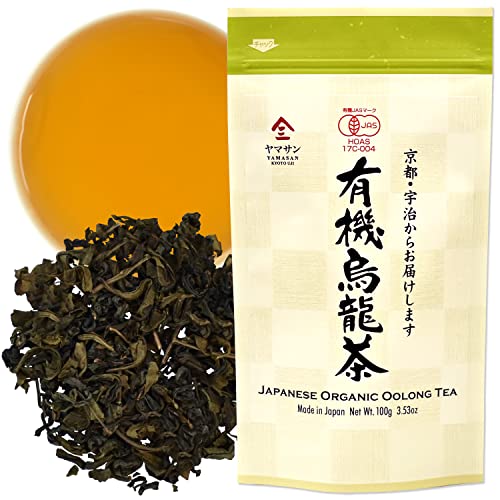
This is a rare beast — Japanese-grown organic oolong from Gokase Town in Miyazaki Prefecture, where the cool mountain climate produces a tighter leaf structure and a distinct umami backbone absent in most Chinese-style oolongs. The leaf originates from plants cultivated without synthetic pesticides or chemical fertilizers and carries the JAS organic certification, which is among the strictest organic standards globally.
The recommended brewing parameters are 90-95°C for about 90 seconds, but even a slight oversteep pushes the flavor toward a pleasant, full-bodied bitterness rather than the harsh bite of lower-grade teas. Because the leaves are whole and well-oxidized, each steep reveals a different character — the first steep delivers a floral aroma with light roasted notes, while subsequent steeps bring out a clean, almost mineral finish. Multiple reviews mention the tea stands up well to a splash of milk, which is unusual for a premium oolong.
The 3.53-ounce bag is compact compared to bulk competitors, but the leaf yield per gram is high because of the tight roll and multiple-infusion nature of the material. This is the right choice for anyone who wants an authentic Japanese single-estate tea with traceable farming practices.
Why it’s great
- JAS-certified organic from Japan with verified single-origin leaf
- Complex umami profile that holds up across multiple steeps
- Zero-calorie brew with naturally high manganese and B2 content
Good to know
- Brewing requires careful temperature control to avoid excess bitterness
- Higher per-ounce cost compared to blended bagged teas
3. VAHDAM High Mountain Oolong Tea Bags (30 Count)
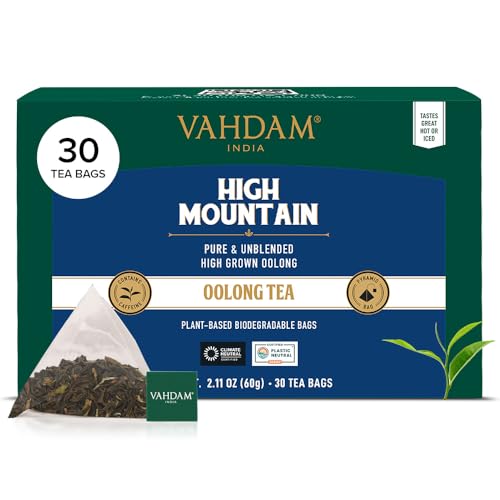
VAHDAM sources this oolong from high-altitude estates in India, a growing region that offers a lighter, floral-fruity profile reminiscent of jasmine without artificial flavoring. The pyramid-shaped, biodegradable tea bags give the leaf enough room to expand during steeping — a design that outperforms flat pillow bags in flavor extraction. The flavor is medium-caffeinated and smooth enough to drink without sweetener, which makes it an accessible entry point for drinkers transitioning from green tea.
Reviewers point out that the tea steeped for 4 to 5 minutes still tastes non-bitter, which suggests the leaf is well-oxidized and free of the stemmy off-notes common in budget tea bags. A minority of buyers reported inconsistency in flavor intensity across different batches, but the majority appreciate that the bagged format eliminates the mess of loose leaves while preserving a surprisingly high quality level. Each bag is individually wrapped inside a resealable ziplock pouch to protect against humidity.
VAHDAM operates a direct-trade model, reinvesting portion of revenue into education for tea growers’ children, and the brand offsets its carbon and plastic footprint. For buyers who prioritize ethical sourcing and a convenient brewing method without sacrificing the floral top notes that define oolong, this pouch is a strong contender.
Why it’s great
- Pyramid biodegradable bags allow full leaf expansion for richer flavor
- Naturally floral and non-bitter, even with longer steeps
- Carbon-neutral, plastic-neutral brand with direct-trade farmer compensation
Good to know
- Some individual bags use more packaging than loose leaf equivalents
- Flavor profile may be lighter than traditional Chinese oolong drinkers expect
4. Prince of Peace Organic Oolong Tea – 100 Tea Bags (Pack of 3)
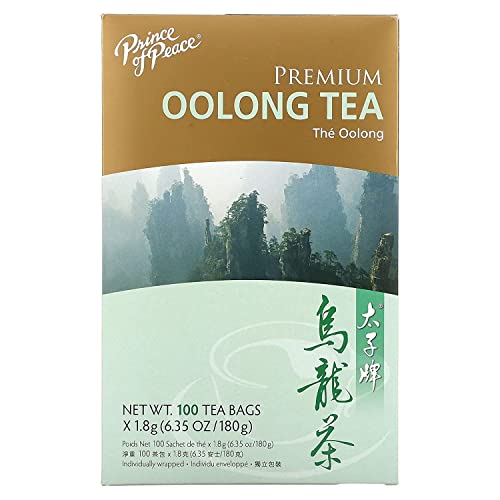
This is a three-pack of 100-bag boxes, totaling 300 servings for everyday drinking or kombucha brewing. The tea is hand-picked from certified organic plantations in China, and the flavor aligns closely with the classic, mildly floral oolong served in Cantonese dim sum houses — light golden in color, gentle on the stomach, and smooth enough to drink unadorned. Each bag comes with a string and tag, which makes brewing in a thermal mug straightforward.
Kombucha brewers on Amazon report using seven bags per half-gallon jar with consistent results, producing a well-fermented base with no off-flavors. As a hot tea, it steeps easily in just-boiled water and does not develop the metallic notes that plague bargain-bin oolongs. The company donates a portion of profits to support orphaned children in China, adding a charitable angle to an already affordable bulk purchase.
The primary trade-off is that the bagged fannings limit you to a single infusion — the second steep yields a noticeably weaker cup. Consumers who plan to brew by the pot each morning and don’t mind discarding the bag after one serving will find this the most cost-effective organic option per serving among the five products evaluated.
Why it’s great
- Extremely low cost per cup with 300 tea bags in one shipment
- Mild, non-acidic flavor works well for both drinking and kombucha fermentation
- USDA Organic with hand-picked certification and charitable business model
Good to know
- Bagged format means only one usable steep per serving
- Flavor is gentler than deep-roasted or high-mountain oolong profiles
5. Fusion Select 200 Counts Organic Oolong Tea
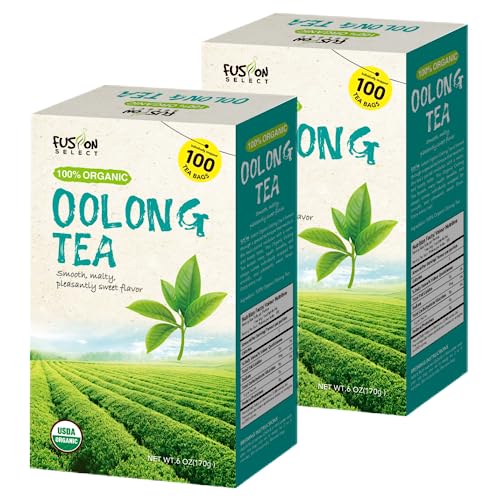
Fusion Select takes a straightforward approach — 200 individually wrapped tea bags at an entry-level price point that is hard to beat for pure volume. Reviewers describe the flavor as “smooth,” “mildly sweet,” and “kind to the stomach,” which suggests the oxidation level is in the middle range and the leaf is free of pesticides as advertised. This is not a tea meant for connoisseurs, but rather a reliable, mass-produced organic option for people who want a caffeine-friendly alternative to coffee without breaking their monthly grocery budget.
The individual wrapping on each bag adds an extra layer of freshness protection for those who do not go through tea quickly — a practical feature for occasional drinkers or office desks. Steeping instructions are simple: pour hot water over the bag and let it sit for three minutes. The resulting liquor is golden and consistently pleasant, if not complex. Customers who use this tea for recovery after meals note that it does not trigger acid reflux, a common complaint with lower-grade bagged teas.
The manufacturer’s claim of a “relaxing and calming” effect aligns with the naturally occurring L-theanine content in oolong, though the total caffeine per bag is likely lower than specialty loose-leaf counterparts. For households that drink multiple cups per day and prioritize organic sourcing over single-origin prestige, this 200-count box represents the most price-conscious option in the lineup.
Why it’s great
- High bag count at a budget-friendly cost for daily consumption
- Individually wrapped sachets maintain freshness over long storage periods
- Mild, smooth profile with no reported stomach irritation
Good to know
- Single-steep bags deliver less flavor depth than whole-leaf alternatives
- Origin or farm traceability is not disclosed in the product detail
FAQ
What does organic mean for oolong tea compared to conventionally grown?
How long should I steep organic oolong tea bags versus loose leaf?
Can I use organic oolong tea for kombucha fermentation?
Final Thoughts: The Verdict
For most users, the best organic oolong tea winner is the ZONE – 365 Oolong Loose Leaf Tea because it delivers authentic high-mountain Alishan character, supports five steeps per serving, and arrives in vacuum-sealed tins that lock in freshness for months. If you want a convenient bagged option with a floral jasmine-like profile, grab the VAHDAM High Mountain Oolong Tea Bags. And for a budget-friendly bulk supply that still meets organic standards without sacrificing drinkability, nothing beats the Prince of Peace Organic Oolong Tea.