A dry layer of straw is the difference between a vegetable bed that bakes under the sun and one that holds moisture like a sponge. But the wrong straw—full of weed seeds or chemical residues—turns a simple mulch job into a season-long battle with unwanted grass and soil contamination. You need a straw that suppresses weeds, not one that introduces them.
I’m Mohammad Maruf — the founder and writer behind AirfryerBite. I’ve spent years digging through product specs, breaking down tensile strength and compaction ratios, and analyzing how organic wheat straw behaves in raised beds versus in-ground plots.
Whether you are protecting seedlings from erosion or insulating the soil around your tomato roots, choosing the right bale matters. That is exactly why I built this guide to the best straw mulch for vegetable garden.
How To Choose The Best Straw Mulch For Vegetable Garden
The key to effective straw mulch is matching the bale’s physical properties to your garden’s specific needs — soil type, climate, and crop layout. Not all straw is created equal, and the wrong choice can introduce more problems than it solves.
Seed load and chemical residue
The single biggest failure point in straw mulch is the number of viable weed seeds it carries. Hay is notorious for introducing grass seeds into beds; straw, by definition, is the leftover stem after the grain head is harvested. But even straw can carry residual seeds if not properly cleaned. Look for products that explicitly state “weed seed free” or “cleaned” on the package. Some premium bales undergo mechanical filtration to remove dust and chaff, which also reduces the seed count significantly.
Fiber length and interlocking ability
Straw that is cut too short tends to blow away in wind or wash out during heavy rain. Longer fibers — typically between two and four inches — interlock when watered, forming a natural mat that stays in place without chemical binders. This physical mat is what actually suppresses weeds and slows evaporation. If you plan to use straw for lawn seeding as well, longer fibers are critical to prevent the straw from shifting off the seed bed.
Compressed volume versus actual coverage
Most garden straw is sold by weight (pounds) or by compressed cubic footage. A 3-cubic-foot compressed bale can expand to cover roughly 100 square feet at the recommended two-to-three-inch depth. For a standard 4×8 raised bed, that is about 32 square feet, so one bale covers roughly three beds. If you buy by the pound, expect four pounds to cover roughly 20 square feet at a thin one-inch layer. Always check the expanded coverage claim — not just the bag weight — to avoid underestimating your order.
Quick Comparison
On smaller screens, swipe sideways to see the full table.
| Model | Category | Best For | Key Spec | Amazon |
|---|---|---|---|---|
| HealthiStraw GardenStraw | Premium Bale | Large raised beds & lawn seeding | 3 cu ft compressed / 20 lbs | Amazon |
| Out-Grow Wheat Straw | Mid-Range Bag | Small beds & cat shelters | 1 cu ft / 4 lbs | Amazon |
| Natural Wheat Straw (Acostop) | Entry-Level Bag | Seed coverage & craft use | 1 lb vacuum pack | Amazon |
| CZ Grain Wheat Straw | Mid-Range Bag | Outdoor pet bedding | 4 lbs / 12x12x5″ box | Amazon |
| Natural Wheat Straw (4 lbs) | Standard Bag | Container garden mulch | 4 lbs / 18x8x12″ bag | Amazon |
In‑Depth Reviews
1. HealthiStraw GardenStraw, 3 cu ft
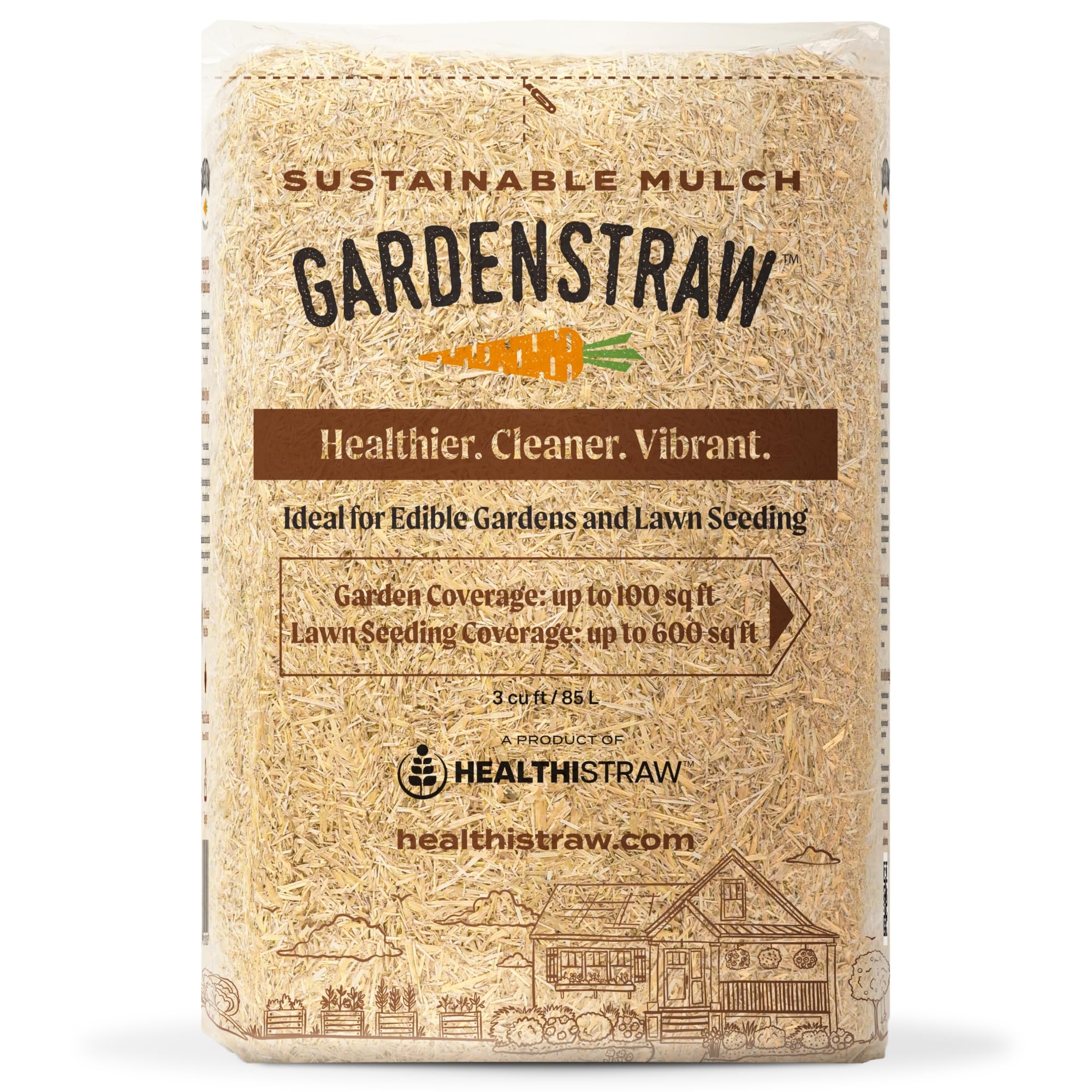
HealthiStraw delivers a full 3-cubic-foot compressed bale that expands to cover up to 100 square feet at a two-to-three-inch depth. The straw fibers are cut long — roughly three to four inches — so they interlock when watered and resist wind displacement without chemical binders. Multiple verified buyers report the bale is dry on arrival, smells clean, and produces very few errant grass shoots compared to generic bale straw.
This product is mechanically filtered to remove dust, dirt, and as many weed seeds as possible. For a vegetable gardener, that means less time pulling volunteer wheat and more time tending actual crops. The straw breaks down fairly quickly in compost, adding carbon and improving aeration, which is a bonus for gardeners who practice no-till or lasagna-bed methods.
One trade-off is the weight: at 20 pounds, the compressed bale is dense and may be awkward to carry from a car to a backyard bed. There are a few reports of grass seeds germinating after application, though the consensus among reviewers is that the seed load is far lower than typical feed-store straw. For a large garden, this bale is the most efficient and cleanest option currently available in the sub-fifty-dollar range.
Why it’s great
- Expansive coverage — 100 sq ft at 2-3″ depth
- Very few weed seeds compared to standard straw
- Long fibers interlock and resist wind and rain
Good to know
- Heavy compressed bale (20 lbs) is bulky to transport
- A small percentage of users still find grass seeds
2. Out-Grow 100% Natural Wheat Straw, 1 cu ft

Out-Grow offers a one-cubic-foot bag of natural wheat straw grown on-site for quality control. The straw is described as clean and low-dust, with minimal weed seeds — a common complaint among cheaper straw products. Gardeners report it holds moisture well in container beds and raised plots, with several reviewers noting their plants stayed hydrated longer after applying a two-inch layer.
This bag is also widely used for outdoor feral cat shelters because the hollow wheat stems repel moisture and do not freeze like hay. The four-pound net weight makes it easy to handle and store, though the bag is compressed enough to require fluffing before application. The manufacturer does not specify fiber length, but user photos show a mix of short and medium stems that spread evenly.
One reviewer reported finding a large foreign object in the box, suggesting packaging quality may vary between batches. For small raised beds (4×4 or smaller) or container tomatoes, this bag provides a solid value without the commitment of a full bale. It is also a practical starter option for first-time straw mulchers who want to test the method before scaling up.
Why it’s great
- Clean, low-dust straw with minimal weed seeds
- Lightweight bag at 4 lbs — easy to handle and store
- Effective moisture retention for raised beds and containers
Good to know
- One reported instance of a foreign object in the bag
- Coverage is limited — best for small beds or targeted use
3. Natural Wheat Straw (Acostop), 1 lb

Acostop packages its sun-dried wheat straw in a vacuum-sealed bag that keeps the straw odor-free and compact for storage. The straw is advertised as 100% chemical-free and safe for organic vegetable gardens. At just one pound, this is the smallest unit in the list, designed for targeted jobs such as covering a freshly seeded patch or filling a small cat shelter.
Buyers praise the straw for its cleanliness and lack of moisture. Several gardeners used it to cover a 36-inch circle of new grass seed, reporting the straw stayed in place even during wind and rain. A second person helps when spreading the straw in breezy conditions, but the tacky substrate of the straw itself helps it cling to soil. This product is also popular for crafts and fall decor, though that is secondary for vegetable gardeners.
The clear drawback is quantity: one pound yields only enough for a very thin layer over roughly a 3×3-foot patch. For a full raised bed, you would need multiple bags, which quickly makes this option less efficient than buying a larger bale. It works well as a trial pack or for apartment gardeners with a single container, but serious vegetable growers should consider the larger options for better per-square-foot value.
Why it’s great
- Vacuum-sealed packaging stays clean and fresh
- Chemical-free and safe for organic vegetable beds
- Stays in place on seeded soil during wind and rain
Good to know
- Very small quantity — not economical for full garden beds
- Best suited for seed patches, crafts, or single containers
4. CZ Grain 100% Natural Wheat Straw, 4 lbs
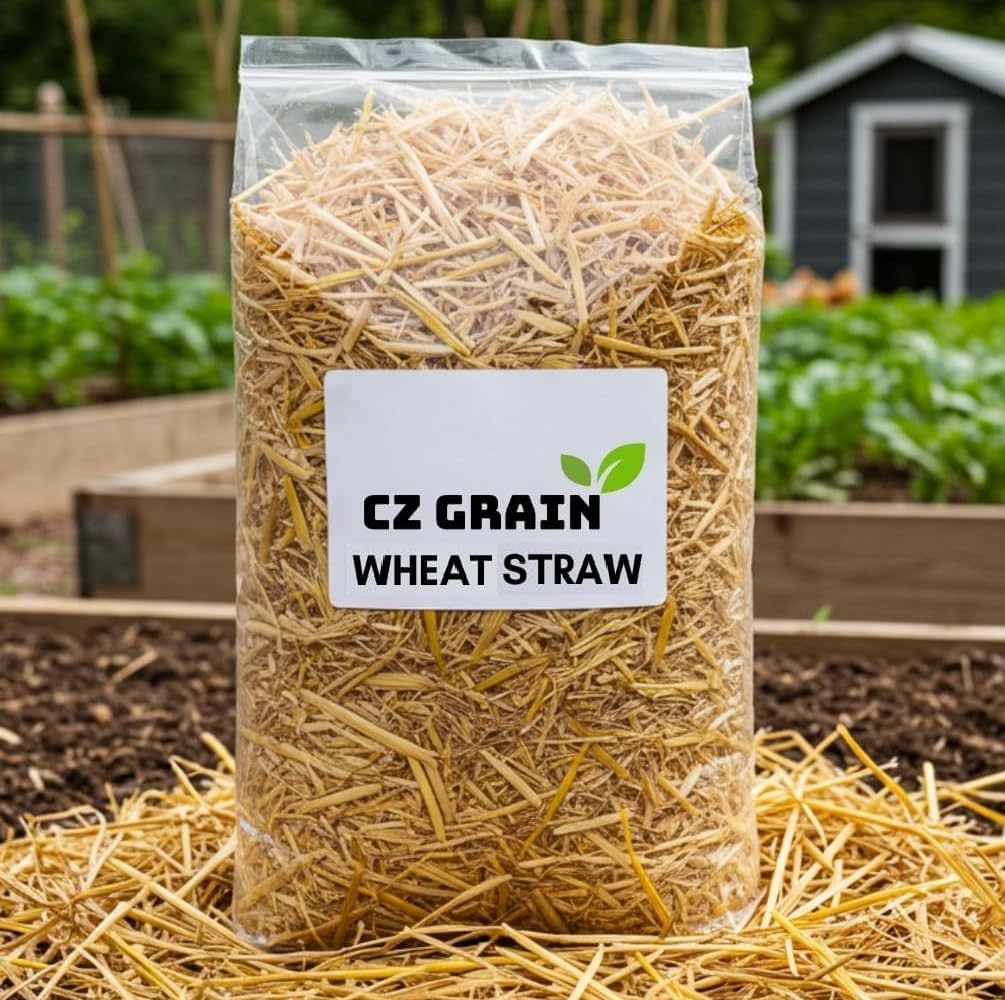
CZ Grain packages its wheat straw in a compact 12x12x5-inch box, making it one of the more space-efficient options for gardeners with limited storage. The straw has a soft texture and pieces are long enough to use without additional shredding. Several verified buyers used it as bedding for outdoor cat houses and noted the straw remained dry and comfortable during freezing weather.
For vegetable garden use, the straw is clean and dust-free, but the quantity is modest. One reviewer described it as “a little skimpy” for the price, and another rated the quality as “extremely poor” with a bad smell — though that review was an outlier among primarily positive feedback. The packaging includes a resealable ziplock bag, which is useful for storing leftover straw without moisture ingress.
This product is best suited for small-scale gardeners or those using straw primarily for animal bedding with occasional garden use. For a dedicated vegetable bed, the per-pound cost is higher than the larger HealthiStraw bale, and the shorter box dimensions mean the straw arrives more compacted, requiring thorough fluffing before spreading. Check the batch quality upon opening, as the outlier review suggests some inconsistency.
Why it’s great
- Soft, long straw pieces — no shredding needed
- Resealable ziplock packaging for easy storage
- Compact box size fits small spaces
Good to know
- Some batches reported as poor quality or with bad odor
- Quantity is skimpy for the price compared to larger bales
5. Natural Wheat Straw (4 lbs), Standard Bag

This four-pound bag of natural wheat straw is a straightforward entry-level option for gardeners who need a moderate amount of clean mulch without committing to a compressed bale. The straw is dry and light yellow, and buyers consistently describe it as “good quality” and “clean.” Several customers used it successfully as container garden mulch and reported that it slowed evaporation significantly compared to bare soil.
One detailed review from a container gardener noted that the straw is gentle on direct-sown seeds and easy to apply but warned that it does not act as a pest barrier and may contain some weed seeds. The bags are packed loosely, so the four pounds fill a slightly larger volume than the CZ Grain box, but the coverage is still limited to roughly 20 square feet at a one-inch depth. This bag also doubled as bedding for feral cats during cold Michigan winters, with multiple five-star reviews praising its insulating properties.
Delivery timing can be inconsistent — one buyer reported a shipping delay but praised the seller’s responsive customer service and reimbursement. For a small raised bed or a collection of large containers, this bag is a reliable, no-fuss option. The main limitation is value: the per-pound cost is higher than the HealthiStraw bale, and you will need to buy multiple bags to cover a standard 4×8 vegetable bed.
Why it’s great
- Clean, dry, and ready to spread with minimal dust
- Gentle on direct-sown seeds and new transplants
- Effective moisture retention for container gardens
Good to know
- Contains some weed seeds — monitor for sprouts
- Does not double as a pest barrier
FAQ
How thick should I spread straw mulch in my vegetable garden?
Will straw mulch attract slugs or other pests to my vegetables?
Can I use straw from my local feed store for vegetable garden mulch?
How long does straw mulch last before it breaks down?
Final Thoughts: The Verdict
For most users, the best straw mulch for vegetable garden winner is the HealthiStraw GardenStraw because it offers the best balance of coverage, low seed load, and interlocking fiber design for a large or medium vegetable plot. If you want a budget-friendly option for a small raised bed or container garden, grab the Out-Grow 1-cu-ft bag. And for a compact trial pack or seed-patch coverage, nothing beats the Acostop Natural Wheat Straw for its vacuum-sealed freshness and mess-free handling.