For bakers, the rolling pin is the tool that separates tender, even pie crusts from tough, lopsided ones. The market is flooded with dowels, tapered French pins, heavy marble rollers, and adjustable rings, so finding the right one means knowing how material weight, barrel diameter, and surface finish interact with your specific dough. This guide cuts through the noise to identify the best-rated rolling pins for serious home bakers.
I’m Mohammad Maruf — the founder and writer behind AirfryerBite. I’ve analyzed hundreds of customer reviews, studied wood grain hardness scales, marble density specs, and engineering tolerances on rolling pins across every major brand to pinpoint exactly which designs consistently deliver uniform dough thickness and effortless release.
Whether you need a cool marble surface for butter-based pastry or a lightweight French taper for delicate work, the best rated rolling pin must balance heft, surface porosity, and dimensional precision to match your specific baking style.
How To Choose The Best Rated Rolling Pin
The right rolling pin is defined by your primary dough type — a cool marble pin keeps butter solid for flaky pastry, while a lightweight maple French pin gives delicate control for cookies and pasta. Here are the non-negotiable specs to evaluate.
Material: Wood vs. Marble vs. Silicone-Coated
Wood (beech, maple) offers low thermal transfer and a porous surface that holds flour to prevent sticking. Marble is dense and naturally cool, inhibiting gluten formation and keeping butter-based doughs cold for flakier results. Silicone-coated pins release dough without flour, but the coating adds drag and can reduce sensitivity to dough thickness. Serious bakers prefer wood or marble for tactile feedback.
Barrel Shape and Dimensions
A straight barrel (uniform diameter) delivers consistent pressure across the entire sheet; a tapered French pin, thinner at the ends, allows your hands to control edge pressure for round shapes like tortillas and pie crusts. Barrel diameter matters: 1.35–1.75 inches provides a comfortable grip-to-roll ratio, while longer barrels (17–20 inches) let you roll larger dough pieces in fewer strokes.
Weight and Surface Finish
Weight is a double-edged sword: a 4.5-pound marble pin presses dough with minimal user effort, but heavily weighted pins can compress delicate enriched doughs. Lighter wooden pins (0.6–1.1 pounds) give you full tactile control. Surface finish should be smooth but not glassy — wood with a 220-grit sanded texture holds flour particles, while polished marble should be free of pits that trap dough.
Quick Comparison
On smaller screens, swipe sideways to see the full table.
| Model | Category | Best For | Key Spec | Amazon |
|---|---|---|---|---|
| Ateco 20175 French Rolling Pin | Premium | Delicate pastry & tortillas | 20-inch tapered maple body | Amazon |
| SIPARUI Marble Rolling Pin | Premium | Flaky butter pastry | 4.5 lb cool-polished marble | Amazon |
| Mepple Adjustable Wooden Rolling Pin | Mid-Range | Consistent dough thickness | 4 removable thickness rings | Amazon |
| Flexzion Marble Rolling Pin | Mid-Range | Everyday pizza & tortillas | 80-oz 10-inch barrel + cradle | Amazon |
| Etens 17.3-Inch Wooden Rolling Pin | Budget | Straightforward all-purpose rolling | 1.73-inch beechwood dowel | Amazon |
In‑Depth Reviews
1. Ateco 20175 French Rolling Pin

The Ateco 20175 is a 20-inch French rolling pin machined from solid maple in Canada — one-piece construction with no handles and a center diameter of 1.35 inches tapering to 0.8 inches at the ends. At just 0.6 pounds, it’s exceptionally lightweight, giving you full tactile control over dough pressure rather than relying on brute heft. The tapered ends allow you to apply more pressure to the edges of a round dough disk, making it ideal for tortillas, pie crusts, and puff pastry where shaping the perimeter matters as much as the center.
The maple grain is sanded smooth but retains enough micro-porosity to hold a light dusting of flour without forming a paste layer. Bakers report that it produces uniformly thin chapatis and 11-inch pie shells with minimal effort, and the narrow profile fits into standard kitchen drawers. A few users mention uneven lathe work on the initial finish, but a quick pass with 220-grit sandpaper and a coat of mineral oil resolves the grain unevenness.
The absence of handles means your palms contact the wood surface directly, which provides immediate feedback on dough thickness and any trapped air bubbles. Hand washing and occasional oiling are required, but the maple resists staining and moisture absorption better than open-grain woods like cherry or walnut. This is the definitive choice for bakers who prioritize precision and control over sheer rolling speed.
Why it’s great
- Lightweight 0.6-lb maple construction for fatigue-free rolling
- Tapered ends let you shape round dough with controlled edge pressure
- 20-inch length handles large dough sheets in fewer passes
Good to know
- Initial finish may need light sanding and food-safe oil conditioning
- Direct hand contact transfers warmth to dough — work quickly with butter doughs
2. SIPARUI Marble Rolling Pin with Cradle

The SIPARUI rolling pin packs a dense 4.5-pound polished marble barrel measuring 9.84 inches long with a 2.36-inch diameter, supported by a wooden cradle and ergonomic round handles fixed to stainless steel bearings. The bearing mechanism allows the marble barrel to spin 360 degrees while the handles remain stationary — your wrists stay straight, and the rolling action comes from the pivot, not torque. The cool marble surface chills naturally, keeping butter-based doughs firm and preventing the gluten stickiness that plagues room-temperature wood pins.
User reports consistently highlight how the natural weight does the work: pizza dough presses flat with a single forward pass, and pie crusts roll to a consistent 3/16-inch thickness without tearing. The included cradle stores the pin safely so the heavy barrel won’t roll off the counter and chip a tile. A few customers received units with damaged packaging — the styrofoam cradle is thin — but the marble itself arrives intact in most cases.
Cleanup involves a damp cloth wipe; marble resists oil absorption, so odors and stains common to wooden pins are non-issues. The rubber ring between marble and handle protects against abrasion, though the pin is heavy enough to be cumbersome for younger or weaker bakers. This is the go-to for anyone who bakes laminated doughs weekly and wants a gravity-assisted roll that stays fridge-cold.
Why it’s great
- 4.5-lb polished marble barrel rolls dough with minimal user force
- Stainless steel bearings provide smooth 360-degree rotation with stationary handles
- Naturally cool surface keeps butter firm for flaky pastry layers
Good to know
- Heaviest pin on this list at 4.5 pounds — may fatigue arms with extended use
- Packaging has been reported as underprotective; inspect on delivery
3. Mepple Adjustable Wooden Rolling Pin

The Mepple rolling pin solves the biggest variable in dough work — uneven thickness — with four removable beech wood rings that lift the barrel to exact heights: 1/16 inch (2mm), 1/6 inch (4mm), 1/4 inch (6mm), and 3/8 inch (10mm). The 17-inch total length with a 2.5-inch barrel diameter gives enough surface area to roll a standard pie crust in two passes, and the inch/centimeter markings engraved on the barrel help you measure dough spread without a separate ruler.
The rings attach to both ends via a threaded mechanism, though some bakers find the rings tight to remove, especially when new. A few users noted the absence of a 1/8-inch (3mm) ring, which would be ideal for pie crust thickness; the 1/6-inch ring (4mm) is close but not identical. The beech wood body requires a vegetable oil soak before first use and should never be submerged or dishwashed to avoid cracking the wood grain.
Where this pin shines is repeatable results — cookie doughs come out the same thickness batch after batch, and fondant for cake covers stays uniform across the entire sheet. The rings also work as spacers for pasta sheets if you own a manual pasta roller, though the 10mm ring is thick enough for focaccia or thick pizza bases. This is the best choice for bakers who struggle with eye-balling thickness and want a mechanical guarantee.
Why it’s great
- Four removable thickness rings (2mm, 4mm, 6mm, 10mm) for repeatable results
- Engraved inch/cm markings on barrel for real-time measurement
- Beech wood body is lightweight at 1 pound with a 2.5-inch barrel diameter
Good to know
- No 1/8-inch ring included; 4mm ring is slightly thicker for standard pie crust
- Removable rings can be difficult to twist off initially; needs break-in
4. Flexzion Marble Rolling Pin with Stand
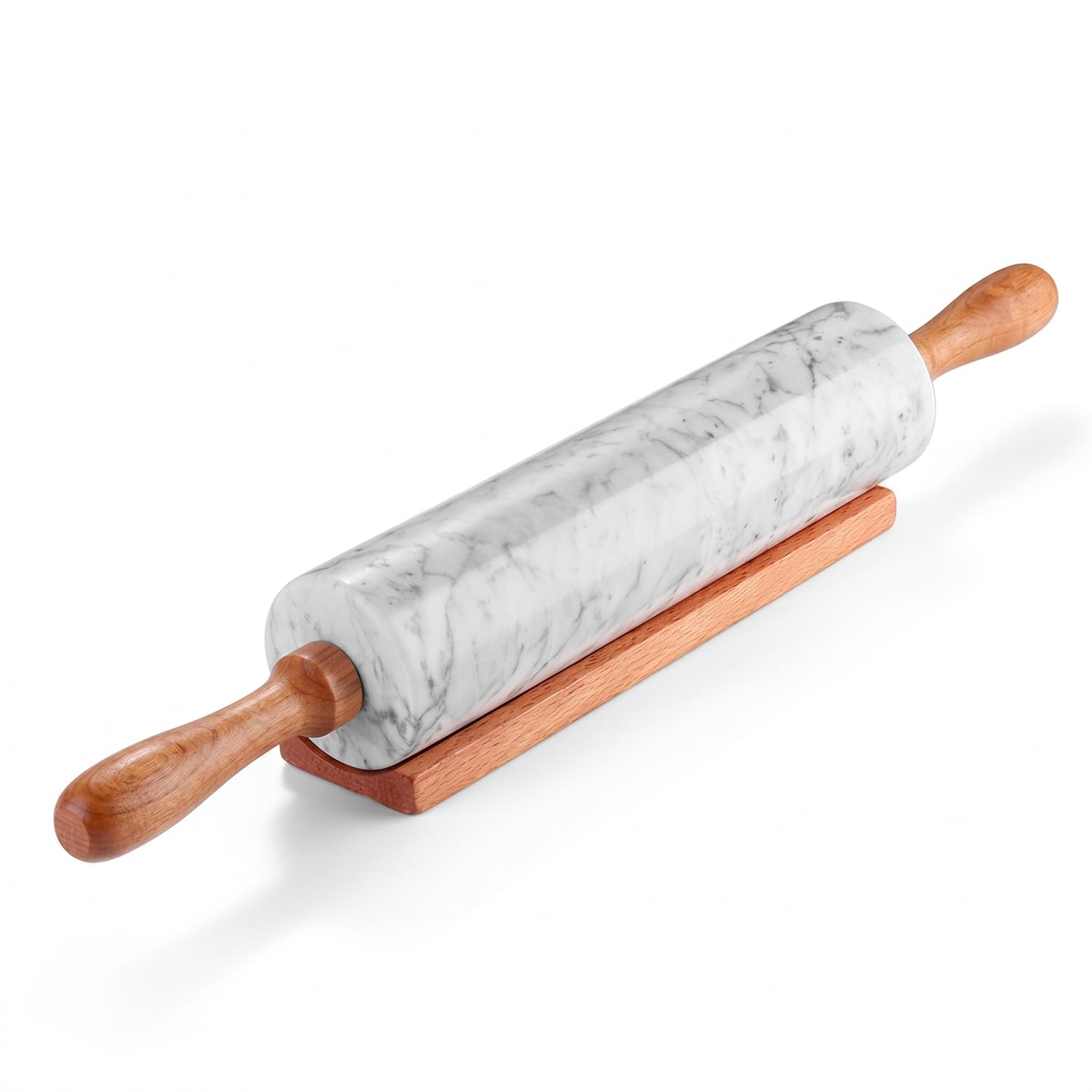
The Flexzion marble rolling pin delivers a 10-inch polished white marble barrel weighing a substantial 5 pounds, cradled in a carved wooden stand that keeps the heavy cylinder from rolling off your counter. The ergonomic wooden handles are attached via a rigid axle — no ball bearings, but the marble’s momentum makes up for the lack of friction reduction. The weight is the defining feature here: the pin essentially rolls itself, requiring only directional guidance rather than downward pressure.
Bakers who use this for pizza night report that a 14-inch round of dough flattens in three forward-and-back passes with zero sticking, thanks to the cool marble suppressing gluten adhesion. The 10-inch barrel length is shorter than the 17–20 inch options, so rolling out an entire pie crust may require shifting the dough and making a second pass. The included cradle is both a practical countertop dock and a display piece, though the marble barrel can feel overly heavy for delicate cookie rolling.
The polished surface wipes clean easily and does not absorb food odors, but the marble can chip if dropped on tile or granite. A few buyers noted that the 5-pound weight made maneuvering around pre-cut dough shapes harder than expected. It is best suited for high-volume rolling of forgiving doughs — pizza, bread, and pasta — rather than fragile puff pastry or shortcrust.
Why it’s great
- Heavy 5-pound marble barrel rolls dough with virtually no user pressure
- Wooden cradle prevents counter damage and offers stable storage
- Non-porous polished surface resists sticking, odors, and stains
Good to know
- 10-inch barrel is shorter than competitors; needs dough repositioning for larger sheets
- 5-pound weight can feel unwieldy for delicate or small-batch dough work
5. Etens 17.3-Inch Wooden Rolling Pin

The Etens rolling pin is a classic straight-dowel design: a single 17.3-inch length of European beech wood with a uniform 1.73-inch diameter, weighing 1.1 pounds. No handles, no bearings, no rings — just a cylinder of wood that requires you to apply even pressure with your palms. The surface is hand-finished and slightly textured, which helps hold a flour dusting without turning gummy when rolling sticky doughs like croissants or enriched bread dough.
Customer reviews underscore its versatility — users roll pizza, pasta, pie crusts, Chinese dumpling wrappers, and even fondant with consistent results. The 1.73-inch thickness sits in the sweet spot between thin French pins (which require more finger pressure) and thick marble pins (which are too heavy for delicate work). The straight barrel means dough thickness depends entirely on your hand pressure, so beginners may need practice to avoid thinner edges.
The beech wood is denser than pine or bamboo, so it resists denting and warping if stored properly — hand wash and dry immediately, never submerge, and apply mineral oil monthly. At this price point, it offers the most usable length-to-weight ratio among pure wooden dowels and is the ideal entry-level buy for anyone who wants a no-frills, pro-style rolling surface without spending on marble or adjustable rings.
Why it’s great
- Solid European beech wood with a uniform 1.73-inch diameter for even pressure
- 17.3-inch length accommodates large dough sheets without crowding
- Slightly textured surface holds flour to resist sticking on wet doughs
Good to know
- No thickness guides — dough evenness depends entirely on user hand technique
- Requires regular mineral oil conditioning to prevent wood cracking over time
FAQ
Should I get a tapered French pin or a straight dowel?
How do I prevent my wood rolling pin from cracking?
Can I use a marble rolling pin for all dough types?
Final Thoughts: The Verdict
For most users, the best rated rolling pin winner is the Ateco 20175 French Rolling Pin because the lightweight solid maple construction and precise tapered ends give you tactile control over dough thickness and shaping that no marble or adjustable pin can replicate. If you want a gravity-assisted roll that keeps butter doughs naturally cold, grab the SIPARUI Marble Rolling Pin. And for repeatable, machine-precise dough thickness batch after batch, nothing beats the Mepple Adjustable Wooden Rolling Pin and its four thickness rings.