Nothing dulls a chef’s knife faster than a bad cutting surface, and nothing protects your blades like a properly selected natural wood board. The market is flooded with bamboo composites, plastic sheets, and glued-together strips, but a true natural wood cutting board made from a single hardwood species delivers the knife-friendliness, durability, and self-healing grain that serious home cooks demand.
I’m Mohammad Maruf — the founder and writer behind AirfryerBite. I’ve spent years analyzing wood density charts, grain construction methods, and food-safe finishing protocols to understand exactly what separates a 5-year board from a 30-year heirloom in the natural wood cutting board category.
Whether you are prepping a charcuterie spread or breaking down a whole chicken, the board you choose directly affects your knife edge and your cleanup routine. This guide breaks down the top options to help you confidently pick the best natural wood cutting board for your kitchen workflow.
How To Choose The Best Natural Wood Cutting Board
Picking the right board comes down to three interlocking decisions: grain orientation, wood species, and thickness. A mistake in any one of these areas can lead to warping, knife dulling, or premature cracking. Here is how to evaluate each factor.
Grain Orientation: End Grain vs. Edge Grain
End-grain boards (wood fibers oriented vertically) are the gold standard for heavy use. The fibers absorb knife impacts, keeping edges sharper longer and actually re-closing after a cut — this is the “self-healing” property you see in premium boards. Edge-grain boards (fibers run lengthwise) are more stable against warping and often cost less, but they will show visible cut marks over time and dull knives faster. For a daily-use board, end grain wins unless your budget is tight.
Wood Species and Janka Hardness
Teak, walnut, acacia, and sapele all rate well on the Janka hardness scale, but each behaves differently. Walnut (around 1,010 lbf) is softer and easier on knives but scratches more visibly. Teak (1,000–1,155 lbf) offers natural oil resistance to moisture. Sapele (1,510 lbf) is extremely hard and durable but demands sharp knives. Acacia (1,750 lbf) is very hard and affordable but can be tough on blade edges. Match the Janka rating to your knife steel — softer European blades pair better with walnut or teak.
Thickness and Stability
A board under 1.5 inches thick is prone to warping, especially if you wash it frequently or store it near a heat source. Boards at 1.75 inches or thicker stay flat under heavy cleaver work and provide enough mass to stay put on the counter without rubber feet. If you have limited storage, a 1.5-inch board with non-slip feet is a reasonable compromise, but never go below 0.75 inches for a primary cutting surface.
Quick Comparison
On smaller screens, swipe sideways to see the full table.
| Model | Category | Best For | Key Spec | Amazon |
|---|---|---|---|---|
| Sonder Los Angeles Alfred | End Grain Walnut | Knife preservation & organized prep | 17x13x1.5 in, 3 sorting wells | Amazon |
| Yes4All Teak End Grain | End Grain Teak | Heavy chopping & moisture resistance | 20x15x1.5 in, 11.2 lbs | Amazon |
| Ironwood Gourmet Charleston | End Grain Acacia | Deep juice channel & serving | 20x14x1.13 in, 10 oz juice well | Amazon |
| Winco WCB-1824 | Edge Grain Rubberwood | Massive prep surface & durability | 24x18x1.75 in, 17.8 lbs | Amazon |
| BABILONIA Acacia | Edge Grain Acacia | Budget-friendly with prep plate | 15.7×10.2×1.6 in, oil included | Amazon |
| Brosisincorp Sapele | Edge Grain Sapele | One-piece no-glue durability | 14.96×11.02×0.98 in, 3.9 lbs | Amazon |
| Naturally Med Olive Wood | Edge Grain Olive | Artisan serving & light chopping | 14×8.27×0.79 in, 2 lbs | Amazon |
In‑Depth Reviews
1. Sonder Los Angeles Alfred Cutting Board
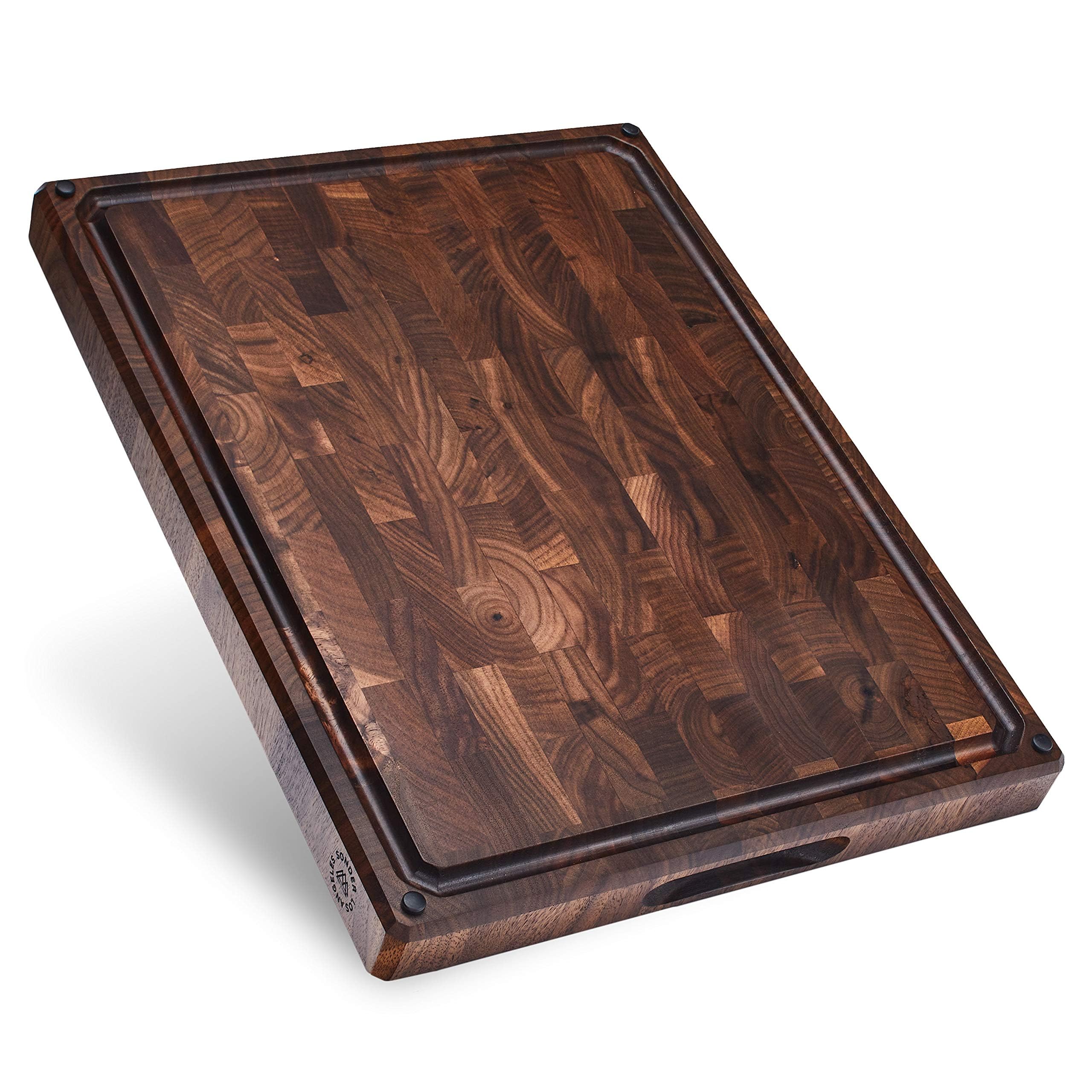
This is the board you buy when you want end-grain construction, American black walnut, and a set of features that genuinely improve your prep efficiency. The three built-in sorting compartments let you stage chopped garlic, herbs, and shallots without grabbing extra bowls — a small detail that speeds up mise en place noticeably. At 17 inches by 13 inches by 1.5 inches thick, it offers generous working area without overwhelming a standard countertop.
The deep juice groove holds up to 3.5 fluid ounces of liquid, which handles a sliced roast chicken or a batch of ripe tomatoes without spilling over. The removable non-slip rubber feet keep the board locked in place during vigorous chopping, and the dual-sided design means you can reserve one side for raw proteins and the other for produce. Sonder LA backs it with a one-year warranty against manufacturing defects, and the included gift box makes it ready for gifting out of the box.
Black walnut sits at around 1,010 lbf on the Janka scale — soft enough to protect high-end Japanese knife edges while still being dense enough to resist deep gouging. Just plan on oiling every two to three weeks with food-grade mineral oil or board butter to maintain that rich chocolate color and prevent the wood from drying out.
Why it’s great
- End-grain black walnut self-heals and preserves knife sharpness
- Three sorting compartments replace extra prep bowls
- Deep juice groove handles heavy liquid runoff
Good to know
- Requires oiling every 2-3 weeks to prevent drying
- Premium price reflects USA-made walnut build
2. Yes4All Large Teak End Grain Cutting Board

At 20 inches by 15 inches with a full 1.5-inch thickness, this teak end-grain board delivers professional-grade surface area for large-scale prep — think holiday turkey breakdown or multiple-pound vegetable roasts. Teak’s naturally high oil content (Janka 1,000–1,155 lbf) gives it inherent moisture resistance, meaning it warps less than walnut in humid kitchens and requires slightly less frequent oiling.
The end-grain blocks absorb knife impacts rather than resisting them, so your blade edges stay sharper between honing sessions. A wide juice groove runs around the perimeter, and the built-in handles on both sides make it manageable despite the 11.2-pound weight. Customers consistently note that the board arrives flat and stays flat, even after months of daily use and regular washing.
One thing to watch: teak’s natural oils can darken over time if exposed to direct sunlight, and the initial finish may feel slightly waxy until you apply your own mineral oil. Also, the surface texture on the first unit can be a bit rough — a light sanding with fine-grit paper followed by a heavy oil soak smooths it out nicely.
Why it’s great
- Massive 20×15 inch prep area fits large roasts
- Teak’s natural oil resists moisture and warping
- End-grain construction protects knife edges
Good to know
- May need light sanding and heavy initial oiling
- Teak darkens with sun exposure over time
3. Ironwood Gourmet Charleston End Grain Board

If a juice channel is your top priority — and it should be if you regularly slice roasted meats, grilled pineapple, or heirloom tomatoes — the Ironwood Gourmet Charleston features a channel that holds up to 10 fluid ounces of run-off, one of the deepest capacities in this class. The acacia end-grain construction (Janka 1,750 lbf) gives it impressive durability, though acacia is hard enough that you will notice slightly more blade friction compared to walnut or teak.
At 20 inches by 14 inches and just over 1 inch thick at the edges (1.13 inches listed), this board is lighter than the Yes4All at 6.6 pounds, making it easier to move from counter to sink. The contrasting light-to-dark acacia grain patterns make it attractive enough to double as a serving board for charcuterie or sandwiches. Ironwood Gourmet uses food-safe finishes with no added chemicals.
The main criticism from users is that some units exhibit a slight rocking motion on flat countertops, likely due to minor warping during manufacturing. If you receive a board that wobbles, a quick check with a straight edge and a light sanding on the high corners often resolves it. Plan on an initial mineral oil treatment to bring out the grain depth.
Why it’s great
- 10-ounce juice channel is one of the deepest available
- Lightweight at 6.6 lbs for easy handling
- Rich acacia grain doubles as serving board
Good to know
- Acacia is hard on knife edges vs walnut
- Some units reported minor rocking on counter
4. Winco WCB-1824 Wooden Cutting Board

This is not a board you buy for its looks — you buy it because you need a 24-by-18-inch butcher block that covers an entire sink or serves as a secondary worktable in a cramped kitchen. At 1.75 inches thick and 17.8 pounds, the Winco WCB-1824 is an industrial-grade rubberwood slab that will not budge during heavy cleaver work. Rubberwood (Janka around 950 lbf) is sustainably harvested from latex trees and offers a good balance of knife-friendliness and durability at a reasonable cost.
The edge-grain construction means it will show cut marks over time, but the thickness allows you to sand it down and refinish it multiple times over the years. The tan color and subtle grain pattern are understated, which works well in commercial kitchens where appearances take a back seat to function. The board is eco-friendly (rubberwood is a byproduct of latex production) and comes with a one-year manufacturer’s warranty.
Be prepared for the sheer size and weight — you are not moving this board around casually. It needs a dedicated storage spot. Some units arrive with minor corner damage during shipping due to the weight, so inspect the edges on arrival and contact Winco if the damage affects flatness. This board is not reversible in the traditional sense because of its weight, but both sides are usable.
Why it’s great
- Massive 24×18 inch surface for heavy prep
- 1.75-inch thickness resists warping under cleaver use
- Sustainable rubberwood is eco-friendly
Good to know
- Extremely heavy at 17.8 lbs — not portable
- Edge grain shows cut marks over time
5. BABILONIA Acacia Cutting Board
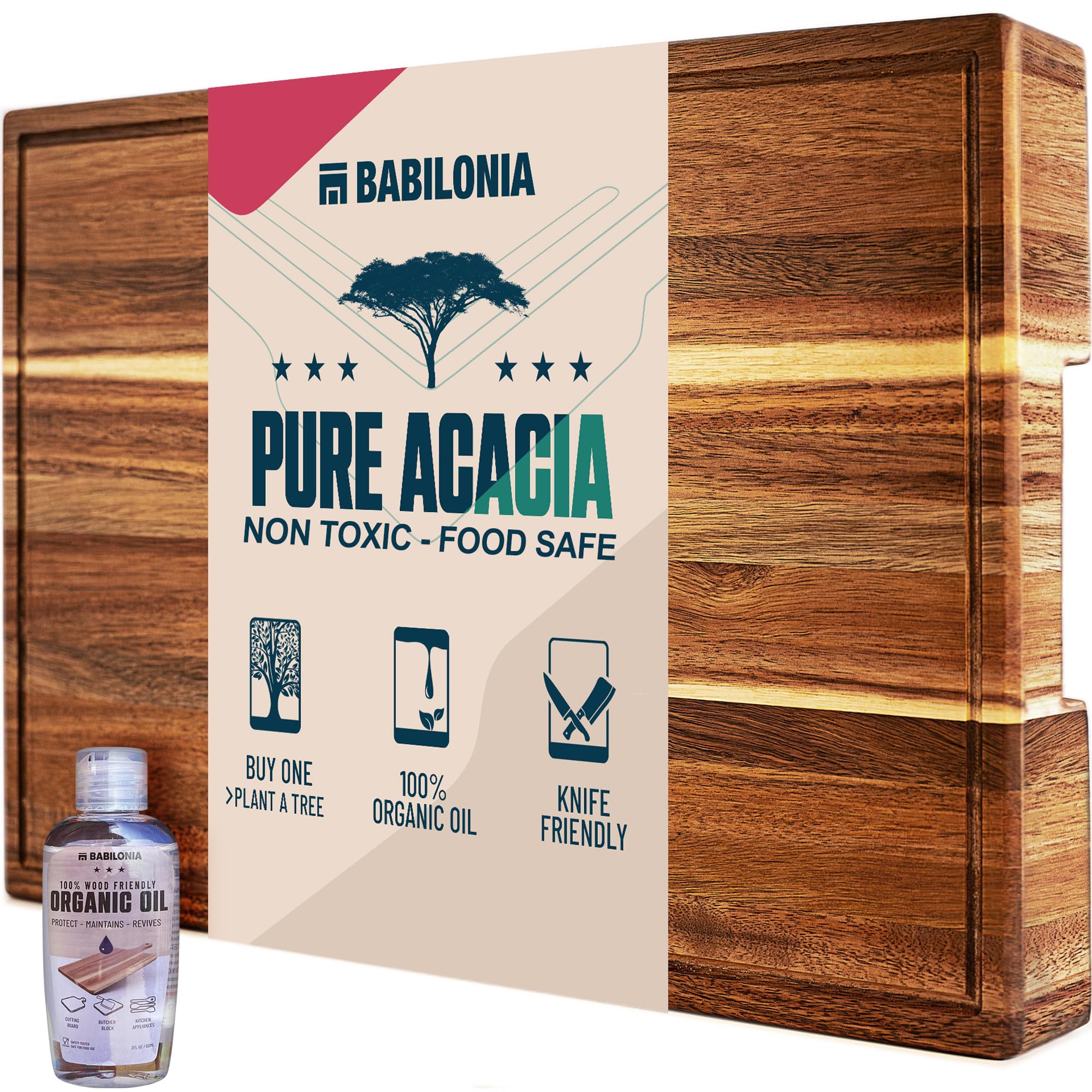
The BABILONIA stands out in the mid-range tier because it includes a free organic oil bottle and a prep plate that slides into the board’s notch — a clever design that lets you transfer chopped vegetables directly into a pot or bowl without lifting the board. At 15.7 inches by 10.2 inches and 1.6 inches thick, it offers a substantial cutting surface without dominating counter space.
The edge-grain acacia construction (Janka 1,750 lbf) is very hard and durable, but acacia’s density means you will need to keep your knives sharp. The board comes pre-oiled and ready to use out of the box, though the manufacturer recommends hand washing with mild soap and storing in a dry place. The reversible design lets you use one side for prep and the other for serving.
BABILONIA backs it with a two-year warranty, which is generous at this price point. The main trade-off is that edge-grain acacia will show cut marks faster than end-grain alternatives, and the included oil bottle is small — you will need to buy a larger supply for regular monthly maintenance. If you want a budget-friendly board with useful accessories, this is a solid choice.
Why it’s great
- Includes prep plate and organic oil for immediate use
- 1.6-inch thickness provides stability
- Reversible design for prep and serving
Good to know
- Edge-grain acacia shows cut marks faster than end grain
- Included oil bottle is small for ongoing maintenance
6. Brosisincorp Sapele Cutting Board

What sets this board apart is that it is cut from a single piece of sapele hardwood — no glue, no joints, no risk of delamination. Sapele (Janka 1,510 lbf) is an African hardwood that combines the hardness of oak with a tighter, more moisture-resistant grain structure than acacia. The 0.98-inch thickness is on the thinner side, but the dense wood and pre-applied mineral oil help maintain flatness.
The board features a reversible double-sided design with a stainless steel handle for easy lifting and hanging storage. Rubber feet on one side prevent slipping during use, and a drainage gap at the bottom prevents water pooling. The manufacturer heat-treats the wood at 491 degrees Fahrenheit to stabilize moisture content, then cures it at low temperature to reduce the risk of cracking.
At 14.96 inches by 11.02 inches, this board fits standard countertops well. The main consideration is the 0.98-inch thickness — it is not heavy enough to stay completely put without the rubber feet, and it may warp over time if you let it sit in standing water. Regular monthly oiling with food-grade mineral oil is essential to maintain the surface.
Why it’s great
- Single-piece sapele wood with no glue joints
- Heat-treated to stabilize moisture and prevent cracking
- Stainless steel handle for easy hanging storage
Good to know
- 0.98-inch thickness may warp if not properly dried
- Requires consistent monthly oiling
7. Naturally Med Olive Wood Cutting Board

This board is a handcrafted artisan piece made from a single slab of olive wood, known for its dramatic natural grain patterns and golden-brown hues that deepen with age. At roughly 14 inches long and 0.79 inches thick, it is best suited for light chopping, cheese slicing, and charcuterie presentation rather than heavy-duty meat breakdown. Olive wood is naturally antimicrobial and contains no glues or synthetic finishes.
Each board is unique — the photo is an example, not the exact piece you receive. The wood is very hard (Janka around 2,700 lbf for olive), making it extremely durable but also harder on knife edges than walnut or teak. Reviews consistently praise the artisan quality and visual appeal, with many buyers using it as a serving piece for cheese and charcuterie in addition to light cutting tasks.
The thin profile (0.79 inch) means this board is best for occasional use rather than daily heavy chopping. Hand washing is mandatory, and applying food-grade mineral oil regularly keeps the grain from drying out. Some units may have minor sanding inconsistencies, so inspect on arrival and contact the seller if the surface is rough. It comes gift-ready in simple packaging.
Why it’s great
- Unique handcrafted olive wood with one-of-a-kind grain
- Naturally antimicrobial with no synthetic finishes
- Ideal for charcuterie and light cheese service
Good to know
- Thin 0.79-inch profile not suited for heavy chopping
- Olive wood is very hard and can dull knives faster
FAQ
How often should I oil my natural wood cutting board?
Can I put a natural wood cutting board in the dishwasher?
What is the best wood type for a knife-friendly cutting board?
Final Thoughts: The Verdict
For most users, the best natural wood cutting board winner is the Sonder Los Angeles Alfred because its end-grain black walnut construction offers superior knife protection, and the three sorting wells genuinely improve workflow. If you want a massive prep surface with excellent moisture resistance, grab the Yes4All Teak End Grain. And for a budget-friendly board that includes a handy prep plate and oil, nothing beats the BABILONIA Acacia.